


55.5 F
Davis

Davis, California

Tuesday, December 23, 2025
Home Blog Page 891

Aggie Arcade

0

Best of 2013

This is the final edition of the Aggie Arcade for 2013, which means it’s time to go back and look at the year’s best games. Although the release of the PlayStation 4 and Xbox One dominated headlines in November, the whole year was successful thanks to these top-notch games.

5) Tearaway

The PlayStation Vita has a solid lineup of games a year after its initial release, but only a few have actually used the portable’s technology in meaningful ways. Media Molecule’s Tearaway stands out as the best example, with its extensive use of touch controls and the Vita’s integrated camera in order to combine the actual player with the in-game world. The storybook narrative and paper-crafted art style exude charm and warmth, but the way in which the game creates a connection between the player and the visual world ends up being the game’s greatest strength.

4) The Stanley Parable

Earlier this year I came across a forum post in which a user described The Stanley Parable as an “interactive essay.” The classification makes quite a bit of sense when one considers how the game explores deep and complex topics like the idea of player choice and authoritative control. The actual mechanics simply involve walking around and making choices, but the way in which the wonderfully-voiced narrator adapts to those choices highlights a fantastic narrative that addresses the very nature of video games and the effect they can have on both players and creators. It makes for the most fascinating game of the year.

3) Rogue Legacy

Every year an indie release comes out of nowhere and ends up on my best of the year list. This time it’s Rogue Legacy, a downloadable game for the PC. Players explore a treacherous castle in an effort to earn gold and kill dangerous foes, but the game uses a rogue-like template in which players must start from scratch after each death. Whereas most games like this leave the player with no reward after death, Rogue Legacy does include player persistence. So after each death players still level up and use gold to unlock new abilities, which results in one of the year’s most addicting experiences.

2) BioShock Infinite

The main reason that I loved 2007’s BioShock was its introduction of Rapture, a fascinating underwater city that crumbled under a faulty utopian vision. Exploring that virtual world for the first time was incredible, and somehow BioShock Infinite replicates that feeling with Columbia, a gorgeous city in the sky. But uncovering the darkness beneath the beautiful landscape reveals yet another failed utopia, one in which issues of race, class, and social conventions divide the people. All of it adds up to a wonderfully unique narrative; it also helps that Infinite contains perhaps the most mind-blowing ending I’ve ever encountered in a video game.

1) The Last of Us

I went back and forth between my #1 and #2 picks throughout the year, but a second playthrough of The Last of Us solidified my top choice. Its emphasis on complex and dynamic characters makes for an emotionally resonating story, despite the familiar “infectious outbreak” storyline that has dominated all media in the past few years. And though I wouldn’t classify the game as “fun” thanks to the level of tension it maintains throughout the campaign, I did enjoy its healthy mix of combat, stealth and crafting. No other game in 2013 executed on both gameplay and narrative at the level of The Last of Us, and that makes it my game of the year.
This Week in Science: 11/25 -12/01

Supercomputers and Humanoids

With the help of quantum mechanics and supercomputers, scientists are now able to create new materials without having to run experiments first. Materials science allows engineers to turn matter into new and useful forms. Researchers working at the California Institute of Technology and five other institutions plan to use supercomputers to study thousands of chemical compounds at the same time, increasing efficiency.

http://www.scientificamerican.com/article.cfm?id=how-supercomputers-will-yield-a-golden-age-of-materials-science

Nostalgia at its best

A study links nostalgia and boost in optimism for the future. According to Dr. Tim Wildschut, from the University of Southampton, nostalgia for past events invokes self-esteem and maintains self-worth, which helps an individual to foresee the future as optimistic. Optimism seems to be linked with improved health by boosting the immune system. This feeling has also been noted to make people more charitable.

http://www.psychologicalscience.org/index.php/news/nostalgia-for-the-past-boosts-optimism-for-the-future-study-suggests.html

Night vision

According to a study conducted by Kevin Dieter at Vanderbilt University, half of the 129 participants were able to see the motions of their hand even in the dark, suggesting that our brains use sensory signals from our movements to form our visual perceptions.

http://www.psychologicalscience.org/index.php/news/some-people-can-see-in-total-darkness-study-says.html

Electric energy from footsteps and vehicle traffic

Generating electricity from the steps of pedestrians and flow of traffic is a technology entrepreneurs in Mexico are currently working on. Héctor Ricardo Macías Hernández, developer of the system, states that this form of technology can serve as a source of sustainable energy.

http://www.sciencedaily.com/releases/2013/11/131129101759.htm


Phobias explained

Research from Emory University School of Medicine in Atlanta, published in Nature Neuroscience, found a link between our irrational phobias and DNA. Tested on mice, they discovered that memories can be passed down from our ancestors in utero, thus creating some of our irrational phobias. Such information can be inherited by the chemical changes that occur in DNA. Thus, for example, a fear of snakes may actually be a reflection of our ancestors’ defense mechanisms.

http://www.telegraph.co.uk/science/science-news/10486479/Phobias-may-be-memories-passed-down-in-genes-from-ancestors.html

Opponents of transgender student bill seek referendum

0

Opponents of a state bill that would allow transgender K-12 students access to school facilities and programs that match their gender identity have submitted a referendum in hopes of repealing the law.

Referred to by detractors as the “coed bathroom bill,” AB 1266 would codify certain rights for transgender students, such as the ability to join a sports team or use the bathroom that corresponds to their gender.

Signed by Gov. Jerry Brown on Aug. 12, the bill is scheduled to become law on Jan. 1, 2014. However, if the referendum is approved, the law’s enactment will be postponed until it can be put on the ballot in 2014.

Opposition groups include the California Republican Party as well as Privacy for All Students (PFAS), a coalition of conservative groups that have spearheaded the referendum effort. They fear that the bill is a violation of the privacy rights of students and a matter better left for school districts to deal with on a case-by-case basis.

“It’s a serious violation of privacy rights under the U.S. Constitution,” said Brad Dacus, president of the Pacific Justice Institute (PJI), a legal defense organization that drafted the referendum.

“No person, including a 13-year-old girl, should be forced to change or undress in front of a 16-year-old boy who thinks he is a girl on the inside,” Dacus said.

PFAS has also enlisted the help of veteran political advisor Frank Schubert, president of Mission Public Affairs and a key leader in the 2008 Proposition 8 campaign. Schubert echoed this sentiment in an email.

“The bill is a gross invasion of privacy for California students in the most vulnerable areas of public schools, subjecting them to the opposite sex sharing showers, bathroom, changing areas and locker rooms on a claim of ‘gender identity,’” Schubert said. “It doesn’t even require that a student have ever presented himself as the opposite sex.”

Opponents also view AB 1266 as an unnecessary overstepping on the part of the state, with Dacus referring to the bill as a “one-size-fits-all piece of legislation,” and Schubert calling it “wide open for abuse as drafted.”

However, supporters of the bill find these claims to be overstated.

“For me, it seems like a bit of a made up scenario,” said Kim Westrick, the interim office coordinator for the UC Davis LGBTQIA Resource Center. “It’s the kind of thing that comes from imagining trans folks as predators. They aren’t considering the kind of oppression trans people face.”

Geoff Kors, senior legislative and policy strategist for the National Center for Lesbian Rights (NCLR), a cosponsor of the bill, called the sorts of hypotheticals popularized by PFAS a “total fallacy” and a result of “scare tactics and fear mongering” from the bill’s opponents.

“It’s a mean spirited attack on some of our most vulnerable young people,” Kors said.

Other supporters of the bill, such as the ACLU of Northern California and Gay Straight Alliance, have joined with the NCLR in opposing the referendum, saying that the bill is an important step in eliminating barriers to participation for students who question their assigned gender.

Mark Snyder, communications manager for Transgender Law Center, another support group, cited the success of school districts within California that have already adopted the policies AB 1266 is based on.

“LA Unified School District has had these sorts of policies in place for almost a decade without any of these sorts of violations happening,” Snyder said.

Groups at UC Davis have also rallied behind similar policies, with the UC Student Workers Union sponsoring a petition to create more gender neutral restrooms on UC campuses like those found at the new Student Community Center.

While existing California law already prohibits schools from discriminating against students based on their gender identity, if passed AB 1266 would be the first of its kind in the U.S. to specifically enumerate some of the rights of transgender students.

“The law simply restates existing state and federal law, regardless of the referendum,” Snyder said. “The repeal would not take away existing protections.”

According to Kors, “in the unlikely event that the referendum would qualify and pass, it would have little effect.”

In order to qualify for the 2014 ballot, the referendum must garner around 505,000 signatures, or an amount equivalent to five percent of the votes cast in the last gubernatorial election.

According to the CA Secretary of State’s office, opponents of AB 1266 submitted 614,311 signatures, about 18 percent over the required minimum. Around 400,000 of these were collected by volunteers, with the rest being provided by signature gatherers paid for by PFAS.

Extra signatures are needed in petition drives as many are often invalidated for being duplicates, belonging to unregistered voters or representing false information such as names or addresses.

Initial counts of the signature validity rate looked grim, with a random sample released on Dec. 2 finding only about 76.6 percent as legitimate. With the surplus of signatures collected, the petition would need to hit at least 82 percent validity to qualify.

Supporters of the referendum have developed a few contingencies to stop the law in the event that AB 1266 passes regardless of the referendum, with the PJI exploring options for a legal challenge to the law.

The fate of the referendum will be decided when a definitive valid signature count is released on Jan. 8, 2014.

Turning photography around, 360 degrees

For those who love taking panoramic pictures and capturing a larger perspective of their special moments, Panono will certainly spark your interest. The Panono camera allows the user to throw the camera into the air and automatically capture a 360 degree image at the highest point the camera reaches. What is achieved is a complete aerial panoramic image of your surroundings.

The Panono camera comes in the shape of a ball outfitted with 36 small cameras that deliver a 72 megapixel photo and an incredible “360 degree by 360 degree” image. To take a picture one can throw the Panono up, or also utilize it as a handheld camera and press a button on the top of the ball to snap a picture. The ball is encased in tough clear plastic to ensure its safety during those rare times when the Panono is not caught on the way back down. This device comes from the mind of Jonas Pfeil, creator of the camera and president of the Panono company.

Though traditional panoramas can look nice, there are drawbacks such as the time it takes to capture the entirety of the setting you want, and the issue of “ghosting” that may happen if there is movement in the photo which causes an unattractive and distorted panorama. These problems were the inspiration for Pfeil to think of a better panoramic camera, and it is the Panono, simply by design, that provides a unique solution.

Because the Panono is built with an accelerometer, it can calculate the acceleration of its launch into the air, and simultaneously fire all of its 36 cameras once it reaches its highest point. This swift snapshot thus captures a complete moment in time. There is no possibility of a blurry image, as movement is simply not a factor like with traditional panoramas.

“The Panono Camera creates an entirely new panoramic-photography experience, one that can include people for the first time,” Pfeil said. “The ball shape invites you to throw it into the air, which provides a vantage point that enables the camera to capture everything in every direction. No other camera can do that. The resulting image is really fun to view on an iPhone or iPad. People just move their device up and down and in whatever direction they want to look, as if they were inside the image. With 72 megapixels, no detail is lost.”

The company is currently undergoing a crowdfunding campaign on Indiegogo.com, where you can preorder one of the first Panono cameras. As of now the camera is expected to be available for shipment sometime in late 2014.

Heading into the new year, be on the lookout for photography pioneers next fall, as they capture panoramas while playing a game of catch.


Natsoulas Gallery End of Year reception

0

The John Natsoulas Gallery, located at 521 First St., will be hosting its “End of the Year Party” and Exhibit Opening Reception on Saturday, Dec. 7, from 7 to 10 p.m. The special evening will mark the conclusion of a successful year of gallery exhibits at the Natsoulas Gallery, and will include showcasings of specific artists, known for their uniquely “California style.”

Free of charge, this unique opportunity to view these select artists will also be accompanied by an evening filled with holiday drinks and hors d’oeuvres.

“The opening reception will present four different artists who will be taking the floor to introduce their works,” Adriana Macias, the gallery’s designer, said. Formally, it will be very similar to our other opening receptions, but this one will be unique due to the nature of the specific artists chosen by gallery owner John Natsoulas himself.”

Renowned for their reputation to represent the best of California art, the John Natsoulas Gallery specifically selected the artists whose work will be presented at the exhibition. All the artists operate in completely different mediums to produce very different styles, so there will be something for everyone at this special group exhibition.

Hand selected by John Natsoulas, four trail-blazing artists, Kerry Rowland-Avrech, Michelle Gregor, Nathan Ring and Rodney Artiles, were chosen to conclude the year of exhibits at the Natsoulas. Because they all have very different styles, the diverse range creates an opportunity to observe the many ways California has been represented in art.

Sculptor Michelle Gregor’s work has been specifically seen as important to the gallery’s mission. With a bachelor of fine arts degree from UC Santa Cruz and a master’s degree from San Francisco State University, Gregor is also a professor, as well as a well-known figurative sculptor. Some of her best known works may be seen in locations such as The Spa at Pebble Beach and The Olympic Club in San Francisco.

“Michelle Gregor is one of the most significant female sculptors in the country, and definitely one of the best of Californi,” John Natsoulas, owner of the gallery, said. “I would have done anything to get her into this show. She is a not only an amazing painterly and abstract sculptor, but she is a mentor to many young women. She sculpts with such fervor and passion, which is really inspiring to many young artists.”

Her style is described as emblematic of the unique Californian style seen in art, as it is not too representational, but has a certain serenity and spiritual feeling about it. She comes from a generation that blazed the path of abstract expressionism in the Bay Area, specifically for female artists.

“She sculpts without a lot of planning, when looking at her art, you really feel that she sculpts from the gut, which is emblematic of the Beat Generation, something that my gallery really strives to represent,” Natsoulas said.

Artist Kerry Rowland-Avrech will be showing her second exhibit at the John Natsoulas Gallery. A Davis local, her first show that was exhibited in June of last year depicted all abstract works. However, this exhibit shows her work that moves towards a more figurative style.

“Last year, I was still relatively new to the area which resulted in my artwork being expressed in a pure abstract style,” Rowland- Avrech said. “However, since I’ve been absorbing more of the Central Valley, my style has evolved. I’ve moved from acrylic, back to oil. My art is still abstract, but a bit more representational, figurative and realistic. More Californian.”

Her style has been very frequently described as very similar to that of German Expressionists, such as Ernst Ludwig Kirchner or Edvard Munch. This can be seen represented in her mural downtown on the back of ACE Hardware as well as in this exhibition, in works such as “The Blue Dress,” which represents an abstract woman walking away for the viewer.

“In most of my works, I like to use a lot of light and color that give off a kind of spirituality, without an explicit spiritual content,” Rowland-Avrech said. “Many people say that they perceive a haunting or slightly scary impression of my works. In essence, that is what I am trying to achieve. Not to scare the viewer, but to provoke a reaction. For them to have a reaction like that means that they have stopped for a moment, and really looked at my work.”

Nathan Ring, a potter, also represents the quintessential California artist as selected by Natsoulas. He presents art as functional and affordable and chooses to work in a medium that is seen as a dying artform. He produces works that would typically be seen in a California home, and makes it a Christmas present to buy during the holiday season.

Pop artist, Rodney Artiles’ work will also be exhibited. Choosing to operate in a completely different style than the other two artists, his art is emblematic of contemporary street art that one could usually find on the streets of San Francisco.

“All artists that will be exhibited at the show have their own style, which all kind of represent the differences we see in California,” Macias said.

The show will be exhibited through December. To see the artists themselves, audiences can attend the opening reception on Dec. 7.


ASUCD Senate Quarterly Report

0

Compared to Fall Quarter of last year, ASUCD Senate fell behind when it came down to writing legislation, ending with 20 bills versus last year’s 36. The senate’s progress is determined by each bill’s effectiveness and relevance to the student body, as well as the number of bills passed.

*Editor’s note: For Bills 1-5, please see our mid-quarter evaluation at theaggie.org.

Senate Bill #6

Senator Maxwell Kappes introduced a bill to amend Bylaw 412, thereby providing the Elections Committee with the discretion to choose how they would like to distribute sample ballots. Previously, Bylaw 412 required placement of the sample ballot in The California Aggie. This new amendment removes any direct reference to the placement of the sample ballot in The California Aggie. The amendment passed by a 11-1-0 vote.

Senate Bill #7

Senator Ryan Wonders introduced a bill to create a formal procedure for renaming current ASUCD units. The bill was put into effect due to the absence of any formal naming procedures in Senate Bill 93, which only created a procedure for creating or dissolving ASUCD units. It ensures that all units are referenced only by one official name. The bill passed by a 11-0-1 vote.

Senate Bill #8

Senator Tal Topf introduced a bill to make the points of inquiry during senate meetings consistent with Robert’s Rules of Order (a book widely used as parliamentary authority in the United States). Before the bill was enacted, only one point of inquiry — the Point of Clarification — was officially recognized by the ASUCD Bylaws. Even that point of inquiry was inconsistent with Robert’s Rules of Order. The new bill will therefore enact five points of inquiry consistent with Robert’s Rules of Order: the Point of Order, Point of Parliamentary Inquiry, Point of Information, Point of Clarification and Point of Personal Privilege. The bill passed by a 12-0-0 vote.

Senate Bill #9

Senator Maxwell Kappes introduced a bill to clarify the role of deferments as well as to place restrictions on them. In parliamentary procedures, deferments are intended to allow members — other than the original speaker —the opportunity to speak or ask questions without cutting into the time allotted to the original speaker. In the past, however, deferments have been used as a way to defer the conversation back to the original speaker, thereby granting them more time. Since this is not explicitly forbidden by Bylaw 105, the new bill will place restrictions on this type of exchange to limit any unfair gain of time by the original speaker. The bill passed by a 8-2-2 vote.

Senate Bill #10

Senator Armando Figueroa introduced a bill to clarify the language in Bylaw 801A. The bill will recognize that the ASUCD Commission responsible for authoring or introducing a particular bill is allowed to formally recommend its own legislation for consideration by the senate.

Senate Bill #11

Introduced by Senator Miles Thomas, this bill will allocate $2,500 from the ASUCD Senate reserve to Aggies of Color. The money will be used to fund student attendance to the 25th Annual Students of Color Conference (SOCC). The bill passed by a 7-3-2 vote.

Senate Bill #12

Senators Maxwell Kappes and Armando Figueroa co-authored a bill to allow for directed comments to both senators and other subordinate officials. This bill aims to hold elected officials accountable for their comments and actions while facilitating transparency within ASUCD’s body of elected officials.

Senate Bill #13

Senator Miles Thomas introduced the bill to amend Section 107 of the ASUCD Bylaws to change the average “10-minute break” at senate meetings. Initially, it was mandatory to take breaks approximately every hour after the start of each meeting. Section 107 was amended to change the allotted time to a minimum of 30 minutes before five hours have exceeded. It was thought to be more effective to have less short breaks frequently. This bill is still pending legislation.

Senate Bill #14

ASUCD Senators Miles Thomas and Maxwell Kappes authored the bill to consolidate ASUCD funding sources. In order to ensure fairness among the 500 registered student organizations, Club Finance Council (CFC), one of ASUCD’s largest programs, determines the amount of funding a student organization is able to receive. However, clubs have been disregarding the cap and going directly to the senate for more funding. Disproportionate funding has resulted from this “double-dipping.” SB #14 seeks to amend Section 604 of the ASUCD Bylaws so that ASUCD cannot allocate funding to any organization already applying or receiving funding from CFC and vice versa. This bill is pending legislation.

Senate Bill #15

Written by ASUCD Senator Liam Burke, SB #15 calls for a voluntary recital of the Pledge of Allegiance at the beginning of ASUCD Senate meetings. There should be an opportunity to show respect to the American flag as ASUCD’s governmental structure follows the federal government of the United States of America. Order of agenda at senate meetings is to include a voluntary recital after the call to order. This bill is pending legislation.

Senate Bill #16

Authored and introduced by ASUCD Senator Miles Thomas, SB #16 is to allocate $3,460.34 from Senate Reserves to supply AggieTV with two new cameras. AggieTV does not own any DSLR cameras and their $1,700 equipment budget is only enough to cover routine expenses. Producers have had to supply their own cameras. In return for acquiring new cameras, AggieTV is to increase footage quality, production turnover and revenue. This bill was passed in a 9-1-2 vote.

Senate Bill #17

ASUCD President Carly Sandstrom authored the bill to re-allocate Cal Aggie Camp money into the Stipend Positions and create two new positions. In order for volunteer camp employees to qualify as ASUCD stipend employees and continue to receive stipends, funds must be appropriated from the unit’s Services Rendered line item into General Assistance. Because Cal Aggie Camp counselors are not independent contractors and are completely directed by ASUCD, re-allocating is necessary to comply with federal tax law. This bill was passed in a 12-0-0 vote.

Senate Bill #18

The bill was recommended by the Internal Affairs Commission to make the hiring process of ASUCD associate justices and chief justices and the structure of the ASUCD Court more clear. There has been confusion due to the vagueness in ASUCD bylaws. SB #18 is to address and clarify the bylaws. This bill is pending legislation.

Senate Bill #19

The bill seeks to amend The California Aggie budget to accurately reflect the pay weeks worked by Aggie employees. The budget is written incorrectly and should be adjusted for each position to be paid for 30 weeks instead of 16. It will reflect its actual operations and make it easier when writing budgets in the future. In addition, it has been requested that the Art Director’s pay be raised from $40/week to $55/week because the position is just as demanding as the Design Director’s. Because it is no longer necessary for a second Assistant Business Manager position, the pay raise will be accommodated. This bill is pending legislation.

Senate Bill #20

ASUCD Senator Miles Thomas introduced the bill to implement a revised Long-Range Plan for the Campus Center for the Environment (CCE). CCE was created as a student-run organization to promote awareness of environmental issues, ecological health and environmental education. This bill is pending legislation.

Bohart Museum of Entomology plans weekend open house, contributes to university research

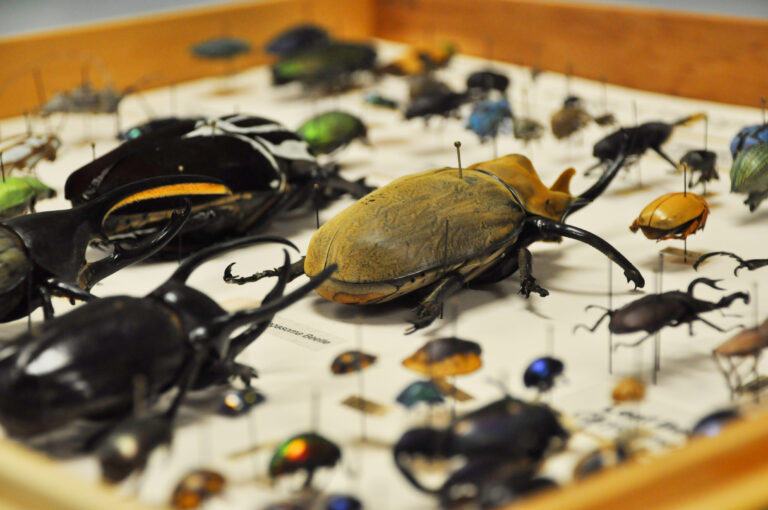
Whether you are a butterfly enthusiast or bee fanatic, the Bohart Museum of Entomology just might be the place for you. About every month, the public has the opportunity to attend a bug-themed open house and observe the vast collection of insects at the museum.

Due to the demand for a December event, the museum will be holding a special weekend event from noon to 3 p.m. on Saturday Dec. 7. Additionally, the previously scheduled January “Snuggle Bugs” open house will take place as planned on Jan. 12.

Home to over seven million insect species, the museum holds one of the largest insect collections in North America.

“This month we decided to focus on beetles,” Tabatha Yang, the education coordinator of the museum, said. “Beetles are the most extraordinarily diverse group and we have a really large beetle collection.”

On Nov. 23, the museum held “Beauty & Beetles,” its second open house of the academic year. Due to the massive crowds on Picnic Day, Yang decided to plan specialized open houses throughout the year.

According to Yang, typically 80 to 100 people from all over the county come to explore the museum.

“We have people coming in from Sacramento, Yuba City, Elk Grove, just to name a few,” Yang said.

Lynn Kimsey, the director of the Bohart Museum and professor of entomology has found that the weekend open houses are more accessible and less crowded in general.

“It’s hard for families to come in on weekdays,” Kimsey said. “Sometimes it’s pandemonium with 200 people coming in.”

After its founding in 1946 by UC Davis professor of entomology Richard M. Bohart, the collection gradually grew as a result of the collaborative effort of scientists, hobbyists, retired professors and graduate students.

“This [collection] is a lifetime’s work and has been built by everyone’s efforts, growing since UC Davis was established,” Yang said as she pointed to jewelry composed of beetle wings.

The jewelry included a beetle-beaded necklace and earrings that were donated by a woman who purchased the items while traveling to various locations in South America.

Once individuals donate resources to the museum, staff and volunteers meticulously organize the specimens by species, date, location and collectors.

Jeff Smith, an entomologist who worked in the pesticide control industry, has been volunteering at the museum for 26 years.

Due to his passion for insects and love of nature at a young age, Smith helps to organize and maintain the collections.

“It combines my love for bugs, neatness and organization and I enjoy helping to educate people about bugs,” Smith said.

Smith believes that education is imperative in order for the general public to truly understand the importance of insects.

“People tend to forget about bugs,” Smith said. “Or most people will just kill them — if there’s a bug in the house, kill it.”

Along with unawareness, insect endangerment and extinction is often left unrecognized as well.

Greg Kareofelas, a volunteer at the museum and open house, explained that several unique species from nations such as Ecuador and Costa Rica are slowly decreasing over the years.

“These [bugs] will come and go and no one will even notice,” Kareofelas said.

Like Smith, Kareofelas began volunteering at the museum because of his love for insects. His eyes lit up as he pulled out a case of Morpho butterflies which are predominantly located in South America.

After explaining how difficult it is to find one of these stunningly shiny, blue butterflies, a young girl asked him whether it was worth it to go to South America for the butterflies, despite the other harmful insects that are usually found in the area.

“This is worth whatever or how miserable you may be to see this in your life,” Kareofelas said. “To see one of these in the sun would blow your mind.”

Many of the volunteers and staff are clearly excited to share these insects with the public. As Yang showed a collection of dung beetles, she specified the apparent differences in size among the beetle population.

While pointing to a round, brown ball of elephant feces that was found in the Republic of South Africa in 1987, Yang talked about the way in which the beetles work to form this precise symmetry.

“It would be fairly easy for us humans to roll this dung into a round ball. But imagine a little beetle rolling around and creating this,” Yang said. “We would have a disgusting, poopy world.”

In order for scientists to study evolutionary relationships and analyze species like these dung beetles, the museum organizes everything taxonomically. Additionally, the specimens include more specific information such as collection date, location and who it was collected by.

“A collection can help you determine patterns in nature and the world,” Yang said. “Through collections, scientists can compare the specimens and observe the changes over time.”

Although Yang finds that evolution is not necessarily a nice or neat process in that it is not always easy to interpret, she believes that the museum’s lifetime of work continues to drive significant research and findings.

In addition to the abundant resources that the museum provides for ongoing projects and research, Yang intends for it to be accessible to everyone.

“Anyone can walk through our door and we will do our best to welcome them and fuel their passion or interest,” Yang said. “The museum is a mecca for people who love bugs.”

Private donations: Where are they going?

0

On Nov. 15, it was announced that The Campaign for UC Davis reached its fundraising goal of $1 billion from over 100,000 private donors. This was the University’s first-ever comprehensive funding campaign, which began in October 2010 and reached its goal one year earlier than its scheduled end date of December 2014.

The funds will be distributed across many disciplines and will address various needs for students, professors and University projects. The campaign is funding over 1,000 new scholarships, fellowships, awards and other activities for students, as well as implementing improvements in the University that will “advance the university’s mission and vision.” The largest private donation was a $100 million grant to establish a nursing school.

We think that the success of this campaign will be beneficial to students and we appreciate the large support from alumni, professors and other private donors — it shows that people all over the U.S. care about UC Davis and the success of its students.

In light of this economic boost, we hope that the money we received will be distributed fairly amongst the academic departments and in a way that will foremost benefit students. Being a primarily science and research University, we are excited about the opportunities this money will provide the scientific community, but we also hope that those departments that have suffered most from recent budget cuts will receive their fair share of the money as well.

Although we appreciate the success of the campaign, we question whether the fact that the funds come from private donors will restrict the University’s freedom in deciding how to use them. It’s great that we will be creating a new nursing school because of a single donation, but will other donors take the decision-making out of the University’s hands?

In these tough economic times, this campaign will inevitably benefit the University. But can we really rely on private donations to fix all of our economic burdens? No, but at least it will help — for now.


West Village energy: Close enough

UC Davis’ West Village opened two years ago, boasting to be the largest zero-net energy planned community in the nation. However, a study by the Davis Energy Group revealed that it currently produces only 87 percent of its energy, failing to meet the promised goal of 100 percent of its own energy.

West Village is supposed to be a city on the hill for aspiring sustainable developers, and has received quite a bit of media and political attention since opening. Solar panels over the parking lots generate most of the electricity at the moment, and are providing just as much as the initial models predicted. The problem is not in the generation, but in the consumption.

Currently housing 1,980 students, faculty and staff, West Village is predicted to house 3,500 in the next several years, and 350 single-family homes will also be built at some point in the future.

The energy inefficiency has been identified as collective overuse, as the community planning was based on data from family units, and typically, a group of four students will consume more energy than a family of four. West Village residents also aren’t charged for utilities, so there’s no monetary incentive to turn lights off. As a result, energy use has exceeded expectations.

Even so, 87 percent is impressive. The Aggie Editorial Board acknowledges that West Village is a pioneer in its ambitions, and that such a close shot early on is more of an achievement than an outright failure.

The failure has even been defended with a reminder that it is a real estate development as well as a campus project, and that it has to be attractive to students as well as sustainable. $300 million went into developing West Village, $17 million coming from UC Davis, $2.5 million from the California Energy Commission and millions also from taxpayer dollars. The project has been open for two years, and we think the management has had enough time and resources to address this issue.

At the moment, West Village is once again predicted to meet its energy goals in the next two years. Despite this recent letdown, prospects look bright, as a newly built anaerobic biodigester will be converting leftover food from the UC Davis Dining Commons into energy for the campus.

In the meantime, The Aggie offers West Village congratulations on an almost perfect run, the suggestion that some incentive might increase student conservation and encouragement to keep trying.


News in Brief: UC Davis Baroque Ensemble to perform at Mondavi

0

The UC Davis Baroque Ensemble will be performing in the Yocha Dehe Grand Lobby in the Mondavi Center Dec. 5 at 12 p.m.

The ensemble will be performing Vivaldi’s Concerto in A Minor for Two Violins, which will feature soloists Michael Sand and Jolán Friedhoff, Handel’s selected Opera Arias and Purcell’s Scene from King Arthur, which will feature tenor Jonathan Nadel and soprano Jennifer Jung-Hyun Park.

One of the most unique characteristics of the group is the size of the ensemble and the attention to detail that is employed.

Devin Hough, a Davis community member and violinmaker who has been performing with the group since 1994, creates period-correct instruments for members of the ensemble to perform with.

“This group alone allows students to try playing period instruments and bows so they can really experience recreating the sounds and style of the music as the composers intended,” said Hough in an email interview.

 Danielle Leinwander, a second-year double major in music composition and biological sciences describes how she enjoys the style of Baroque music as it allows for greater interpretation of the music.

“Baroque music, because it is one of the earlier periods, permits a lot more ‘wiggle room’ for interpretations than more modern music,” Leinwander said. “This allows us to really flourish and show off our imaginations.”

The performance is free of charge and will be the Baroque Ensemble’s first and last performance of the quarter.

The Left Nut: A grain of salt

0

If you’ve been following my column all quarter, then I’d like to take a moment to sincerely thank you for your support. Without readers, we writers would have nothing to write for. If you listened to everything I had to say, then awesome. You have my gratitude.

If you accepted everything I had to say, however, we might have a problem. Here’s the thing: I write an opinion column. Everything herein, while based in fact, really just stems from my interpretation of history and current events. That means you’re not supposed to agree with all of it.

Do I want people to agree with me? Of course. I wouldn’t publish my thoughts if I didn’t think they were right. But if everyone agreed with me, my opinion wouldn’t be worth much, would it?

I’m just a punk freshman opinion columnist at a college newspaper. I’m not claiming to be the Messiah. Aside from pure facts, I don’t even know if I’m right half the time. As well-informed as I’d like to consider myself, I’d probably be laughed out of the room if I sat down with an economics professor for half an hour (your move, economics professor).

To be honest, I write this column in part because I hope that someone will one day render me completely and utterly speechless. I would consider this column a resounding success if someone destroyed my ivory tower, if someone wrote to me saying, “Hey, you’re absolutely wrong, and here’s the evidence to prove it.” After all, we’ll never have conviction in our beliefs if no one challenges them.

Being informed citizens means admitting we’re wrong sometimes. Look at Obamacare. We Democrats have been pretty high on that ever since Obama first hinted at it in the 2008 primaries. When it passed? We jumped for joy. When the Supreme Court upheld it? We pissed ourselves in excitement.

Yet, when it failed, so many of us tried to delude ourselves. “It will work in the long run,” we continue to say. We might be right; it might be salvageable. Right now, though, we all have to look in the mirror, swallow our pride, and admit the cold, hard, truth: that Obamacare has failed thus far.

Left-wing news sources admit it. Even Congressional Democrats are starting to defect in order to look for alternatives. Healthcare.gov is in utter disarray, and help doesn’t seem to be coming anytime soon. What once looked like the new precedent for the American healthcare system now appears to be a catastrophe.

If anyone believes that Obamacare has been even remotely successful, ask them why a mere 106,000 people (well short of the 800,000 minimum projected through the first month) have successfully signed up for it.

In 2009, Obama promised all Americans that they could keep their current plan if they wanted. As it turned out, this was not the case; many Americans were forced to switch coverage because of the new law. Many liberals quickly jumped to Obama’s defense, giving him a free pass just by virtue of being a Democrat. In doing so, they created a double standard. If we’re going to call out Republicans for lying, not doing the same for our own party is downright hypocritical.

No matter how much we fawn over our idols, we can never fully trust them. Have I ever contemplated the idea of being a woman just so I could get with Rachel Maddow? You bet. Is Rachel Maddow a completely objective, unbiased news source? Probably not. Of course, the same goes for any news anchor. Listening to news media is almost as bad as listening to politicians themselves.

By admitting our mistakes, we are owning up to the simple fact that we are human. This realization itself is not too hard to come by. What many people forget is that, like us, the people we elect into office are human as well. Obama puts on his pants one leg at a time just like you and I do. He showers, shaves and eats breakfast like you and I do.

As we saw with the “keep your insurance” promise, Obama also lies like you and I do. That said, I would vote for him again in a heartbeat, if for no other reason than because no viable alternatives exist.

If you disagree, which you’re totally allowed to, it doesn’t change your value as a human being and it doesn’t reflect on your moral or intellectual worth. I’ve met incredibly smart and incredibly dumb people on both sides of the spectrum. If there’s one thing I want you to get out of this column, it’s that I would much rather you be an informed Republican than a stupid Democrat.


If you think ZACH MOORE was ever completely, hopelessly wrong in any of his columns, speak now or forever hold your peace by emailing him at zcmoore@ucdavis.edu. To read more of his political rants you can add him on Facebook until he creates a blog.


Artsmonth: December

0

ART

Holiday Market at Pence Gallery

Now – Dec. 24, free

Pence Gallery, 212 D St.

Find unique hand-crafted gifts and keepsakes at the Pence Gallery’s annual Holiday Market. All sale items are created by local artists and craftsmen. Members of Pence get 10 percent off all purchases.

Gallery 1855 presents Silvia Poloto

Now – Dec. 31, free

Gallery 1855, 820 Pole Line Rd.

Gallery 1855 will showcase work from nationally-renowned artist Silvia Poloto. Poloto, a Brazilian-born painter, is well-known for her use of bright bold colors and abstract takes on her pieces. She has been featured in galleries throughout the U.S., Europe, the Middle East and Southeast Asia.

FILM

International Film Series: Hugo

Dec. 20, 7:30 p.m., free

International House, 10 College Park

The Davis International House will be screening Martin Scorsese’s Hugo free of charge. Refreshments will be served at 7:30 p.m. and the program will start at approximately 8 p.m. The film will take place in the Community Room and all ages are invited to watch.

Yolo Film Society: Charlie Chaplin’s “City Lights”

Dec. 22, 7:30 p.m., $2 suggested donation

Yolo Pleasure Dome, 1401 Pole Line Rd.

The Yolo County Film Society will be screening Charlie Chaplin’s City Lights free of charge for all ages. Come enjoy this classic silent rom-com and take a nostalgic ride back to 1931.

THEATRE/DRAMA

Stories on Stage Davis: Featuring Lucy Corin & Elise Winn

Dec. 14, 7:30 p.m., $5 suggested donation

Pence Gallery, 212 D St.

Enjoy a night of stories from Lucy Corin’s newest short story collection One Hundred Apocalypses and Other Apocalypses and other works by UC Davis alumna Elise Winn. Readings will be delivered by featured actors Kelley Ogden and Jessica Goldman Laskey.

Davis Musical Theatre Company: Cabaret

Jan. 3 to Jan. 26, tickets $9 to $18

DMT Performing Arts Center, 607 Pena Drive

The Davis Musical Theatre Company is set to open their production of Cabaret on Jan. 3 with a special New Years Eve performance on Dec. 31. It is suggested that attendees be at least 10 years of age or older. Tickets can be purchased online at dmtc.org.


MUSIC

American Bach Soloists: Messiah

Dec. 15, 4 p.m., tickets $12 to $54

Jackson Hall, Mondavi Center

The American Bach Choir is set to perform Handel’s Messiah under the direction of UC Davis Music Professor Jeffrey Thomas. This traditional holiday concert will feature some of the best classical soloists in Northern California. Tickets can be purchased at the Mondavi Ticket Office or online at tickets.mondaviarts.org.

Folk Music Jam Session

Dec. 20, 12 p.m., free

UC Davis Arboretum, Wyatt Deck

Come to Wyatt Deck’s weekly folk Jam Session and appreciate acoustic tunes with fellow music enthusiasts. Everyone is encouraged to bring their acoustic instruments regardless of musical experience. Listeners are also welcome to join the jam session.

Police Briefs

SUNDAY 11/22

Hoodlums

A large group of people dressed in black appeared to be putting hoods on each other on Sycamore Lane.

MONDAY 11/23

Trader woes

A group of people were throwing things at passing cars and bikers on the Trader Joe’s side of Sycamore Lane.

WEDNESDAY 11/25

To get to the other side

Five wild turkeys were crossing the road on Russell Boulevard.

FRIDAY 11/27

Waste not, want not

A guy was walking around Pole Line Road leaving notes saying if people wanted to get rid of belongings to call him.

Para-shoot

Someone saw a person parachuting down on Sutter Place and was concerned they had missed their target.

SUNDAY 12/1

Money laundering

A girl and guy were messing with the coin machines inside a laundry room on Simmons Way.

Watts Legal

0

Question: I have a sports law question for you. So the Sacramento Kings tried to leave the city for Seattle earlier this year, but now they’re staying. But as I understand it, they’re staying only because the city promised to pay something like $258 million to help build them a new sports arena. The Kings are a private corporation, aren’t they? Aren’t there laws against handing out taxpayer money to convince a basketball team not to move to Seattle? And if there aren’t any laws against this, what’s to stop me from forming a kickball team and demanding money from, say, the Davis City Council to build me a kickball field in my backyard? For $10 million, I’d totally promise never to move my kickball team out of Davis.

I also don’t understand the cost. If I’m remembering SimCity correctly, it costs $30,000 to build a stadium. Then they pay back $10,000 every year thereafter, in addition to raising property values and preventing citizens from being unhappy. (Casinos, on the other hand, pay out more. But they also raise the crime rate.)

-Ryan M.

Davis, CA


Answer: I’ll give some background for those who do not pay attention to local sports. This is the nutshell version without the details:

The Kings are Sacramento’s NBA team. A couple rich guys were trying to move the team to Seattle, where they were promised a fancy stadium. The NBA and the team’s new owners were upset that the Kings did not have a fancier stadium. But a lot of people in Sacramento really like the Kings. And those people vote. In March, the Sacramento City Council tentatively agreed to shell out $258 million to subsidize the cost of a new $448 million arena (private backers would fund the rest). Most of these millions would come from the money the city normally collects from parking meters and tickets. This new arena convinced the NBA that there’s a good market for the Kings in Sacramento, so the Kings can stay in the area.

 Other people think that the city should not spend public money on a sports arena or, at the very least, the voters (not the city council) should decide whether to fund the arena. These people call themselves Sacramento Taxpayers Opposed to Pork, or “STOP,” and they are gathering signatures on petitions to call a special election. Their goal is to pass a measure through the special election preventing the city from spending public funds on private arenas without a public vote. They are still gathering signatures. (Incidentally, signature gathering is a great job during times like this. They’re paying petition gatherers between $2 and $5 per valid signature last I checked.)

 On to your question. Nothing’s legally stopping your kickball team from enjoying the same public largesse as the Sacramento Kings. Assuming your kickball team carries the same emotional weight with the Davis citizenry as the Kings fans have imposed on the City of Sacramento, you’ll have no problem getting public funds. Of course, you’d want to form a corporation and create a business checking account so it is clear to the city council where the money is going. And the city council is going to want public testimony from your fans asking them to save your team. They will ask you for attendance figures showing that your backyard games regularly sell out, and you’ll need a market analysis attesting to your economic impact on the region. Get those papers together, and you can start slurping at the public trough just like the big leaguers.

There are a few insurmountable obstacles, however. Your primary roadblock is your irrelevance to the citizenry. In short, no one cares about your kickball team.

But a lot of people do not care about the Kings, either. Or the Chargers, or any of the other teams that have convinced their host cities to subsidize them to keep them from moving to another city with a more pliant public treasury.

 In 1995, San Diego’s city council passed a “ticket guarantee” bill to keep the Chargers around. They guaranteed the Chargers that they would sell 60,000 tickets for each Chargers game. If the seats did not sell, the city would make up the difference out of its own pocket. And according to a 2010 New York Times article, the cities of Houston, Kansas City, Mo., Memphis and Pittsburgh are still paying off millions in stadium debts from sports teams that skipped town before their bills were paid.

Sports teams do this all the time. Anything outside of baseball, basketball, football or hockey is going to be a tough sell. Good luck with your kickball team.

 Daniel is a Sacramento attorney, former Davis City Council candidate and graduate of UC Davis School of Law. He’ll answer questions sent to him at governorwatts@gmail.com or tweeted to @governorwatts.

State to pay Yolo County $1.4 million in wildlife dues

0

The California State Department of Fish and Wildlife owes Yolo County $1.4 million for the management of the Yolo Bypass Wildlife Area, accumulated over the last 13 years.

“Our wildlife areas are state-owned, so these payments are in lieu of taxes. They may have a tight budget, but these fees haven’t been paid in over 10 years,” said Cindy Tuttle, Yolo County’s manager of Inter-Governmental Relations.

The Yolo Bypass Wildlife Area is located in the heart of the Pacific Flyway, and part of the Yolo Basin, a natural basin in the north part of the Sacramento-San Joaquin River Delta.

The Yolo Bypass Wildlife Area is “more than 17,770 acres and is part wildlife area, part outdoor education experience, and part birders’ paradise all in one,” stated the website for the California Department of Fish and Wildlife. “Birders, hunters and schoolchildren all come to the area to experience wildlife up-close in nature.”

This is the only wildlife reserve in Yolo County, and so it is the closest reserve to the UC Davis campus to be utilized for student and faculty use.

“It is important that the state help manage the wildlife area because students and future generations need to understand first-hand how nature affects humans and other species internationally and locally,” said Tony Blanco, second-year wildlife, fish and conservation biology major. “State-funded areas like this, Yosemite, Yellowstone and the Grand Canyon exhibit a stark contrast to city blocks and urban areas.”

Since the Yolo Bypass Wildlife Area is state-owned, the state must pay a certain amount for the county to manage the area.

This plan of payment-in-lieu-of-taxes (PILT) was established in 1949 to offset the adverse impacts to county property tax revenues.

“The state is required to pay according to Fish and Game Code 1504, which states that income derived by state as Wildlife Management must pay annually,” said Beth Gabor, Yolo County Public Information Officer.

According to the PILT press release, Fish and Game Code 1504 specifies that the California Department of Fish and Wildlife shall pay annually to the county in which the property is located, an amount equal to the county taxes levied upon the property at the time the title was transferred to the state.

“The State of California has a great desire to partner with Yolo County on projects in the bypass including fish run, restoring fish habitat, restoring the delta and plans that involve mitigation,” said Matt Rexroad, Yolo County supervisor.

However, because the Department of Fish and Wildlife has been very elusive about paying their dues, it may strain their relationship with Yolo County.

“As an elected official, it makes me less trustful of them (the state) and less likely to want to partner with them, especially when they have promised repeatedly to pay their bills and still haven’t,” Rexroad said.

If the state continues to evade paying this $1.4 million invoice, the costs are greater to the county itself as far as managing the Yolo Bypass Wildlife Area, which affects the distribution of money that should go elsewhere.

“The properties come off of tax rolls,” Tuttle said. “It allows both the county and the state to sustain economic viability. Our board of supervisors feels that it’s very important to attain because when we receive PILT payments, it is distributed like any other tax.”

The payments on the Yolo Bypass Wildlife Area affect not only the management of the wildlife area itself, but the surrounding community.

“All other organizations supported by tax revenues are impacted,” Tuttle said. “The Fire District receives a percent [as does] resource conservation, the school [and] mosquito control.”

So by withholding the funds due to Yolo County for the Yolo Bypass Wildlife Area, the state is indirectly withholding funds from the City of Davis and UC Davis.

Yolo County is one of 36 counties in California affected by this payment evasion. The state owes over $17 million in total.

“I joined several of my colleagues in the California Legislature in writing a bipartisan letter to Gov. [Jerry] Brown requesting that the 2014-15 state budget include funds to pay the delinquent reimbursements,” said Mariko Yamada, California State Assemblymember in a letter to Supervisor Duane Chamberlain.

The letter to Gov. Brown was signed by 23 assembly members of various districts to urge the funding of these overdue bills.

The state has yet to answer or give any indication of intentions to pay these overdue fines. The district officials of the affected counties also have given no indication of their next plan of action.