34.4 F
Davis

Davis, California

Tuesday, January 13, 2026
Home Blog Page 926

Annual Davis BeerFest on Saturday June 1

The ninth annual Davis BeerFest is on Saturday June 1 at Sudwerk Brewing Co. on 2001 Second Street. This event is a fundraiser for local charity Citizens Who Care (CWC) and will last from 2 p.m. to 5 p.m.

CWC has been a nonprofit organization in Yolo County for 25 years and they serve the elderly and their family caregivers said Walter Sykes from CWC.

The organization has three main programs to help the elderly. They send volunteers to elderly people who need assistance around the home. They also give caregivers time off by organizing activities at the senior center for elderly residents. Additionally, CWC has a convalescent hospital program which provides companionship and mental stimulation to socially isolated elderly residents.

According to a press release, this year’s BeerFest will feature over 100 different microbrews. Live music performed by three bands, ZuhG, Massive Delicious and Lava pups, will be featured at the event. Sudwerk brewery tours will also be available.

Tickets are $38 in advance, $45 at the door and $10 for designated drivers. Advance tickets can be purchased online, in person at Sudwerks and the local CWC office in Woodland or by phone at 530-758-3704.

All proceeds from the event will benefit CWC’s programs.

— Paayal Zaveri
 

Movement attempts shutdown of Monsanto office in Davis

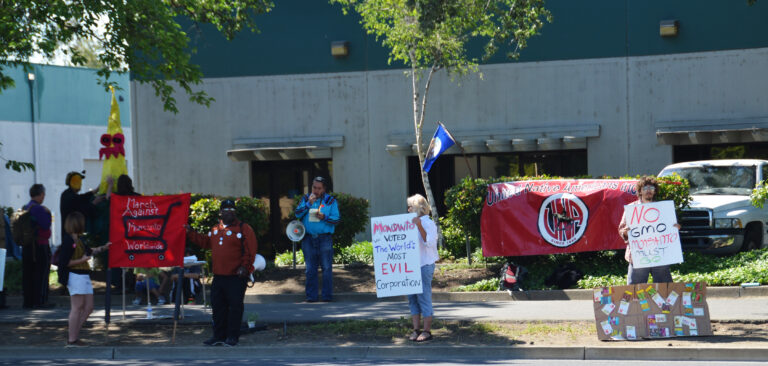
As early as 6 a.m. on May 24, around 100 protesters had already gathered at the Davis office of Monsanto Company at 1910 Fifth St. — known to most as just Monsanto — to express their discontent with the actions and legacy of the multinational agribusiness corporation.

“We’re just trying to spread awareness about their history and eventually bring them down,” said Kim Sloan, lead activist with the Anti-Monsanto Project (AMP) who was present at the protest.

The protest was initiated by the Anti-Monsanto Project, a movement composed of over 30 Northern California groups and organizations, as part of the worldwide March Against Monsanto movement. The movement aims to “bring awareness to health, agricultural, environmental and political issues associated with Monsanto,” according to the demand letter issued by the AMP.

That letter, according to Sloan, was sent to the Environmental Protection Agency (EPA), the California Department of Agriculture, Gov. Jerry Brown and California Attorney General Kamala Harris, among others, as part of the lobbying efforts of the AMP. The AMP lobbied at the Capitol on May 22, in addition to marching at the Capitol on May 25 and attempting to shut down the Davis Monsanto office.

Protesters blocked off the driveways leading into the office parking lot from Fifth Street, although the building was still accessible from a back driveway. On multiple occasions, drivers, possibly Monsanto employees, attempted to drive into the lot from Fifth Street before realizing they were blocked and driving away. Protesters formed a human chain across the back driveway at approximately 7 a.m., but let police officers through.

“We’re just out here keeping the peace,” said Davis Police Lt. Ton Phan. “So far there have been no issues and we like that.”

At approximately 7:30 a.m., a man on a bicycle approached the chain, telling the protesters, “I’ll run you down,” if the protestors refused to move and let him pass. The man biked through, and a protester asked if he worked for Monsanto.

“Yes I do, and I’m proud of it,” the bicyclist said.

In addition to the formation of a human chain, protesters employed the use of various chants such as “human need, not corporate greed” along with “hey, hey, no, no, GMO has got to go” and “hey, hey, no, no, shut down Monsanto.” Many protesters stood along Fifth Street with signs and were honked at by motorists, seemingly in approval.

“This is the largest event we’ve ever had in Davis and and we’re expecting around 1,000 people to come through here today,” Sloan said. “On May 22, we lobbied legislators and sent out our demand letter, but today is about education. I believe highly in the value of public participation, especially considering what our government has done with Monsanto.”

Monsanto and politics
Sloan cited the Supreme Court ruling in Bowman v. Monsanto on May 13, in which the court ruled in favor of Monsanto and held that patent exhaustion does not permit a farmer to reproduce patented seeds through planting and harvesting without the permission of the patent holder — in this case, Monsanto. Monsanto has the patent rights to 96 percent of the GM (genetically-modified) seeds planted in the US, according to a fact sheet issued by the AMP.

“Justice Clarence Walker was an attorney for Monsanto,” Sloan said.

Sloan mentioned a number of other factors that have fired up the opposition against Monsanto, such as the failure of Proposition 37 to pass in the 2012 elections, a ballot initiative which would have required the labeling of GMO products sold in California. Monsanto was the leading financial contributor in the opposition campaign.

A federal bill recently proposed by California Senator Barbara Boxer and supported by the AMP, the “Genetically Engineered Food Right-To-Know Act,” is once again tackling the issue, and would require the labeling of GMO foods. Sixty-four countries, including China, Japan, Russia and all countries within the EU, currently require GMO foods to be labeled.

“It’s a huge issue in California, but we don’t have as much power on the federal level, so we’re lobbying at the state level hoping to eventually reach the federal level,” Sloan said. “That’s our first step.”

Protester motivations
The event attracted both seasoned and first-time protesters, all of whom had slightly different personal motivations for voicing their concerns.

“This is the first protest I’ve been to in my life,” said Sacramento resident Lynn Sagerdahl. “I’m not much of an activist, but I feel I don’t have a right to talk about it without doing anything.”

Sagerdahl expressed concern about Monsanto’s GM seeds and their effect on bee population, holding a sign reading, “All we are saying is give bees a chance.” March against Monsanto pamphlets available at the protest cite connections between GM seeds and colony collapse disorder (CCD).

“I used to go into my lavender plants and watch the bees, and in the last couple years there are less and less,” Sagerdahl said. “I don’t think companies like Monsanto see the big picture.”

Sagerdahl was not the only first-time protester at the event.

“This is the first protest I’ve been to in my life. I’m passionate about this because it’s killing us and killing our kids,” said physician assistant and midwife Margie DiFelice. “I bought a house in 1989 right next to the fields and would see the planes flying over and spraying. I wouldn’t let my kids play outside then.”

Also at the protest was Andrea Mrotz, leader and organizer of Label GMOs Vallejo/Benicia. Mrotz graduated from UC Davis with a degree in microbiology and is working to ban GMOs in Solano County.

“I did genetic modification in the lab there, so I’m familiar with it,” Mrotz said. “I think a lot of people don’t understand GMOs and what exactly they are, and with my scientific background I want to spread awareness in my community [Vallejo/Benicia].”

Mrotz became involved in the cause around the 2012 elections when she began volunteering on behalf of the Yes on 37 initiative. After the election, she began working with the California grassroots organization behind the initiative, Label GMOs, and wanted to form a group in her community.

“If Marin and Mendocino County can do it, why can’t we?” Mrotz said on banning GMOs.

Mrotz, who held a sign at the protest, has a tattoo on her forearm of an ear of corn. On closer investigation, it is apparent that several of the kernels are drawn to resemble human skulls.

“The biggest scare is biological contamination,” Mrotz said. “It’s not just about protesting, but educating people about the small things they can do, like gardening. We need more people speaking out to be heard.”

Monsanto’s response
Tom Helscher, director of corporate affairs for Monsanto, issued a statement via email regarding the protest.

“While we respect the right of individuals to express their point of view on these topics, harassment of individuals is not an appropriate way to further their cause,” Helscher said. “At Monsanto, we believe we are making a contribution to improving agriculture by helping farmers produce more from their land while conserving natural resources such as water and energy.”

Sloan connected her activism with the AMP to other issues of social justice she finds concerning.

“It’s all one for me. The raping and pillaging of our environment, to me, is connected to violence against women,” Sloan said. “That’s kind of out there. But that’s my ideology.”

MEREDITH STURMER can be reached at city@theaggie.org.

Shrem Art Museum to break ground next year

Plans are in motion to open the new Jan Shrem and Maria Manetti Shrem Museum of Art at UC Davis next year, but the university still needs at least $5 million to outfit the building and officially launch.

The capital budget for this project is $30 million, which has been approved by the Capital Resource Management group and will be provided by donations and campus funds. In addition to the start-up costs, the university aims to raise an endowment of $5 million to $20 million to allow the museum’s program to expand, according to Karen M. Nikos, senior public information representative at UC Davis in an email interview.

“There are four components to launching the new museum: an architecturally significant building, an innovative program, an endowment to sustain the institution and the art collection to be exhibited in the new galleries,” Nikos said.

The museum is named in honor of proprietor of Clos Pegase winery Jan Shrem and his wife, arts patron Maria Manetti Shrem. The couple donated $10 million to the university in 2011, and the funds will be used for the museum.

After a five-month competition, SO-IL, a New York-based firm, was named the museum’s design team in partnership with architectural firm Bohlin Cywinski Jackson and contractor Whiting-Turner. The team was among three finalists that were considered by a jury of faculty and professionals in the art and architecture fields.

“We were looking at a number of things, including visitors’ experience, energy conservation, sustainability and what was most fitting for UC Davis — everything from design and aesthetics to functionality,” said Clayton Halliday, assistant vice chancellor of Design and Construction Management and head of the jury.

According to Halliday, the museum will include spaces for teaching, appreciating and making art, and for students to spend time with one another.

“The design envisions a new type of campus art museum, more open and participatory,” said Lias Papageorgiou, associate principal at SO-IL in an email interview. “The main idea is to blur the edges between inside and outside by creating a portfolio of interconnected exterior and interior spaces all with distinct spatial and lighting qualities that create a variety of opportunities for art display, learning and experimentation.”

The design includes glass walls that connect interior and exterior spaces as well as a distinct 50,000 square-foot steel canopy.

“We thought this was truly the most unique design. It was most fitting for UC Davis and most closely matched with the requirements that we set,” Halliday said. “Right when you walk in, you know it’s all about art and art education.”

LAUREN MASCARENHAS can be reached at campus@theaggie.org.

Five Davis neighborhoods top Atlantic’s list of most bikeable

On May 17, The Atlantic magazine published a list of the 25 most bikeable neighborhoods in America, based on ratings given to each neighborhood by Bike Score, an extension of the Walk Score and Transit Score. Davis had five neighborhoods in the ranking and Sacramento had seven.

Professors from Simon Fraser University and the University of British Columbia helped to develop the methodology for rating cities. The rankings are based on thousands of voters from the community near the headquarters in Seattle, Wash. Voters suggested over 100 factors that make a city bikeable.

“Bike Score provides a 0-100 rating of the bikeability of a location based on the availability of bike infrastructure (lanes and trails), the hilliness of the area, nearby amenities and road connectivity, [in addition to] the number of bike commuters,” Walkscore CEO Josh Herst said in an email.

The first Bike Score came out in May 2012, with rankings for only 10 U.S. cities, and today they offer a Bike Score for over 100 U.S. cities. Based on a city’s bike score, cities are put into categories: Biker’s Paradise (90-100), Very Bikeable (70-89), Bikeable (50-69) and Somewhat Bikeable (0-49).

Old North Davis was rated as the number one bikeable neighborhood, with a perfect score of 100. Two other Davis neighborhoods, Old East Davis and Downtown Core, also received perfect scores, along with neighborhoods in Madison, Wis., Boulder, Colo. and Eugene, Ore. University Avenue in Davis was given a score of 99.8, and Interland/University Research Park in Davis received a score of 99.7.

The high ranking that neighborhoods in the City of Davis received from Bike Score doesn’t come as a surprise to David Takemoto-Weerts, TAPS Bicycle Program Coordinator.

“Biking became popular in Davis in the 1960s, before the city started to promote it. [Davis is] flat, has mild weather year round and is surrounded by farmland. If you lived in Davis, your commute was relatively short in the 1960s — two to four miles,” Takemoto-Weerts said.

In the 1960s, when Davis started to become a pioneering bicycle city, a much higher percentage of the city’s population was involved with the university than today, so any efforts to improve bikeability on campus inevitably spread to the surrounding city.

“The city and campus have a symbiotic relationship,” Takemoto-Weerts said.

Several of the top Bike Score cities in the U.S. are known as college towns, including Cambridge, Davis, Berkeley and Boulder.

The bikeability of the UC Davis campus was greatly influenced by Emil Mrak, who was the chancellor of UC Davis from 1959-69. He aimed to make the campus more bicycle-friendly and in 1967 introduced the bicycle-only blocks around campus.

He also made sure that bike parking was available at every building, close to the major entrances to encourage students and faculty to bike to class.

The City of Davis was the first city in the U.S. to implement bike lanes in 1967, no small feat.

“It wasn’t an easy process, [the project] had to go through Caltrans and various legislatures for approval,” Takemoto-Weerts said.

In 2006 Davis became the first city to earn the Platinum Bicycle-Friendly Community Award from the League of American Bicyclists. The City of Davis is also home to the U.S. Bicycling Hall of Fame.

Jimmy Fong, a transportation program specialist for the City of Davis, said that the city plans to improve bikeability for its residents.

“We want to improve safety, continue to educate bikers and incorporate infrastructure updates for problem areas,” Fong said. “In 2017, the 50th anniversary of bike lanes in Davis, we will celebrate with a festival. We want to move up to the Diamond Bicycle-Friendly Community award.”

The highest-ranking neighborhood on the Atlantic’s list is Old North Davis, which is getting ready to celebrate its 100th anniversary. It was the first suburb of Davis. Old North Davis spans from G Street to the railroad tracks, and from Fifth Street to Seventh Street.

Steve Tracy, the president of the Old North Davis Neighborhood Association, said that the neighborhood is working to improve bikeability for its residents.

“For 10 years we’ve been lobbying to reduce the lane count on Fifth Street to two lanes and add bike lanes, which will be happening this summer,” Tracy said.

Old North Davis will begin to charge for parking in their neighborhood, something they haven’t done in the past. Parking passes will cost approximately $75 annually, and the revenue will be used to improve safety for bikers and neighbors.

Tracy credits the neighborhood’s high Bike Score to the amenities that are available in Old North Davis.

“All kinds of day-to-day services are available in North Davis; the Davis Co-op, restaurants, a lumber yard and more. It is the best place to live in Davis; I’ve been here for 40 years,” Tracy said.

TAYLOR CUNNINGHAM can be reached at city@theaggie.org.

A road less traveled

The Aggies completed their season with a 19-37 record overall and finished with a 5-22 record in conference play. UC Davis baseball may look upon this season as a down year, but there were some positive moments. In a season of struggles, the Aggies can view their experience as a platform to build off of in the future.

Heading into the 2012-13 season, coach Matt Vaughn began his second year as head coach of the UC Davis baseball team. He came into the season with a young Aggie squad consisting of just a few seniors.

“When you lose three starters — Anthony Kubpens, Dayne Quist and Tom Briner — in the same year, that is a big blow,” Vaughn said.

UC Davis opened up their season with a giant victory against Pac-12 foe Washington. In a game in which the Aggies never trailed, the 8-4 victory marked only the second straight year that the Aggies opened up the season with a Pac-12 Conference member. The Aggies would go on to eventually win the four-game series.

“For the most part we did a very good job,” Vaughn said. “To get three wins against a very good Pac-12 — you cannot start much better than that.”

The Aggies continued their early season success with a 22-4 decimation of San Jose State, which interestingly set a Davis school record for batters getting hit by a pitch, as seven batters trotted to first base the hard way.

Davis then struggled mightily however, losing several non-conference series matchups against Utah, Oklahoma State, CSU Bakersfield and Seattle University.

However, a 2-1 thriller at Dobbins Stadium against Stanford proved a high point in the season. Down 1-0 to begin the bottom of the ninth, sophomore John Williams crushed a 3-2 pitch to right field for a triple. Stanford would retire the next two batters, but Williams would eventually score on a costly Stanford wild pitch. The Aggies took advantage of the error. With a single from senior Paul Politi and a walk to junior Steven Patterson, junior Nick Lynch connected on his first pitch with a single to right field, bringing Politi home for a walkoff win.

“This was a big win especially coming off a tough series against Seattle University,” Vaughn said.

Following the exciting Stanford victory, the Aggies began conference play on the road against 21st-ranked Cal Poly, which would lead to another streak of consecutive conference losses. Davis lost their first nine conference games to fourth-ranked Cal State Fullerton and then Long Beach State. In what was statistically the toughest schedule in Big West play, the Aggies were able to maintain consistent hitting throughout, ranking top five in conference with a .281 team batting average.

Davis picked up their first conference victory and series sweep against UC Riverside. In the sweep, Politi shined with two home runs and went 4-5 in their final game of the series. Patterson maintained a hot bat as well, as he went 3-5 with three runs and a game-high five RBI, including a solo home run.

“We weren’t playing well but we were playing hard in that tough stretch,” Vaughn said. “To finally have our efforts pay off with some wins is fun.”

However, following their series sweep of UC Riverside, the Aggies’ struggles in conference remained, losing season series to nationally ranked UC Irvine, Cal Northridge, Hawai’i and UC Santa Barbara.

The Aggies’ bright spot during this span was a road-conference series victory against Pacific which saw junior Harry Stanwyck toss the Aggies’ first shutout of the season and of his career. The final stretch of the Aggie season also saw increased hitting production from Patterson, who held a team-high 13-game hit streak during his streak of 27 consecutive games reaching base.

What separates a good team from a great team is learning from mistakes and hardships. While the Aggies lose several seniors who helped contribute to their conference leading 555 hits and third-ranked .283 batting average, the Aggies still hold onto key contributors such as Patterson, Williams and Lynch.

Meanwhile, the inexperienced pitching staff gained valuable experience and playing time this season on their way to posting a 5.32 ERA. Hopefully, the Aggies can use these experiences as a chance to learn and grow as players.

SHAUN MONCADA can be reached at sports@theaggie.org.

The Aggie Arcade

In this week’s Aggie Arcade video I explore the world of Fez, a 2012 puzzle platformer that came out for the PC earlier this month. The visuals are vibrant and inviting, but the ominous music foreshadows Fez‘s many hidden secrets. Only by shifting the world and collecting cubes can I uncover the mysteries that truly define the Fez experience.

Xbox One’s unknown audience

Last week Microsoft finally unveiled its upcoming console — the Xbox One. The company mentioned how the system will be consumers’ one main living room device in order to justify the name, but let’s all just agree Xbox One is a silly name. Far more concerning are the details regarding the successor to the Xbox 360.

My Aggie Arcade column a couple of weeks ago outlined a short wishlist for Microsoft’s big reveal of the Xbox One. The main things I wanted to see were plenty of games, a small emphasis on Kinect and an explanation of the system’s always-on requirements. Well, it turns out that Microsoft didn’t feel like doing any of that during the event.

Instead, the company showed no live demos, revealed that Kinect will be bundled with the system and only created more confusion regarding internet connection requirements. In fact, I’d say “confusing” is the one word that best sums up the event.

The biggest source of confusion stems from that fact that I don’t know what kind of audience Microsoft is targeting with the Xbox One. A large portion of the video game community thought Microsoft’s event was a disaster, myself included. Instead of emphasizing the Xbox One’s prowess as a video game console, the company focused on television services, easier-to-navigate menus and other categories that speak to a far broader audience.

Perhaps Microsoft intends to take Nintendo’s approach with the Wii and market the Xbox One as a system for families and more casual audiences. The fact that Kinect is now required seems to support that particular viewpoint. But when I think back to last week’s event, I remember Microsoft did not fully commit to such a vision.

Microsoft still teased 15 exclusive games in the first year, though only one was actually shown (Forza Motorsport 5). The company also mentioned how next month’s E3 will be a bigger showcase for the system’s upcoming library of games, which always proves to be true. But how many of those exclusive titles will be Kinect-based? And how many of them will feel like rehashes of past releases with prettier visuals?

Even worse are the reports regarding restrictions on used games. It’s a controversial issue that doesn’t necessarily apply to me since I don’t purchase used games, but if you want a subject that will rile up the video game community, then this is it.

Xbox One owners will be required to install game discs to their hard drives. At that point the disc is no longer required, but that doesn’t mean friends can then borrow the game free of charge. Once a game has been tied to an Xbox Live account, subsequent users will have to pay a fee to gain access to the disc. That fee will likely be the full price of the game.

What does that mean for retailers like GameStop or services like GameFly? Well, I can’t see them surviving with those kinds of systems in place. It’s like a big middle finger to companies that rely on used games sales. Microsoft has said it does still have plans for used games, but here we are a week later with no actual details.

I can’t help but feel cynical after the reveal event. It seems like Microsoft is trying to be everything to everyone, but no video game company has ever truly succeeded with that kind of mentality. Some people have said we can’t truly judge the system until we see Microsoft’s E3 conference in June — I sure hope they’re right.

ANTHONY LABELLA can be reached at arts@theaggie.org.

‘Anonymous’ tells stories of women

The Department of Theatre and Dance presents Anonymous, a multimedia collaboration inspired by real stories of real women.

The show will feature videos, text, participatory sculpture and dance. The stories are inspired by the lives of the collaborators, who all bring their experiences to the table.

“These are stories about being women,” said Jarrell Chua, an MFA candidate in dramatic arts and the director of Anonymous. “These are our struggles, our joys and our experiences.”

Anonymous came to be while Chua was working with a group of women last year.

“I was trying to do a different piece and it wasn’t cohering very well. I thought, ‘What do they all have in common?’ and the only thing I could come up with was that they were all women,” Chua said.

The project was made possible by a grant from the Puffin Foundation, a group from Teaneck, N.J. that, according to Chua, specializes in funding projects that don’t normally get funded.

“I found the Puffin Foundation while researching grants for a class I was taking. I actually wrote them for this grant as the final project for that class. I wasn’t expecting to get this grant, and now I am doing this show when my thesis is due,” Chua said.

Chua was influenced by Anna Halprin’s “Life/Art Process,” which was developed in the 1970s and is discussed in Chua’s thesis.

“It involves taking personal life material and developing it into art, as well as recognizing the interchange between life and art and how art can influence people’s lives,” Chua said.

For this piece, Chua asked her collaborators to think of a personal experience that was very strongly related to womanhood.

“We drew pictures of these experiences in order to extract it. Then we wrote it to extract it more, and then we danced for it. That’s how we came up with the material for this collection,” Chua said.

Maribel Lopez, a fourth-year psychology and dance double major, is one of the contributors and collaborators on Anonymous. Lopez shares how she contributed to the piece by drawing from her personal life.

“My contribution to this piece was a lot of my own stories, sharing and reflecting as a woman and the woman I’ve become.

Personally, it was a way of reflecting on my relationships with my parents and how they have molded who I am and reflect who I want to be,” Lopez said.

Another contributor is Kristen Rulifson, a fourth-year neurology, physiology and behavior major.

“My contribution was to share my story and to inspire other women to share theirs. I have tried to incorporate what women can do, the risks they can take and the strengths they have to feel empowered. I think that through this piece, my purpose is to inspire women and men to think about these issues and concerns that women face,” she said.

Rulifson enjoyed working with Chua.

“It’s been an experience, and I have learned so much about myself,” Rulifson said. “We work in a very creative process and in a safe space, so the movement that we generated has been real and novel, a reflection of our sensations that we feel as part of our identity as women.”

Chua felt lucky to have this opportunity.

“It’s been an interesting journey and a real pleasure to work with these women, and they’ve been inspiring both artistically and personally,” Chua said.

JOHN KESLER can be reached at arts@theaggie.org.

Inside the Game with Justine Vela

0

Although UC Davis women’s softball did not make it to regionals, sweeping Cal Poly with three big wins allowed the girls to end their season on a positive note.

However, one player that has consistently performed at a high level for the team both this season and last is sophomore Justine Vela.

The Bakersfield, Calif. native has once again been named to All-Big West Conference First team for her second solid year of pitching for the Aggies. She finished off the 2013 season with a 2.03 ERA, the lowest average in the Big West.

With two more years of ball ahead, there are high hopes both for herself and the rest of the team to do big things in the Big West and beyond. She sat down with Aggie Sports Writer Sloan Boettcher to discuss where it all began, her sports hero and her expectations for her next two years wearing Aggie Blue.

The Aggie: How old were you when you first started playing ball?
Vela: I started when I was like four or five playing tee-ball. But I didn’t start playing competitively till I was 10.

Have you always been a pitcher or were you the kind of player that covered every position on the field as a kid?
When I first started out I played third. I guess I had trouble because my parents always said I had bruises on my shins. I started pitching when I was 10 after one of the other players on my team broke her wrist during a game and the coach asked me if I wanted to pitch.

As a freshman, you came in and dominated throughout the season, being named to All-Big West Conference First Team and receiving the honor of Big West Conference Pitcher of the Year. How did it feel coming in so young and establishing yourself as the No. 1 pitcher for the Aggies? Was it intimidating at all or just excited to take on that role?
I was definitely excited. There’s always a little nervousness as a freshman, coming in and playing Division I athletics. My club coaches prepared me for the experience that I was going to go through as a freshman and I knew I was going to be taught a lot here at Davis. I was definitely eager and ready to take on that role.

How has your strength and endurance grown since you came in as a freshman?
I would say I’ve grown a lot since I started as a freshman. It took me a little to adjust from the shorter games we played in travel ball to the over two-hour games here in college, but my endurance has definitely improved. But I know there’s always room for more improvement. I want to be able to throw two or three games in a day and still feel strong.

You’ve once again received top honors being named to First Team this year. How does it feel after an up-and-down season for the team to finish on a high note with both yourself and your short-stop receiving that honor?
I mean, it feels great and I’m so glad our freshman earned that honor — she did amazingly this season. We did have a little trouble this year, but after this season we know where we’re at and that we’re capable of winning the Big West. There is extreme potential for the team we have here.

On a different note, I read that your sports hero is Bethany Hamilton, a well-known female surfer. Obviously she is quite inspirational coming back after losing her arm in a tragic surfing accident, but could you tell me why in particular you chose her as your hero?
I think the reason I chose her was because you have to be strong on the mound. If I let myself show any discouragement it rubs off on the team; being able to lose an arm and still wanting to go out and surf and push yourself to do that is very inspirational. I’ve always wanted to be very calm and not let my emotions show — if I’m off, I can throw the team off. I just know that the team feeds off the energy that I give. I always want to give off positive energy.

And one final question — what are your hopes and expectations for yourself and the team for next year?
Definitely to win conference and make it to regionals. After this year there is no doubt that there’s potential there. The biggest thing is to realize we have this talent and have the potential to win conference and go further than regionals. It’s definitely an obtainable goal.

SLOAN BOETTCHER can be reached at sports@theaggie.org.

Fallen Aggie soldiers honored at Memorial Day event

On May 23, about 100 people gathered to honor Aggies who lost their lives at war during a Memorial Day event.

The names of the Gold Star Aggies — 135 fallen soldiers from World War I through the Iraq War — were read aloud as part of the ceremony outside the Memorial Union (MU), the building that was originally dedicated to student service members in 1955.

“The department of Campus Recreation and Unions, under leadership of Executive Director John Campbell, has been preparing for the renewal project of the building. Through research into the history of the facility, they felt that bringing the meaning of the Memorial Union back to the attention of the campus was very important,” said Amy Shuman, HR analyst and executive assistant at Campus Recreation and Unions.

Victor Garcia, a veteran of the Iraq War and a transfer/reentry advisor in the Veteran Affairs office, said that the MU is a major part of the campus community, but unfortunately most people do not know the meaning behind it.

“For a lot of students and the community, the MU is such a part of our daily lives, but a lot of them do not understand why it’s important,” Garcia said.

Garcia also added that the Golden Memory Book, a book that lists 134 Aggie casualties (the most recent death has yet to be added), is located in Griffin Lounge next to the fireplace, but most students do not realize it is there.

The plan is to make this ceremony into an annual event to honor the Aggie soldiers who passed away and to create greater knowledge of the history of the building.

“This year, we set the foundation for a ceremony that will become an annual event. It’s not necessarily the details of the ceremony that are most important to expand, but rather that through this event, we can increase awareness of the history and meaning of the Memorial Union,” Shuman said.

A new entrance to the MU is set to be constructed near the current north entrance. In addition, a kiosk will be built inside where the names and stories of the Gold Star Aggies can be viewed and permanently honored.

“The department of Campus Recreation and Unions seeks to make the Memorial Union feature a prominent part of the renewal so that all who visit it will know a piece of the history and will have the opportunity to learn more,” Shuman said.

ASUCD President Carly Sandstrom said these new additions to the MU would be an excellent way to honor Aggies who served the country.

“We are recognizing and re-dedicating this Union to those Aggies who were courageous and selfless enough to risk their lives to fight for our country. We are honoring our student heroes for their bravery and sacrifice to protect us,” Sandstrom said.

SASHA COTTERELL can be reached at campus@theaggie.org.

Campus Judicial Report

Caught in the act
During an exam, a TA noticed that a student was looking for extended periods of time in the directions of the students sitting around him. It was made clear that this was not simply a case of wandering eyes when the student was observed clearly trying to discern what was on his neighbors’ exams. Furthermore, he did not simply look once, but the cheating was noticed again at least 15 minutes after the TA first noticed his actions. On one occasion, the student was looking both directly at his neighbor’s paper when he realized the professor was standing no more than 10 feet away. Upon noticing the professor, he quickly turned his head and looked as if he had been caught doing something. Because it is explicitly against the rules to look at another student’s exam, he accepted probation through graduation and 20 hours of community service.

Similar solutions
A student was referred to Student Judicial Affairs (SJA) when a TA grading lab reports recognized answers from the previous quarter’s solution key. The professor had posted the solutions to the lab from the previous quarter on SmartSite, but it was made clear that the students had to do their own work. A number of students had answers identical to what was posted by the professor online. The Judicial Officer issued a censure to the student, warning that repeated behavior could result in more serious consequences.

Double trouble
While grading quizzes, a TA noticed two students had virtually identical answers to all parts of a quiz, which happened to be distinctly wrong. The two quizzes were next to each other in the stack of quizzes, indicating that the pair were next to each other when the quizzes were collected. Although cheating was not directly observed, the probability of the quizzes being so similar and next to each other as well was incredibly small. Consequently, the students were referred to SJA, and accepted deferred separation as well as 15 hours of community service.

Tech Tips: Real-life swipes

Imagine visiting the ASUCD Coffee House, loading up on delicious entrees such as a garden salad from Croutons, or a seam-bursting burrito from TexMex, pulling up to the checkout counter, and instead of desperately searching for plastic cards in your backpack, wallet or purse (ladies, can I get an amen), you simply swipe your finger to pull up your information and pay for your food. Thanks to engineers at the School of Mines and Technology (SMT) working in a new field called biocryptology, this reality might not be too farfetched.

Biocryptology, currently used in products such as fingerprint door locks and retinal-scan identifications, is a real-life manifestation of science-fiction technologies of a bygone era. Biocryptology is a blossoming field of technology comprised of the functional combination of biometrics (the use of anatomical identification) and cryptology (the study of encoding private information). South Dakota’s student engineers are on the way to improving how college students experience and interact with financial transactions by way of the current plastic technology.

This technology is a major step toward decreasing the inconveniences and increasing the security of students. Through the employment of smart fingerprint scanners, SMT is working to eliminate credit card-based shopping on its campus, and eventually, campuses nationwide.

While credit card-based shopping presents its various problems, identity theft being the most daunting and common, this new biocryptic implementation seeks to forestall common security concerns. The new rendering of fingerprint-based shopping takes into account the various hazards that, in the past, have been associated with anatomical identification. Student engineers have developed a sure-fire way to hinder thieves who may attempt to use another’s prints via removal of a finger or limb by developing smart sensors that verify not only an individuals’ prints, but their functioning blood flow as well.

While it may take a few years for systems such as these to become a reality at the University of California, at least you’ll get the chance to squawk at your grandchildren, “When I was your age, we had to use pieces of plastic to buy things!”

EMILY SEFEROVICH can be reached at science@theaggie.org.

Column: Living with pests

We’ve all seen them: aphids, dandelions, cockroaches, rats, bread molds, racoons, pigeons and many others. We’ve seen these unique and resilient organisms deemed pests by so many. These creatures are often considered objects to be exterminated or controlled, and for good reason. They harbor disease, they eat what isn’t theirs (according to us, at least) and they can ruin a perfectly ordered garden. I’ll submit that before we go and try rounding up all of these living things and giving them the same treatment as the western black rhinoceros or the American bison, we take a step back and consider a few things.

Thinking like an ecologist (or a child), it becomes abundantly clear that all of these organisms eat and are eaten by others. The removal of any significant proportion of any of their populations would have a tremendous impact on the surrounding trophic levels, otherwise known as participants in food webs, otherwise known as things that eat other things.

For instance, many people are fearful of spiders, but if we were to dramatically thin out their numbers in a short enough time frame, the results would be unpleasant to say the least. The spider’s primary prey, winged arthropods (bugs), would have considerably fewer predators and their populations would soon run rampant in areas where spiders were the predominant form of population control. Without spiders, we could literally be knee-deep in insects within a few years. Moreover, some bird species whose diets may depend heavily on spiders would experience a food scarcity and have no other option but to find new sustenance or die. The resulting behavior of the birds could result in increased competition with other animals, causing a cascade of other struggles for food and further straining a damaged ecosystem. The overabundance of winged arthropods could result in overgrazing of plant matter — or whatever items these flying bugs primarily eat — and could ruin the ecosystem for everybody.

Needless to say, removing a member of an ecosystem could have dire consequences.

It is also important to consider that evolution is a very opportunistic tinkerer and natural selection is a relentless mechanism. Any unoccupied niche in an environment is asking for something to step in and take advantage of the situation. Cockroaches are successful because they’re resilient to so many would-be fatal living conditions. They don’t need to eat much or count calories and they reproduce very quickly in spaces that many overlook. They can also survive pretty much everything except a direct nuclear strike. They can even have their heads cut off and continue to reproduce. Even if we did successfully engineer a system to wipe them out, something else would assume the then-empty role in a more tenacious way than we could imagine.

These garden-variety pests as we like to call them don’t exist the way they do simply to be an inconvenience to us. They’re playing the game of life, and winning. Despite all of the things we do to make non-human/non-human-cultivated life a non-factor — urbanization, proper sanitation, removing the lion’s share of loose food scraps, carpet-bombing crops with insecticides, habitat destruction and the many other things that make humans an inopportune species to share a planet with — these organisms are not only skating by, they’re thriving.

I’m not saying we should rapidly embrace the aphids, cockroaches, spiders and rats of the world. It’s often advantageous for us to remove them from our immediate vicinity for hygiene reasons. But it is important to consider that these organisms are participants in a system so prevalent, so natural that it’s very easy to lose sight of.

The classical mantras of manifest destiny, exploration and conquering the unknown have been synonymous with progress and advancement. But in reality, we humans are participants in a system that extends far beyond our own needs. The tune of mastering the environment should be changed to one of finding a way of successfully coexisting.

ALAN LIN tries to be a conscientious planet-mate. He can be reached at science@theaggie.org.

This week in science

Green Fuel:
Researchers from Lawrence Livermore National Lab have recently developed a process that some might call the environmental savior. This new process removes CO2 from the atmosphere and at the same time creates high-alkalinity, carbon-negative hydrogen, which can be used for both fuel and to offset the acidification of the ocean. The hydrogen can be used as fuel in any hydrogen-fuel capable vehicle and would work to de-acidify the ocean in the same way alka-seltzer works to neutralize the acid in your stomach.

Adaptable Brain:
You may have heard the term “neuroplasticity” before. It refers to the brain’s ability to continuously adapt to new situations and environments. Doctors from the University of New South Wales Black Dog Institute have discovered that the brains of people with depression are far less “plastic,” and are far less able to adapt to new situations. This means that “depressed” brains are less able to learn and retain new information, and are less able to create new connections between different areas of the brain.

Electric Cement:
Researchers working with the Department of Energy and Argonne National Labs have just figured out how to turn liquid cement into liquid metal, essentially turning the cement into a semiconductor that can be used in electronics. This new material can potentially
replace silicon as a conductor in electronics, paving the way for cheaper, more durable products without the need for the rapidly dwindling silicon supply.

Space Rocks:
The Oort cloud is an enormous “cloud” of comets, asteroids and tiny planetesimals that surrounds our solar system. Astronomers from Yale University have recently identified an asteroid from the Oort cloud that is moving slowly enough that we will potentially be able to study it and learn a great deal about the origins of our solar system. The object is completely frozen, so it contains preserved samples from the early years of solar system formation.

Mutant Cockroaches:
Cockroaches love sweets, as many of you know. That is why the traps we set for them are so successful. The traps are filled with sugary sap that draws the roaches in, and traps them. But like something right out of a nightmare, some roaches have actually evolved to find the taste of sugar to be bitter and distasteful, allowing them to avoid the sugary deathtraps. The researchers from North Carolina State University have found that the roaches will actually cringe and attempt to distance themselves from any source of glucose. The best part? This evolution is most definitely our fault.

Super Band-Aids:
New Band-Aids infused with the building blocks of life could help heal wounds far faster than they normally would. These bandages are infused with RNA molecules that contain the genetic instructions for healing. The RNA can be delivered directly to the wound via the bandage. Surgeons can even use these bandages after internal surgery by implanting a dissolving RNA-infused strip on top of surgical cuts.

Bright Sound:
Believe it or not, there are still some things that science cannot answer. One of these things is why an air bubble can produce light when burst with sound waves. This phenomenon was first observed in the 1930s and is called sonoluminescence (light from sound). When an underwater air bubble is collapsed with intense sound waves, small bursts of light are emitted… and no one has any idea why. This may not be “this week in science” material, since we don’t know what it is, but it is very pretty.

HUDSON LOFCHIE can be reached at science@theaggie.org.

I see tech people

0

Ah, technology. The giver of light. The bringer of information. The creator of worlds both Orwellian and Farmvillian. In the sunrise of the digital age, in the shadow of Silicon Valley, I can sit and marvel at the technology that surrounds and permeates life, and I can see how it has changed our world for the better.

Skype connects loved ones across time and space. Facebook and Twitter helped spark the Arab Spring. And Wikipedia lets me discover if Home Alone really did make more money than Home Alone 2. (It did.)

But for all the praise heaped upon technology, Sherry Turkle, author of Alone Together, believes it influences our behavior and values in very potent and not always positive ways. In her book, Turkle expounds upon her study of how robots and social networks isolate us from each other. Instead of making lives easier, it can make life confusing and cold.

We need look no further than our own dining commons for evidence. Only most of the diners there prefer to stare at phone screens instead of their friends’ faces. Games like Doodle Jump become more important than relationships. This even surprises Kevin Durant, who expresses his disapproval eloquently: “Doodle Jump? Man, that’s messed up.”

Champions of social media claim that it democratizes speech. And to an extent, it does. But this democratization also debases quality writing and original thought by throwing them among the riff-raff of the internet. Should your friend who thinks The Avengers was a cinematic masterpiece really be considered alongside a New York Times journalist? I’m not so sure.

Furthermore, Facebook allows you to “like” things such as colon cancer. Like colon cancer? Who in their right mind likes colon cancer? It’s a disease that can make you carry around a bag of your own excrement — not a hot, 20-something grad student you met at your friend’s party.

Technology masquerades hollow, empty gestures — for example, sharing a picture of a soldier — as genuine and legitimate action. Admittedly, sharing is caring. Still, walking up to a service member and shaking his or her hand seems to be a more appropriate Memorial Day activity than clicking a link. They may have fought and died for our freedom to shop in our pajamas, but we should at least try to get out of the house — and houseboats — to thank them for their service.

But for all the distance injected into our lives by technology, Turkle sees a glimmer of hope in a frail, imperfect place: us. We can change, she argues. We can reexamine our relationship with technology, and more importantly, with each other. And all it takes is conscious effort and purposeful acts.

I saw this action taken by a friend of mine who I’ll call “Chris.” Chris invited me and two other friends to dinner at his house because he feels he doesn’t see enough of us. People lose touch when the daily grind takes over. Chicken, rice and asparagus were his way of saying “I treasure your friendship, in a platonic fashion of course.” Cooking them all said, “I don’t want you to die from salmonella.”

Chris inspired me, although I only gave his restaurant a three-star rating on Yelp (A long wait to get in and only tap water? I’m not an animal). He made me want to connect with my friends and family in a more intimate, real manner. So I picked up my pen and wrote a few postcards, complete with Disney movie stamps.

Technology can bring us together. Still, we shouldn’t forget to look up sometimes from the interfaces that launch a thousand apps. For all you know, you might see a face that could launch a thousand ships, much to my Greek homie Homer’s delight. Or exasperation. I’m not quite sure which, since he’s dead and I can’t ask him. But I think he’d agree with me when I say that we can choose to invest in each other, in life, in love. And that mentality, that investment, is something truly worth sharing.

BEN BIGELOW thanks UC Davis veterans and active duty personnel for their sacrifice, and Chris for his perpetual inspiration. He can be reached at babigelow@ucdavis.edu.

Watts Legal?

Question: Who owns my Gmail account after I die? And who can access my Gmail account after I die? There’s some stuff in there I’d prefer my family can’t read, but I don’t know if they’ll be able to.
— David M., Davis, Calif.

Answer:

Nobody owns it. You yourself don’t even own it. You own the intellectual property rights in the content in your accounts (and those rights would pass to your heirs, just like any other property rights), but your use of Gmail, Yahoo! or any other web-based email service is subject to a contract you signed when you opened your account. Remember scrolling through those “terms of service” and then clicking on a box that said “Dude, I totally read this?” (I’m paraphrasing here). Those terms of service still apply.

And those terms don’t specifically explain what happens to your account after you die. But they do say that Google can “suspend or stop a service” like Gmail at any time. They also say Google can change the terms at any time, and could terminate your service for violating any Google policies. One of those policies bans you from transferring your account to another person — including your next of kin.

Although Google’s terms of service seem to ban transferring your account, Google does allow a deceased person’s next-of-kin to download the contents of their Gmail inbox. After you die, your family could get an order from a judge commanding Google to open up the account. Or a family member could just print out and send a copy of the family member’s driver license, a print-out of an email from you (to prove you actually talked to each other using the Gmail account), a death certificate and “proof of authority under local law that [the family member] is the lawful representative of the deceased or his or her estate.” Google will either send the contents of the inbox on a CD or close the account entirely, depending on the request.

Question: We have a roommate who is moving out at the end of the lease and is being profoundly difficult with respect to allowing us to see the bedroom so we can get a new roommate. They requested 24 hours notice, which we try to accommodate, but given our schedules, it is often difficult. The roommate says that if we don’t give them 24 hours notice, or if they don’t consent, that their rights are being violated. However, some laws I’ve read suggest that 24 hours is a reasonable amount of notice and that they can’t refuse to allow us to see the room. What are their rights? What are ours? What options do we have for getting a new roommate for the new lease year? We talked to our landlord, who agrees the tenant is being unreasonable, especially since our lease says that a tenant needs only four hours notice before the “landlord or his agent” shows the room.
— Van T., Davis, Calif.

Answer: 24 hours is plenty of notice. But it’s your landlord, not you, who has the right to show the room.

According to California Civil Code section 1954, a landlord may enter the house to “exhibit the dwelling unit to prospective or actual purchasers, mortgagees, [or] tenants.” And your lease, as you’ve quoted it, says that only four hours is enough notice before the landlord can exhibit the room.

You, however, are not the landlord. You are a co-tenant.

It seems your landlord is on board with you showcasing the house, though. One easy solution would be for your landlord to deputize you, preferably in writing, making you his agent. As his agent, you could enter the room with at least four hours’ notice (according to the lease) or 24 hours’ notice (according to California law). The landlord could write up something saying that “Van T. is my authorized agent and will exhibit your room to prospective tenants on June 5, 2013 at 5 p.m.” Post that on your roommate’s door at least 24 hours in advance along with a highlighted copy of the lease and California Civil Code 1954.

You might also remind them that refusing to allow access is a breach of the lease, and might be grounds for eviction — and payment of the landlord’s attorney fees.

Daniel is a Sacramento attorney, former Davis City Council candidate and graduate of UC Davis School of Law. He’ll answer questions sent to him at governorwatts@gmail.com or tweeted to @governorwatts.