39.7 F
Davis

Davis, California

Tuesday, January 13, 2026
Home Blog Page 925

Best Quotes 2012-13

“It would have been nice if the UC Davis administrators driving this case had had such support rather than spending [students’] funds on a petty and ill-fated prosecution. For obvious reasons, they did not.” — The Davis Dozen in an email interview on reaching a plea deal.

“Imagine a world where the free exercise clause allowed people to get out of laws by claiming their religion made them do it. Rastafarians could smoke pot. Jonestown cultists could murder people. And I’d sign up as the first Pope of the new religion, ‘Destroy-all-leaf-blowers-ism.’” — Daniel Watts in his column Watts Legal? on the First Amendment.
“When we did the discussion about this, what we found is that a lot of the constituent groups have the same basic concerns: How safe am I to reveal my sexual orientation, learning disability, industrial or personal injury, etc.? [These] concerns were common across all constituent groups. It was interesting to see how cohesive the questions were because we literally just went, ‘How safe are you about revealing blank?’” — David Ritz, vocational rehabilitation counselor in the department of human resources, on the Campus Climate survey.
“Hate speech affects people on a psychological level, and if you’ve ever been told that your existence, your faith or that your ‘brownness’ is the reason for all evil in the world, then you know exactly what I’m talking about.” — Sonum Saeed, fourth-year psychology major and publicity coordinator for the Muslim Student Association, on the ASUCD “Islamophobia” Resolution (SR 21).
“You develop a sixth sense for seeing glass — I’ve only stepped in glass twice. You just adapt. I walk along the white lines on pavement and try not to get off my bike until I am as close as I can get to my destination.” — Elena Piotter, first-year international relations major, on her choice to never wear shoes.

“People would try to pet his stomach because he tried to roll over, but the costumes’ buns got in the way, so he couldn’t turn over completely.” — Nycole Copping, fourth-year neurology, physiology and behavior major and employee at the CoHo, on Rodney, the corgi mascot for the CoHo hotdog cart.

“There are some students who don’t have stellar GPAs or stellar test scores, but they have amazing stories — life has dealt them a real difficult hand, like the girl who was 14 [years old] and was raising her daughter while still being the student body president … We admit stories — quite frankly, stories of outstanding students.” — Walter Robinson, executive director of UC Davis Admissions, on competition in gaining admission to UC Davis.

“I’m Jewish, so I sat home by myself and then went to Denny’s on Christmas Day.”
— Jeff Ratti, third-year microbiology major, on his winter break horror story.

“The awkward saga continued when I had the entire Target team attempting to find temporary tattoos for me … I told one of the guys who was helping me that I would prefer some with ponies or princesses or something.” — Aggie columnist Marci Montanari on Target etiquette.

BEST QUOTES 2012-13 was compiled by MUNA SADEK. She can be reached at campus@theaggie.org.

Best of Campus News

ASUCD Senator Yara Zokaie steps down
Oct. 30 — Following pressure from within the Association, ASUCD Senator Yara Zokaie, who is currently attending law school at the University of San Diego, stepped down from her position.
Originally reported by Adam Khan

Tuition to increase by $2,400 should Prop. 30 fail, Student Regent says
Nov. 5 — Students faced a tuition increase of up to $2,400 if Proposition 30 failed during the November presidential elections. The proposition passed.
Originally reported by Natasha Qabazard

KDVS receives $36,000 loan from ASUCD for new radio tower
Nov. 20 — KDVS received a $36,000 loan from ASUCD Capital Reserves to fund the radio station’s new radio tower.
Originally reported by Mengshi Shao

UC suspends new logo in face of system-wide opposition
Jan. 7 — Following a 54,000-signature petition opposing a new logo, UC made a decision to suspend its use.
Originally reported by Stephanie B. Nguyen

Pepper spray settlement finalized
Jan. 10 — The Nov. 18 pepper spray lawsuit was finalized, with each plaintiff receiving $30,000 and a formal apology from UC Davis Chancellor Linda P.B. Katehi.
Originally reported by Muna Sadek

UC President Mark Yudof announces resignation
Jan. 22 — Mark Yudof, UC president of five years, announced plans to resign and teach law at UC Berkeley, effective August 31.
Originally reported by Muna Sadek

Explosion at Russell Park leads to criminal investigation
Jan 22 — A UC Davis junior researcher was arrested following an explosion at the Russell Park apartments. He was charged with possession of an explosive, possession of materials with an intent to make explosives and two counts of possession of a firearm on campus.
— Originally reported by Natasha Qabazard

Students launch bi-weekly campus publication
Feb. 19 — The Davis Beat, a bi-weekly publication, made its debut Spring Quarter.
— Originally reported by Stephanie B. Nguyen

ASUCD Senate passes resolution condemning Islamophobia
May 2 — Senate Resolution 25, condemning Islamophobic speech at the University of California, passed senate with a 7-4-1 vote.
— Originally reported by Liliana Nava Ochoa

Davis Dozen settlement reaches plea deal before trial
May 9 — The Davis Dozen, a group of one faculty member and 11 students who were charged with obstructing movement in a public place and conspiracy to commit a misdemeanor, following protests outside the Memorial Union U.S. Bank, agreed to community service hours and an infraction ticket before their set trial date.
— Originally reported by Muna Sadek

UC Davis to withdraw from UC Student Health Insurance Plan
May 16 — After the discovery of a $57 million deficit in the UC Student Health Insurance Plan (UC SHIP), UC Davis has chosen to withdraw from UC SHIP.
— Originally reported by Lauren Mascarenhas

Comeback Team of the Year: Men’s Basketball

0

In just his second year with the Aggies, coach Jim Les has made a remarkable turnaround with the program. The season highlights include a nationally televised game that was decided in the final few seconds and Big West recognition. The 2012-13 season has been one of the most successful campaigns for UC Davis since their transition to Division I competition.

The Aggies saw a nine-win improvement in their overall record compared to last season. UC Davis won more games due to its disciplined defense and precise offense.

The high level of play by the Aggies caught the attention of ESPN, as they chose to broadcast UC Davis’ home game against Long Beach State. This game was the first-ever nationally televised game at the Pavilion.

In a packed house, the Aggies fought valiantly, but lost to Long Beach State by a point. Although the final result did not end with a victory, both conference and network officials were impressed with the way UC Davis competed. The Aggies may have earned additional television appearances in the near future.

“The energy from the crowd and atmosphere was amazing,” said coach Jim Les. “I’ve been to a lot of arenas and a lot of places; this building took a backseat to nobody tonight.”

The Aggies will continue to take the next step as 84 percent of the offense will return next season. These include All-Big West First Team Honoree sophomore Corey Hawkins, Davis career three-point record holder junior Ryan Sypkens and the shot-blocking big man sophomore J.T. Adenrele.

Although the program will be losing seniors Ryan Howley and Paolo Mancasola, joining the Aggies next season will be Brynton Lemar. Lemar, who played at St. Augustine High School, averaged 21.0 points per game, 8.2 rebounds and 7.0 assists. He will be an asset for UC Davis next year.

“His skills, along with his work ethic and character, will make him a big contributor to the future success of UC Davis basketball,” Les said, describing the combo-guard.
UC Davis hopes to build on its success from this season and make a serious postseason run in the future.

— Shaun Moncada

Women’s Athlete of the Quarter: Justine Vela

Focus. Intimidation. Drive. All qualities which every star athlete strives to achieve. As a softball pitcher, those qualities are especially important. With all eyes on you, physical and mental strength come into play every pitch of every game in every ballpark.

With another year of ball under her belt, sophomore Justine Vela possesses not only physical control but mental poise out on the mound. These skills have allowed her to dominate lefties and righties alike this past 2012-13 season.

With a final ERA of 2.03, Vela ranked third in the Big West Conference. She also led the league with a .177 opposing batting average, was sixth in innings pitched at 172.2, third in strikeouts at 175 and fifth in overall wins at 15. Earning her way into multiple ranking categories, her statistics reflected her ability to command both home and away games this year.

With Vela, the numbers do not lie. Her ability to throw a full game on a Friday and bounce back to throw a second game the next day is only one example of how she excelled physically on the mound. With a total of seven shutouts on the year, Vela deservedly received multiple top honors again this season.

In February, Vela was named Big West Pitcher of the Week. She then earned one of only 12 spots on the All-Tournament Team during the Aggies visit to Clearwater, Fla. for the National Fastpitch Coaches Association (NFCA) Leadoff Classic, which was held from Feb. 22 to 24.

However, Vela’s biggest award came at the end of the year, when she received First Team All-Conference recognition. This marks her second year in a row of earning All-Conference accolades.

With all of her accomplishments not only this season but last, and high expectations for further success her next two years at Davis, Vela is worthy of being named Women’s Athlete of the Quarter.

— Sloan Boettcher

Male Athlete of the Quarter: Tyler Raber

As senior Tyler Raber knocked in his final putt at the NCAA Pullman Regional to post his best post-season finish, a tie for 23rd, it concluded the end of his outstanding career at UC Davis.

Raber, who began golfing for the Aggies in 2008, competed in 11 of 13 tournaments and led UC Davis at NCAA Regional with a two-over 218 in his first year. In his second year, Raber was All-Big West Conference Honorable Mention. Raber’s third season as an Aggie was another productive one as he was named All-Big West Conference First Team. He also finished fourth at the Big West Championship.

Before the start of the 2012-13 season, Raber was the only American to advance in the round of 16 at the British Amateur Championship. He was also an individual medalist at the 109th Trans-Mississippi Championship and qualified for the U.S. Amateur Championship.

Raber’s success in his final season included a seventh-place finish at the SCVB Pacific Invitational, a sixth-place finish at the Winchester Classic and an individual fourth-place result at the U.S. Intercollegiate, which helped the Aggie golf team finish fifth overall.

Raber’s hard work earned him a spot at NCAA Regional.

“We’re very honored that Tyler is going to be representing UC Davis at the NCAA’s,” said coach Cy Williams. “He’s an outstanding player, he’s had a great career and he was clearly our best player this year.”

After carding an opening-round 67 and a second-round 71, Raber was in the position to post a solid finish. He eventually tied for 23rd and finished with an impressive 23 birdies.

Raber finishes his career as probably one of the best golfers in the history of UC Davis men’s golf and is worthy of being recognized as the Male Athlete of the Quarter.

— Shaun Moncada

Team of the Quarter: Women’s Golf

0

As three-time defending Big West champions heading into this season, the women’s golf team happens to be one of the most successful teams at UC Davis. With results come expectations, and the Aggies had a lot of expectations for this season.

Despite this pressure, the women’s golf team delivered once again. Winning a fourth consecutive Big West Championship, the Aggies exerted their dominance on the field. Ranked 17th in the country at the end of the year, UC Davis excelled in tournaments throughout the season.

The Aggies claimed numerous awards and gained recognition this season for their outstanding play. Senior Demi Runas won the Big West Player of the Year award as well as being recognized as a second-team All-American. Also, freshman Andrea Wong won the Big West Freshman of the Year award. Altogether, the Aggies had five players win awards this season.

The team played well in the Big West championships as they shot a team score of five-over 881 for the week. This score beat the second-place Long Beach State by a massive 29 strokes.

Riding the momentum from their win in the Big West championships, the Aggies went to Oklahoma to play in the NCAA regionals. They finished sixth in the competition and clinched the top-eight finish needed to reach NCAA nationals.

The Aggies’ journey through post-season play ended in the NCAA nationals as they finished 16th overall. However, this was UC Davis’ best finishing ever at the event.

The future is bright for the Aggies, as they are returning six players next season. While the two seniors, Demi Runas and Amy Simanton, were anchors for the UC Davis team, the Aggies still have plenty of talent. The success of the team throughout the season makes it the Team of the Quarter.

— Kenneth Ling

Team of the Year: Women’s Track and Field

0

Known for hosting some of the top track and field events in the United States, Eugene, Ore. will be home to the NCAA Track and Field Championships in less than a month. UC Davis, named the Big West Team of the Year, will send three top-tier athletes to compete in multiple events.

Standout performances from sophomore sprinter Ashley Marshall, middle-distance runners senior Lauren Wallace and sophomore Katie Fry during the NCAA West Regionals, held at the University of Texas, displayed why the Aggies have had tremendous success this season. These three women were a big part of the team’s success throughout the year. During the preliminary rounds each of the runners demonstrated their abilities to cope with weather setbacks.

“After hours of protracted weather delays, we stressed the importance of focusing on the task at hand rather than worrying about the conditions or the later hours,” said head coach Drew Wartenburg.

The three took coach Wartenburg’s advice and ran well in their races. Marshall finished with the eighth fastest time in the 100-meter dash at the meet, with a time of 11.70 seconds. Wallace raced well and earned the second-fastest time in the 800 with a time of 2:04.05. Finally, Fry’s time of 9:58.97 set a school record in the 3,000-meter steeplechase.

Along with the successful trio, seniors Melanise Chapman, Kayla Carter and Emily Bush also competed in Austin, Texas.

“Reaching this round in postseason is gradually becoming the norm in our program, and the staff remains proud of all the athletes that represented UC Davis here this week,” Wartenburg said.

Last season, the team sent a program-high of two runners, which was the most the program had ever had compete since moving to Division I in 2008. With three qualifiers this season, the Aggies continue to make strides toward becoming a perennial contender in track and field. There are high hopes for Marshall, Wallace and Fry at Nationals, along with great expectations for continued growth in the seasons to come.

— Sloan Boettcher

Female Athlete of the Year: Ashley Marshall

0

There were many athletes in contention for this spot, from senior golfer Demi Runas to senior gymnast Katie Yamamura. However, sophomore sprinter Ashley Marshall claims the top spot for her outstanding results throughout the year.

Marshall was absolutely dynamite throughout the year, posting solid times in the various meets she competed in. What made her season special though was her excellence in the postseason races.

She posted a time of 11.70 seconds in the NCAA Regionals for the 100-meter. This placed her as the second fastest sprinter in her heat and the eighth fastest overall. Her top-three finish in her heat allowed her to advance to the NCAA Division I national championships. Marshall becomes the Aggies’ first female sprinter ever to advance to the NCAA championships.

Marshall also qualified for the International Association of Athletics Federation (IAAF) championships in Moscow due to her fast times in the Big West Championships. She qualified for both the 100- and 200-meter, with a time of 11.34 seconds in the 100-meter and a school-record-breaking 23.25 seconds in the 200-meter, respectively.

Scoring valuable points for the team as Marshall won her individual 100- and 200-meter races, she became the Big West title holder for both of these events.

Her results and accomplishments this season were noticed by the Big West as Marshall was named the Big West Track Athlete of the Year. She became the second-straight Aggie to win the award.

Marshall’s impressive season still has not ended as she heads to the NCAA national championships from June 5 to 8. The event will be held in Eugene, Ore. at the University of Oregon’s track. Hopefully, Marshall can add to her winning season with a top-five finish at nationals.

One thing is certain as the school year comes to a close: Ashley Marshall has been a constantly dominating presence for the Aggies. As only a sophomore, she has accomplished pretty amazing feats. Good things are in store for both Marshall and the UC Davis women’s track team.

— Kenneth Ling

Column: Watts Legal?

Question: Can my roommates force me to pay the rent for a subleaser who’s replacing me? I’m moving out of my apartment early, and I found a subleaser to take over my room for the summer. The subleaser signed an agreement to take over the remainder of my lease, so she’s on the lease now — not me. But my roommates made me sign a second agreement making me responsible for the new girl’s rent in case the new girl doesn’t pay. Can they go after me for rent if the subleaser doesn’t pay her rent?
— Jennifer W., Davis, Calif.

Answer: Yes, if you sign an agreement to guarantee the new girl’s rent, you’re probably stuck with it.

Landlords and tenants have some flexibility in designing the terms of a rental agreement. Even though almost every landlord in Davis uses the Davis Model Lease, they don’t have to use it.

(I wish landlords wouldn’t use it at all, actually. The Davis Model Lease is a monster of a document, with a bunch of sneaky little clauses that are either void for violating California tenants’ rights laws or inappropriate for student tenants.)

Anyway, landlord-tenant law allows you to sign leases with varying terms. For example, you could agree to pay on the 10th instead of the first, or pay once every four months instead of monthly. The lease could allow you to assign your tenancy to subleaser upon subleaser into infinity, like nested Russian dolls. Or you could pay your rent in bitcoins or sheep. It’s up to you and your landlord.

Part of that flexibility allows people to “guarantee” another person’s lease (or any other contract, for that matter). Imagine if this new tenant had horrible credit, no job, no income and no savings; the landlord wouldn’t trust that she’d pay rent. A guarantor provides reassurance to the landlord that even if the tenant screws up, the landlord will still get paid.

This is actually a good thing for tenants, because it lets people with crappy credit find a place to live. It’s a good thing for people like you who are leaving their lease early, too. If you didn’t sign the guarantee agreement, the landlord might not have let this tenant move in to replace you, and you’d get stuck paying for the apartment over the summer.

So even though you’re on the hook for her rent if she bails, you still have recourse against her if she doesn’t pay. If you end up needing to cover her rent, she should have to reimburse you for it.

Question: I got attacked by a chihuahua in my apartment complex. Since I was sitting on the grass at the time, it jumped up, bit my face and tore my lip. The chihuahua had escaped from a backyard with a broken fence. I complained to the dog’s owners, and they said there’s nothing they could do because the apartment manager has refused to fix the fence. I complained to the manager, and they said they were sorry; the manager said that they knew the dog was dangerous but hadn’t had a chance to fix the fence yet. Can I get my apartment complex to pay my medical bills?
— Tasha Y., Davis, Calif.

Answer: Yes. The apartment complex and the dog owner are probably both liable for the injuries caused by the dog.

“The owner of any dog is liable for the damages suffered by any person who is bitten by the dog while in a public place,” according to California Civil Code § 3342(a). Yolo County and the City of Davis both require dogs to be on a leash or under the owner’s control at all times. When a law or ordinance imposes a duty on someone in order to protect the public, a breach of that duty will make the person liable for the resulting injuries, if the injury is inflicted on a victim who the law was supposed to protect. Here, the leash laws are meant to protect you from getting bit, and the dog’s owner breached his duty by letting the dog run wild.

The landlord himself has a duty to exercise reasonable care in the inspection of his property and to remove a known dangerous condition. In this case, your landlord should’ve told the tenant to remove the vicious dog or, at the very least, the landlord should’ve fixed the fence to enclose the dog.

Daniel is a Sacramento attorney, former Davis City Council candidate and graduate of UC Davis School of Law. He’ll answer questions sent to him at governorwatts@gmail.com or tweeted to @governorwatts.

Hammers

Let’s pretend for a moment that hammers hadn’t been invented throughout the entirety of human history. We still had nails and rail spikes (which are just another form of nail designed with a specific purpose), anyway. Now suppose a team of researchers in both private industry and academia started learning more about the exciting field of driving objects into other objects to hold things together.

The common man has long suffered the tyranny of the screw, forever forced to worry about ruining the threading or over-torquing one made of a particularly weak metal and ruining the head. Another alternative had been proposed in bolts, but the conspicuous heads protruding from surfaces made for a less-than-ideal solution to the problem of holding things together.

Fortunately, a team of bright minds got together and decided to apply science and technology to the field of holding things together. After years of planning and meticulous study of the process by which an object can be driven into another, they came up with a solution: why not just hit the things together? Voila! Hammers were born.

The innovation was conceptually very simple but could be utilized to solve a wide variety of problems. No longer did people have to drill preexisting holes to hold things together. The promise of all kinds of furniture and buildings arose from the breakthrough of the hammer. The world might not enter into a terrible shelter crisis after all!

Of course, like with any innovation, there were zealous critics.

Some groups objected to the hammers on moral grounds. According to their patron deity, an electrician that told people to love each other, surfaces weren’t meant to be held together in such an unnatural manner.

Unions of construction workers who would in principle approve of innovations that would improve their line of work also seemed to be a very vocal group in resistance to hammers. It would seem that Craftsman, a major distributor of hammers, had employed many draconian business practices to protect their invention and were running many construction workers out of a job.

Some were concerned about the efficacy of the devices. They worried that the overuse of hammers could lead to a dangerous lack of diversity in building practices that could leave buildings susceptible to collapse from adverse conditions.

There were those who feared the hammers. They called the inventions dangerous and cited bludgeonings as a reason to never produce the devices. They felt that the potential danger of being struck by a hammer was too great a risk for any alleged benefits. Of course, among those fearing for public safety, there were those who took a more moderate stance as well. They just simply didn’t have enough data on the impact hammers had on human health.

The example is a little bit extreme, but it conceptually mirrors the backlash against the idea of genetically modified crops (GMOs).

The human population has risen to about 7 billion and is increasing exponentially. As things currently stand, there might be difficulties associated with feeding the planet in the future. Genetic modification represents a fundamentally simple way of helping to solve that problem. Taking the beneficial genes of our choosing and placing them in existing crops will theoretically help them grow up with traits that we, as a species, want.

Plants could easily be selected to grow faster, bigger and more resistant to harsh growing conditions. A process that could take eons under the conditions of natural selection can be expedited to a matter of months or years.

Fundamentally, a lot of the distaste for GMO food comes from a lack of understanding of what genetic modification entails. The two words are big and sound very science-y together (and I really do suppose that they are), so some people naturally assume that adult specimens of the food are being manipulated in some way in a laboratory. This simply isn’t the case. All living things have a set of instructions that dictate what traits the organism will be born with: blue eyes, freckles, susceptibility to diabetes and a whole slew of other things. Genetic modification allows the manipulation of traits a generation of crops could be born with.

While there may be dangers associated with genetic modification, the process itself isn’t inherently evil or malignant to human society. It is simply a tool that can be used to our benefit as we develop a better understanding.

Other critics of GMOs are often vehemently against Monsanto. But a distaste for the practices of the largest GMO producer isn’t necessarily the most well-thought-out objection to what GMOs actually are. For instance, just because Craftsman may or may not have done something unethical isn’t a reason to give up hammers entirely. Modern internet service providers are frequently critiqued for their service practices of throttling bandwidth and getting away with it because there are few competitors for any region, but one doesn’t see people protesting the internet. Again, the tools provided by a company aren’t inherently good or bad, but they can be very useful.

ALAN LIN can be reached at science@theaggie.org.

UC Davis to become smoke free in 2014

A press release sent to UC Davis students on June 4 stated a new policy to make all UC campuses smoke and tobacco free will go into effect starting Jan. 1 of next year.

John Meyer, Vice Chancellor, Administrative and Resource Management, cited the initiative as part of a system-wide effort announced by UC President Mark Yudof last year. The press release stated that when in effect, “smoking, smokeless tobacco products and unregulated nicotine products will be prohibited on any UC Davis owned property”.

For full information, visit http://BreatheFree.ucdavis.edu.


-Adam Khan


UC Davis-trained wine educator featured at Winestock SF

Pablo Antinao-Alvarez came to California for the wine, and because its landscape reminded him of his home of Chile. Two years later, in 2006, his formal wine education began. He participated in a winemaking program offered by UC Davis Extension and continued his wine professional and sommelier certification in Napa Valley, California, and Barcelona, Spain.

PA2_4248

At the very first Winestock San Francisco in July, Antinao will be hosting a workshop entitled Wine 101. The class is broken up into three parts — how wine is made, how to train your senses, and how to taste and appreciate wine. Think terms like “legs” and “viscosity.” Antinao’s class is one of nine educational events at the Winestock festival, in addition to the opportunity to taste over 100 wines and nibble on a spread of hors d’oeurves, cheeses and charcuterie. There will also be a three-course menu paired with wines, live music and of course, the chance to mingle with winemakers and Bay Area food artisans.

During Antinao’s own wine journey, he knew early on that he wanted to travel more and get certified multiple times if he wanted to seriously enter the wine world.

“The more you learn, the more you realize you’ve learned so little,” he says.

Enter his wine school, which is taught in various locations throughout the Central Valley and Central Coast. He teaches Wine 101 ($65), as well as courses on sparkling wines, fortified and dessert wines, and food and wine pairings. Antinao says he loves teaching about wine because he can continue to learn about it, as well as continue to improve his English, his second language.

By the end of July, Antinao hopes to establish brick-and-mortar locations on the Central Coast and in San Francisco. Also in the works: organized wine tours to South America.

To newer wine drinks, Antinao recommends experimenting — there are roughly 10,000 grape varieties in the world, 3,500 wineries in California, 7,000 wineries in the country, and so much to try.

“Today more than ever, it’s an exciting time to explore the world of wine,” he says. “Be open-minded. Be an explorer.”

Winestock SF

July 20-21

Firehouse 8, San Francisco

$50

Tickets and more info here


Cool down with popsicles

As the heat climbs to a nearly unbearable 100 degrees outside, consider making popsicles a staple in your diet.

Popsicles are getting trendy (see Buzzfeed roundup) and there’s no reason why they shouldn’t be praised as a gateway frozen treat for DIY-hipsters. There is little work or skill involved, and quite honestly, recipes aren’t needed either. Use your imagination and conjure up the most saliva-inducing flavor combo ever, and throw it into a popsicle mold.

And more practically, popsicles can become a quick, on-the-go breakfast on sticky mornings. Yogurt, berries and a drizzle of honey sounds like a perfectly acceptable breakfast, and it’s perfectly acceptable and delightful when frozen. In my brief two week affair with a popsicle mold, I’ve made apricot-honey-yogurt pops, raspberry-mint-yogurt pops, mango-peach-orange pops, chocolate-marionberry pops and green tea-lemon-mint pops.

popsiclesI encourage you to follow my lead.

Green Tea Lemon Mint Popsicles

2 cups water

2 green tea bags

Handful of mint leaves, roughly 20

1/2 cup sugar

1 lemon

In a small sauce pan, bring the water to a simmer. Add the tea bags and steep for four minutes, tearing up the mint leaves and adding them directly to the water half-way through. Turn off the heat.

Take the bags out, add the sugar and mix until sugar completely dissolves. Squeeze in the juice of one lemon and mix again. Pour the mixture into popsicle molds — there should be enough for six. If you are using popsicle sticks, you’ll need to wait a couple hours so they’ll stay in place. Alternatively, you can hold the sticks in place with foil. Either way, your confection will be ready for devouring in about six hours.


U-Pick fruit all summer long

You want to eat fresh fruit all day. You don’t want to spend $5 per pound on peaches at the Davis Food Co-op. You also want to go on a leisurely bike ride, where you pass all the nothingness you too often forget you are surrounded by here in Davis.

Well, maybe not that last bit.

Enter the brilliant concept of U-Pick farms: you go to the farm and pick the produce yourself, thereby eliminating labor and transportation costs and paying a fraction of what you might expect.

And what luck! There’s a U-Pick farm just west of Davis — a 20 to 30 minute bike ride from campus to what is practically the backyard of Arlington-dwellers.

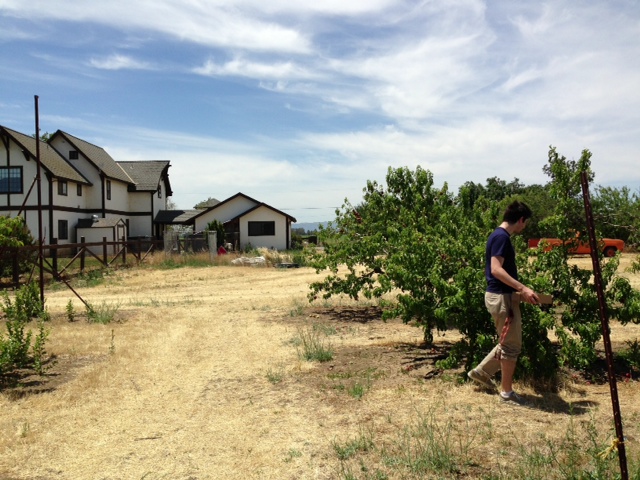
Impossible Acres is open Wednesday through Sunday from 9 a.m. to 6 p.m. When you arrive, you can ask for a cardboard tray to load up on goodies as well as a map that highlights what’s ready for harvest. Last week, we were drawn to sweet white peaches and plump marionberries, but there were also rows of ripe pluots, raspberries and nectarines. As a price reference, peaches were 99 cents per pound.

You can check the calendar to see what fruit Impossible Acres expects to be ready each week, though the harvest varies depending on weather and other factors. Pro tip: if you’re biking, bring a backpack and a mason jar to safely pack your precious berries. Bring a plastic bag or two for larger fruit too, as the farm doesn’t have any. If you forget like we did, consider asking for two cardboard trays and duct tape to engineer a box, and bike carefully home.

Dixon man arrested for illegal relationship with a minor

The Davis Police Department was notified on May 22 that the Dixon Police Department was investigating an illegal sexual relationship between a 37 year old Dixon resident and 17 year old Dixon resident.

According to a press release by the Davis Police Department, the suspect, Troy Anthony Hensley, was taken into custody without incident in Davis on March 30. The investigation determined that, while in Davis, Hensley had engaged in a sexual relationship with a minor for three and a half months in 2012. Police also determined that Hensley made threats to the victim and others if they reported the relationship to the police.

Hensley is currently being held at Monroe Detention Center and his bail is set as $1,000,000. He is accused of engaging in an illegal sexual relationship with a minor, making criminal threats and intimidating a witness. Hensley is a former youth basketball coach in Dixon.

The Davis Police Department and the Dixon Police Department are investigating to find out if there are any other victims in the Davis and Dixon area.

Anyone with information regarding Hensley is urged to contact the Davis Police Department at 530-747-5400.

—Paayal Zaveri