


47.8 F
Davis

Davis, California

Sunday, January 11, 2026
Home Blog Page 945

Women’s golf looks to four-peat at Big West Championships

1

While most will be complaining about standing around in the heat at Picnic Day this weekend, the UC Davis golf teams will have no time to whine as they soldier on to their respective tournaments.

The men’s golf team will co-host the Winchester Classic in Meadow Vista, Calif. from April 19 to April 21.

Last year, the Aggies finished in a three-way tie for second place and were led by current junior Matt Seramin and sophomore Mike Brockington.

Seramin played a consistent couple of rounds to tie for second in the tournament, as he never dropped out of the top-five individual competitors. Brockington put up a 68 to boost himself up eleven spots from 15th to fourth.

UC Davis has enjoyed the return of senior Tyler Raber this year, as he has been posting low numbers for the Aggies all year long.

The tournament at the Winchester Country Club, just as it has in the past, precedes the Big West Conference Championships and will act as a good warm-up for UC Davis.

Raber will bring an abundance of experience to the course for the two-time defending champion Aggies when the Big West Championships arrive. UC Davis took a young roster last year and stunned the golfing world by surging ahead to take a conference championship

The Aggies are coming off of an eighth place finish at the ASU Thunderbird Invitational, where junior Jonny Baxter fired a 212 total to stand in 11th place overall. Raber followed that up with a 215 over three rounds to tie for 23rd.

On the women’s tees, UC Davis has enjoyed considerable success this season as expected. The Aggies will compete in the Big West Championship tournament on Sunday April 20 through April 23.

UC Davis has taken the past three Big West titles and shows no signs of slowing. The Aggies are currently ranked 16th in the country, led by No. 22 Demi Runas.

The senior is coming off of a second place performance at the Ping/ASU Invitational, which is, in fact, a step down from her performance at the tournament last year despite a lower score this year. Runas shot a 209 this past weekend, a couple strokes more than in 2012, when she shot a 212 and placed first.

Still, the Aggies are more than just a strong top-player. Their depth is truly what has gotten them far in these tournaments. Though Runas has led UC Davis in most of the competitions this year, the Aggies have had substantial contributions from every player playing in the subsequent spots.

From senior Amy Simanton, sophomores Blair Lewis and Bev Vatananugulkit, freshmen Andrea Wong, Betty Chen and Raegan Bremer and junior Jessica Chulya, all have gotten playing time and all have put up impressive numbers.

This will provide some safety and relieve some of the pressure on the players, knowing they can depend on anyone that gets the call to play.

This well-balanced attack will be difficult for other teams to overcome at the Big West tournament, where the Aggies have had considerable success in the recent past. Last year, it was Vatananugulkit that posted the top score for UC Davis with a 220 en route to the Aggies’ first place finish.

If the Aggies are to four-peat as Big West champions and continue their dynasty-in-the-making, they just need to play how they have been all season.

MATTHEW YUEN can be reached at sports@theaggie.org.
Police briefs

0

WEDNESDAY 4/10
The perfect crime
An unknown suspect entered a home through an unlocked door and stole three MacBook Pros on Apple Lane.

THURSDAY 4/11
Extreme couponing
A customer swung at the manager of a restaurant because he was upset over not being able to use a coupon on G Street.

SATURDAY 4/13
Footloose and fancy pee
An intoxicated guy urinated on his vehicle on Second Street.

SUNDAY 4/14
Joyride
Two adult males with overstuffed backpacks and shaved heads were riding small pink bikes on Second Street.

A+ signaling
Someone driving a white pickup swerved, flipped people off and threw a drink at the vehicle behind her on Fifth Street.

MONDAY 4/15
Distractions can be taxing
Somebody complained that she couldn’t focus on her taxes because some officers had a suspect detained in front of her house, and her dog was going crazy on Olympic Drive.

Police briefs are compiled from the City of Davis daily crime bulletins. Contact EINAT GILBOA at city@theaggie.org.

Column: Now you see it …

Most people are familiar with the image of corporate America. An image of men in business suits in a very tall building comes to mind. We associate these images with wealth and status, which have always been very important societal values. Wall Street, Fortune 500 companies and other big business, and even many scientific fields all exhibit discrimination characteristic of the glass ceiling.

We don’t tend to think about it too often, but I pose the question: Why is it that when we think of wealth and status in regards to careers, women take the backseat? Although corporate businesses have admitted there is still a glass ceiling, you will find that the invisible ceiling is present in more than the corporate world, and science, renowned for prizing facts over bias, is no exception.

One may argue that the statistics for women look great right now. More women are attending college than men, and more of these women are moving forward to successful careers than ever before. The recession is finally starting to subside and females are moving into the working world. Women like Marissa Mayer, the CEO of Yahoo, and Sheryl Sandberg, the COO of Facebook, have beat the odds, becoming two of the most powerful women, and two of the most powerful people, in the country. However, even though these women have become successful, the fact that there are only a handful of women in similar positions throughout the country is indicative of an ongoing problem.

A report recently came out from UCSD, examining professions in law, medicine, science and engineering. These fields were chosen based on two characteristics; they are traditionally male-dominated fields, and they contain some of the highest-paying jobs. It turns out that women only comprise 21 percent of the science and engineering fields and only 34 percent of medical doctors. In the field of law, the percentage seems a bit more promising at 45 percent, but of that percentage, only 15 percent are senior (equity) partners.

The report also examines the gender pay gap, taking into account work time, specialization and experience. Women earn at most 86 percent of what their male co-workers earn. For female surgeons and physicians, the percentage is 79 percent. Keep in mind this is just a pay gap between genders; it gets even uglier when delving into categories like race.

If you believe in equality at all, you will probably agree that this is not fair. If you are like many Americans, you will probably also shrug your shoulders and say there is nothing you can do about it. There is no such thing as a one-(wo)man army, but there is such a thing as combating apathy. Perhaps you are wondering why anyone should care; after all, the problem is swept under the rug so often, it has become a disappearing act.

While some discrimination is due to men in power preventing women from taking controlling roles in their fields, much of the remaining discrimination is due to innate cultural practices that have yet to conform to modern society. For example, in the last decade, women have gone from a major minority in receiving scientific degrees, to receiving a majority of all scientific degrees. However, despite the growing number of women in scientific fields, they are still dramatically underrepresented in the high-level positions of those fields.

At UC Davis, four out of the five nominees for the U.S. Presidential Awards are men, nine out of 13 members of the National Academy of Engineering are men and 19 out of 22 UC Davis members of the National Academy of Sciences are men.

Many factors are responsible for the way society has seemingly blocked women from high-level positions, but the main culprits are prejudice, leadership style demands and resistance to female leadership — the latter of which I can personally relate to. We may point the finger at the big bosses for these issues, but we really should be pointing fingers at ourselves. No matter how progressive the world is becoming compared to decades past, many people are still unaware of how they personally contribute to the perpetuation of social stereotypes.

A father and a son get into a car accident. The father escapes with cuts and bruises. but his son is badly injured and unconscious. The paramedics quickly rush him and his son to the hospital operating room, but when the surgeon sees the man’s son on the gurney, the surgeon stops and says, “I’m sorry, I cannot operate on this patient; he’s my son.” Figure out the riddle yet?

If it seems like nonsense, you just proved my point. The first step to making everything a level playing field is acknowledging that there is a problem, and it needs to be fixed. Sheryl Sandberg, the COO of Facebook summed it up pretty well: “The blunt truth is that men still run the world.”

The next step is to change; easier said than done. Changing hundreds of years of culturally ingrained stereotypes is no small feat. Only 50 years ago, African Americans were not allowed to vote or drink from the same water fountains as Caucasians. Only 60 years ago, women were expected to be baking in the kitchen in a homemade sundress while ironing their husbands’ shirts. Needless to say, we have a long way to go.

NICOLE NOGA says the answer is the Mom. She can be reached at science@theaggie.org.

Sports cuts reexamined in light of increasing athletics debt

1

In April of 2010, Chancellor Linda Katehi and former Athletics Director Greg Warzecka announced that UC Davis would be cutting women’s rowing, men’s swimming and diving, men’s wrestling and men’s indoor track and field. The decision came at the cost of athletes’ careers and sporting legacies, but it was expected to save an estimated $2.4 million.

The intention was to ease the Intercollegiate Athletics (ICA) debt, but instead, the deficit has doubled.

Some question if the reasoning behind cancelling teams was as financially pressing as reported, especially in light of the application of sex equality laws and administrative silence toward the directly impacted student-athletes.

With a newly appointed Athletic Director in place who stresses more transparent proceedings, some see the future of UC Davis sports as a positive one. But others fear facing the same closed doors and questionable motives that were experienced in 2010.

ICA and students’ wallets
As the department continues to forge ahead in National Collegiate Athletic Association Division 1, Athletics Director Terry Tumey envisions having UC Davis’ academic and athletic prestige on level ground.

However, this dream will not be realized unless the budget crisis within the athletic program is resolved.

According to the UC Davis Athletics 2011-12 financial review and 2012-13 budget, the net deficit increased from to $1,429,858 to $3,612,220 in one year.

The athletics department blames accounting discrepancies for a portion of the high numbers.

“We had an accounting shift this last year where the NCAA revenues we receive are now accounted for in the following year, so it makes [the deficit] look a whole lot worse than it actually is,” Tumey said. “That being said, it means no excuse. The [athletics department] needs to go out and do more in the way of raising revenue.”

Although the 2010 cancellations were expected to save the university $2.4 million, the ever-increasing deficit raises serious concerns as to where the supposedly saved money is going, and why the teams were eliminated if their removal did not make a significant impact on the debt.

“The lion’s share of the costs are due to scholarships, the P.E. program, and salaries and benefits,” Tumey said. “[In regards to the 2010 cuts] there was a definite effect on the financial bottom line.”

UC Davis students support 75 percent of ICA’s budget through various student fees paid along with tuition — $18 million. Athletics takes a share of the Student Activities and Services Initiative (89 percent), the Campus Expansion Initiative (36 percent), the Facilities and Campus Enhancements (22.47 percent) and the Student Services Fee (6.96 percent) paid by each student, for a total of $654 per year. With the cancellation of sports not effectively negating the debt, some are concerned that these fees will increase with the ICA deficit.

“Student fees are not expected to increase — students are the reason why we are succeeding as a department and as a university, and we don’t [want their athletic fees to increase],” Tumey said. “Instead, we are looking to cover the deficit through fundraising and fostering corporate sponsorships with those who share our value system.”

Funding is more likely to come as UC Davis receives more nationwide attention, like the recent ESPN-televised CSU Long Beach basketball game, he added.

Sacrificing interest for equality
While the four teams were never provided a detailed explanation as to why they were singled out to be cut, university officials noted that Title IX compliance had to be upheld no matter what.

Title IX requires that public schools allocate proportional spending — for both the team’s expenses as well as scholarship dollars — on male and female sports based off of demographical populations, as well as to provide proportionate numbers of male and female positions on teams.

Public education institutions must be in compliance with the Title in order to continue to receive funding from the government.

“First, a school can comply by offering male and female students athletic opportunities that are substantially proportional to the percentage of undergraduate male and female students who are enrolled at the institution,” said Title IX Chief Compliance Officer Wendi Delmendo in an email interview. “Second, a school can comply by demonstrating continuing expansion of its athletic program for the underrepresented gender … Third, the university must survey its student body about the athletic interests and establish that it is providing opportunities that satisfy those interests for the underrepresented gender.”

UC Davis only needs to uphold one of the criteria to be in compliance with law, but instead upholds all three. While this can be a cursor to the administration’s own progressive, firm stance against sexism, some see upholding all three prongs of the title as an unnecessary amount of legal red tape.

“Things like this have a tendency to work themselves out based on interest level. If nobody shows up to try out for a sport, [and] if the interest level is low, then it makes sense that it would get cut. That just wasn’t the case with wrestling,” said Morgan Flaharty, a fifth-year exercise biology major and art minor and former wrestler.

Administrators stand by the law and the decision to uphold all three criteria.

“Title IX was not set up to minimize opportunities for men, it was put in place to allow women the same opportunity and access as men … It is unfortunate that financial burdens have been so widespread across the country and athletic departments are not immune from that. Both men and women’s programs have been affected, so to say that it is detracting from male opportunities is a common misconception,” said Nona Richardson, senior associate athletics director, in an email interview.

Some say this forced numbers-game may suggest why men’s swimming and diving, wrestling and indoor track were chosen to be dropped: the combined 80 men could balance the 73 women on the rowing team.

The cuts
Although there was some indication that budgetary cuts were expected in 2010, the manner in which players and coaches were notified continues to confuse those involved to this day.

“The way my teammates and I were told that wrestling was getting cut was that on Picnic Day, we got a text message,” Flaharty said. “We all thought we were safe; we had a really big alumni community, UFC world championship backers, and we were successful in our league. It just didn’t make sense.”

The women’s rowing team was especially surprised at their discontinuation, considering the recent growth of the sport.

“Most schools are actually adding rowing teams. They use that as one of the ‘big women’s sports’ to balance [the rosters]. It was unusual that we were cut. It was unheard of,” said Emily Neary, president of the club women’s rowing team, which formed following the 2010 cut.

The players were not the only ones kept in the dark regarding the Athletics Department’s proceedings.

“I found out that wrestling was being cut ten minutes before the press release,” said former head coach Lennie Zalesky, who now coaches wrestling at California Baptist University.

The cuts were not due to athletes’ lacking talent. In 2007, the wrestling team had a NCAA Weight Class Champion, and Scott Weltz from the men’s swimming team went on to compete in the 2012 Olympics after graduating in 2010.

“I never would have made the Olympic Team going to any other school. I loved my time at UC Davis, and I still love being a part of the Davis community,” Weltz said in an email. “I would not have attended Davis without a swim team because swimming in college and being a student athlete was very important to me. Without a swim team at Davis, I would have gone somewhere that had one.”

Zelsky said the wrestling team wasn’t given the option to fundraise.

“We attempted to save ourselves financially, but there was not a whole lot of talk. The doors got shut on us,” he said.

Swimmers said they raised enough money to self-sustain, but were also barred from continuing their program independently.

“The athletic department didn’t like that style [of independent fundraising]; they said it wasn’t a sustainable way to keep the program going,” said Alex Daneke, who transferred to swim at CSU Bakersfield. “We just wanted to raise enough to play until everyone on the team graduated.”

University officials didn’t confirm or deny Daneke’s and Zelsky’s versions of what happened in regards to fundraising.

Aftermath
Although the 2010 cuts continue to cause distrust and bitterness toward the perceived intentions of administration, Tumey is committed to bettering the future.

“We are still paying for the cuts. People were hurt, we saw some financial relief, but it was at the cost of student opportunities. In moving forward, we need to be smart and find solutions to maintain our current [teams],” he said.

Tumey said that he has no plans for more teams to face cancellation, and that the topic of conversation needs to change.

“The concentration on deletion of sports has been such a continually picked on and such a sensitive subject. It isn’t productive, and it doesn’t allow for growth to continue,” Tumey said. “I understand that a lot of people are still impacted by the cancellations. Although ICA tried to mitigate the impact it had on students [by] ensuring that scholarships were still honored, nothing can really lessen the blow or make it less of a traumatic experience.”

Following the cuts, administration made strides to ensure that scholarships awarded to athletes were still honored and that opportunities to continue on a club-team level were made.

However, the reality of the situation turned out to be very different for some. Daneke said he left Davis because he lost a scholarship that he was set to receive his sophomore year. However, the 2010 cuts happened at the end of his first year, meaning his promised scholarship was nullified.

“I wasn’t financially prepared for that money to be gone,” he said. “I tried going to the athletic department with the email that said that the scholarship would still be honored, but it was no use. I love Davis, but I couldn’t afford to go back.”

Even with women’s club rowing experiencing success, the transition was difficult for many. There is not a single women’s rower from the ICA team currently on the club team.

“There is still a really big group of passionate players out there, but the transition from being paid to play a sport to paying an upwards of a thousand dollars a year per player [on club] was hard [for former rowers],” Neary said.

Others wonder how future students will react to the decrease in available sports programs.

“I do not feel bitter, but I feel sad the others might not ever get to experience what I did at UC Davis,” Weltz said.

HANNAH KRAMER can be reached at features@theaggie.org.

Column: Fantasy fantasy sports

0

If there was a fantasy sport where you got points for being loyal, I think I’d be a key player. I’m not sure what makes me buy into the whole “‘till death do us part” with everything in my life.

That being said, you already know Derek Jeter is staying as my starting shortstop on my fantasy team. Yes, he was my first-round draft pick. Yes, he may not come back until June. And yes, to answer the question you already know the answer to, I am in last place in my league.

Either way, the new generation of baseball players is coming up and I am hopelessly behind in the baseball world. The realm of sports is changing so fast and so often that the only player whose stats I can reel off right now are Derek Jeter’s. Partly because he’s my favorite player, but mostly because he has stepped into the batters box this season as many times as Mulan’s father talked about his son Ping.

I think I need to add a fantasy category, one that won’t change as the old replaces the new.

If there was a fantasy category for players that have the best names, I’d really have to give it to sophomore John Williams. Not only is it an incredibly uncommon name, but it is also the name of the greatest movie composer of all time.

This is the father of Star Wars, Jurassic Park, Indiana Jones, Superman and Jaws, to name a few. That sort of prestige puts Williams at the top of any stat category as a dependable top performer.

A safe second-round draft pick would be sophomore Beverly Vatananugulkit from women’s golf. She definitely packs a lot of punch and is a good power player to have on the team.

As I continue here, I realize why I’m not the one who makes the statistical categories for fantasy sports. I’ll stop there before things get too foolish.

I’m aware that it’s all my fault, my refusal to adapt to the times, to change my strategy as the game changes. As my favorite players start getting older, so do I. In terms of fantasy baseball, I keep drafting them and, for some reason, my team seems to get worse every single year. The big issue with sports is that when your players end their careers, you have to replace them. Because you continue to love the sport, but they cease to play it.

It makes me wonder whether, when I graduate, I will still feel the need to live vicariously through college athletes, or whether I will just feel like Simba once his father dies. One second he can’t wait to be king, but when he is removed from that environment, it’s the last thing on his mind.

But that’s beside the point. Being loyal can be one of the hardest things about being a fan. But it’s also most rewarding.

Even if the fantasy stat categories remain the same, I’ll still be choosing Derek Jeter. Even when he’s on the disabled list. Even when he’s retired. Even when I don’t even play fantasy anymore.

I can’t be saying goodbye to him because Jeter’s a trooper and I’m sure he’ll play until he’s using his bat as a cane more than to hit balls. But the fact that he’s sitting out the first half of the season is a bit of a wake-up call that I’m going to have to find someone else to root for; his career may end eventually, but I know I can’t just stop loving baseball.

The game is changing, as are the players, which is probably why I’m currently dead last in my fantasy league. But I could never live with myself if I started with someone instead of Derek Jeter in my shortstop slot.

And what an applicable time to be talking about this. As my fourth year ends … This is what happens when you listen to Jurassic Park music while writing. Darn you John Williams. I’ll stop now. There’s still a long season ahead of us. Interpret that as you may.

MATTHEW YUEN got sunburnt for the very first time in his life this weekend in Arizona. He’ll be staying inside for the rest of the year, so reach him at sports@theaggie.org.

City responds to amended water rates lawsuit

0

On March 29, the City of Davis was served an amended lawsuit over the city’s water rates.

The new suit alleges that the city’s wastewater and water rates are in violation of Proposition 218, which states that a ratepayer cannot be charged more than the cost of supplying water to their property. Additionally, the lawsuit states that the City of Davis has not been charging itself for its water and wastewater usage.

The plaintiffs, Yolo Ratepayers for Affordable Public Utility Services (YRAPUS) and John Munn, the former president of the Yolo County Taxpayers Association, are represented by former Davis City Council member Michael Harrington.

“We’re going after them for the wastewater rates because they treat themselves like they do water,” Harrington said. “The rates, we think, are illegal and in fact, the city knows it.”

The plaintiffs believe the wastewater rates are illegal because monthly fees are based on potable water usage rather than the actual amount of water that enters the city’s wastewater system. Wastewater rates are calculated from November to February because that is when the least irrigation takes place.

A press release from the City of Davis stated that “the city firmly believes the water and sewer rates are legally valid and the lawsuit is without merit. This is based on legal analysis by statewide experts on rate structure legalities.”

Deputy City Manager Kelly Stachowicz said that the city doesn’t know what other aspects of the lawsuit were changed in the amended suit.

The city sent a response to Harrington and the plaintiffs, denying every allegation made against them regarding the water and wastewater rates.

“As part of our research into the rate structure, we uncovered problems with the wastewater treatment rates,” Harrington said. “We became convinced that the rate structure doesn’t comply with [Prop.] 218.”

The amended lawsuit retains the original allegations regarding the city’s water rates to be in violation of Prop. 218.

YRAPUS filed the original lawsuit in January and city officials answered and acknowledged not paying for their water consumption.

The city’s statement in response to the original lawsuit said “the city does not separately account for water used at city facilities, [but] the city also does not charge the water division rent for its use of city park space where some wells are located, and the reimbursement of other city services and facilities is overdue for reconciliation and an update.”

Interim Public Works Director Bob Clarke said the city has already budgeted its water consumption for the 2013-14 fiscal year.

As a result of Measure I, water rates are expected to increase starting May 1. Measure I was approved by the Davis City Council on March 19. The lawsuit states further rate increases will be in violation of Prop. 218.

Measure I will raise water rates over the next five years to pay for Davis’ share of the $245 million Woodland-Davis Clean Water Agency surface water project. By 2018, water rates are expected to triple.

In light of the rate increases, the City of Davis has created an effort to help residents reduce their water consumption.

“Rates are going to increase and we want to give an added incentive for people to conserve,” Stachowicz said.

The city teamed up with San Francisco-based WaterSmart Software to create a program with which residents can monitor their water consumption. Residents can sign up on the city’s website to view their water usage online and receive water reports by email.

“The residents of Davis are eager to do their part to conserve water,” said City Manager Steve Pinkerton. “WaterSmart Software has provided us with a cost-effective way to do just that. With WaterSmart, water customers in Davis can track their water use, compare their usage to similar households and learn about simple ways they can do their part to conserve.”

The city is moving forward with the rate increases and implementing new programs related to water consumption.

“It is unfortunate that the Yolo Ratepayers for Affordable Public Utility Services group are not satisfied with the outcome of the Measure I election. Based on the Measure I vote, the city has a duty to move forward and meet the city’s future water needs,” the city stated in a press release. “The city will vigilantly defend itself and the ratepayers against this lawsuit. Regretfully, the Davis ratepayers will bear the cost of defending this lawsuit.”

PAAYAL ZAVERI can be reached at city@theaggie.org.

Student dance groups to compete for $1,000 prizes

0

One of the more popular Picnic Day events, the annual Davis Dance Revolution (DDR) will feature 14 student-run dance organizations competing for two $1,000 prizes this Saturday, April 20.

DDR began nine years ago as an event to allow student-run dance organizations to perform for audiences and showcase diversity through modern and traditional dance, upholding UC Davis’ Principles of Community.

Seven dance groups compete under each category, modern and traditional, with each category offering a grand prize of $1,000.

“It’s important to see the richness of the diversity of our campus, and the event shows the power of dance through showcasing the talents of our students,” said Lori Fuller, DDR coordinator. “The performances speak volumes to who we are as a community on this campus.”

Due to the popularity of the event for both performers and audiences, DDR has expanded this year, adding Agape, SoNE1 and Salsa Adiccion to the lineup.

“This year we have 14 groups performing, and there were many other teams that wanted to participate but there was no more space in the show,” Fuller said. “It’s a show that’s growing, and it’s a show that people are interested in.”

In its ninth year, dance clubs continue to up their game in hopes of wowing the crowds and winning the highly coveted grand prizes.

Groups under the traditional dance category include Davis Ballet Company, Golden Turtle Lion Dance Association, FILAH: Filipinos in Liberal Arts and Humanities, JASS: Japanese American Student Society, Na Keiki ‘O Hawai’i, PASE: Pilipino Americans in Science & Engineering and SoNE1.

Bryan Ramirez-Corona, one of the main choreographers for Na Keiki ‘O Hawai’i and a fifth-year genetics major, discussed the group’s preparations for this year’s tough competition.

“‘O Hawai’i club has competed every year of DDR. Our DDR performance is a subset of one of the several different dances that we perform for our main annual event, the Luau,” Ramirez-Corona said. “For DDR, we perform one of our Tahitian dances. We start preparing for DDR very early on in the year; we have tryouts in the fall, we start practicing right away and we put a lot of effort into our preparations because a $1,000 prize is at stake.”

‘O Hawai’i is frequently one of the top three finalists and has won first prize under the traditional dance category in 2010 and 2011. This year, Ramirez-Corona hopes the group will take the prize by demonstrating their talents and adherence to Polynesian heritage.

“Every year, we try to have a ‘wow’ factor. In past years, we’ve incorporated sticks into the choreography, had a giant banner drop and increased the difficulty of our dances. This year’s dance is the most traditional choreography we’ve had in five years, and we are excited to use music I found in Tahiti,” Ramirez-Corona said.

In addition to using authentic music and choreographies, part of ‘O Hawai’i’s effort to uphold tradition is the incorporation of elaborate, hand-crafted costumes and Polynesian body painting.

“What separates us from other groups is that we are very hard-core about being traditional. We make all of our costumes by hand. We have costume-making parties where we will all sew together pieces of real grass and greenery, beads and shells — and I paint animal symbols on each of the dancers for the performance,” Ramirez-Corona said.

Groups competing under the modern dance category are Agape, Breakdance Club, MK Modern, Mobility, Popping Club, Salsa Adiccion and Released Contemporary Dance Company (RCDC). RCDC co-director Elyan Shor, a fourth-year animal science major, discussed RCDC’s experience with DDR.

“Released is a fairly new company to Davis, and we’ve only been competing in DDR for the past four years. It’s a really exciting experience, and we start putting together our piece in January,” Shor said. “It’s a great opportunity for members of the group to contribute their ideas to the choreography.”

As one of the only non-hip hop groups in the modern dance category, RCDC uses its unique style to stand out for the audience.

“Contemporary dance is hard to define, but it’s a bit like a mixture of jazz and modern dance. It’s not as structured as jazz, and it’s a lot more free. It’s tough to compete against the talented hip hop and breakdance groups, and one challenge is our size — we’re a smaller group compared to the others, and we try to stand out by putting something creative out for the audience to respond to while still staying true to what we’re good at,” Shor said.

Never having won first place in the competition, RCDC revamps its performance strategy by having a clear thematic focus and strengthening their technique for this year’s event.

“It’s a showpiece, so you need to have a theme to make your piece cohesive. When it comes to DDR, we try to focus on a theme or emotion to convey. In the past we got carried away with more complex themes that took away from our performance, so this year we wanted to have a really strong dance piece while using a simpler theme to tie it all together,” Shor said.

Davis Dance Revolution presents a unique opportunity to view the talent and cultural diversity of many of Davis’ student-run dance groups. Tickets are available at the Aggie Stadium ticket office, tickets.ucdavis.edu and at the door.

CRISTINA FRIES can be reached at arts@theaggie.org.

Letter to the Editor: Response to “Capitalism and the poor”

2

In Tristan de Liege’s April 11 Op-ed, “Capitalism and the poor,” an attempt is made to justify laissez-faire capitalism. The justification rests on two faulty premises: that capitalism is justified by the alleged benefits it brings, and that in a capitalist society wealth is distributed on the basis of voluntary choice.

Firstly, economic and political systems cannot be justified solely on the basis of the benefits they bring. Even if we were to accept, as de Liege asserts, that capitalism will improve the standard of living for the majority of individuals, this is no justification. Slavery certainly “improved” the standard of living for slaves and their masters. It is common knowledge that immediately after slavery was abolished in the South, many former slaves found themselves worse off than they did when they were still slaves. Does this justify slavery? Certainly not.

Secondly, wealth has historically not been distributed on the basis of voluntary choice in capitalist systems for multiple reasons. First, capitalist systems ignore past involuntary wealth transfers. Even Robert Nozick and other radical libertarians agree that history has been so full of unjust involuntary transactions such as colonialism, slavery and wars of aggression that in the short term a radical redistribution of wealth would be justified. Second, the fact that one needs wages for human survival means that contracts cannot be considered voluntary. If one is completely dependent on wages for his or her own survival, as many in society are, employment contracts can reasonably be seen as a form of compulsion.

Evan Sandlin
Political science graduate student

Editorial: Pull up a stool

0

There have been some rumors circulating recently that there will be a new pub opening at UC Davis. We just want you all to know that this is, in fact, true, and it will be located in the East Wing of the Memorial Union where the Post Office is currently located. Soon, instead of sending a letter to a loved one, you can drink the pain away like a true adult.

While many of the Aggie staff members are thrilled to have a bar so close by — even Hemingway said to write drunk and edit sober — we had a few questions about some of the important details of the new pub.

Looking at the popularity of the current pub on campus, Gunrock Pub, we have to ask ourselves: Will anyone actually go to a bar on campus? We think yes. It will just be harder and harder to find time for all these classes between beer breaks.

Will the new pub be open on weekends? That would be nice. It would take some of the crowds away from the ruckus of downtown. Who will perform at the entertainment venue? Will there also be live music on the outdoor patio where we can soak in the sun while we sip on the suds?

There should definitely be an 18-and-over trivia night. Just make sure that you don’t give any embarrassing answers in front of your hot TA.

In all seriousness, however, a pub on campus would be a great resource for students who are looking for a study spot slightly more lively than the 24-Hour Room. The pub could play soul music, while the 24-Hour Room only sucks out your soul.

There are a few other semi-important questions that need to be answered before the pub opens, such as how to prevent minors from drinking. Where will the financing come from, and where will the profits go? Will there be pub food, and who will be making it? Can Professor Charlie Bamforth create a new Aggie beer for us? And of course, most importantly, will the basement dwellers get a discount?

We just hope that no one will try to sing karaoke while we are trying to study.

Hot topics in global warming

Day in and day out, the U.S. population is bombarded with controversial opinions and claims about global warming.

As with many mainstream scientific issues that implicate mankind of wrongdoing, there appears to be a split in popular belief. There are even those who simply have no desire to acknowledge different arguments.

Some people are of the opinion that global warming is a hoax generated by the scientific community. Others have concluded that global warming is an entirely natural process that the earth experiences in cycles (and is in no way, or is insignificantly influenced, by human action). The third hypothesis is that global warming is a natural process accelerated by man-made industry.

By what is a seemingly inevitable process, most people find themselves caught somewhere between these three schools of thought with no idea as to what is fact or fiction.

Global warming is literally defined as “the rise in the average temperature of Earth’s atmosphere and oceans.” It is a process that has been observed since the late 19th century and is under scrupulous investigation by a congregate of the world’s leading scientific institutions, including UC Davis.

The William Horwath Biogeochemistry and Nutrient Cycling Lab at UC Davis is focusing on aspects of global warming influenced by soil-dwelling microorganisms.

“CO2 (the main greenhouse gas) concentration today is almost double what it has been for the last 600,000 years until about 100 years ago, and the increase of its concentration is accelerating,” said Martin Burger, a researcher at the UC Davis Department of Land, Air and Water Resources, and a member of the Horwath Lab team. “The changes occurring in many ecosystems because of global warming will be dramatic. Climate change will also impact how and where we grow food on the planet. In some areas, it will be very difficult to live.”

This study also investigated the role of ammonia-based fertilizers and the process of nitrification in the fashioning of the highly potent greenhouse gases nitric and nitrous oxide. UC Davis researchers found that nitric and nitrous oxide production, via the process of nitrification, increases with decreasing oxygen concentration.

Nitrification is a metabolic process carried out by microorganisms that live in soil-based environments. It was previously believed that as the availability of oxygen in the soil decreased, the process of nitrification (and the resulting production of the greenhouse gases nitric and nitrous oxide) would decrease in similar fashion. However, UC Davis researchers were able to amend this previous assumption.

“The main findings of this study show that nitrous oxide (N2O) and nitric oxide (NO) production via ammonia oxidation pathways increased as oxygen (O2) concentrations decreased,” said Xia Zhu, a researcher in the UC Davis Department of Land, Air and Water Resources and the Chinese Academy of Sciences, in an email interview.

The results of the team’s research pointed to some areas of agricultural practice that have a particularly heavy influence on these soil-based microorganisms.

“Our results show that we must pay more attention to the soil conditions when nitrogen fertilizers (most are ammonia based) are applied,” Burger said. “We also found that some fertilizers result in more nitrous oxide than others.”

UC Davis Department of Land, Air and Water Resources researcher Timothy Doane asserted that the study conducted would potentially help to set standards for what soil conditions, fertilizers and industrial practices should be utilized in order to decrease the production and dispensation of such volatile nitrogenous compounds.

“[This study] may help to reinforce exactly what soil conditions favor more or less emission of nitrous oxide and nitric oxide, as well as why this happens,” Doane said in an email interview. “Management decisions may then be modified to take this into consideration.”

Ultimately, regardless of whether or not industry contributes to the process of global warming, it is crucial that the scientific community continues to seek the answer to two very pressing questions. First, does human-derived industry in fact contribute to the process of global warming? And second, how can industrial practices be altered in ways that diminish the potential impact these industries may have on global warming?

To the groups that acknowledge the reality of global climate change, this study will help to enlighten potentially contributing industries on the importance of soil and fertilizer management. In doing so, these industries can begin to take measures to mitigate any possible impact they may have on global warming.

EMILY SEFEROVICH can be reached at science@theaggie.org.

Softball Preview

0

Teams: UC Davis at UC Riverside
Records: Aggies, 17-21 (4-7); Highlanders, 16-24 (0-9)
Where: Amy S. Harrison Field — Riverside, Calif.
When: Saturday, April 20 at 12 and 2 p.m.; Sunday, April 21 at 12 p.m.
Who to Watch: Freshman Christa Castello has been a terror on the base paths this season. She is tied for sixth in the Big West for stolen bases, with 11 steals. This, along with her impressive .287 batting average and 11 runs batted in after the UC Santa Barbara series, will definitely cause UC Riverside’s less than stellar pitching staff some problems.

With the Highlander pitching staff prone to giving up home runs, the addition of Castello on the bases gives the UC Riverside pitchers something else to think about. Thus, the Highlander pitchers may not be as focused on making the best pitch and could make a costly mistake leading to big hits for the Aggies.

UC Davis needs to find consistent run production, and the series against UC Riverside seems like the perfect opportunity. Castello should be able to help spark the Aggies’ batting order in the weekend series.

Did you know? Senior Kelly Shulze has been hit by a pitch 15 times this season, taking the phrase “take one for the team” to a whole new level. Shulze’s resiliency to keep getting in the batter’s box is impressive. She has also shown impressive patience at the plate, drawing 14 walks this season.

Her propensity to draw walks and get hit by pitches has earned her an impressive .433 on-base percentage. This is the fifth highest in conference. Her ability to get on base should prove helpful for the Aggies as they attempt to jumpstart their offense against the Highlanders. Hopefully this does not involve Shulze getting injured.

Preview: The UC Davis softball team has had an up-and-down year so far. They have had impressive wins this season, such as the 14-1 stomping of Santa Clara. However, they have also struggled mightily this year, as evidenced in Arizona State’s 12-3 rout of the Aggies.

However, the Aggies do have hope heading into the weekend series in Riverside against the Highlanders. Though UC Davis lost the past weekend’s series against UC Santa Barbara, the pitching was stellar. They held the Gauchos to only two runs the entire series. Such impressive pitching has been a recurring theme this season as the Aggies have a combined earned-run average of 2.40.

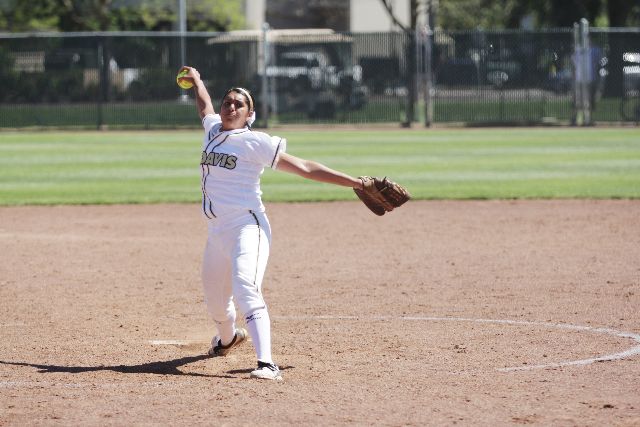
The pitching staff is led by sophomore Justine Vela who, as of the series against UC Santa Barbara, owns an 11-6 record as well as an outstanding 2.14 ERA. In her recent performance against the Gauchos, Vela pitched a complete game shutout, only allowing three hits and striking out five. Such dominant pitching displays will make winning the weekend series against UC Riverside a lot more attainable.

The real challenge for the Aggies is consistent hitting. In the last series against the Gauchos, UC Davis scored an impressive eight runs in the first game. However, they were subsequently shut out by UC Santa Barbara in the next two.

The bats of sophomore Amy Nunez and senior Kelly Schulze, which have produced five of the Aggies’ eight home runs this year, may prove crucial in the series against the Highlanders.

UC Riverside’s pitching staff has given up a total of 34 home runs this season and as of their game against San Diego State, hold a team ERA of 5.37. Obviously, pitching is not one of the Highlanders’ strengths. The Aggies must take advantage of this, and could possibly have a field-day jumpstarting their offense.

The Aggies should head into the weekend series with a sense of confidence. The Highlanders are a very pedestrian team and should give the UC Davis’ offense the spark which they have needed this season. Hopefully, the Aggies can turn their season around starting with UC Riverside.

— Kenneth Ling

Neighborhood Court to be established in Davis

0

In May, Yolo County will become the second county in California to employ Neighborhood Court, a method of restorative justice, in Davis and on the UC Davis campus.

This program, a partnership between Yolo County District Attorney (DA) Jeff Reisig, the Davis Police Department and the UC Davis Police Department, will handle low-level, nonviolent adult criminal offenses that would normally proceed through the criminal court system. There will be a separate neighborhood court for the UC Davis campus and another for the Davis community.

According to Reisig, the process of establishing a Neighborhood Court in Yolo County began in January, although he first began to consider the idea after a conference with other district attorneys about a year ago. Inspired by the success of the neighborhood court implemented in San Francisco by District Attorney George Gascon, Reisig believed a neighborhood court would be suitable for Davis as well.

“What intrigued me about it was that it’s a total alternative to the criminal process for low-level crimes,” Reisig said. “I was an undergrad at UC Davis, lived in the Davis community and knew it would be a good fit for Davis. It’s a diverse community, a sophisticated community, and there are a lot of people who would be interested.”

According to UC Davis Chief of Police Matt Carmichael, the neighborhood court process would begin like one for a typical misdemeanor: The offender is either cited or arrested for a low-level misdemeanor such as vandalism, theft, public drunkenness, loitering or being a minor in possession of an open container of alcohol and is issued a ticket with a court date.

“These are victimless crimes, but the victim is the community,” Carmichael said. “With a typical misdemeanor, the victim doesn’t have a role in the process.”

However, starting on Picnic Day, April 20, when the program officially begins, the offender will also receive a notice to contact the district attorney’s office within two weeks if they are interested in participating in the Neighborhood Court. If contacted, the district attorney’s office will determine the eligibility of the offender. The incident must be a first offense, and the offender must participate voluntarily.

“This is not a venue where people will go to determine guilt or innocence,” Reisig said. “The guilt of the offender is already established and the goal of the process is to make the victim whole. However, it is also a huge opportunity for the offender. The DA won’t file a criminal complaint, it won’t go on their record and they won’t have to live with the stigma of a criminal offense.”

The restoration of the victim, according to both Reisig and Carmichael, is the overarching goal of restorative justice. In the Neighborhood Court, this restoration is achieved through community service, to be agreed upon by the panel and the offender. Depending on the nature of the crime, this may include actions such as writing letters of apology or volunteering in the UC Davis Arboretum.

“The aim is to make the community whole and to fill in the gap created by the offender,” Carmichael said.

Annually, there are approximately 5,000 misdemeanors in Yolo County, 1,000 of which are issued in Davis, Reisig said. In addition to saving the time and money incurred through the court process, the Neighborhood Court has further benefits as well, according to Reisig.

“The problem with the traditional system is that the penalties are not meaningful for the parties involved,” Reisig said. “Davis is a college town with a young population base, and most of the offenders in crimes such as these are not ‘bad’ or destined for a life of crime. These are often just stupid decisions, and it [the Neighborhood Court] gives them the opportunity to make it right and avoid the stigma of a criminal offense.”

Neighborhood Court panelists are screened volunteers and receive approximately 20 hours of restorative justice training before participating. Neither the Davis panel nor the UC Davis panel is intended to be an unbiased decision-making body such as a jury — on the contrary, the UC Davis panel is composed of UC Davis undergraduate and graduate students, faculty or alumni who are part of the community.

“These are confidential hearings,” Reisig said. “They’re not open to the public or the media and are really a dialogue between the offender and the community. The program has proven successful in San Francisco from talking to the panelists and participants involved there.”

According to Reisig and Carmichael, the Neighborhood Court will never consider serious or violent crimes such as assault or rape. The goal, they say, is to ensure it is safe for everyone involved to participate.

“We’re primed for this,” Carmichael said. “I’m impressed we’re moving forward and am excited to be a part of it.”

Anyone interested in volunteering on a Neighborhood Court panel can apply at yoloda.org, which receives applications on a rolling basis.

The program has been met with positive reception by the UC Davis and Davis communities thus far, according to Reisig and Carmichael.

“The only criticism so far is that it should have started sooner,” Reisig said.

MEREDITH STURMER can be reached at city@theaggie.org.

Doctor’s orders

0

People love doctors. And, more importantly, people love TV shows about doctors. “ER” ran for 15 seasons, launching George Clooney’s career. “Grey’s Anatomy” introduced M.D.s nicknamed McDreamy, McSteamy and Katherine Heigl. She doesn’t need a nickname; she’s perfect the way she is.

These TV doctors solve so many problems: Gregory House, for example, can deduce in a trivial 45 minutes that Patient A does not have an antibiotic-resistant strain of Ebola, but suffers from hypochondria. Yet for all their knowledge of disease, doctors — real and fake — are not able to solve the most diseased part of our healthcare system: its costs.

Earlier this year, Steven Brill published a special report in Time Magazine to answer one question: Why does health care cost so much? Essentially, he found out, because it does.

Hospital prices are based on a centralized document called a chargemaster, which lists prices for every procedure or service. But I’m a vibrant, youthful 18 to 25-year-old, you say. This doesn’t affect me.

I thought the same thing, until the healthcare system touched me — literally and figuratively — when I dropped what I was doing to drop my pants in the doctor’s office for a physical exam.

Over spring break, I had a physical exam because I like to be told that 135 pounds is a healthy weight for a 20-year-old, 5-foot-9 male. It’s the opposite of what I get told in the ARC weight room. After the exam, I needed to get a human papillomavirus (HPV) vaccination.

A few days later, I saw the physical cost $50 and the vaccination was $150. If syringes cost that much on the free market, heroin addiction would drop to zero; no one would ever again be forced to see Jared Leto’s infected arm in Requiem for a Dream. Seriously though, that was almost as gross as watching Kevin Ware break his leg.

Because of the sticker shock, I decided to research the UC Davis chargemaster. Luckily, California has a law requiring hospitals to disclose their chargemasters, which you can now search online. It’s called the Payers’ Bill of Rights. As White Goodman said, “The hippies finally got something right! Just kidding. But not really.” The chargemaster for the UC Davis Medical Center provides insight into and evidence of the broken healthcare system in the United States.

An arm cast from UCDMC costs $1,273. If you choke in the ER and a nurse performs CPR to save your life, that’s $1,400. Men, if your, ahem, “syringe” becomes engorged with fluid (and not the wink-wink-nudge-nudge type), incision and drainage will set you back $1,800. Women, you might receive a bilateral magnetic resonance imaging (MRI) to screen for breast cancer; but at $7,439.50, the procedure requires too many Benjamin Franklins to pay for to fit into any size cup.

My recreational drug and makeshift poker chip of choice, aspirin, costs $1 per pill. Compared to Amazon.com prices (4 cents per pill), UCDMC marks it up 2,500 percent. The other 96 cents must get you great service.

A power gradient exists between doctors and patients. Katherine Heigl can run a line down my throat to administer feeding fluid; I can run Google to look at pictures of Katherine Heigl. I’d like to think that they require the same level of skill, but they don’t.

Consequently, we defer to M.D.s and don’t question them as we should. But we need to. Doctors don’t grace us with their presence: They work in a service industry. Just like we have a right to ask for fries with that at Mickey D’s, we should have a right to assert ourselves with our healthcare providers. At $1 a pop, no, I don’t want aspirin with that.

For $50, I’d like more out of my annual “turn-and-cough” exam. A hearty red wine and rib-eye steak would be nice. So ask more of your doctors and accept your role as a patient with rights, not just responsibilities.

We need to demand more transparency from healthcare providers and less from their latex gloves. I implore you to hear my cry to action, because the $95,760 cochlear implant that could help you hear it is probably out of your price range.

If you would like BEN BIGELOW to turn and cough for you, contact him at babigelow@ucdavis.edu.

Event sparks free speech debate among campus community

0

On April 11, a forum featuring Elan Journo, fellow and director of policy research at the Ayn Rand Institute; Daniel Pipes, writer, founder and director of the Middle East Forum; and Larry Greenfield, political commentator and columnist, was held in 1001 Giedt Hall to discuss conflicts in the Middle East and their stance on current issues on Islam.

The event, titled “Islamists Rising in the Middle East: Where next for America?” was hosted by the Ayn Rand Society at UC Davis. Students, faculty and staff gathered in the audience and were able to submit written questions as well as stand up and pose verbal questions to the forum speakers.

Speakers stated that extremist Muslims aim to exercise their right over non-Muslims and women.

Organizers and audience members had concerns of potential disruptions or quarrels involving speakers, but the event ran smoothly.

Among the audience were Arab and non-Arab students, including fourth-year biological systems engineering major and former president of the Arab Student Union Ahmed Desouki.

“I am extremely offended. [The speakers] were talking about my country and my state as if they are experts on it. Everything was misinformation, false,” Desouki said. “I definitely feel that we are misrepresented on campus and by the administration.”

Speaker Journo told TheBlaze.com before the event that the speakers relied on the University and security to uphold the freedom of speech of the panelists by preventing any potential disruptions from audience members.

“It is ludicrous, if it were not so sad, that public discussion of the Islamist movement is somehow a taboo. This is the ideological movement behind al Qaeda, Taliban, Muslim Brotherhood and Iran. Surely the more people learn about it, the better,” he said.

The Ayn Rand Society did not receive any funding from the campus for this event, according to a letter by Ralph J. Hexter, provost and executive vice chancellor.

In response to letters from the campus community, Hexter sent out a letter on April 11 on behalf of Chancellor Linda P.B. Katehi. In the letter, he stated that the administration abhors “hateful” speech based on individuals’ religion and national origin, including that directed at students of Middle Eastern descent or Muslim and Jewish students.

“We want you to know that the University is deeply committed to providing a safe educational environment that is free of unlawful harassment for all of our students, and has been proactive in addressing the event this evening,” the letter stated.

Hexter also said that there would be staff from Student Affairs, the campus engagement team and Aggie Hosts in attendance to address any concerns, disagreements or violations of campus protocol.

Four ASUCD senators, Alyson Sagala, Armando Figueroa, Reuben Torres and Yee Xiong, submitted a letter to the Chancellor on their concerns about the event.

“We acknowledge that free speech is a cherished civil right, but hate speech and racist mischaracterizations of demographics’ entire cultures and life histories are not conducive to an academic environment that promotes a safer campus climate,” the letter stated.

JESSICA GRILLI and MUNA SADEK can be reached at campus@theaggie.org. KELLEY DRECHSLER contributed to this article.

Editorial: Happy 99th

0

This Saturday, April 20, is Picnic Day, and like all red-blooded UC Davis students, The California Aggie editorial board is stoked for a full day of campus celebration and cheer. Since many of us have gone through the wringer a few too many times, we would like to give fresh-faced freshmen (our main reader base) a full 7 inches of tips, tricks and protocol to make 98 years of past Picnic Day-ers proud.

Since past editorials have focused on campus safety and behavior, we won’t waste too much space reminding you that under no circumstances should you hang out with visitors from Woodland. Do not invite these people into your apartment. Do not tell them “where the party’s at,” and do not, DO NOT get into a friendly brawl with these visitors on Third Street. This rule applies to visitors from nearly every regional suburb, though is especially true for citizens of any town that can be reached via Hwy 113.

If you want champagne with your orange juice, buy it early. Over 50 local businesses that serve or sell alcohol have pledged to alter their offerings — they’re limiting sales before 11 a.m. and are not having special alcohol promotions. Not to mention, by April 19, liquor store shelves will be stripped of college student budget-friendly drinks, such as plastic handles of vodka.

While it may be tempting to leave room in your stomach for rage cage losses and soon-to-be-expelled bile, nothing beats Picnic Day in the dining commons, or a long, indulgent brunch with your friends. Please eat, or risk becoming a woo-girl. (This applies to everyone.)

Once you’ve eaten your weight in cereal, explore! The best times may be had at some North Davis megacomplex. But other really fun times can be had in Wellman, where there are often kittens, student films and kittens.

Be sure to bring cash. You never know when the ASUCD Coffee House registers will go down, or when you’ll need to be Pedicabbed across town. Unitrans charges $1 on Picnic Day, too.

If drinking isn’t for you, and the date 4/20 means nothing to you, Picnic Day is still a lovely time to sit on the grass and listen to live music. If “drinking isn’t for you,” do not choose Picnic Day for your first time on hallucinogens. Not only will the crowds be overwhelming, you will regrettably be awake during the citywide 3 p.m. siesta.

More tricks and tips can be found in our Picnic Day insert. But if you read it, don’t do anything we wouldn’t do.