39.7 F
Davis

Davis, California

Tuesday, December 30, 2025
Home Blog Page 977

Letter to the editor: Grievance regarding ASUCD Elections Committee

1

On Tuesday, Feb. 5, Migz Espinoza and Lane Lewis, two transgender students running for the ASUCD executive office, were publicly outed as transgender when the ASUCD Elections Committee released their legal names on the ASUCD elections website.

Before being outed, Espinoza and Lewis had repeatedly asked the elections committee chair, Aaron Hsu, to use their preferred names on all publicity and elections material. Hsu responded that he could not because of ASUCD bylaw 405E which states that a student’s “name on the ballot must be that which appears on the student’s UC Davis Student ID card.”

When the official list of candidates was posted on the elections website with Espinoza’s and Lewis’ legal names — despite the fact that they had appealed to Hsu multiple times stating that their preferred names are not simply nicknames, they are their identities, the importance of a bylaw was placed before that of the safety of these two students.

Transgender people often face mental, physical and emotional harassment or abuse on account of their gender identities. Outing a transgender person, disclosing their transgender identity, puts them at further risk of this danger.

Espinoza and Lewis were able to have their names corrected on the elections website over the next 48 hours, after contacting the ASUCD business manager, president and vice president, as well as the director of the Lesbian Gay Bisexual Transgender Resource Center and the director of the Cross Cultural Center.

On Thursday, Feb. 7, the ASUCD Gender and Sexuality Commission presented to the senate about the transphobic nature of the bylaw and Hsu’s communication with Espinoza and Lewis. The senate suspended bylaw 405E and, after one failed vote and much advocating by Espinoza, Lewis, the Gender and Sexuality Commission and other members of the public, passed the motion to close session Hsu.

This means the Senate will have a closed meeting where they will discuss the serious nature of these actions.

This is one just example of the many times ASUCD officials, senators and policies have discriminated against marginalized and underrepresented communities. Past examples include challenging the funding for the ethnic and lavender graduation programs, the annual ASUCD sponsored “Singles Awareness” event at which people are auctioned and sold, and the ASUCD sponsorship of events which upheld discriminatory federal policies pertaining to blood drive.

ASUCD has repeatedly, willfully misrepresented the undergraduate student community. By failing to attend mandatory SafeZone and PEACE trainings as well as spend time in outside student spaces, they lack the knowledge and experience to represent the student body.

Migz Espinoza, fourth-year women and gender studies major
Kriti Garg, second-year international relations, and community and regional development double major
Iris Xie, third-year English major
Lane Lewis, fourth-year international relations major
Hawkins returns to business

0

UC Davis entered UC Santa Barbara’s “Thunderdome” and proceeded to bring the house down. Sophomore J.T. Adenerele scored the first points of the game by slamming a dunk through the hoop, despite the Gaucho player hanging on his back.

It is rare for UC Davis to jump to an early lead on their opponents, but once the energy was established, the Aggies never backed down. Sophomore Corey Hawkins was certainly eager to return to the court and reassert his offensive skills. He totaled a team-high 20 points and helped the Aggies maintain a double-digit lead for most of the game.

Junior Ryan Sypkens and Adenrele also banked double-digits for the Aggie offense. UC Davis’ offensive performance was paired with a solid defense. The Gauchos were never able to find a rallying rhythm because UC Davis was able to steal the ball six times throughout the game to keep the momentum.

Freshman Olivier Paul-Betu has been playing some hard-earned minutes lately. His small stature gives him a decided size disadvantage, but no one can fault his skill or his commitment to the team.

Paul-Betu held his ground under the basket and managed to draw an offensive charge against the Gauchos’ best player, Alan Williams. The charge put the ball back into the Aggies’ hands and it gave them the chance to pull away on another run.

“Olivier is a tough guy who leads our team in charges during practice. He may not be one of our biggest guys, but he is one of the toughest because he is always willing to lay his body on the line. That charge energized our team,” said head coach Jim Les.

The Aggies struggled to combat Williams during their last meeting, but they pressed him hard on Thursday and his scoring abilities were severely diminished. He was often guarded by several Aggies at once, and he was held to 15 points.

The focus on Williams allowed a few other Gauchos to step up and score for their team, but the Aggie defense was able to hold them in check, even through the final minutes of the game. UC Davis was able to walk away with a 64-56 victory.

“UC Santa Barbara shoots the ball well, but I thought they missed a lot of shots because of our defense and our physicality. We are really pleased with our defensive effort tonight,” Les said.

The Aggies were thrilled to walk away with a win. It was their first victory in Santa Barbara since 2007 and it gave UC Davis the juice to contend with Cal Poly on Saturday.

The last game against the Mustangs ended when Hawkins somehow managed to land a buzzer-beater shot while falling to the floor. It was a tough contest and the Aggies were expecting much of the same.

Unfortunately, most of UC Davis’ offense failed to catch the bus to San Luis Obispo. However, Sypkens definitely had his swagger from beyond the three-point arc. He continues to achieve robotic near-perfection from beyond the arc, landing five treys on the night.

Hawkins surged later in the game, scoring 12 of his 16 points in the final half of the game. Adenrele also pitched in an additional 10 points for UC Davis. It was not a terrible performance for the offense, but it seemed flat. Usually, UC Davis struggles to dominate the defensive side of the paint, but they rarely have trouble scoring.

“Offense doesn’t always travel,” Les said.

The Aggies did a phenomenal job of minimizing Cal Poly’s best player, Chris Eversley. The Mustangs’ primary offensive weapon was held to a mere nine points throughout the game. Unfortunately, the focus on Eversley prevented the Aggies from guarding the rest of the Mustangs’ squad.

The game was a disappointing loss because Les felt like his team should have been in contention. Instead, their offense fizzled and their defense was unable to provide any energizing spark.

“I thought we were not as aggressive on defense as we needed to be. We needed to be the aggressor, step up on defense and set the tone for the game.” Les said. “When we watch the tape, everyone is going to see the difference between Thursday night and tonight.”

The Aggies split the weekend and moved to 9-13 overall and 5-6 in the Big West Conference. They hold the sixth-place ranking in conference, and they have two chances to earn more conference wins in the Pavilion this week.

KIM CARR can be reached at sports@theaggie.org.

Food Not Bombs Davis celebrates 17 years

0

Last week, Food Not Bombs (FNB) celebrated 17 years in Davis. FNB is group of volunteers that are dedicated to serving free vegan and vegetarian food to the Davis community.

The organization has a group of chapters all around the United States. FNB Davis was created in the winter of 1996. One of the founding volunteers, Roger Ford, has been volunteering the longest at FNB Davis. He is currently the main volunteer with two other volunteers that help him pick up and prepare the food every week.

“Davis students and residents got involved and started FNB 17 years ago,” Ford said. “Once members started leaving, I kept it going. I learned how to cook.”

Their ideology is to protest violence and poverty by serving food to anyone in the community, with the main goal being to take waste from organizations and distribute it to the public. FNB takes waste from the Davis Food Co-op as well as Delta of Venus and the Village Bakery.

“Everyone is struggling to get food, at least once in their lifetime,” Ford said. “Community meals really can help.”

FNB Davis meets every Sunday, no matter the weather — rain or shine. The volunteers go the Davis Food Co-op every Saturday night to get the food that would otherwise be thrown out. Sunday morning, volunteers meet at a private location where they cook the food and serve it at Central Park at 1 p.m.

“It is a very peaceful gathering, like a picnic. We have a clean up station,” Ford said. “People feel welcome because they can help themselves to seconds and are able to clean up after themselves.”

In the past years, the FNB Davis chapter has had benefit shows with suggested donations. These benefits have local bands play and help give awareness to the organization.

“FNB seems like a really good organization that takes in the values of helping out the community,” said Eddie Saldana, a second-year electrical engineering major. “I see them every Sunday in rain or shine, it’s impressive.”

Only three volunteers are left. Ford said that they are in major need of help with transportation to pick up the donations as well as with cooking and cleaning up the food.

All different types of people come and enjoy the food every Sunday, including construction workers, homeless people and people with jobs. Mark Nelmida, a second-year neurobiology, physiology and behavior major, just recently discovered FNB.

“This is my first time. I am interested in volunteering,” Nelmida said. “I’ve met a lot of interesting people and this is definitely helping people out who are in loss of finding food.”

Ford emphasized that the FNB Davis chapter is one of the smaller chapters in the country. The San Francisco chapter is much larger in terms of volunteers and people who come for the food. They serve twice a day, every day of the week.

Ford said that there are other organizations in Davis that offer more than food to help the community. Grace in Action, a faith-based organization that reaches out to the needs of the homeless, offers food, clothing and spiritual companionship. FNB and Grace in Action have collaborated before.

“We don’t know who will come. Sometimes one person comes, sometimes 10. Anyone can come to eat,” Ford said. “Nobody is taking away from anybody else by eating the food. My hope is to keep doing it and that more people will get involved.”

KAMILA KUDELSKA can be reached at city@theaggie.org.

Beauty & the beast: Barbie world

When people think of the word Barbie, it’s natural to envision a tall, blonde doll covered in pink and chalked up with all sorts of blame and negative connotation. Barbie dolls have long been accused of instilling a false image of beauty to young girls all around the world, linking Barbie dolls to low self-esteem and eating disorders.
But that’s because people tend to focus solely on Barbie’s outer appearances, a tendency which is innately shallow and sets a bad example for children. Barbie teaches us lessons about pursuing dreams.
Keeping in mind the generations and the decades Barbie dolls appealed to, Barbie broke the typical domestic housewife stereotype of woman. There is a Barbie doll for every profession I can think of, including male dominant professions, such as scientists and athletes.
This is not only refreshing, it is inspiring and instills confidence in aspiring young children all around the world.
As a child I probably recognized Barbie’s beauty, but I focused more on her outfits and accessories, which portrayed her various personas. I do not believe I noticed the unrealistic details of Barbie’s beauty, like the gigantic boobs and the itty bitty waist.
Sure, Barbie’s beauty may be unattainable, but I think it’s more likely a young girl internalizes Barbie’s lesson to be an individual and stay true to her own goals rather than strive for her unrealistic beauty.
Barbie is a prime example of how people tend to dwell on superficial aspects, such as appearances and outer looks, rather than seeking within. As a result, Barbie’s positive, empowering messages to young girls are often overlooked or ignored.
Appearances do matter to some extent, even though it really shouldn’t. This week in my Interpersonal Communication class, Professor Catherine Puckering taught us the Implicit Personality Theory. Basically, we tend to group personality characteristics together, and since attractiveness is positive, it is usually connected with positive personality traits. For example, given the words tall and handsome, you would more likely pair it with the word friendly than unfriendly.
However, I think as a society, we have put beauty on a pedestal. Our focus on appearances is unhealthy and distracts us from more important aspects.
Furthermore, our definition of beautiful has become essentially unachievable. It is unhealthy for girls to compare themselves to these unrealistic portrayals of beauty.
Whether Barbie factors into self-image issues in young girls is debatable. It is very possible that a child raised in this appearance-obsessed society would adopt the mindset to focus on looks and unconsciously internalize Barbie’s beauty. But one thing for sure is that Barbie dolls are definitely is not alone or the major aspect of the blame.
There are plenty of other “barbies” little girls look up to, and unlike actual Barbie dolls, these include real humans, so it makes it seem like a more realistic goal for girls who strive to look like them.
I know in high school I was shown in health class that Barbie’s beauty is unhealthy, but once again, Barbie is just a doll. It would be much more effective if kids were educated more about the reality of the real life Barbie dolls we all look up to.
Victoria Secret Angels come to mind when I think of real life Barbies. Unlike Barbie dolls, which are plastic, these are actual humans. This makes it seem a lot more attainable to young girls around the world, thinking along the lines of “If Miranda Kerr, a real human being, can have that figure, maybe if I starve myself some more, I can too.”
Well, I read an article that said a week before the show, they are not allowed to have any solid food, and two days before the show they only drink water.

This is not exclusive to just Victoria Secret models, or even models.

It seems to me that everyone in television shows, even characters who are supposed to be plain, meet conventional beauty standards. It seems natural, but we don’t think about the professional make up and editing procedures they go through. They also probably have professional nutritionists or trainers to cater to their specific body needs in order to achieve the look they desire.
The same goes with magazines covers, commercials or ads. They select beautiful people to begin with, and then on top of that, have professionals airbrush them to complete perfection. A computer can easily fake what we deem as beauty by simply adding a bra size, blurring cellulite, skimming down unwanted areas, deleting a pimple … essentially completely transforming the original picture.
My high school had a mandatory health class which addressed this issue. I think the education system should continue exposing the ugly truth so that adolescents know that what they are comparing themselves to are fake, like a Barbie doll.
Although the typical tall, thin model still dominates, there seems to be more models of different shapes and sizes out there these past few years.
It’s crucial to counter the lies the media is bombarding us with today and let everyone know that they’re beautiful in their own unique way.

EUGENIA CHUNG can be reached at ehchung@ucdavis.edu.

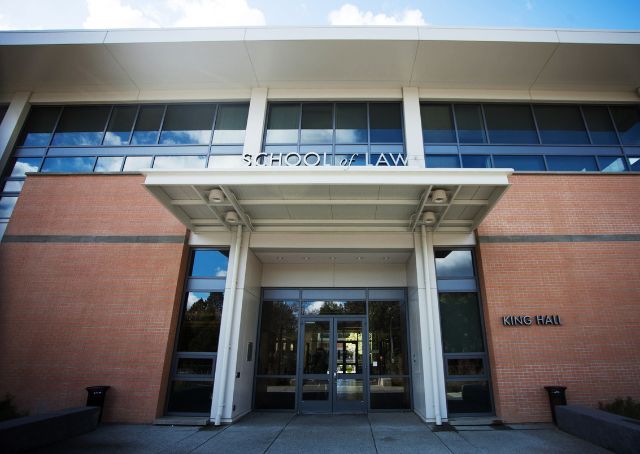
UC Davis School of Law ranks No. 25 in nation

1

Graduating fewer than 200 students per year, the UC Davis School of Law is one of the smaller law schools in the nation, particularly relative to the neighboring 32,000 UC Davis students.

However, despite its size, King Hall found itself at the center of honorable accolades this month, as it ranked the 25th best law school in the nation by the graduate school rating website, graduateprograms.com.

“Graduateprograms.com is unique in that its ratings are based entirely on grad student and recent grad student comments and reviews of their grad school and program,” said Harvey Berkey, the website’s chief operating officer. “Their reviews and ratings compiled from those reviews cover the entire graduate experience from the student point of view.”

The website is broken down into 15 ranking categories, each rated with 1 to 10 stars.

UC Davis Law was ranked highly in academic competitiveness, affordability of living, campus safety and faculty accessibility and support. It ranked lower in financial aid, student diversity, surrounding area and workload.

Kevin R. Johnson, dean of King Hall, was pleased with the ranking.

“While it is important not to place undue emphasis on rankings, it is a welcome recognition of the excellence of UC Davis School of Law to be ranked among the nation’s top schools,” Johnson said. “It is gratifying to be ranked highly by graduateprograms.com because the site’s rankings are based on surveys of students and recent graduates — including our own students and alumni who think highly of their King Hall education.”

— Rohit Ravikumar

The Freak’s haircut

0

“That’s why his hair’s so big. It’s full of secrets.”

Tim Lincecum emerged onto the Major League Baseball scene as a scrawny 23-year-old out of the University of Washington. Off the top of my head, I think he measured in at about 5’11”/150.

The biggest thing about him was his reputation and his hair.

Tim, often known as “The Freak” or “The Franchise,” had secrets to his pitching style that hitters just could not figure out. This became evident early in his career when he reeled off two straight Cy Young awards in his first two full seasons in the big leagues.

Timmy had a poor year last year, one that saw him performing so badly that he was shunted off to the bullpen. He salvaged his season with a couple of strong performances in the postseason that saw the Giants grabbing their second World Series championship in three years.

This upcoming season will be the last of his two-year contract, and thus, The Franchise is pitching to remain The Franchise. If he is to get an offer that he wants, he will need to pitch well. Which means he will need to change everything he was doing last year.

By the end of the 2011 season, his weight went up about 30 or 40 pounds (not all muscle) which was not good for his motion. I read an article when Timmy was just getting big (figuratively) in the majors, and an interview with his father talking about all the mechanics of the Freak’s pitching motion.

Every single movement is tailored to Lincecum’s specific body type, and his dad would get mad when people tried to change his delivery.

I’ve already heard people complain that Timmy’s haircut will change him. He won’t be the same two-time-Cy-Young-Award-winning-“let Timmy Smoke”-cursing-during-his-interview-after-winning-the-2010-NL-West Timmy.

Well, if voluminous hair makes a good ballplayer, then I choose either Rapunzel or James P. Sullivan to be on my team. Or Brian Wilson’s beard (I guess if Brian Wilson himself comes along with the beard, then I’ll take him as well).

I know I just talked about Lincecum’s pitching motion and how the slightest change could throw him out of order, but I wouldn’t extend the same rule to his hair.

Lincecum was just as dominant of a pitcher before he had his long hair (reference: roster picture from when he went to University of Washington). The thing about Timmy’s appearance is that he looks like a kid no matter how long his hair is.

Revamped with a haircut and a very humbling 2012 season that saw his team win the World Series virtually without him, I’m excited to see what the Freak can produce this year. The days that he is pitching still bring in the biggest crowds.

Even if Lincecum falls apart again this season due to his haircut and he doesn’t get a big contract, at least he won’t have to spend much money on shampoo.

So everyone: please excuse Timmy for cutting his hair. He may look more like someone you’ll see in the library than the rebellious teenager you want him to be, but hey, if it brings back the two-time Cy Young Award-winning pitching from his 10-15 record that included a 5.18 earned-run average, I don’t care how much of his hair he keeps or cuts off.

Jeremy Lin was at the Davis In-N-Out on Saturday night? Next time, notify MATTHEW YUEN at sports@theaggie.org promptly.

Women’s basketball team finishes 1-1 week

0

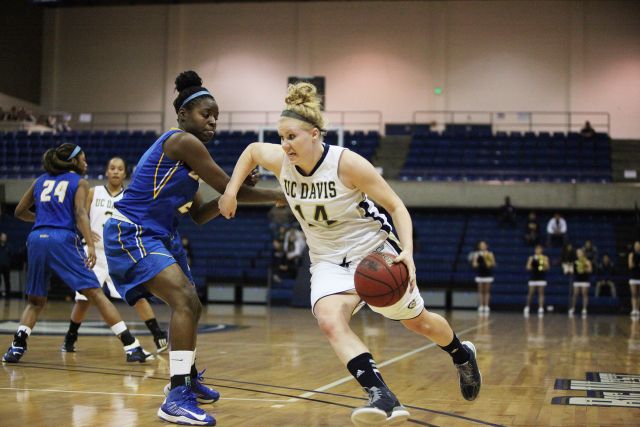
The UC Davis women’s basketball team split its two games last week and currently holds a record of 5-6 in Big West Conference play and is 10-12 overall. After losing to UC Santa Barbara 60-52 on Thursday, the team displayed its second-highest point production of the season by beating Cal Poly on Saturday afternoon, 79-69.

In their loss to UCSB, the Aggies trailed by seven points at halftime and could not take the lead for the rest of the game. With 2:58 remaining, Cortney French’s layup cut the lead to one, 52-51. However, the Gauchos scored six of their next eight points with clutch free throws to ice the game.

Sydnee Fipps led all scorers with 16 points and added four rebounds. Molly Greubel came off the bench to score 14 points.

The Aggies struggled with shooting the entire night, shooting 35 percent from the floor and 20 percent from the three-point line.

Looking to bounce back from the tough loss, the Aggies came out to a hot start against Cal Poly. They scored the game’s first 11 points by converting their first four field goals, three of them coming from beyond the arc. The rest of the first half went back and forth and the Aggies led at the half 36-35.

“We started the game with just tremendous energy, knocking down shots,” said head coach Jennifer Gross. “Sometimes when you do that, obviously the other team is going to make a run at some point and so we did have to overcome a little adversity throughout the game.”

After reaching a 10-point lead with 12:03 remaining, the Aggies remained in control to finish the game and secure the win.

“The exciting thing was in the locker room, at halftime, I really felt like our team just believed in ourselves and we came out and really executed much better in the second half offensively. We were able to string some stops together defensively,” Gross said.

Senior Blair Shinoda showed off her passing as she tallied up nine assists and also added six points.

As the season is progressing, she is becoming more familiarized to a natural point guard’s role.

“It’s great when your teammates hit the shots, you get the assists. Just as a point guard, it’s really fun running in transition and hitting people like Sydnee who can score the ball,” Shinoda said.

Fipps filled the stat sheet, racking up 18 points, seven boards, three assists and three steals.

“I thought that as a team we did very well,” she said. “I mean a couple of my steals were just tips from other players and I was just the one that ended up getting the ball. [By] making those extra passes, we knocked down shots so that made it really convenient. When other people are hitting, you’re left open.”

The game held a little more meaning to the players and coaches on Saturday. Sporting stylish pink jerseys, the Aggies supported their cause for breast cancer awareness.

“One of our players, [redshirt freshman] Lauren Beyer, her mom is going through breast cancer right now so it was very personal for us,” Gross said. “We were just playing a little extra for Lauren’s mom and for everybody else that we know personally that has been affected by this.”

The Aggies will travel to Honolulu for a game against Hawai’i on Thursday.

LUKE BAE can be reached at sports@theaggie.org.

Aggie Digest

0

In the extremely busy world of UC Davis athletics, the Aggies had a variety of sports in action this weekend. Some sports are in the middle of their grueling season while others are just kicking off.

The men’s golf team participated in the Annual Amer Ari Invitational at Waikola Village’s Kings’ Course in Hawaii and finished 16th. This was the first tournament of the spring season for the Aggies, and though this was not a discouraging showing, this was not the best they could have played.

Senior Tyler Raber placed 60th in his first spring competition back after he red-shirted last season, while junior Matt Hansen led UC Davis with a 218 total to tie for 48th place.

The Aggies’ 887 over three rounds gave them a 16th-place finish behind some of the nation’s top teams, such as the winners of the tournament, UCLA and Washington, who tied with an 842 total.

UC Davis will co-host their next competition with Stanford, which will be at The Prestige at PGA West in La Quinta, Calif.

The UC Davis women’s water polo team is coming off a loss to No. 1 ranked Stanford, in which the Cardinal scored 15 goals to the Aggies’ four. UC Davis got three goals from senior Jessica Dunn and one more from sophomore Elsie Fullerton, but the Aggies couldn’t put much else together against visiting Stanford.

The Cardinal dropped in three, four, two and six goals in each of the quarters, respectively. The loss drops UC Davis to 1-5 on the season despite their No. 13 ranking.

The Aggies will return to Schaal Aquatics Center to host the Davis Challenge next weekend.

On the tennis courts, the UC Davis women’s tennis team traveled to Oregon for a battle of West Coast teams. The Aggies dropped the doubles point again, and couldn’t gain any momentum in the singles competitions.

The Aggies lost all their first sets except for at the sixth slot, where junior Nicole Koehly put together a 6-4, 6-3 victory. Fellow junior Melissa Kobayakawa’s match, in which she trailed 4-6, 2-3, resulted in a point for the Aggies because her opponent retired.

All the other UC Davis players lost in straight sets, resulting in a 5-2 loss to the 69th-ranked Ducks. UC Davis continued its tour in Oregon with a match against Portland on Sunday and will come back to a match much closer to home when it plays Sacramento State on Friday.

— Matthew Yuen

Senate briefs

0

ASUCD Senate meetings are scheduled to begin Thursdays at 6:10 p.m. Times listed are according to the clock at the Feb. 7 meeting location, the Memorial Union’s Mee Room. The ASUCD president is not required to attend senate meetings.

Meeting called to order at 6:14 p.m.
Rebecca Sterling, ASUCD president, present
Yena Bae, ASUCD vice president, present
Beatriz Anguiano, ASUCD senator, present
Bradley Bottoms, ASUCD senator, present
Liam Burke, ASUCD senator, present
Armando Figueroa, ASUCD senator, present
Don Gilbert, ASUCD senator, absent
Joyce Han, ASUCD senator, present
Maxwell Kappes, ASUCD senator, present
Kabir Kapur, ASUCD senator, pro tempore, present
Paul Min, ASUCD senator, present, late
Felicia Ong, ASUCD senator, present
Alyson Sagala, ASUCD senator, present
Tal Topf, ASUCD senator, present

Consideration of Old Legislation:
Senate Bill 33, authored by Shehzad Lokhandwalla, to enact a committee that would represent international students within ASUCD. Lokhandwalla said that this committee is important because there are a lot of international students on campus and because there are no international students on the senate, international students need some representation on campus. The bill passed unanimously.

Public Discussion:
Chucha Marquez, chair of the Gender and Sexuality Commission (GASC), said in regards to the upcoming Singles Awareness Night that the commission does not believe that the intentions behind the fundraiser are negative, but that the means by which the fundraiser is being executed are insensitive to some groups.

Marquez’s reasons included the trivialization of human trafficking through the process of selling students for money and placing a monetary value on people. The commission asked for consideration of students’ self-esteem and the fact that there is a lot of pressure on students to participate in this event, as it is for a good cause. Lastly, it was stated that the auction goes against the Center for Student Involvement’s (CSI) policy regarding the auctioning of students on campus.

Sterling said that ASUCD’s goal in holding this event was to remain relevant to what is important to the student body and do something unique to previous fundraisers. She also said that she was under the impression, after contacting CSI, that the auction was not in violation of their policy.

Lane Lewis, GASC commissioner, said that though it is inconvenient to cancel a planned event six days before it is held, in the interests of protecting the students, either the fundraiser or the auction aspect of the fundraiser should be canceled.

Lewis brought up an issue with the ASUCD Elections Committee, after Lewis’ birth name was put on the official executive candidates list, despite the fact that Lewis put down their preferred name on the ballot. Lewis’ birth name was publicly announced at a candidates meeting, as well as posted online. This issue with the incorrect name also occurred with another transgender student on campus running for ASUCD.

Lewis explained that the committee’s reasoning for not changing the name was because of bylaw 405E, which did not allow the changing of the name. Lewis said that they wanted something to be done to amend or change this bylaw.

The senate motioned for a vote to close session and discuss this issue with the chair of the Elections Committee, Aaron Hsu.

In a 4-7-1 vote, the motion failed.

A second motion to vote for a closed session passed with a vote of 7-2-3.

The senate motioned for a vote to suspend bylaw 405E. The motion passed with a 8-0-4 vote.

Emmanuel Diaz-Ordaz said that there was a resolution that passed that stated that ASUCD should cut its relations with Blood Source because the policies are based on sexual orientation and not sexual practice. He said that sexual orientation is desires, what you like about people, what attracts people to people. Sexual practices are the acts that you engage in.

The FDA policy is that if you are a man who has sex with a man then you cannot donate blood and you are deferred for your whole life. He said that this is called “high-risk,” but it is very explicit in their rules saying if you are a gay man you are at high-risk. However, you are not at a higher risk of getting HIV or AIDS if you are a gay man. Cano said that this does not address the large number of straight people who contract HIV.

Cano said that he does not dislike Blood Source, and he is an advocate for blood donations, but the policies that are being followed are inherently homophobic in the way that they are enacted.

Cano said that Senate Bill 33 was tabled in December due to issues such as how the membership would be described. In addition, there was language about an action plan that was implemented, the objective section was modified slightly because the language didn’t accurately reflect what the bill intended to do, saying that there was no orientation for international students, etc. After two meetings, it still reflected IAC’s opinion. They think it’s a great committee and that it will be a very valuable resource for ASUCD.

Meeting adjourned at 10:17 p.m.

Open positions within ASUCD can be found at vacancy.ucdavis.edu. JESSICA GRILLI compiled this senate brief. She can be reached at campus@theaggie.org. LAUREN MASCARENHAS contributed to the senate brief. XXX

Pirating your way to an A

1

A student nonchalantly walks into a bookstore, finds the textbook they need and flips it over to the back cover. The price tag reads into the 200-dollar range. The student coyly scans the aisle to make sure no employees or security cameras are watching, then slips the volume under their coat and walks out. Another student searches online, finds the same textbook in its entirety, and downloads it in the form of an illegally posted .pdf. Both have committed the same crime, but due to the highly accessible, nonphysical, anonymous world of the internet, one is considered a thief — the other, someone who has found a clever loophole in the system.

“I’ve downloaded both the Communication 3 and Economics 115 textbooks,” said an anonymous economics major. “I don’t have a problem with it. It’s not stealing. [Textbooks] are expensive and I’m broke.”

Downloading textbooks is a serious offense, one that is punishable by both copyright law and UC Davis.

“Information relating to a particular [person/IP address downloading copyrighted material] may be referred to campus authorities, including but not limited to Student Judicial Affairs, Network Operations Center, Chief Compliance Officer, Campus Counsel or departmental network and human resources staff, for review relating to campus policies,” according to the UC Davis Policy and Procedure Manual.

Still, when a significant amount of money is on the line, there is an allure to having textbooks with just one click.

“I would do it again. It was just there, and I thought, ‘why not save $212?’” an anonymous engineering major said.

With textbook and tuition prices climbing ever higher, some are willing to think beyond legal, legitimate options in order to prevent economic strain.

“My parents both had to take lower-paying jobs recently and I’m going abroad; so I’m paying a lot for that. I was talking to my dad about textbooks, and he said that we’re tight on money … I just told him that I was going to find another way,” the economics major said.

For those who buy textbooks with their own money, the drive to find a free method is, in the minds of students interviewed, less a matter of malice and one of desperation.

“It is stealing … and my teacher wrote the book, so I feel bad. The thing is, my parents aren’t helping me with buying textbooks, and I’m tight on cash right now. I’ve gone through over $2,000 over the last two quarters with everything [for college]. I try to find my books online because they are ridiculously expensive otherwise. I gotta do what I gotta do to save enough money as possible,” a second anonymous economics major said.

The methodology behind obtaining the textbooks online is simple: find the book in the form of a .pdf and save it. Most of the time, using search engines with the correct keywords such as the author’s name and title of the book is all it takes for the desired link to appear.

For some books, searching the web directly doesn’t always yield results. In the event of this type of case, students rely on friends, or friends of friends, to post links to a textbook’s .pdf on social media outlets, where they are then shared.

“I downloaded both the [Math] 21 series textbook and the solutions manual. For the textbook, someone posted a link onto [a Davis-affiliated] Facebook page, and I just clicked it, got the .pdf, and saved it onto my desktop for future access,” the engineering major said. “The solutions manual took a little work. I got it through Dropbox, which is a file-sharing program.”

A major point of contention for many students stems from required texts not being used, or used enough, in class. While most classes utilize, or at least reference the required textbooks in some capacity, some students buy books that end up sitting on a shelf all quarter.

“A lot of the time we have to buy all these books, and then we never use them. It’s ridiculous. I spent $50 on a book last quarter that I never touched,” the first economics major said. “That’s what really pushed me [to start looking for my books online].”

Another impetus for turning to illegal activity was a course’s subject matter in relation to an individual’s major.

“I would be willing to cash out more for books that are required for my major; paying a ton for books that only satisfy GEs doesn’t make sense,” the second economics major said. “Why would I spend $150 for an Intro to Human Evolutionary Biology textbook when I’m an economics major?”

While some see buying books that don’t fall directly into a major’s criteria as unnecessary, others see value in accruing knowledge for the sake of personal growth.

“I would hope that anyone with intellectual curiosity, anyone who would want to evolve knowledge, would want to buy their textbooks,” said Professor Bella Merlin, Drama 10 teacher and writer of the internationally acclaimed textbook, The Complete Stanislavsky Toolkit. “It’s a matter of respecting that it could be them, that they could be the next person to have a breakthrough and write a textbook.”

Despite the reasoning of all three students, more affordable, legal alternatives than theft do exist for even the most cash-strapped student. Jason Lorgan, director of UC Davis Stores, and Kato Meley, assistant director of course materials of UC Davis Stores, explained the MU Bookstore’s extensive rental program.

The Bookstore’s register system recognizes which titles are available to be rented, and the cashier then presents the buyer with an option to buy or rent. At the end of the quarter, students must bring the book to one of the buyback programs put on by the University around campus to turn it in.

“Around 15,000 students use the rental program,” Lorgan said. “At this point, about 70 percent of our titles are available for renting. Students are paying below the university’s cost, and can save up to 71 percent off the price of a new book by renting. The only things not available to rent are custom editions, online single-user codes, and workbooks with torn out pages — that’s the 30 percent that doesn’t have a resale value.”

Renting is only one aspect of the bookstore’s effort to provide lower-priced options. They also provide an expansive used-book sales system, real-time price comparisons of other vendors at the bookstore website, loose leaf and e-books.

“We understand the economy. We’re doing what’s right for the students. We’re not a traditional business. Our mission is not to make money off of selling books. It’s to provide students with options and the lowest possible cost to get through college,” Lorgan said.

Professor Merlin said that while she periodically receives a small amount in royalties for the success of The Complete Stanislavsky Toolkit, that the monetary impact associated with illegal downloads is not the biggest part of her problem with the practice.

“[Stealing is] a really bad habit to develop as a young human being … It’s not the way the game should be played. I’m not so worried about the money. The moral aspect is the biggest thing,” Merlin said.

As for the future of the trend, all three students did not express concern for being caught or reprimanded for their actions.

Logan, however, feels a pushback is inevitable.

“This is a growing trend, and there is no question that we will see more and more enforcement as time goes on,” Logan said. “It’s a fairly new thing still, so we haven’t seen the publishing companies react to this quite yet. But because we know that it is starting to become more and more common, it’s only a matter of time.”

HANNAH KRAMER can be reached at features@theaggie.org.

News in Brief: New police lieutenant sworn in Thursday

1

The UC Davis Police Department (UCDPD) welcomed Lt. Gregory Murphy Thursday night as he was sworn in during a badge-pinning ceremony.

Murphy participated in a community-based hiring process, according to UC Davis Police Chief Matthew Carmichael.

“This process is unlike any other as new employees are selected with major input from the community. With the strong support of community members such as the GSA, ASUCD, Academic Senate and community members at large, I have found to date, this process is working,” Carmichael said.

Patrick Sheehan, a third-year computer science major and former ASUCD senator, said that he saw this event as a symbol of the police department’s progress.

“It’s nice to see that the UCDPD, under the lead of a new police chief, has actually taken community input and turned it into substantive changes in department policy. Positive changes should be celebrated and displayed to the campus community and that was the essence of Thursday’s event,” Sheehan said.

The first class of student cadets from the Volunteers In Police Services (VIPS) Cadet Program were also sworn in Thursday.

UC Davis students who are part of the VIPS Cadet Program are seniors who are interested in careers in law enforcement. The program is a scholarship competition that offers training to the students and gives them experience in the field.

At the end of the program the top three graduates will be given a scholarship to attend any police academy they want in California, and the top graduate will be considered for hire to a position with the UCDPD.

Carmichael also reflected on the event during his closing remarks.

“UC Davis is an amazing community and this swearing-in ceremony demonstrated the commitment of many to work together in a collaborative spirit to keep our campus safe,” he said.

For more information on the cadet program or to learn more about the UC Davis Police Department, visit their website at police.ucdavis.edu.

– Sasha Cotterell and Kelley Drechsler

Urban herbalist

0

If the adage goes “you are what you eat,” then what does that make us? Probably a combination of colorful, plastic shrink-wrapped packaging and a transparent orange cylinder with a person-proof white cap.

At times, it seems as if we eat pharmaceuticals like food and take our daily doses of healthy food or vitamins. Everything we put in our bodies — pharmaceutical drugs and food — has a profound effect on our health.

Maybe we intellectually recognize this fact, but we are neither particularly patient nor good at resisting instant gratification impulses. Processed food has been designed to taste good, and food companies have found the way to our hearts (and wallets). So, we don’t buy the frozen yogurt, the mac and cheese and the chocolate-covered pretzels because we think it is good for us. (We do it because it’s midterms, and fuck it! I deserve it!)

Pharmaceutical drugs have also been designed as a way to circumvent our lack of patience. Last quarter, I was diagnosed with strep throat — a fairly common and benign illness. Even though the doctor informed me that medication would only shorten the course of the entire infection by 18 hours, he still offered me steroids, antibiotics and Vicodin. Medicine, in this case, was not treating illness, but impatience.

What if we were more patient with medicine? What if we were more intentional with what we put in our bodies? The definition of medicine is something used to treat or prevent illness. Everything we eat could potentially be a medicine.

If this were the case, practically any edible plant would qualify. Walking through the produce section at the grocery store or a wild landscape could be like walking through a pharmacy. Herbalism, the practice of using plants to treat illness, requires both patience and intention in order to be effective.

Probably the biggest blow to herbal medicine comes from the scientific community. Despite the fact that people have effectively used herbal cures for centuries, science prioritizes its limited experience with herbal medicine as the premier source of knowledge on the subject. A Google search on nearly any herbal medicine will likely yield a few academic sources that provide inconclusive evidence on its effectiveness.

Pharmaceutical drugs are recalled from the market regularly and the pharmaceutical industry has a reputation that leaves much to be desired from the standpoint of patient (or consumer) health. Here, it is paramount that we separate herbal medicine from pharmaceutical drugs. Herbal medicine is like open-source software — it is free for anyone to learn about and use. Information on pharmaceutical drugs, on the other hand, is intentionally withheld and too complex to understand even if it were available.

But I can understand herbs. There is only one ingredient in garlic, after all. Garlic is medicinally useful for its antibacterial and antifungal properties. Like all other herbs, its use is accompanied by many positive side effects.

To treat colds or aid digestion, three to five cloves can be eaten raw. Garlic tea is also convenient to prepare, and easy to drink. For colds accompanied by an irritable throat, garlic can be prepared as a sore throat syrup. Simply mash the garlic into a paste and blend it with honey and lemon. Most often, the reason why herbal medicine fails to meet our expectations is because we take too little. Be generous with your herbal treatments!

This is just one herbal remedy of many others. Western medicine has its benefits, but try an herbal option before heading over to Rite Aid to treat a common illness. The Food Co-op on Sixth and G streets has the most extensive selection of herbal treatments available in Davis. If you think herbal medicine is outdated, consider that about 75 percent of the world’s population still relies on it to some degree.

If this topic interests you, read my column next Monday focused on herbs for women’s reproductive health.

To educate ELLI PEARSON on your favorite herbal remedies, email her at erpearson@ucdavis.edu.

News in Brief: Volunteer Recruitment Fair tomorrow

0

The City of Davis and Davis Police will hold a Volunteer Recruitment Fair tomorrow at the Veterans Memorial Center located at 203 E 14th St. from 10:30 a.m. to 1:30 p.m.

The city and Davis Police Department (DPD) are looking for individuals interested in volunteering in various city services. According to a DPD press release, services include clerical duties, traffic control assistance at events, graffiti abatement, neighborhood presentations and others.

Those as young as 13-years-old can volunteer by joining the Police Cadet Program.

For more information, contact Michele Sharitz at (530) 747-5411 or msharitz@davispd.org.

— Claire Tan

Dining commons workers dissatisfied with new schedule

Dining commons (DC) workers on campus are considering filing a demand to bargain with the University after recent changes to their work schedules.

“Starting Feb. 1, about half of us got a half hour to one hour cut from our schedule,” said an anonymous cook working at the dining commons. “We weren’t notified about the schedule change.”

Management and some DC and union workers disagree over whether or not these schedule changes are considered “cuts.”

“As we opened in the Fall Quarter, many of our cooks were scheduled longer shifts and overtime to compensate for vacant positions, employees on leave, employee absences and a number of new employees in training,” said Brenan Connolly, general manager of Resident Dining, in an email interview. “There have not been cuts in worker hours, but rather a return to the base schedule (i.e. no or little overtime) as positions have been filled.”

Some workers and union representatives do not agree with the explanation given by Connolly.

“From our perspective, they’ve cut hours. I’ve talked to at least 15 workers who have had their schedule cut lower than it’s ever been,” said Tarone Bittner, American Federation of State, County and Municipal Employees (AFSCME) union representative. “What they are referring to as the original schedule has never been implemented.”

Some workers said they are unfamiliar with the original schedule that management says they have reverted to.

“I’ve been working here for five years. This ‘base schedule’ is a mythical thing,” said Julius Hughes, senior cook in the Segundo Dining Commons.

The DC workers’ contract with the University expired on Jan. 31. Workers learned about the schedule changes on Feb. 1.

“They are allowed to make schedule changes, but they didn’t properly notify us. There was not the 20-day notice that is necessary,” Bittner said.

Connolly said that it is in the practice to post schedules at least two weeks in advance, whenever possible.

“There are times when we must make schedule changes with less notice to meet customer needs and compensate for staff leaves due to unexpected illnesses,” he said.

The issue of notification has been a point of contention for some DC workers.

“We’d even like to just have a meeting to discuss what’s really going on here. They didn’t say anything; they just put the new schedule up,” Hughes said.

Workers may have a chance to voice their concerns more openly and actively soon.

“We are going to file a demand to bargain,” Bittner said.

According to Hughes, the schedule changes could have an affect on productivity in the DC.

“You have to do more labor in less time. They have the same expectations even though they’ve cut hours. The quality of food is going to go down. Production will go down,” Hughes said.

These concerns were echoed by other workers.

“There are [fewer] hands in the back kitchen to prep for the next day’s meal. We get behind, and if we don’t have time we have to do it the morning of,” the anonymous worker said.

Connolly responded to questions about the schedule changes affecting the quality of work in the DC.

“We do recognize that some employees will need to rearrange tasks, utilize co-workers differently and use prep time more efficiently,” he said.

Sodexo could not be reached for comment.

LAUREN MASCARENHAS can be reached at campus@theaggie.org. xxx

Love drugs

2

Late at night this past weekend, I sat down and watched the movie Love and Other Drugs starring Jake Gyllenhaal and Anne Hathaway. The movie follows two particularly gorgeous lovers going at the intricacies of mutual trust and understanding within a society awash in pharmaceutical drugs.

The movie focuses on the development of Gyllenhaal’s character, Jamie, an intelligent young man from a wealthy family of medical practitioners, who has yet to contend with his own potential. At his job, Jamie applies his innate ability to communicate with others toward the manipulation of women for sex, in addition to selling high-end stereos and electronics.

Inevitably, Jamie is caught scarfing down on his oafish boss’s girlfriend and is fired. Jamie’s family then guilt trips him into taking on the more financially rewarding career of a Pfizer pharmaceutical salesman. After a whirlwind introduction into the fast-paced world of promoting drugs to the medical elite, Jamie internalizes the advice of his family and sets his sights on earning more money.

And it is through his new job that Jamie gets to take a peek at the soft exterior of his soon-to-be girlfriend, Maggie, as played by Hathaway.

The beginning of the relationship is hard-fought for the couple, but something compels them to keep seeing each other. It is not until a particular scene in which Jamie is sitting in an empty bathtub, lying to his mom on the phone, that Maggie realizes something is amiss.

Amidst Jamie’s skyrocketing success at Pfizer — he has become the point-man for sales of the newly invented Viagra — Jamie condescendingly exaggerates the dollar figure of his success to his mom in order to make her feel better.

It is here that Maggie begins to wonder if Jamie would ever treat her in a similar fashion.

Jamie’s life has conditioned him into thinking that everything and everyone he wants — particularly women — can be treated like a product that can be bought, sold or traded. And, when someone’s wants are not met, Jamie believes that some drug can replace the longing for even the most profound parts of the human condition.

Maggie has the medical condition known as Parkinson’s. An artist and outsider to the medical community, she has been juggled from doctor to doctor her entire life, her medical needs rarely being met. It is difficult for Jamie to understand that there is a fine line between playing doctor to his girlfriend’s condition and taking the time to appeal to her as a person.

It is very difficult for Maggie to relate to how hard Jamie wants to fight for her. Jamie has been butting heads with members of the medical establishment his entire life. The rage she witnesses from deep within him as he tries to fix her condition intimidates her. Maggie has a difficult time understanding that Jamie, for the most part, seeks only to exert his rage at those who want to exploit her.

The final question posed by the film is whether Maggie can partially compromise her idealistic understandings of her identity in order to let Jamie into her life. At the same time, Jamie has to decide whether Maggie is worth not competing over as though she is a commercialized product in the fast-paced, coat-and-tie world to which he is so accustomed.

Jamie, certain things in this world must develop at a natural pace and there’s nothing that even your best-intentioned rage can do to change that. Don’t coddle Maggie like a child — protect her like an adult.

Maggie, Jamie seeks only to fight for you. At some point, if you ever actually do want your needs to be met by the medical community, you’re going to have to compromise some of your anti-establishment values. Both of these characters seek to gain a whole lot from understanding that, sometimes, the only virtue the strongest warriors carry in their hearts is patience with those who are different from them.

Jamie, while it may be hard for you to see at the get-go, there are a few beautiful things in this world that ought never, ever be even partially about fame, fortune, money or power. To you, Maggie is unquestionably one of these things.

Do our star-crossed lovers ever let go of their personal struggles in order to let each other into their respective lives, or do they go about their own ways separately and wait to become intimate with someone else who is more similar to who they were before meeting each other? You should probably watch the movie and find out for yourself.

MICHAEL FIGLOCK can be reached at the bottom of his prescription vial, or at mpfiglock@ucdavis.edu.