Roberta L. Millstein’s clarification of Aldo Leopold’s environmental ethics suggests that we rethink what we owe to our natural communities
BY JULIE HUANG – arts@theaggie.org
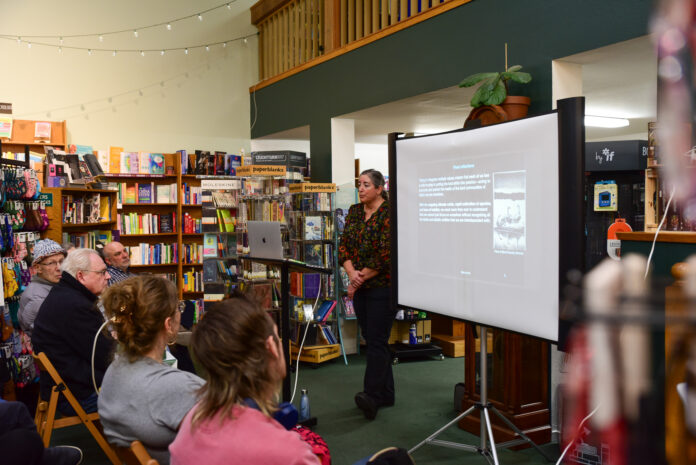
At The Avid Reader on Jan. 23, UC Davis Professor Emerita and researcher Roberta L. Millstein presented her interpretation and defense of Aldo Leopold’s “The Land Ethic,” an approach to human interaction with the environment, as outlined in Millstein’s book, “The Land is Our Community: Aldo Leopold’s Environmental Ethic for the New Millennium.”
Millstein began the talk by introducing Leopold’s history and background as a hunter, forester, wildlife manager, ecologist, conservationist and professor, giving context to the development of his attitude on ethical behavior toward the land. Although he is best known for his book, “A Sand County Almanac,” and the essay, “The Land Ethic,” contained within it, which were posthumously published in 1949, Leopold published more than 500 works and wrote just as many unpublished works.
“He’s kind of a standard figure in all of the anthologies for environmental ethics, and you can’t help but teach him,” Millstein said.
When asked what inspired her to write about Leopold specifically, Millstein cited her experiences as a professor. They led her to observe how Leopold’s ethical views were universally appealing, allowing students of many different academic backgrounds to find value in his philosophy.
“This [‘Land Ethic’ approach] was a view that a lot of [students] find attractive, and I mean students from different backgrounds and majors, like art, philosophy, history and different kinds of science majors,” Millstein said. “This is something that could draw a lot of people in and get people interested.”
However, Millstein noticed that there were many interpretations of Leopold’s “The Land Ethic” that misrepresented the intended meaning of his work. She eventually decided to write a book with the aim of clarifying his beliefs and defending the validity of his arguments.
“I felt that a lot of interpretations out there were leading people to reject him too quickly, so I wanted to write this book and clear things up so that if people reject him, they at least reject his theory on the right grounds,” Millstein said.
Taking an analytical approach based on the history of environmental science, Millstein explained how Leopold’s ethics emphasize the status of the individual as a member of a natural community that includes living beings, such as plants and animals as well as abiotic components like soil and water. Sharing the status of membership within a community implies that humans owe a level of respect to the natural environment in which they reside, also termed by Leopold as “a conviction of individual responsibility for the health of the land.”
Two sentences that Millstein identified as a major source of misinterpretation of Leopold’s ethic are: “A thing is right when it tends to preserve the integrity, stability and beauty of the biotic community. It is wrong when it tends otherwise.”
“A lot of people took these sentences to mean that the individual should be sacrificed to the community — which a lot of people read, found to be fascist and rejected immediately, saying that, ‘This is off the table,’” Millstein said. “Others read it, came to the same conclusion and agreed with that wrongful interpretation.”
The enduring nature of this interpretation of Leopold’s original perspective published in mid-century America has had far-reaching implications, as future environmentalists were influenced by his words in the following decades.
However, Millstein argued that when examining Leopold’s actions throughout his life, it is clearly impossible for Leopold to have intended for this interpretation. From his writing, readers gathered that actions are wrong if they do not benefit the entire community or that individual outcomes should be sacrificed for the good of the collective. However, Leopold meant something different entirely, according to Millstein. Rather, in addition to the obligations that humans have toward other humans, there exists also an obligation to protect and promote the capacity of land communities.
“Why should we undertake efforts to protect and restore the natural environment?” — Millstein posed the question before going on to answer it. The individual is a member of a community of interdependent parts. Protecting the health of the land that human societies exist on also protects the capacity of the environment for self-renewal, which comes back to benefit humanity in the end, according to Millstein.
“In human communities, we accept limitations on our freedom of action and rules of social conduct, because we are parts of competing and cooperating interdependent human communities,” Millstein said.
Drawing from the disciplines of history and ecology, Millstein argued that we should extend our understanding of the interdependence between beings to include not just humans but the other members of our land communities — soils, waters, plants and animals.
The existence of bees was used as one example. Various crops and flowers grown by humans are dependent on bees for pollination, and yet there are a variety of threats to bees that are also caused by humans, such as pesticides and climate change.
“Harmful interactions with bees make them vulnerable, and that vulnerability is important, because it makes them dependent on us — on human actions — and what we do or don’t do,” Millstein said. “The key point is to recognize and act on obligations to the land over and above self interest.”
If we are capable of accepting limits on our personal freedoms and obligations to other human beings in order to participate in society, consistency demands that we expand these ethics to include the land, which we share an interdependent relationship with.
“Each of us has a role to play, especially with the ongoing climate crisis, rapid extinction of species and loss of habitat,” Millstein said. “We need, more than ever, to understand that we cannot just focus on ourselves.”
When the conversation shifted toward recent political developments and the light they have shed on the environmentally destructive actions, as well as policies pursued by a small number of individuals with vast amounts of wealth and power, Millstein voiced a call to action.
“It is up to the rest of us,” Millstein said. “We [are greater than] them in numbers. If I had the most grandiose hope for the book, I’d hope that we all start to say that [this kind of policy] isn’t in our best interest, and it is not in our community’s best interest.”
Written by: Julie Huang — arts@theaggie.org