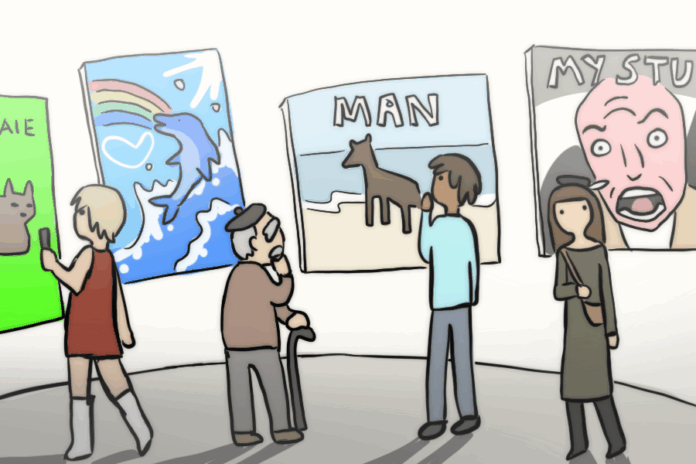
Exploring the historical ontology of fine art
By VIOLET ZANZOT— vmzanzot@ucdavis.edu
Historical ontology. Just reading these two words invoked a complicated and philosophical feeling. It probably makes old white guys feel really important when they talk about it, but it can also be explained perfectly by this upcoming tanning season.
Allow me to explain, and not like one of those guys with the scrunchy faces that all look the same. Today, a proper tan is a thing earned by spending hours sitting by a pool or on the beach. Some people go so far as to use spray tan as a shortcut.
However, historically speaking, being tan was often a byproduct of extensive hours of outside labor. This “farmer’s tan” spoke for itself — it was usually agricultural workers who got tan. As time passed, the social context of a tan has changed. This example can very loosely be representative of the idea of historical ontology: things change meaning as society changes.
Other than the sex appeal of skin damage, lots of things have changed meaning over time — notably, the theater and art.
I recently went to the Crocker Art Museum in Sacramento with my grandmother. Walking in with a discounted student ticket, I asked myself why I hadn’t gone sooner. I always loved art in the many forms it takes (excluding opera). But it just doesn’t feel like a normal thing for a kid to enjoy on their own accord.
I get my mass art from the movies, TikTok and, if you catch me on a good day, a book. There is the small chance that I am but one person suffering an ailment of cultureless existence, all by my lonesome. What I think might make more sense, though, is that the experiences we deem as “fine arts” have become victims of historical ontology.
Things we see as high culture, high brow — best observed with high heels and caviar — are the things that used to belong to the masses. Shakespeare didn’t write “Romeo and Juliet” so that the rich Londoners could take a limo down to the historic Globe Theater dressed to the nines.
He wrote it for the “ones” to come together to feel like “10s.” Because 10 guys with a penny might as well be a dime piece when the goal of the author is to write for the masses.
The very idea of which art exists for the masses has shifted over time. Today, people come together over mass media. We scroll the halls of TikTok; We don’t stroll the halls of the Louvre.
This is not to say that historically different aspects of the arts have not been gate-kept by the elites. The idea of salons as a place to meditate on art’s cultural acceptability was specifically a space for the elite to dictate the worth of certain art.
But we have shifted the art and entertainment that was originally designed for us lowly normals to be experiences that feel inaccessible. There is art that was designed to be gawked at by only the few who could afford to gawk. There is also art that was designed to give people a mirror to understand their own humanity.
We have lost access to this art. Of course, the meaning of art is always changing, and what is produced now will not look like what Picasso produced, but I do not think that means we should deny ourselves access to the world that was told through less direct means.
People are meant to be their own translators to the world of art, and yet we’ve allowed the perpetuation of the idea that there must be a “middle man” to explain what Andy Warhol meant when he mass-printed soup cans.
We exist in the rapid age of advancement and technology that over-emphasizes the ability to produce. Call me a romantic, but I think it’s high time we bring back a love for the ability to create. Let’s shed light on the world as seen through the eyes of a visionary. Let the poets preach and the painters paint. Let us learn that art, too, is a common language we can share, rather than a world one must be able to afford. Consider this my formal petition to make art lowbrow again, without changing the art but solely by changing the way it is seen by the people.
Written by: Violet Zanzot— vmzanzot@ucdavis.edu
Disclaimer: The views and opinions expressed by individual columnists belong to the columnists alone and do not necessarily indicate the views and opinions held by The California Aggie.