






Minecraft: the miracle maker
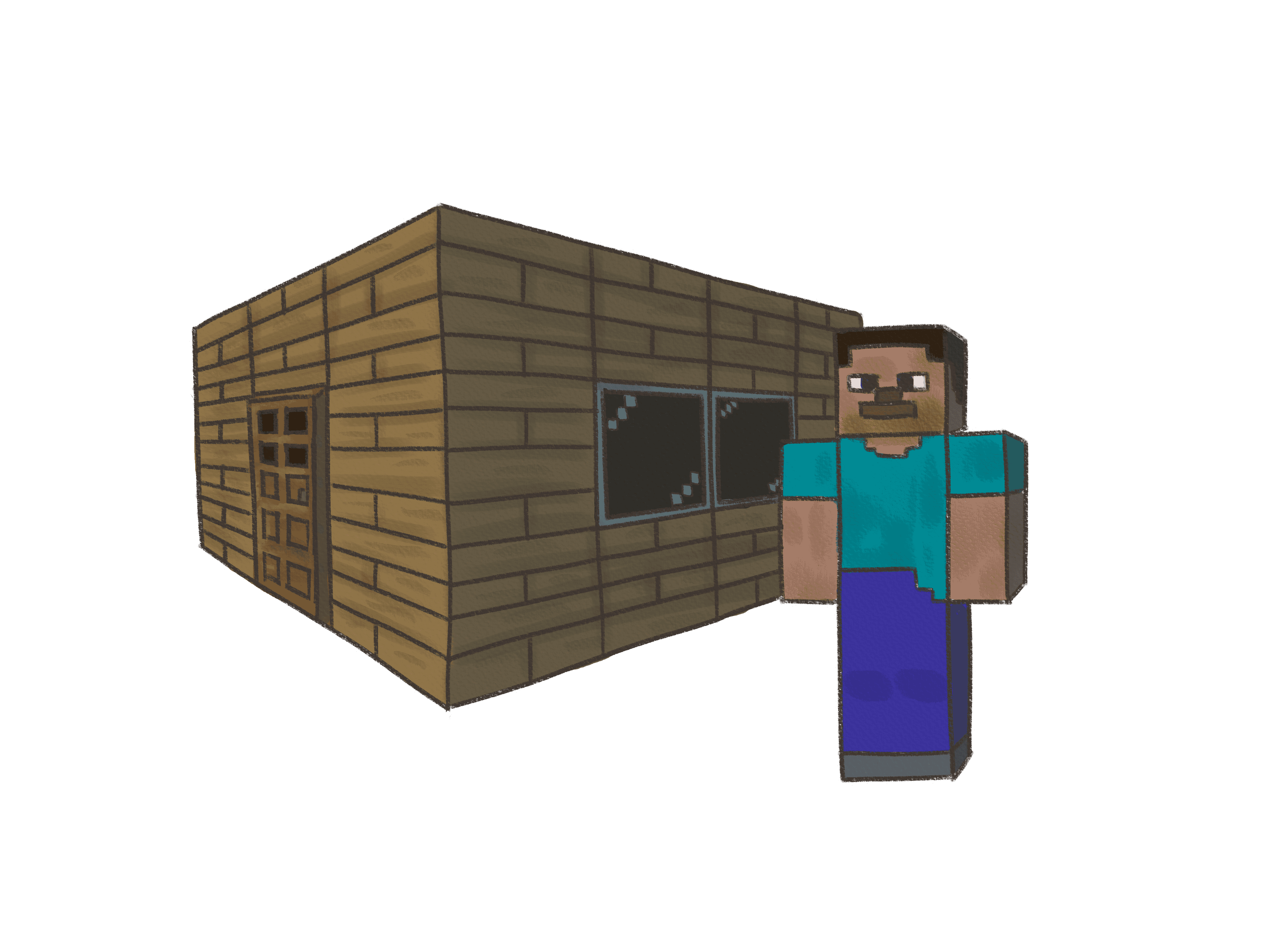
Anything is possible with a pickaxe and a dream
By NADIA IWACH — nmiwach@ucdavis.edu
In the era of technological free-for-all, a platform capable of optimizing, monetizing and gamifying every interaction would seem like a glitch itself.
Where Instagram became auto-voyeuristic and Facebook faded into the digital peripheral, the answer to facilitating community, creativity and applicable skills is simple: Minecraft.
Minecraft has no algorithm, no creator fund and no “perfect ratio” of followers to following. Just a user, a pickaxe and a dream. Despite a lack of external incentives — or maybe because of them — it quietly became one of the most formative creative platforms of our generation. Kids mining redstone, fighting zombies and shepherding chickens suddenly found themselves acting as real innovators, honing their home-grown ability to develop the technology of tomorrow. The best part? They simply wanted to build something cool.
Minecraft does more than reward creativity — it interpolates the typical trajectory of skill development and flips the script entirely. Build now, learn later. With a little more than an introduction tutorial, users are flung into an armageddon of monsters and tasked with the most primitive task: survival.
Starting with only a building block, users are given a carte blanche to create worlds only they could imagine. The process — self-led and intuitive — rewards intrinsic motivation; the more you build, connect and obsess, the more knowledge you absorb without even realizing it. Led by pure love of the game, there’s no room for ego when you’re knee deep in a to-scale recreation of the Golden Gate Bridge, arguing with the 12-year-old server admin.
A case study in the archetypal builder this ecosystem creates is Nils Fleig, a current first-year. He’s easy to approach but does little to advertise that he’s among the most promising minds on campus.
Initially, he taught himself coding and programming as a Minecraft user before becoming involved in what he describes as the tightly-knit server host community. Since then, he’s become something of an early savant — recently, he won his first hackathon at Stanford University’s TreeHacks, where he claimed victory by devising a crime detection software.
The mission of his startup, MCMetrics, underscores the relationship between technical curiosity and community-driven collaboration by returning lost revenue to Minecraft server hosts.
“When I was 14 and making Minecraft servers, I was just messing around with code; MCMetrics turned into messing around with the business side,” Fleig said. “I found that the combination of coding and business — turning your work into a product that solves problems — is what I love doing most.”
Beyond its entrepreneurial advantage, the venture echoes a deeper impulse etched into the platform’s DNA: a desire to create for the greater good.
Fleig’s story is likely the “nth” anecdote of genuine ability and impact: discovered, rather than pressured. A close friend of mine from high school, who once ushered me through a Disneyland server complete with ride soundtracks and parades, is now pursuing UX/UI and Design at UC Berkeley. Her inclination for visual arts, design and building purely for enjoyment was always obvious, long before college applications or career plans were ever a question.
Minecraft, while often dismissed as the birthplace of many memes and cringeworthy catchphrases, earned its longevity by rejecting the blueprint of a standard video game. With a user-driven approach to learning and creating, the lack of a strict storyline acted as a creative petri dish where no idea was too great. This model, in addition to fostering the creation of truly fascinating digital communities and collaborative builds, instilled a quieter truth in a generation raised to optimize — true creation doesn’t need the mechanics of a five-year plan or a four-figure course. With just the right tools at their fingertips, they only need a space to try, fail and care.
More simple than we care to admit, the most meaningful innovation is uncovered in what you build when no one is watching. Rejecting the pressure to optimize or monetize, individuals are equipped with the keys to create: a user, a pickaxe and a dream.
Written by: Nadia Iwach— nmiwach@ucdavis.edu
Disclaimer: The views and opinions expressed by individual columnists belong to the columnists alone and do not necessarily indicate the views and opinions held by The California Aggie.