How code-switching changes a person’s identity
By VIOLET ZANZOT— vmzanzot@ucdavis.edu
How many languages do you speak?
Personally, I can speak English. That’s it. That being said, I can do a decent amount with English. I like to think that I can write in formal English, and on occasion, I can speak in formal English. I speak casually with friends. I speak a very different kind of casually with customers while working in the service industry. The way I speak with my sister is probably considered English to most, but may not be to others.
I can use the singular language of English as a performative tool in order to connect with others. This is because language is more expansive than grammar rules, syntax, letters or words. Language is a code that represents meaning and culture.
Fatiha Guessabi explains that “to interact with a language means to do so with the culture which is its reference point.”
While this rings true, it is also important to consider that many cultures may use the same language with slight differences in their coding. By engaging in code-switching, shaping the culture of the language one is speaking in, one can alter their linguistic vocabulary to portray oneself in unique ways.
Former President Barack Obama was notoriously captured greeting white basketball coaches very differently than Kevin Durant, a Black basketball player, in 2012. The scene was later parodied by comedians Keegan-Michael Key and Jordan Peele. The humor of their bit devolves from the reality that is code-switching. To see it so drastically, obviously and quickly feels like we’re seeing a secret switch that often exists behind closed doors. Putting both versions of Obama in one room is so seemingly contradictory that it’s parodiable.
“Broadly, code-switching involves adjusting one’s style of speech, appearance, behavior and expression in ways that will optimize the comfort of others in exchange for fair treatment, quality service and employment opportunities,” according to an article by the Harvard Business Review,
The authors describe code-switching as a practice that benefits specifically the Black community, but which can also be an underlying cause of psychological trauma. Because language is an expression of culture, it seems clear that code-switching — in other words, changing how one chooses to say something — changes more than just the exact words being used. While the point of code-switching may be inherently used in order to change culture, a commonly ignored and harmful side effect is that it forces people to take on multiple identities and change their version of themselves.
Speaking differently to operate in specific environments requires a person to act duplicitously: to never be singular and always be plural. How can one have a sense of self when that self must change to adapt in every situation?
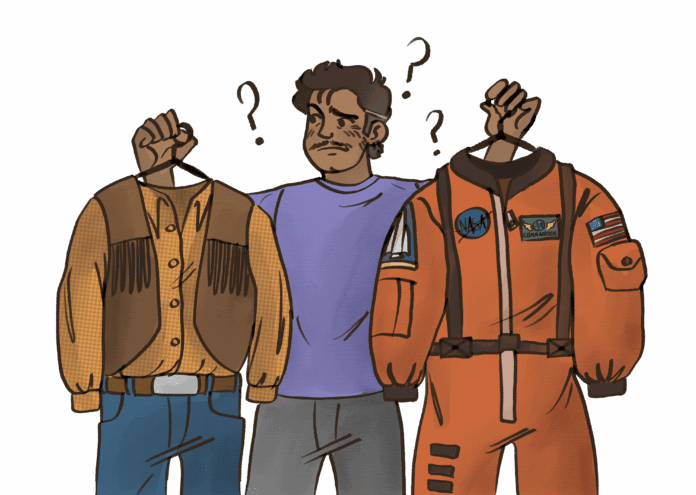
If you ever put on a costume, or even just wear a different style of clothing, you sense yourself embodying that role. Somehow, wearing the cape makes the man “super.”
Language does the same thing. While we might find that we can maintain the same disposition, morality or sense of self, as we are forced to change our verbal costume, so does our personhood change. There is no singular self in a world of code-switching; we become the way we use our language.
Written by: Violet Zanzot— vmzanzot@ucdavis.edu
Disclaimer: The views and opinions expressed by individual columnists belong to the columnists alone and do not necessarily indicate the views and opinions held by The California Aggie.