






How to induce the flow-state
I got you girl — from right here
By NEVAEH KARRAKER — nakarraker@ucdavis.edu
“Lord of the Rings.” “Star Wars.” “Harry Potter.”
It’s easy to get lost in the lore of incredible stories like these. I can spend hours studying elvish runes, ancient wars and the distinct fighting styles of each Jedi without a hint of boredom. And yet, when it comes to a basic Canvas assignment, I struggle to even start — that red and white logo just stares back at me with judgement, and frankly, a sense of looming doom.
I can’t imagine the things I’d accomplish if I approached my academics with the same enthusiasm I do with my hobbies. However, that sense of wonder doesn’t just disappear — it becomes buried underneath the stress of deadlines and exams. By overpowering passion with pressure, academic institutions indirectly suppress a students’ desire to learn — which is ironically the exact quality they’re looking to nurture. It’s like when your parents ask you to wash the dishes right as you’re about to do them on your own; the task has now been reduced to an obligation instead of a choice.
So, how do we revive that wonder?
Let’s be real, taking unique classes that pique our interest is not always a possibility. Higher education will always come with unwanted assignments, so it becomes the student’s responsibility to generate their intrinsic motivation.
Take this as a sign to try and see your coursework as an opportunity: an “I get to” rather than an “I have to.” Here are some tips that I’ve gathered to help you resist intellectual burnout — a little more than the standard advice to “get eight hours of sleep” (although that is equally important).
Fuel your body. Eat fruit and salty foods throughout the day to boost your electrolytes and consume protein to stimulate neurotransmitters tied to concentration and mood. Food is brain fuel, after all.
Romanticize the grind. Buy some new stationary, fix a snack of sliced apples, crank the volume up on a good playlist — treat studying as you would arts and crafts during the summer: wield that yearning for creativity and nostalgia.
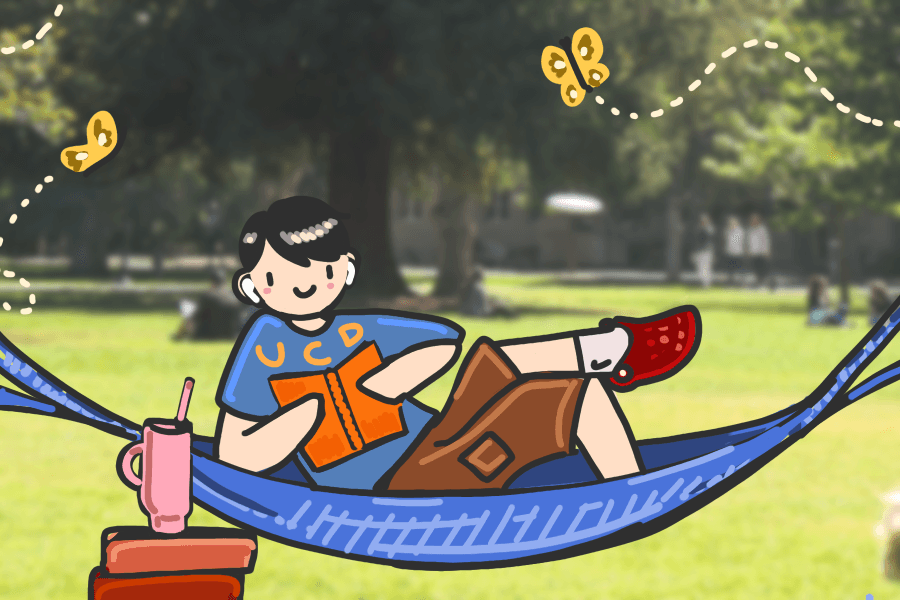
My personal favorite tip: trick your mind. Being immersed in a novel feels like entering a flow-state. Those that get it, get it (bookworms know exactly what I mean). That effortless, consuming focus you slip into when a story grabs your attention can be recreated with schoolwork by fabricating the environment around you. Set the mood with candles that dimly light the room and send the scent of tea wafting through the air. Can’t take a crack at that painstaking essay just yet? You’re not a history student, you’re a wizard at Hogwarts: that chemistry homework is just a polyjuice potion recipe.
Create a reward system. A second part of this little trick is to construct an incentive program, and take it seriously. Rewiring your brain to bestow mini dopamine shots every time you pick up your Apple pencil can be a very effective technique of motivation — fully embrace neuro-manipulation. Every time you finish a paragraph, treat yourself with a bite of chocolate. Hit play on your favorite show only once you’ve started studying. And, if you can’t focus in your room, go to the CoHo and make a firm rule: matcha is only for solving calculus problems. With consistency, you will have successfully correlated studying with the things you love the most, making your brain look forward to doing work.
Now, these tips are merely tools to reframe your attitude; They are not substitutes for balance or masks for exhaustion and burnout. Don’t forgo rest if you need it — nourishment is essential for productivity.
In the end, you have the power to respond to the rigid systems around you, even though your “laziness” is justified by them. Because you’re not truly lazy, you’re simply uninterested. If you can get emotionally invested in the politics of Middle Earth, you can learn how to become invested in your education. We can’t blame everything on the system; now that’s lazy.
There’s only so much others can do for us. My role is telling you this; Romanticize everything. The rest is up to your own drive and discipline.
Written by: Nevaeh Karraker—nakarraker@ucdavis.edu
Disclaimer: The views and opinions expressed by individual columnists belong to the columnists alone and do not necessarily indicate the views and opinions held by The California Aggie.