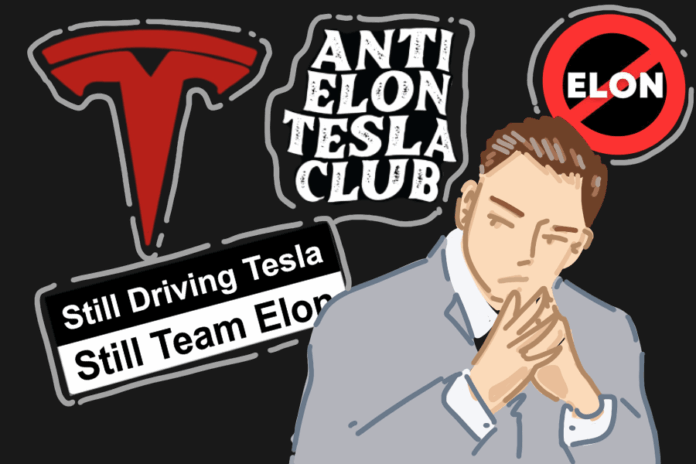
Loving the craft while hating the craftsman: Teslas and Elon Musk
By VIOLET ZANZOT— vmzanzotl@ucdavis.edu
If you need a surgery — a surgery so rare and specific that you feel cosmically unlucky to need it — I’m sure that finding the perfect surgeon would be a priority.
When searching for this surgeon, wouldn’t you be likely to consider their morals and ideals? If their morals very specifically contradicted your own, which do you sacrifice: the surgery from the best doctor or the insistence on upholding your strongest conviction?
The separation of surgeon and surgery, art and artist, craft and craftsmen is a quandary that broadly peaks my interest. Using the controversy around Elon Musk and his company, Tesla, as an example, it becomes clear exactly how nuanced the question really is.
Let me paint you a picture. It’s 2023, Biden’s Inflation Reduction Act passed almost a year ago, you just got a bonus at work and you are in the market for a new car. With their popularity exploding in your San Francisco suburb and their stock prices clearly rising — not to mention the tax credit advantages — a Tesla seems to be the most enticing option.
Now, flash forward two years: a new man is in office and the air feels heavier. As you drive to the job you feel lucky to still have, you reflect on the recent madness. You find yourself stuck thinking about the guy whose company made the car you proudly bought. He has been such a central character in the media cycle for almost two years —- his notoriety makes you angry.
You get home from work that day and the only thing you can think to do is buy a bumper sticker that reads: “I bought this before Elon went crazy.” You feel you have done your part; You love the craft, but you hate the craftsman.
Teslas are juxtapositions on wheels. They demonstrate why conflating the art and the artist is a one-dimensional way to look at a three-dimensional problem.
Think about the product itself: it’s a tech forward, eco-friendly and expensive automobile. With that in mind, the target audience should be future-focused, wealthier people who care about protecting the environment. And yet, Elon Musk’s political involvement with Trump seems to attract the opposite demographic. He is marketing himself to an entirely different audience than his company’s product might naturally attract. Part of the complication in separating the art from the artist is that they may have different intended audiences. Musk and Teslas are designed for different shoppers, but sold in the same store.
This discrepancy that arises between the creator and their product leads to another predicament. Generally, the product is largely intended to be a positive addition to society. Many people purchase Teslas because they want reliable cars that are less harmful to the environment. So, if the product is beneficial, does it matter who created it?
To add in another layer, I beg the question of how important a product’s creator should be to the consumer. Or, is it more important to focus on their expertise? If a person is very good at baking and that is where their knowledge lies, must we take their opinions on something like film seriously, or should we just accept the fact that they are speaking not as an expert, but as an interested novice?
The answer to that question may lead directly into the other dilemma: cancel culture. Our society is quick to judge creators — we dismiss someone’s products all together if we find out they committed a moral injustice that is unrelated to what they sell. Often, we decide how related a person’s actions are to their product based on the extent to which their actions bothered us. Would it be better to find the separation between someone’s personal and business endeavors before we discount them on account of a sensational story?
At the end of the day, the question of whether or not we should separate the art and the artists (or craftsmen and their craft) is not as simple as individual preference. The product and the producer are not always the same — we may love the product and it might benefit the world. Teslas are driving oxymorons and demonstrate how hard it is to be a consumer of both products and people in the modern world.
Written by: Violet Zanzot— vmzanzot@ucdavis.edu
Disclaimer: The views and opinions expressed by individual columnists belong to the columnists alone and do not necessarily indicate the views and opinions held by The California Aggie.