






A look into dinosaur ecosystems and its insights on evolution
Examining the various theories and evidence about life before the extinction of the dinosaurs
By EMILIA ROSE— science@theaggie.org
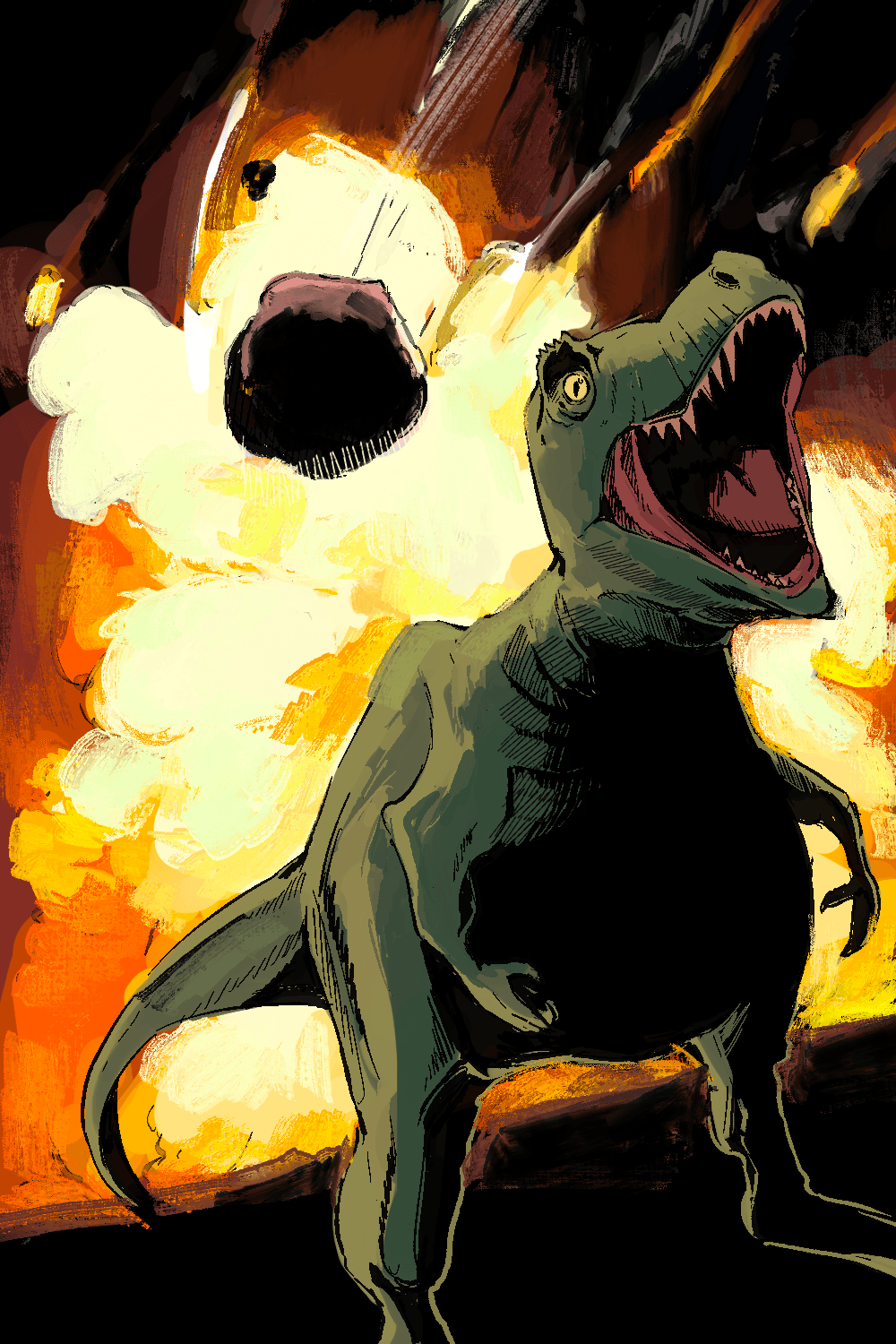
66 million years ago, an asteroid of similar size to Mount Everest collided with Earth with the power of 10 billion atomic bombs. Not long after, on a geologic timescale, nearly 75% of all animals died out; among the most notable creatures to perish during this era were the dinosaurs.
Among scientists in the field, a question remains: Were the dinosaurs already in decline, doomed before the asteroid hit, or did they die purely due to a sudden cataclysm?
One commonly-held theory argues that dinosaurs were already on the path to extinction prior to the impact of the asteroid. In a 2016 research article, paleobiologist Manabu Sakamoto commented on the specific evolutionary statistical trends within dinosaur populations.
“We find overwhelming support for a long-term decline across all dinosaurs […] where speciation rate slowed down through time,” Sakamoto said. “Our results highlight that […] dinosaurs showed a marked reduction in their ability to replace extinct species with new ones, making them vulnerable to extinction and unable to respond quickly to and recover from the final catastrophe event.”
By looking at the rate at which new dinosaur species evolved, researchers found that this rate was slowing down, leaving them more vulnerable to extinction. Thus, when the asteroid hit, they didn’t have that evolutionary buffer to keep them from dying out. However, a problem with these findings remains: How do we know that these findings support every dinosaur species, and not just a few?
“Because the fossil record has long been known to be incomplete, it is possible that the observed slowdown and downturn are byproducts of undersampling,” Sakamoto said. “This assumption would imply that there is a systematic downward bias in the phylogeny toward recent times.”
In this way, regions with more complete fossil data can disproportionately influence the assumed global trend. It is essential to note that, although Sakamoto and his team accounted for these biases in their calculations, this factor raises a concern about assuming general patterns of decline to be consistent across all regions.
Geerat Vermeij, a professor of marine paleoecology at the University of California, Davis, shared the same sentiment.
“Regional data cannot be easily scaled up to a global analysis,” Vermeij said via email.
Because of these sampling issues, it becomes way easier to find examples of regions where dinosaurs were thriving rather than declining.
In a research article published in October 2025, Andrew Flynn et al., discussed the uncertainty surrounding the diversity of dinosaur species before the asteroid, highlighting new evidence that they were, in fact, thriving in some regions.
“Ecological modeling shows that North American terrestrial vertebrates maintained high diversity […] with bioprovinces shaped by temperature and geography,” Flynn et al. said in the research article. “This counters the notion of a low-diversity cross-continental fauna.”
Additionally, Vermeij stated that marine ecosystems showed similar trends.
“In general, there were no declines in marine ammonites or most other molluscs,” Vermeij said. “Reef-forming rudist bivalves apparently became extinct before the end of the Cretaceous […] but marine systems thrived until the catastrophe.”
Even though Sakamoto and his team’s findings were statistically valid, especially since they accounted for many biases, several regions throughout both land and sea have been shown to counteract the idea that all dinosaurs were declining before the asteroid hit. Any assumptions that were made about the global average created an illusion of universal decline.
The fact that some dinosaurs were thriving right before the cataclysmic event confirms the notion that it is not always the strongest members of a species who are guaranteed success in a given environment. Just one sudden event can cause mass extinction.
“Crises are crises for the simple reason that they are rare, extreme events to which organisms are not necessarily adapted,” Vermeij said. “Most of these crises hit some kinds of organisms more than others, depending on whether they are or are not predisposed to dealing with unusual conditions.”
Often, chance mutations can lead to the survival of a rare cataclysmic event like an asteroid. The survival of any organism is not about “winning” in normal conditions — it is about being born with or developing traits that allow them to survive.
For the dinosaurs, one change, shock or environmental shift led to their extinction. Evolution isn’t purely a linear process or a reward for being the best in a given environment; we exist now not because the species that survived the asteroid were superior, but because they happened to have the traits to survive the storm — something the dinosaurs weren’t designed for.
“Resilience after [a] crisis is a hallmark of life in general,” Vermeij said. “Some groups can take advantage of newly-available opportunities and others cannot, but this is a recurrent pattern throughout the evolution of life. Crises reset ecosystems, but very often the new ecosystems come to resemble the old in terms of interdependencies and other interactions.”
Life today can be thought of as an echo of what came before. It is an extremely resilient force of nature, and yet some parts of it struggle to keep up, prompting extinction. When examining the demise of the dinosaurs and the many resets throughout Earth’s history, science shows that we would not be without those who came before.
Written by: Emilia Rose — science@theaggie.org