





Upside down and all around: ‘Stranger Things’ and Gen Z nostalgia
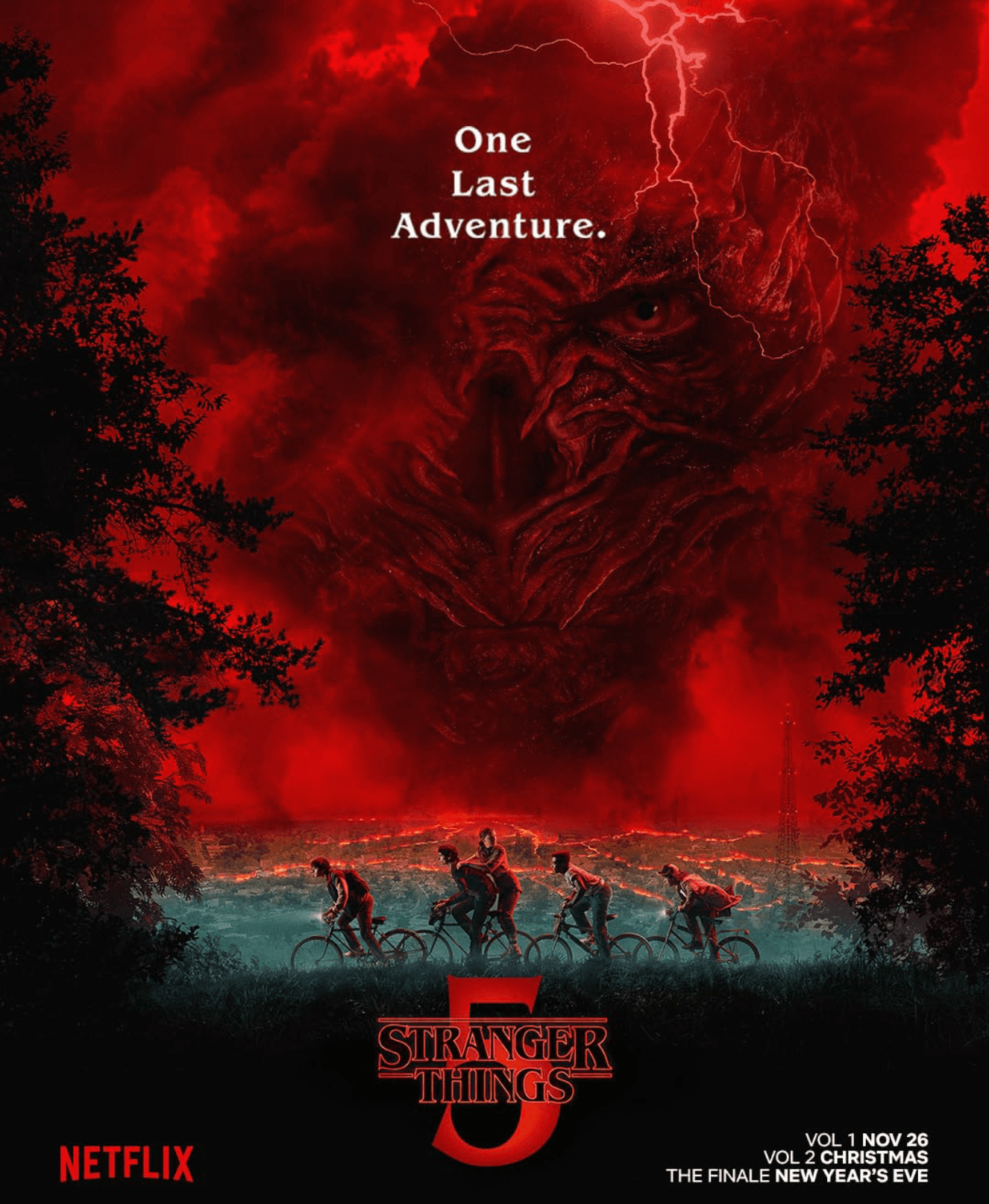
Why Gen Z is still enamored with ‘Stranger Things’ as it premieres its final season
By IQRA AHMAD — arts@theaggie.org
When “Stranger Things” first flickered onto screens in 2016, it wasn’t just another piece of nostalgia-laced science fiction: It became a phenomenon powerful enough to turn the world upside down. For Gen Z, many who grew up alongside the cast and watched the series evolve across its five seasons, the show has consistently commanded their attention upon each return.
Set in 1980s Indiana, “Stranger Things” chronicles the lives of a group of best friends, Will, Mike, Dustin and Lucas, whose ordinary world fractures when Will mysteriously vanishes on his bike ride home after a night of playing Dungeons & Dragons (D&D).
Their search for answers leads them not only into the dark shadows of their small town, but to Eleven, a quiet girl with a buzzed haircut and the unnerving power of telekinesis. What begins as a quest to find a missing friend quickly unravels into an encounter with sinister forces and an otherworldly, parallel dimension that challenges the concept of reality itself.
As the series premieres its final chapter — with volumes releasing on Nov. 26, Dec. 25 and Dec. 31 — its influence feels impossible to ignore. With all four previous seasons charting on Netflix’s Top 10 list and setting viewership records, the show’s reach has stretched far beyond its sci-fi niche. But, how did “Stranger Things” come to resonate so profoundly with a generation raised on hyper-connected media, visual storytelling and a relentless churn of pop-culture cycles?
Retro-rewind and Nostalgia
A central part of the series’ appeal lies in its meticulous curation of 1980s aesthetics and pop culture. From the use of iconic tracks like Kate Bush’s “Running Up That Hill” and The Clash’s “Should I Stay or Should I Go” to film references ranging from “Stand by Me” (1986) to “The Goonies” (1985) and even “The Terminator” (1984), the series utilizes homages to connect with various viewers.
“It’s a big Halloween bowl of retro candy,” James Poniewozik wrote for The New York Times. “It is, in other words, a human-made equivalent of the algorithm.”
“Stranger Things” exemplifies the way streaming television repurposes pop culture touchstones audiences already love, by packaging them into a bingeable, immersive viewing experience, according to Poniewozik. In this sense, the series does not simply evoke nostalgia, but embodies the streaming era itself: a medium defined by discovery, recommendation and the philosophy that “If you liked that, you’ll like this next,” according to Poniewozik.
These retro elements are not only decorative, but serve as a bridge between generations, according to Lubna Beary, a second-year cognitive science major.
“I obviously didn’t grow up in the 80s, but I did grow up listening to a lot of 80s American music and movies because of my dad,” Beary said. “So in that sense, I did experience nostalgia whenever I would notice a reference to an old movie or heard a familiar tune. References in general are always well-received by an audience, and help people feel more connected to what is going on by linking what they are already familiar with to something new and exciting.”
The show also exemplifies the nostalgia Gen Z chases through retro music, older movies and vintage fashion, according to Shaffana Mustafa, a second-year statistics and economics double major.
“I feel like Gen Z is heavily inspired from previous eras,” Mustafa said. “We’ve seen the return of low rise jeans, Y2K fashion, etc., and “Stranger Things” is very reminiscent of past eras. It also brings back nostalgia of magical and supernatural stories we grew up reading like Harry Potter and Jurassic Park.”
While the referential aesthetics of the show were key in shaping viewers’ fascination with the series, so did its original, now-emblematic moments, according to Chloe Zarrinkelk, a second-year linguistics major.
“I remember the image of Joyce’s Christmas lights and letters being everywhere,” Zarrinkelk said. “It was just so new for us at the time; everyone was addicted.”
Why Gen Z Can’t Look Away
The series’ ability to blend horror, sci-fi, thriller, comedy and drama is more than just stylistic flair — it mirrors the way Gen Z consumes media, according to Beary.
“The mix of genres — in combination with the pacing of each episode — allows the show to be engaging to a wider audience,” Beary said. “Our generation has a shorter attention span, so mixing genres like horror with sci-fi allows the audience to constantly be on their feet and guessing what happens next, whilst the occasional comedic relief prevents overstimulation.”
While the fusion of these different genres may be a reason why Gen Z can’t seem to look away, another possibility for why the show is so enthralling to viewers is the sense of figuring out the mystery as the series goes on, according to Zarrinkelk.
“‘Stranger Things’ does one thing really well, and that’s at the climax of the season when all [of] the separate plot lines come together,” Zarrinkelk said. “We have all these characters that have been working independently realize that everything is actually connected. It’s just so satisfying.”
Characters and Connections
At its core, “Stranger Things” is about connection: highlighting both the joys and challenges of friendship. Max Mayfield — who skated onto the scene in season two and solidified herself as a main character after her older brother became possessed by the Mind Flayer — for example, has resonated strongly with viewers like Beary.
“I consistently related to Max, especially with how her character was introduced as sort of an insert into the friend group,” Beary said. “It reminded me of my own friendships where I have felt like I didn’t belong with certain people. One of the most relatable aspects of her character was her use of music as a form of escapism throughout the seasons. The way her detachment and depression was showcased in season four was one of the most accurate depictions of what grief looks like on television.”
Beary noted that the friendships portrayed in the show, such as the bond between Max and Eleven, also demonstrate the importance of support and personal growth.
“Most times in shows, directors tend to pin the two girls in a group against each other, but ‘Stranger Things’ did the opposite, using their friendship as a way to grow Eleven’s individuality and expand her character beyond just a girl with powers,” Beary said. “Max showed Eleven what it meant to be a teenage girl and the importance of girlhood.”
This depiction of relationships applies across the cast. Characters like Steve Harrington evolve from self-centered teenagers into empathetic, supportive friends, demonstrating growth that mirrors real-life emotional development.
“Steve confesses his feelings to Robin, and instead of shaming her for being queer, he respects her and doesn’t tell anyone,” Beary said. “Given the norm of homophobia in the 80s, his reaction shows a lot about his development.”
Mustafa noted that these arcs give the series emotional weight, offering young viewers a mirror for their own struggles and growth; the realistic nature that both the characters and their relationships experience is another feature that has heavily shaped the popularity of “Stranger Things” among Gen Z.
“What makes it relatable is that the characters were also kids around our age and did kid-like things: played D&D, rode bikes everywhere, had crushes and all that,” Mustafa said. “At the end of the day, they’re still kids, except that they live in the 80s and fight monsters. The series shows the good, the bad and the ugly of friendships and how characters work to overcome them.”
By combining streaming-era binge habits, nostalgic elements and universal themes of childhood and friendship, “Stranger Things” is both immediate and timeless, according to UC Davis students. It’s a series built for a generation that grew up in the digital age while longing for old-school charm; appreciative of genuine connection and relationships, no matter the era.
Written by: Iqra Ahmad — arts@theaggie.org