






Are electric scooters making our campus more dangerous?
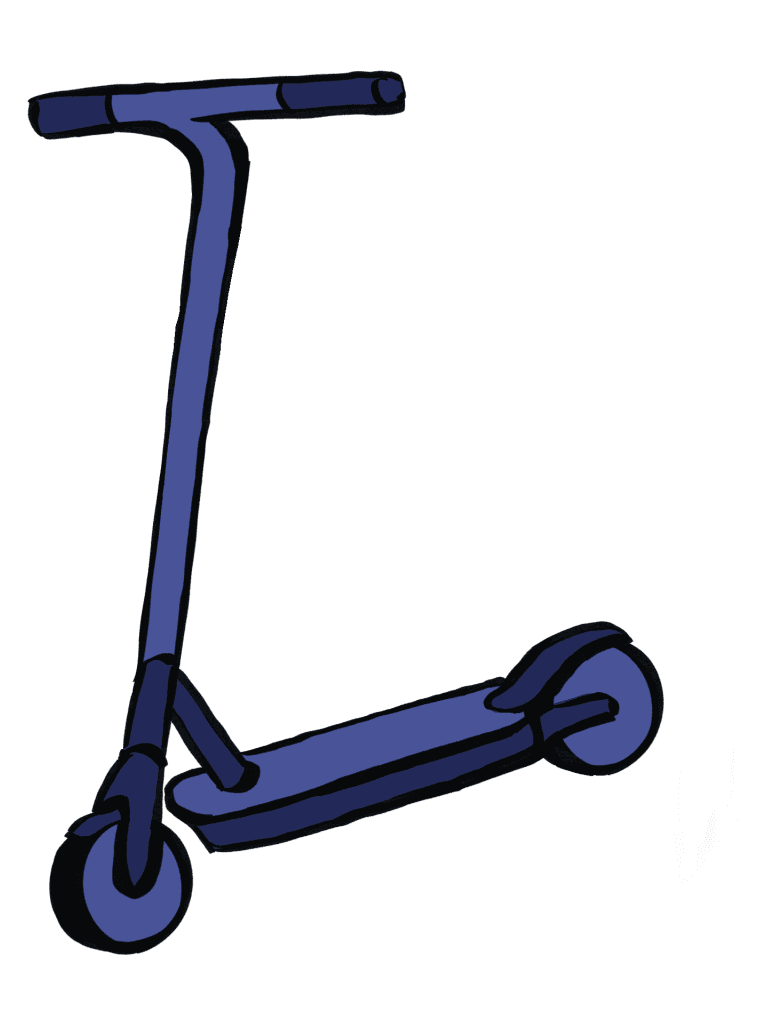
Unsafe riding practices and haphazard storage may impact student safety while navigating campus
By AMBER DUHS — features@theaggie.org
Picture this: It’s a foggy morning and you’re sluggishly walking to your 9 a.m. class across campus. An AirPod in one ear and a hot drink in your hand, you walk to the edge of the sidewalk to cross the street. You look one way, clear; you look the other way, clear. As you finally set your foot onto the asphalt and begin crossing, you hear a faint noise: a person on an electric scooter is hurling towards you at a solid 30 miles per hour. You step back in disbelief, as they zoom by — nearly missing you — and seemingly unbothered by the fact that they almost hit you.
As the largest of the University of California campuses, UC Davis has a long-standing tradition of encouraging students to walk or bike to class as a way to bolster environmental sustainability and an active lifestyle. UC Davis was home to the first bike lane in the United States, and Davis residents will often joke that the campus holds more bikes than students at times. Yet, as technology has developed, the electric scooter has appeared to create a trifecta of carless transportation on campus.
Electric scooters host a myriad of benefits when navigating the thousands of acres UC Davis sits upon, allowing students to get between classes quickly and cut down on commute times. For busy students navigating a heavy courseload, clubs, internships and sports, the speed and flexibility can feel unmatched.
However, many students who opt to bike or walk feel that the scooters themselves impact the safety of campus, especially due to their higher speed and the sense of carelessness that may accompany its riders.
“It’s more dangerous just because electric scooters can go really fast and most people who are riding them don’t really pay attention to all of the people walking,” Jeaneavy Vu, a second-year neurobiology, physiology and behavior major, said. “I think they just [think] ‘we have the right of way.’”
Beyond the typical electric scooter riders who zip around campus, there are also “Spin scooters:” rentable electric scooters that students can borrow and pay for by the minute. Mostly found in large urban centers — and now on college campuses — they provide an easy way for students to cross long distances when they’re in a time crunch, or ride back to their dorm once it’s dark and they no longer feel safe walking. They additionally enforce campus speed limits, as they’re programmed to go no faster than 15 miles per hour and will become immobile in designated “no-ride” zones.
The Spin scooters, however, present their own set of issues. With the easy grab-and-go service they provide comes the fact that there’s no singular designated space on campus for these scooters to sit when they’re not in use. This has resulted in scattered scooters everywhere on campus.
“Specifically the Spin scooters can be an issue as people just leave them wherever they want to after they are done,” Anya Stutz, a first-year neurobiology, physiology and behavior major, said. “I’ve seen them in the middle of sidewalks, in grassy areas and in general places where they shouldn’t be. They’re honestly just an eyesore.”
These scooters tend to be strewn about bike racks, often tumbling into properly stored bicycles or left on the side of the road — posing a potential danger to pedestrians and cyclists alike.
UC Davis has rules in place that are meant to keep students on campus safe, such as helmet rules and the designated 15 mile per hour speed limit for electric scooters, but it can be difficult to enforce when many scooters have the ability to go up to 25 or even 30 miles per hour.
“They’re unsafe and cause people to be a little stupid and reckless due to how fast they can go,” Stutz said. “People who ride scooters often don’t follow the rules, such as speed limits.”
This recklessness can cause crashes on campus, further complicated by the combination of the afternoon rush that all of campus experiences and the mix of students, bicyclists and the occasional bus or service vehicle. Due to the speed at which the electric scooters are travelling, especially compared to that of a bicycle, the crashes are often more detrimental, more dangerous and result in more damage to both parties’ vehicles.
“My sister has a scooter and she ended up running into somebody and ended up fracturing her leg,” Katherine Vu, a second-year human biology major, said. “I’ve only ever heard horror stories.”
While electric scooters are often a more convenient, or even more fun mode of transportation to choose, they can impact the safety of those navigating campus by foot or bicycle if not used properly. Despite the challenges electric scooters may present to road safety, regulations and safety systems are sure to evolve as bicycles and electric scooters learn to coexist at UC Davis.
Written by: Amber Duhs — features@theaggie.org