Learning pop culture as a Third Culture Kid
By ABHINAYA KASAGANI — akasagani@ucdavis.edu
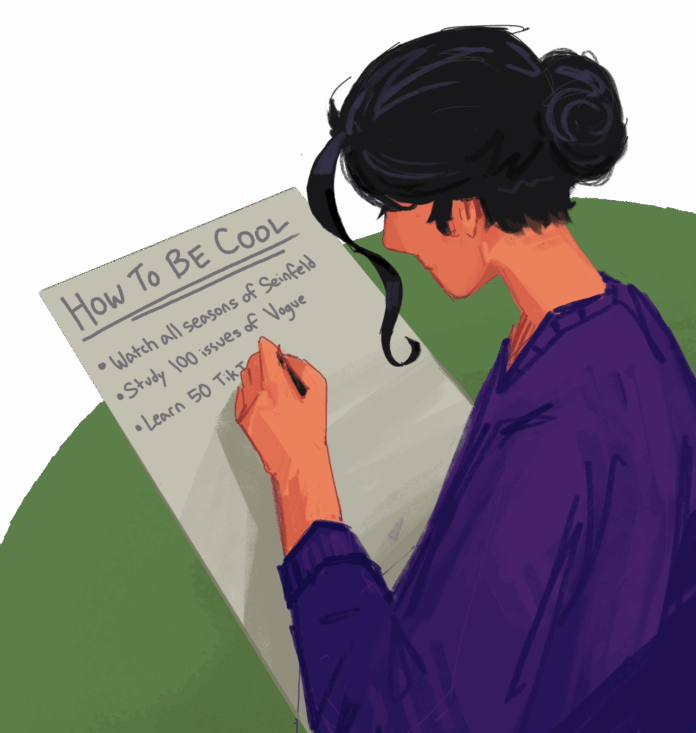
For as long as I can remember, the joke always went over my head. Growing up as a second-generation child automatically disqualified me from getting most references, and my parents had differing beliefs that there were bigger priorities than catching the season finale of “Seinfeld.” Whoever “cool” was, I was not allowed to befriend her. While I no longer fault my parents for this mode of operation, I deeply resented it growing up.
Despite having emigrated from India long before I came into the picture, my parents were far less concerned about being perceived as “cool,” and more preoccupied with building a life that was sustainable and freeing. While the emancipatory possibilities of their immigration brought them joy, I remained antsy about the very ways in which I walked through the world. Being second-generation meant that I had to parent myself (and occasionally them) in order to ensure that I never forsook any cultural capital I was offered.
“Cultural capital,” a term coined by sociologist Pierre Bourdieu, refers to the non-financial assets that influence one’s social mobility. For instance, working to acquire things like education, language, style or cultural knowledge allows you not only to assimilate for survival, but to successfully integrate yourself within a society.
As I was growing up, it was clear to me that my parents understood American systems quite instinctively. I, however, came to nothing easily. Like how a child learning a language translates a sentence word-by-word in order to understand, I, metaphorically speaking, began to do the same. My inability to speak anything other than English for the first 10 years of my life kept me from being entirely of any place — my identity is an amalgamation of a myriad of different influential cultures and elements.
This idea of being citizens of “everywhere and nowhere” is a popular rhetoric that comes up when one discusses their experience as an immigrant. Known as Third Culture Kids (or TCKs), a term coined by sociologist Ruth Hill Useem, these children tied their identities to people rather than places. While some argue that TCKs possess a broader worldview and awareness of social systems and institutions, others suggest that their frequent displacement leaves them questioning where “home” really is.
Most immigrants speak of an experience similar to mine, where the goal is often to be resilient as one engineers conditions within which they can survive. It has rarely occurred to them that the early onset of such imposter syndrome — brought about more evidently by the idea of an invisible cultural inheritance — makes certain references or ways of speaking feel inaccessible.
What was framed for years as something you either got or didn’t now reveals itself as a form of social currency that widens the gap instead of bridging it. Shielded from the American TV canon, music periods, celebrity gossip and fashion cycles, second-gen immigrants find themselves in what they believe to be a coolness deficit until they work to learn it themselves. My home life remained unburdened by the dominant culture as my parents remained unfazed. To them, witty exchanges and sprightly banter were not the goal; instead, they wanted tangible results that reaffirmed their life choices.
For hours on end, I studied pop culture as if I were expecting to be quizzed at any moment. Consuming various forms of media was often laborious, especially when you are more focused on “getting it” than caring about it. Over time, I learned how to consciously absorb the culture around me. I became more aware of how “cultural capital” worked to exclude those who cannot afford their social position. The paradox of learning what is meant to be inherited is that it moves you away from intentional tastemaking. In bridging the acculturation gap, one widens the space between who they are and who they used to be. The good news is that you can learn to get the joke; the bad news is that you might not even find it funny. There’s no use in fluency if you can’t say your piece.
Don’t get me wrong: I birthed my “cool,” and I am beyond proud of her. I am instinctive about her in ways that I wasn’t ever previously. She no longer laughs on cue or puppeteers for those who “get it.” In writing this, I am recognizing the death of the perpetual translator. I am now equipped with the language to orient myself in a world that my parents offered to me, without forsaking my identity as a TCK.
Written by: Abhinaya Kasagani— akasagani@ucdavis.edu
Disclaimer: The views and opinions expressed by individual columnists belong to the columnists alone and do not necessarily indicate the views and opinions held by The California Aggie.