The romantic fantasy author discussed inspiration for her latest novel, from resource wars to friendship
BY JULIE HUANG — arts@theaggie.org
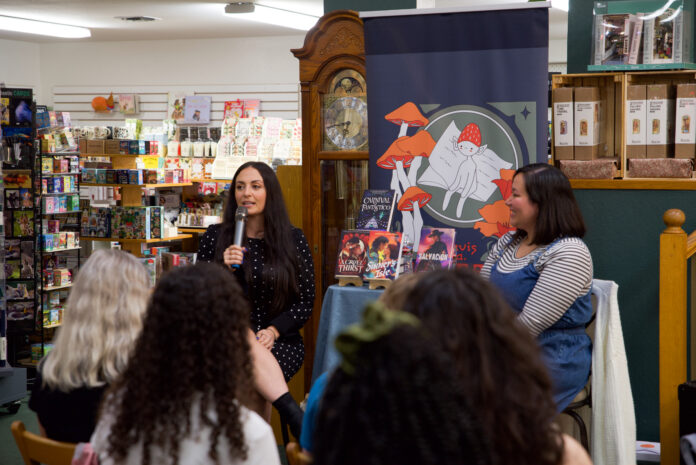
On Feb. 6, author Angela Montoya visited The Avid Reader to discuss her third and latest novel, “Carnival Fantástico,” published on Feb. 3.
Like her previous works, “Sinner’s Isle” and “A Cruel Thirst,” “Carnival Fantástico” is a blend of romance and fantasy, colloquially termed “romantasy.” However, Montoya noted that the process of writing her latest novel felt different from her previous endeavors.
“This time around, I trusted myself to tell the story and let it unfold more slowly, instead of hitting my readers with action right away,” Montoya said. “I learned from my other two stories that I could take the time to dive into this world a little more.”
Montoya’s setting for “Carnival Fantástico” was inspired by books like “The Night Circus” (2011) and “Caraval” (2016), which feature their protagonists navigating mysterious, tense circumstances in circus or circus-adjacent settings, intertwining elements of fantasy and romance.
“This story was a snowballing build,” Montoya said. “We had finished ‘A Cruel Thirst,’ and I was wondering what I was going to do next.”
Montoya was also inspired by “Revelle” (2023) by Lyssa Mia Smith; she complemented both the book and its author in her discussion.
“I started thinking, maybe I could try writing a story like that too, with Latinx characters,” Montoya said. “It’s automatically different from traditional iterations of these tropes because, unfortunately, a lot of people haven’t experienced Latinx characters before.”
Latinx characters are featured as protagonists in all of Montoya’s works. The nature of her novels as romantic fantasies is also influenced by Mexican culture, folklore and mythology.
“In ‘A Cruel Thirst,’ I wasn’t drawing on Eastern European vampire folklore, but Mexican folklore,” Montoya said.
Montoya also explained that her writing is guided by her awareness of the need for positive Latinx representation in media.
“Often, Latinx men are portrayed in only one light, as cartel members or villains,” Montoya said. “Those aren’t the men I’ve had in my life. I wanted to portray men that I know, like my son, partner and father, who are good, kind, beautiful men.”
In her work, Montoya aimed to push back against negative stereotypes and highlight the complexity and humanity of her characters.
“All three of the young men I write have not been your typical alpha-dude jerk,” Montoya said. “They’re not unkind, and that was purposeful. Every young man that I write is sensitive, sweet, pure-hearted and courageous. Maybe it takes a little time, but they’re good humans.”
Montoya explained that her characters exist independently of the romance that she writes for them. Before pinning anything else down, Montoya carved out the backstory for Esmeralda, the novel’s female protagonist.
“She’s a child that’s been left behind,” Montoya said. “She lives her life trying to prove her worth, and that carries her throughout the entire story. Everything she does is because she has this hole in her heart. How does that affect you as you grow into a young adult?”
Montoya also described the romance of “Carnival Fantástico” as a “second-chance romance,” shaped by miscommunication between Esmeralda and her love interest, Ignacio.
“I love all the scenes where they’re bantering,” Montoya said. “I love when people bicker. I don’t love participating in it, but I love watching it and writing it.”
Underneath the romance, the novel’s story is also shaped by a resource war that alters the lives of the characters.
“That subplot comes from my own perspective in life, and having my eyes opened over the last few years to what’s really happening,” Montoya said. “Thank God for social media, because it gives us a glimpse into the world that’s unfolding instead of what we’ve been told.”
Instead of existing parallel to the protagonists and their love story, the political and economic underpinnings of the novel’s setting directly inform its characters’ identities and developmental arcs.
“All his life, Ignacio’s been told that his country is the savior, and he believes it because that’s what he’s been taught,” Montoya said. “What do you do when the people that you idolize are actually the villains in most people’s stories?”
Offering hope throughout the narrative is the presence of friendship and sisterhood, which most clearly materializes in the form of Esmeralda’s friendships, according to Montoya.
“Esmeralda’s best friend is a sister, which helped her understand how to love someone even when they make you upset at times,” Montoya said. “This is great for Esmeralda because she doesn’t really know how to be a friend, and having these found-family friendships she’s built are really healing for her.”
On and off the page, friendship and community are crucial to Montoya’s writing.
“Being an author is hard because every day you have to ask yourself why you want to do this,” Montoya said. “Just having a few friends who really, really care has been everything to me.”
“Carnival Fantástico” is now available for purchase, and Montoya’s next novel is already in the works.
“It feels great, it feels exciting, it feels overwhelming,” Montoya said. “Honestly, it’s wild. I feel really lucky to be able to keep doing this.”
Written by: Julie Huang — arts@theaggie.org