






Consumerism rebranded
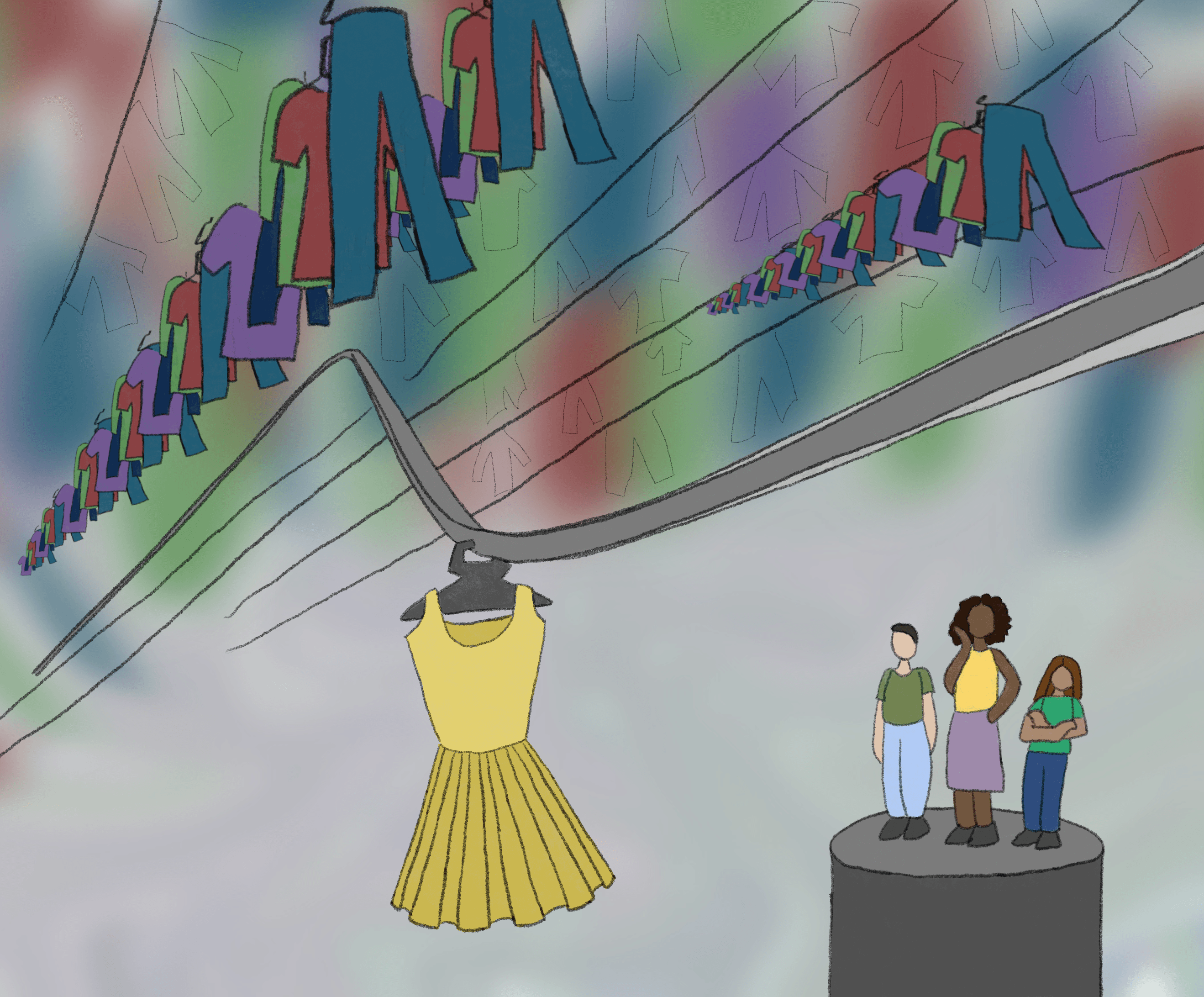
Has thrifting culture resulted in a new kind of materialism?
By ANJALI IYER — amiyer@ucdavis.edu
Last summer, my friend and I decided to visit the Goodwill bins in Sacramento as a post-finals reward. I was no stranger to the perils of the bins, having heard stories of friends finding used diapers and sanitary pads hidden among the chaos. Yet, the pay-by-the-pound system was far too enticing, so we snapped on our rubber gloves and began sorting through the piles.
As the afternoon progressed, I was becoming increasingly aware of a sinister presence lurking just beside us. It was a relatively unassuming group of boys who were sitting at the front of the store. They seemed harmless at first, but as my friend and I picked through the clothes, I noticed some of them had turned to observe us as they muttered amongst themselves. I was confused, but I dismissed their stares as mere curiosity.
After a few minutes, the doors to the warehouse opened and a worker rolled out a new bin of clothes. Without warning, the boys abruptly sprang from their seats and descended on the bin before anyone else could get to it. It was only as I watched them claw through the clothes with a ferocity comparable to that of a ravenous pack of wolves that I realized what they were: Depop resellers — people who patrol Goodwill bins to buy out thrifted items at their original price, only to sell these clothes at a vastly inflated price on popular websites like Depop or at flea markets.
Over the course of the last few years, Generation Zers have grown increasingly enthusiastic about thrifting. It’s no surprise that thrifting has garnered such popularity, as its core principles align with Gen Z’s generally progressive ideals. Thrifting is a relatively low-cost activity, which naturally makes it an affordable alternative to first-hand shopping. As young people struggle to afford basic costs of living, romanticizing frugality and democratizing fashion have become mainstream. Gen Zers also tend to be more concerned about the worsening state of our environment than previous generations, and thrifting is a practice that invariably helps keep clothes away from landfills.
It’s reasonable to assume that the environmentalist and egalitarian values behind thrifting would help remedy the constant flow of materialistic microtrends across social media platforms. After all, the wastefulness required to adhere to the everchanging trend landscape is an inherent antithesis to the core principles of thrifting.
Thrifting has allowed us to reconcile the pressure to stay “on trend” with a desire to remain politically conscious; it gives us a significantly less harmful way to consume fashion. However, it’s a superficial solution to the deeper issue behind modern overconsumption: materialism induced by a desire to keep up with the products, microtrends and lifestyles being sold to us on every platform at every turn. It’s resulted in a pattern of overconsumption we convince ourselves is sustainable, in which our impact on the environment is negated, but the fundamental desire to consume is still overtly prevalent.
As thrifting continues to soar in popularity, social media has become saturated with content advising audiences on where to thrift, how to find better pieces and what vintage brands to look out for. The TikTok-ification of thrifting has transformed the practice from a sustainable way to curate a personal style into another exhausting means of keeping up with online trends.
Social media’s fascination with thrifting has empowered an even more insidious group — resellers. Like the group of boys from the bins, resellers browse thrift stores to buy pieces at their secondhand price and artificially mark up their prices to turn a profit. Resellers operate by snagging trendy vintage pieces from cheaper, second-hand stores and curating a catalogue of thrifted items to sell at absurdly high prices. This practice inherently excludes people who may genuinely rely on the affordability of thrift stores, as there are no rules that regulate acceptable markup prices. A quick scroll through Depop reveals that one seller markets an Amazon tube top as a “statement piece” and another prices a polyester top at $42.70. And yet, the site metrics show that multiple people have sent offers to the seller or have the items in their carts, indicating their intent to buy it. Despite the flaws of the system, it’s undeniably successful.
The inflated prices associated with curated thrift have distorted the practice into a modern status symbol that works in tandem with shifting microtrends to feed a culture that encourages overconsumption. As resellers raid thrift stores, they shamelessly profit off what used to be an anti-capitalist and environmentally conscious movement.
It’s unrealistic to demand individual change as a means to overcome our cultural obsession with consumption, especially in a country that rewards excessive accumulation. It’s especially difficult to divorce ourselves from the pressure to consume in a technological landscape that survives — nay, thrives — on pushing adverts to our feeds.
All we can do is be critical of the pieces in our carts and ask ourselves: Do I really need another pair of low-waisted, straight-cut jeans? After all, it’s only a matter of time before it’s replaced by 2016 skinny jeans as the next “need to have” item in your closet.
Written by: Anjali Iyer — amiyer@ucdavis.edu
Disclaimer: The views and opinions expressed by individual columnists belong to the columnists alone and do not necessarily indicate the views and opinions held by The California Aggie.