






Review: ‘The Secret Agent’ rivetingly depicts life under authoritarianism
The acclaimed Brazilian political thriller balances brutality with empathy
By JONAH BERMAN — arts@theaggie.org
Our newest inductions into the cinematic pantheon have little in common, but if they share any trait, it’s this: So often, their protagonists are struck by the beauty and terror of memory. Whether due to tragedy, resilience or resistance, characters struggle with the legacy of generations past. While many recent features have addressed this only peripherally, “The Secret Agent” brings the power of history to the forefront, and in the process, creates a “sui generis” thriller as powerful as it is engaging.
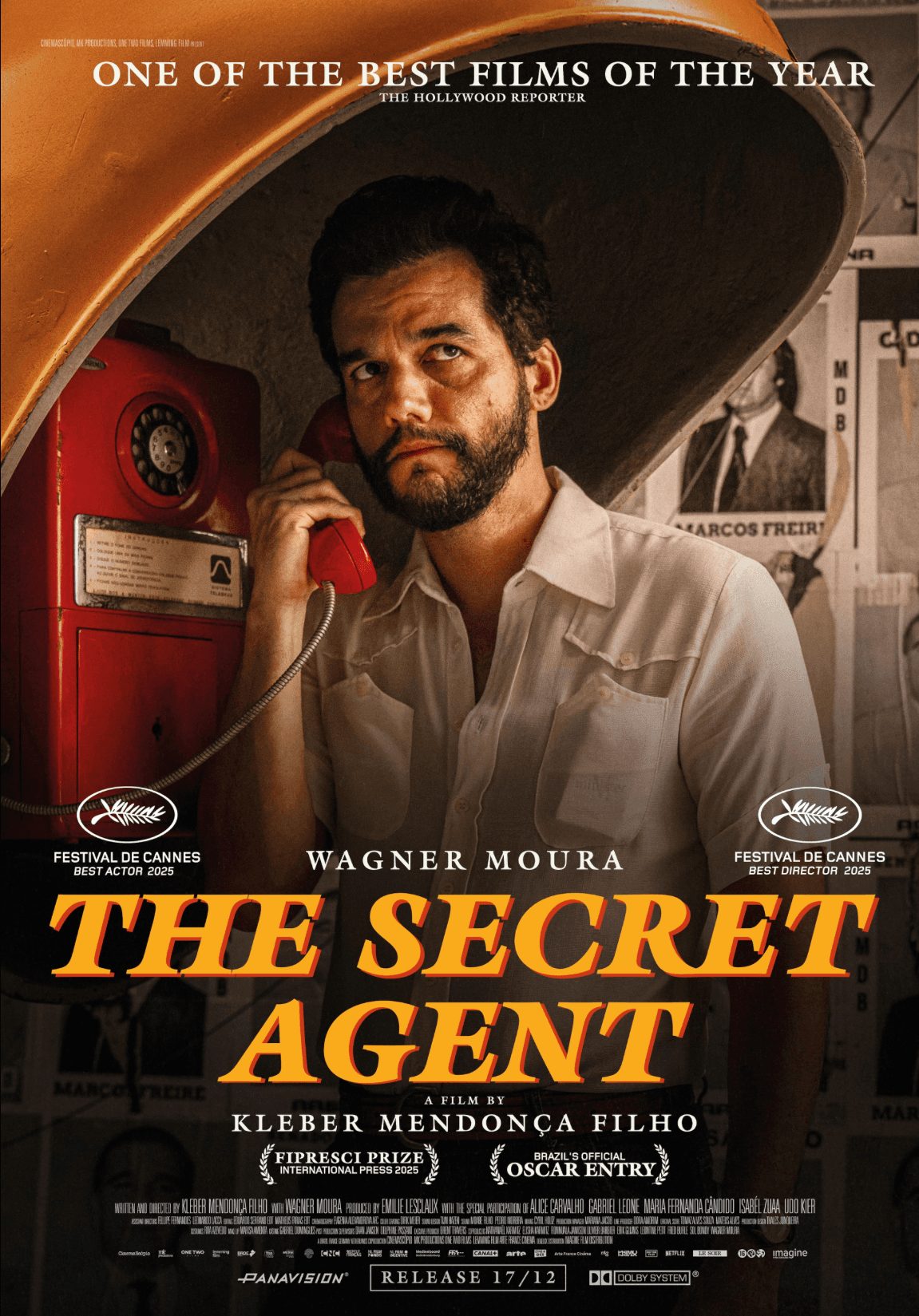
“The Secret Agent” is thematically centered around the brutality of Brazil’s military dictatorship, as Armando Solimões (Wagner Moura), an academic pursuing innovative research, flees from his university after his colleagues are threatened and assumes a new identity as Marcelo Alves in the Northern Brazilian city of Recife.
The film has been nominated for four Academy Awards, including Best Picture and Best Actor for Moura. It marks the fourth feature for Kleber Mendonça Filho, director and former film critic, who also penned the script.
The film’s nearly three-hour runtime is certainly not unearned — at no point did any scene induce boredom — but the screenplay’s structure might feel too back-heavy to some.
Due to the film’s expansive ensemble and layers of subtext, it takes an exceedingly long time for all the story’s pieces to fall into place; by the time it feels like the film has truly “begun,” it’s already half-over. But while the journey may lose some, the destination more than makes up for it.
The shot composition and editing are superbly well-matched to the neo-noir style the film pursues. Cinematography buffs may note the film’s occasional use of split-diopter shots, in which an additional piece of convex glass is placed over half of the camera lens. This technique is a microcosm of cinematographer Evgenia Alexandrova’s knack for visual language; for example, one use of the split-diopter shows the emotional distance between Alves and his son, whom he has not seen in years.
The film also makes frequent use of wipes and dissolves to transition between scenes, along with seemingly unmotivated zooms at the end of shots. This is because not only is “The Secret Agent” set amongst the backdrop of the 1970s, but it also reflects the filmmaking of that era in both content and form.
Mendonça has cited the influence of the New Hollywood movement, including Directors Martin Scorsese and Brian De Palma. New Hollywood often interrogated the inconsistent ethical codes on both sides of the law, forcing the audience to reckon with how characters find meaning in arbitrary and brutal societies. This tonal nuance suits a story like “The Secret Agent” perfectly.
For instance, although Alves flees from violent government forces in South Brazil, he nevertheless must collaborate with a corrupt municipal police chief in Recife. Steven Spielberg’s “Jaws” (1973), often screened at the cinema where Alves’ father-in-law is a projectionist, also takes on a metatextual role within the film.
However, many of the 1970s classics featured protagonists who acted more like stoic paragons of hyper-masculinity than three-dimensional characters. Instead, Mendonça’s filmmaking allows space for the characters to truly sit with their emotions and reckon with the authoritarian regime under which they live.
Moura, who gained prominence for his role as Pablo Escobar in the Netflix series “Narcos” (2015-2017), delivers a knockout acting achievement more than worthy of the many awards it has received so far. Moura’s performance, reserved and simple at first, reveals itself to be a nesting doll that gives the audience more to chew on with every new line delivery or passing glance.
Dual roles, all the rage as of late, require a rich understanding of multiple characters’ psychological nuances, and Moura’s emotional tightrope act is no different. In flashbacks that show Alves’ life before he became Marcelo, his confidence gives a glimpse into a man who has not yet been terrorized by the regime; this bygone assertiveness makes Alves’ pain in Recife all the more searing.
The film does not center only on Alves’ chilling predicament, however. Many important scenes are cross-cut with a historian, Flavia, listening to recordings of Alves in the present day. The recordings are then presented to Armando’s now-adult son, Fernando, who is also played by Moura.
Flavia, through this listening, becomes an audience conduit, now privy to the history but unsure what to make of it. This temporal construction is a stroke of genius on the part of Mendonça, who was awarded Best Director for the film at the Cannes Film Festival last year. He has noted how, during the filmmaking process, he foregrounded the film’s political themes with the context of current Brazilian politics, which have been characterized by democratic backsliding in recent years.
Through this epilogue, the audience must wrestle with the same question as Flavia: How should we look towards the past? “The Secret Agent” provides the answer: not through sterile analysis and emotional remove, but through intensely personal moments of love, anguish and tenderness. Then, and only then, do we have the power to use history not as a means to justify our pessimism, but instead to color the present with the hues of memory.
Written by: Jonah Berman—arts@theaggie.org