






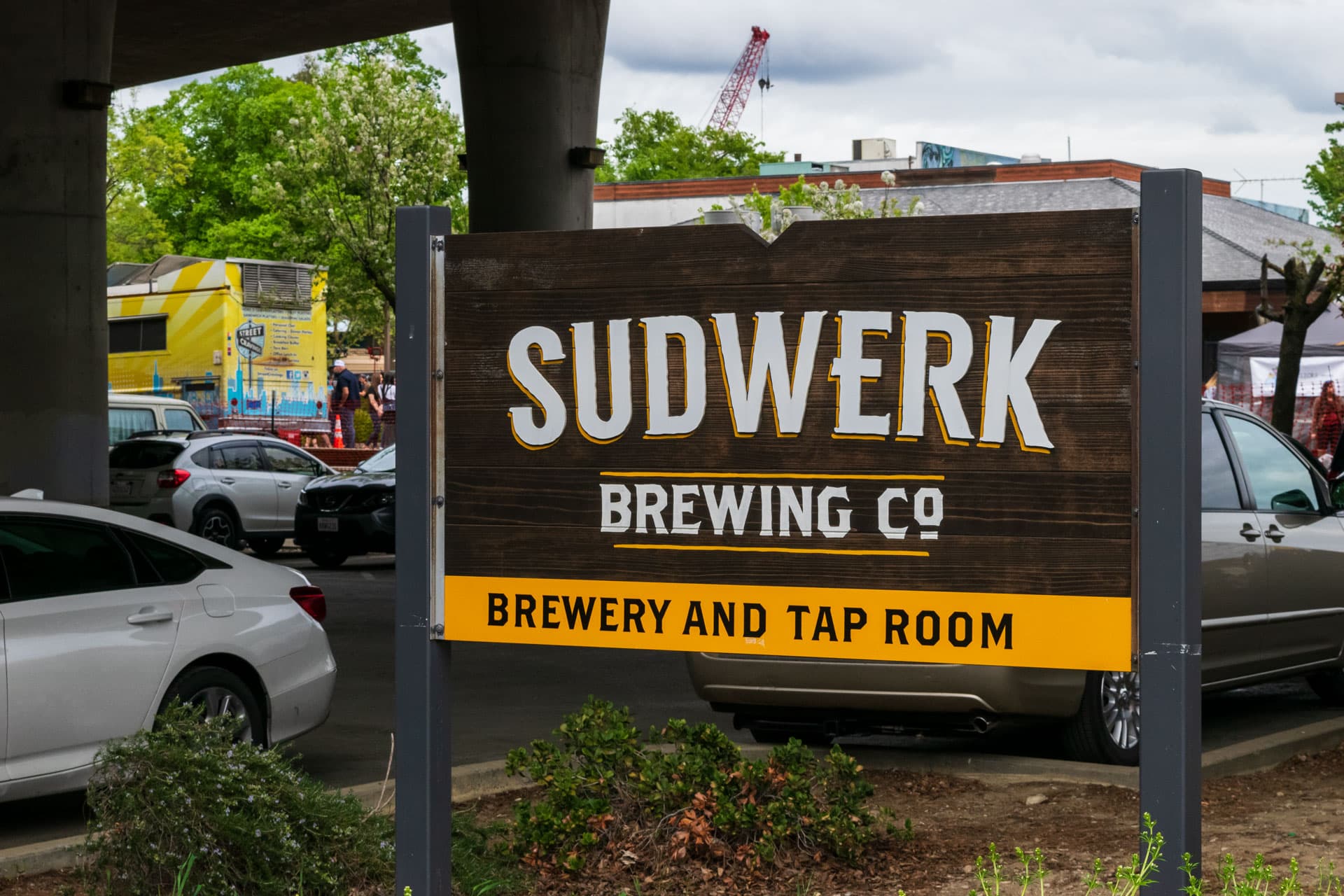
Sudwerk Brewery hosts ‘Astronomy on Tap’
Dr. Sean Carroll and Dr. Andrew Wetzel give astrophysics talks to Davis community
By SONJA WOOLEY — city@theaggie.org
Davis students and families gathered at Sudwerk Brewery on Thursday, Feb. 5, to hear talks on supernovae and the fate of the cosmos by Dr. Sean Carroll, a professor of natural philosophy at Johns Hopkins University, and Dr. Andrew Wetzel, a professor of astronomy and physics at UC Davis. The monthly event was put together by the Davis chapter of Astronomy on Tap (AoT), an organization that hosts science education events at local bars and breweries.
AoT was founded in 2013 in New York City by Physicists Meg Schwamb and Emily Rice. It has since expanded to cities across the United States and to international locations including Canada, Chile and Taipei. The Davis Chapter of AoT was founded in 2018 and is currently led by graduate student Kelsey Glazer and the UC Davis Physics and Astronomy Department along with graduate students Paige Kelly, Darshana Mehta and Emily Hoang and UC Davis Associate Project Scientist Sam Schmidt. They host AoT events at Sudwerk brewery on the first Thursday of every month.
Glazer spoke about what AoT brings to Davis.
“It’s a way to get the community together and essentially get to hear about the latest and greatest stuff going on in the field,” Glazer said. “The heart of AoT comes from the general public of Davis, where we pull in parents, students, teachers, retirees, everyone across the spectrum.”
Brian Khov, a third-year physics major who attended the event, shared his enthusiasm.
“I just really love astro stuff, it relates a lot to physics and I think it’s one of the most interesting things,” Khov said. “With astronomy, you just look out and see the stars, and I think it’s just one of the most beautiful sights you could ever have. Astro[nomy] is just so cool.”
Wetzel also spoke about the value of the AoT events.
“Meeting people who are just [as] enthusiastic about astronomy helps fuel my interests,” Wetzel said. “I feel a certain sense of responsibility or duty because I’m funded by the state, [and] I get a lot of federal grants, so I consider a part of my job is not just to write papers that are mostly read by other experts but to communicate those findings.”
The AoT organizers also gave a presentation on current science news, including the announcement that the James Webb Space Telescope had recorded the most distant galaxy ever discovered on Jan. 28; an update on the launch date of Artemis II, the first manned NASA mission around the moon since the Apollo 17 flight; and the detection of a new supermassive black hole collision which helped confirm Einstein’s theory of general relativity.
Carroll focused his talk on the scientific concept of entropy and its importance to the study of cosmology.
“Everything you do, all the eating of food and sweating and making noises and everything, increases the overall entropy of the universe,” Dr. Carroll said. “In the future, there’s going to be a bunch of black holes, because all the stars in the universe will fall into black holes eventually […] Stephen Hawking says [the black holes] will radiate away into nothing, and the future of the universe, as far as we know, is empty, cold, desolate space. Enjoy your drinks now. There’s no beer being served in what we call the dark energy-dominated universe.”
Wetzel also described his research on the evolution of the Milky Way Galaxy at UC Davis, and explained that the upcoming launch of the Nancy Grace Roman Space Telescope will greatly aid in his research.
“What I do is I take the laws of physics as we know it and translate them to computer algorithms, and then use them to generate models of our Milky Way Galaxy,” Wetzel said. “Thus far, we’ve only been able to chart a tiny, tiny fraction of the stars in our Milky Way Galaxy. But the Nancy Grace Telescope will produce a catalogue of some 20 billion more individual stars. It will make Hubble seem like tunnel vision.”
Wetzel also focused his discussion on the study of supernovae.
“Ultimately, supernovae were vital to the emergence of life,” Dr. Wetzel said. “Most of the carbon oxygen [and] iron [in our galaxy] were produced in these supernova explosions. So think about it: most of the oxygen you’re breathing right now was created in a supernova explosion.”
The next AoT talk will be held on March 5 at Sudwerk Brewery.
Written By: Sonja Wooley — city@theaggie.org