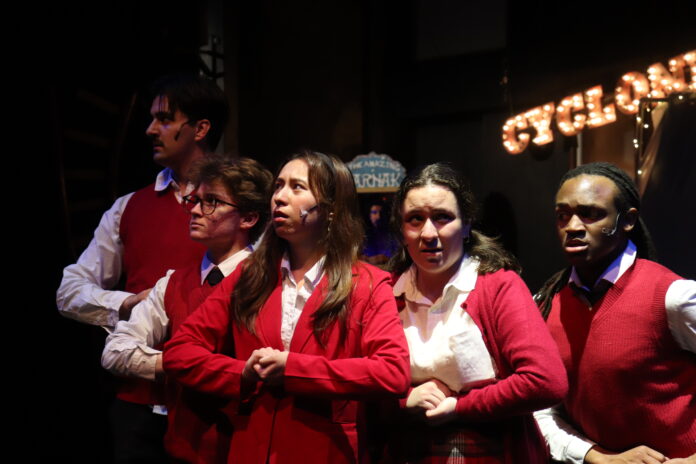
Studio 301’s sold-out production delivered a momentous, dark comedy at the Wyatt Pavilion Theatre
By IQRA AHMAD — arts@theaggie.org
Studio 301’s rendition of “Ride the Cyclone” premiered this past weekend on Feb. 27, Feb. 28 and Mar. 1, selling out every seat at the Wyatt Pavilion Theatre. The student-run company took on a show that’s equal parts dark comedy, pop concert and existential gut punch, delivering a fast-moving production that felt both polished and daring in its simplicity.
“Ride the Cyclone,” directed by Eli Gunn, a second-year communication and sociology double major, centers around a group of six St. Cassian High School students from the small town of Uranium, Saskatchewan, who died in a roller coaster accident on “The Cyclone” and entered a surreal limbo state.
The group: Ocean O’Connell Rosenberg, the fiercely ambitious overachiever; Constance Blackwood, the warm and loyal optimist; Mischa Bachinski, a tough-talking Ukrainian adoptee with a hidden vulnerability; Noel Gruber, a melodramatic romantic longing for more beyond his hometown; Ricky Potts, a quiet and misunderstood dreamer; and Jane Doe, a mysterious girl with no memory, no family and no name, are greeted by a mechanical fortune teller, Karnak, who offers one of them a chance to return to life.
Staged in a thrust configuration, a stage that projects and extends into the audience on three sides, Studio 301 treated the space like a feature, not a limitation.
“I’ve never seen any musical or play performed on a thrust stage, and I’ve always wondered how it really works,” Ezra Kotovsky, a second-year mechanical engineering major, said. “I’ve done theater in the past and a big part of theatre is ‘cheating out,’ which is when you’re always facing the crowd even in dialogue. But, inevitably, when you have a crowd that wraps around, your back can sometimes be facing the crowd, so there were points when I was like, ‘Is this a bad place to be sitting?’ But they used the stage really intentionally, especially with the choreography, so that there really was no bad place to sit.”
The momentum matched the structure of the musical itself. “Ride the Cyclone” doesn’t offer the audience much time to breathe, and Studio 301 leaned into that relentlessness.
“You felt like you were really in the musical the whole time,” Kotovsky said. “They really harnessed the fact that it was only a two-hour play and built so much momentum. There were no breaks and I think something that made the show really fun was that all of the characters were involved pretty much in every scene.”
One of the biggest surprises of the night were the minimal but effective props. Studio 301 relied on lighting, projection and performance to build the limbo state that the characters were placed in. The musical featured projections of childhood photo galleries and flashes of the characters’ backstories to build the personas of the characters.
“I thought the set was really well done,” Liliana Gavin, a second-year cognitive science major, said. “It was simple in a way that didn’t detract from what was going on on stage, but the use of the screen and all of the different transitions between characters was really well planned. I also thought the character in the box [Karnak] had a great prop and stayed in character the entire time.”
Members of the audience were taken by Jane Doe, as her first entrance hauntingly snagged their attention.
“Jane Doe enters in full makeup,” Kotovsky said. “The makeup and costumery clearly had so much attention to detail. Jane Doe begins to sing in an opera-like voice and from there, my expectations were definitely blown away.”
Gavin also attested to this perspective, discussing the striking nature of Jane Doe’s presence and persona.
“I think the big, shocking moment for me was seeing the character of Jane Doe,” Gavin said. “I was familiar with the musical before, as my housemate was the choreographer, but the moment when Jane Doe entered the stage from behind the white screen with her costume and makeup, I was shocked. Her doll-like movements and vocals were really unexpected.”
What made each performance especially compelling was the cast’s commitment to remaining in character — even when not the center of a scene. Small background gestures, glances and actions rooted in the characters’ personas kept the stage alive at all times. The cast did not just take the spotlight in their individual numbers, but treated the limbo state as an all-encompassing, realized world.
The costumes were also noted by audience members, who described them as a series of surprises, full of little quirks of character.
“The outfits didn’t really convey much, but there were minor things that stood out to me about each character,” Kotovsky said. “Ocean was wearing a blazer which definitely suits her academic personality, versus Constance, who’s wearing a cardigan which suited her more. Mischa also had an unbuttoned shirt with the collar a bit astray. It was super effective because everyone is wearing the same top and slacks with [a] little tweak.”
The hidden natures of the characters came through in each performance across the ensemble. Gavin pointed out how many characters shared similar experiences in their small town of Uranium, but that the musical developed and revealed their personalities.
“This musical really felt like a story about people’s hopes and dreams,” Gavin said. “It showed that there are moments in life that people might not have shared with others and that people have these hidden parts of themselves. The musical showed what makes life meaningful in a way, because they’re trying to figure out who deserves the opportunity to live by some metric. But at the end of it all, it came down to the characters’ compassion for this girl [Jane Doe] who didn’t have anything.”
Even the characters that initially felt archetypal, like the academic overachiever or the rebellious “bad boy,” were given the room to complicate themselves through the numbers.
“‘Ride the Cyclone’ will take you on a roller coaster, up and down and around every story trope that you think it’s headed,” Kotovsky said.
By the time the ending arrived, the production earned its bittersweetness, with enough closure to feel intentional and ambiguous at the same time.
“I feel like even though it was a comedy, it was also a bit sad and sweet,” Kotovsky said. “For example, Jane Doe was inherently tied to comedy; she’s a pitiful character and has had such an awful time, but she’s granted the chance to go back to her life which was full circle. It’s both sad and funny at the same time.”
In the end, “Ride the Cyclone” doesn’t offer any easy answers or neatly resolve the absurdity of loss or impossible nature of measuring life’s worth. Studio 301 embraced that uncertainty with confidence, and allowed the characters and audience to sit with the uncertain nature of life and the hereafter. The production garnered a standing ovation after the show, capturing the powerful impact and admiration held by the audience.
If this production is any indication, Studio 301 shows no signs of slowing down. As they prepare auditions for their spring quarter production of “Chicago,” prospective fans can follow along with their journey on their website and Instagram, @studio301productions.
Written by: Iqra Ahmad — arts@theaggie.org