Clavicular and the mainstreaming of 4chan speech
By MILES BARRY —mabarry@ucdavis.edu
Clavicular is the online moniker of Braden Peters — a 20-year-old from New Jersey who live-streams for eight hours a day. Clavicular had a relatively normal childhood. Then, at age 14, he discovered Looksmax.org, an online men’s group dedicated to “looksmaxxing,” or the attempt to become more conventionally attractive through extreme tactics.
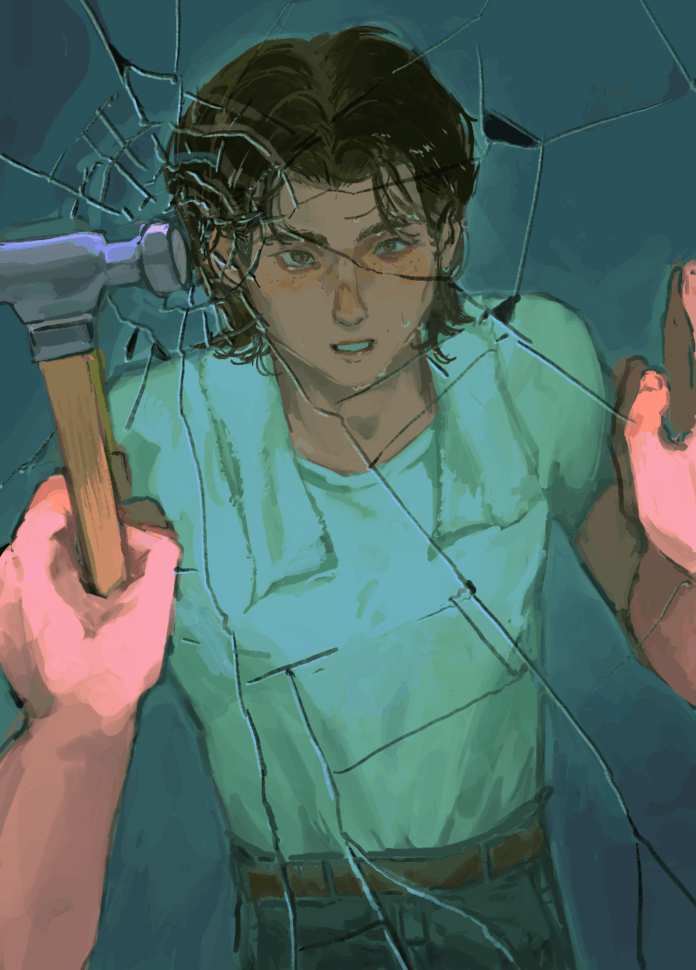
Clavicular began posting on this forum so frequently that he was made a site moderator. At the same time, his looksmaxxing techniques became more and more grotesque: He took steroids to gain muscle, abused methamphetamine to stay lean and routinely tapped his face with a hammer to produce sharper cheekbones. These measures led to his eventual expulsion from college for steroid possession and, by his own admission, his likely infertility due to experiments with testosterone ingestion.
Clavicular’s popularity has been primarily driven by the absurd language that he and his community use. His content features “mogging” — in which another man stands next to Clavicular and they both preen, trying to look more attractive for the camera. It also involves talking to “normie foids” (less-online women) at bars and “jester gooning,” a term for joking around. Clips of these encounters go viral because the vocabulary is memorable — terms like “mogging” and “jester gooning” are funny, strange and shareable in a way that Clavicular himself is not. In interviews and live-streams, he actually seems quite boring. He isn’t funny, he has edgy, half-baked political beliefs and he isn’t particularly personable. His fame is a linguistic phenomenon more than a personal one.
Growing popularity has made Clavicular a walking, hollow-cheekboned gestalt. Writers have tried to understand him by comparing him to a medieval monk (extremely ascetic), a fig wasp (single-mindedly devoted to a cause), a World Wrestling Entertainment (WWE) wrestler (performing combative masculinity), a performance artist (producing extreme public-facing content), a male version of a drag queen (using campy techniques to perform male beauty) and a radical submissive (completely shaped by social media algorithms). He’s graced the pages of the New York Times, GQ, the Atlantic, Vice, Playboy, Complex and New York Magazine, but was practically unheard of until December 2025, when his content gained traction on TikTok and Instagram.
I can’t help but think that Clavicular might be closer to suffering from mental illness than being a “performance artist.” The more I read, the worse I feel for him — his teen years were spent chatting with anonymous men who encouraged him to irreversibly modify his body. Despite my sympathy for him, very specific cultural tides have carried this injured young man to our screens and our newspapers. Examining his rise allows us to measure these evolutions, and to discuss how an individual can embody larger cultural forces.
Antonio Gramsci was an Italian philosopher who wanted to understand how ideology becomes common sense — how a set of ideas can become so embedded in everyday life that they feel natural and inevitable, rather than political. He developed these ideas over the last decade of his life, spent in Benito Mussolini’s prisons.
Gramsci began with what he called “spontaneous philosophy.” This is the raw material of culture — the ideas contained in language, conventional wisdom, empirical knowledge and popular religion. We use spontaneous philosophy every day without thinking about it. A given social group, Gramsci argued, will find certain ideas within this raw material more resonant with its own everyday experience than that of others. Over time, the group develops a shared worldview built from these resonant fragments and starts to vie for cultural hegemony as their particular set of ideas feel natural and inevitable, even to people who don’t necessarily benefit from them.
As the group’s ideology gains popularity, all members are not equally responsible for its rise. Gramsci argued that these groups produce (and are produced by) “organic intellectuals.” These intellectuals aren’t just professors, artists and writers; they can be factory workers, plumbers, priests — figures who function to further their group’s productive activity and general principles.
Clavicular has received so much media coverage precisely because he is an organic intellectual for a group that has been gaining cultural capital for some time: right wing incels who spend too much time on 4chan (an anonymous imageboard that’s become a popular hub for internet culture and controversial or extremist discussion). Their ideology — that human social life is a biological hierarchy, that women are objects to be evaluated, that attractiveness determines your worth — has been seeping into spontaneous philosophy through language for some time.
Linguist Adam Aleksic recently noted that “when you go back and do an epidemiological analysis of how Gen Z slang broke contagion, the patient zero is almost always African-American English or 4chan, or something adjacent to it.”
I frequently hear my peers across the political spectrum unknowingly or ironically using terms that came from 4chan; things like “simp” (a man who will do anything for a woman he’s romantically attracted to), “based” (used to express agreement with an idea) or “chad” (a hyper-masculine, alpha male). Even when terms like “mogging” and “jester gooning” enter mainstream usage ironically, their associated ideology starts to become common sense. Kids using “mog” on the playground aren’t endorsing social Darwinism, but they are reproducing a framework in which people are ranked by physical dominance all the same. This is hegemony being built through language.
Written by: Miles Barry—mabarry@ucdavis.edu
Disclaimer: The views and opinions expressed by individual columnists belong to the columnists alone and do not necessarily indicate the views and opinions held by The California Aggie.