Really? Not even a thank you?
By NEVAEH KARRAKER — nakarraker@ucdavis.edu
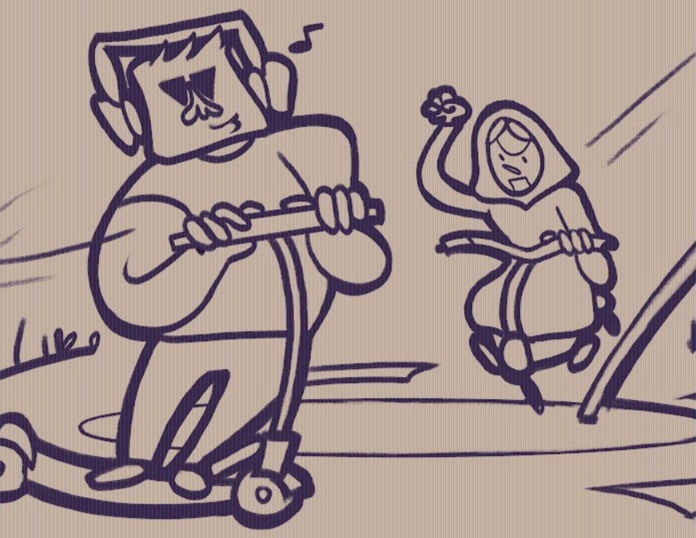
The lack of situational awareness on campus has become enraging. Between classes, I’ll be walking with a friend behind someone in the middle of the sidewalk, headphones blaring and trudging along slow enough that a line forms behind them.
In the next instant, an electric scooter rider will zip past through the crosswalk, almost striking out the entire group like bowling pins as they cut off a biker. Once I reach the library, I’ll open the door for someone who will thank me by physically pushing past me without a glance of acknowledgement. And then, when it seems like it can’t get any worse, I’ll find a group of students conversing loudly on the fourth floor, heedless of others studying for important exams or of their insensitive volume.
The carelessness of others generally isn’t a valid reason to create a scene, but the annoyance and frustration steadily brew. Coming from someone who grew up in a friendly surf culture, it was quite a shock for me to move to a place where not everyone acts like a chatty Trader Joe’s employee. Instead of smiles and waves, I get nasty looks, subtle comments and rude manners.
The population density on college campuses like UC Davis has largely increased, with over 40,617 students enrolled in 2025 (down 1.5% from the high of 41,000 students in 2024). The number of applications is increasing each year. Classrooms are overfilled as students struggle to get off the waitlist for major-required courses, and study spots around campus become increasingly hard to find. This population density could contribute to the absent-minded culture, as people become unconcerned with their actions in the belief that they will most likely go unnoticed. And to the majority, it does.
But this pattern is silently observed.
The worst part is that it’s encouraged instead of addressed; it’s not just the growing collegiate bodies or the collective craving to watch anime while commuting, but the way in which society accepts bad manners. The notion of being perceived as “cool” or “nonchalant” inadvertently disavows accountability and edifies this behavior.
In grade school, we’re taught the basics of being a bystander versus being a bully. In college, while we may stand up for others with political rallies or protests, it’s become acceptable to be a bystander to rudeness. We let it slide time and time again; modernity has desensitized sincerity and stamped indifference — or nonchalance — as a cultural status symbol. Ironically, we complain that the environment we reside in is unhealthy.
Just like how students endeavor to create a more politically and economically stable world, we have the power to change societal norms with visible consequences: public shaming.
Embarrassment is one of the most powerful emotions — it’s been unexplored and heavily avoided. The more it’s induced, the more its intense unfamiliarity and unpleasantness catalyze change. By weaponizing embarrassment as a form of gentle social pain, we can reform our culture.
Where I grew up in Santa Cruz, it’s common to volunteer to teach kids to surf, swim or lifeguard. If one kid is misbehaving, the blunt style of surf communication means that the instructor will call them out in front of their friends. The discomfort is healthy because it stimulates accountability and prevents future misconduct.
While not every insignificance on college campuses should be confronted, overcoming fear of awkwardness is central to rectifying etiquette. A simple “excuse me” or forward look can serve as a necessary reminder that the world doesn’t revolve around one person and that inattention is, in fact, noticed.
Public shaming is a vital tool in healthy social reform, but it’s important to exercise it with a kind intent. Politeness has become a strange boldness that we don’t employ enough. It’s not something to be ashamed of; it’s incumbent to create a thriving, collaborative community.
Written by: Nevaeh Karraker—nakarraker@ucdavis.edu
Disclaimer: The views and opinions expressed by individual columnists belong to the columnists alone and do not necessarily indicate the views and opinions held by The California Aggie.