Gender disparity and misogyny in the 2026 Winter Olympics
By VRITI SHAH — features@theaggie.org
The recent Winter Olympics ended with many victories for the United States. These include 12 gold, 12 silver and nine bronze medals — with a total of 33 medals this year. This places the U.S. second internationally for the number of medals won in the 2026 Winter Olympics.
Along with the celebration of the nation’s vast wins, however, came the sexualization and patronization of its female Olympians. After the U.S. men’s hockey team won gold in the Winter Olympics for the first time in 46 years, they were congratulated by a phone call from President Donald Trump. During the phone call, Trump invited them to celebrate at the State of Union address. On the same call, he mocked the women’s team.
“I must tell you, we’re gonna have to bring the women’s team. You do know that,” Trump said in an interview with ABC News. “I do believe I probably would be impeached.”
The women’s U.S. hockey team also won gold — their first gold medal since the 2018 Winter Olympics. The women’s team declined Trump’s invitation to the White House after their win due to conflicting schedules.
Much of the media reacted with outrage to Trump’s comment and the response of the men’s hockey team — who were heard laughing along with the president in the call. A petition with over 20,000 signatures was created to call on the men’s hockey team to apologize and to not attend the State of Union address in solidarity with the women’s team.
Students have their own varying opinions regarding the misogyny these female Olympians have faced.
“I obviously don’t agree,” Anna Maffia, a third-year chemistry major, said. “I think that’s pretty sexist. I think that if they are representing the country, they have to represent both sides of the country […] the women’s and men’s teams.”
The phone call between the president and the athletes was startling to some. However, others believe that this is normalized behavior with an extensive history.
“I think [misogyny is] pretty common for women’s sports, to be honest,” Ava Keochekian, a second-year biological sciences major, said. “Even though they’re playing the same sport [and] they’re equally as athletic, they’re typically seen as lesser. It’s pretty awful to see [the men’s hockey team situation] coming from not viewers, but other Olympians.”
Stephanie Morales, a fifth-year psychology and human development major, believed that Trump’s comment was a showing of patronization to the women’s hockey team.
“I feel like they didn’t really view the women’s team as serious,” Morales said. “I mean, since they only invited them in, and then they were like, ‘Oh, I guess we’ll have to invite the women, you know, since we invited you guys.’”
Despite the belittling discourse toward women in this conversation, others believe that this behavior has been seen from Trump before. Notably, Trump’s rhetoric toward female journalists has grown increasingly hostile in recent months; after being asked by a female reporter about his involvement with Jeffrey Epstein, President Trump responded by yelling, “Quiet, piggy!”
This is one of many examples of Trump’s misogynistic behavior that continues to be cited amidst this conversation. Morales continued to note the normalization of similar attitudes cascading from the government level.
“It was just not new behavior from the president,” Morales said. “I mean, we shouldn’t expect it, but it’s just crazy to see that phone call get out and see how the government views women in general.”
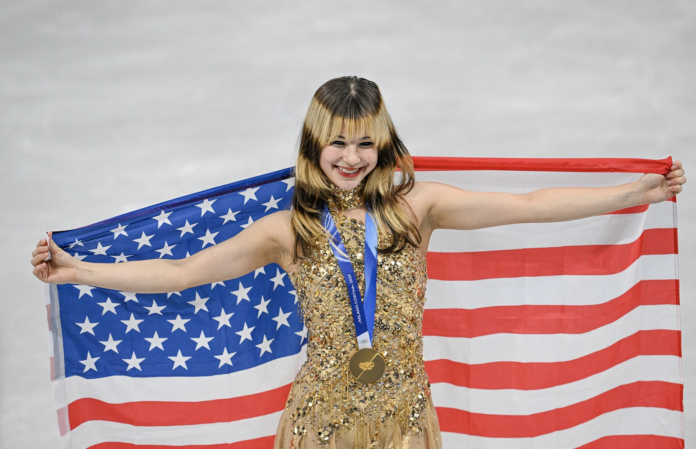
Alysa Liu, a 20-year-old U.S. figure skater who recently won gold in the 2026 Winter Olympics, has faced online comments regarding her self-expression — including her hair, piercings and style. After winning her gold medal, Liu posed for a photo sticking her tongue out. Commenters described this photo as “goonbait” — a slang term used when sexualizing a person. This led to nonconsensual artificial intelligence-generated nude photos of Liu and other female athletes.
“If it’s to do with her self-expression, I know some people are really talking about her hair and stuff and questioning sort of like what the expression of femininity looks like in that sport,” Maffia said. “And I think it’s more like we should just be focusing on her character.”
Maffia went on to share her thoughts on how female athletes are viewed in the media, discussing that Liu’s demeanor and energy should instead be a larger part of the conversation.
“It seems like she’s just a force of positivity,” Maffia said. “And, I think that should be more [of] the conversation. Like, why does it [matter] what people do to their hair?”
These UC Davis students agreed that there is a misogynistic optic that dominates popular culture’s view toward female athletes. For these students and many beyond, the normalization of misogyny at all levels, from the government level to rhetoric online from observers, has no place in the Olympic arena — or anywhere else.
“I think they should obviously be seen as more equal,” Morales said. “Because, I mean, they both won […] gold medals. So I don’t understand, like, what’s the difference? Only gender.”
Written by: Vriti Shah — features@theaggie.org