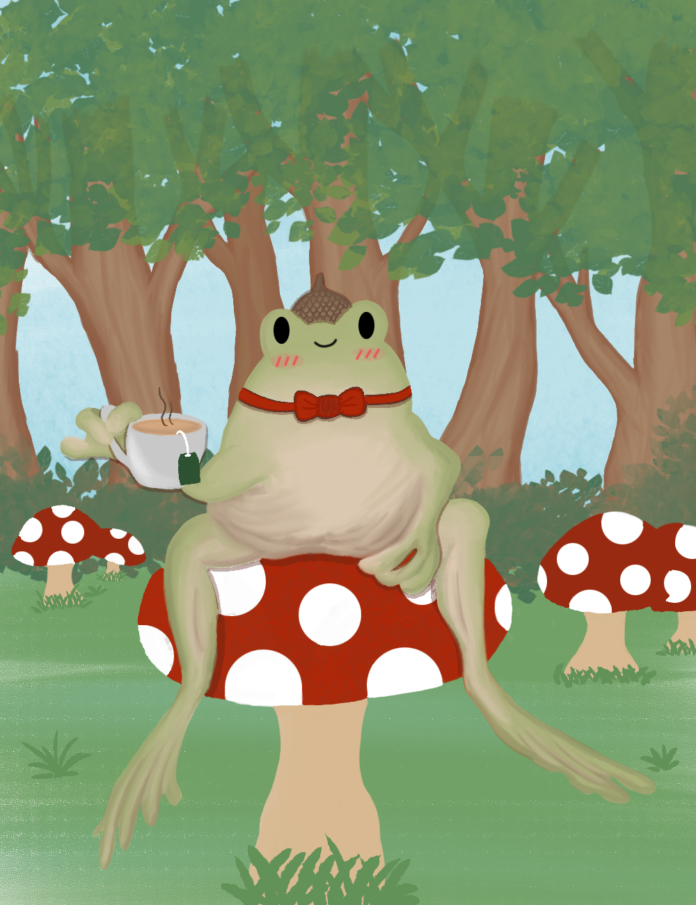
The background behind the frogs that live in Davis and how students can help them out
By AMBER WARNKE — features@theaggie.org
Frogs have long been objects of fascination and been depicted in countless memes, stories, TV shows and other aspects of pop culture. It is no surprise that they have found their way into the hearts of many UC Davis students as well.
Ethan Negus, a second-year biological sciences major, grew up loving the creatures.
“I used to always go to the [Los Angeles] Zoo and go to the little [amphibian exhibit], and I would always just stare at the frogs,” Negus said. “I don’t know what inextricably drew me to them, but I just feel like when I stare [into] the eyes of a non-thinking frog, I just feel my soul at peace. They’re just so chill.”
Matthew Perez, a fourth-year chemical engineering major and long-time frog lover, tuned into the frog conversation as well.
“I’ve noticed that a lot of people are into frogs [in Davis],” Perez said. “They’re really seen as a symbol of nature itself, and there [are] a lot of people in Davis that came here because they love the amount of nature.”
Brian Todd, a professor of conservation biology and herpetology at UC Davis, agreed with this statement, explaining that amphibians help connect him with nature as a whole. Todd also believes that many people love frogs because of their strange, alien-like appearance.
“Half their body looks like a mouth, and I think that creates this really weird alien perspective — and yet they always seem pretty harmless,” Todd said. “And with the exception of some of the grumpy frog memes that you see on the internet, they also seem to always be in a relatively whimsical mood.”
Negus shared Todd’s love of frogs, describing the amphibians as lovely, but added that his feelings are multifaceted.
“They’re pretty awesome, except for when they do irrevocable damage to the ecosystem,” Negus said.
Certain invasive frog species can greatly harm ecosystems, especially when they outcompete native frog species. Invasive species often threaten native ones by competing for scarce resources, reducing biodiversity and altering habitats.
“One [species] that you’ll sometimes see [in Davis] that’s not native is the American bullfrog,” Todd said. “[They] will either eat the [native] tadpoles or they’ll outcompete them. One [native species] you don’t see a whole lot anymore but can still be found in the area, especially along Putah Creek, is the western toad.”
The western toad frogs can grow up to four inches in length and are brown, gray or olive with black spots. They can secrete an irritating fluid from glands on their skin and feed on aquatic plants, insects and small invertebrates.
Todd also explained that contrary to popular belief, toads are still frogs, but not all frogs are toads.
“We reserve ‘frogs’ often for the more aquatic or arboreal species, [ones that are found] climbing in trees,” Todd said. “We reserve ‘toads’ for the more terrestrial, drier-skinned species that are found.”
Todd continued by describing some other common frog species in Davis.
“The other [species] that you’ll see more commonly, and [that] you’re more likely to hear than you are to actually see, is the western chorus frog,” Todd said.
These frogs, also called the Hollywood frog, are quite small, growing up to only 1.5 inches in length, and have several dark brown or gray stripes.
“Anytime you see a movie or a TV show and they have frogs calling, it’s usually a recording of the western chorus frog or Pacific chorus frog,” Todd said.
Todd added that the Pacific chorus frog can also often be heard calling in the UC Davis Arboretum but can be hard to spot, as they often hide in dense vegetation. In recent years, pacific chorus frogs are much more populous in Davis than western toads, but this hasn’t always been the case.
“Western toads used to be all over Davis, so much so that Davis was famously made fun of on Fox News because, at the expense of the city, they developed a tunnel that went under a road, and it was called the toad tunnel,” Todd said.
The Davis toad tunnel was constructed in 1995 at a cost of $14,000 and ran underneath Pole Line Road overpass. Unfortunately, the frogs overheated and died from lights in the tunnel and were picked off by birds that waited at the tunnel’s end.
“[The tunnel] was supposed to connect one side of the road to a wetland on the other side, so that all the toads would go under it,” Todd said.
While the tunnel is no longer operating, students can still visit Toads Hollow, a small set of frog-themed statues and ornamental houses that were meant to await the toads on the other side of the tunnel.
Today, Todd said the major challenge native frogs in Davis face is tied to the way the land of Davis has been altered over time.
“We have changed a lot of the waterways in California so that they don’t dry out every summer like they were supposed to and like they used to,” Todd said. “That’s actually really good for amphibians, when they dry out — because it keeps things like fish and bullfrogs from taking over.”
This has led to less space for frogs to breed, lay their eggs and survive, according to Todd — majorly problematic as frogs are also highly important to ecosystem health. Frogs are a “keystone species,” balancing the food chain by acting as both predator and prey: They act as a food source for birds, fish, snakes and other wildlife while also controlling pest levels. Most critically, however, they are also an “indicator species,” which means that frog species are the first to be affected by pollution and ecosystem changes. Frog species’ well-being thus reflects the general health of an ecosystem.
Because of this, however, over half of all frog species are in danger of becoming extinct, especially as the Chytrid fungus, discovered in 1998, has been causing rampant disease in frog species across five continents.
The most important way to protect frogs is by pushing for environmental protection in general by supporting laws that emphasize conservation and combat climate change. Increasing the amount of habitat available to frogs, such as by incorporating more ponds and greenery into gardens, can also be beneficial.
“If you live in a place where you can manage your landscape, having lots of shrubs and bushes around seems to be where all these frogs like to hang out,” Todd said.
Avoiding using pesticides and slug pellets is also vital, as these pollute the environment with chemicals that can be absorbed directly into frogs’ skin. Lastly, Todd added that students should look, but not touch, any froggy friends that they see.
“Not handling them is a good thing,” Todd said. “It’s hard not to want to pick up every frog you see, but a lot of times that can stress the animals out and can introduce or spread diseases around.”
Protecting these amphibians is especially important to Negus, who believes that frogs carry life lessons all UC Davis students can benefit from.
“I think at least every person in their time on Earth should look into the eyes of a frog as it’s just really living it up in a water structure and just existing,” Negus said. “I think we could all learn to exist like frogs and just put aside whatever troubles us. Anything in life that seems insurmountable at any point, we should just take a minute to appreciate that frogs, [who] no matter their strife and effectiveness of their tunnels, just seem to have a good time, all the time.”
Written by: Amber Warnke — features@theaggie.org