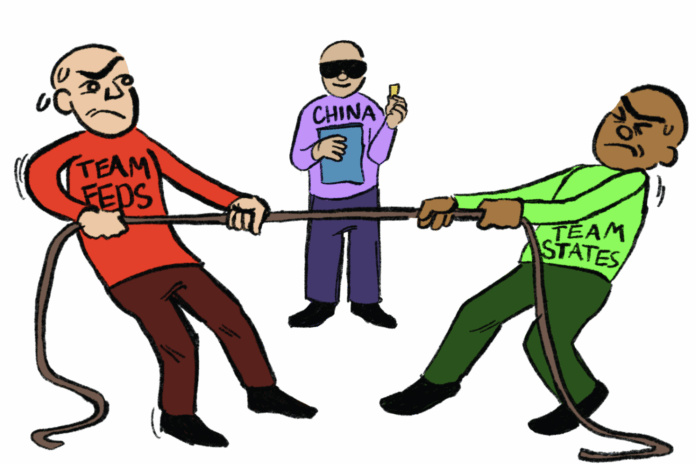
While the order invokes competition with China, Trump’s chip export policy tells a different story
By MILES BARRY —mabarry@ucdavis.edu
On Dec. 11, 2025, President Donald Trump signed an executive order titled “Ensuring a national policy framework for artificial intelligence,” claiming that the United States is in a “race with adversaries” for artificial intelligence (AI) “supremacy,” and that various state laws regarding AI regulation curb innovation. The new order, intended to reform this process, establishes an AI litigation task force to challenge state laws regulating AI and threatens to withhold funding from states implementing those laws.
There is a sizable group among AI researchers, policy wonks and tech investors who believe that hindering the development of this technology for the sake of public safety will ensure world domination by China. This belief is laid out clearly in the widely-cited essay “Situational Awareness: the Decade Ahead” by Leopold Aschenbrenner, an OpenAI alignment researcher-turned-investor.
“Superintelligence will be the most powerful technology — and most powerful weapon — mankind has ever developed,” Aschenbrenner said. “Only if we preserve a healthy lead of democratic allies [against China] will we have the margin of error for navigating the extraordinarily volatile and dangerous period around the emergence of superintelligence.”
Aschenbrenner also outlined AI scenarios that would be at home in a science fiction film (think nanobots dismantling every Chinese nuclear weapon or domestic defense systems that can intercept missiles with 100% accuracy) to justify the acceleration of its development.
If you believe this hypothetical future, Trump’s executive order — which “may not be legal,” according to National Public Radio (NPR) — might seem rational. However, this national security justification is completely undercut by the administration’s recent attitude towards semiconductor exports. On Dec. 8 — three days before signing the executive order — Trump approved the export of Nvidia’s H200 semiconductors to China. The H200 is one of the most powerful AI chips ever manufactured, and Nvidia, a semiconductor manufacturer, has at times been the most valuable company in the world.
This is a significant policy reversal. Both the first Trump administration and the Biden administration established restrictions on semiconductor exports, aiming to slow “China’s development of competitive capabilities” in AI and computing. Under these restrictions, the most powerful chip available to Chinese customers was Nvidia’s H20, which was designed to comply with export controls and is weak by consequence. Nvidia’s H200s, which were approved for export on Jan. 13, are 13 times more powerful than the H20s. They are the same chips used by OpenAI and Google. Nvidia could ship about a million H200s to China, increasing “the total amount of AI compute installed in China in 2026 by 250% relative to if China relied solely on domestic AI chips,” according to the Council on Foreign Relations (CFR).
While China still must approve the import of these chips, the Trump administration’s decision to approve their export highlights the absurdity of its December executive order.
“In every other element of the AI stack — data, research talent, algorithmic innovation, applications, and electricity generation — China either equals or surpasses the United States,” CFR noted.
Chips are currently our only advantage; clearly, this order is not about competing with “adversaries,” or national security. Instead, it appears to be ideological.
The second Trump administration has been notoriously hostile to “wokeness” — a term they use as a pejorative for efforts to promote diversity or address historical inequities. On his first day in office, for example, Trump signed an executive order requiring federal departments to recognize only two “biological sexes.” Defense Secretary Pete Hegseth has ordered the Navy to review ship names honoring civil rights leaders and banned military observances of Black History Month and Pride Month.
For this administration, many state AI laws fall into the same “woke” category. Colorado’s Artificial Intelligence Act requires companies to conduct impact assessments and disclose how they manage the risk of algorithmic discrimination. Illinois prohibits employers from using AI that discriminates based on protected class — even unintentionally — and bans using zip codes as proxies for race. New York City mandates independent bias audits for automated hiring tools. These are consumer protections, but to an administration that views anti-discrimination efforts as ideological overreach, they look like “wokeness” in a masquerade.
Luckily, the executive order is likely toothless. Its legal foundation is shaky, and ironically, even proponents of deregulation are unhappy with it. The order has derailed congressional efforts to create a federal AI framework, substituting executive overreach for the industry-friendly legislation they actually wanted, according to POLITICO. As for China, we can only hope they don’t accept the chips that Trump has served them on a silver platter.
Written by: Miles Barry—mabarry@ucdavis.edu
Disclaimer: The views and opinions expressed by individual columnists belong to the columnists alone and do not necessarily indicate the views and opinions held by The California Aggie.