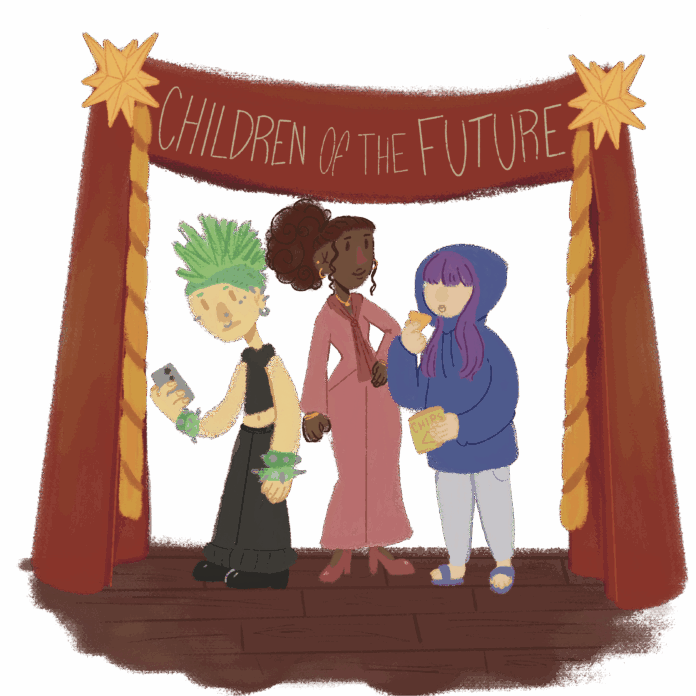
Does this paradox hold true?
By ABHINAYA KASAGANI — akasagani@ucdavis.edu
Recently, a call with my mother led to a prolonged lecture about how, although our generation is more aware than hers had been, we are less able to translate our awareness into action and more inclined to morph it into anxieties. There are few poignant ways of commenting on this predicament of one’s youth without invoking “youth is wasted on the young.”
The great Irish dramatist and author, George Bernard Shaw, derogatorily claimed that the average young person has “squandered every opportunity of being young, on being young.” While considered by some to be empty rhetoric, the phrase does manage to articulate a paradox that has long been felt by many but never fully unpacked. The running joke is that although young people are inadequate occupants of society, they must still be primed to take it over following the passing of their predecessors. What this conveniently overlooks is that the historical weight of inherited crises is precisely what has produced the wariness — and the weariness — that now characterizes youth; who must rely on their collective knowledge to survive the world as we know it.
As a child, I yearned to be an adult. I almost pigeonholed myself into a higher, unattainable standard that disallowed me from ever being carefree and fearless. When people later called on me to act responsibly because I had presented myself this way, I resented it, begrudging being told that I was “mature for my age.” The issue with this is that the allure of another state of being, with different abilities and attitudes, had struck me as better than what I already had. The grass is always greener on the other side.
Once the child conscripts themself into the role of an adult, they cannot return to simplicity. Too much awareness all at once nurtures skepticism and jadedness. While youth have long been thought to exude a vivacious spirit that is unlike any other in terms of the possibilities it grants, this generation finds itself immobilized by the current state of the world and thus remains unable to move forward.
When one is told that they are “wasting” something, especially something that is largely aspirational, it places them below the standard of adequacy; it suggests laziness rather than incapacity. What we fail to consider is that the youth are more weary than proactive because they are reliant on external tools they often lack. Like Shaw, many view young people as incapable of making sound choices, and yet they remain interested in exploiting this naivete. Others attempt to expose children to a degree of risks early so that they will be better equipped to navigate them later in life. The downside of this kind of practice is that it fails to equip them with the necessary tools just as much as it leads them to distrust the world.
In 2024, the World Happiness Report revealed a concerning truth about young people: “In North America, happiness has fallen so sharply for the young that they are now less happy than the old,” the Report read. Amongst several factors contributing to this decline were rising prices, the job market, social media and subsequent isolation, climate change and political polarization. The United States scientific journal, PLOS One, reported the same in 2025.
With the collapse of the world as we know it, the youth are taking to social advocacy. Older generations often tend to disregard that misfortune accumulates just as wealth and experience do. Activism here functions almost like housekeeping — guiding young people toward crisis response and fostering collective awareness. Ironically, overtaken by a disinclination to care deeply (or perhaps a larger inclination to outwardly feign nonchalance), they are interested in addressing the bigger picture. Yet, when discussing present crises — whether political, economic, digital or environmental — the youth appear profoundly disillusioned, often opting out of collective action for the sake of their sanity.
This is precisely why the youth rejoiced at the prospect of Zohran Mamdani’s mayoral win. In his article on the 2025 New York election, journalist Amr Kotb wrote about how the election rekindled his faith in politics.
“Why burn our resources and livelihood on struggle and frustration?” Kotb said. “I was ready to live the rest of my life that way until Mamdani won the primary.”
Before this, the idea of universal childcare and healthcare, food security and affordable housing and transport felt impossible. To many, Mamdani’s victory was hopeful not only for its social and cultural implications, but because it got them out of a rut that had them believing things would never improve.
Sociologist Jonathan Haidt posits that while social media is one agent of depression and anxiety, the main issue is that these networks have transformed how young people socialize. He believes, not entirely falsely, that this has formed an anxious generation. Our previous reliance on institutions, structures and digital products and services has shaped our collective identities.
While we must continually reevaluate our dependence on these systems, we needn’t shirk them entirely. Instead, examining why we are so cautious — and so fearful of failure — might allow us to trust ourselves and take more risks. Although burnout may extinguish idealism, restoring collective belief in our individual agency and in our ability to make a difference can lead us closer to community and farther away from the sense of futility that now fractures our social relationships.
Growing up, in so many ways, is like Plato’s “Allegory of the Cave” — once made aware, one is unable to return to unseeing. Not being bogged down by minutiae allows one to work towards actionable goals. Recognizing that the term “wasted” is an inadequate measure of our worth doesn’t allow us to squander our potential, but instead enables us to navigate inherited crises with more perspective and less fear.
Written by: Abhinaya Kasagani— akasagani@ucdavis.edu
Disclaimer: The views and opinions expressed by individual columnists belong to the columnists alone and do not necessarily indicate the views and opinions held by The California Aggie.