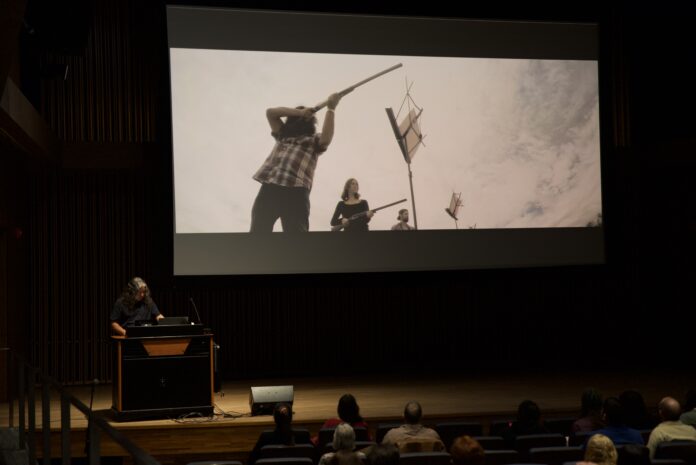
Chacon spoke in depth about many of his distinctive works as The California Studio: Manetti Shrem Artist Residencies’ winter quarter spotlight artist
By JONAH BERMAN – arts@theaggie.org
On Feb. 5, installation artist and composer Raven Chacon gave a public lecture hosted by The California Studio: Manetti Shrem Artist Residencies program at UC Davis.
Chacon, who originates from Fort Defiance, Navajo Nation, has been creating art in multiple mediums for over twenty years. His work has been exhibited at the Los Angeles County Museum of Art and the Whitney Biennial, and he was awarded the Pulitzer Prize for Music in 2022 and the MacArthur Fellowship in 2023.
During the lecture, Chacon used sharp insights and dry wit to guide the audience through his oeuvre by highlighting works from multiple stages in his career. He began by focusing on the first piece he ever created: “Field Recordings” (1999).
Chacon formulated the piece, which consists of different audio tracks, while pondering the importance of silence, especially in natural locations.
“The idea was to go to different locations around the Southwest,” Chacon said. “They were places I considered to be very quiet. The idea was that I would find a very quiet day, no wind, no people around, no cars on the road or airplanes in the sky, and make a field recording of that place.”
The near-silent tracks were then volume-adjusted to be as loud as possible, placing newfound emphasis on our most silent and unnoticed landscapes.
“I wanted to think about how the process of recording can be something that’s anthropological, or even ethnographic,” Chacon said. “I think today we often hear this term ‘land acknowledgement,’ but looking back now, I see these as acknowledgements of these places.”
Chacon further showcased his unique knack for innovation within the musical medium through “Report” (2001). Conceived while he was attending college, Chacon wanted to challenge himself with a composition for a restrictive instrument.
“So what can I do — what instrument can I write for that can’t play melodies, you can’t control the volume, you can’t really harmonize, you can’t change the sound?” Chacon said. “So I decided to write a piece for guns.”
Before playing a video recording of the piece for the audience, Chacon elaborated by noting that the piece is not explicitly pro- or anti-gun, but rather it simply reflects on the uniqueness of the weapon and a recognition of the land upon which it is often fired.
“In every gunshot you can hear the echo of the valley, you can hear the sound of the place again,” Chacon said.
Although he has received most of his acclaim for his compositions, Chacon has also created multiple installation artworks, especially as part of the Indigenous artistic collective Postcommodity. With that group, he created “Repellent Fence” (2015), a work that was displayed in multiple incarnations, but originated from the idea of a bird repellent balloon product sold on Amazon. The advertisement inspired Postcommodity to remake the product in order to craft a political statement.
“If a 10-inch balloon could scare away pigeons, then maybe a 10-foot balloon could ward off western civilization,” Chacon said.
The repellent balloon was first flown above the office of Maricopa County Sheriff Joe Arpaio, who has been criticized for his racist and anti-immigrant rhetoric.
Later, Postcommodity installed a chain of balloons adjacent to the US-Mexico border wall.
“The goal was to make twenty-four balloons and fly them in contrast, and in conflict, to the US-Mexico border,” Chacon said. “The Repellent Fence is a 2-mile-long land art installation that is in every way different than the US-Mexico wall. It’s different in materials. Our fence is also temporary. We’re not pretending it’s going to last forever.”
Chacon also described in detail his process for creating “Voiceless Mass,” which won him the Pulitzer Prize for Music in 2022. Commissioned by the Present Music ensemble in Milwaukee, Chacon was initially skeptical of whether he should agree to compose; this was due to the performance occurring on Thanksgiving and inside a Catholic cathedral.
However, Chacon instead used the opportunity to create a powerful and harrowing composition. The piece, while inspired by classical masses, contains no vocals; rather, the instrumentation is meant to display the loss of Indigenous language and culture as was perpetrated by the church.
“This piece was never meant to be accusatory,” Chacon said. “It was meant to bring this history to light, to those that might not have been aware. And now when it’s performed, a lot of those leaders and members of those churches are interested in engaging in the conversation and apologizing for the church’s role in these histories.”
Lastly, Chacon discussed “Tiguex” (2025), a large-scale composition that consisted of twenty different performances over the course of a single day in the city of Albuquerque.
“Tiguex is the Indigenous name for the area now occupied by Albuquerque,” Chacon said. “And ‘Tiguex’ is a musical score written for the entire city.”
Chacon enlisted the help of over two hundred musicians to perform the work. Low-riders, mariachi bands, musicians on horseback and hot air balloons were all aspects of the colossal artistic achievement.
On Feb. 6, an ensemble of UC Davis Music students performed Chacon’s composition “American Ledger No. 1” (2018). Emblematic of the recurring motifs seen throughout Chacon’s career, the piece describes the many historical conflicts related to America’s founding. While “American Ledger No. 1” is primarily written for traditional instruments, the piece also utilizes coins dropping onto cymbals, the chopping of wood and the striking of a match as additional sources of sound. The work’s sonic spectrum spans from void to cacophony, capturing moments of anguish and serenity while retracing America’s history.
The emotionally layered piece was reminiscent of something Chacon remarked about in his lecture the day before, defining music in his own words.
“Music is the things we don’t know how to speak about,” Chacon said. “That’s why it’s music. It says the things we will never have words for. And it doesn’t have to mean anything; it just is something. Some kind of entity, some kind of energy.”
Written by: Jonah Berman — arts@theaggie.org