The museum’s newest exhibition details the process of a massive undertaking that aims to make its collection more accessible
By JULIE HUANG — arts@theaggie.org
On view from Jan. 21 to May 2, “Backstory: Digitizing the Museum Collection” will be open to the public at the Jan Shrem and Maria Manetti Shrem Museum of Art this winter quarter.
Co-curated and developed by Manetti Shrem’s Deputy Director Randy Roberts and Associate Curator for Collection Digitization Jez Flores-García, the exhibition aims to open a window for the viewing public to observe the essential processes of collections management.
In other words, “Backstory” is a behind-the-scenes look into how the Manetti Shrem maintains and organizes its extensive collection of fine art, including pieces that were previously kept out of the public eye.
“We are in the process of digitizing our collection to make it more accessible, so you’ll be able to access all the information and images online,” Roberts said. “We thought that while we were doing that, we could make the process transparent for people to see how it all works.”
The exhibition is designed to engage the general public while also spreading awareness of the Manetti Shrem’s digitization project as the museum approaches its 10th anniversary.
Roberts and Flores-García worked with UC Davis students enrolled in the Fall 2025 Exhibition Practicum course taught by Assistant Professor Alexandra Sofroniew, bringing a new perspective to the creation of the exhibition through student involvement.
Students suggested that Flores-García and Roberts integrate collection circles, originally a private system of categorization, into the public structure of the exhibition. Consisting of five different categories, collection circles mark how closely a piece of art is tied to UC Davis and guide audience members on how to think about their experience.
Circle one pertains to artworks made by past or current UC Davis faculty — notable examples include Robert Arneson, the creator of the UC Davis Eggheads, and Still Life Painter Wayne Thiebaud. The Manetti Shrem’s ability to house pieces with direct ties to the history of the UC Davis art department, which forms a key component of its own identity, is a point of interest that sets it apart from other museums.
“This is not common to museums, but something very special to Davis,” Flores-García said. “When you think about our first generation faculty, you’re thinking about the first professors who taught in the art department.”
The second circle consists of artworks made by current or past Master of Fine Arts students at UC Davis, while the third circle contains artworks made by visiting artists who taught on the campus.
Furthest from the nucleus of UC Davis activity, the fourth and fifth circles contain art made by 20th, 21st and pre-20th century artists, creating a collection that spans hundreds of years.
“This is a whole conversation across time and place,” Flores-García said.
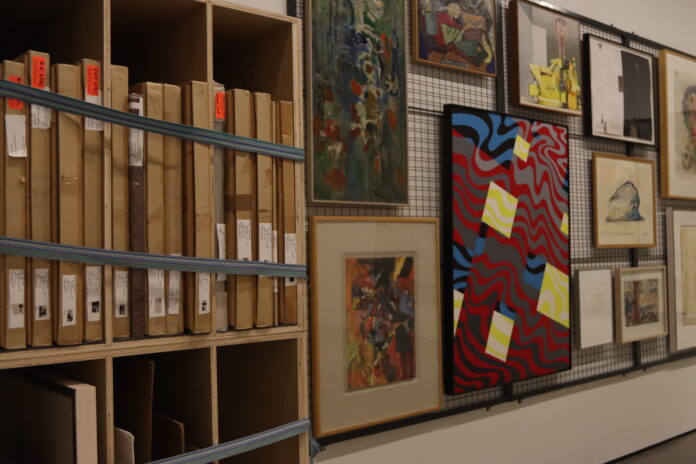
Farther into the exhibition is the designated staging and working area, where visitors are invited to peer into the process of documenting and photographing the museum’s artworks as they are transferred in and out of storage from the exhibition area to the digitization laboratory.
Full of filing cabinets, with one central cabinet in the middle of the room, the working area is structured in the same fashion as museum storage areas that normally go unseen by visitors.
“This part of the exhibition is what the word ‘Backstory’ in the exhibit’s title is referencing,” Roberts said. “This is where we’re circulating art that we’re going to be photographing. Everything here will be switched out every two weeks.”
The hanging artwork on the walls serves a dual purpose. Visually captivating, they hold aesthetic appeal for visitors, while also serving as a convenient method of storage as they wait their turn to be photographed and documented.
As part of the experience, visitors are invited to look into the filing cabinet in the center of the room, which contains a collection of works stored within that viewers are able to immerse themselves in.
“This room simulates the experience of working in storage,” Roberts said. “This is kind of what it would look like, and at the same time, it’s part of an exhibit on display. We’re able to gain this space for photography, while also inviting people to witness it.”
Essentially, the working area merges the transformative experience of seeing beautiful works of art with the practical necessities that go into keeping a museum’s collection up-to-date and organized. Its blend of artistic beauty and practical utility speak to the way museum staff approach the technical considerations that facilitate aesthetically pleasing experiences.
Digitization Assistant Anya Thompson said that the experience of working to put “Backstory” together enhanced her own understanding of art history and the role played by the Manetti Shrem.
“I didn’t know that all of these works of art lived here, not just contemporary work, but also the work of the old masters,” Thompson said. “The amount is staggering. I think it will have such an impact if you’re someone like me, who’s an artist or loves art history, to be able to access all of this.”
Though the experience of viewing artwork has the capacity to inspire deep and wordless emotions, those transformative experiences are supported by mechanical involvement and consistent effort by museum staff such as Thompson herself.
“The collection essentially lives in a series of numbers and letters in a database, and it’s my job to keep the database formatted according to certain standards,” Thompson said. “There’s a lot of investigative work, and a lot of paperwork and files.”
The process of putting “Backstory” together required a large team with a range of specializations and skills working in tandem.
“It takes all kinds of people to handle this kind of project,” Roberts said. “We have registrars working with us whose job is to make sure the art is safe. We hired a special photographer who’s an art handler but also trained in art photography.”
The construction of “Backstory” and the digitization project that it spotlights, has been a collaboration between the Manetti Shrem and the wider UC Davis campus. Most of their pieces are not purchased but donated.
“One of the interesting things about this collection is that a lot of it was driven by faculty, whether it was faculty donating their work, giving their work to another faculty member who gave it to us, collecting work or using it for a class,” Roberts said. “We want to tell the story of the artists and donors who care about this place, because much of the works we have come from them.”
Since the beginning, the Manetti Shrem has also been working with database experts from the Shields Library to choose the database model that best suits the needs of the museum. When the digitized database opens to the public, its first point of access will be through the UC Davis Library Search, and all of the database information will be integrated into the new model.
“[The Manetti Shrem] couldn’t have done any of this until now, because almost everyone working on this was hired just for this project,” Roberts said. “We’re hoping to get the bulk of the collection digitized by the summer, but then as we bring new objects into the collection, we’re going to continue.”
One of the primary aims of “Backstory” is to display pieces from the Manetti Shrem’s collection that visitors have not had the chance to see before. In doing so, Flores-García and Roberts hope to make it clear that many people are behind the decisions that contribute to which pieces are hung up on the wall and which are kept out of sight, stored away in the collection.
“Museums are places that hold value and power, and we want to open that up,” Roberts said. “We are trying to bring in diverse opinions and perspectives so that what we’re keeping 50 years from now is not going to be work from only a few kinds of artists and genres.”
Museums are often vested with the ability to influence what is considered art, and this boundary is reflected in every piece that a museum chooses to display to the public.
“We want to say that there’s no such thing as good art and bad art,” Roberts said. “There is no such thing as art worth valuing versus not worth valuing. It’s all about the decisions being made about what we’re keeping and how we’re caring for it.”
Ultimately, “Backstory” aims to show that the meaning of a work of art is stored not just within the walls of a museum space but also in the experiences of its visitors and handlers.
“One of the things I always want for people who come and visit a museum is for them to fall into a special kind of moment with the artwork,” Flores-García said. “I can remember paintings that I saw at one museum ten years ago, and it still sticks with me. Anything you display is part of a story that you tell.”
Written by: Julie Huang — arts@theaggie.org