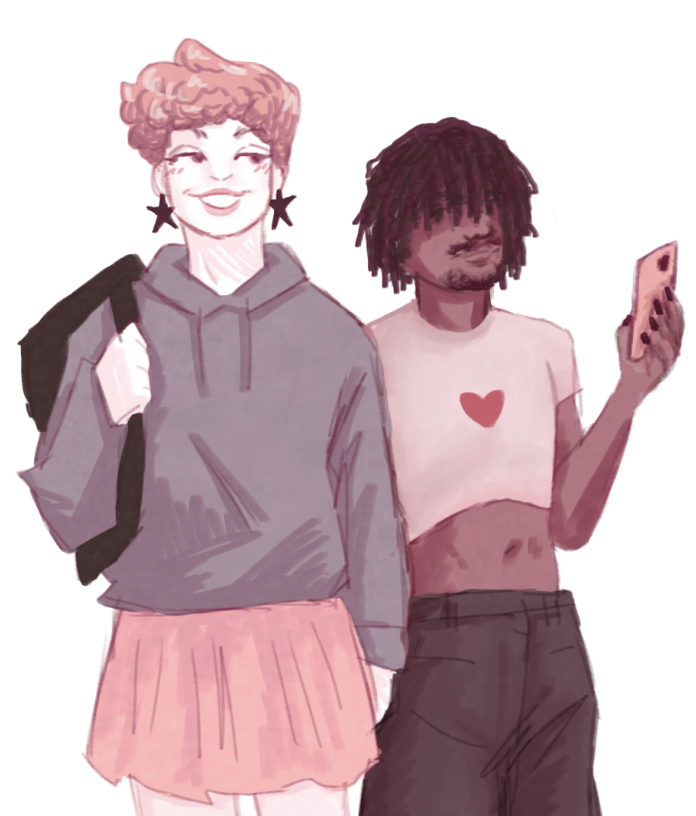
Why we should celebrate femininity in men
By SAGE KAMOCSAY— skamocsay@ucdavis.edu
In the past few years, there has been a rise in Generation Z men getting piercings, doing their makeup, painting their nails and participating in all other manners of stereotypically feminine forms of gender expression. And, contrary to what one may assume, they aren’t all “gay.” While some may decry this trend as a bellwether of the fall of manhood, it isn’t — it’s good.
Womanhood and femininity have been seen as “beneath” men for centuries in the Western world. Any sign of girlyness by a young boy is stamped out by parents and classmates out of fear that he may not grow up to be the man he should be: that he may be weak, ineffective or a dud.
It’s an unfounded fear that has led to unfathomable amounts of oppression and violence over the course of human history, including intimate partner violence, femicide, sexual assault and harrassment. This fear is based on the assumption that women, and anyone who “acts” like a woman, are inherently inferior: that they deserve to be toyed with, disrespected, used, beaten or worse. As a man, to present yourself femininely is to lower yourself to this same subhuman status.
Deeply intertwined in this issue are homophobia and transphobia. Femininity in men is often attributed to being gay or transgender; for some, to be gay or trans is seen as worse than being a cisgender woman. Stereotypically, straight men are more masculine than gay men or trans women; therefore, any deviation from masculinity points to queerness. Any hint of a boy doing girly things, like playing with dolls or putting on a tiara, is a hint of his inferiority — this time in terms of his sexuality or gender.
Men who choose to do even the smallest things to defy the status-quo — like painting their nails or wearing a nice pair of women’s jeans — are acting in opposition to the harmful ways they have been socialized to behave. The recent surge in popularity of men adopting traditionally feminine forms of expression is an indication that some men are losing this fear of being perceived as a woman, or as queer; it’s a sign that the world is slowly becoming a safer place to live for those who are not cisgender, heterosexual men. It’s also a sign that men are healing. While it’s not a lot of progress, it’s progress nonetheless.
But of course, with every step forward there is also backlash. Hatred toward more feminine men is still rampant in certain communities. Now that femininity is in style, the fear that so many have been able to hold at bay is rearing its ugly head. To fearful people in very often bigoted environments, this trend is a sign that their worst nightmares are coming true: that men are becoming less “manly” and therefore weaker. These fears spiral; they start to believe that this weakness can only last for so long before something horrible happens, and that there will be nobody to go to work, solve problems and protect their families.
It’s important to combat these fears. But to do so, it’s even more important to understand their origins: years of conditioning that reinforce notions of masculinity’s necessity for survival in men. As a boy, if you weren’t “man” enough, you might be bullied by your friends or chastised by your parents. You might feel weak — after all, if you were strong enough to fight back, you wouldn’t be in this situation in the first place. You might feel inferior.
While deeply ingrained in society as a whole, the belief of femininity as inferior is firmly untrue. It’s viscerally real for many individual boys and men, but it’s irrational. The fear of femininity comes from a fear of being helpless as a child — of being bullied, scolded and ostracized: a notion that needs to be slowly coaxed out of most through discussion and therapy. Truthfully, it’s a delicate condition.
But exposure can be powerful. If more people begin to see strong, feminine men, and if more boys have strong, feminine role models, the world can slowly begin to heal — violence against women may be lessened, as well as discrimination based on gender and sexual orientation. Change will be slow, and it won’t come easily — but most good things don’t, anyways. Good things come kicking and screaming, but that doesn’t mean they’re not worth fighting for.
Written by: Sage Kamocsay— skamocsay@ucdavis.edu
Disclaimer: The views and opinions expressed by individual columnists belong to the columnists alone and do not necessarily indicate the views and opinions held by The California Aggie.