55.5 F
Davis

Davis, California

Tuesday, December 23, 2025
Home Blog Page 102

There’s tension in the Unitrans driver community

In other words: bus beef


By ALLISON KELEHER — adkeleher@ucdavis.edu


If you have ever ridden on a Unitrans bus line, you have probably noticed the friendly disposition of the drivers. I have seen the drivers chatting with each other before their buses depart and overall having an admiral little community. Once on the road, the drivers will wave at each other in passing. Sometimes, having such an amazing public transport system running on undergraduate student labor feels surreal.

However, one of my extremely reliable sources informed me of a “black sheep” within the Unitrans community. 

“I waved at him at the stop sign downtown, and he ignored me!” my source said in complaint. 

This seemed pretty dramatic, so I confirmed with other sources about the meaning behind an ignored wave. Apparently, it’s very offensive to ignore a fellow Unitrans bus driver. 

“One time, I almost crashed the bus trying to wave!” another bus driver confirmed. “But it’s essential.” 

Anyway, the current rebel in the Unitrans driver community has consistently forgotten to wave at every fellow bus driver who passes by. This has created serious tension between the drivers, because the majority of the Unitrans drivers need that friendly validation to enjoy their otherwise terrifying and tiring job. 

To mitigate the problem, a driver staff meeting was called to discuss the joys of getting students to class on time, but secretly the meeting was orchestrated to corner the rogue driver at the end of the meeting and get answers. Once the meeting adjourned, three Unitrans drivers circled the culprit and asked, “Why do you hate us? What did we do to you? Who do you think you are?”

The accused driver was extremely confused and started getting increasingly anxious. 

“I’m not sure what you mean,” he said.

“You know what you did!”

“What?” The driver was holding back tears at this point. 

“You never wave to us!” they finally clarified once they saw the tears streaming down his face. 

Apparently, this driver never got the memo that you had to wave since he had just become a driver two weeks ago. Suffice it to say, the drivers felt pretty bad for the confrontation and devised a plan to apologize. The driver was scheduled for the W route the next morning, so they planned to set up his bus to say “W driver” on the little screen on the front and shower him with gifts and praise. However, they never got the chance because the driver quit the next day.

When asked for a statement, all he said was a combination of many curse words I don’t wish to repeat. 

Well, Unitrans is hiring, so if you’re interested, practice your waves for the interview. 


Written by: Allison Keleher — adkeleher@ucdavis.edu


Disclaimer: (This article is humor and/or satire, and its content is purely fictional. The story and the names of “sources” are fictionalized.)
City of Davis hosts movie viewing in remembrance of Executive Order 9066

“And Then They Came For Us” discusses Japanese American Internment during World War II 


By ALMA CULVERWELL city@theaggie.org 


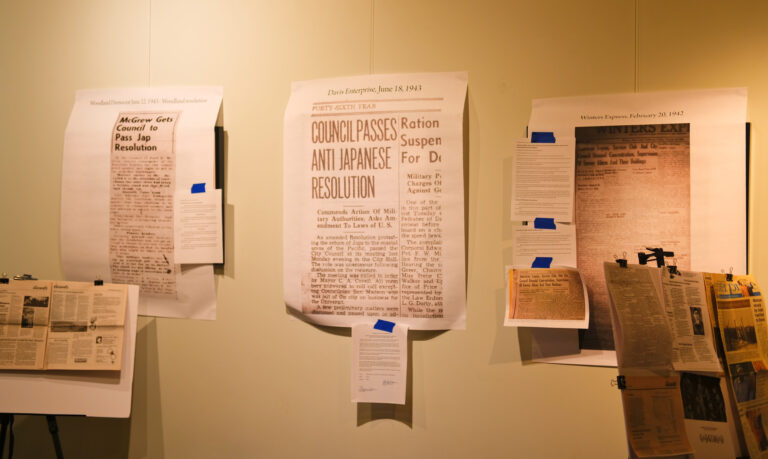
On Feb. 26, the city of Davis hosted a community viewing session of the film “And Then They Came For Us” in recognition of Executive Order 9066 at the Veterans Memorial Theater. Executive Order 9066 was the bill that led to Japanese American internment during World War II. 

The event was free for the public to attend and co-sponsored by Davis Asians for Racial Equity, Davis Phoenix Coalition, UC Davis Asian American Studies and the city of Davis’ Human Relations Commission. The doors for the event opened at 5:30 p.m. with the film viewing starting at 6 p.m., followed by presentations and a Q&A session directly after. An estimated 275 people attended the event. 

Pattie Fong, lead organizer of the event, commented on the goals she had when planning. She originally came up with the idea to hold the event in January and began outreach in her local volunteer newspaper, Currents.

“The goal of this event is to have more people knowledgeable about the impact of Executive Order 9066 because the hysteria of WWII against Japanese Americans is repeating in our contemporary lives,” Fong said. “Muslim bans, refugees at the southern border being called criminals, teachers/librarians who sponsor LGBTQ+ events being called perverts and molesters, etc. The fake news is all around us and the politicians are fueling the hate.”

“And Then They Came For Us” is a 2017 documentary directed by Abby Ginzberg and

Ken Schneider. The film retells the history of Japanese American internment during World War II and follows current-day Japanese American activists speaking out against the Muslim registry and travel ban.  

Dawn Yackzan, a community member who attended the viewing, described her feelings about the event. 

Pattie Fong’s Japanese Remembrance Event at the Veteran’s Memorial was wonderful,” Yackzan said. “I learned important history and new details of the traumatic events forced upon Japanese Americans. I teared up when listening to some speakers. I loved the side comments from the audience members, some of whom were historians, giving context and personal details.”

Yackzan went on to describe some of the logistics of the event. 

“[Fong] had a comprehensive PowerPoint running in the background with decades of photographs and publications from 1942 to the Feb. 2024 Koramatsu ribbon cutting with paintings done by Toni Rizzo and community [members],” Yackzan said. “Fong’s Japanese Remembrance program was as moving as it was important.”

Fong noted her extensive background research and interest in the Woodland and Yolo County archives surrounding Executive Order 9066.

“I [spent] many days and hours reviewing microfiche of historic Davis Enterprise and Woodland Democrat newspapers, [which are] available at the public libraries,” Fong said.  “The Yolo County Archives [were] also helpful with research on the Winters Express newspaper, WWII records […] and Yolo County government records.”

Fong emphasized the importance of familiarizing the community with Executive Order 9066 and raising awareness of ongoing current-day events. She added that she would love to assist with future similar events moving forward.

“This conversation is also a learning opportunity for the entire community to acknowledge [that] institutionalized hate is a prime example of critical race theory and [to] recognize that the hateful speech against southern border refugees, Muslims, Asian American Pacific Islanders [and the] LGBTQ+ [community] is the same hate articulated by a verbal minority who directly or indirectly urge harm and violence against specific groups in our community,” Fong said. “We need to recognize hate, feel empowered to denounce it and be good bystanders to stand with those being targeted, even today.”


Written by: Alma Culverwell city@theaggie.org 


UC Davis women’s lacrosse dominates in exhilarating 13-12 win

The Aggies keep their winning streak alive


By MEGAN JOSEPH — sports@theaggie.org


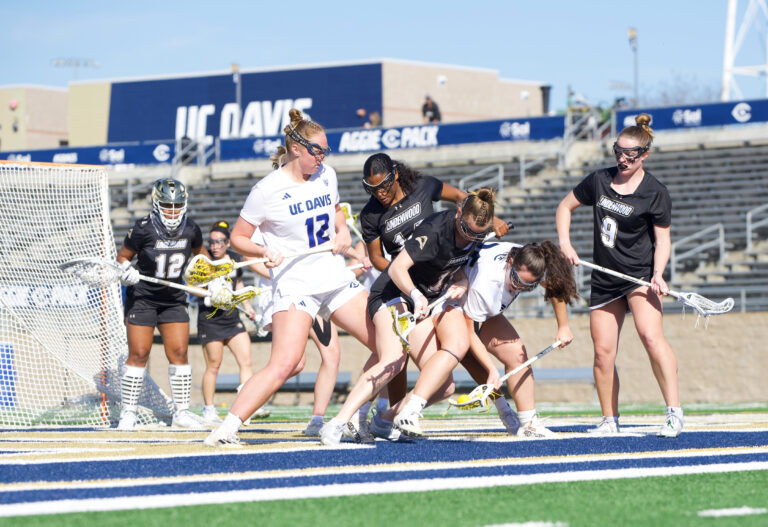
As the season starts to ramp up, the UC Davis women’s lacrosse team pulled out a thrilling win against the Lindenwood University Lions on Feb. 25. The game proved to be one of the hardest matches this season for the Aggies with the Lions’ undefeated record. However, it wasn’t enough to deter the Aggies away from their third consecutive win of the season

Starting the match off strong, the Aggies recorded their first goal within the first 10 seconds of the first quarter. Second-year sustainable agriculture and food systems major Rhea Cosand had a strong play when she faked out the Lindenwood offense and sent a powerful top-corner shot straight into the goal for the Aggies’ first goal of the game.

The Aggies maintained an early lead over the Lions for the rest of the first quarter: Lindenwood scored one goal, while the Aggies scored three more. Third-year economics major Alannah Scott had two major plays in the first quarter, scoring two goals at 9:42 minutes and 13:08 minutes. Scott has had a strong season thus far, typically playing in the attacking position with her ability to outmaneuver the other team’s defense. 

Following Scott’s lead, third-year political science and history double major Ella Brislin made a powerful play to the Lions’ goal and scored yet another goal for the Aggies in the 12th minute of the game. 

Going into the second quarter of the game, the Aggies looked strong holding a 4-1 lead over the Lions. However, the Lions came back hard, scoring a total of three goals in the span of four minutes with attacker Reese Krieger spearheading the charge.

Nonetheless, it wasn’t enough to phase the Aggies as they continued to score many of their own goals in the second quarter. In the fourth minute of the game, Brisbin came back for her second goal against Lindenwood as she lofted the ball into the top corner of the net. Additionally, fifth-year civil engineering major Claire Moats and first-year undeclared major Cami Johnson both found their way to the goal in the eighth minute and fourteenth minute of the second quarter, putting the Aggies in a 7-4 lead at the end of the second quarter. 

In the second half of the game, the third quarter proved to be the most challenging for the Aggies. Following halftime, Lindenwood came back strong and eager to keep their perfect seasonal record. In the second and third minutes of the third quarter, the Lions managed to outplay the Aggies and score three consecutive goals. With fast and hard shots into the net, Lindenwood’s Emily Mowbray, Krieger and Alissa Digiacinto brought the score to an astonishing 7-7 tie. 

Trying to put themselves back in the lead, the Aggies’ very own third-year design major Grace Gerbhardt made a counterattack against the Lions, bringing the score to 8-7. However, two minutes after the Aggies’ goal, Lindenwood veteran Krieger made a goal of her own into the back of the Aggie net, bringing the score back to a tie at 8-8. 

The Aggies, not willing to give up their lead so easily, made a total of four other goals in the last six minutes of the third quarter. With goals by Brislin in the ninth minute, Moats in the eleventh minute, Johnson in the fourteenth minute and third-year genetics and genomics major Natalie Markman in the fourteenth minute. Although Lindenwood also made two more goals in the third quarter, it wasn’t enough to tie the score again.  

Going into the fourth and final quarter of the match, the Aggies had a three-point lead with a score of 12-9. The Aggies scored their thirteenth and final goal in the eighth minute of the quarter when Johnson collected the ball from a mistaken ball drop by the Lindenwood goalie. Even though Lindenwood scored a total of three goals, it wasn’t enough to take the lead from the Aggies. In the final fourteenth minute of the fourth quarter, Lindenwood’s Breylin Bright scored the Lions’ twelfth and final goal of the match, securing the 13-12 final score.

Although the Lions had significantly more shots on goal and gained more possession off of draws, the Aggies dominated turnover and total possession throughout the game. Davis had a total of seven caused turnovers and 11 regular turnovers that gave them the upper hand over Lindenwood. 

As the season is just starting to ramp up for the Aggies, hopefully they can keep their winning streak alive when they face other tough Pack-12 competition and bring home a championship title for Davis.


Written by: Megan Joseph — sports@theaggie.org

Of the ‘big six’ romantic poets, who would your perfect romantic match be?

Caution: the standards are low


By MIAH JORDANE — mjcampos@ucdavis.edu


There are a plethora of period-drama pieces within cinema, theater and literature: “Pride and Prejudice,” “Bridgerton,” “Hamilton,” “Little Women” –– the list goes on. Despite the problematic aspects of the eras these pieces take place in, there’s a fixation with romanticizing and fantasizing about life during older times. The Romantic Period was particularly interested in the romanticization of life through art and literature; we can specifically see this within the “big six” romantic poets: William Wordsworth, Samuel Taylor Coleridge, John Keats, Lord Byron and Percy Bysshe Shelley. Their poetry highlights their romantic perspectives on life, but how would they actually carry themselves within their romantic lives? Here’s my opinion on if the “big six” would actually be as “romantic” as their poetry makes them sound, or if they would even treat you well at all…


William Wordsworth: Sadly, we are off to a rough start. Wordsworth wouldn’t be obsessed with you because he’s too busy being obsessed with himself. Confidence can make someone attractive, but narcissism kind of does the opposite. Unlike the other poets, if you were to date him, you wouldn’t even get some decent poems written about you out of the experience because they’d all be about how romantic of a partner he is instead. 


Samuel Taylor Coleridge: To put it simply, Coleridge would not be emotionally available for a relationship. He definitely has some daddy issues he has yet to confront, and, let’s be real, he might be a romantic but he’d likely not be romantic for you… He’s rumored to be in love with William Wordsworth. This isn’t an issue, in fact, we are all rooting for him. However, you’d most likely never be number one in Coleridge’s heart if you were to date him. If you’re okay with that, though, then at least you would have some nice poetry written about you. 


Lord Byron: The archetype of history’s classic, bad-boy poet of the nineteenth century. This relationship would be a toxic mess, but I wouldn’t necessarily blame you for giving it a shot. As a founding father to vampire literature, a political activist and a man with adventurously fluid sexuality, Lord Byron seems to have been quite charming and appealing during his times. Perhaps his bad-boy charm would work on you, too. 


Percy Bysshe Shelley: Oh, Shelley. Hopping from wife to wife –– even marrying a sixteen-year-old girl to supposedly save her from suicide, only to get annoyed with her and leave her for another woman. Shelley has a history of not being loyal. If you engaged in a relationship with Shelley, I bet it would be quite invigorating as he’s a charming romantic poet, but it would also be short-lived –– like his ex. Sorry. 


John Keats: Last but not least, John Keats: the moody, broody, mysteriously passionate soul who died too young. Keats infamously fell in love with the girl next door, therefore ending the list as the most wholesome of the six romantic poets. Though he never married, in this imaginary world where you are in fact dating Keats, I’m sure he would be true to the romantic poet title and would have a cute, wholesome romance.


In retrospect, this list isn’t super promising. But who is shocked that the romantic poets also had pretty chaotic, realistic romantic lives? No one. 


Written by: Miah Jordane — mjcampos@ucdavis.edu 


Disclaimer: (This article is humor and/or satire, and its content is purely fictional. The story and the names of “sources” are fictionalized.)

Four fan-favorite sitcoms to keep you laughing for the rest of the quarter

Each pick follows a unique cast of characters as they undergo life’s daily struggles and odd situations 


By SAVANNAH ANNO — arts@theaggie.org

Sometimes, all you need is a TV show that can provide you with simple entertainment. There’s no murder plot, no mind games or big mystery; sitcoms are easy and enjoyable. 

A sitcom, or situational comedy, is defined as a television series that follows a consistent cast of characters that experience funny, everyday situations and problems within a realistic setting. “The Office,” for example — one of the most popular sitcoms of all time — follows a cast of coworkers as they navigate their jobs, relationships and an unprofessional boss. 

In an interview with Sean Evans on “Hot Ones,” sitcom writer and comedian Quinta Brunson weighed in on why she thinks sitcoms are so special. 

“It doesn’t take up your emotional energy,” Brunson said. “Some of my favorite shows emotionally drain me, but my favorite comedies don’t do that. I just had a ball with [“New Girl” characters] Nick and Jess and Schmidt. We just had fun, and we went on our little adventures.” 

With accessible humor and relatable settings, sitcoms invite viewers into the story and include them in the lighthearted chaos. If you’re looking to take your mind off of more serious matters, try watching any one of these four sitcoms. 


New Girl” (2011)

When 29-year-old Jessica Day catches her long-term boyfriend cheating on her, she quickly leaves and moves in with three random guys. Becoming the “New Girl,” the show follows Jess as she navigates her new friendships with her roommates: the overly dramatic Schmidt, big-hearted Winston and the grumpy but loyal Nick. 

As the seven-season series continues, the unlikely group of friends becomes closer and closer as they experience career changes, heartbreak, new romances and more. Their apartment, referred to as “the loft,” becomes the center of the series as the characters rely on each other for support through each conflict and strange scenario. Hilarious and heart-warming, “New Girl” is the perfect watch for a group of roommates, Taylor Swift fans (she does, in fact, make a cameo) or anyone who enjoys the friends-to-lovers trope. 


Abbott Elementary(2021)

Currently airing its third season, “Abbott Elementary” has gained popularity not just on streaming services like Hulu but also on network television. With an average of eight million viewers each episode, “Abbott Elementary” has brought new life to network comedy

Starring the show’s own writer and creator Quinta Brunson as elementary school teacher Janine Teagues, the series highlights the struggles of both teaching and learning in an underfunded, predominantly Black public school in Philadelphia. The cast of teachers — all with different backgrounds and education methods — solve student problems and deal with the difficult school district and challenges of their personal lives. “Abbott Elementary” shows the love and joy within the community as they tackle each aspect together. If you’re an education major or remember loving Tyler James Williams in childhood Disney movies like “Let it Shine,” be sure to tune in weekly on ABC or search for the series on Hulu. 


“How I Met Your Mother” (2005)

Feeding nostalgia for the early 2000s, “How I Met Your Mother” is the sitcom to watch for anyone who feels like they are living in the wrong decade. Spanning nine seasons, the show focuses on Ted Mosby, as the entire series revolves around his retelling of the years that led up to him meeting his eventual wife and mother of his children. 

Along with his four best friends, Ted goes on dates all across New York City in order to find “the one.” The ensemble cast features break-out actors like Neil Patrick Harris and Jason Segel, as well as a handful of notable guest stars like Britney Spears and Katy Perry. Similar to “New Girl,” the cast goes through adulthood together: attending weddings, going out to bars and finding themselves in hilarious situations that test the strength of their friendship. With great outfits from best friends Robin and Lily and a noteworthy soundtrack featuring Radiohead, Elliott Smith, Vampire Weekend and more, “How I Met Your Mother” is a quintessential sitcom of its time. 


“Community” (2009)

“One of the most inventive shows in TV history,” according to Vox, “Community” follows lawyer Jeff Winger who is forced to earn a college degree after his law firm discovers he lied about graduating from Columbia University. Interested in one of his classmates, he once again decides to lie and tells her he runs a Spanish study group. When he finds other community college students who want to join the study group, he is forced to keep up with the meetings. 

The group quickly becomes close, and the sitcom follows their journey through Greendale Community College as the episodes become progressively imaginative. The series features a stop-motion Christmas episode, futuristic and action-packed concepts, giant pillow forts and a thousand other pop culture references. Each episode is named after a made-up college course, adding an element of humor specific to university students and life. “Community” is also a necessary watch for any Donald Glover/Childish Gambino fans who got one of his first jobs as Troy in the cult-classic series. 


With these four suggestions, you’re ready to begin your journey into the world of sitcoms. As the quarter comes to an end and finals start popping up, remember to take breaks and enjoy things that make you happy. A lighthearted, 20-minute episode of TV while you eat a snack or unwind after class may be just what you need to keep going. 


Written by: Savannah Anno — arts@theaggie.org


The Editorial Board meets with UC Regent to discuss decision to delay undocumented student employment

Regent Keith Ellis explains his reaction to the decision and what’s next

Below is a transcript of the meeting that has been edited for length and clarity. Here you can find an LA Times article providing background on the situation and the most recent Regents’ decision.

The California Aggie’s Editorial Board met with UC Regent Keith Ellis to discuss his reaction and involvement with the UC Board of Regents decision to defer action regarding undocumented student on-campus employment. Ellis reached out to The Aggie after the Regents’ decision was announced with a request to speak to our editorial board and share his perspective with students. We also wrote an editorial about the situation when the decision was announced, which you can read online.

Ellis: [I wanted to share] my perspective and how I felt things unfolded because [this decision on undocumented student workers] has kind of consumed my entire time on the board. And it’s taken up a lot of oxygen, I would say, and rightfully so. So I joined the board in July of 2022 and I want to say it was the September Regents meeting of 2022, [when] we were presented with the Opportunity for All campaign’s proposal to allow students with undocumented status to hold student employment positions on campus. 

My understanding of the legal theory is, not to get super technical, there’s two types of law: there’s statutory law — that’s like the Schoolhouse Rock on the bill law — and then there’s case law that courts create, based on precedent. And so their legal theory is that there’s case law that says unless Congress explicitly states that a law applies to the states, it does not. And then, of course, the University of California is semi-autonomous under the California Constitution. So, there’s case law that says Regents policy has the same force and effect as statutory law. So that’s kind of the basis of their legal theory. 

Note: Ellis explains this concept of UC semi-autonomy more later in our conversation.

And so part of my frustration was, we were presented this in September and it really didn’t get on our agenda until May. Several of us were pushing the board leadership to put it on the agenda. It finally did [make the agenda] but wasn’t quite in the form that I think many of us were hoping. Typically, when Regents create policy, it goes into effect immediately. But in this case, we delayed implementation until November at the earliest. And then no real action was taken at that point, until January when we voted to kick it down the road another year. 

And part of the issue was that there were some, shall I say, back channel communications. Essentially, the Department of Homeland Security told the Office of the President that if we move forward with implementing Regents policy for 4407, they would be forced to do an I-9 audit on the university, which would potentially jeopardize any and all federal funding. Pell Grant, any research dollars we get from the federal government, all would be in jeopardy, basically. 

In addition to that, under the Immigration Reform Act of 1986, individual hiring managers could be civilly or criminally liable for signing off on knowingly hiring employees who are undocumented. While we didn’t necessarily think the Biden administration would lock up our hiring managers for doing that, it’s still a risk to the university and to those individuals. 

Also, there’s the deportation risk for the individual students in question, which, I think they know that risk better than anybody else. So at least my position on it was that that risk to me, the individual risk, to the student in question is a personal choice. Whether they choose to do this or not, they full-well know all of what’s associated with that, so far be it for me or far be it for the Regents to dictate an individual choice risk like that. 

But there were larger risks to the University of California that I think really drove some of the discussion and decision making. 

Also for me, you know, not to say the University of California isn’t special, because it is very special in a lot of ways, but I really kind of took issue with the fact we were going this alone. Why just us, you know, why not CSU community colleges? Also, the state itself? You know, there are student employment positions throughout state government and other departments and agencies have student employment positions that students who are undocumented can’t apply for. Why are we just doing this alone? Why aren’t we taking a more [statewide] approach to it, which now, thanks to Assembly Member [David] Alvarez, there’s a bill [AB 2586] to essentially do that, for the most part. 

That was kind of my frustration in January. I proposed, essentially, if we were going to delay it by a year, we should just delete the policy. I don’t think in a year the federal landscape is going to change very much. I mean, not for the better, for sure. You know, the key choices are four more years of Biden or President Trump comes back. And I don’t think either of those yields the change we’re looking for on the federal level in terms of the immigration reform. So if that’s what we’re waiting for, then that’s not going to change by January 2025. Call me a pessimist or a realist, but if that’s what we’re waiting for, it’s not going to happen. Why bother having a policy we have no intention of implementing. 

So that’s why I motioned to just remove it because the Regents could always come back later, and put it back and actually implement it. That’s my big issue: we have a policy on the books and we have no intention of implementing [it] anytime soon.

Editorial Board: You’re talking about collaboration with other schools. Do you have any idea if they were reached out to when this process began? Or if they reached out? Was there any communication about working together on it? 

Ellis: My understanding is that some of the candidate colleges are an interesting beast because the districts hold most of the power in that regard. The 72 districts would have to be the entities that actually implement this kind of a thing at the community colleges, so the Board of Governors doesn’t have authority in the space. They may have been aware but there’s no action they could take. Maybe some of the local districts have been aware or have wanted to take action but you’re talking 72 different governing entities. So it’s a little unwieldy. 

I do believe we did reach out to CSU. And it was my recollection that the response was more like, “Yeah, we’re aware.” Not to put words in their mouth but my understanding is they weren’t really willing to join. And were just willing to sit on the sidelines because the authority that we’re invoking doesn’t apply to them either, because they don’t have the autonomy we do. So they would need action by the legislature to go down this route.

Editorial Board: Just to clarify, though, I know you don’t speak for the Regents but say the CSU were to theoretically be on board and take a similar action that the Regents originally wanted. Do you think that would change the Regents’ or your decision on the policy?

Ellis: Yeah, I mean, me personally I think so. I don’t know about the rest of the Regents. My guess? Maybe a few. But yeah, if CSU were willing to join in, it would have made me feel at least a little bit more comfortable. [Although, CSU] joining in on something like that would be more symbolic than actionable.

Editorial Board: Can you explain the difference between the CSU and the UC’s autonomy?

Ellis: The UC was established in Article Nine, Section nine of the California constitution. So we have full organizational power, minus a few carve outs for finances and the construction of buildings. Beyond that, we pretty much can do almost anything within bounds of federal law whereas CSU was created by the legislature, so they are totally dependent on any authority that they have, which comes from acts passed by the legislature. That’s why when you see a law that applies to all three segments, it says CSU and the community colleges “shall,” and “we request the Regents of the University of California” to do whatever. It’s usually an ask by the legislature to the Regents for us to do something. We’ve [almost] never said no to those asks because they do fund us. So that’s the other part where the legislature still kind of has a good amount of control over the UC through budget. [The legislature can] build or attach strings to our funding saying you can have this money if you do these other things.

Editorial Board: In terms of what would have to change to ensure viability of this policy, it seems like the most likely path right now is the bill or the legislation you talked about that’s currently being discussed going through. Is that true? Is there any other path to take looking forward?

Ellis: Yeah, I mean at this point, the House of Representatives can barely agree on who their speaker is, let alone the day of the week. So that’s why I really don’t have a lot of hope on that. But at least in terms of the implementation of this policy, if the legislature passes that bill, and the governor doesn’t veto it, then we would be in a position where we would essentially need to comply with it. To my knowledge, at least in the current form, there’s no money attached to it. So supposedly, we probably could ignore it. But traditionally, the Regents have not done that. And I don’t think we would in this case. If that bill passed, most likely, we would then take action to implement policy for 4407 under the cover of that bill because anything then that would happen would be directed to the state of California, not just to the University of California. So then, if we got sued, the attorney general would have to be involved because it’s state law that we’re complying with. 

Editorial Board: Okay, so that would sort of mitigate at least the university concerns, while the individual concerns might still be there. 

Ellis: Yeah, some of the risk would be then distributed to the state as well. It wouldn’t absolve us, at least I think; I’m not a lawyer and I intentionally decided not to go to law school. But yeah, my understanding is if this were to go forward, the risks would then be distributed. 

Editorial Board: Okay. I don’t know if you know, but what do you think the odds are that AB 2586 does pass? What would the timeline be on that?

Ellis: The last version that I read has an urgency clause. So, it would go into effect immediately. That also requires two thirds of both the Senate and the Assembly. So if they can get that, then great. That could be something that the authors negotiate, if they can’t get the two-thirds vote they need in both houses. Typically, in California, bills go into effect either Jan. 1, or July 1, just kind of depending on when they pass and things of that nature. So it could be Jan. 1, 2025, or July 1, 2025. Or if the emergency clause stays, then it would go into effect immediately. Then the Regents would have to take action. Yeah, it’s kind of up to the legislature. 

The giant question mark — I think they could get a majority vote in both houses — but I don’t know about the two thirds. That can be a difficult hurdle. But whether the governor will veto it or not? I don’t know. Because now, we’re not just talking about the risks associated with the University of California. We’re talking about any federal dollar that comes to the state of California now, which is pretty substantial. You know, we’re talking about things like Medi-Cal and federal highway dollars and disaster relief dollars. It runs the gamut there. That legislation could put the governor in a position I wouldn’t want to be in if I were the governor, I’ll put it that way.

Editorial Board: Especially depending on the November election. 

Ellis: Exactly, which is the position that the Regents were in, right?

Editorial Board: Right. Another federal question along with that: could elaborate on your knowledge about the communications between the Department of Homeland Security and the regents? When did you know the department reached out to them? And you said this was through some back channel communications. Could you explain that a little more?

Ellis: Yeah, I think there was an article in Politico that kind of sums that up a little bit, but my understanding was that the Office of the President had conversations, I want to say around September or October, somewhere in that timeframe is my understanding. Does that answer your question?

Editorial Board: I mean, if that’s all you could expand to it. That’s fine. 

Ellis: I mean, I didn’t call them up. Yeah, so that’s my understanding. The other part that I kind of left out in my initial monologue, is that we did reach out to three different law firms between May and January to get some expertise on this that we don’t have. Essentially, all three said we would lose. At the end of any legal proceeding, we’re talking about the US Supreme Court. Right? And so all three law firms basically came back [and said] given the current makeup of the court, we would lose, notwithstanding the precedent we’re talking about. 

So the other suggestion that was offered by, I am not sure if it was all three, or one or two of the three law firms [that] suggested we can do something that’s called “sue for injunctive relief.” Basically, it means we say to the court, hey, we want to do this. Can you tell us whether it’s legal or not? You know, anything in the legal system is not quick. So, a lot of the students and the advocates in the group that was pushing for this [policy] weren’t keen on us doing that, given that timetable. They decided not to pursue that route. And I think that’s part of why we reached out to Homeland Security and things like that, as another way of getting confirmation of if it’s legal. In one way or another, if we’re not going to go to the courts, we would like some other way of presenting what we’re trying to do, as you know, legal. 

Editorial Board: Sure. So to my understanding, this decision was made by a 10-6 majority.  I was wondering if you could explain to me where the dissent came from? I mean, there have been a couple of regent members who have been kind of vocal on saying they’ve never been more disappointed in this decision. I’m just wondering if you could explain their thought process and maybe if they have a different interpretation of the legal matters here.

Ellis: Well, don’t forget about the one abstention too.

Editorial Board:  Oh, sure of course. 

Ellis: I’ve said this to a number of folks — And no personal offense to [Regent Hadi Makarechian]— but really, there was only one wrong way to vote on this and that was to abstain. I respect and value the 10 Regents on the other side from me on this issue, very much. So I don’t feel that you know, just because I voted one way, and they voted the opposite way, I don’t feel that their vote was necessarily wrong. It just was really hard given the sheer amount of risk to the university. So while I decided to vote with the students, and not delay implementation, I’m guessing the Regents who voted to delay were hoping that maybe the risks can be mitigated in some way down the road, or [that] some other action might be taken that would help us get to where we want to be. 

I think the disappointment isn’t just those of us who voted to delay. I mean, I was definitely disappointed in the outcome and I think that just shows that all of the Regents are there for the same reasons. We’re there to do what’s best for the university and what’s best for California. We might disagree on what that actually is. That’s where I think a lot of that disappointment stems from is that we really want to do the right thing here, but it’s really hard to do that. Just given the circumstances.

Editorial Board: What do you mean when you say “the right thing?” Do you mean finding a way for this legal theory?

Ellis: I mean, yeah, the right thing to do is to let any student who wants to work on campus to work on campus regardless. In my opinion, the reason why we have these opportunities for students to have employment on campus is so they get tangible work experience while they’re getting their degree. So there’s a kind of a synthesis of the coursework and practical experience that’s going on. Whether you’re working in the Career Center, or in the Financial Aid Department, or in the Dining Commons, all of these experiences help you as part of your career in the long term. [This is] in addition to other experiences that might not be employment related, as well, you know, [like] going to conferences and volunteering on campus and in other capacities. All of these things build you up in ways that will better you for your entire life. 

Generally speaking, I don’t want to exclude anybody. To take it out even further, I don’t want to exclude anybody from attending the University of California, either. I know admissions decisions are coming out [soon] and students are going to have to decide to accept or decline in the next few months. If we have the space, I would admit any and every Californian who wants to attend the University of California who meets our admissions qualifications, but the demand just outpaces the supply there. 

So even to that point, the students should be able to have any job on campus that you think you’re qualified for and would enhance your skill set and your experiences going forward. I don’t want to put up any artificial barriers to anybody if I can avoid it. But as omnipotent as we Regents might be, or people might think we are, we don’t have all the power sometimes.

Editorial Board: Just to elaborate on other things, you said the only wrong way to vote on it was to abstain. Why is that and why do you feel that way?

Ellis: Chair Leib told me, when I first joined the board, you have to vote yes or no because we’re here to represent Californians and to make tough decisions. So really, those are the only choices. If you’re going to abstain, you need to give a reason why. And it needs to be rooted in some sort of conflict that you’re having. If you have some sort of business interest or conflict of interest or something, that’s what the abstention is for, to absolve [yourself of] any appearance of malfeasance or wrongdoing.

So typically, I did this before I even got to the Regents, anytime I would abstain on an issue, I would give the reason why I’m abstaining. And I’ve done it in the past on other boards. I don’t know why Regent Makarechian abstained. So that’s part of it and then the other part is that this is a really tough decision. So I kind of agree with Chair Leib on that. We have to pick one or the other. We can’t throw up our hands and walk away from the tough decisions that need to be made.

Editorial Board: Okay, great. We really appreciate your time and this has been super helpful to us in understanding what goes on behind the scenes. And I think a lot of students and readers will also appreciate understanding a little bit more about what’s happening in the Regents room when you’re trying to make these decisions. 

Ellis: Yeah, definitely. I mean that’s been the hard part with this one. Since there’s a lot of legal issues around it, most of this decision making was made in consultation with our lawyers and during closed sessions. I really struggled [with that]; I would love to really be having more of a conversation in the eye of the public, not all of us just kind of having our monologue to the public on why we were going to vote the way we were going to vote. Because, yeah, more or less, the decisions on how we were going to vote were pretty much made in closed session, and then we went into open session, and I really didn’t care for [the way the process went.] But, you know, it is what it is sometimes.

Editorial Board: Yeah, I can understand that legal stuff makes things complicated.

Ellis: Yeah, I mean when we’re going to try to buy a piece of property, we don’t take that action in public because we don’t want the other side to know our thinking on the negotiations of buying a piece of property like how much we’re willing to spend. Because they’re gonna have all the advantage. Those kinds of things make sense to me, but this one, there were parts of it where we needed to go to open session.

Editorial Board: Thank you so much again for thinking to reach out to student newspapers. We really appreciate it and we appreciate your time.

Happy fourth Quarantine-iversary

The world may not be the same as it was pre-pandemic, but at least we can hug people again

By THE EDITORIAL BOARD

Nearly four years ago on Mar. 13, 2020, California governor Gavin Newsom issued an order to close schools in response to the COVID-19 pandemic. What was originally celebrated as an extra two weeks of spring break quickly spiraled into over a year of isolation, alarming death tolls and the sinking reality that this would be our ‘new normal.’ No one knew when the global lockdown would end, and there was nothing we could do but wait. 

Once it became clear that COVID was here to stay, we were thrown into a routine of never-ending Zoom meetings, strict masking regulations and daily health questionnaires. Conversations about upcoming school dances and sports seasons were replaced with handouts on vaccination policies and social distancing guidelines. Waking up with something as seemingly innocuous as a sore throat would often lead to rapid testing, contact tracing and a two-week quarantine.

If you were like the majority of high school students during lockdown, most of 2020 probably felt a lot like Groundhog Day, repeating on an incessant loop. A phenomenon dubbed the “2020 Effect” has been used to describe our collective skewed perception of time during the pandemic, where monotonous routines and lack of social interaction made the days’ events blur together. The world seemed to be in agreement that we were making a rapid descent into a state of perpetual turmoil.

Current undergraduates have the unique perspective of seeing everything come full circle, as we are now in the same grade as we were in high school when the pandemic began. Here we all are four years later, living in the exact moments we spent those lockdown days dreaming about. During the peak of COVID, as case numbers were climbing out of control, an eventual return to normalcy seemed impossible. We weren’t able to enjoy something as simple as sitting in a lecture hall (think of this the next time you’re tempted to skip class!), eating in a restaurant or speaking to a coworker without having to imagine what the lower half of their face looked like without a mask.

Although it’s easy to dwell on missed milestones, we can also reflect on the growth we experienced during lockdown. We were forced to slow down and appreciate the things we tend to take for granted, like time. In a society that never seems to slow down, free time can be a luxury. Away from school and work, many of us were able to more deeply connect with ourselves and explore our interests. The pandemic served as a harsh reminder that time is not an infinite resource, and now that we’re back to our fast-paced lifestyles, we need to be mindful about spending it in ways that make us fulfilled and happy.

Perhaps the most obvious realization we had during the pandemic was that our relationships have a profound impact on our lives and mental health. Brief interactions like joking with a classmate and hugging a friend became things of the past, and prolonged social isolation prompted us to reflect on our innate need for human connection. Now that we are able to have in-person gatherings once again, it’s important to cherish the moments we have with friends and family.

Soon-to-be-graduates can also look forward to finally having a proper send-off after their high school events like prom, senior trips and an in-person commencement ceremony were canceled. Barring the arrival of another global crisis, UC Davis’ class of 2024 will have the opportunity to physically walk across the stage; four years ago, most high school graduates received their diplomas from the safety of their cars, or worse, in the mail. So if you’re wrapping up your final months of college, get ready to celebrate in a way that would make your high school self proud — and even if you’re not graduating, you may as well use COVID’s anniversary as an excuse to enjoy everything you missed out on while stuck in lockdown.

We also recognize that many members of our community lost loved ones during the pandemic and that certain individuals, such as those who are immunocompromised and the elderly, are still significantly impacted by COVID. We need to remain aware of the pandemic’s lasting mental and physical impacts in our society and approach these struggles with empathy and understanding.

Written by: The Editorial Board

Girlwalking back into the 1950s

Hey, sometimes girl math is just math


By GEETIKA MAHAJAN — giamahajan@ucdavis.edu


Being a girl is easier than ever these days; instead of working out, you can go on a “girl walk.” Instead of budgeting, you can just justify your expenses with “girl math.” Over the past few years, the internet has been building a virtual “girl world”: there are categories for what “type” of girl you can be, from a “clean girl” to a “mob wife,” and norms that attempt to define femininity. 

Online, these trends may seem harmless — empowering, even — as content creators advocate embracing these supposed “celebrations” of girlhood to challenge the idea that success requires abandoning feminine qualities. But the widespread acceptance of these trends, when examined on a deeper level, only serves to reify gender binaries and is counterintuitive to the empowerment of women and progressive thinking in general. 

We can make the blanket statement that society rewards masculine traits while deeming seemingly feminine traits as “inferior.” The problem has a very simple solution: display feminine traits while succeeding in a masculine world — patriarchy destroyed. The equation becomes a little more complicated when you begin to think about what is considered ‘feminine’ in society, who constructed these ideas and how much ‘femininity’ is just conflated with conventional attractiveness and ascribing to gender stereotypes. 

The concepts of femininity and masculinity have complex cultural and historical backgrounds, and ignoring how deeply these ideas are tied to the construction of gendered roles can result in “feminist” movements that feel good but don’t really change anything. Dovetailing femininity with feminism can provide some illusion of empowerment — but at the end of the day, it is still just an illusion. 

At the center of any discussion of “masculine” and “feminine” traits is the underlying assumption of gender essentialism, or the belief that there are certain characteristics that are unique to women and men. Whether this takes the form of “girl math” or “embracing the divine feminine,” it contributes a reification of gender roles that is, at best, not empowering and, at worst, actively anti-feminist.

 There’s no actual inherent property that makes girls unable to comprehend basic finances. These categories and conditions for girlhood aren’t based on anything “real”— but they reinforce the idea that there is some ontological property that separates men and women. Essentially, TikTok has girlmath-ed its way back to “pink is for girls and blue is for boys.”

These ideas about the divine masculine and feminine claim to make life easier by teaching women to live in states of “flow” and “receiving.” Guides on attaining a “clean” or “it” girl lifestyle are supposedly encouraging women to become their best selves. But portrayals of femininity require nuance — otherwise, they fall back into perpetuating outdated stereotypes and infantilization. Women who possess traits deemed more “feminine” should not be seen as weaker or less capable than those who don’t — but the solution is not to glorify these traits and cement them as part of the “female experience.” This only serves to further emphasize the idea that there are feminine and masculine personality traits that are inherent within men and women. A truly productive solution would require examining how and why these ideas of “masculine” and “feminine” traits have been constructed — a conversation that may be too complex for a 15-second TikTok video. 


Written by: Geetika Mahajan — giamahajan@ucdavis.edu


Disclaimer: The views and opinions expressed by individual columnists belong to the columnists alone and do not necessarily indicate the views and opinions held by The California Aggie.

Why are we more productive when we work in coffee shops?

UC Davis students discuss the “coffee shop phenomenon”


By ZOEY MORTAZAVI — features@theaggie.org


Picture yourself in your ideal studying environment: you’re in a workflow; your headphones are on; your devices are charged and nothing can stop you. No matter where you are picturing yourself, it is no secret that everyone has a preferred place to get their work done, whether it’s their room, in the library or in a bustling coffee shop. 

For many UC Davis students, coffee shops are central to our studying environment. The ASUCD has two units based around coffee — the Coffee House (CoHo) in the Memorial Union and the CoHo South Cafe in the Student Community Center. UC Davis also features six Peet’s Coffee shops throughout campus, which are popular study spots for students. Downtown Davis is also home to a variety of coffee shops, including places like Mishka’s and Philz. 

 The question must be asked: what draws so many people to the busy atmosphere of a coffee shop as opposed to somewhere less populated or quieter? Coffee is a worldwide phenomenon in itself, with coffee shops providing a space to gather since their inception in the 16th century. Coffee is universal and has been celebrated in places where people come together to socialize, get work done or simply enjoy the rich taste of coffee in the environment where it is being served. 

This introduces a concept known as the “coffee shop phenomenon.” This theory hinges on the idea that productivity flourishes within a coffee shop atmosphere. 

Whether it’s the wafting aroma of coffee beans, the noise of an espresso machine or the sound of other people working around us when we sit down to lock in, many students at UC Davis have reported that studying in coffee shops boosts their productivity. 

“I think that studying and doing work in a coffee shop has helped me be able to be more productive, but I think it’s also important to find one that fits your vibe,” Annaliese Dobbins, first-year biochemistry major, said. “Like for me — I like going to coffee shops that have comfy seats and that aren’t too hectic. I’m not as productive in a lively coffee shop like the CoHo as I tend to be in a smaller and quieter one. Having other people around [who] are also doing work helps me stay focused.”  

Studies, such as one published in the Journal of Consumer Research in 2012, show that productivity can increase when a certain level of background noise is present. Coffee shops tend to have an amount of background noise that’s beneficial for a working environment.

Coffee shops seem to offer the perfect dose of noise (not too high, not too low) which studies have shown can help improve performance on creative tasks,” Steve Fitz wrote in an article for Medium’s Writing Cooperative. “Noise that isn’t overwhelming seems to enhance cognitive flexibility — the ability to think divergently or ‘out of the box.’ This is important for generating new ideas and linking concepts together when writing.”

Students at UC Davis felt that while the coffee shop atmosphere can boost their productivity levels, it can also be a distracting environment when others aren’t focused on academics. 

“I feel like I can be more productive in a coffee shop, especially if other people are studying around me,” Tajinder Cheema, a first-year psychology major, said. “It makes me feel more pressured to study and work, but if people are talking and having fun, it could be hard to focus in a place like that […] and maybe [you can] even create a community with other people that are doing the same thing.” 

Research, including a study conducted by the Harvard Business Review, cites that many adults can work productively in a noisy coffee shop but not in their own office — even if the noise level is the same. The ideal environment for creative and active work has at least some background noise. 

Charlotte de Roulhac, a first-year undeclared social sciences major, discussed her thoughts on this phenomenon and agreed with its benefits. 

“I find it helpful to work with people, and with noise around, I tend to get easily distracted and lost in my own head, especially if there is no background noise for me to tune out,” de Roulhac said. “The hustle and bustle of a cafe is ideal for focus and enjoyment. Also, it has the plus of a tasty beverage.” 

No matter their ideal location for studying or working, everyone is wired differently. A study location that may work for you and help bring out your most productive self might not be the same as your peers. 

If you are looking for a new place to study, consider working in a coffee shop — science shows they can be productive environments. When it comes to getting your work done, try studying in many different types of environments and see what works best for you. 


Written by: Zoey Mortazavi — features@theaggie.org 


Fire University arrives at E Street Plaza

The group hosts weekly sessions for fire artists to practice and express their craft


By MATTHEW MCELDOWNEY — city@theaggie.org


On Feb. 22 at E Street Plaza, members of Fire University gathered to perform fire and spin dance performances.

Fire University, founded in 2006, is a collective of impassioned practitioners who gather weekly on Thursdays. By refining their skills, they provide a mesmerizing experience for the city of Davis. 

Complete with bass music and fire performances, the group welcomes fire artists of all levels of experience, whether they have made their professional debuts or only recently started dabbling in the craft. Fire University encourages public participation and aims to provide a safe learning environment for all.

A performer at the show, who asked to stay anonymous, has been with the group for over a decade. When detailing the storied history of the group’s first public performance in Davis, they also shared that the group “worked closely with the Davis Police and Fire Department.” 

The performer explained how they learned ways to safely practice their art in Davis. With the prioritization of fire safety, the group at Fire University has reported no incident throughout their 18 years of operation. 

“It’s just art,” they said. “We’re out here to just do it. I’ve performed in big venues, large crowds, all that, but for me, I wanted to be able to learn [and] make mistakes. I can let loose that way.”

As an artist, the performer said they took inspiration from various martial arts movies they watched when they were younger. These influences were put on full display for the crowd as this performance blended the innate frenetic energy of the crackling flames with a kasarifundō chain ball that whipped through the air. 

Spectators watched as these performers put their passion and creativity on full display. Mileyna Soo, a third-year student at UC Davis, had nothing but praise for their performances.

“I was just so in awe; it was really mesmerizing,” Soo said. 

Specifically, Soo mentioned a dancer whose hula hoop erupted into fire as it swirled around them and a performer who shot fire into the air from their prop. She is excited to watch more performances at the Plaza, especially the aforementioned artist. 

Shasun Sular, a graduate law student, saw the Fire University’s performances for the first time on Feb. 22 and was captivated by their craft. 

“Everyone is just so talented,” Sular said. 

During the show, Sular explained the cultural connection he felt while watching. He talked about the significance of fire to his Indian culture and found a sense of familiarity with the group and the street performers. 

For the most up-to-date information on Fire University’s future events, find them on their Facebook page. As of March. 7, they will continue to host public performances at E Street Plaza every Thursday from 9 p.m. to 12 a.m.


Written by: Matthew McEldowney — city@theaggie.org


An introduction to the language of flowers

Floriography, the study of flowers as symbols, is a unique and seasonally relevant way to express your thoughts about your loved ones 


By NATALIE SALTER — arts@theaggie.org 


With spring arriving soon, the change of season beckons new opportunities to celebrate your loved ones and the planet we share. Gardening, going for picnics or reading in the shade of a blossoming tree — after the restricting weather of winter, the pleasant days and fresh natural life that come with spring are perfect for engaging in countless seasonal activities. Likewise, the beautiful sights and smells of the Earth blooming again are a breath of fresh air after months of bitter storms. 

One of the loveliest parts of spring is the rejuvenation of nature, and this goes hand-in-hand with the arrival of hundreds of flowers in every variety. On their own, flowers are beautiful but can be an even more gorgeous centerpiece on one’s table or perched on a windowsill. Gifting flowers to a loved one, whether in a romantic or platonic context, is a thoughtful way to express your happiness to be a part of their life.

Floriography is the study of flowers in their individual meanings and can be utilized to send certain messages through carefully curated bouquets. As a distinctly beautiful form of cryptological communication, floriography is a useful skill to learn if you are interested in expressing your feelings about a person in a unique and unconventional way. Furthermore, floriography has been employed by artists and authors alike to symbolically convey certain emotions and add nuance to their works. 

The gifting of flowers has often been employed in a romantic context, and if you’re looking to express your love, the most straightforward and commonly understood means of doing so is to give your lover a bouquet of roses. Pure red roses historically have been known to symbolize deep romantic love and devotion. If unwavering affection is a bit too strong a statement for your relationship, pink roses carry a lighter connotation: flirtation rather than romance, indicating a more playful and youthful love one may carry for their significant other. Primrose is another good choice to send a romantic message, as it represents devoted love.

Spring is a time of new beginnings in our daily lives just as in nature. Daisies are a popular flower that represent playfulness and youthful exuberance. If you happen to know a new mother, however, daisies hold a special significance, as they are also known to represent the joy of new motherhood and life. Symbolically, baby’s breath and lilac are also indicative of youthfulness and purity and when put together may convey to the recipient that you enjoy the lightness they bring to your life, and you wish them the best in their new adventures.

Though some of your loved ones may be experiencing new joys, others may be facing trouble, and you can use floriography to express your condolences. Sage represents protection and wishes for good health, which might be a thoughtful choice for an individual who is dealing with health problems. Poppies represent strength and respect and are also associated with sleep and dreams. If you know someone who has been working very hard, give them some poppies to express your respect, but also to remind them to get rest and look after themselves. For those dealing with loss or missed opportunities, sunflowers and lavender are associated with hope and optimistic thought and can assure the recipient that there is hope to be found even when all else seems dire.

This just scratches the surface of floriography, which can be used in more than just gift-giving. In art and literature, the intentional usage of a certain flower in a scene may further indicate the theme that the creator wishes to convey. If you learn flowers and their meanings more seriously, you might notice some of your favorite art pieces have a deeper symbolism than meets the eye. If you like creating art of your own, clever usage of floriography can enhance your work and take it to the next level of creative depth. 

Floriography is a fascinating and unique study and will deepen your understanding of and appreciation for the world of flowers more than ever before — so if you are looking for a new subject to learn this spring, look no further than the season’s prettiest natural occurrence.


Written by: Natalie Salter — arts@theaggie.org


Unitrans celebrates 100 million riders, 56th anniversary

One student was gifted a “Golden Ticket” valid for a lifetime of free Unitrans rides, among other prizes


By VINCE BASADA — campus@theaggie.org


Unitrans celebrated both its 100 millionth rider and its 56th anniversary on Feb. 28 with much fanfare, choosing one rider to be gifted a “Golden Ticket” and giving away goodie bags and souvenirs to commemorate the milestone.

The lucky 100 millionth rider, Gabriela Jimenez, a third-year political science major on her commute to class, was one of approximately nine people on the randomly selected Q Line bus. Each rider was given a small gift basket, with Jimenez receiving a large Willy Wonka-esque golden ticket that read “100 Millionth Rider.” 

She exited the bus, which had just pulled into the station, with rounds of applause from onlookers, live music and local media documenting her historic ride.

Alongside the ticket, Jimenez was given a larger gift bag, including gift cards, merchandise, a pizza party for eight from Woodstock’s and Unitrans-themed accessories valued over $200 — not to mention that Jimenez’s golden ticket grants free Unitrans rides for life.

Jimenez, who spoke with The Aggie as she walked to her fast-approaching class, expressed shock at her good fortune.

“The odds of this happening are so low, and then it happened, and I was like, ‘Whoa, that’s crazy,’” Jimenez said.

She said that she takes Unitrans daily but was not originally planning to take the winning bus. 

“I was originally going to take the W in the morning, but then I ran late and […] ended up taking the Q instead,” Jimenez said. “Lucky choice.”

Stacy Clark, a local Davis resident who was on the same bus as Jimenez, said that she saw the initial announcements for the festivities and predicted that the Q line would be the winning bus, given its scheduled stop time at the station.

“Everyone was just kind of numb, but I got all weird and was like, ‘Oh yeah, we’re all going to win something,’” Clark said. “There’s, like, me and eight students on the bus, and the girl behind me was the winner.”

The celebration began shortly before noon at the Memorial Union bus terminal. The UC Davis marching band performed as dozens of students lined up for merchandise and light refreshments served by Unitrans workers.

Unitrans, which serves as the primary public transport service for not only UC Davis students but also members of the Davis community, began service in 1968 with two vintage double-decker buses.

Unitrans services three million riders annually and projects that approximately 20,000 people will ride its buses each weekday this academic year. The service employs 225 student workers who run 18 routes throughout Davis.

Unitrans Director Jeff Flynn said that Unitrans has been logging riders since its founding and has projected it would pass the 100 million mark this year, eventually crossing to commemorate it on the same day as its 56th anniversary.

“We are really grateful for our riders who ride [with] us every single day,” Flynn said. “We know it’s been a rough year with very crowded buses, but we’re hiring drivers.”


Written by: Vince Basada campus@theaggie.org

Davis City Council recognized February as Black History Month at recent meeting

The city council officially recognized and held a ceremonial presentation for Black History Month


By HANNAH SCHRADER city@theaggie.org


On Feb. 20, Davis City Council held their second meeting of the month and officially recognized February as Black History Month. 

Mayor Josh Chapman started the council meeting by recognizing the importance of Black history. 

“Each year, Black History Month has a theme, and for 2024, it is ‘African Americans in the arts,’” Chapman said. “Exploring the influences African Americans have in the fields of visual and performing arts, literature, fashion, folklore, language, film, music, architecture and other forms of cultural expression. Whereas art is a powerful motivator, a storyteller of people and their experiences, cementing their legacy in history and their local communities in the United States, and whereas today and every day is a time to honor the influences and legacies of African Americans.”

Chapman then made the official proclamation recognizing February as Black History Month.

“Therefore we, the Davis City Council, on behalf of the citizens of Davis, do hereby recognize and acknowledge the significant contributions made by African American people to our community and proclaim February 2024 to be recognized as Black History Month,” Chapman said.

Camica Edwards, the president of the Black Student Union at Davis Junior High, then accepted the recognition.

“It is my honor and privilege to be here with you today to accept this Black History Month proclamation from the city of Davis,” Edwards said. “Former U.S. President Ronald Reagan is quoted as saying, ‘understanding the history of Black Americans is a way of understanding the strength of our nation’ so thank you to all of you who in this place, like me, believe Black history is American history and deserves just as much attention and focus.”

Edwards then thanked the city council as well as the Davis community at large for their contributions to uplifting members of the Black community.

“Thank you to Davis City Council for recognizing the significance of this month and for continuing to implement city policies that build up the Black community so we can continue to make contributions to our city,” Edwards said.

Edwards then recited the Black national anthem, “Lift Every Voice and Sing” written by James Weldon Johnson. 

“Lift every voice and sing, till heaven and earth ring. Ring with the harmonies of liberty, let our rejoicing rise high as the listening skies. Let it resound as loud as the rolling sea. Sing a song full of faith that the dark past has taught us, sing a song of hope that the present has brought us,” Edwards recited.

To end Edwards acceptance of the proclamation, she reiterated her support for uplifting the community.

“I encourage all of you to continue listening to, learning from and loving on each other this Black History Month and every day, so thank you and have a good night,” Edwards said.


Written by: Hannah Schrader — city@theaggie.org

Everything that you think is real is a lie

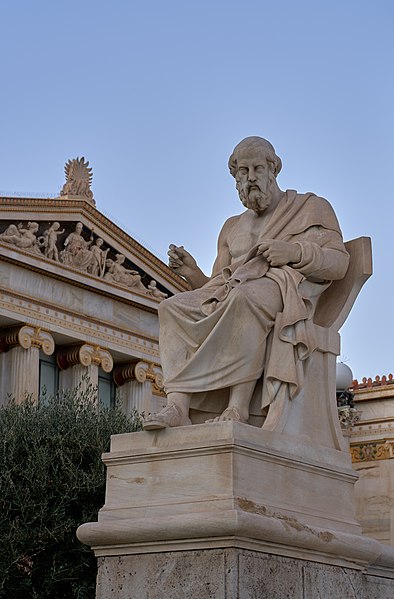
Plato’s metaphysics are really weird


By MALCOLM LANGE —- mslange@ucdavis.edu


When one hears the term “philosopher,” it is very common to think of the traditional Western or Greek philosophers. Plato — one of the most well-known philosophers — was the student of Socrates and a great thinker in Ancient Greece, writing many philosophical books in the form of Socratic dialogues. But he was also so much more — by the end of this article, you will find that Plato is really just a silly little fella. 

A Socratic dialogue is where the main character is Socrates and, surprisingly enough, is in the form of a dialogue, following a first-person perspective of Socrates. Is this weird? Sort of. I mean, if I were to write a philosophical book, I probably wouldn’t make the main character any of my professors (sorry professors), but it is less egotistical than having the main character be himself, I guess.

Socrates, also a predominant philosophical thinker of his time, was sentenced to exile or death for allegedly corrupting the minds of the youth by, essentially, asking them to think critically, especially before going to war. There might be more nuance to it, but as this is not a lecture, and I am not a professor, get off my back. Anyway, Plato, appearing to have not taken the death of his teacher very well — as in later books, such as “The Republic” — blames the idiocracy of democracies and claims that those who sentenced him to his death are simply unknowledgeable of what good truly is.

In Plato’s “The Republic,” he offers many critiques of democracy and gives an interesting claim to what is now called Platonic Metaphysics. His metaphysics are strange, to say the least, but I will try to do it justice for the argument of this article. In my opinion, his metaphysics seem like a lame excuse to explain away Socrates’ death sentence by shifting the blame to the people of Athens.

In the name of simplification, we will first look at Plato’s “Allegory of the Cave.” In this allegory, we are to imagine that there are prisoners in a dark cave who are only able to look straight ahead; on the wall of this cave exist shadows of objects and people. Behind the prisoners is a fire and people controlling the shadows. To the prisoners, who have been down there their entire life, the shadows are their complete world. Eventually, a prisoner breaks free of his chains and moves through the cave to see the fire — its light burning his eyes as it is brighter than anything he had ever seen before. 

This escaped prisoner, let’s call him Bufford (not for any specific reason), realizes that his whole life is essentially wrong; the shadows are, in fact, mere images of what is real — in this case, the objects casting the shadows. Like the fire, the prisoner was blinded by the light of the sun as he reached the exit of the cave, only able to look straight to the ground and view the shadows of objects. After some time, Bufford is able to train himself to look at physical objects and then even, with enough strength, the sun itself. 

His whole world is shaken by the revelation of all that exists in the upper world. Bufford feels an obligation to the other prisoners and sets to return to the cave and reveal his findings.  However, his eyes are no longer used to the darkness. The prisoners fear this “loss of sight” and deem the upper world dangerous —  they would even go as far as killing him or anyone else who would try to remove them from the cave. 

This weird allegory symbolizes the different stages of knowledge: those who only see shadows in the cave are at the lowest form of knowledge — “ignorance” — primarily knowing nothing real. Those who make it to the fire know a little more, what is perceived as “opinion” by Plato. Those who can make it out of the cave enter the intelligible world, which is closer to the truth, and have “true opinion.” They might understand mathematics or science but are still only able to look at the shadows of the real truth. 

When Bufford looked at the sun, that was the highest form of knowledge: looking upon the “good” and where everything good stems from. Plato claims that most people live their lives stuck at the ignorant stage, with few having the ability to ever make it to full wisdom. I am sure that an astute Plato fanatic would be able to point out mistakes in this summary, but as I have a page limit — and a personal, mental limit — this is the best I can do.

One of the weird claims that Platonic Metaphysics makes is that everything we see, touch and interact with is not real. They are just corrupted versions of the real things, only able to be perceived by looking at the “good.” The intelligible world is the one that holds everything real, while the physical world (down in the cave) holds mere reflections or poor creations of what is real. 

Another weird aspect of these metaphysics is that after explaining the cave allegory, he goes on to say that someone who looks at the sun and goes into a dark room will temporarily be blind; the same is true for looking at the “good” and then coming back down to false reality. Their senses might be slightly dulled as they adjust, and it would be unfair to compel them to courts before they have the time to acclimate to the change. 

How could you force them to debate on the mere shadows of justice and human evils after having spent so much time in the intelligible world looking upon true justice and goodness? And to try to debate these certain subjects with people who only know the one false way that justice is? 

This is clearly a reference to his teacher Socrates and an explanation as to why he lost in court and was sentenced to death or exile. It is hard to tell, at least from “The Republic” alone, if Plato truly believes in his metaphysics or if it is just a way of explaining wisdom. If he truly believed in his writing, it would imply that Plato himself has seen the “good” to some extent. However, especially paired with the allegory of the cave, it appears to be created in the attempts to give a reason for Socrates’ death, claiming that he was still just adjusting to the darkness of the physical world and had to argue with, essentially, idiots who did not know the true meaning of justice. 

The latter could be excused enough, with no need for the metaphysics, by claiming that everyone is simply too dull to understand true wisdom and that democracy is at fault for allowing dull people to dictate society. In conclusion, Plato’s metaphysics are strange and, quite frankly, could only have been written by a silly little fella, thus proving that Plato is indeed a silly little fella.


Written by: Malcolm Lange — mslange@ucdavis.edu

Disclaimer: The views and opinions expressed by individual columnists belong to the columnists alone and do not necessarily indicate the views and opinions held by The California Aggie.

Culture Corner

The Art Desk’s weekly picks for movies, music and more


By ANNABEL MARSHALL — arts@theaggie.org


Book: “Almost Invisible” by Mark Strand (2012)

“Oh,” said my friend after reading this book. “I didn’t realize poetry could be enjoyable.” If that glowing review doesn’t have you rushing to the nearest library, I don’t know what will. Mark Strand’s strand of poetry marks (hah!) a deviation from what you may have thought of poetry in high school: a dead-but-beaten horse oscillating between tortuous Middle English blather and soulless Instagram axioms. That’s not this. Clocking in at about 70 pages, each poem from “Almost Invisible” is a tight, affecting riddle, ranging in topic from the mythical to domestic satire. 

And if you already love poetry, including the Middle English blather, this is still a wonderful read by a literary star: Strand won the title of Poet Laureate and a Pulitzer for his contribution to the American poetry scene. So that’s fun.


Album: “The Rise and Fall of a Midwest Princess” by Chappell Roan (2023)

True Midwest princess Chappell Roan occasions the only time I will ever use “fantastic” and “Missouri” in the same sentence (no offense to the “Show Me!” state). Roan captures the angsty-teenage-bedroom-pop vibe in a way that’s especially familiar to queer kids and anyone with a dream of moving far, far away. Just a few weeks ago, an impressive late-night debut cemented her instant-cult-classic quality: campy visuals, Stevie Nicks vocals, the works (YouTube it!). You may have heard songs like “California” or “Casual” bouncing around the internet for the past few years before finding a home on this album, but also check out “Red Wine Supernova” and “Picture You” — my current favorites. Catch her on the upswing so you can say to your friends that classic remark of taste: “I knew them before SNL!”


Movie: “In the Mood for Love” dir. by Wong Kar-wai (2000)

To me, this is the perfect rainy-day flick: intensely personal, patient but not slow and visually gorgeous. For people who are into film, this is an obvious choice, but I had never heard of this movie until I stumbled upon it mid-pandemic. Even with my limited understanding of cinematography, I thought it was brilliantly enjoyable. Primarily in Cantonese and Shanghainese and set in 1962, this film embodies an era-defining aesthetic while speaking to universal themes of longing and beauty. I’ll say it’s 50-50 if you cry or throw something at the screen. If nothing else, you can finally be one of those annoying art bros who talks about Wong Kar-wai at house parties.


TV Show: “Supernatural” (2005 to 2020)

If you’re new here: welcome to the worst TV show that has ever had several master’s thesis projects written about it. If you’re not new, so sorry to see you here again. Here’s the deal: two brothers fight monsters on the greatest American road trip ever broadcasted by the CW. Everyone is hot, violent and suffering from daddy issues of biblical proportions (literally, biblical). This show is where a lot of the ex-“The X Files” crew ended up and it shows — it’s actually pretty gruesome. But more than that, it’s hilarious, stupid, emotionally devastating, gay, homophobic, a modern-day “Inferno,” meta, Jensen Ackles shedding a single tear, cringe-worthy, timeless and a decade-and-a-half-long fever dream. One of the great joys of “Supernatural” is that the canon content only makes up about 30 percent of the experience of being a fan; the show has produced a robust internet community (remember SuperWhoLock? No, me neither.) with high levels of interaction from the cast and creators, to the extent that major plot points started out as internet speculation. So if you’re the person googling “cast” or “bloopers” the second the movie is over, this one’s for you. You’ll laugh, you’ll cry, you’ll be astonished they renewed this for 15 years.


Written by: Annabel Marshall — arts@theaggie.org