52.2 F
Davis

Davis, California

Thursday, December 25, 2025
Home Blog Page 152

New UC project aims to lower cows’ methane emissions by editing the genome of their gut microbiomes

CRISPR, a powerful gene-editing tool, can be used to improve environmental and human health


By LILLY ACKERMAN — science@theaggie.org 

Lea este artículo en español


Researchers at UC Davis, in collaboration with others at UC San Francisco and UC Berkeley, have been granted $70 million for a project that aims to reduce methane emissions from cows via Clustered Regularly Interspaced Short Palindromic Repeats (CRISPR) genome editing of their gut microbes. 

The funding comes from donors through the TED Audacious Project, an initiative that supports projects with potentially huge global impacts by taking them from ideas to actionable multi-year plans with donor support. 

Microbes, or microscopic organisms ranging from bacteria to fungi to viruses, have a much larger impact than their size would suggest. They live pretty much everywhere, including the insides and outsides of our own bodies, and play a major role in the function and health of the system they inhabit. 

The new project has two main focuses for microbial genome editing: improving human health by relieving childhood asthma and reducing methane emissions from cows, which are a significant contributor to climate change. 

Cows are ruminants, which means that they have specialized digestive systems that use microbes to ferment the food they eat. This process produces methane and other byproducts. Methane is one of the most potent greenhouse gasses, and with around 1.7 million dairy cows in California alone, transforming their microbes to produce less methane would make a huge difference.

The actual genome-editing portion of the project will be undertaken  through the Innovative Genomics Institute at UC Berkeley by Dr. Jennifer Doudna, who earned a nobel prize for the development of CRISPR technology in 2020, and Dr. Jill Banfield.

The two UC Berkeley researchers will work closely with Dr. Matthias Hess, an associate professor of animal science at UC Davis who studies how microbial systems interact with their environments. Hess will test the edited microbes in a laboratory setting.

“We will basically be developing tools that will not only allow us to hopefully solve the problem of methane emissions from livestock but really allow us to reverse-engineer microbes in the environment,” Hess said.

Dr. Ermias Kebreab is a professor of animal science, World Food Center director and associate dean for global engagement in the College of Agricultural and Environmental Sciences at UC Davis. After testing in the Hess lab, the tools developed by the project will be tested in live calves by Kebreab.

“Once we have a community of microbes that have the desired effect that we want, […] we are going to use that and take it into the field,” Kebreab said. “So that’s where I come in to do the in vivo work.”

The goal is to be able to implement the new microbes into cows when they are young and while their rumens, or the parts of their stomachs where fermentation occurs, are still developing, according to Kebreab.

“There is some evidence that early-age introduction of microbes gives an advantage to those microbes to become settled in and become the majority once the rumen develops,” Kebreab said. “So we are hoping to see, one, a substantial reduction in emissions and two, a better feed efficiency as well.”

The other sector of the project hopes to use microbes to directly improve human health. At UC San Francisco, Dr. Sue Lynch will also be working with Doudna and Banfield to apply CRISPR to children’s microbiomes in hopes of relieving childhood asthma.

“It will be this whole interconnection between tool development, animal health, human health and ecosystem health,” Hess said. “So really it’s a great project in many different dimensions.” 

Written by: Lilly Ackerman — science@theaggie.org

Carlos Dominguez pleads ‘not guilty’ to two counts of first-degree murder, attempted murder, use of a deadly or dangerous weapon

The suspect has been denied bail and will remain in custody while awaiting trial


By KATIE DEBENEDETTI — city@theaggie.org


This afternoon at 1:30 p.m., Carlos Raeles Dominguez was charged with two counts of first-degree murder, one count of attempted murder and three counts of use of a deadly or dangerous weapon at the Yolo County Superior Court.

Dominguez, who was represented by Yolo County Public Defender Daniel Hutchinson, pleaded not guilty on all counts and denied all enhancements of the counts. Bail of $4 million was originally considered, but District Attorney Matt De Moura, who represents the People of the State of California in the case, requested that no bail be set for Dominguez.

“The defendant is not entitled to bail given the circumstances of the case,” De Moura said. “When the court were to consider the facts and circumstances of the case and presume them to be true for purposes of bail, they are of such an egregious and dangerous nature to the community that it took two lives and almost costing a third person her life. Given that and the danger that the defendant represents to the public, I would ask that no bail be set.” 

In response, Hutchinson requested the bail remain set at $4 million. Judge Dan Wolk denied this request to keep the bail set at $4 million, instead deciding that no bail would be set. A pre-hearing conference will be held at 9 a.m. on May 22, until which Dominguez will remain in custody. 

Written by: Katie DeBenedetti — city@theaggie.org

As Davis recovers from tragedy, be respectful and stay safe

Remember to protect your physical and mental health as we continue to grieve the deaths of David Henry Breaux and Karim Abou Najm  


By THE EDITORIAL BOARD


The stabbing incidents this past week have shaken the Davis community and left many struggling to reconcile the trauma and uncertainty that followed. The last homicide within the city occurred almost four years ago in 2019, and it’s no surprise that residents and students alike had urgently voiced concerns for safety.

Even though a suspect has been arrested, the events of the past week have left many students feeling on edge, faced with the reality that even small-town Davis isn’t immune to violence. As life in Davis begins to return to normal, the Editorial Board would still like to offer tips, in addition to the ones the Davis Police Department has provided, to help students feel more safe.

While this may seem intuitive and repetitive, stay vigilant and aware of your surroundings, especially at night. Keep your doors and windows locked, and if possible, minimize the amount of time you spend alone outside when it’s dark. If you feel unsafe, trust your instincts and remove yourself from the situation as best you can. If it makes you more comfortable, you can also look into personal self-defense mechanisms. 

As more news continues to develop, it may be tempting to speculate and feed on rumors surrounding the investigation. However, until the Davis Police Department officially announces the resolution of the case, scrolling through and contributing to online discussion threads on Reddit, Discord or YikYak for theories, for example, isn’t helpful. Spreading false narratives is disrespectful to the victims who have passed. Instead, refer to updates on WarnMe and official announcements from the university and local news sources to stay informed. Remember to be conscious of the media you read.

Grieving the losses of community members and dealing with a lost sense of safety and independence in Davis can impact your mental health and it’s important to take care of yourself.

To avoid falling into a dangerous rabbit hole of conspiracy theories, try taking your mind off of recent events by engaging in hobbies. Reading, cleaning or being active are great ways to calm your mind.

Additionally, professors and TAs are also members of the Davis community, and they may be struggling with similar stress and feelings to students. Be patient with them as they navigate this confusing time and adapt their class schedules accordingly.

While many of us might feel more on edge following these events, it’s comforting to know that members of the community are ready and willing to work together and take care of each other. The Davis Police Department received around 15 call-in tips from different residents that helped successfully locate and apprehend the suspect.

While a return to normalcy seems imminent with the arrest of the alleged perpetrator, it is understandable that this might feel difficult. Unfortunately, Davis is not immune to tragic, heartbreaking events like the stabbings of David Henry Breaux, Karim Abou Najm and Kimberly Guillory

As the Davis community continues to grieve and heal together, the Editorial Board urges you to keep these safety tips in mind, prioritize your physical and mental health and be respectful of the friends and families of the victims who have passed.  


Written by: The Editorial Board

Identification of genes associated with stroke can improve efficiency of diagnoses

Gene expression has been found to correlate with the severity of strokes and can be used as biomarkers for diagnosis and treatment


By KATIE HELLMAN — science@theaggie.org 


According to a recent UC Davis study published in the journal BMC Medicine, analyzing an individual’s genes following a stroke may improve the efficiency of diagnosis and treatment. 

Dissecting the temporal dynamics of gene expression after IS (ischemic stroke) improves our understanding of immune and clotting responses at the molecular and cellular level that are involved in acute brain injury and may assist with time-targeted, cell-specific therapy,” the study reads.

Strokes can be classified as hemorrhagic, which means that they are caused by bleeding in the brain, or ischemic, which means they are caused by blood clots forming near blocked arteries. Without immediate treatment, parts of the brain become damaged or die as a result of brain swelling. Strokes are the second-leading cause of death worldwide.

Bodie Knepp, co-author of the study and assistant specialist in the Department of Neurology at UC Davis Health, explained what happens to the body during a stroke.

“During an ischemic stroke, a clot blocks a vessel and stops blood flow to a region of the brain,” Knepp said via email. “This causes brain tissue to not get enough oxygen and damages brain cells in the primary injury.”

Paulina Carmona-Mora, a research scientist in the Department of Neurology at UC Davis Health, commented on the importance of the relationship between strokes and gene expression.

“After a stroke, we observe changes in gene expression,” Carmona-Mora said. “Blood is a nice proxy for us to understand what’s going on in the site of the injury in the brain. Stroke diagnosis has to be within a critical time window; for example, within the first couple of hours, you can have a therapy that can break the clots that block blood flow in the brain.”

The current protocol for stroke treatment  includes the timely administration of medication and advanced brain imaging, but many hospitals aren’t equipped with the appropriate technology. This is especially true of medical facilities in rural areas and countries that lack sufficient resources to purchase and maintain advanced clinical equipment.

Researchers at UC Davis Health have been developing treatments designed for certain genes in stroke patients. With the help of her team, Carmona-Mora examined blood samples from 38 patients admitted to the emergency department for ischemic strokes and 18 patients admitted for other reasons. 

The researchers were able to identify differentially expressed genes, which show how a cell responds to its changing environment, by isolating the blood cell samples and specific biomarkers. The gene expression profiles of the stroke patients were then compared to those of the non-stroke patients. Many genes were associated with the severity of a stroke, depending on whether the gene expression was identified as more abundant, less abundant or absent compared to the data gathered from the non-stroke patients.

“There are genes that peak in the first 24 hours [after a stroke] and then decrease, which are nice for biomarkers and for diagnosis,” Carmona-Mora said. “There are genes that steadily increase their expression within the first 24 hours and then peak over 48 hours, and there are others that decrease constantly — so we see these genes in the controls and they decrease as the time after the stroke progresses.”

The results of the study provide a foundation for more efficient treatments to be administered to stroke patients, which could substantially decrease the risk of death and paralysis. 

“It is likely that most diseases are accompanied by changes in gene expression, either due to the disease itself or the body’s response to that disease,” Knepp said. “If these changes are distinct enough, and if they are unique compared to other diseases, the gene expression changes have great potential to aid in the diagnosis of that disease.”

Written by: Katie Hellman — science@theaggie.org

UC Davis Office of Sustainability, ASUCD Environmental Policy and Planning Commission celebrate Earth Week on campus

Several events and challenges were planned to encourage students and staff to think about their environmental impact and build a culture of sustainability 


By KAYA DO-KHANH — campus@theaggie.org


The UC Davis Office of Sustainability and the ASUCD Environmental Policy and Planning Commission (EPPC) planned a number of activities and events for the campus community to celebrate Earth Week. Both partnered with The Green Initiative Fund (TGIF) to present the Earth Week Challenge, which provides a list of challenges from four different categories: food and waste, water, energy reduction and education. Some of the challenges listed include using one’s organics as fertilizer, going vegan, binging climate change and sustainability films and only walking or biking for a week. Community members were encouraged to join the event and challenge others to participate through social media. 

The EPPC hosted two events on campus for Earth Week, starting with a seminar speaker event on April 18 by environmental lawyer and UC Davis Professor Tracy Windsor about the basics of environmental law and specific cases she has worked on. The event was successful and received positive feedback, according to fourth-year environmental science and management major and former EPPC Chairperson Mackenzie Field. The second event was a campus clean-up on Earth Day.

“We hosted a speaker event because responses to our Environmental Justice Survey Report from Fall 2022 indicated that more students wanted to learn about environmental justice,” Field said via email. “We are hosting a clean-up event to make a direct, positive impact on our campus. I hope the community continues to engage in sustainability throughout the year, not just during Earth Week.”

The EPPC also partnered with the UC Davis Office of Sustainability on the Cool Campus Challenge, a competition between UC Berkeley and UC Davis to claim the title of the “greenest campus.” The competition is running from April 3 to April 28 and encourages students to engage in climate-friendly actions to reduce their carbon footprints. Field said that there has been more engagement in the challenge this year than in previous years. 

“We hope the competition will gain more traction during Earth Week when students are more consciously aware of their environmental impact,” Field said. 

This month, the Office of Sustainability is promoting their Sustainability Champion Awards nominations for their Sustainability Summit on June 2, which is an opportunity for people on campus to recognize their peers who are environmental leaders on campus, according to Engagement Program Manager for UC Davis Sustainability Carla Fresquez. 

Fresquez also highlighted the Office of Sustainability’s recent partnership with Student Housing and Dining Services to give out free, reusable utensil sets to the campus community. There was a reusable utensil giveaway on April 18 at the CoHo and another on April 19 at the Student Community Center for the UC Davis Farmers Market’s Earth Week celebration. Fresquez said that the reusable utensil giveaways have been well received by both students and staff. 

“That has been a campaign that I have been really excited to see the response to,” Fresquez said. “We have been getting so many inquiries about how people can get their hands on one of these sets and how they can make these sets available to their whole departments so that they no longer need to purchase disposable items for break rooms and offices.” 


Written by: Kaya Do-Khanh — campus@theaggie.org

Upcoming Events in May

Concerts, research events, art exhibitions and more to check out this month


By SARAH HAN — arts@theaggie.org

“Lara Downes & John McWhorter” (Mondavi Center for the Performing Arts, 7:30-9:30 p.m. on May 5)

Pianist Lara Downes and author and commentator John McWhorter will perform pieces by Scott Joplin, a classically trained composer dubbed the “King of Ragtime” due to his revolutionary musical ambitions. Downes and McWhorter will play, tell Joplin’s story and legacy, and discuss the lineage of Black music in America. Those interested can find more information, including how to obtain tickets, on the Mondavi Center’s website


UC Davis Symphony Orchestra: “Brazil & Jazz” (Mondavi Center for the Performing Arts, 7:00-8:30 p.m. on May 6)

Starring guest conductor Evandro Matté, the UC Davis Symphony Orchestra will perform Alberto Nepomuceno’s “Batuque from Série Brasileira,” George Gershwin’s “Concerto in F” and Heitor Villa-Lobos’s “Chôros No. 6.” The concert will also feature Sacramento’s own Natsuki Fukasawa as the Gershwin piano soloist.


2nd Annual Research Symposium — Center for Neuroengineering & Medicine (International Center, 12:00-7:30 p.m. on May 9)

Held at the International Center, the 2nd Annual Research Symposium of the Center for Neuroengineering and Medicine brings neuro-engineering faculty, physician-scientists, clinicians, students and postdocs from engineering, medicine and neuroscience together to share research and network with other researchers. Faculty, graduate students and distinguished professor Viktor Jirsa, Ph.D. will speak at the event.


UC Davis Research Expo (Conference Center and Welcome Center, 10:00 a.m.-3:00 p.m. on May 16)

If you want to see the latest insights, resources and tools of research, visit the UC Davis Research Expo to learn more. The event will display presentations, workshops and exhibits for students to learn more about research opportunities. Those interested can check out the UC Davis Office of Research’s website


Curtis Symphony Orchestra (Mondavi Center for the Performing Arts, 2:00-4:00 p.m. on May 21)

The Curtis Institute of Music is one of the finest music conservatories in the world, producing world-renowned musicians like violinists Hilary Hahn and Ray Chen, conductor Leonard Bernstein and pianist Lang Lang. On May 21, internationally renowned conductor Osmo Vänskä will lead the Curtis Symphony Orchestra through renditions of Dai Wei’s “New Work,” Béla Bartók’s “Piano Concerto No. 2 in G Major, Sz. 95” and Nikolai Rimsky-Korsakov’s “Scheherazade, Op. 35.” The performance will also feature Grammy-winning soloist Yefim Bronfman in Bartók’s “Piano Concerto No. 2.” Those who would like to attend the event can refer to the Mondavi Center’s website for more information.


“Mike Henderson: Before the Fire, 1965-1985” (Manetti Shrem Museum, 11:00 a.m.-6:00 p.m. every day through June 15)

Join UC Davis Professor Emeritus Mike Henderson in his first solo U.S. museum exhibition in 20 years. The exhibit opened at the Manetti Shrem Museum on Jan. 29, and has recently been extended for display through June 15. Henderson highlights his contributions to the history of contemporary painting, filmmaking, radical Black politics and California art. The exhibition displays paintings and films about Afro-futurism, surrealism, anti-Black violence and utopian visions.


Written by: Sarah Han — arts@theaggie.org

Lawntopia 2023 delivered good music, dancing to the UC Davis community

ASUCD Entertainment Council’s annual spring quarter event garnered an impressive turnout  


By CLARA FISCHER — arts@theaggie.org


On Friday, April 28, the ASUCD Entertainment Council (EC) held Lawntopia at Dairy Field. The highly anticipated event, featuring notable American rap and hip-hop artist Isaiah Rashad as the headliner, saw a sizable and energetic turnout from the student body.

EC hosts several events similar to Lawntopia throughout the year, including Sunset Fest in fall quarter and Brainfreeze in winter quarter. These performances usually feature various openers, who are typically local musicians, and one more well-known headliner. This past weekend, Rashad stepped into that role.

Rashad is one of the most notorious musicians EC has managed to bring to Davis in recent years (especially compared to further back, when artists such as Drake, Florence + the Machine, Tiësto and more made stops on campus), with more than 4 million listeners on Spotify, collaborations with other mainstream artists like SZA and Kendrick Lamar and multiple Grammy nominations.

Third-year political science major Angelica Martinez expressed her excitement about the headliner, stating that the thing she was most looking forward to for the night was “definitely Isaiah Rashad, obviously.” 

The crowd at Lawntopia appeared to appreciate Rashad’s performance, with plenty of head-bobbing, jumping, cheering and moshing. Some in the audience seemed to know the rapper’s discography by heart, singing along word for word, and those that didn’t still brought ample energy. 

Even for those who weren’t super-fans of Rashad, the event had something to offer. Lawntopia featured performances by smaller artists, including Byemilo, DJ Mellax, Ladies First DJ Club and more, as well as pop-ups from local art vendors and information booths for various organizations.

One of the vendors selling art at the event was local artist and Sacramento State student Kendall Kennedy, who stated their excitement about seeing the opening acts perform.

“I’m excited to hear the openers,” Kennedy said. “I’m excited to hear the local bands.”

Roxy, a second-year environment and management major, has previously collaborated with Kennedy as a vendor at the Davis Art Market. She was given the opportunity to participate in Lawntopia through her previous work with Kennedy, playfully stating that she “got dragged in here with them.”

This year marked the first time Lawntopia was held at Dairy Field; previous shows were held at the Quad. The larger venue allowed for an increased number of attendees, but also caused lengthy entrance lines. Students were lined up around the block from when the doors opened to when they closed, and there was some confusion about which line was the correct one for students to wait in. 

Overall, this year’s Lawntopia was an exciting way to usher in the (much-needed) warm weather of spring quarter. The minor kinks in the organization of the event only served to remind concertgoers that there’s a possibility for an even better experience next year and were ultimately outweighed by the positive energy shared by the performers and the crowd.

“From last year to this year, it’s the perfect shift,” Martinez said. 

Her sentiment echoes the feelings radiating from the crowd at the event — students were, more than anything, happy to be spending time together to mark the start of the (arguably) best quarter of the year. 

Written by: Clara Fischer — arts@theaggie.org

What this one of these says about you

Your choice reveals characteristics about you!


BY ANNABEL MARSHALL — almarshall@ucdavis.edu 


Pick an option.


Option 1: Bleh. Boo! This is the worst one of these. Everyone agrees. Nobody likes this one, so you must be a bad, not good, person.


Option 2: You’re okay. You picked the safe option, which is how I know you’re not interesting, intrinsically. Maybe you didn’t wait to hear the rest of the options.


Option 3: This one is my favorite! I like it because I think it’s good. If you like it, it’s probably because you think it’s good.


Option 4: I think it was pretty obvious what this option would lead to. I think you knew exactly what would result from picking this option, and you picked it because you wanted to be special and better at interacting in social situations. I don’t respect you for picking this one. I’m going to throw up into your open hands.


Option 5: Are you serious? No one even thinks of this one as an option — which is why earlier I said that Option 1 was the worst option. I hadn’t even considered that you would choose this option, although I did offer it as an option for some reason. This makes you a terrible person morally and in terms of physical attractiveness. Pick the best option next time instead of such a bad option.


Option 6: I can tell from the fact that you picked this one that you will die in exactly six years. Probably noon-ish. Mark your Google Calendar.


Option 7: This is the option that means that everyone wants you carnally. You may have picked this one on purpose so that people will want you carnally, but it only works if the decision comes from the heart.


Written by: Annabel Marshall — almarshall@ucdavis.edu 

Disclaimer: (This article is humor and/or satire, and its content is purely fictional. The story and the names of “sources” are fictionalized.)

Senators raise concerns about election bias at April 27 meeting

Following several confirmations, quarterly reports and legislation deliberations, senators discuss their concerns regarding election biases during the ASUCD spring elections 


By LILY FREEMAN — campus@theaggie.org 


Vice President JT Eden called the April 27 Senate meeting to order at 6:10 p.m. After roll call, he read the UC Davis Land Acknowledgement.

Next, the Sustainability and Career Fair Committee confirmed Jordyn Kosai, a third-year sustainable and environmental design major, as the new committee chair. Jonathan Ng, a first-year political science major, Angelina Chen, a second-year communication major, and Eliana Avalos, a second-year psychology and Chicana and Chicano studies double major, were then confirmed as committee members to the Aggie Mentors Committee.

Following these confirmations, Picnic Day Director Jesse Goodman, a third-year economics major, and Vice Chair Bradford Martin, a second-year economics and psychology double major, presented their quarterly report. 

“Picnic Day 109 was a huge success,” Martin said. “We had high attendance, with around 60,000 people all over campus, hundreds of events and hundreds of volunteers.” 

Goodman said that the unit’s ideas to improve Picnic Day moving forward are increasing the number of bathrooms available to the public to reduce lines and minimizing the rising costs of events on campus for every community member to enjoy. 

Next, The California Aggie presented its quarterly report. Sophie Dewees, a fourth-year economics major and the editor-in-chief of The California Aggie, and Katie DeBenedetti, a fourth-year political science major and the managing editor of The California Aggie, gave the report. 

Dewees outlined the publication’s recent accomplishments, such as the increase in the publication’s social media presence, which includes the creation of a humor Instagram page and a new weekly podcast, “The Aggie’s Weekly Roundup,” where top headlines from a given week will be discussed. Additionally, Dewees highlighted that The California Aggie now publishes Spanish translations of some articles in collaboration with a Spanish class on campus. 

The External Affairs Commission (EAC) then went on to provide its quarterly report. Daniel Mojica, the chair of the commission, explained what the commission has accomplished this quarter. 

Mojica said that recent accomplishments of the EAC include pursuing city council and local school connections, partnering with the Student Advocate Office and increasing social media activity. The EAC is currently working toward its Advocacy Week, an event mainly composed of tabling on campus throughout the first week of May, with each day focusing on a different aspect of advocacy. 

Following quarterly reports, the Senate moved on to consider legislation. 

SB #95, which establishes the ASUCD Pride Festival as an ASUCD unit, passed unanimously. 

SB #101, which is emergency legislation to authorize a transfer of $3,000 from the Whole Earth Festival (WEF) equipment rentals line item to the WEF equipment purchases line item, and $2,000 from the WEF SecurityAggieHost line item to the WEF Chaos Control Foods line item, passed unanimously. 

SB #96, which establishes a new unit called the ASUCD Innovation and Research Lab, passed unanimously. 

Senators approved past meeting minutes and moved into open forum. Senator Jacob Klein voiced his concerns about potential acts of bias during the ASUCD spring elections. 

“The elections officer has clear ties with specific candidates, which is in violation of our bylaws,” Klein said. “The elections officer disclosed details about an email regarding a campaign with the opposing ticket. To share confidential information with the opposing ticket is incredibly concerning. Additionally, the elections officer shared confidential information about a slate prematurely with only one specific group of candidates, rather than all of the candidates. Ultimately, an explanation is owed to not only the affected candidates and members of our institution, but our voters. We deserve to have fair elections.”

Klein deferred to Senator Eustacio Alamilla, who affirmed these concerns. After no comments from other senators directly followed, and the table instead began discussion regarding other topics, Klein brought these concerns up again.

Senator Shrey Gupta responded. 

“I do not think that this is the right place for us to talk about this,” Gupta said. “I hear you guys and your concerns, but just think about the power that the table has on this. I think you need to go in front of the Elections Committee and the elections officer. The people on this table are also candidates. Before you speak, think about who you are speaking to. This is a waste of my time and a waste of the rest of our time. We’re essentially spending student fees of every single person here to just rant about how some people are getting unfair treatment, and none of us can change that.” 

Eden responded. 

“I am recognizing my bias, but I do think that a special sight hearing on the whole Elections Committee could be kind of sketch given how many candidates are on this table, including myself,” Eden said. “I don’t think it’s right to drag the people in charge of the administration of elections before the people who are seeking election for oversight.” 

Senator Stephen Fujimoto followed.

“I also want to note that just knowing the elections officer, I don’t think this was intentional or malicious,” Fujimoto said. “I don’t know what I can do to uphold the legitimacy or what can be done. If the people bringing these concerns feel that strongly that our elections are being compromised, then I encourage you to explore a closed session. I just don’t feel like I can do much as a senator, that’s not my role.” 

Klein then said that he did not want any election results to be published until these concerns were addressed.

After further discussion on the topic of election bias, with various senators suggesting limiting the communication and the number of meetings between candidates and ASUCD leaders during elections, Gupta moved to adjourn the meeting. 

With no objections, Eden adjourned the meeting at 10:02 p.m.


Written by: Lily Freeman — campus@theaggie.org

Sanrio, the home of Hello Kitty: why the brand is appealing in a boring, adult world

Students share their perspectives on the Japanese character brand


By KACEY CHAN — features@theaggie.org  


Sanrio is one of the most well-known brands out there. Its most iconic character, Hello Kitty, is worth an estimated $7 billion alone. There are over 50,000 Hello Kitty product lines available in more than 130 countries, and Sanrio’s peak revenue in 2022 was $575.3 million. The “Hello Kitty Girl,” a term coined on TikTok, refers to a typically younger woman who is a fan of Sanrio and often styles herself in accordance with the brand. 

There are numerous reasons for the popularity of Sanrio and specifically why the brand has been able to maintain its appeal for so long. 

Sanrio is a Japanese brand that primarily creates a line of simple, animated characters. While Hello Kitty is it is most well-known, the brand features other popular characters such as Cinammonroll and Kuromi, who each have their own signature personalities and symbols. Since the creation of Hello Kitty in 1974, people all over the world can instantly recognize the character upon seeing the figure’s iconic red or pink bow. 

Sanrio’s line of cutely designed, minimalist characters with their own color palettes and backgrounds has influenced students on a deep level. Leah Tahmassian, a third-year political science major at UC Davis and member of the Davis Anime Club, attests to the popularity of the brand. 

“When I was little, one of the first characters I found out about was Hello Kitty simply due to seeing her around school when other girls wore her shirts and had her backpacks,” Tahmassian said via direct message. 

Sara Lindstrom, a second-year design major, also became interested in Sanrio when she was younger and has continued to be a loyal fan into adulthood. 

“I’ve stayed loving Sanrio over the years because it reminds me of being a kid,” Lindstrom said in an Instagram direct message. “I get excited to have special Sanrio backpacks, clothing, stickers, etc.” 

Indeed, this youthful aspect of the brand seems to be its draw for students and young people in general. Unlike other children’s brands, which may lose their target audience over time as fans age, Sanrio has ensured their brand remains childlike but not childish

“The creator, Yuko Shimizu, and her company have done an exceptional job at marketing and curating a world with characters that people of all ages can enjoy,” Lindstrom said. “They keep the childlike wonder alive by not taking things too seriously in the Sanrio world.” 

A particular example, and perhaps an endearingly eccentric one, is that Hello Kitty’s size is exclusively measured in apples. 

“She’s five apples tall and three apples heavy,” Lindstrom wrote. 

The company also seems to inject a simple happiness in a world that rather lacks it. A study conducted by Medium magazine which examines Hello Kitty as a symbol determined that Sanrio has successfully “created a product that emotionalizes and humanizes everyday human world through embodied charm.”

Cassandra Brown, a small business owner from Georgia selling beaded jewelry online, has noticed Sanrio items tend to sell more quickly than non-Sanrio items.

“I think Sanrio is so popular because there’s a lot of variety,” Brown said in an Instagram direct message. “People can find [a character] that fits them and their aesthetic the best.” 

It is also this universality which has led to the brand’s cult following online. 

“I love the diversity of the characters because it feels like there’s one for everyone with all their many different styles and colours and personalities,” wrote Adele Newcomb, a second-year biological sciences major, in a direct message. 

Newcomb points to the increasing popularity of niches on social media which users often strongly identify with. 

“With the rise of different aesthetics such as the ‘clean girl,’ the ‘it girl,’ etc., I think Sanrio seems to be a more flexible aesthetic than many others,” Newcomb said. 

Clarissa Gutierrez, a third-year cinema and digital media major and small business owner, confirms the establishment of the brand as its own niche. 

“Whenever I think of Sanrio, I think of cute characters, soft colors and very girly things,” Gutierrez said in a direct message. “Even online, there are such things [labeled] as ‘Sanriocore.’”

A key attraction of the brand is its various types or sub-aesthetics. Almost functioning as a cuter version of the Myers-Briggs Type Indicator personality test, each character has its own colors, themes and even personality traits. 

Kuromi, a white dwarf rabbit who often wears a black jester’s hat, has a darker theme identifiable by the colors black and pink. My Melody has a “light” theme, as opposed to Hello Kitty and Keroppi, who have more “bright” themes. 

With the rise of other East Asian cultural trends like K-Pop and anime in the U.S. over the past few years, it is perhaps not surprising that Sanrio would be a part of this wave as well. Tahmassian, for example, mentioned that her preference for a particular Sanrio character — Little Twin Stars — led her to watch an anime called “Sanrio Danshi,” which centers on a group of boys all obsessed with different Sanrio characters. 

Sanrio may be a children’s brand on the surface, but it is clear that the brand has maintained a strong following and fan base of adults. Sanrio, and Hello Kitty, have curated their image to such a degree that it lacks a specific, target age. 

“I know of many older adults who have and love Sanrio things, like people my parents’ age,” Newcomb said in a direct message. 

Lindstrom has become such a fan of the brand, she has Hello Kitty tattooed on her hand.

“Sanrio fits into my personal style really well,” Lindstrom said in a direct message, “so much so, that I have Hello Kitty on me forever.”


Written by: Kacey Chan— features@theaggie.org 


Correction: In a previous version of this article, the incorrect pronouns were used for Sara Lindstrom. Her pronouns have been changed from “they/them” to “she/her” to better reflect her lived identity. The California Aggie regrets this mistake.

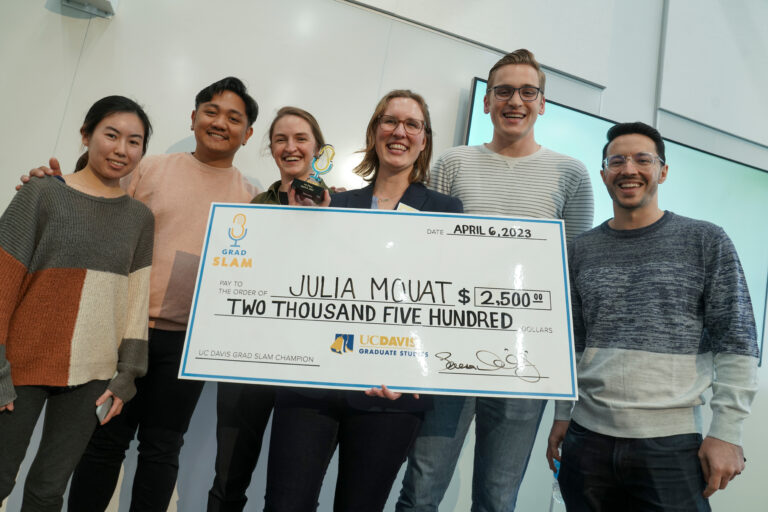
Julia Mouat is named winner of the UC Davis Grad Slam competition

The winner and runner up share the inspirations for their research presentations


By JADE BELL — campus@theaggie.org


The semi-final round of the UC Davis Grad Slam competition was held on Thursday, April 6. Participants presented their graduate research to a diverse audience and panel of judges in just three minutes, competing for a chance to win $2,500. 

Teresa Dillinger, Ph.D., the director of GradPathways Institute for Professional Development in Graduate Studies, shared that Grad Slam is one of many professional development opportunities during which graduate students can improve their presentation and communication skills.

“Our mission is to prepare all graduate students for success both here at UC Davis and in their chosen career paths,” Dillinger said via email. “To prepare them, we provide programs based on 8 core competencies and one of these is Presentation Skills. We all need to learn to effectively communicate what we do – but for graduate students who spend hundreds of hours on their research, Grad Slam is a challenge because they have to communicate the highlights in just 3 minutes!  And they are required to present their research in a way that is compelling and accessible to all audiences.”

Julia Mouat, a fourth-year Ph.D. candidate studying integrative genetics and genomics, did just that with her winning presentation “Grandmas, Ghosts, and Genes.” Mouat shared that her research was an attempt to understand what factors increase the likelihood of autism spectrum disorders.

“Research has shown that grandparental social factors and environmental exposures may increase the risk for autism spectrum disorders in the grandchild,” Mouat said. “[In] particular, grandmaternal cigarette smoking. So, my research is trying to look at the mechanism of how this is happening.”

Mouat’s choice of topic was inspired by why she came to grad school — to integrate genetics with environmental health sciences.

“I have been thinking a lot just about this multigenerational risk and resilience that communities and families go through,” Mouat said. “Families and communities are exposed to high levels of pollution because they live near a power plant or something like that. Or face social factors that increase stress levels or whatever it may beI’. m just really interested in trying to incorporate those factors with biology and how those together interact and influence risk for disease.”

Nalina Aiempichitkijkarn, a fifth-year Ph.D. student studying animal behavior and the second-place winner of the competition, was also interested in the links between disease and animal behavior.

“I am interested in primate social behavior, how they interact among themselves,” Aiempichitkijkarn said. “They live in a big group and they have a social hierarchy. They have friends and some that they don’t like. Sometimes they fight a lot. I want to bring that [and] connect that with infection status because the pilot study shows that 10% of this group have tuberculosis or TB, but we don’t know who are those [that do]. We try to look at their social behavior [and] try to link [that] with the infection status – who are those [that are] infectious.”

Aiempichitkijkarn said that she chose this topic due to her love for animals.

“My first project about animal behavior happened to be monkeys,” Aiempichitkijkarn said. “Since then, I’ve just been into the monkey field. I’m more interested in the social behavior of monkeys and it’s cool when you can link [it] with an aspect that gets some interest from the general public, like an infectious disease diagnosis.”

Both contestants shared that the main challenge they faced during the Grad Slam competition was speaking in terms that the general public can understand while retaining their interest in the presented research.

“It’s a new experience for me to talk to a general audience because I normally talk in my lab group or in an academic setting,” Aiempichitkijkarn said. “So I need to be careful with the word choice I use. With [the] general public it’s a bit different, I try to be correct but in the same way [also] be understandable without any jargon.”

Both participants said that despite the challenges, they enjoyed the competition as well, whether it was chatting with other contestants or learning about each others’ research.

“I really enjoyed meeting all the other contestants,” Mouat said. “Everyone was just friendly, even the photographer, camera people and lights people — they all helped us that day…I thought that the other contestants were there just to have fun and do their best. It didn’t feel like a competitive or toxic environment. It felt really positive and supportive.”

Beyond Grad Slam, Dillinger wants graduate students to know that they are not alone and can receive guidance on their professional and career development concerns.

“We hope that graduate students and postdocs know that the GradPathways Institute in Graduate Studies is here for them to support their professional and career development needs,” Dillinger said via email. “The GradPathways Institute partners with units from across campus to offer hundreds of workshops, consultations, and training throughout the year – all in support of grad student and postdoc success.”

Written by: Jade Bell — campus@theaggie.org

Mid-season update: UC Davis softball

Head Coach Erin Thorpe has created a winning program full of talent


By CAROLYN (CARI) FENN — sports@theaggie.org


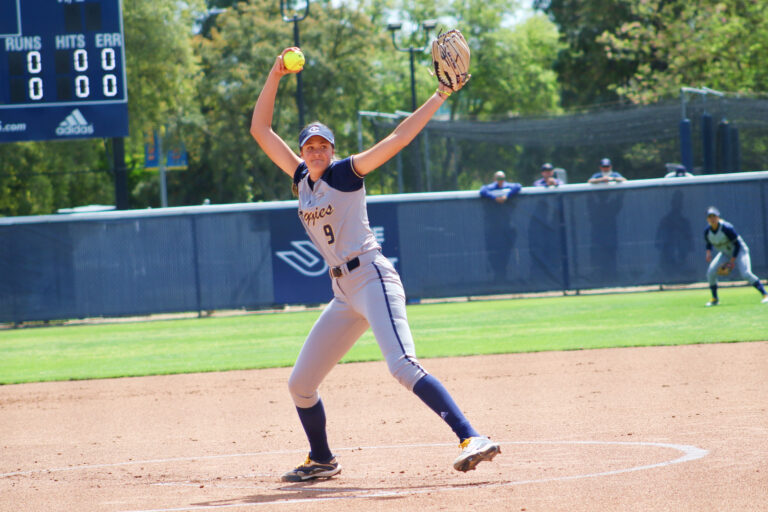
While the UC Davis women’s softball team still has six games left in the 2023 season, they have already shown great improvement compared to their 2022 season. Despite having highs and lows in a 49-game season, the Aggies have had an overall impressive performance so far, currently placing fifth in the Big West Conference. While it is possible that their placement could change as a result of the next few games, the Aggies have already guaranteed a better conference placement than in the 2022 season, when they placed eighth in the Big West.

When comparing UC Davis’s record and statistics from the last two seasons, it is clear just how much improvement the players have made — both as a team and as individuals.  

The most obvious difference is the number of wins against Big West Conference opponents the team has had. Last season, the Aggies had an 11-16 conference record and an overall record of 23-29. This season, they have a current conference record of 12-8 and an overall record of 26-16

As a team overall, their statistics in every criterion have also improved. For instance, the team’s hitting average ranked eighth overall in the Big West last season, with a batting average of 0.242 seconds. This season, the Aggies’ hitting average is ranked third at 0.271 seconds. UC Davis’s pitching dropped from first to second in the rankings, but the team’s overall earned run average (ERA) went from 2.68 in 2022 to 2.24 this season. While their standing did decrease in the Big West Conference, it is important to note that their current ERA is currently better so far compared to last year. Lastly, for fielding, they went from being ranked ninth to being ranked fifth.

All of their improvements as a team have contributed to their winning percentile, which has jumped from 0.442 to 0.619 overall and from 0.442 to 0.605 in conference play. It is obvious that their growth as a team has benefited them greatly throughout the 2023 season. 

While the team as a whole has shown statistical improvement, their success wouldn’t have been possible without the individual improvements of many of the UC Davis players. 

In 2022, no Aggie was named in the top 10 batters in the Big West. Yet this season, the Aggies have third-year outfielder Anna Dethelfson breaking through the top 10, going from being ranked 17th with a batting average of 0.328 seconds to being ranked second with a batting average of 0.405. Dethelfson is also ranked first in stolen bases with an impressive 36 total this season. Additionally, she tops many of the other lists of hitting leaders in the Conference, being first in doubles, third in on-base percentage, third in total hits and third in runs scored. The impressive growth Dethelfson has displayed this season is one of the reasons why the Aggies are succeeding offensively.

Because of this, t is no surprise that Dethelfson was recently named UC Davis’s female student-athlete of the week after achieving a 0.400 batting average, four stolen bases, three runs and two doubles during their series against UC San Diego.

When it comes to pitching, the Aggies had the best pitcher on the mound in the 2022 Big West Conference in third-year Kennedi Brown. While she has dropped from the No. 1 ranking, she is still one of the top pitchers in the conference, currently ranking third

Statistically, Brown has performed incredibly this year. Her ERA is currently 1.77 and she has had a career-high of 14 wins and 127 strikeouts this season. In 2023, Brown has thrown a shutout, been named Big West Pitcher of the week twice, threw her second career no-hitter, been named to the Big West Softball Preseason Coaches Team and most impressively, broke the school record for most strikeouts thrown in UC Davis’s programs history. 

UC Davis also has third-year pitchers Taylor Fitzgerald and Sarah Reineman who have had impressive pitching performances this season. Fitzgerald is ranked eighth with a 2.24 ERA and Reineman is ranked 13th with a 2.70 ERA. Fitzgerald was previously ranked 11th and Reimeman was not ranked at all prior to this season. Having two pitchers rank in the top 10 and three pitchers in the top 15 is a great example of just how much the Aggies’ pitching rotation has grown over the past year.

While UC Davis as a team didn’t reach as high in the fielding rankings as they did in the  hitting and pitching rankings, they still have shown growth in the area compared to the 2022 season. Specifically, Fourth-year infielder Sommer Kisling and third-year first baseman Sarah Starks have both stepped up their fielding this year. 

In 2022, Kisling was ranked 33rd in fielding, but this season she has risen to the fifth spot. Starks ranked 15th last season and is currently ranked ninth. Kisling is also ranked third in fielding percentage at 0.994.

While the Aggies have had some low points during the season, such as losing in extra innings against both UC San Diego and UC Berkeley, they have also had many highs — setting program records and climbing the Big West rankings. It will not be a surprise if UC Davis ends up finishing higher than fourth in the conference and making it far in the NCAA tournament at the end of the season. 


Written by: Carolyn (Cari) Fenn — sports@theaggie.org


‘Discovering Academia’ gives students an inside look at the world of scholarly research

Founders Brent Valentine and Keller Kramer discuss the creation of the podcast


By ANA BACH — arts@theaggie.org

Lea este artículo en español.


Discovering Academia” is a student-run podcast that explores the seemingly endless research opportunities here at UC Davis. Brent Valentine, a second-year managerial economics and neurobiology, physiology and behavior double major, and Keller Kramer, a second-year international relations and agricultural and environmental technology double major, help bridge the gap between students and their professors’ research outside of the classroom.

“The initial point for [creating the podcast] was that I needed a letter of recommendation,” Kramer said. “I started to reach out to different people and try to learn more about what they are doing.”

Kramer’s first conversation prior to starting the podcast was with a political science professor who discussed her training in engineering and how she applied those principles to political science at a higher level. 

“I hadn’t really considered how each of these professors could be interdisciplinary within their own field,” Kramer said. “I had always wanted to do some kind of podcasting, and Brent and I first connected because we listened to the same podcast. It kinda just made sense to do it together.” 

The process for producing an episode of “Discovering Academia” begins with Kramer and Valentine reaching out to professors via email. They typically reach out to anywhere from fifty to seventy professors and then accumulate a list of topics to log any ideas that may spark interest.

“After we email them, we will gauge their interest and see if they want to do the podcast,” Kramer said. “If they are interested, we have a link to send them where they can sign up for a quick [introduction] meeting.”

The first meetings consist of a general outline and fleshed-out plan for how the episode will flow. 

“We will explain what the point of the podcast is and what we are hoping to get out of it,” Kramer said. “We talk to them about their current research and primarily focus on that work because a lot of the databases where the research is recorded haven’t been updated in a while.”

Additionally, Kramer said that many professors’ websites aren’t easily navigable by those who aren’t experts in the professors’ respective fields. The goal of “Discovering Academia” is to make the content of these websites and databases more digestible by manipulating complex content within research into a conversation that the majority of students can understand. 

“We will then send the questions over to the professor,” Valentine said. “They have the freedom to edit what they want to keep in and take out. We want them to know the general flow we are trying to go for.”

The format of their episodes is to spend the bulk of the conversation centered around a professor’s experience within their field. The podcast then closes by drawing attention to if the professor has opportunities for student involvement, advice for undergrads or anything that listeners may find interesting that is not directly related to the topic.

The two said that pursuing this project has been difficult at times amidst all the chaos of being an undergraduate student, but so far, it’s proved to be worth the work.

“My GPA definitely took a hit, and that was just something that we were comfortable with because we knew we needed to get it done,” Kramer said. “We both thought that it was more important than grades. As long as we still understand what we are learning, and we are still trying, that’s all we can ask for.”

“Staying organized is so critical,” Valentine said. “When you start to lose that, it falls apart completely.” 

Valentine and Kramer want students to be able to find opportunities and learn about research that might lead to more creativity on their academic paths rather than studying what they believe will be the most efficient way to success. 

“Especially at Davis, there is so much out there and so much freedom,” Kramer said. “There is a ton of funding and a lot of people who would want to help you move forth on that idea.”

The podcast gives students the encouragement, tools and network to truly dive deep into their own curiosities about the academic systems they interact with every day.


Written by: Ana Bach — arts@theaggie.org 

‘Discovering Academia’ ofrece a los estudiantes una mirada interna al mundo de la investigación académica

Los fundadores Brent Valentine y Keller Kramer discuten la creación del podcast 


Escrito por ANA BACH — arts@theaggie.org

Traducido por JOSÉ HERNANDEZ

Read this article in English.


Discovering Academia” es un podcast dirigido por estudiantes que explora las aparentemente infinitas oportunidades de investigación aquí en UC Davis. Brent Valentine, estudiante de segundo año con doble especialización en economía gerencial y neurobiología, fisiología y comportamiento, y Keller Kramer, estudiante de segundo año con doble especialización en relaciones internacionales y tecnología agrícola y ambiental, ayudaron a cerrar la brecha entre los estudiantes y la investigación de sus profesores fuera del salón.

“El punto inicial para [crear el podcast] era que necesitaba una carta de recomendación,” dijo Kramer. “Empecé a acercarme a diferentes personas e intenté aprender más acerca de lo que están haciendo.”

La primera conversación de Kramer antes de empezar el podcast fue con un profesor de ciencias políticas que discutió su entrenamiento en ingeniería y cómo aplicar esos principios en la ciencia política en niveles altos. 

“Realmente no había considerado como cada uno de estos profesores podrían ser interdisciplinarios entre su propio campo de estudio,” dijo Kramer. “Siempre había querido hacer algún tipo de podcast, y Brent y yo nos conectamos porque escuchábamos el mismo podcast. Simplemente hizo sentido hacerlo juntos.”

El proceso para producir un episodio de “Discovering Academia” empieza con Kramer y Valentine contactando a los profesores por correo electrónico. Por lo general, se comunican con entre cincuenta y setenta profesores y después acumulan una lista de temas para registrar cualquier idea que pueda despertar su interés.  

“Después de enviarles un correo electrónico, mediremos su interés y miraremos si quieren hacer el podcast,” Kramer dijo. “Si están interesados, tenemos un enlace que mandarles donde se pueden registrar para una junta introductoria rápida.”

La primera reunión consiste de un esquema general y un plan desarrollado para ver como va fluir el episodio. 

“Explicaremos cuál es el propósito del podcast y que estamos esperando obtener del podcast,” dijo Kramer. “Les hablamos acerca de su investigación actual y principalmente nos enfocamos en ese trabajo porque muchas bases de datos donde la investigación está grabada no ha sido actualizada en mucho tiempo.”

Adicionalmente, Kramer dijo que los sitios web de muchos profesores no son fácilmente navegables por aquellos que no son expertos en los respectivos campos de estudio de los profesores. La meta de “Discovering Academia” es hacer el contenido de estos sitios web y bases de datos más digestible al manipular contenido complejo dentro de la investigación en una conversación que la mayoría de los estudiantes puedan entender.

“Enviaremos las preguntas a los profesores,” dijo Valentine. “Ellos tienen la libertad de editar lo que quieran mantener y sacar. Queremos que sepan el flujo general al que estamos tratando de llegar.”

El formato de sus episodios es pasar la mayor parte de la conversación centrados en la experiencia de un profesor dentro de su campo. El podcast entonces cierra llamando la atención hacia sí el profesor tiene oportunidades para el involucramiento estudiantil, consejos para los estudiantes o cualquier cosa que la audiencia pueda encontrar interesante que no esté directamente relacionado con el tema. 

Las dos dijeron que perseguir este proyecto ha sido difícil en ocasiones entre todo el caos de ser un estudiante, pero hasta ahora, se ha demostrado que vale la pena el trabajo.

“Mi promedio de calificaciones definitivamente se vio afectado, y eso fue algo con lo que nos sentimos cómodos porque sabíamos que teníamos que hacerlo,” dijo Kramer. “Ambos pensamos que era más importante que las calificaciones. Mientras, aún entendamos lo que estamos aprendiendo, y aún estemos intentando, eso es todo lo que podemos pedir. 

“Mantenerse organizado es tan importante,” dijo Valentine. “Cuando empiezas a perder eso, se cae por completo”. 

Valentine y Kramer quieren estudiantes que sean capaces de encontrar oportunidades y aprender acerca de investigación que podría dirigir a más creatividad en sus caminos académicos en lugar de estudiar lo que ellos creen que será el camino más efectivo para el éxito. 

“Especialmente en Davis, hay tanto por ahí y tanta libertad,” dijo Kramer. “Hay mucha financiación y mucha gente que querrían ayudarte a seguir adelante en esa idea.”

El podcast le da a los estudiantes la motivación, herramientas y red para sumergirse de verdad en lo más profundo de sus propias curiosidades acerca de los sistemas académicos con los que interactúan cada día. 


Escrito por: Ana Back — arts@theaggie.org 

Traducido por: José Hernandez