55.7 F
Davis

Davis, California

Monday, December 22, 2025
Home Blog Page 164

Report released about death of 21,000 fish at UC Davis research center

The report found that the loss was caused by toxic levels of chlorine in the center’s tanks


By KAYA DO-KHANH — campus@theaggie.org

Lea este artículo en español.


An independent investigation report into the fish mortality event that occurred on Aug. 9, 2022 at the UC Davis Center for Aquatic Biology and Aquaculture (CABA) was released in Feb. 2023, according to a recent press release. The university called the loss of approximately 21,000 fish a “catastrophic failure” in a statement issued on Aug. 11, two days after the incident. 

The investigation report by Dr. Anthony Farrell, a professor emeritus at the University of British Columbia, stated that the water contamination, which was the cause of death for the fish, was due to an accumulation of mineral deposits inside sealed piping that led wastewater away from the facility. According to Farrell, this was a problem that had been developing over the course of several decades. The mineral deposits created a blockage that led to a sudden contamination of toxic levels of chlorine into the well water supply that was used to supply the tanks. 

 “No individual or collection of individuals can be singled out as being responsible,” Farrell wrote in the report. “The support staff, faculty and students who dealt with the catastrophe are to be commended for their collective responses to the catastrophe. The responses were both rapid and appropriate.”

The event occurred overnight, and an undergraduate student employee discovered the fish mortality around 8 a.m. on Aug. 9. According to an article from The New York Times, the chlorine damaged the gills and skin of multiple fish species in the tanks of the center, including the green and white sturgeon and Chinook salmon, which is endangered. Approximately 100 fish survived the event.

The CABA center was built in the 1950s and is home to research programs aimed at sustaining California’s aquatic species, supporting the technological framework of the state’s aquaculture industries and creating sustainable aquaculture production. The center had never before had such “an all-encompassing loss” of fish, said Dr. Brignolo, the executive director of the Research and Teaching Animal Care Program, in a statement to The New York Times. 

In the report, Farrell made a number of recommendations to eliminate the risk of a similar event occurring in the future. The recommendations include a replacement of the disinfection system and an advanced procedure for emergencies. Some of the actions that were recommended are already being implemented or planned, and the university has committed to funding improvements for the center.

“We are thankful for our campus partners, staff, faculty and students who have been instrumental in rebuilding the facility quickly and with compassion so that our aquatic conservation programs could be restored,” a statement from the university reads. “CABA welcomed fish back into the facility in October 2022.”

Written by: Kaya Do-Khanh — campus@theaggie.org

Ali Baba releases new hangover-curing breakfast burrito

I can feel my mom’s disappointment fade away with every bite!


By CARMEL RAVIV — craviv@ucdavis.edu


You may have experienced a pounding headache, a dry throat and the feeling that your stomach has turned inside out while picking up breakfast from Ali Baba. Maybe you have even thrown up in the bathroom and come back to the table like a champ once or twice. After all, you have to contribute to the debrief of last night’s occurrences at the Pi Sigma Alpha Beta Delta party, even while a family of five has lunch at the table next to you, their grandma pointing to your table and warning her grandchildren not to make the same mistakes you did.

If this sounds like you, then you’re in luck; Ali Baba has just released a cure for our hangover problems. Introducing the “Hangover Burrito”: It’s better than a cup of coffee, a shower and a hug from your mom combined! 

The recipe for the Hangover Burrito is revolutionary. Like all good breakfast burritos, it contains scrambled eggs, bacon and fried tater tots to soak up the alcohol left in your bloodstream. It also features a creatine-infused hot sauce to give you that boost of energy and a spicy kick and chunks of Tums to soothe your stomach. The burrito also contains fried onions, melted cheese and a dollop of Gatorade-flavored sour cream to revive your electrolytes. By the time your order is ready, Ali Baba will have one of your professors release a 53% grade on your midterm to wake you up and keep you alert and focused.

We know the burrito is great, but don’t take our word for it. Just ask Kyle Johnson, a frequent party-goer and believer in the Ali Baba Hangover Burrito! Oh wait, he’s passed out at the Farmer’s Market by the apple cider stand, which he mistook for a keg. Oh, and he’s butt naked. Well, there’s never a dull day in Davis, and now, never a bad hangover, thanks to Ali Baba.

So if you wake up after a night of partying feeling like a “Last of Us” zombie, come on down to Ali Baba and try the new Hangover Burrito. You won’t regret it, just the rest of your life’s choices.


Written by: Carmel Raviv — craviv@ucdavis.edu


Disclaimer: (This article is humor and/or satire, and its content is purely fictional. The story and the names of “sources” are fictionalized.)

UC Davis and UC Berkeley compete to see which campus is greener

The sustainability challenge runs from April 3 to April 28 on both campuses  


By SYDNEY AMESTOY — campus@theaggie.org


UC Davis and UC Berkeley students and faculty will soon have a chance to participate in the ultimate sustainability face-off to claim the title of “greenest campus” in the upcoming “Cal vs. Davis Cool Campus Challenge.”

From April 3 to April 28, students and staff from both campuses can record their “waste and emission-reducing actions” on the Cool Campus Challenge website, according to the event flyer. They will earn points for their school based on their recorded actions, and at the end of the competition, the school with more points will win. 

According to Mateo Alliende, a fourth-year environmental policy analysis and planning major and the co-developer of the project, this event takes inspiration from previous Cool Campus Challenge events that involved all 10 UC campuses. 

“The Cool Campus Challenge is a program that existed in the past,” Alliende said, “I thought that I could kind of incorporate that into my own project. And since I was talking to my friends at Berkeley, we were like, ‘Let’s just create an inter-campus competition, Davis versus Berkeley, and really build engagement that way.’”

Alliende worked alongside UC Berkeley student Garrett Kitahata to develop the project and bring it to both campuses. Kitahata could not be reached for comment as of March 26.

Reducing shower times, using public transportation, turning off lights when they are not in use and watching educational environmental videos are just some of the actions that participants can record on the Cool Campus Challenge webpage during the event, according to Alliende. 

“It’s kind of like a social media page,” Alliende said. “When you complete an action, you take a picture and post it and just say what kind of action it was, and you get points for your school that way. At the end of the competition, the school with the most points wins; it’s a pretty simple format.”

Alliende hopes students and staff from both campuses will get involved. Participants can work as individuals or as groups to earn points.

“Our intention is going to be education and empowering individual action,” Alliende said.  “If I change a habit, or a group changes a habit, how does that scale over time? Our message is really just about learning about our personal impact on the environment.”

The competition ends on April 28, and one campus will be declared the winner shortly after. 

“It’s definitely going to be Davis [that wins],” Alliende said. “We are the most sustainable university — it’s not even a question.”

To sign up for the challenge, you can go to www.coolcampus.org/UCDvsUCB2023/login or scan the QR code on the @coolcampuschallenge Instagram.


Written by: Sydney Amestoy — campus@theaggie.org


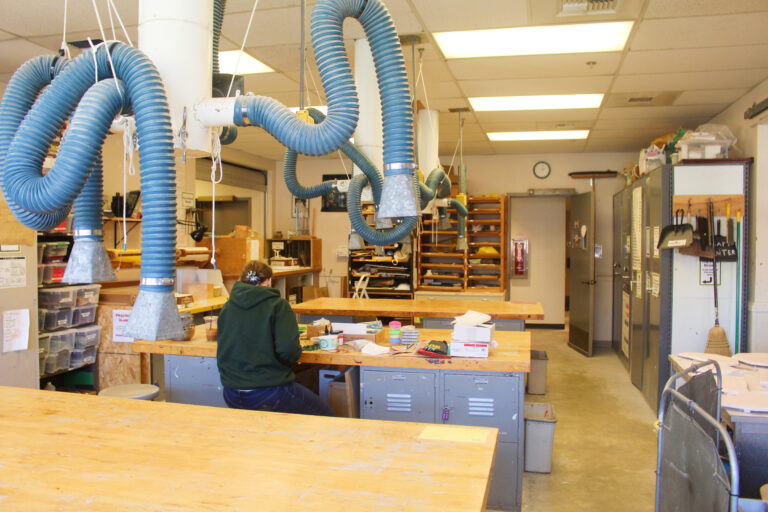
UC Davis Craft Center allows students to take a step back from their day-to-day life to express their creativity

Choose from dozens of unique, skill-based art classes to take without the pressure of a letter grade 


By REBEKA ZELJKO — features@theaggie.org 


For many students, the UC Davis Craft Center serves as a break from their hectic academic schedules. According to its website, the Craft Center offers upwards of 50 different classes per quarter, including ceramics, glass blowing, 3D printing, weaving and welding. 

Meredith McClintock, a fourth-year communication major and studio manager for the glass and screen printing studios, said that the Craft Center attracts students of all majors who are looking for a creative outlet. 

“One of the interesting things is we don’t have that many art majors taking the classes,” McClintock said. “Almost everyone is a science or humanities major because this is their outlet. I know like four aerospace engineers who regularly take classes here.”

Andrew Hui, a fourth-year science and technology studies major said he enjoys going to the Craft Center in his free time. 

“I think there’s not a lot of chances to express my artistic or creative side in my classes,” Hui said. “So even though [Craft Center] classes aren’t for credit, it’s a really chill way to spend your time and meet new people.”

The relaxation is a big selling point for students who are accustomed to a fast pace and demanding academic environment.

“It’s completely pressure-free,” McClintock said. “We will give you an orientation and ascertain your skill level to ensure you have a fun and safe experience, but there’s no grade attached to this.”

According to the Campus Recreation website, these classes cost between $14 to $250, but students can utilize the Well-Being Fee Waiver to offset these costs. Students can apply for the waiver using a Google Form, and it can be applied to one class or a studio pass to access the Craft Center for free or at a discounted rate. 

Harrison Dietzman, a graduate student studying creative writing, teaches a black-and-white photography class at the Craft Center.

“I’d taught writing and literature classes but never taught an applied hands-on class before,” Dietzman said. “It’s been fun to teach something more skill-based and less abstract.”

The diverse array of majors in his classes is also something Dietzman noted.

“Most of my students are not in the fine arts academically,” Dietzman said. “There’s a lot of engineers and animal life science, which is just the composition of this university. They usually express that they have a hobby that feels active and productive and gets them out of their normal classes.”

Dietzman said that the close-knit community at the Craft Center is what solidified his involvement as a volunteer instructor. 

“We cap the photo classes at a really small class size, so it’s a very hands-on instruction experience,” Dietzman said. “It feels less alienating than what people might be used to going to UC Davis. In school, the class sizes are [often] going to be more than 25 people, but here, they’re much smaller.”

The relaxed and creative nature of the classes offered by the Craft Center makes it an incredibly popular recreation space for students. McClintock recommends that people plan ahead of time to secure a spot in a class that they are interested in taking. 

“Our upcoming registration is open on the very first day of instruction, so April 3,” McClintock said. “We open at 12:30 p.m. in person, but people will usually start to line up earlier, depending on the popularity of the class.”

It’s not uncommon for popular classes to fill up quickly, so Hui suggests getting there as early as possible. 

“I think most of the classes fill up super fast,” Hui said. “The day of the sign up, the line was around the Silo, so if you want a ceramics class, you have to line up in the morning.”

But if you aren’t able to get the class you want, there are other ways for you to get involved in a creative pastime. 

“Even if I don’t get a class, you can buy studio passes,” Hui said. “You go through a small orientation or training, and then you can get access to the studio and make things in your own free time.”

Hui said he recommends you have a game plan going into the sign-up process.

“Pick multiple classes you are interested in just in case,” Hui said. “They all seem really fun, and I think they will all help with your well-being and develop your skills in some way.”

Dietzman said that even if you don’t get your first-choice class, every offered course can be beneficial in some way.

“There’s such a broad range of programs at the Craft Center,” Dietzman said. “They have metal working and glass blowing and different classes, but they’re all making an object so you have something to keep, take home and be proud of.”


Written by: Rebeka Zeljko — features@theaggie.org 


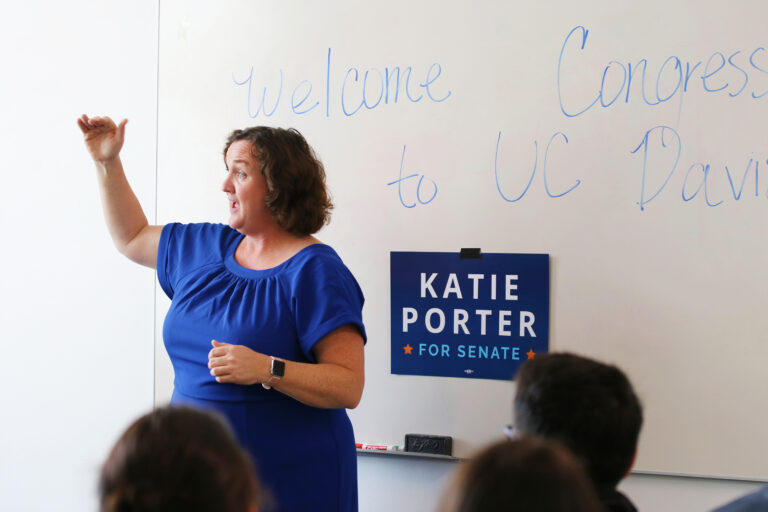
‘I don’t do Washington the way other people do:’ Congressperson Katie Porter holds campaign event on campus

Following her announcement to run for Senate, Representative Porter discusses corporate PACs, abortion access and other issues facing California 


By CHRIS PONCE  — city@theaggie.org


On March 15, Democratic Congressperson Katie Porter, who represents California’s 47th District (CA-47), held a campaign event at the UCD Alumni Center. The event was hosted by the Davis College Democrats (DCD). Rep. Porter is one of three declared Democratic Representatives campaigning to replace long-time Sen. Dianne Feinstein following her decision to retire in 2024.

DCD President Frances Haydock introduced Rep. Porter to those in attendance, welcoming her to Davis. Porter, who was a law professor at UC Irvine, talked about her experiences with Davis.

“This is my second trip to UC Davis,” Porter said. “And I’m going to tell you what I thought after my first trip, which I’m reminded of. Davis is like a little slice of heaven. It’s just a little slice of heaven, so it is really wonderful to be back here and be with you all. And I won’t comment on the Anteaters vs. Davis.”

Rep. Porter  began by introducing herself, touching on her title from the San Francisco Chronicle as “Congress’s single mom and watchdog.” Porter spoke about how her background impacts her candidacy and ability to fight against issues that are affecting Californians.

“It is not good enough that we have to worry that we are not going to be able to stay in California and raise our families in California because we can not afford the cost of housing,” Porter said. “It is not good enough that when we go to a church or to a school or to a movie theater we have to worry about the threat of gun violence. […] There are real challenges that we are facing in California and those battles and those solutions are going to be fought in the U.S. Senate.”

During the 2022 election cycle, Porter’s campaign received the largest sum of donations for a Democrat candidate running for the House of Representatives that year — and her campaign did this without accepting donations from Corporate PACs. Porter discussed her grassroots campaign strategy and talked about how it separates her from other candidates in the Senate race.

“I ran [for the House] in 2017 and got elected for the first time in 2018,” Porter said. “I’ve never taken a dime of corporate PAC money and I am the only candidate in the race who can say that and I am very, very proud of it. I am one of 11 members of the 435 people in the House of Representatives who do not take contributions from federal lobbyists. You cannot have your hand out for a contribution check at six o’clock at a reception and turn around and help the American people — expect the American people to believe you’re voting in their best interest — the next morning.”

Following her speech, Porter opened the rest of the meet-and-greet to take questions from students and those in attendance. The Porter campaign event came one day after Turning Point USA (TPUSA) held an event on campus, and Porter was asked about it.

One person in attendance asked Porter, “A lot of people that were [at the TPUSA event] are people that we’re going to be in class with, our peers. Some people that we might have considered friends, how do we come to terms with those people being around us?”

“This is a question you have to think about when the elevator opens and the person you’re going to have to ride with is Marjorie Taylor Greene,” Porter said. “We have to value and we have to respect free speech, but we also have to be willing to call out and fight against and hold people to account for hate speech. That is a line we have to be willing to draw. And we have to make sure that our institutions, including our educational institutions, are not hiding behind free speech to facilitate hate speech. We have to try to reach across the aisle when we can, but you don’t compromise your values to do it.”

Another attendee asked Porter about the push to codify Roe v. Wade and the Equal Rights Amendment: “that was my mother’s fight, and now our fight, and now my daughter’s.”

“Make no mistake, Republicans will enact a nationwide abortion ban so we need to codify Roe v. Wade,” Porter said. “We’re stuck, the number of Democratic women in the Senate has actually gone down. The only reason the number of women hasn’t gone down is because Republicans [have been] elected. We are not making forward progress. California’s tradition of elected female leaders is amazing, and I’m proud to walk in those footsteps. That is a trail they have made for people to follow. I’m really proud to be following in it and I commit to all of you to widen that trail for others whose voices need to be heard and are often ignored in Washington.”


Written By: Chris Ponce city@theaggie.org

The best Dark Academia books to read before winter is over

Unfolding the origins of the literary subgenre and aesthetic


By CORALIE LOON — arts@theaggie.org


With spring just around the corner, lovers of the darkest and coldest time of the year are savoring the last moments of winter. One way to make use of the last few weeks of the rainy season is to stay inside, curl up with a warm drink and get lost in a good book.

Dark Academia, a literary subgenre and aesthetic that has gained considerable popularity in the last decade, may be perfect for lovers of mystery, historical fiction, academic settings and sometimes even fantasy. According to L’Officiel, while the term Dark Academia “first appeared on the blogging platform Tumblr around 2015,” the genre is widely accepted to have been sparked by Donna Tartt’s 1992 novel, “The Secret History.”

Book Riot defines Dark Academia as “a book which features an academic setting, like a college or boarding school, and usually features some kind of a dark twist.” L’Officiel cites common elements of Dark Academia as classical literature, European art, gothic architecture and the appearance of “puzzles, murder, danger, cults and secret clubs.” This element of darkness, which distinguishes it from “light” and much more romanticized academia, often serves as a commentary on the “darkness” of elitist culture.

For those who grew up reading “Harry Potter,” Dark Academia has a certain appeal as the grown-up version of the magical, anachronistic high-school drama. If any of these elements sound intriguing, here are some of the best Dark Academia books to read this year:


“The Secret History” by Donna Tartt (1992)

It’s hard to find any list of Dark Academia books without “The Secret History” on it. This modern classic is an immersive, slow and simmering story of murder within a group of college students. The story is narrated by Richard Papen, who, after beginning to attend college in New England, attempts to join an exclusive ancient Greek program that is as small and intriguing as it is elusive. Naturally, things don’t go as planned. What makes this book interesting is not the murder itself, but the coy way the narrative structure frames the murder and slowly uncovers all that happens leading up to and following the pivotal moment.

There’s a reason this book is often called the original Dark Academia novel: its atmospheric and immersive tone, the presence of a mysterious “society” and its literature-loving and elitist cast of characters all cumulate into this memorable plunge into corruption and moral ambiguity.


“Vita Nostra” by Maryna and Serhiy Dyachenko (2007)

Originally written in Russian and translated by Julia Meitov Hersey, this novel combines references to Dark Academia with heavy doses of fantasy and existential dread. “Vita Nostra” follows a young woman, Sasha, who encounters a mysterious man while vacationing by the beach. Sasha is manipulated into following the stranger’s requests, which are increasingly bizarre and revealed to be part of an initiation into a school she’s never heard of: The Institute of Special Technologies. The story follows her journey through an education that seems to baffle as much as it teaches.

“Vita Nostra” is not for the casual reader: it is dark, ambiguous and detached from the physical world. A Goodreads user by the name of “Rincey” compared the book to “Harry Potter,” if it was written by Kafka. A better definition would be hard to come by.


“If We Were Villains” by M.L. Rio (2017)

Another classic on the Dark Academia bookshelf, “If We Were Villains” is the most similar to “The Secret History” out of the books on this list. It follows Oliver, a man who was imprisoned for supposedly murdering a fellow classmate in his college days, as he explains the truth of the event to a detective. Similar to “The Secret History,” “If We Were Villains” follows a group of friends brought together by a similar interest: in this case, Shakespeare. As the story progresses, interpersonal relationships grow and tensions bubble, slowly blurring the lines between theatrics and reality.

“If We Were Villains” is captivating, dramatic and hard to put down, making it a more favorable read for those who found “The Secret History” to be too meandering. Despite its commitment to almost all the tropes of Dark Academia literature, it reads as a fresh and memorable take on a Shakespearean tragedy.


“Maurice” by E.M. Forster (1971)

Not published until a year after the author’s death, “Maurice” is not usually viewed as a member of the Dark Academia subgenre. However, its setting at a university, focus on interpersonal relationships and involvement with literature, art and Greek culture make it a prototype of the genre’s eventual development. “Maurice” follows the life of a young man growing up and grappling with his sexual identity. While studying at Cambridge University, he begins to fall in love with his classmate, Clive, and develops a relationship that is strained by both parties’ inability to commit to something they find morally unjustifiable.

“Maurice” lacks the elements that make it clearly “dark” — no murder occurs and nothing supernatural pokes through the surface. But it is also not clearly “light” academia — it critiques elitist culture and the heteronormative world it produces rather than romanticizing them. At the heart of “Maurice” is the theme that appears again and again in Dark Academia: characters who are rejected by the outside world and must create their own version of social reality.


Written by: Coralie Loon — arts@theaggie.org


Oddli: the sustainable clothing brand embracing the inner child within all of us

One of the company’s founders, Jensen Neff, discusses how clothing can be ethically sourced and playfully vibrant 


By ANA BACH — arts@theaggie.org


Oddli is a sustainably sourced clothing brand co-created by Jensen Neff and Ellie Chen. The two decided to pursue this business venture while in their senior years at Stanford University after finding out just how much fabric goes to waste in the fashion industry.

“The initial idea for Oddli came after we were invited down together to shoot at Patagonia’s creative headquarters in Ventura,” Neff, who is the Creative Head of the brand, said. “After seeing the way that their business functioned, [while] simultaneously being at Stanford, watching girls overnight order (and me included) clothing pieces to wear for a formal the next day,” they were inspired to start their line.

Oddli’s clothing is mainly made up of leftover scrap fabric. There are roughly 14 million pounds of fabric left over every day in the clothing industry, and in creating a brand that recycles excess materials from larger fast fashion companies, Oddli creates clothing that actually contributes to the overall health of the planet. Each piece is made from a unique array of these fabrics, leaving each buyer with a special story of creation tied to their clothing.

Neff said that Stanford’s Capstone Project requirement provided the two with the necessary mentorship and encouragement they needed to move forward with their business venture.

“We started by tackling the waste issue in the industry,” Neff said. “We had gained an 8,000-person waitlist and did 50,000 [orders] in pre-order in one month. Then we said, ‘Let’s go test it for one year in Los Angeles.’ Now it has been two years and we just got our first full-time employee and office space.”

Neff said that the inspiration for the brand name came from a Shel Silverstein poem. “Falling Up” inspired the feeling that the two wanted for the brand.

“We wanted that feeling of falling up in a name,” Neff said. “I think the name couldn’t be more fitting.”

The brand releases a limited product line, which the founders say is meant to shift the culture that is charged with a constant need to endlessly produce new pieces to keep consumers interested. Oddli hopes buyers will treasure fewer pieces for a longer period of time.

Oddli’s products have been showcased on a handful of influencers’ TikTok and Instagram accounts. Neff stated that the best way to grow the brand has been through “intentional gifting.”

“I really look for people who have creative passions [and those] who have small businesses or are building platforms around something,” Neff said. “Gifting-wise, I choose what I think they would like.”

Still, in the early stages of brand building, Oddli is looking to grow an even bigger sustainable business. While other companies in the fashion industry aim to grow the product line physically by constantly producing new items, Oddli is looking to resourcefully takes what has already been put into the material world and spin it into something new.

“I believe that the world needs Oddli,” Neff said. “The vision overall is to become what will be Gen-Z’s ethical clothing brand, and what would be the replacement for Urban Outfitters or Brandy Melville. I will do anything it takes to get there and I think the way that we market is going to shift, especially in this next year.”

In addition to prioritizing sustainability, Oddli also sets itself apart by prioritizing connecting with buyers. Neff emphasized the impact that brands have on shaping our identities.

“The way that a brand could help me define myself and stand for my values was unmatched,” Neff said. “One of my favorite things that we have been hearing a ton with Oddli is that anytime someone wears it and someone else comes up to them, I think they automatically feel a connection as well as an overall kindness. I hope that Oddli stands for not taking ourselves too seriously while also feeling cool and sexy and any of those things that we want to be.”

Neff spoke about where she sees the brand going within the next year.

“The goal for this year is growth,” Neff said. “We really want it to be the year where Oddli reaches so many more eyes […] I am just in love with the world we are building. I want more people to be a part of it.”


Written by: Ana Bach — arts@theaggie.org 


Spring tunes for the upcoming season

From country to pop music, this selection is sure to set the tone for warmer days ahead        


By SARAH HAN — arts@theaggie.org


“Like I Loved You” by Brett Young (2017)

First on the list is a country song by well-known country singer Brett Young. The lyrics are about moving on from a relationship, but the real standout is the upbeat, catchy tune in the beginning. Whether you’re looking for a new addition to your playlist or want to check out some country songs, this is a good option to start with.


“Goodbye My Lover” by James Blunt (2004)

Although this song has been out for almost two decades, I only recently encountered it and I was immediately drawn to it. Blunt has a very distinguishable voice — it’s very subtle, yet still clear. The chorus is my favorite because it follows the type of tune that will replay in your head. This song brings out the warmness of spring, so feel free to check it out if you want to listen to an oldie but goodie.


“July” by Noah Cyrus (2019)

Compared to her sister Miley Cyrus, Noah Cyrus has similar depth in her voice, but also possesses a notably softer quality. Similar to “Like I Loved You,” this song also has a country vibe; however, it incorporates a pop feel that many people may be familiar with. The lightweight strums of the guitar match the lighthearted feel of spring, so this is definitely one of my top choices on the list.


“Tom’s Diner” by Suzanne Vega, cover by AnnenMayKantereit x Giant Rooks (2019)

Although the original by Suzanne Vega has its charm, AnnenMayKantereit and Giant Rooks put their own spin on “Tom’s Diner” by changing up the rhythm and introducing their unique voices to the track. The lead singer of Giant Rooks has a very clear voice, which contrasts well with AnnenMayKantereit’s aggressive, grungy voice. The lyrics match the mild, relaxed vibe of spring, so I definitely recommend checking out this cover or the original version.


“My Future” by Billie Eilish (2020)

This song was made in the thick of the pandemic; therefore, the official music video is all digitally produced. The digital art and the rain perfectly encapsulate the flowers and trees of spring, and the subtle yet addictive beat is sure to cause your head to bop up and down. Eilish’s voice fits seamlessly into the overall beat of the song, so whether you are a Billie Eilish fan or you want to see a digital music video, I recommend this song.


“Supermarket Flowers” by Ed Sheeran (2017)

This song captures the calmer, sweeter sides of spring. Sheeran reminisces on his late grandma in a positive way rather than a sorrowful one, which aids the overall calm vibe of the song. I think this will be a good song to listen to when biking to class, sitting at a cafe or studying for a test.


“Love Come Around” by Elina Stridh (2021)

Following the calmness of Ed Sheeran’s “Supermarket Flowers,” Swedish singer Elina sings very meaningful yet relaxing lyrics about the hardships and triumphs of life. Elina’s music videos involve a lot of scenery and still objects, which we will see frequently in the upcoming season.


“Hurricane” by Bridgit Mendler (2012)

Whenever spring rolls around, I always feel nostalgic — and what better way to embrace that nostalgia than listening to “Hurricane” by Bridget Mendler? This song is a classic tune that will help you reflect on your childhood. Additionally, the word “hurricane” seems fit for the frequent rains that will occur in the spring.


Written by: Sarah Han — arts@theaggie.org


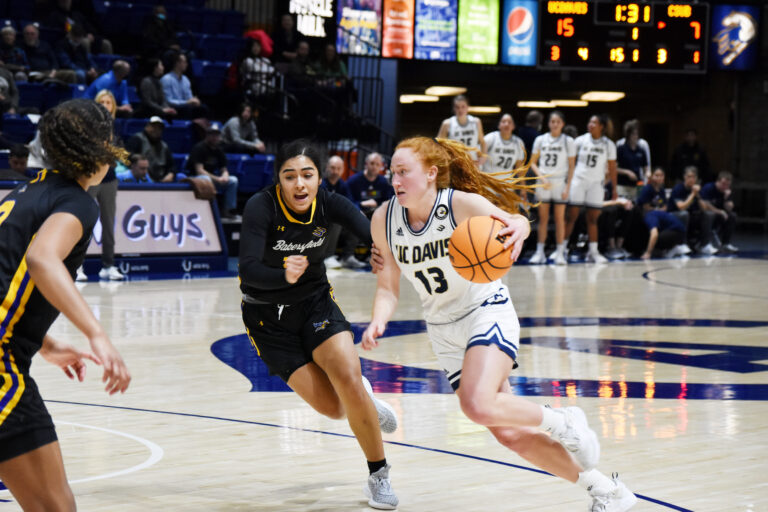
UC Davis suffers a 34-point loss against UC Santa Barbara in Big West quarterfinals

Despite a tough end to the season, Evanne Turner earned a slot in the All-Big West First Team and Megan Norris was awarded Big West Freshman of the Year 


By MARLON ROLON — sports@theaggie.org


A season of ups and downs for UC Davis Women’s Basketball came to an end in Henderson, Nevada after a lackluster performance during the quarterfinal round of the Big West Tournament. The Aggies fell to the No. 4 seed UC Santa Barbara, 70-36.

“It’s obviously really disappointing,” UC Davis Head Coach Jennifer Gross said, following the team’s playoff exit. “We felt like we were playing some great basketball last week going on the road and got two big wins. We were trying to carry that momentum into this week and obviously struggled today — struggled to make shots, struggled to get stops. It’s always hard when you don’t finish the season playing your best.”

The Aggies went into the tournament with momentum, winning seven of their last 10 games and earning the No. 3 seed in the tournament. A week prior to the quarterfinal loss, UC Davis even defeated UC Santa Barbara by a margin of 21 points on the road, splitting the season series 1-1. On the road, the Aggies also defeated the No. 2 seed Long Beach State during their regular season finale. 

However, coming into this season, a lot of uncertainty swirled around the team; they were no longer the Big West favorites that dominated the conference over the course of the last four seasons. UC Davis Women’s Basketball was in a rebuilding stage after three star seniors who won four regular season championships, two Big West Tournament championships and two trips to the prestigious NCAA Tournament graduated last year. 

“We brought a lot of new pieces this year, we obviously graduated some talented seniors that had been pretty successful and brought in Tess Sussman, Tova Sabel, Victoria Baker, Nya Epps and Megan Norris coming in from a redshirt year,” Gross said.

The Aggies struggled in the early portion of the season and it was evident that it would take time for the new players to gel with the rest of the team. The roughest stretch of the season came from Nov. 22 to Jan. 5; in that span, the Aggies lost seven of 10 games. 

“We have this whole new group of people and you can’t snap your fingers and have them just gel and create chemistry,” Gross said about the adjustment.

As the season progressed though, the Aggies looked more comfortable playing with each other. This newly built chemistry led to the highest point in their season. From Jan. 19 through March 2, UC Davis won 10 of their last 13 games. 

“It was all the off-court stuff, all the relationship building, all the team building that sort of led us to this final stretch where I felt like we had developed that tremendous chemistry and so that was really a prideful moment for me just seeing that showcase itself on the court,” said Gross.

However, when it mattered most, the Aggies had their worst outing of the season and only managed to score 36 points in the quarterfinal — the fewest points scored in a game in program history. 


Big West Quarterfinals

The Aggies fell behind in the early stages of the game against a confident and physical UC Santa Barbara team. Especially inside the paint, UC Davis had a hard time guarding fourth-year center Ila Lane who dominated inside the key with 10 points in the first quarter.

“We went back to some things we hadn’t run as much lately and we’re just like ‘let’s throw everything at ‘em, let’s just throw everything we run for Ila [Lane] right away and see what they got and see what they do,’” UC Santa Barbara Head Coach Bonnie Henrickson said in the post-game interview.

 UC Davis had a hard time generating points, only managing to make two of their 10 shots in the first eight minutes of the opening quarter. The Gauchos quickly jumped out to a 14-5 lead while the Aggies got into foul trouble early, committing seven fouls in the first quarter.

“We felt like going to Ila early deep in the paint, right in front of the rim where she could just pivot quickly and score,” Henrickson said of Lane’s impressive performance in the first quarter.

“[Lane] got great position and we made good on-time target passes and we shot 12 free throws in the first quarter.”

As the quarter progressed, the shooting woes continued for UC Davis as the Gauchos’ defensive pressure seemed to bother the Aggies. UCSB forced third-year guard Evanne Turner to go left; Turner has trouble shooting when opponents force her left, making her uncomfortable as she could not drain a shot. 

After missing seven straight shots, the highlight of the quarter came at the 1:46 mark — Turner pulled up from the three-point line and splashed a three-pointer while getting the foul and earning a four-point play. UC Davis trailed UC Santa Barbara 28-10 at the end of the quarter. 

The shooting slump followed the Aggies into the second quarter — shooting an abysmal 10% from the field — as the game started to get out of reach. Two minutes into the quarter, UC Davis scored their first point off of a free throw after redshirt first-year center Megan Norris was sent to the line.

The problems didn’t stop there for UC Davis; they got into foul trouble again, repeatedly sending the Gauchos to the free-throw line for easy baskets.

The last points that the Aggies would score in the second quarter came from third-year guard Grey Cambell at the 6:43 mark as she drove inside the paint for a layup, making it 33-13. 

With six minutes remaining in the second quarter, UC Santa Barbara went on a 13-0 run that extended into the third quarter. This culminated in a nine-minute scoreless drought for UC Davis, who missed their next 12 shots. Third-year guard Tova Sabel finally ended the drought with a free-throw shot, but by this point, UCSB led by a wide margin of 32 points and the score was 46-14.

With 5:49 remaining in the third quarter, Sabel ignited a spark for the Aggies by scoring five straight points, including a three-point play, to make it 47-20.

However, UC Davis couldn’t catch a break as UC Santa Barbara’s third-year guard Alyssa Marin quickly responded by scoring five straight points for the Gauchos. A few plays later, Marin closed the quarter with a three-pointer to put UCSB ahead 57-24.

The Aggies had a difficult time guarding Marin, who was on fire, scoring 11 points in the third quarter alone. The struggles on both ends of the floor were evident — UC Davis shot 25% (4/16) from the field and 0% (0/2) from the three-point line in the third quarter. Meanwhile, the Gauchos were more efficient with their shots, shooting 38% (5/13) from inside the paint and 50% (3/6) from three.

With the game out of reach entering the fourth quarter, the Aggies enjoyed their highest scoring output with 12 points. Turner and Sabel each scored six points. 

The Gauchos ended the game with an 8-0 run and eliminated UC Davis from the Big West Conference Tournament with a final score of 70-36.

In a win-or-go-home situation, UC Davis played their worst basketball of the season — fouls, turnovers and missed shots that they historically haven’t made derailed the team’s chances of advancing to the next stage of the tournament.

“It’s always disappointing when you invest so much and don’t come out on top,” Gross said, who was visibly disappointed post game.

Despite the loss, there were two bright spots on the team: Turner and Sabel, who scored 16 and 15 points, combining for 31 of the 36 points scored by the Aggies. 

In the end, UC Davis shot 22.8% from the field (13/57) and 12.5% from three (2/16), way below their season averages of 41% and 31%, respectively. The Gauchos had better success, shooting 42.9% (21/49) and 54.5% (6/11). It’s worth noting that UCSB gained 22 points out of 27 attempts from the free-throw line, whereas UC Davis gained just eight points out of only 12 attempts.

Although the season concluded in a disappointing fashion, Gross and her team achieved more than what was expected this season. In the preseason polls, the Aggies were projected to finish in fifth place in the standings. However, they finished fourth and defeated two of the top three teams in the Big West in the regular season. 

“We had our fair share of ups and downs, and through it all, they stuck together, and they played for each other, and they stayed super invested and bought in,” Gross said. “As coaches, that’s all you can really ask for, and so I just want to thank them for that and tell them again how proud I am despite the game today not going our way.”  


Written by: Marlon Rolon — sports@theaggie.org


These are the best and worst bathrooms on the UC Davis campus

Students review the quality of bathrooms on campus — citing the Teaching Learning Complex as the No. 1 option


By KACEY CHAN — features@theaggie.org 


No one loves a public bathroom. However, in times of need, these restrooms become a necessary evil. Here on the UC Davis campus, your bathroom experience will vary depending on which building you’re lucky (or not so lucky) enough to stumble upon. Students are full of opinions on what they think are the best and worst bathrooms, with reasoning spanning from privacy to the presence of terrifying chains.

In a survey conducted by The California Aggie, students almost unanimously agreed that the bathrooms in the Teaching Learning Complex (TLC) were by far the best. Located near the Silo bus terminal, the TLC bathrooms are the cleanest, most spacious and the most private, according to students. 

“I love that you can tell when someone is inside or not,” Brenda Do, a third-year design major, said. “The doors cover the stall completely so there aren’t any gaps and the stalls are super roomy.”

Other surveyed students agreed with this sentiment. A few also reported the gender-neutral bathrooms in the TLC are a huge plus. 

Another noteworthy bathroom is the one in Cruess Hall. In a TikTok post by user @treebeatle, the UC Davis student gives the bathroom a rating of “8/10” — respectable given the fact that it is the only positive score in the post. 

The lovely decor of the bathroom should be noted, according to students. In the TikTok post, @treebeatle mentions the uplifting stickers on the walls, including one which says “Be-YOU-tiful.”

“I love the easter eggs in the bathroom, especially the mirrors,” Do added. “It’s a fun walk to the bathroom because of the easter eggs all around.” 

Student opinion appears to be more divided on the worst bathroom on campus. From the survey, a common response was the toilet in Haring Hall. Melissa Soria, a third-year psychology major, responded in the survey that “it gives creepy bathroom vibes all the way.” Similarly, in another TikTok post by @treebeatle, the user gave this location a rating of “-3/10.” 

“Immediately no,” the caption reads. “How much am I paying for tuition again?”

Another popular answer, for all the wrong reasons, was the bathroom on the ground floor of Veihmeyer Hall. Located along Sprocket Bikeway, many students chose this location as the absolute worst on campus. 

“The stairs […] when you open the door and the green tiling make the bathroom feel very ominous,” Angeline Gatchalian, a second-year chemistry major, wrote in the survey.

Multiple students also reported the odd and unusual inclusion of a shower in a lecture hall’s bathroom.

Perhaps most startling of all was the bathroom located in Hutchison Hall. Infamous amongst students, this toilet features a mysterious, dilapidated bed and mattress in a room behind the sinks. On the r/UCDavis Reddit forum, multiple students noted the questionable chain attached to it. In a post from @treebeatle, the student gives the bathroom a rating of “1/10.” The caption tags the official UC Davis TikTok account. It reads, “still waiting on an explanation for the bed and chains” — a question that many students seem to also have in mind. 

Lecture halls and other spaces that see a lot of foot traffic also received criticism from students. The Shields Library bathrooms in particular were named often in the survey. 

“The second-floor women’s toilet is always smelly, dirty and not very accessible,” Skye, a third-year psychology major, reported in the survey.

Similarly, another student reported that the third-floor bathroom only has one working stall. 

Olson Hall and Wellman Hall were also criticized. 

“Wellman and Olson are always dark, dirty and wet,” Do commented in her survey response.

A criticism of the former in particular seems to be the lack of privacy, which, according to a comment from user @KarlaFung on the UC Davis Local Wiki page for campus bathrooms, involves “stalls almost touching the toilet itself.”

“You could easily injure yourself somehow in there,” the comment reads. 

With its long history since 1908, the UC Davis campus is bound to feature a variety of lecture halls and their bathrooms. These recommendations (and warnings) can hopefully steer students toward cleaner and more appealing locations for a toilet break. 

For those interested in even more toilet talk, the Davis Local Wiki features a detailed list of bathroom reviews both on and off campus. 

Written by: Kacey Chan — features@theaggie.org

Despite late rally, UC Davis falls to UC Berkeley in extra innings

Libbie McMahan’s late heroics are not enough as the UC Davis Softball team drops to 13-7 on the season


By CAROLYN (CARI) FENN — sports@theaggie.org


 The Aggies’ softball team couldn’t keep up with their four-game win streak from the previous weekend, losing 8-5 to UC Berkeley on Tuesday, March 7 at La Rue Field. Despite losing the game by three runs, UC Davis displayed tremendous resiliency and rallied back to tie the game in the seventh inning, sending the game to extra innings.

Because UC Berkeley is a part of the PAC-12 Conference and UC Davis is a part of the Big West, their faceoff is a once- maybe twice-a-year occurrence — depending on outside tournaments. And the rare match up was going to be tough for Davis, as UC Berkeley’s ranking by the NCAA at 29 and UC Davis at 56. With the two teams in different conferences, there isn’t much opportunity for the players to face off, which could’ve been the cause of UC Davis’s struggles in the middle of the game. 

Pitching for the Aggies was third-year Pitcher Kenedi Brown, who was named Pitcher of the Week by the Big West Conference. After pitching her second career no hitter earlier in the season and being 6-3 this season, it is no surprise that UC Davis Head Coach Erin Thorpe would have her pitch against one of their most challenging opponents. 

To start the game, the Aggies appeared to threaten Cal with their outstanding pitching. Brown was able to maintain her 0.00 ERA, keeping UC Berkeley from even touching first base for the first two innings. Along with their strong start defensively, UC Davis took the lead 1-0 by the end of the first inning thanks to an RBI by third-year shortstop Libbie McMahan that brought in third-year outfielder and catcher Anna Dethlefson across home plate.

Despite Brown keeping her strong 0.00 ERA in the third inning, only allowing a single walk, UC Davis’s offense didn’t carry on into the inning. For the next four innings, UC Berkeley’s third-year pitcher Sona Halajian prevented the Aggies from hitting the ball and did not allow any runs across home plate. The only times the Aggies were able to get on base came as the result of walks or the batter getting hit by a pitch. 

While the Aggies were struggling to get hits, UC Berkeley was able to get the better of Brown, scoring two runs in the fourth inning and taking a 2-1 lead.  

In the sixth inning, UC Davis’s defense began to fall apart as well. UC Berkeley capitalized on two errors by the Aggie defense, scoring three runs and jumping to a 5-1 lead.

While a home run by UC Berkeley’s third-year infielder D’Asha Saiki that brought two of Cal’s players across home plate was unavoidable, one of the runs was a result of an error by the UC Davis defense.

The first run of the sixth inning by Cal came as a result of a throwing error by UC Davis’s third-year third baseman Bella Pahulu, allowing UC Berkeley’s third-year catcher Amanda Kondo to score. 

Despite UC Davis’s defensive struggles at the top of the sixth inning, the offense came back strong, letting their bats fly and starting a comeback. McMahan blasted a home run deep to left field, cutting the deficit to three.

The Aggies’ defense kept Cal from scoring in the top of the seventh inning, giving the offense one last opportunity to even the score. However, they were down by a margin of three and against a PAC-12 team, so this was no easy feat. 

In the bottom of the seventh inning, McMahan once again set her mark by hitting the ball to the left side of the field, allowing Dethlefson to cross home plate on an RBI, narrowing UC Berkeley’s lead to just a two-point difference. 

With two outs and two strikes posted on the scoreboard, the win probability was low, but the Aggies had players on first and second base. It seemed as if the game was nearing its end until third-year right fielder Sarah Starks sent the ball flying down center field. This hit led both third-year utility player Leah Polson and McMahan to score and tie the game, 5-5. However, the Aggies could not close, and the inning ended on outs, leading to extra innings. 

Despite UC Davis’s impressive rally against UC Berkeley, Cal proved to be the stronger team in the game’s extra inning. UC Berkeley was able to muster up three runs with four hits in the eighth inning and the Aggies came up with zero hits and zero runs. Cal ultimately secured the win 8-5. 

The Aggies’ performance seemed to be very unpredictable throughout the game. There were strong moments by both the offense and defense, but with no consistency, it was only a matter of time until the opposition would capitalize.

However, one player that shined during the game was McMahan. Her four at-bats resulted in three hits, three RBIs and one home run. While this was a difficult loss for the Aggies, they displayed resilience, forcing UC Berkeley — who is 17-4 overall —  into extra innings. 

In their next outings, the Aggies defeated Rhode Island (4-3) and San Jose State (3-1) on Friday, March 10 in San Jose. On March 11, UC Davis traveled to Santa Clara and defeated Utah State University (7-6) and fell to Santa Clara (3-2).

The Aggies will travel to Southern California to open their Big West Conference play against Cal State Fullerton in a double header on March 17.


Written by: Carolyn (Cari) Fenn — sports@theaggie.org


Culture Corner

The Arts Desk’s weekly picks for music, movies and more 


By CLARA FISCHER — arts@theaggie.org


Podcast: “Anything Goes” by Emma Chamberlain (2020)

If you’re on the younger side, you’ve likely heard of viral sensation Emma Chamberlain. Gaining notoriety through her ability to stay relatable even after immense success, Chamberlain’s podcast builds on this brand identity. Though her affluent lifestyle can make her perspective out of touch at times, hearing Chamberlain talk through her thoughts out loud is mentally stimulating, and gives the listener the feeling as though they’re participating in an engaging discussion with a loved one. The unique format of this podcast — no guests — relies purely on Chamberlain’s ability to engage listeners with just her rambles, and the rampant success of “Anything Goes” proves that she is more than capable of this.   


Song: “Jesus in Berlin” by Nullzwei (2022)

Coming from Rotterdam-based newcomers to the house music scene, Nullzwei’s “Jesus in Berlin” is a catchy, tongue-in-cheek single that beautifully combines techno beats and wit. This song has been my and my friends’ getting-ready anthem of choice; every time this song comes on, someone inevitably turns the speaker up. I recommend giving this track a listen, whether you’re a die-hard house music fan or only a casual listener — you may be surprised by how much you like it. 


Movie: “Forrest Gump” dir. by Robert Zemeckis (1994)

This 90’s cult classic recently came out on Netflix, so naturally, I immediately dropped all of my other work to rewatch it. “Forrest Gump” is a heartwarming story about love, acceptance, identity and the relationships that make us who we are. Having won six Oscars, this film isn’t exactly underrated; however, its maintained cultural relevance and strong performances from the cast justify its success. If you want a feel-good movie that’ll make you experience a wide range of emotions, I recommend “Forrest Gump.” 


TV Show: “Outer Banks” (2020)

While I have been known to be a bit of an entertainment snob, in my humble opinion, “Outer Banks” is one of the best shows Netflix has put out in recent years. With the recent release of season three, now is a great time to distract yourself from the stress of finals by watching a group of teenagers on a wild goose chase for a golden cross. The extended drama, though repetitive at times, is action-packed enough to keep me hooked, but not too serious to the point that I stress myself out by watching it. The cast has engaging chemistry, the dialogue is surprisingly witty and the soundtrack transports viewers to a sunny place far away from the Davis rain. 

Written by: Clara Fischer — arts@theaggie.org

The Aggies fall to the Highlanders in Men’s Big West Conference tournament

The loss featured shooting struggles and turnovers but also a major milestone for guard Elijah Pepper 


By PATRICK FIGUEROA — sports@theaggie.org


The Aggies struggled in their one and only game during the Big West Conference Tournament in Henderson, Nevada last weekend, losing to the UC Riverside Highlanders (68-52). The season-ending loss eliminates the Aggies from the tournament. 

The Aggies had a hard time making shots throughout this game. They shot 34% from the field and did not make a single three-pointer in the first half. UC Davis averaged 34% from the three-point line in the regular season but only made one three-pointer out of 16 attempts in the entire game. UC Davis Head Coach Jim Les attributed this to the Highlanders’ physicality throughout the game. 

“I just thought that their overall physicality was really good and they were putting bodies on us,” Les said when asked what the Highlanders did to make it difficult to score. “I thought they contested. They hard contested every look. We got very few open looks, and you know when a team is that aggressive and physical, I thought we got sped up a little bit. Any open opportunities we did have, I thought we rushed them, but then that’s a credit to them and their defense.” 

The Highlanders also struggled to shoot from three in the first half, as they made only two of their 10 three-ponter attempts. This contributed to a low-scoring first half, after which the Highlanders led 28-24. However, in the second half, the Highlanders made seven out of 13 three-pointers, allowing them to pull away from the Aggies. Surprisingly, this was not part of the Highlanders’ game plan. 

“Well, you know what’s funny is we wanted to pound the paint,” Highlanders Head Coach Mike Magpayo said when asked about the three-point shots’ role in his game plan. “Of course we’re a good three-point shooting team, but we wanted to pound the paint. It sucked in their defense, and we found some open guys.”

Both teams had their fair share of turnovers, but the Aggies had 12 costly turnovers that slowed them down in the first half. This included multiple errant passes that were the result of  miscommunication and risky decision-making. They finished the game with 17 turnovers, but they managed to stay in the game until the second half because their defense forced 14 turnovers in the game.

The second half began with an offensive explosion that saw the Highlanders take a 37-30 lead. Aggies second-year guard Robby Beasley made the Aggies’ only three-pointer to cut the lead to 37-33, but the Highlanders’ offense continued to pile on. Several Highlanders’ players, including first-year guard Nate Pickens and second-year forward Luke Turner, made three-pointers that extended the Highlanders’ lead to 19 points (61-42) with six minutes left in the game. 

Late in the game, star third-year guard Elijah Pepper, who broke the team’s single-season scoring record with over 600 points earlier this season, hit a career milestone that was a bright spot for the Aggies. Pepper reached 1,600 career points with just over four-and-a-half minutes left. He added another two points in the last minute of the game for a total of 1,602 career points at the end of the season. Pepper finished the game with 22 points, but he shot just 38% from the field (7 out of 18). However, this is in part because the Highlanders’ defensive game plan included containing Pepper. 

“We tried to protect the paint. We tried to bring bodies [to Pepper],” Magpayo said. “It’s really hard. He’s kicked our butts, but luckily we found a way to survive and today this was probably the best job we’ve done of all three games this year.”

Magpayo also gave credit to his guards, including Pickens, graduate student Flynn Cameron and fourth-year Zyon Pullin for their defensive success against Pepper and the Aggies. 

When asked about recruiting Pepper and if he knew how special of a player Pepper would become, Les said, “I had an inkling. I’d like to say I knew but what I love about him is how hard he works [and] his competitive spirit. Those right there give you a chance to be successful and then add the fact he’s awfully skilled. It’s a lethal combination.” 

Les added that Pepper has been a joy to coach and a fun player to have as an Aggie. 

Pepper made the Big West All-Conference first team for his performance this season. This was the second time he made a Big West All-Conference team; he made the Big West All-Conference second team last season. By achieving several accolades and milestones, there is no doubt that Pepper has been one of the most impactful players for UC Davis in his time here. 

Despite the disappointing end to their season, the Aggies received a round of applause from their fans who had traveled to Henderson to watch them play. The 2022-2023 college basketball season was a memorable one for the Aggies. There are several moments throughout the season that will not be forgotten: beating UC Berkeley for the first time in program history, beating Cal Poly with a 13-point comeback in the last four minutes of the game and beating Long Beach State in double overtime to clinch a first-round bye for the Big West Conference Tournament. These are the moments that will be remembered from this season. 


Written by: Patrick Figueroa — sports@theaggie.org

With spring commencement around the corner, seniors say they are feeling excited, anxious

UC Davis offers resources and opportunities to set students up for post-grad success


By REBEKA ZELJKO — features@theaggie.org 


Spring quarter is approaching, and along with it, the impending graduation of much of the class of 2023. 

Minerva Padilla, a fourth-year managerial economics major, expressed that her time as an undergraduate UC Davis student was worth the hard work. 

“I’m feeling so accomplished,” Padilla said. “I’m like, ‘Oh my gosh, four years passed?’ I’m also a first generation [college student], so everyone in my family is like, ‘Wow, you are the first of all the grandkids!’”

Padilla said that as one of six siblings, she hopes to set an example for them to also go to college. 

“I decided to go to college because it was kind of pushed on us in my classes,” Padilla said. “I didn’t really know what I wanted to do, and I didn’t want to put the financial stress on my mom, especially since there are so many of us. But now that I’ve looked back on it, I’m really glad that I came because I feel like I’ve learned so much that I can apply in life.” 

Andrea Sanchez, a fourth-year psychology major, said she is feeling a lot of anticipation as her final months at UC Davis approach. 

“I think I’m equally nervous and excited,” Sanchez said. “I didn’t get to fully enjoy my time here because I transferred here during COVID, but I’m also excited for this next chapter.” 

Sanchez expressed that a big part of the nervousness she feels is about her post-graduation plans.

“It’s super nerve-wracking to go job hunting,” Sanchez said. “Especially because a lot of places expect you to have experience, and I’m pretty much at an entry-level position.”

To ease the uncertainty, Sanchez took advantage of the opportunities available to students on campus.

“I went to a lot of job fairs and resources on campus, so I definitely feel more prepared for the workforce,” Sanchez said. “They helped me with job searching, resume building and you can meet a lot of employers ahead of time to see what they expect from you, and so you don’t have to go through it blind.”

Marcie Kirk Holland, executive director of the UC Davis Internship & Career Center (ICC), wants graduating students to keep in mind what an accomplishment it is to have made it this far, even as they search for jobs and prepare for post-grad life. 

“It is [important] to remember that they have made it through a four-year degree from UC Davis, and that demonstrates a lot to employers and potential graduate programs,” Kirk Holland said. “It shows that [you] can set goals and stick to them even though it’s difficult at times, or if they have to pivot. It shows they have what it takes to persevere, and that is highly transferable to any profession.” 

Kirk Holland also highlighted the resources the ICC has available for all students.

“We have a wonderful advising team,” Kirk Holland said. “[Students] can also make an appointment with one of our career staff through Handshake […] and we have a great offering from a Youtube channel. [It covers] all sorts of topics, from what to wear to an interview to how to build a resume. There’s really something there for everyone, and we offer several [videos] in Spanish and Mandarin.” 

Students can also take advantage of the ICC career fairs hosted once every academic quarter. 

Even with these resources, though, the job search process can be intimidating to some. Sanchez said that she was initially overwhelmed by the process, but the ICC was able to help.

“I wish I explored those resources more,” Sanchez said. “I didn’t get to until this year when I was more familiar with campus, and it made my experience go by a lot smoother. I want to emphasize to not be afraid to use and enjoy the organizations and resources available to you. Just don’t be afraid to go out and use those spaces; they are for us.”

It’s not only the resources that set up graduating students for success but also the experiences they have shared. Padilla said that UC Davis enriched her life in many ways during her four years as a student. 

“I really made Davis my home; I feel like I found myself here,” Padilla said. “Everyone is so nice, and since I met all my best friends here, I really associate it with a part of who I am.”

With the school year coming to a close, Kirk Holland offered some advice for the graduating class.

“I think part of it is being clear about what you want and what is important to you, then looking for jobs that reflect that,” Kirk Holland said. “It’s about finding work that [you] find meaningful, and considering things like where do you want to live, how much do you need to earn and so on. It’s about feeling confident about your options.” 

Padilla said that it’s important to remember that everyone’s academic journey looks different. 

“It’s not linear for everyone,” Padilla said. “It’s okay if it takes a little longer than you expect. I don’t like the idea that people all expect to graduate in exactly four years. I failed my first class here, and I was so bummed out. But like, it’s real, it happens, sometimes classes are hard, you just [have to] look at it and think back on what you can do better. You learn from it.”

Written by: Rebeka Zeljko — features@theaggie.org

Davis Chamber of Commerce hosts annual State of the City address

Mayor Will Arnold and City Manager Michael Webb joined the chamber to discuss housing, infrastructure and more


By MADELEINE YOUNG AND ALEX UPTON  city@theaggie.org 

On March 1, Mayor Will Arnold and City Manager Michael Webb presented the annual State of the City address with the Davis Chamber of Commerce. The panel discussed pressing issues in Davis such as financial outlook, infrastructure investments, development updates, social services and the housing crisis.

Executive Director Cory Kohler said that while the chamber is financially stable and healthy, membership has declined due to the pandemic. The chamber contributes substantially to Davis’s economic position, dating back to when it lobbied for UC Berkeley’s farm (now UC Davis) to be placed in Davis. 

Mayor Will Arnold began the address by discussing a key concern for Davis residents: housing insecurity. According to Arnold, the city approved an unprecedented number of new housing projects to address student and workforce housing needs, as well as implementing several larger projects. He specifically mentioned Paul’s Place, a vertical home village that opened recently.

“Certainly there’s more to be done,” Arnold said. “We need to redouble our efforts on seeking supportable and sustainable housing, particularly for folks who are a part of our workforce, folks who qualify for low-income housing and for young families.”

Arnold made a point to recognize the relationship between Davis public schools and the well-being of the city. He spoke about the schools’ steady decline in enrollment and why it is important to address the housing crisis in a way that ensures families with young children will be able to afford housing in Davis. 

“As goes our school districts, so goes our property values in Davis,” Arnold said. “I’m a firm believer in that. It’s easy to say there’s a big difference between the work that the school does and the work that the city does, but in this case, there’s a real symbiotic relationship here between the quality of community assets that we’re able to provide and the quality of schools we have.”  

During the address, multiple charts were presented detailing the city’s general funds and sources reported in this fiscal year as well as revenue trends. The lack of affordable housing, senior housing and student housing amounted to 29% of the key issues the city is focusing on. The data presented also revealed that other pressing issues were homelessness, crime, safety and development.

“The city really is looking at the full spectrum of housing needs in our community, whether it’s student housing, housing for folks who work in town, housing for folks who are coming off of the streets,” Arnold said. “These are all critical needs and all things that you have a council that recognizes the importance of that need and is continuing to do the work even in the face of community opposition when it happens to add housing.”

City Manager Michael Webb concluded the address by discussing the condition of the city and reviewing city research. He said that, overall, residents appear satisfied and optimistic. Affordable housing is the predominant issue in Davis, followed by homelessness and public safety. While the city budget is dependent on property tax for revenue, cannabis taxes are quickly becoming a strong revenue source. 

The city is investing in improving pavement conditions and expects to focus on repairing downtown and other busy streets in the coming year, according to Webb. Webb emphasized the importance of investing in these kinds of repairs before the damage gets too drastic. Specific focus was placed on roads and pavements, as currently, Davis pavements are rated between fair and poor. The address noted that without further action by 2029, 25.5% of streets and 26.1% of bike paths will be considered in “failed” condition.  

“It’s crucial that we make every effort to stay on top of our road conditions and not let them get to a point of failure because at that point, they are exponentially more expensive to repair,” Webb said. “I want to applaud the City Council for making substantial improvements in terms of our investment locally in general fund dollars, seeking grants, using some of our gas tax money and putting that directly towards roads to the tune of about 9 million dollars a year. That is a huge improvement over what investments were made prior to that.”


Written by: Madeleine Young and Alex Upton