

Drawn by: Sandhya Pfile — sbpfile@ucdavis.edu
Disclaimer: (This cartoon is humor and/or satire, and its content is purely fictional. The story and names of “sources” are fictionalized.)
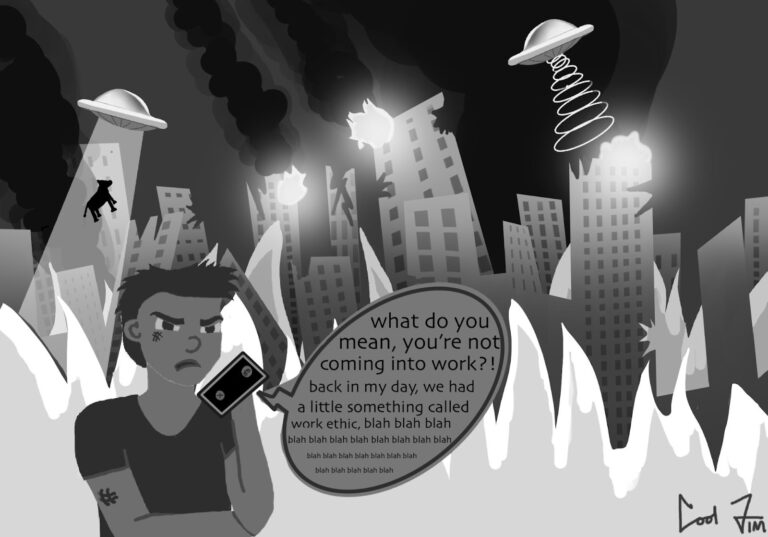
Drawn by: Sandhya Pfile — sbpfile@ucdavis.edu
Disclaimer: (This cartoon is humor and/or satire, and its content is purely fictional. The story and names of “sources” are fictionalized.)
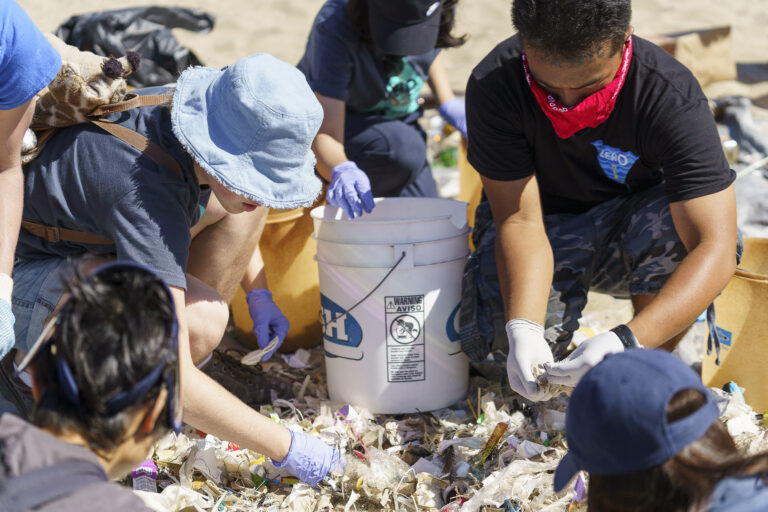
Improve yourself while improving your community
By EMILIE BROWN — emrbrown@ucdavis.edu
At the end of our lives, when we are on our deathbeds, we realize that all the money, all the popularity and all the things we bought, sold, owned and collected don’t really matter. In the end, the only thing that really matters is the impact we have on other people’s lives.
Community service provides all of us with the opportunity to truly make a positive impact on other people, which is an incredibly rewarding experience. Volunteering benefits your community, your health and your future, and brings us one step closer to a brighter world.
Community service allows you to give back. By volunteering your time and resources, you can help to make a real difference in the lives of others. Whether you’re volunteering at a local food bank, participating in a neighborhood cleanup or helping out at a community event, your efforts can have a positive and meaningful impact on the people around you. In my opinion, there is no better feeling than that.
Additionally, volunteering can help your health and overall well-being. Personally, community service has helped me feel needed and powerful and has given me a sense of purpose I was previously lacking. I believe it can do the same for others. In fact, a study by the Corporation for National and Community Service found that those who volunteer have lower mortality rates and lower depression rates, so community service can quite literally help improve your mental and physical health.
If you’re still in need of reasons to volunteer, community service is also a great addition to your resume. Not only can you learn new and valuable skills through volunteering, it also provides an opportunity to network with others in a setting you would not usually come across in your everyday life. Community service activities on your resume also tell your potential employers you are a kind and well-balanced person — the type they would want working for them.
Now that you know why you should start participating in community service, you’re probably wondering how to get involved as a student. Luckily, the Community Service Resources Center group of the Internship & Career Center has you covered. They keep a list of over 500 local community service organizations and ways to get involved today. You can find this list at icc.ucdavis.edu/find/volunteer/list. Get involved today, for yourself and for others!
Written by: Emilie Brown — emrbrown@ucdavis.edu
Disclaimer: The views and opinions expressed by individual columnists belong to the columnists alone and do not necessarily indicate the views and opinions held by The California Aggie.

Film soundtracks have long been a key feature in entertainment
By SARAH HAN — arts@theaggie.org
Films are some of the most influential works today, with one of their most critical aspects being the music that sets their tone. From horror movies to animation, many notable film scores have gained wide recognition among the public.
From the 1890s to 1929, the silent film era involved musicians playing live alongside films. Pianists and small ensembles played in the background, accompanying the movie’s visual story. Most of the music was improvised, but some consisted of classical repertoires.
One of the most famous scores during this era was the music in “The Assassination of the Duke of Guise,” which was written by the French composer Charles-Camille Saint-Saëns. He was one of the first to create an official score for a film, which gave way to other popular soundtracks we know today.
Following the silent film era was the Golden Age of Hollywood, during which there was a spike in film scores. This particular time period for film scoring was characterized by creativity, matching of music to films and concert and orchestral pieces.
Austrian-born composer Erich Wolfgang Korngold was one of the most accomplished composers of this time. One of his works is the soundtrack in “The Adventures of Robin Hood,” which earned him an Academy Award. Another notable example of his work is the soundtrack in “The Sea Hawk,” which was considered one of the best film scores at the time.
The next shift in the film-scoring industry was in the 1950s when composers started to emphasize originality and diversity. In 1951, composer Alex North made a symphonic-jazz soundtrack for the film “A Streetcar Named Desire,” which integrated jazz with traditional classical music.
Following the work of North, musician Miles Davis also revolutionized film scores with jazz. He contributed to the soundtrack of “Elevator to the Gallows,” which featured many jazz improvisations. Davis’s work in the film “Gallows” was also significant because it paved the way for African American musicians that we know today, including Herbie Hancock and Quincy Jones.
One of the major scores of the 1950s was the soundtrack in “Ben-Hur,” composed by Hungarian American composer Miklós Rózsa. It combines the style of more traditional orchestral repertories, such as suites and overtures, and is considered to have changed the film-scoring industry for the better.
In the 1960s, jazz, pop and western music became more popular in films. The soundtrack in “The Magnificent Seven” by Elmer Bernstein incorporated western-style music; likewise, composer Maurice Jarre created a soundtrack for “Lawrence of Arabia,” which incorporated Middle Eastern styles.
The 1970s were marked by the famous composer John Williams, who created the “Star Wars” soundtrack. The theme in “Star Wars” is considered to be one of the most well-known scores today.
Following the 1970s, John Williams also composed the soundtrack for “Indiana Jones,” “E.T.” and “Superman.” Meanwhile, other famous composers joined the picture, such as Jerry Goldsmith, who scored “Star Trek” and Hans Zimmer, whose work is featured in “Black Rain” and “The Pirates of the Caribbean.”
Today, many pop singers are even contributing to film scores: one notable example is Shakira’s “Try Everything” in the movie “Zootopia,” which was a huge success in the pop industry. Seeing that film scores are incorporating a diverse range of musical genres, the future of film scoring seems to be on an upward trajectory.
Written by: Sarah Han — arts@theaggie.org

UC Davis notable undergraduate scholar recognized by the Aquarium of the Pacific
By FAITH DEMEULENAERE — features@theaggie.org
Genece Grisby, a fourth-year marine and coastal science major with an oceans and the earth system emphasis, has been relentless in her pursuit of success, despite the challenges that the COVID-19 pandemic posed.
According to Grisby, the pandemic held her back during the first few years of her undergraduate education, but she constantly searched for marine science jobs, asked questions and applied to numerous opportunities to gain relevant experience. As a result of her hard work, Grisby recently received the 2023 African American Scholar Program award from the Aquarium of the Pacific.
“Just generally learning about all the different animals, big and small, inside the ocean piqued my interest the most,” Grisby said. “Of course, I have a love for terrestrial animals, but anything in the ocean […] has always had my entire heart. Right now, I am most interested in learning about the impacts climate change has [and] will have on popular megafauna such as sharks, rays and marine mammals.”
Grisby has reached enormous heights in her scholarly career and said the future is bright.
“[A] special thank you to everyone who has supported me and helped me reach my goals the last few years,” Grisby said. “You know who you are.”
Written by: Faith DeMeulenaere — features@theaggie.org

My emotional support rat must have his own room
By CARMEL RAVIV — craviv@ucdavis.edu
Hello, my name is Juke Jakeson. I am in dire need of a roommate next year for off-campus housing, and you must be in need of one too! It’s like I’m reading your mind! Ahaha.
A little about me:
If you are to live with me, I would like a balance of studying and fun activities. If you opt for a wild night, such as playing Uno past 11 p.m. or drinking Mountain Dew after brushing your teeth, I would appreciate being made aware ahead of time. Additionally, you must be well versed in Excel so we can coordinate schedules.
I’d love to find a place that is close to campus, especially the Physics Building. To be completely honest, I have a friend that hangs out there a lot. He’s a ginger, always down to eat and sunbathe. I would ask him to move in with me, but he’s a cat, and I don’t think he has a stable source of income. I’m curious about his financial situation, but I know it’s rude to ask. I’m sure you will hit it off with each other once I introduce you all!
I mainly respond through Slack, Pinterest DMs or Clash of Clans 1v1 battles, so feel free to contact me through any of those if you have questions.
Have a nice day! Go Aggies 🙂
Written by: Carmel Raviv — craviv@ucdavis.edu
Disclaimer: (This article is humor and/or satire, and its content is purely fictional. The story and the names of “sources” are fictionalized.)
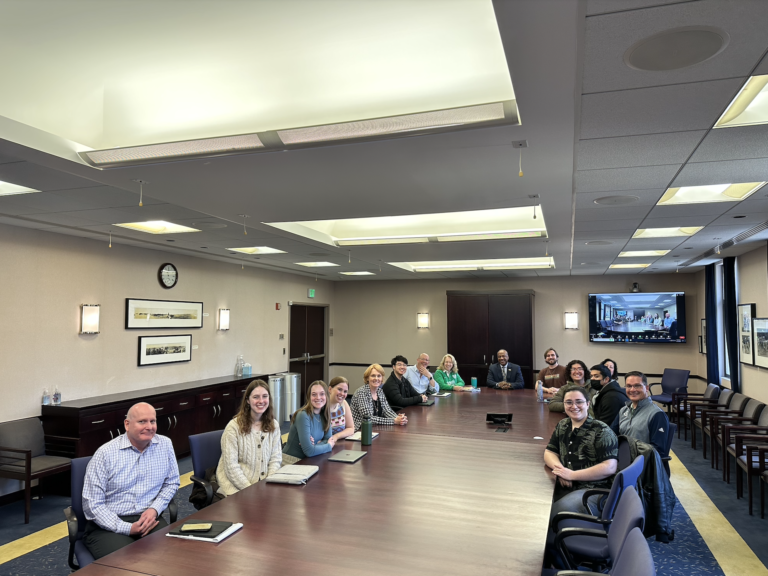
May and administrators discuss ChatGPT, Turning Point USA, expanding mental health resources and more
The California Aggie’s Editorial Board met with Chancellor Gary May, Provost and Executive Vice Chancellor Mary Croughan, Associate Chancellor and Chief of Staff Karl Engelbach, Vice Chancellor for Finance, Operations and Administration Clare Shinnerl, Chief Marketing and Communications Officer Dana Topousis, Faculty Advisor to the Chancellor and Provost Ari Kelman, Director of Athletics Rocco De Luca, Chief Campus Counsel Mike Sweeney and Chief of Staff to the Division of Student Affairs Lindsay Romasanta.
Below is a transcript of the March 17 meeting that has been edited for length and clarity.
Question: With the increased prevalence of generative AI programs like ChatGPT, is the university developing a way to prevent or regulate students’ use of these programs?
May: So I’ll start and I’m sure that [Croughan] and [Kelman] will also have comments. So we are aware of the fact [and we are] talking about ways to help students understand how these chatbots and content generators can be used in their academic work. I actually applaud that approach. We can’t hide from these or run from these — they’re here. People are going to use them; we should figure out how to use them in a constructive way for the educational process, as opposed to worrying too much about academic misconduct and that sort of thing. You have to be worried about that, but that shouldn’t be our prime driver in thinking about how to use these things. We had a meeting of our leadership team, the Chancellor Leadership Council, where we discussed this with the Academic Senate and we’re thinking about, you know, perhaps a working group or something like that, to think more broadly and deeply about the future of how we deliver education within this universe. Another aspect that we need to think about is admissions. You know, writing essays and statements of purpose and things like that is no longer the same as it was, right, and how to make sure that we’re admitting students in a proper way given the ability of these tools to do these things.
Croughan: Now just one thing I saw that actually was probably the most convincing aspect of an investigation into what happens with these was that ‘Chronicle of Higher Education,’ which most of us in leadership get every morning, had an article written by their chatbot and you read the article, [it] totally made sense. It was on sleep deprivation and health and encouraging people to get more hours of sleep per night. It gave data, nicely written, grammatically correct, all that. And then they analyzed it, and of the two studies, one was incorrectly cited, one was cited with an author who had nothing to do with either of the research projects, there was no link between the research that they cited and what the recommendations actually were at the end of the article. I’m like, okay, so this is a nice way to clean up the writing when you’ve actually done all the research and the background, but it’s not a way to develop something from scratch. And when I’ve talked to students and faculty about it, they’re like, “You know, for students to be able to learn like the standards for a resume or a letter of introduction or something like that it helps with the formatting but [you shouldn’t] believe the content necessarily.” So I think as we talk about teaching about it in our classrooms — what works [and] what doesn’t — I think that’s going to be important, especially around professional development, career progression. But we’ve got to be careful that people don’t trust the information there because the research is showing that a lot of mistakes get made, it’s not perfect, it’s far from it. So what I hate to see is our students rely on it. You’re not going to do very well. Whether or not you get caught is not the issue, it’s that the actual content will not be strong enough.
Kelman: I’m teaching this quarter, a pretty large upper-division history class that has two writing assignments, and we ran both of them through ChatGPT just to see what kind of answers we would get to the prompts. And just building on what both [May] and [Croughan] have said, what you’re going to get will depend to a very great extent on the question that’s asked. The answers that we got to the questions that we had were garbage. And because we asked questions that are rooted in very, very specific historical texts, ChatGPT doesn’t know anything about these texts because they’re a little bit off the beaten path. As [Croughan] said they were grammatically [correct], I mean it was very interesting to read the answers because it appeared that they had been written by someone who was well versed in the English language but knew absolutely nothing about the material, and so I think, again, there are a variety of different ways of thinking about this — some are ethical, some are pedagogical. I will say that I’m considerably less concerned about the faculty side of this than I am about the student side. I think that students need to be very, very cautious about what these programs can and cannot produce for them. And that’s the message that I think is most important really.
Q: Students are struggling to find affordable housing, with some students even camping out overnight in an attempt to secure a place to live. How is UC Davis addressing housing insecurity on campus and in downtown Davis? Does the university have plans to make changes to campus housing to make it more accessible to low- and middle-income students?
May: I’ll start by saying, we’re in the midst of our biggest housing construction initiative in the history of the university. We’re in the phase of Orchard Park being finished sometime this summer. We’ve spent more than half a billion dollars to build more housing, and when that project is finished, we’ll be able to house 40% of the student body. This was about 15,000 beds that were added over that period of time (since we started in 2017-2018). We are well aware of the affordability issue. We have a need-based rent subsidy program that’s available for students with demonstrated financial need. We have rapid rehousing through the Basic Needs Center, and that program has 20 beds for students that are experiencing being unhoused or at imminent risk of being unhoused. In 2023, more beds are going to be added to that program to help these students that are having those experiences. And residents in The Green have eligibility for apartments that are available for them as well with their financial aid package. So we’re trying to address this problem the best way we can.
Romasanta: Definitely understand the concerns. We want you to know that it’s top priority. I know that from a student’s perspective, “Wow, like this is really expensive,” but a lot of our properties, in fact most of them, are significantly below market rate — anywhere from 8-55% below. So I understand that from the student’s perspective, like the sticker shock is really high. But if you were to go out to market and look at other things in Davis, what we have on campus is actually still the most affordable option for students. The other piece that I think sometimes students may not always know is we have partnerships with some of these properties that actually provide funding directly to financial aid. So for example, like $250,000 goes directly to financial aid so that students can get access to other things that help them with educational attainment and UC Davis’s efforts around housing, rapid rehousing, the things that Chancellor May was talking about, is actually often cited in the system as one of the best model practices on campus. So it’s top priority. We’re always looking at how we can build more so that affordability is attained. And in the fall, the new developments [will be] coming online, [and] we’ll be able to reach that significantly more. But we understand that and will continue to work on it.
Shinnerl: I’ll also add that we have submitted a proposal through the UC Office of the President who is submitting that proposal to the state. The state sometimes has money and they have received our proposal and we hope to get some funding at some point. Because obviously if we can get either a low-cost interest loan or a grant from the state, it lowers our construction costs and that turns into lower rents for you. So that’s all in the works.
Q: Food insecurity has been a long-standing issue for many. With student initiatives like the ASUCD Pantry being used by 1,000+ students weekly, how is the university supporting and expanding options like The Pantry for students?
May: So we opened the Aggie Compass in 2018 after a study by a task force I initiated, and since then, we have been able to make a serious dent in this food insecurity problem. We have not solved it, but we have made quite a bit of progress. One thing that’s going to happen next month is that a new food truck will be available for students at whatever [price] they can pay.
Romasanta: It’s a really innovative concept. So it’s called ‘Aggie Eats,’ which is a name that actually students chose, and the idea is that there’d be a [appointed] system in which you could place an order. And there’s been a lot of thought around it where this pay-as-you-can food truck will actually go to places on campus that might be considered food deserts. So if you think about places where you’re like, “Gosh, I’m really hungry, but I have to walk really far.” I thought a lot about this, and it’s a really innovative concept. So that will launch a couple of weeks into spring quarter, but the official celebration will be April 19.
Q: The administration has been under fire for letting TPUSA return to campus. Why was another event permitted to take place? How is the university making sure marginalized students are being heard in their complaints against the organization?
May: The university is not letting speakers [speak on campus], the speakers are invited by registered organizations and the university follows our policy and the UC policy and the Constitution with respect to free speech, to give the speakers a forum. And that’s what was done in this instance, as has been done in every other instance. Believe me, I looked for every loophole we could possibly find to prevent this from happening. No one wanted this to happen less than me. As you can probably see from events that have followed since then, we felt that we had an obligation to uphold free speech, and we did so. I understand students’ concerns, but I think we addressed some of those concerns in some video messages that I’ve put out. I understand they’re ongoing concerns, but free speech means you listen to people that you don’t agree with. Or don’t listen to them, but they have the right to say what they want to say. And I don’t think any of you wants me to be deciding who gets to talk and who doesn’t. Because a future [chancellor] may not let somebody like us, who is more progressive, give a speech, as opposed to a conservative.
Q: Are there policies in place to require that groups allowed to become and remain Registered Student Organizations [RSOs] uphold the UC Davis Principles of Community?
May: So we should remember the Principles of Community are aspirational, and they’re not policy. But we do try to make policy that is consistent with the Principles of Community with respect to Registered Student Organizations. There is a process for that, [and] that process gets examined from time to time. We probably will have it examined again now. If I’m being honest, I’ll tell you that this particular student organization has a very small number of students. I’m not sure that we want to let an organization with three or four students invite a speaker of this sort to campus. I sort of think [RSOs] should have faculty advisors as well, something we will look at. But as the policy stands, we’re not going to make policy for particular speakers, we’re going to make consistent policy for all of our events and activities.
Q: So are there any plans to change policies surrounding RSOs?
May: We’ll examine them. Changes may happen; I can’t predict whether changes will happen or not.
Q: Can offensive language, even if not necessarily hate speech or not directly encouraging violence, ever be considered an act of violence?
May: There’s a line, right? You can say things, but you can’t incite violence. You can’t yell fire in a crowded room if there’s no fire. So words can be restricted, but that restriction does not apply to things that people find offensive, such as “hate speech,” which is not really a legal term. So hate speech is protected.
Sweeney: I think [May] and all of us feel that hateful words can feel like violence. They can have a devastating emotional impact on people. And I know [May] feels very strongly about that. And I think he’s been the victim of hateful words and he can probably speak to that.
May: Since Tuesday, I’ve received many, many phone calls, emails, texts, social media comments. I’ve been called everything from a liar to the N-word. I’ve been threatened, my faith has been questioned. So there’s been a real set of repercussions for the events of Tuesday that I have felt personally, but I think [Topousis] said it this morning that I hadn’t thought about, but maybe making me the target deflected some of the higher-ups in this group of people away from our trans and other marginalized community groups and toward me, which I’ll take that bullet for them.
Q: Please correct me if I misunderstood your response, but when you’re talking about hate speech, you seem to specify that we can’t regulate something like that on campus, we can’t identify that, so is there a line where the university would step in and say, “Okay no, this is an example of hate speech,” or can people, if they’re a club, say whatever they want?
Sweeney: As [May] said, hate speech is […] actually protected by the First Amendment. So the university, as a public university, cannot regulate hate speech. We can’t regulate civility. But there will be a point where that hate speech may cross the line and be an incitement of violence. This is what [May] referred to. It’s a pretty high standard. I won’t get into that right now because it would take up the rest of the hour, but pure incitement of violence can cross the line to become unlawful but you know, hate speech as we know it is actually protected speech under the First Amendment. And students and others cannot be disciplined or arrested for hate speech itself.
Kelman: So I was at the event. I was also at, I don’t know how many meetings, planning for the event in advance. It was dozens of meetings where various parts of the campus community discussed how we were going to deal with this and coordinated. [May] encouraged us in those meetings to disagree with one another so that we would understand that there were a number of different viewpoints, even among campus leadership, [and] that it was important for those viewpoints to be heard. It was extraordinarily unpleasant to be at the event and to listen to some of what the speaker had to say. I want to reiterate something that [May] noted earlier that perhaps didn’t land in the way that it might have. We follow the law for a variety of different reasons, in part because we are bound to, but also because process matters. We have a chancellor right now who believes in freedom of expression. And I won’t get into his personal politics; they’re actually not even my business, but he’s generally fairly progressive. In fact, I think almost always fairly progressive. We have no idea who a chancellor will be 10 years from now or 20 years from now. If we establish a precedent where a chancellor has what amounts to a veto or can act in opposition to the law, and we allow that, we open ourselves up to all kinds of abuse. When I served as the Interim Dean of the College of Letters and Science, I regularly had faculty who would come to me and who would say, “I have a student in one of my classes who’s wearing a ‘Make America Great Again’ hat,” for example. “I find this disruptive, I find it upsetting. Other students in the class find it upsetting.” I would say to them, “I do too,” and yet, it is the very definition of protected political speech. I would never want our campus counsel telling you [what you can and can’t wear], I would never want a chancellor telling you that. That’s how important these principles are, and they have to guide our decisions. Whether it’s the chancellor or members of our community, people at this table, feeling extraordinarily vulnerable, even like they’ve been attacked, what we have to do is come together as a community in those moments. We have to reaffirm how much we care about one another. We have to make sure that everyone knows that this is a community that is very, very tightly bound together and that we can’t be divided even by speech that we find repugnant.
Q: This spring, the university will host commencement at the Golden 1 Center for the first time. How is the university preparing for this new graduation format? Also, there have been concerns surrounding the small chance that the Kings might play at the center on that Sunday. What will the university do in this case?
May: Let me just, for the record say, I’m a Kings fan. I root for the Kings, the owner is on our advisory board, but generally speaking, I don’t make predictions, but generally speaking, a team that has not been to the playoffs in a long time does not end up in the finals the first year after that long hiatus from the playoffs. So even though I’m pulling for them, I think the law of averages or the probability is probably low that this happens. Nevertheless, we have a contingency plan.
Engelbach: So in terms of planning for the spring commencement ceremonies in 2023, the chancellor formed an advisory committee that includes five students, three ASUCD members, including the two Chancellor’s undergraduate student advisors. One of the first tasks we undertook was to do a survey of graduating students to get their opinions and preferences back about what the commencement ceremony should look like this time. The majority of the students opted for us to move to Sacramento so they could get more tickets for their family and guests to attend the ceremony. So that’s why we’re going to the Golden 1 Center. Students also gave us feedback that they would prefer to select their own ceremony that they participate in rather than joining their own fellow majors. So we gave students the opportunity to select which of the ceremonies they wish to participate in. There is a very small chance, as you just indicated, that game seven of the NBA Finals would fall on the Saturday of the commencement ceremony. Saturday. We don’t think that’s a high likelihood of occurring, that the Kings would be there.
May: It also has to be the home team.
Engelbach: So frankly, our colleagues at Sac State probably have a bigger issue. Because their ceremonies are in May during the playoffs still, but fortunately, that’s not our problem right now. We have put together a contingency plan — we would come back to campus to hold ceremonies. We’d have far more ceremonies than we’ll have at the Golden 1 Center. We will hold the ceremonies here on campus if we have to, but we’re really hoping that this new model that we’re putting together with our students will work. Thanks to help from students, we’ve identified faculty speakers, we’re going to have a faculty speaker for each of the ceremonies, a student speaker, which that process is underway currently, and we’re looking for external speakers right now. So we’re hoping for a celebratory event for all of our graduates.
Q: And would that be at the University Credit Union?
Engelbach: It would be. That’s the only place on campus large enough to accommodate [the event].
May: We wouldn’t try outside again if that’s what you’re worried about.
Q: Would it be the same day?
Engelbach: It would be over several days. That same weekend and probably starting maybe even earlier than the weekend and extending maybe to the day after the weekend.
Q: ASUCD has struggled with low voter turnout in recent years, which has made it challenging for initiatives like TGIF that require a minimum voter turnout threshold to pass. If TGIF does not pass in the spring, does the university have plans to fund it through a different method?
May: We were just actually fresh from our meeting with ASUCD leadership right before this. In 2016, there was a referendum for TGIF that passed with 61% of the vote and a turnout of almost 22%. It passes the campus basic fee which are fees that are levied at individual campuses in the system and paid by all students to whom the fee applies. Since the pandemic, as you noted, ASUCD has struggled to have turnout at elections, at the polls. We were talking with them in this last meeting about some of the things they plan in terms of more physical presence, more kiosks, more QR codes that they can put around campus for students to vote. In fact, [Croughan] volunteered that maybe we can put these in lecture halls for big lectures. So we hope that they’ll have better outcomes with respect to turnout. They’re going to extend the number of voting days from three days to five or seven. I’m not sure what the final number will be. We’ll be as helpful as we can be. I’ve done videos for ASUCD in the past to try to stimulate voter turnout. Some might say that maybe didn’t help, but we’ll try to do as best we can and be helpful.
Q: If TGIF shouldn’t pass, will the administration then be supporting the operations that TGIF would have?
May: So we consider ourselves a leader in sustainability and will continue to be. If it does not pass, we would probably find ways to be collaborative with ASUCD on that score. I don’t want to speak for ASUCD, but maybe [Romasanta] can comment on this. There are funds available […] that could address this issue. But I don’t make that decision, they make that decision.
Q: The Monterey Park shooting on Lunar New Year was especially disheartening to the Asian American and Pacific Islander (AAPI) community. Aside from mental health resources, how does the university plan to protect and provide support to minority communities like the AAPI community that feel targeted by acts of gun violence?
May: We always try to make a statement following such events. You’ve probably seen our statements that we provide resources for students to access for mental health and other reasons. Numerous services are available through Student Health and Counseling Services, the Cross Cultural Center and others that cover wellness in various forms. You know, these incidents are distressing to us all, not just a particular community affected directly, and we try to be vigilant around our own communities within the bounds of the campus. We try to look at our preparedness for such events to make sure that we can prevent to the extent possible these things from happening here on the Davis campus as well as our Sacramento campus. There are regular active shooter drills and training that the police department runs. The WarnMe system on your phone that has notifications for emergencies. There’s all sorts of things happening to try to address this issue.
Q: Often, in statements the university releases following tragedies, you direct people to mental health resources on campus — which is a great pathway — but many have struggled to make appointments with these counselors due to extremely limited availability and a limited scope of services. Does the university have any plans to expand the number of providers or services in general?
May: We already have provided resources to hire an additional 12 counselors or therapists. The problem is not the funding. The problem is finding the people that can do it, as [they’re] a really scarce resource; particularly to find therapists and counselors who reflect the student body in terms of ethnicity and background. Those are just hard people to find. And I’ll also add that at a public university, the salaries we can offer often struggle to be competitive with what they can achieve in a private market. But we’ve made some resources available, and we’re just trying to find the people. There’s been several searches that have not been as successful as we would like. Now, in addition to the face-to-face in-person counseling, we do have telemental health services available and we’re trying to think about better ways, other ways, more creative ways to make those services, as well.
Croughan: We try to be creative. Also, we have a psychiatric nurse practitioner program that’s joint between UC Davis and UC San Francisco (UCSF). We’ve actually done better than UCSF has at recruiting students into that program. So we’re going to become the central hub for it next year. And working with the dean, they took us up on [our plan] to have a required internship placement for all those nurse practitioners with our Student Health and Counseling Services. So that will be a whole group of people with psychiatric backgrounds as nurse practitioners who essentially make some equivalent to anybody who’s a licensed psychotherapist. So they will start rotating through, and our hope is once they’re there, they will learn that they enjoy doing that work and be more likely to be some of the people we can hire into those roles as well. And it’s not just Davis; every single meeting I go to in higher education everybody’s like, “Does anyone have any ideas? Can we get more people to go into this field?” As [May] said, one issue is the salary, but it turns out, I was on this panel, and one of three speakers addressing this a couple months ago [said] that the highest rate of burnout of anybody within the counseling field is higher-education counseling, because it takes more time and energy and according to the surveys of people doing it, you’re talking to and working with younger people and people find it really challenging and discouraging to see whether or not they can actually make a difference for somebody. Not just the resources available, but somebody in their 20s or early 30s facing some of these mental health issues, can you actually get them the services they need? And they look at that as they’re going to have to deal with this for the rest of their life, and it’s apparently discouraging to counselors, so they last like 12 to 18 months at a very high burnout rate. And that doesn’t help in recruitment or retention. I wasn’t aware of that until research started being done because every university is faced with these same challenges.
Shinnerl: The good news is that our fire department, Station 34, is launching “Health 34” in the fall quarter to support behavioral health. And so their goal is to really help students navigate behavioral health resources as a support system. So there’s a nurse navigator who’s here already hired and being trained along with support staff. So you’ll see that available this fall. It’s really the first in the UC system, one of the very first in the country.
Q: Alarming news of the firing of a UC Davis chemistry professor for sexually assaulting a high school student over 10 years ago broke this quarter. What has the administration changed or plan to change to ensure the safety of all students in academic settings and prevent cases like this from happening again?
May: Yeah, it was alarming. Just to be clear, the student was not a UC Davis student when the behavior occurred. She was in high school and was a part of a research summer program or something when the professor initially met the student. We have a full detailed accounting of what happened in the case available online. I don’t believe we’ve had a dismissal, maybe over 50 years ago was the last time it happened, long before our time, [of a tenured professor]. Anyway, at the end of the case, I requested an external review of our procedures internally for youth programs, so we make sure that we’re aware of gaps in our background checks etc. for people who participate in these programs, and that review is ongoing. I don’t have a report yet but we will make sure that we minimize the possibility of this happening. The unfortunate victim here did not report the case until long after it happened. She was, I believe, a student at sister campus, Santa Barbara, and when we found out about it is when we initiated our internal investigation, a Title IX investigation, followed by the privilege and tenure committee of the Senate hearing with the faculty member with respect to dismissal. The dismissal of a faculty member with tenure has to be approved by the regents. So we eventually went to the regents and we had a hearing before the regents with the faculty member and his attorney and myself and our attorney all present to finish up the case and fortunately the regents sided with me and dismissed that faculty member.
Q: Earlier this quarter, a student organization associated with PETA staged a protest on campus calling for the shutdown of the California Primate Research Center. Recently, PETA also ran an ad in The Aggie calling for the same. Is the university planning to keep this facility open? Why or why not?
May: So this is a really timely and complicated issue as well. Animal research that we do benefits human health and also benefits animal health. Our center is a resource that’s used nationwide by other universities and other organizations that are involved in human and animal health. It’s dedicated to discovering causes, prevention, treatments and cures of various diseases. As an example, the drug Remdesivir that was used for COVID cases was initially a cat medication. So just saying that to illustrate the work that we do for and with animals. It’s often critical to what we do to benefit human health. But anyway, our center is strictly regulated by federal law and receives regular reviews of its procedures. In fact, they just had one a month or two ago.
Croughan: We just underwent the re-verification process which took over a year.
May: And came through with flying colors in terms of following all the procedures to be as humane as possible, and treatment of the animals. And we have dedicated staff that tries to ensure that happens, and takes the best possible care of the animals that are in [our] charge. I say all that knowing that some people still don’t think animal research should be done and accept that there’ll be differences of opinion, but we have no current plans to close or restrict the center.
Q: What is the progress on Yolo County, UC Davis and the city of Davis’s Hate-Free Together campaign? Can you describe the scheduled workshops that were to be held early this year to gauge community needs?
May: First, I will mention that websites are up for Hate-Free Together on our [own] as well as [the] Yolo County and city of Davis websites to give you more information. The workshop planning is underway and funding of such is also going to be identified. They’re going to be workshops for our faith-based communities and also for college students, K-12 students, parents, seniors, non-English speakers, nonprofits, etc. And various cultures will be focused on in these workshops.
Engelbach: The city, the county and Davis campus staff are working together to create the programming. Each of us has brought our own ideas to the table and we’re trying to work together to figure out the most efficient way to launch the initiative that’s as inclusive as possible. In addition, each of the entities are attempting to identify resources that help support the effort.
May: And I think on the websites, there’s a link on the UC Davis leadership page that you can go directly inside to see what’s the latest.
Q: Lecturers filed an unfair labor claim in January in response to being asked to grade fall quarter work during the winter quarter as a result of the UAW strike. How has the university been working with lecturers to ensure that they do not have to work without compensation to make up for time lost due to the strike? What does the university plan to do for students whose grades were not input by the Feb. 13 grade deadline?
May: [Croughan] already might have other information but I’m not aware of any grievances on our campus from those lecturers. And I know some have happened at other campuses at the end of the quarter, a lot of grading still had to be done. And so we made some funding available to hire or rehire people just to do that grading. All but a very tiny handful of grades were submitted by the deadline, maybe all of them were sent by the deadline. So we’re happy about that. And kudos to our Academic Senate members and the people that were hired to be readers and graders.
Kelman: I mean, as [May] said, [Croughan] directed during the work stoppage that we should make funds available to support instructors of record, who were not going to have the grading support that they were used to and that they deserve and that frankly, they need, to be able to deliver the curriculum appropriately so that all of you and your peers have good experiences in your classes. As a consequence of that, the overwhelming share of the grading was done honestly, before the end of the quarter. We did have some people who did not have their grading done. I could give you the exact numbers if you want but it was a very small number. As [May] said they, all the three of them, have their grading in by the Feb. 13 deadline that [Croughan]sent out. That deadline was determined because it provided the instructors of record the amount of time that the work stoppage took, so in other words, the amount of time that they might have lost during the work stoppage. Again, it was a very, very, very small number who did not hit the deadline and all of them hit it by the end of that week. So we got grades in and I won’t speak for [Croughan]. I’ll just say we’re very, very sorry for students who didn’t get their grades in by the end of the fall quarter. It was very, very frustrating, we recognize that. But we did everything we could to first of all comply with the fact that this was a legal strike, it was a legal work stoppage. And to make sure that people were not being asked to work outside of their contract, we were compensating them additionally.
Croughan: If I can just add to it too, unfortunately, because of the strike there were TAs who canceled office hours and some faculty did as well. You guys were going into finals when that really became a pretty acute crisis. So there were students who wrote directly to us and said, “Look, I can’t get any help. I don’t have my midterm back and am going into finals. I have no idea if I know this material or how I’m doing right now.” And we would directly work with that student to get help for them, quite honestly. We also had those rare circumstances where grades hadn’t been entered and they were usually entered in as an NG which means no grade. Faculty would put that in as a placeholder holder and that’s different than an incomplete. To issue an incomplete,a faculty member has to have actually met with the student. You agree upon a contract effectively of, “I will get this work done by date X,” and then when you’ve submitted it, the grade gets changed to a new grade. It might be lower because it didn’t happen during the quarter, but depending upon the reason, it might be the same grade it would have been. But we did have some students who were applying for medical school, law school, fellowships, scholarships where they really needed grades by December 30 or January 1 or 2. And if they reached out on that, or the faculty knew, they just literally went in and graded that for that student, even if they didn’t have everybody else done. Last, our emeriti faculty stepped in, so this is our retired faculty, and they said they would volunteer to help. They said, “If faculty need more help with grading, I’m happy to step up.”” We also had faculty who did all their own grading, [Kelman] being one of these who did all of his own grading and then turned around and helped other faculty grade their materials. So I don’t mean to be pollyannaish about it, but it was yet another time where this Davis community stepped up and really helped each other and I was really proud of that.
Q: The academic advising departments in many majors and colleges seem to be understaffed or overbooked, especially around course registration times. Is the university taking any steps to ensure that students are able to see academic advisors when they need to?
Croughan: So I’d already made a commitment that we would increase the number of advisors on campus, we will do that going forward. But simultaneously, we’ve launched a Student Success and Equitable Outcomes task force to really dive in and look at the data of where are the problems? Is it the number of advisors? Is that the only issue? Is it the resources they have, like the software that turns out to be problematic? I didn’t understand personally that the software was such a bad thing until one of the advisors who graduated six years ago pulled up her own MyDegree and showed me that she was still two classes shy of graduation even though she graduated and the registrar shows she has graduated. So we’ve launched multiple aspects; one will be the next three to five years developing new student information systems. There’s literally about two dozen systems that need to be fixed and need to be integrated, and then hiring the additional advisors and then the third component which the task force will really work on is how do we do better quality control and professional development for all of our advisors. And part of [improving advising services] will be with our central advising program that sits in the Office of Undergraduate Education and having every advisor on campus have a dotted-line reporting relationship there so that we have standards, professional development and opportunities for them to grow and improve with onboarding and ongoing training. So it’ll be multifaceted. Just hiring more people is part of it, but it’s not going to actually solve all the issues.
Q: So for seniors in their last heading into the last quarter at UC Davis, do you have any advice for avoiding burnout while applying for jobs and finishing your final courses?
May: I would say, have confidence that UC Davis has prepared you for your career. I would just say kind of relax and don’t stress out about it. Do all the interviewing and filling out the applications, etc. But don’t stress out feeling like you’re not going to be able to get a job or get the career you want. You will in time. It may not be immediately. We do have our Aggie Launch program that’s been ongoing for a couple years now to help people start thinking about that earlier than the quarter they’re graduating. But I think I just want you to feel very confident that you’ve had great preparation and will get the career that you want.
Croughan: I would say take every advantage, as [May] said, of our Internship and Career Center. That can help with developing resumes, finding internship programs. Honestly, you know, you don’t want to get caught in that cycle of “you don’t have experience so you can’t get a job but if you can’t get a job, you don’t have experience.” Internships are one of the great ways to take care of that. They really are seen by employers as an employee situation and it often gives you insights into what you’d want to do and importantly, what you don’t want to do and gives you some of that work experience. There are a lot of employers who hire their interns because it kind of gave them a chance to check you out. And oftentimes they don’t hire anybody that didn’t intern with them. And Davis has a long history of placing students in internships, and employers at our Career Fairs and really appreciate coming and learning about our students and who wants to work for them.

Jóvenes activistas climáticos marcharon al parque central el 3 de marzo para traer conciencia sobre el cambio climático
Por ALEX UPTON — city@theaggie.org
Traducido por JOSÉ HERNANDEZ
Read this article in English.
El viernes, 3 de marzo a las 12:30 de la tarde, un grupo de estudiantes activistas climáticos de Davis salieron de clase y marcharon al parque central como apoyo al movimiento “Fridays for Future”, un grupo de conciencia climática que empezó en el 2018 por la activista del medioambiente Greta Thunberg. El capítulo de Davis ha estado en huelga cada semana desde el 2019, de acuerdo con uno de los estudiantes.
Elito Larson, un estudiante de 16 años en la Escuela Secundaria Superior de Davis y el coordinador local de “Fridays for Future”, empezó por recitar el número mostrado en el reloj climático. El reloj climático muestra cuánto tiempo queda antes de que el cambio climático sea irreversible de acuerdo con un grupo de científicos. El 3 de marzo aproximadamente a la 1 de la tarde, el reloj marcaba seis años, 140 días, 19 horas y 20 minutos. Larson hablaba sobre la urgencia del cambio climático y habló con todos los adultos y jóvenes que asistieron, pidiéndoles tomar acción antes de que sea demasiado tarde.
“No es demasiado tarde para tener esperanza, pero es demasiado tarde para esperar que alguien más vaya a tomar acción por ti, porque no lo están haciendo,” Larson dijo. “Éste es tu tiempo.”
Larson reunió a los jóvenes activistas en la audiencia en un diálogo abierto con miembros del Concejo Municipal de Davis Gloria Partida y Bapu Vaitla. Uno de los estudiantes preguntó cómo involucrarse más en las conversaciones de la ciudad acerca del cambio climático.
“Manifiéstate, realiza comentarios públicos, di que estas son nuestras prioridades, eso realmente entra en el radar del consejo de la ciudad,” Vaitla dijo. “El plan de acción climático está programado para ser escuchado [el próximo mes] antes del consejo para su aprobación final y es muy importante que la gente se presente y declare sus prioridades.”
En 2019, los estudiantes de la Escuela Secundaria Superior de Davis entregaron una carta al consejo de la ciudad pidiendo voces jóvenes en la mesa de decisiones. Ellos continuaron con una carta el septiembre pasado y todavía no han visto ninguna acción tomada. Los estudiantes ahora imploran que el concejo cumpla con la mitad, o reconozca sus esfuerzos para que sean parte del proceso de tomar decisiones.
Gloria Partida ha estado asistiendo a las huelgas del clima desde la primera en 2019. Ella dijo que siempre alienta a la juventud para involucrarse en problemas que los afectan a ellos y a la comunidad.
“Pienso que esta parte de sus estudios,” Partida dijo. “Para que ellos entiendan porque estudian lo que sea que están estudiando en sus clases, tiene que haber un enlace de cómo eso sucede en el mundo real y esto es definitivamente un ejemplo excelente de eso.”
Un estudiante de UC Davis Sam Saxe-Taller se unió a la protesta en apoyo a los estudiantes de la escuela secundaria. Saxe-Taller, un estudiante de primer año estudiando agricultura sustentable y sistemas de comidas, habló acerca de cómo él usa su posición como adulto con privilegios de votar para apoyar activistas más jóvenes.
“La amenaza del desorden climático es urgente y me importa no solo para presentarme y manifestarse, sino presentarme, demostrar y apoyar a las personas que se están organizando en la escuela secundaria y en los más jóvenes,” Saxe-Taller dijo. “Habiendo sido un joven activista en la escuela secundaria, experimente ambas ocasiones donde los estudiantes universitarios eran poderosos y efectivos en apoyar nuestro trabajo y ocasiones donde ciertamente dominaron, por lo que me importa que tengamos una buena relación y apoyemos su trabajo.”
Personas de todas las edades se presentaron para apoyar a la juventud, incluyendo un grupo que se llama “Raging Grannies”. Los “Raging Grannies” un grupo internacional de activistas mayores, asistieron a la protesta para cantar canciones acerca del cambio climático. Lynne Nittler, un maestro de escuela jubilado y miembro del grupo, discutió con optimismo los esfuerzos de la ciudad de Davis para combatir el cambio climático.
“[La ciudad] intenta fuertemente y siempre hay algo para hacer,” Nittler dijo. “Así que seguiremos elogiando los esfuerzos y alentando más.”
Una página de Instagram @climatestrikedavis fue creada en 2019 para el capítulo de Davis de “Fridays for Future” y recientemente celebraron la semana 176 de la huelga climática. La página es usada para anunciar protestas, promover conciencia y comunicar con otros jóvenes activistas.
Escrito por: Alex Upton — city@theaggie.org
Traducido por: José Hernandez

Youth climate activists marched to Central Park on March 3 to raise awareness about climate change
By ALEX UPTON — city@theaggie.org
Lea este artículo en español.
On Friday, March 3 at 12:30 p.m., a group of Davis youth climate activists walked out of class and marched to Central Park in support of the Fridays for Future movement, a climate awareness group started in 2018 by environmental activist Greta Thunberg. The Davis chapter has been striking every week since 2019, according to one of the student speakers.
Eliot Larson, a 16-year-old student at Davis Senior High School and the local coordinator of Fridays for Future Davis, began by reciting the number displayed on the climate clock. The climate clock displays how much time is left before climate change becomes irreversible according to one group of scientists. On March 3 at approximately 1 p.m., the clock read six years, 140 days, 19 hours and 20 minutes. Larson talked about the urgency of climate change and spoke to both the adults and youth in attendance, asking them to take action before it becomes too late.
“It is not too late to hope, but it is too late to hope someone else will take action for you, because they are not,” Larson said. “This is your time.”
Larson gathered the younger activists in the audience into an open dialogue with Davis City Council members Gloria Partida and Bapu Vaitla. One student asked how to get more involved in the city’s conversation about climate change.
“Show up, make public comments, say that these are our priorities, that really does get on the radar of city council,” Vaitla said. “The climate action plan is scheduled to be heard [next month] before council for final approval and it’s very important for folks to show up and state their priorities.”
In 2019, Davis Senior High School students submitted a letter to city council asking for youth voices at the decision-making table. They followed up with a letter last September and have yet to see any action taken. The students now implore the council to meet them halfway or at least recognize their efforts to be a part of the decision-making process.
Gloria Partida has been attending the climate strikes since the first one in 2019. She said that she always encourages youth to be involved in issues that affect them and their community.
“I think that this is part of their studies,” Partida said. “I think that in order for them to understand why they’re studying whatever it is they’re studying in their classes, there has to be a link how that happens in the real world and this is definitely an excellent example of that.”
UC Davis student Sam Saxe-Taller joined the protest in support of the high schoolers. Saxe-Taller, a first-year sustainable agriculture and food systems major, talked about how he uses his position as an adult with voting privileges to support younger activists.
“The threat of climate chaos is urgent and it matters to me to not just show up and demonstrate but to show up and demonstrate and support the folks who are organizing in high school and younger,” Saxe-Taller said. “Having been a younger activist in high school, I experienced both times where college students were powerful and effective in supporting my and our work, and times where they certainly sort of dominated and so it matters to me that we have a good relationship and support their work.”
People of all ages showed up to support the youth, including a group called the Raging Grannies. The Raging Grannies, an international group of senior activists, attend protests to sing songs about climate change. One member, retired school teacher Lynne Nittler, optimistically discussed the city of Davis’s efforts to combat climate change.
“[The city] tries hard and there’s always more to do,” Nittler said. “So we’ll just keep praising the efforts and encouraging more.”
An Instagram page (@climatestrikedavis) was created in 2019 for the Davis Chapter of Fridays for Future and recently celebrated week 176 on the climate strike. The page is used to announce protests, spread awareness and communicate with other young activists.
Written by: Alex Upton — city@theaggie.org
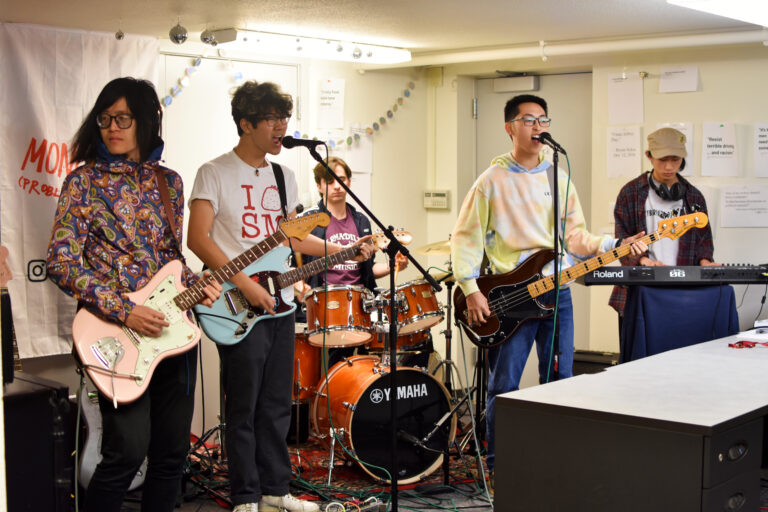
Problem child turned college student — and band
By RUMA POUDELL — arts@theaggie.org
From meeting at a UC Davis Jamming Crew event to performing at Turtle House and numerous other venues, MONDAIJI [problem child] is steadily growing its presence in the Davis community and beyond.
Adam Maru, the band’s leader, has been working on music since early 2019.
“I had music written, everything was ready to be played, and I just wanted to have people to play it with and work on it,” Adam said.
After a one-year hiatus from attending Jamming Crew meetings, Adam returned and just so happened to bump into MONDAIJI’s future lead guitarist, Michael, and drummer, Santiago Milano. From there, the three agreed to work together, and subsequently found keyboardist Elijah Hung and guitarist Shiyu Ji.
“I actually remember the first rehearsal we did,” Santiago said. “We played something for ten minutes. And it was really good. We didn’t expect us to have a jam that was that cohesive.”
Santiago remembers that at the time, some of their friends who were at the rehearsal even asked, “How long have you guys been playing together?” to which he exclaimed, “15 minutes!”
Upon hearing how quickly the band’s sound came together, you probably wouldn’t expect the diversity in each of the band member’s music tastes. Michael enjoys hard rock. HElijahung enjoys KPOP, funk and R&B. Shiyu also enjoys R&B. Santiago is a sucker for jazz. Adam is heavily influenced by Japanese artists.
The cohesiveness of the band arises from a common goal though, according to Michael.
“Adam is our creative leader,” Michael said. “He came to us with this vision […] That gives us a creative framework and focus […] and then we get to support that in our own unique ways.”
The name of the band is derived from “mondaiji,” a Japanese word meaning “problem child,” according to Adam.
“The narrative of our band is kind of just that we’re a bunch of misfits in a way — not in a heinous or malicious manner — we just want to play music together but be a little unhinged sometimes,” Adam said. “Part of that narrative is that [we’re] a kind of villain in [our] own [lives] and think we’re playing parts of delinquents in a way.”
When asked how they would describe their style, the band said that this is the one thing they disagree on, but if they had to, they would use the phrase “sentimental emo bops,” as displayed in their Instagram bio.
Every aspect of the band’s identity is managed internally. From the marketing and their social media aesthetic to recording songs — it’s all done by the band members themselves in Adam’s apartment. Santiago called it a “DIY [Do it yourself] aesthetic.”
When first forming the band, MONDAIJI’s members didn’t expect to gain as much of a following as they have.
“The turnout is always so good. We see the heads and people mashing together,” Siyu said. “People really support us. This is why I’m really glad to be a part of this band.”
He said the group was expecting about eight people to come to their first show, but they were thrilled to see over 100 people in the audience.
The members described playing together as “sentimental,” “very personal [and] very energetic,” an “emotional release,” “honkytonk,” “wholesome” and “so much fun.” Getting to play at Turtle House, a co-op in the Davis community known for hosting local bands, “felt like everything we had been doing had come to fruition,” according to Adam.
Being in the band has brought each member together “like a family,” Michael said.
MONDAIJI was Elijah’s first introduction to rock and has been a creative push for him, and he said that he had “to get a little creative with what [he] play[ed] for the band.”
The band ended off The California Aggie’s interview by saying, “Ever since our first show there’s been this energy […] There’s an enthusiastic attitude towards the creative process now.”
Listeners can expect MONDAIJI to drop a new EP soon. To support them, follow their Instagram (@mondaijiband), stream their songs and catch them at their next show.
MONDAIJI was featured in a Couch Concert with The Aggie on March 11, 2023. The video from the concert will be posted to The Aggie’s YouTube channel.
Written by: Ruma Poudell — arts@theaggie.org
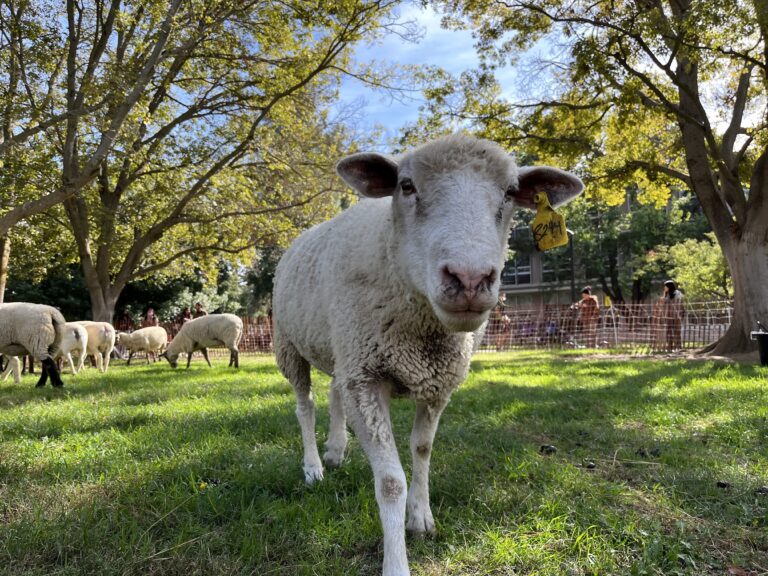
UC Davis study finds that sheep mow and fertilize urban lawn landscapes while decreasing students’ stress levels
By KATIE HELLMAN — science@theaggie.org
For the past two years, 25 UC Davis sheep have been released from their barns seasonally to graze at various parts of campus. These sheep not only provide ecological benefits, but they also improve the mental health and stress responses of students.
Haven Kiers is the lead author of the new study, which was published in The International Journal of Environmental Research and Public Health in January. Kiers is also the director of the sheepmowers project and an assistant professor of landscape architecture in the College of Agricultural and Environmental Science. She surveyed around 200 students with the help of co-authors and additional researchers.
“We noticed that people were just really happy when the sheep were around,” Kiers said. “It boosted their mood and people were starting to say that when the sheepmowers were out, they would come by before an exam to destress, or if they were already stressed they would come and sit [by the sheep].”
Caroline S. Dewa of the UC Davis Department of Public Health co-authored the paper and further commented on the benefits the sheep provided to students.
“For some people, it was an incentive to go to class because they knew if they went to class, after class, they would see the sheep,” Dewa said. “For others, it was a place to relax and chill out after their class.”
To gather data for the study, student employees and student shepherds interviewed participants in person and through social media. Comments were gathered and grouped into themes that included community engagement, place identity, relaxation and academic stress reduction.
These students were found to have a notably lower likelihood of feeling “very stressed” or “stressed” when in the presence of the sheep compared to those who were not exposed to the animals.
“Since the 1980s, college students in the U.S. have self-reported a decline in their physical and emotional health,” the study reads. “[The results] highlight the potential value of nature-based animal-assisted interventions on campus as a strategy for improving students’ mental health and well-being.”
This tradition with sheep mowing, which includes Suffolk, Hampshire, Southdown and Dorset breeds, began in 2021 amid COVID-19 masking and social-distancing protocols. The sheepmowers program’s intention was to determine if there was a correlation between grazing sheep and the health of urban lawn landscapes so that they could be utilized more frequently on campus.
“We are looking at the benefits of using sheep as lawnmowers from multiple aspects,” Kiers said. “We started looking at operational aspects: do they save time compared to lawnmowers? Can they cut the grass as well as lawnmowers? Can they reduce the amount of labor needed, and can they get into areas where traditional groundskeepers can’t?”
Kiers also explained that using sheep to maintain and fertilize the landscape is ecologically favorable.
“We’re looking at sustainability and seeing whether the sheep can help fertilize the grass and the soil, whether we can reduce the need for pesticides and herbicides, and also we’re looking…to see if [the sheep] are actually attracting beneficial insects and bringing in the potential for more biodiversity,” Kiers said.
The sheep also reduce the number of harmful pollutants emitted into the atmosphere by lawnmowers.
“It’s a way of controlling the grass that’s beneficial to the environment,” Dewa said. “[The sheep] don’t pollute, in the same sense, as a piece of machinery might.”
The sheepmowers program also benefits those that aren’t able to visit the sheep in-person. An Instagram account and live “sheep cam” allow people to view them virtually, and there is also a website that showcases the study, the researchers and, of course, the sheep.
“I just love seeing people’s reactions to the sheep,” Kiers said. “I love watching people bike by and just stop and look. People sort of come together and rally around it. I really like that.”
Written by: Katie Hellman — science@theaggie.org
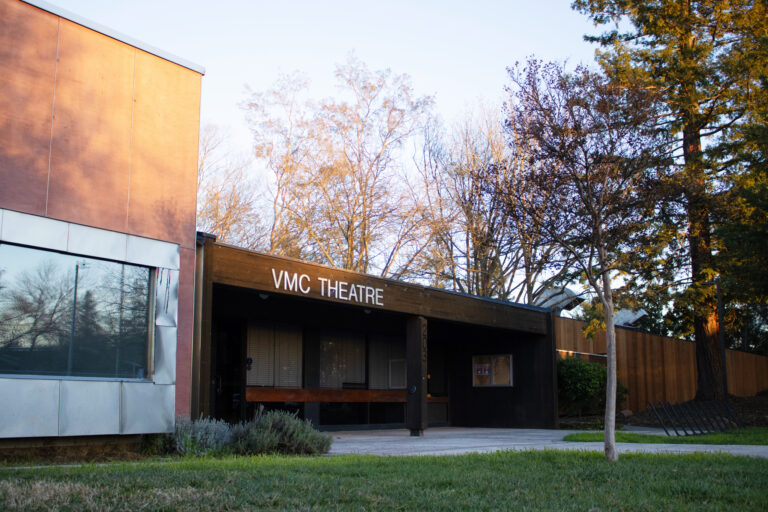
The art pieces are the latest installments in the city of Davis’s “Art in Public Places” collection
By ANTHONY W. ZAMMIKIEL — city@theaggie.org
On Feb. 23, the city of Davis announced that two additional public art pieces were scheduled to be installed at the Veterans Memorial Theatre and San Marino Park this upcoming spring. The pieces will be the latest contributions to the ever-increasing “Art In Public Places” collection that the city of Davis maintains and updates.
The two pieces, titled “Balance Beam” and “Frog Totem,” were created by artist Cedric Wentworth and sculptor Mary Fuller McChesney and are scheduled to be finished and introduced to the Davis community at an undisclosed date and time this spring.
“Balance Beam” was created in 1999 and has been on display for more than two decades at the intersection located between 5th Street and Pole Line Road, but will now be displayed at the northern lawn of the Veterans Memorial Theatre.
“Measuring 6’ x 21’ x 5’ and built from steel and bronze, this piece is an example of the postmodern sculpture work Wentworth is known for that combines abstracted figurative subject matter with industrial structures,” according to the announcement released by the city.
The second installation, “Frog Totem,” was created in 2008. This installation will be an entirely new addition to the public art scene in Davis and will be installed behind San Marino Park on the patio edge that borders the beginning of the greenspace located south of the park.
“The roughly eight foot tall concrete composite piece is a whimsical tribute to our natural environment,” the announcement reads. “The work says ‘Save the Frogs’ in English and ‘Salva las Ranas’ in Spanish, and the artist intentionally created this piece to promote wildlife conservation in her hometown of Petaluma.”
The installations are the latest additions in the extensive catalog that the city of Davis maintains, and the Davis community is largely supportive of the latest installments to the collection.
Rachel Hartsbough, the Arts and Culture Manager for the city of Davis, commented about how the public art collections positively contribute to the Davis community. She also shared how people should continue to support public art installations throughout the city.
“Public art in Davis, and any community, contributes to the quality of life for those who visit or call Davis home,” Hartsbough said. “We know from years of research that the presence of artwork can actually promote safety, improve mental health, increase economic activity, inspire tourists to visit, and so much more.”
Hartsbough shared how these displays will help benefit the community and expand where art is featured in Davis.
“We are excited to site these two new pieces of art because they will help us to provide access to artwork in more neighborhoods and locations and allow more of our community to benefit from the positive impacts,” Hartsbough continued. ”In this case, we are pleased to be able to showcase the work of two new artists to our collection, Ceric Wentworth and Mary Fuller McChesney. Each of their respective works brings a new aesthetic to our collection, and provides new examples of creative approaches to materials and artistic style and method.”
The Art In Public Places Collection was created by the city of Davis in 1973, with the objective being that the city would dedicate 1% of public funding that the city receives for capital improvement projects to make public purchases of art intended to increase the quality of life for the Davis community.
“Artists selected through this program represent a diversity of style and media,” reads the city website page for the Art In Public Places Collection. “Sculptures, murals, paintings, tile work, and functional pieces are located around the city to enhance the quality of life for all Davis residents and visitors.”
Questions, comments and suggestions can be directed to Rachel Hartsough at rhartsough@cityofdavis.org. The city of Davis recommends that members of the community take into consideration the necessary construction required for the installations and act with caution when around the construction areas.
Written By: Anthony W. Zammikiel — city@theaggie.org
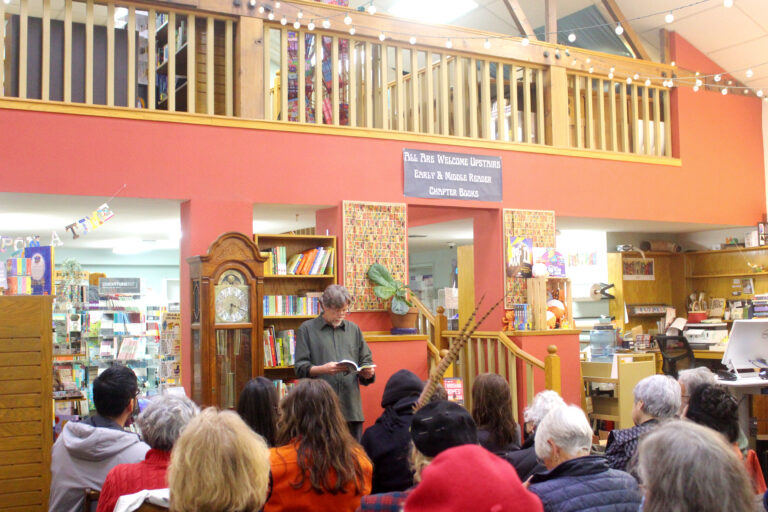
From environmentalist memoirs to action-packed fiction, local authors share their stories
By ANA BACH — arts@theaggie.org
On March 9, The Avid Reader hosted a local author night, where many members of the community gathered to hear from published authors from the area. The event started at 6 p.m. amidst pouring rain in downtown Davis.
The employees congregated at the back of the bookstore to present the authors; Elizabeth Nguyen, Bruce Rettig, Nan Turner and Tom Lin. Each author had roughly 10-to-15 minutes to talk about their work.
Nguyen discussed her book, “Aloha Vietnam,” which follows 17-year-old Anh Nguyen, who uses watercolor painting to cope with her first manic episode and is later diagnosed with bipolar disorder. Her Vietnamese-American family is then introduced to the complex struggles of mental illness, whilst also coping with the hardships that come with leaving Vietnam and moving to Hawaii. Anh finds comfort in her love for the ocean and art, using the creative outlet as a tool in navigating a new place and finding belonging.
Nguyen briefly addressed the nonfiction elements of the storyline, reflecting on her own experience as a Vietnamese-American woman. She explained the connotation of the title, and how the word “Aloha” has several meanings; “hello,” “goodbye” and “love.” The phrase encapsulates the experience Anh is going through and the multiple identities she struggles to reconcile.
Nguyen ended by talking about the role that watercolor plays “in expressing the world through color as someone who is bipolar.” Even though the world seems to have a split black-and-white narrative with clear divides sometimes, there is still potential to see the color or liveliness in the elements that create this cohesiveness within society.
Rettig came to the floor next to talk about his time in the Arctic, which is documented in “Refraction.” His memoir recounts his experience working in Prudhoe Bay, Alaska, which is home to the largest oilfield in North America, and getting to know the Kaktovik villagers during his stay. The title refers to the mirage that is created when viewing the natural forms that make up the Arctic.
“Seeing and perceiving something is often different from reality,” Rettig said.
He emphasized that while this is a memoir, the main purpose of his book is to also shed light on the demise of our planet and the physical severity that the industrial environment places upon the Earth.
“Refraction” has won several writing awards, including first place for narrative nonfiction in the International Chanticleer Book Awards as well as first place for narrative nonfiction in the Pacific Northwest Writers Association’s Literary Contest. Rettig currently does web design work in Davis and has a podcast that discusses the Alaska Story Project. His main emphasis is on the shared home all humans inhabit — Earth — and working to take care of it before it is too late.
Turner shared her intrigue for fashion, specifically for civilian clothing during World War II. “Clothing Goes To War” goes into great depth about the clothing choices made due to the scarcity during the war, and Turner explained to the audience how the production of clothing shifted towards prioritizing the needs of the military at the ti,e. With these adjustments in place, civilians were left with almost nothing and were encouraged to save their articles of clothing until they were scraps.
While working on her master’s degree in textiles, Turner interviewed locals on their experience living through the war. Many discussed the repurposing of men’s clothing and how the clothing shortages had the biggest impact on women because they faced intense societal pressure to look presentable. Some women went to great lengths to achieve this presentable look by using leftover gravy on their legs to resemble the color of nylon stockings. Turner offers an in-depth look into the creativity and ingenuity that jump started this fashion intervention amidst all the conflict imposed by World War II.
Lastly, Lin called attention to the action-filled story of a Chinese-American assassin in “A Thousand Crimes of Ming Tsu.” Ming Tsu is on a quest to rescue his kidnapped wife and exact revenge on her abductors. The story takes place during the late 1860s, during the construction of the Central Pacific Railroad.
Lin discussed the impact that his grandparents had on the book through their persistent efforts to migrate from China to the U.S. The story relates to the journey and driving forces that motivate us to go after what we want. New York Times book review editors called it, “a new old narrative: part revenge fantasy, part classic bloody tale of the Old West.”
The quaint setting of The Avid Reader brings both readers and writers together, even on the gloomiest of winter days. The Avid Reader frequently hosts community events like their local author night, which can be found on their website.
Written by: Ana Bach — arts@theaggie.org

Chances are, you ignore your gut feelings pretty often. Don’t!
By YASMEEN O’BRIEN — yjobrien@ucdavis.edu
Having a gut feeling is one of the only times we feel like we truly know something, but even so, trusting it is surprisingly hard to do. I’ve been in situations where I was extremely unhappy — and I’m sure you have too — where my body felt like it was in a constant state of anxiety. It was screaming at me to get out of the stressful situation, but my “logical” mind ignored it for a very long time, even though my gut was right all along.
I have also been in situations where I’ve felt unexplainably unsafe or uncomfortable and have removed myself from these situations without any “logical” explanation. I didn’t stick around to see if I was right about these scenarios; I didn’t need to know. The feeling my gut gave me was all I needed.
A gut feeling — interchangeable with an intuition, instinct or hunch — is difficult to define. It’s the ability to immediately understand something without active reasoning. It’s that feeling we get in the pit of our stomachs or in the deepest parts of our consciousness. Sometimes it whispers, sometimes it screams. But, because our gut feelings come from within us, they have our best interests at heart.
This may seem obvious — of course, our gut feelings come from within us, all of our thoughts and feelings do. However, in my research, I found some very compelling evidence of just how true this is.
Our intuition is not something we’re encouraged to rely on in the age of big data, it is often deemed as unreliable or even mystical. Although it is true that intuition falters, studies show that pairing analytical thinking with gut feelings helps you make better, faster, more accurate decisions. These studies also show that this pairing gives you more confidence in your choices than relying solely on intellect does.
This becomes important when you are overthinking or making a decision with no clear-cut answer. Even the U.S. Navy has invested millions of dollars into helping sailors and Marines refine their “sixth sense,” precisely because intuition can override intellect in high-stakes situations such as on the battlefield.
There is actually a deep neurological basis for intuition. There is a wide-ranged neural network of 100 million neurons lining your entire digestive tract, which is more than in the spinal cord. The gut has incredible processing abilities.
Essentially, when you approach a decision intuitively, your brain works in collaboration with your gut to instantaneously evaluate all your past learnings, memories, personal needs and preferences, and then uses this assessment to make the wisest decision given the context. This turns intuition into a form of emotional and experiential data that should be valued.
One of the biggest problems with trusting our gut, especially as young people, is that it can be hard to discern intuition from fear. Fear is often accompanied by constricting or minimizing bodily sensations that make you feel tense, panicky or desperate. I would describe fear as having a pushing energy, as if you’re trying to force something, or choosing a path because you want to avoid a threat. Fear is dominated by self-critical thoughts that encourage you to hide, conform or compromise yourself.
You cannot let fear rule you. You would be doing yourself a great disservice to listen to this voice.
On the other hand, I would describe intuition as having a pulling energy, as if your decision is moving you toward your best interest, even if that comes with pursuing a risk or moving slower than others. This feeling is often accompanied by excitement and anticipation or ease and contentment. Physically, listening to a gut feeling tends to allow your body to relax because your intuitive inner voice is wiser and more grounded. It is your mentor.
Intuition is not perfect — but it is probably a decision-making tool you’re underestimating and underutilizing. Use it!
Written by: Yasmeen O’Brien — yjobrien@ucdavis.edu
Disclaimer: The views and opinions expressed by individual columnists belong to the columnists alone and do not necessarily indicate the views and opinions held by The California Aggie.

Drawn by: Lidya Shcherbakova –– lvshcherbakova@ucdavis.edu
Disclaimer: (This cartoon is humor and/or satire, and its content is purely fictional. The story and names of “sources” are fictionalized.)

The coastal West differs regionally in climate and oceanography throughout the period
By LILLY ACKERMAN — science@theaggie.org
A recent study out of UC Davis is the first of its kind in synthesizing climate and oceanography records. It drew records from individual regions in the coastal Western United States into a comprehensive paper that covers changes in the entire region throughout the Holocene.
The Holocene is the most recent geological epoch, or division of geologic time, spanning the last 11,750 years and continuing through today. Despite the fact that it encompasses the present, the Holocene is still relatively understudied in the world of geology.
Veronica Padilla Vriesman, the second author on the study, recently earned her Ph.D. from UC Davis in the Department of Earth and Planetary Sciences. She explained why this synthesis paper was necessary.
“It’s interesting; [the Holocene is] the most recent geological interval, but in some ways, it’s the least understood geologically,” Vriesman said. “[G]eologists tend to focus on millions of years ago, and biologists and ecologists tend to focus on seasons. So this is kind of the in-between timescale.”
According to Vriesman, the inspiration for the study came out of a graduate seminar led by Professor Tessa Hill in the Department of Earth and Planetary Sciences.
“We were looking into climate patterns over the past 10,000 years along the Pacific and the West Coast of North America,” Vriesman said. “And we realized that the paper we were hoping to read didn’t exist, so this paper kind of became a project out of what was missing from the literature.”
The study’s lead author, Hannah Palmer, who graduated with a Ph.D. in earth and planetary sciences from UC Davis in 2021, noted that the study found significant variations in climate patterns, ocean productivity and dominant tree types for coastal Western North America at different times during the Holocene.
According to Palmer, three main subsections within the Holocene can be differentiated, beginning with the early Holocene. This time period was characterized by warmer and drier conditions and reduced coastal fog. It also featured pine-dominated coastal forests (unlike the redwoods we are used to today) and reduced ocean upwelling and productivity, meaning there was decreased synthesis of organic matter and respiration from surface species like phytoplankton that support the consumers in the ocean.
During the middle Holocene, the region began to transition away from the dry and warm conditions.
“In the Middle Holocene, the region was wet and cool and the conditions we see today began to develop during this time (8,200-4,200 years before present), including an increase in coastal upwelling and ocean productivity and an increase in coastal fog and coastal redwoods,” Palmer said via email.
Finally, the late Holocene features characteristics we are used to today.
“The Late Holocene is the most variable interval, both spatially and temporally, and a novel spatial trend appears in terrestrial climate with warmer coastal areas and cooler inland areas,” the study reads.
The study also found a marked change in several environmental factors within the last few hundred years, a time period referred to by Palmer as the “Era of Colonization.”
“A critical finding of this study is the signature of human impacts on the climate and environment beginning several hundred years ago at the onset of settler colonization and continuing through to today,” Palmer said. “Notable changes include changes in fire
activity, shifts in pollen and vegetation composition, landscape change (such as movement of
sediments and changes in the chemistry of sediments), and changes [in] marine resource use.”
The authors hope that their study, which puts together several pieces of the complicated history of the Holocene, can help inform decisions and further research in the face of a changing climate.
“The patterns identified here can inform how we predict and plan for future climate change,” Palmer said. “Further, I hope this study informs future work [that studies] human-environment interactions.”
Written by: Lilly Ackerman — science@theaggie.org

©2021, ASUCD. Designed by Creative Media.