55.9 F
Davis

Davis, California

Tuesday, December 23, 2025
Home Blog Page 191

City of Davis approves new winter shelter plan, partnership with Downtown Streets Team

0

Downtown Streets Team to work with City of Davis to set up winter shelter, offer pay and support for unhoused community

By LA RISSA VASQUEZ — city@theaggie.org


On Oct. 18, at their weekly meeting, Davis City Council passed two proposals aimed to better support people experiencing homelessness in Davis: creating a 2022-2023 Emergency Winter Shelter and piloting a Downtown Streets Team (DST) program. The Council unanimously voted for both.

According to Chris Richardson, the Chief Program Officer of the Downtown Streets Team, the program will employ a 15-member team of unhoused people in the Davis community to clean areas around the city. In exchange, each team member will receive a stipend for basic needs and a case management representative to help them establish more permanent housing and employment.  

“When we launch, we want to be a vital part of the community’s fight against homelessness and to build partnerships with other service providers that are long lasting,” Richardson said. “A big part of the goal is to provide a low barrier entry point for unhoused individuals to meet their basic needs to go from survival mode to goal setting mode.”

Case managers work extensively — 20 hours or more a week on average — according to Richardson. Each team member develops employment and interpersonal skills, receives assistance with building their resumes, preparing for interviews, increasing financial literacy, and applying to federal and state resources, according to the DST website.

“We provide a low barrier way for folks to start addressing their basic needs and engage with community resources, including affordable housing to put them on a path to long term self-sufficiency and housing,” Richardson said.

Although the DST program cannot provide physical shelter, the city of Davis will be contracting with the Davis Community Meals and Housing (DCMH) organization to operate an emergency winter shelter from November to the end of March 2023 for up to 10 individuals on a first come, first served basis.

The shelter will be located in a city-owned house near the Davis Fire Department headquarters in Downtown Davis. Bill Pride, the executive director of DCMH, discussed some of the challenges that the shelter could face in the coming year.

“Getting the right staff and volunteers has been the biggest challenge for us the past few years due to [COVID-19] and other issues,” Pride said. “Our shelter will be collaborating with HEART Davis, the city of Davis and others to support the shelter with food for residents, services and necessary supplies.”

The DCMH can only house 10 residents, but according to the 2022 Yolo County Homelessness Count survey, there are approximately 181 people experiencing homelessness in Davis, about 114 of them are living unsheltered. 

 “Specific to California, we have some of the highest wealth disparity in the country, if not the world, and that is reflected in our housing,” Richardson said. “We have a critical lack of affordable housing throughout the state of California which manifests itself in homelessness.”

Written by: La Rissa Vasquez — city@theaggie.org

New 360-degree multisensory room launched for food product research at UC Davis

The immersive room simulates real-life environments with visuals, air conditions, scents and sounds

By KAYA DO-KHANH — campus@theaggie.org


The Department of Food Science and Technology at UC Davis has launched a new multisensory immersive room for testing sensory science and consumer behavior research, according to a recent press release

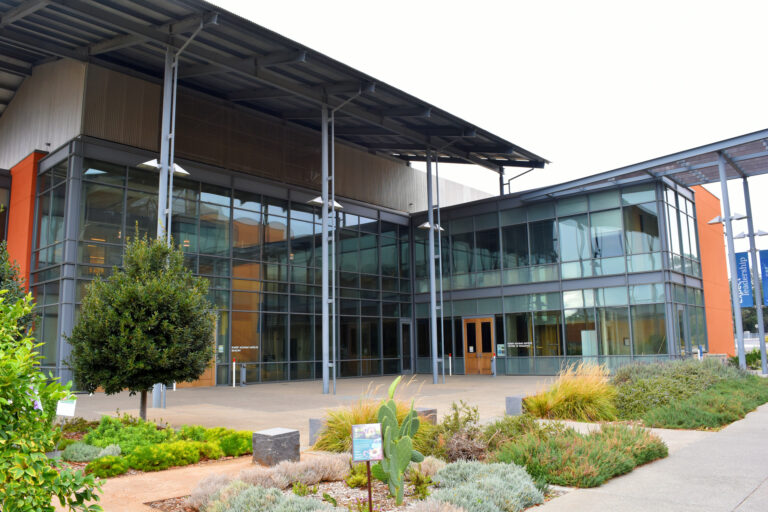
The 360-degree real-life environment experience is located in the Robert Mondavi Institute for Wine and Food Science’s Sensory Building. The room has six video projectors that, according to the release, display high-definition videos on the walls featuring diverse environments like hiking trails and restaurants. The scenery can be changed using an electronic tablet. 

The immersive room appeals to the senses in different ways. Controlled heating lamps, misters and fans can adjust the room’s temperature, a variety of scents can be released to alter the smell and sounds that produce spatialized audio can be played through mounted speakers. 

Julien Delarue, an associate professor in sensory and consumer science, started working on the project to redesign a pre-existing sensory lab that consisted of standard sensory booths around a year and a half ago. He said that it took almost a full year to complete the remodeling.

Delarue is currently planning to use the room to test how different environmental cues affect consumers’ reactions to food products. His first experiments in the multisensory room will be conducted with energy bars, and he said that he hopes there will be different reactions to the product in a more real-life setting than in a standard lab. 

“It’s nothing like a lab, and for me, that’s very important, because that was the goal,” Delarue said. ”It’s really not what you expect. They’re coming to a lab, and then they’re immersed in that environment.” 

In regards to the future of the 360-degree multisensory immersive room, Delarue said there is a possibility of installing the same sensory immersive rooms in other locations around campus and even across California. He also said that the immersive room could be used for other departments, such as for creative purposes in design. 

“In terms of research, it’s an extremely powerful tool,” Delarue said. “There could be different usage for creativity, design or education.”

Christopher Simmons, the chair of the Food Science and Technology Department, said that this ability to depict life-size environments could be a new way of teaching other food science concepts, such as the inspection of food processing and service facilities or creating virtual tours of industrial facilities and agricultural field sites.

“Going forward, the multisensory immersion room will transform how many food products are evaluated by enabling research related to the interactions between consumers, food, and their surroundings,” Simmons said via email. 


Written by: Kaya Do-Khanh — campus@theaggie.org


The Davis Fire Department hosts open house as part of Fire Prevention Month

0

Station 31 opened its doors to the public to teach about fire prevention, fire safety 

By ANTHONY W. ZAMMIKIEL  — city@theaggie.org


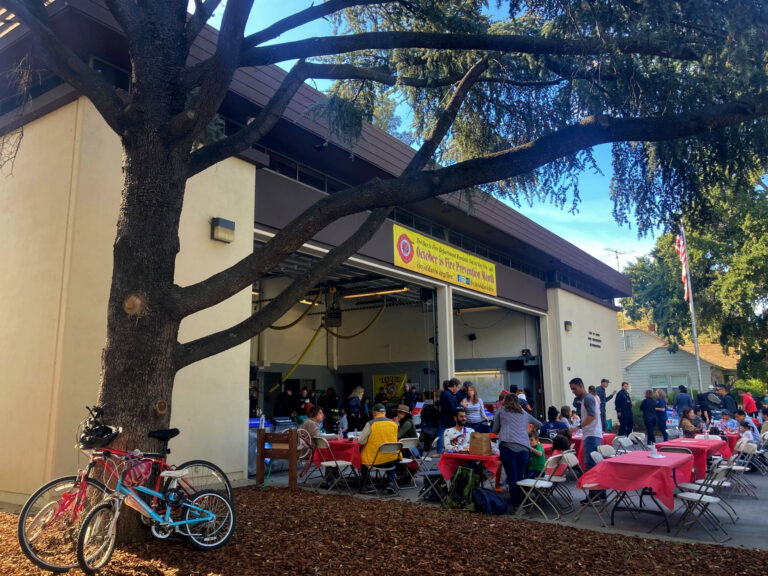
On Oct. 29, the Davis Fire Department (DFD) commemorated Fire Prevention Month by hosting an open house at Station 31, located at 530 5th St. Starting at 10 a.m., firefighters operating the 5th Street station hosted demonstrations and activities for adults and children alike to learn more about fire prevention and safety. The DFD also had a barbecue outside the station, providing free hot dogs for the families attending the event.

At the open house, there were five separate demonstrations. During one, firefighters showed attendees how different pulley systems assist them with carrying heavier weights. They also allowed children to try on the attire that station members wear while responding to emergency events. During the main demonstration of the day, which occurred on a blocked-off section of E Street between 4th and 5th Streets, firefighters set up an inflatable room in which they showed children how to prevent fires from starting as well as how to respond if a fire does start. 

According to Patrick Sandholt, the fire marshal for Station 31, the event was meant to be both positive and informative. He said that it was mainly intended to educate younger members of the public about what to do in the case of a fire-related emergency.

“Really, the purpose of the event is to educate the public on fire safety, to teach kids fire safety and to be comfortable with being around the fire department,” Sandholt said. “The main message here is to teach kids to stop, drop and roll, to call 9-1-1 in case of an emergency and to not play with matches.” 

Sandholt said that throughout the month of October, the DFD also visited all the public elementary schools in Davis to hold assemblies for first-grade classes during which they taught students how to stay safe and prevent fires from starting.

Though the open house concluded the activities that the official DFD hosted for Fire Prevention Month, Sandholt said that Station 31 is always open for the public to come and tour during normal business hours.

Davis’s Fire Prevention Month has been observed by the city ever since former City Council Member and former Davis Mayor Brett Lee formalized the event on behalf of city council on Oct. 7, 2014.

“In recognition of Fire Prevention Month, October 2014, the city of Davis, California is committed to ensure the safety and security of all those living and visiting Davis,” Lee said in a statement to City Council. “Home fires are extremely dangerous and kill. Davis residents should install smoke detectors in every sleeping room outside of every separate sleeping area, and on every level of the home.”

Fire Prevention Services can be contacted via phone at (530) 757-5682 or via email at fireprevention@cityofdavis.org. Inspection, Plans and Permit Services can also be contacted with the same number and the same email address. The Davis Fire Department can be contacted at 9-1-1 or (530) 756-3400 for emergencies and (530) 747-5400 for non-emergencies. Additional information for the Davis Fire Department can be found online at https://www.cityofdavis.org/city-hall/fire-department


Written By: Anthony W. Zammikielcity@theaggie.org


UC, CSU, CCCs release joint statement on DACA ruling in Texas

The appeals court ruling found the program unlawful, but will allow existing DACA recipients to renew their status for the time being

By SONORA SLATER  — campus@theaggie.org

On Oct. 5, a federal appeals court announced its decision on the Texas v. U.S. Deferred Action for Childhood Arrivals (DACA) case, agreeing with the previous judgment on the case that stated that DACA was unlawful, but sending the case back to a lower court in Texas to be decided again based on new rules recently implemented by the Biden administration.

DACA is a national program that was created in 2012 by the Obama administration that allows immigrants who came to the U.S. unlawfully before their 16th birthday to receive a two-year period of deferred action from deportation, as well as the opportunity to become eligible for a work permit. Based on the Oct. 5 ruling, existing DACA recipients are still able to renew their status, but the program is not accepting new applicants for the time being.

UC Davis has an estimated 800 undocumented undergraduate and graduate students, according to Enrique López, a third-year PhD candidate in the Sociology Department and the Training and Engagement Coordinator for the AB540 and Undocumented Student Center. López said that some staff and faculty at the university are also undocumented, and may similarly benefit from DACA.

“The population is not small, it’s not insignificant,” López said. “With this news of possible DACA repeals, there’s a very significant amount of students who are threatened with the removal of a sense of security. [And] if anything happens to DACA, it’s not just happening to students, but it’s also impacting professionals, teachers and faculty who are crucial for UC Davis to function.” 

On Oct. 6, the University of California, California State University and California Community Colleges issued a joint statement on the ruling. 

“Even as we hope that this decision is overturned, the uncertainty it creates is untenable,” the statement reads. “DACA recipients deserve to have their status as equal Americans protected. We support the decision to allow current DACA recipients to avoid immediate disruption to their lives and also to seek extensions of their DACA status.” 

The statement goes on to state that the group is planning on “[advocating] for permanent pathways to citizenship so undocumented Californians can pursue their academic and professional goals without fear of deportation.”

López, who said that he was undocumented in the past but now is not, described his experience of what the emotions surrounding DACA’s uncertainty can be like. 

“I think that the easiest and most accessible thing for everyone to do is to become aware of that liminal and vague space that a lot of students are facing right now,” López said. “Even though DACA students have a sense of security, it’s only temporary. And DACA has been on this very fine thread for a very long time.”

The joint statement states that undocumented students, including DACA recipients, remain welcome at California’s public colleges and universities. 

“The decision […] does not change our mission to welcome and serve all students,” the statement reads. “This is what we have always done, and we will not waver. We will continue to do all we can to ensure our undocumented students feel safe and supported on our campuses.”

In summer of 2021, ASUCD passed a resolution to end the use of the terms “illegal” and “alien” when referring to undocumented individuals. López saw this as “[positive] movement happening at the bureaucratic level,” but he still believes that “more action can be taken.”

The statement by leaders at California universities also shed light on where some undocumented individuals who were once college students may be now.

“Today, [DACA] recipients are first responders, medical professionals, educators, scientists, and serve in a host of other critical professions,” the statement reads. “They have made and continue to make positive contributions to our local, state, and federal economies and communities.”


Written by: Sonora Slater — campus@theaggie.org


2022 ASUCD Fall Elections — Meet the Candidates

This fall, eight candidates are running for Senate, one for External Affairs Vice President, one for International Student Representative and one for Transfer Student Representative

By SYDNEY AMESTOY, KAYA DO-KHANH, LEV FERRIS GOLDENBERG AND RACHEL GAUER — campus@theaggie.org

The following candidates are running in ASUCD’s 2022 Fall Elections for elected official positions in student government. Three Senate candidates were not available for an interview.

Elections will take place from Monday, Nov. 7 at 12:01 a.m. to Wednesday, Nov. 9 at 11:59 p.m. Students can vote online at elections.ucdavis.edu.

Senate:

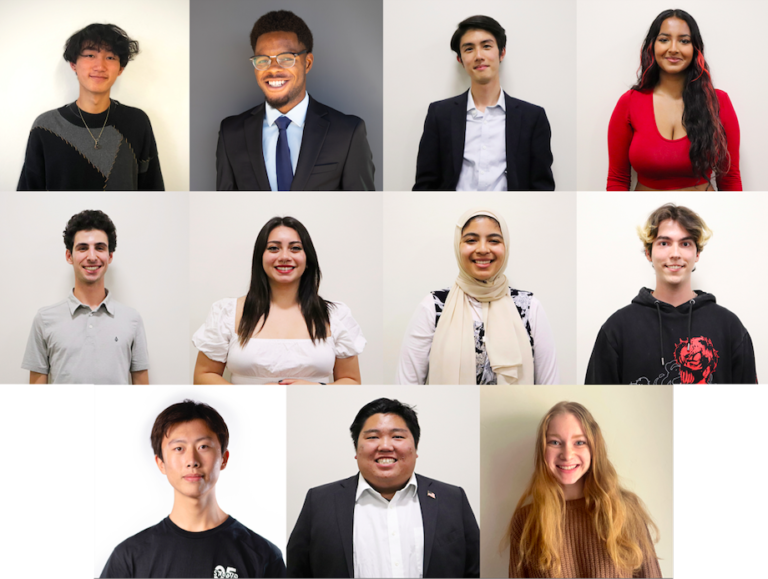
Gaius Ilupeju (he/him/his), a second-year political science and history double major, said that he is running for Senate because he wants to increase student engagement in ASUCD. His platforms include improving employee retention and Black student involvement in student government, advocating for animal rights in terms of more transparency regarding the California National Primate Research Center and student engagement and participation in voting. Ilupeju said that recent years have had historically low voter turnout for ASUCD elections, which he wants to change, and he also wants to improve marketing in order for more people to know about ASUCD and the services it provides. He spent the past year as an ASUCD senator, and he is currently serving as the Senate President Pro Tempore. Projects he has worked on include making the cow the ASUCD mascot and making plans to expand the services that The Pantry provides. 


Jacob Klein (he/him/his) is a first-year political science major. As the only first-year student running for Senate this fall, Klein said that he believes he is uniquely connected with the first-year class and therefore more in touch with their needs and concerns. Klein has a three-pronged platform: reducing antisemitism on campus, limiting the annual student athletics fee and decreasing the daily parking fee on campus. As a queer and Jewish student, Klein said that he believes it is vital for advocates of the queer and Jewish communities at UC Davis to be involved at the Senate level. Additionally, Klein said that, if elected, he intends to help create a fee waiver for those who cannot pay the daily on-campus parking fee. Although Klein has not previously been involved with ASUCD, he states that his leadership experience in high school has prepared him to enter the position.


Stephen Fujimoto (he/him/his), is a fourth-year cognitive science and statistics major and is currently serving as an interim senator. Fujimoto has been a part of ASUCD since his second year when he served as a member of the temporary data task force under former ASUCD president Kyle Krueger. That task force was then turned into the permanent Research and Data Committee, which Fujimoto was chairperson of before being appointed as an interim senator. Fujimoto said that making sure efforts to eliminate or decrease student fees, such as athletic fees, are present on ballots is a large part of his platform. His platform also includes listening to the voices of student-workers and taking action to support them by advocating for better pay, or by supporting the creation of a student-worker union. Fujimoto cites his passion for fighting for the student body and serving them as his qualifications for continuing to serve as a senator. 


Aarushi Raghunathan (she/her/hers), a second-year political science and managerial economics major and a current interim senator, has served on ASUCD since the summer before her first year at UC Davis as a member of the Judicial Oversight sub-committee, the Regulation and Finance sub-committee, and the Internal Affairs Commission (IAC). She later became the chairperson of the IAC before being appointed interim senator following a resignation in the Senate. Her platforms are ease of access and increased affordability across campus. She said that she seeks to reduce campus housing prices, specifically for The Green at West Village, and to provide free menstrual products more widely across campus. Raghunathan said that another key part of her campaign is seeking to make lecture recordings mandatory. Raghunathan said that her current position as an interim senator, and the experience she has gained from that role, are why she believes she is qualified to continue to serve as an ASUCD senator. 


Erek Leschyn (he/they), a third-year political science major, has a platform that centers on basic needs for students — he said that he wants to increase funding and student awareness for programs like The Pantry, Aggie Reuse and others. Their platform includes advocating for greater academic accommodations, decreasing parking fines and increasing grace periods for fine payments and working to expedite the student-employee onboarding process for ASUCD job positions. As a queer transfer student, he said that he hopes to be a representative for some of the minority communities that he is a part of. Leschyn cited their passion for government and commitment to community as reasons they can succeed in the position, as well as their experience as an IAC commissioner and as treasurer and board member for several nonprofit organizations.


External Affairs Vice President:

Celene Aridin (she/her/hers), a third-year international relations major, has been a part of ASUCD since her first year, serving as the Assistant Chief of Staff in the executive office, the UCweVote Coordinator and the Organizing Director in the External Affairs Vice President’s office. As organizing director, she oversaw the UC Student Association’s (UCSA) campaigns on campus, and as External Affairs Vice President, Aridin said that she hopes to enhance student advocacy in these campaigns. Aridin said that she believes her abilities to communicate and delegate make her qualified for this position, as well as her desire to continuously learn. Her passion is community organizing — she hopes to reach out to hear student concerns and work to find the resources to address them. 


Transfer Student Representative:

Logan Ueno (he/him/his), a fourth-year political science major, said that he aims to promote a welcoming community for the transfer community on campus through both academic and social events. Ueno said he gained a vast array of knowledge and experience from his previous position as the Interim Transfer Student Representative. Last year, he said that he contributed to getting a salary-increase budget approved by the Senate table to increase the overall budget for the Office of the Transfer Student Representative (OTSR). Ueno wants readers to know that even though the OTSR is a newer office, the team is “doing so much for transfer students” and that the office is important for fostering the transfer student community. He also encourages transfer students to involve themselves in future ASUCD elections to increase their representation amongst those in office.


International Student Representative:

Keven Zhou (he/him/his), a third-year managerial economics major and the incumbent for the ISR position, said that last year, the office helped to better integrate international students on campus and advocated for issues in terms of mental health and academic success. Zhou said that he has a passion for advocating for international students because he has lived back and forth between China and the U.S. his whole life, so he has a first-hand understanding of issues faced by international students on campus. He said that during his first year at UC Davis, which took place fully online, he became aware of issues such as international students misunderstanding the idea of plagiarism and being sent to the Office of Student Support and Judicial Affairs as a result. After seeing and experiencing the challenges international students can face, he decided to run for the position in order to make a foundational change from the inside. Going forward, Zhou said that he wants more people to become aware of this office and of the resources available to international students on campus and for students to feel that every person on campus is equally represented. 

Written by: Sydney Amestoy, Kaya Do-Khanh, Lev Ferris Goldenberg and Rachel Gauer — campus@theaggie.org

Culture Corner

The Art Desk’s weekly picks for movies, books, television and music

By MAYA REIHANIAN — arts@theaggie.org


Song: “Growing/Dying” by The Backseat Lovers 

The Backseat Lovers is one of my favorite bands of all time. Seeing them in concert for the first time in the fall of 2021 was a life-changing experience for me, and I don’t know how to break it to my future husband that our wedding day might never compare to seeing this band live in concert. The Backseat Lovers first plunged into mainstream indie music with their song “Kilby Girl” from their debut album “When We Were Friends,” and in anticipation of their next album, “Waiting to Spill,” they released their first single from the project. The song, called “Growing/Dying,” effortlessly weaves together immersive guitar solos with powerful vocals and lyrics that truly encapsulate the feeling of being stuck in one place and making the decision to grow into a stronger version of yourself. This track serves as the perfect opener to what is sure to be an extraordinary album.


TV Show: “Teen Wolf” (2011)

In preparation for the spooky season, I’ve been indulging in one of my favorite shows from high school: “Teen Wolf.” The show is about a teenager who becomes a werewolf, which, surprisingly, alters the trajectory of his future. Starring Tyler Posey, who remains as dreamy and charismatic throughout the six seasons of the show as he is in the first episode, It’s both campy and nostalgic, scratching the itch in my brain that craves poor CGI, teenagers running on all fours like wolves and Dylan O’Brien (pre-Taylor Swift’s “All Too Well” (10 Minute Version) short film). 


Book: “Goodbye Days” by Jeff Zentner (2017)

My taste in books has been described as masochistic, and “Goodbye Days” by Jeff Zentner is no outlier. When I enter a bookstore, I ask for a book that will leave me blubbering and sobbing for days after finishing it — and then the store clerk usually gives me a strange look as she hands me a book and tells me this will be the one to break me. “Goodbye Days” focuses on Carver, nicknamed Blade by his friend group “The Sauce Crew,” who is burdened with guilt for sending a text that ultimately leads to his friends getting into a fatal car crash. Blade spends the final month of his summer attending the funerals of his best friends as senior year and college applications loom over him. To find closure, Blade plans “Goodbye Days” with the parents who lost their children in the car accident. This book crushes your heart and soul as you navigate the new and empty world Blade is plunged into as he is blamed for the deaths of his best friends. 


Movie: “The Perks of Being a Wallflower” dir. by Stephen Chbosky (2012)

My Culture Corner wouldn’t be complete without me mentioning “The Perks of Being a Wallflower,” a movie that found me when I needed it the most during my sophomore year of high school. “The Perks of Being a Wallflower” is for anyone who just wants to feel like they belong somewhere, as viewers experience the main character, Charlie, navigating the daunting environment of high school. This movie left an impact on me that no movie has been able to compare to since. Logan Lerman and Emma Watson star in this film and give extraordinary performances as characters with deep layers and dark secrets. (Content warnings: suicide; sexual abuse)


Written by: Maya Reihanian — arts@theaggie.org


We must all do our part to ensure the health of Aggies this winter

The UC Davis college experience is finally starting to resemble life before the pandemic — let’s keep it that way

By THE EDITORIAL BOARD


It finally seems like things are going back to “normal” — most instruction is in-person, the CoHo reopened The Fickle Pickle deli and, believe it or not, Unitrans is no longer accepting applications for new drivers. Downtown is also alive and bustling, with packed farmers markets and vibrant nightlife. However, with this revitalization of Davis comes the slightly concerning sentiment that “COVID is over.” 

It seems that even general illness, like the flu, is something most people aren’t concerned about. College students often think they are invincible, and because of this, they tend to get sick frequently, seemingly all at once. In order to prevent this, we urge you to get your bivalent COVID-19 booster, as well as your seasonal vaccines.

It can be hard to make room in your busy schedule (trust us, we know), but protecting yourselves and others from potentially deadly viruses is always worth taking a little extra time out of your day. UC Davis is now offering COVID-19 vaccine boosters and third doses through UC Davis Health. According to their website, an “updated booster” is now available for everyone ages five and older. These boosters are being distributed at all of the UC Davis Health vaccine clinics, and appointments can be easily scheduled through their portal or through California’s My Turn website. UC Davis Health is also offering flu shots at all their primary care clinics, and you can even choose to add the flu shot to your COVID-19 booster appointment (bonus!).

Despite the general feeling of safety on campus, we must remember that COVID-19 hasn’t magically disappeared. Even though the fear factor around the virus has dissipated for many, COVID-19 is still affecting millions of people across the U.S. In fact, there’s been a significant uptick in cases all over Western Europe, and it’s entirely possible that we could experience a similar pattern at home.

Indeed, getting your vaccinations and continuing to practice health safety might be especially important this winter. According to experts, we might soon be faced with a “Tripledemic” of the flu, respiratory syncytial virus (R.S.V.) and COVID-19. While most cases of these viruses are likely to be mild, hospitals could be overwhelmed by an increased number of patients. To do your part in avoiding this, it’s vital to not only keep on top of your vaccinations, but also to still be testing and wearing a mask when you feel sick.

Even if you test negative for COVID-19 and the flu, you should still wear a mask and try to stay home to prevent other students from getting sick and to recover more quickly.

Herd immunity is another benefit of doing your part to stay safe this winter. When enough people get vaccinated, person-to-person spread becomes less likely. As a result, people who are more vulnerable to the virus, like those who are older or immunocompromised, have a reduced chance of getting sick.

At this point, it doesn’t seem like COVID-19 is going away anytime soon. We should be prepared to add a booster to our list of seasonal immunizations, not just for our own health and safety, but for others as well. Let’s all do our part to keep UC Davis safe and bustling.


Written by: The Editorial Board


Why are so many pop songs about love?

UC Davis community members discuss why love is such a popular topic in the music industry


By SARAH HAN — arts@theaggie.org


From The Beatles to Taylor Swift, music’s biggest stars have historically written about love and relationships. Although not all songs are about love, it’s a common theme across the pop music industry. Looking at Billboard’s Top 100, most songs center around different types and stages of love and relationships.

Sophia Wahanik, the principal bassist of the UC Davis Symphony Orchestra, explains that love might be a popular topic because of its relatability. 

“Love is a big, human, emotional experience,” Wahanik said. “It’s romanticized. It’s something that can be generalized. You just write a song about somebody you love [but] make it vague enough.” 

Indeed, relatability is a common factor. Samuel Nelson, a first-year Ph.D. student in musicology, explains that part of the reason the topic is so relatable is because of the wide variety of types of love that one might write about. 

“The varieties of love [are] open-ended,” Nelson said. “The love that you feel for a lover is one way [and] the love that you feel maybe for a parent or for a best friend [are] different as well. [Empowerment is] love of oneself. Love just comes in a lot of different ways.”

Sarah Miller, a fifth-year Ph.D. candidate in musicology, explained that the many types of love and its vagueness furthers its relatability. 

“[It’s] broadening the interpretation, being a bit ambiguous of what you’re talking about to apply it to your own circumstance,” Miller said. “I think people often write art, poetry or music perhaps [to] leave the imagination [to] the audience.”

Within the broader realm of love songs, tracks often fall into different “tropes,”

“The trope of the quirky, cute and perfect but ‘I’m so awkward’ girl like Taylor Swift, [or] BTS pretending [to be] this perfect boyfriend,” Miller said. “ I think popular music draws from those sorts of tropes.”

Another reason might simply lie in the historical precedence of love in songs.

“[In the] Romantic era, you’ll see poet composers singing often about love topics, unrequited love and this eternal dichotomy between love and duty,” Miller said.

Society’s shift from “love and duty” to a more free-thinking view of love may also explain the spike in the popularity of exploring love through music.

“You didn’t have a choice [about] love,” Nelson said. “Now it’s much more of a freedom, and there [are] so many different types of love as well.”

Miller further explained that the rise of love songs might be the outcome of breaking out of the social norms of what love is and looks like.

“Foucault, a French philosopher, came out with a book, ‘The History of Sexuality,’ and he talks about how we carefully negotiate norms and in what ways [we can] subvert them through language,” Miller said. “Music, historically, is infamous for being difficult to censor. So in what ways is music used to break societal comfort and norms?”

Miller believes music can be a tool for people to express their emotions — uncensored.

“Writing music and sharing music can be used to talk about things that are difficult to talk about, to put yourself in a place that perhaps language cannot fully grasp,” Miller said.

Wahanik agreed, explaining that music has the ability to let people reflect on and share their experiences.

“We feel things with music, so we can play these things on repeat [and] have our thoughts of love or whatever emotion,” Wahanik said. “It can also [be] played again [during a] break up [or when] you remember how we were loved.”


Correction: A previous version of this article attributed incorrect titles to two sources. The article has been corrected to reflect that Samuel Nelson is a first-year Ph.D. student and Sarah Miller’s is a fifth-year Ph.D. candidate. 

Written by: Sarah Han — arts@theaggie.org

UC Davis student entrepreneurs are driven by art and community, not profit 

Students share how selling their art at the Davis Art Market gives them a creative outlet

By MARIA MARTINEZ CASTRO — features@theaggie.org 


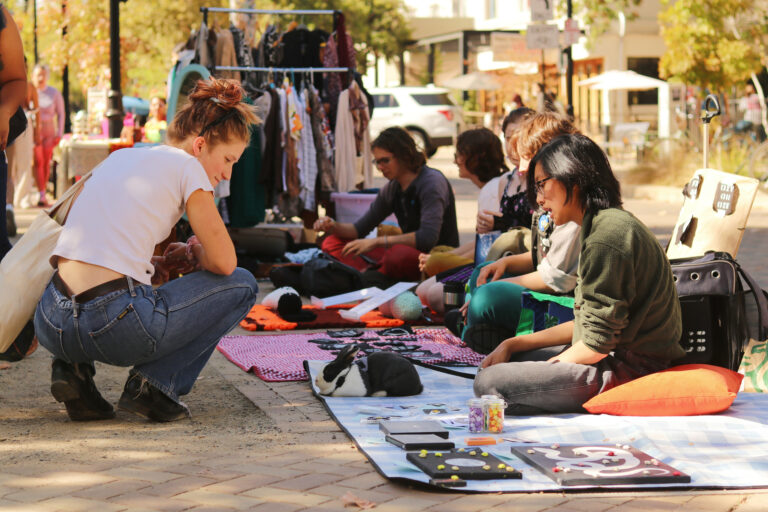
The Davis Art Market serves as a hub for art creators, small-business owners and vendors to share and sell their things to the Davis community. Along 3rd Street, one can find an array of products lining the sidewalk — including crochet hats, unique fashion pieces, handmade jewelry and customized acrylic nail sets. 

While many UC Davis students use the space to promote their business and art, other artists from the surrounding region have also set up shop within the art market. The market has even grown to attract and welcome vendors outside of Davis. 

While the art market does not exclusively house UC Davis student entrepreneurs’ shops, it has served as a platform for many students to establish and grow their small businesses. 

Pinny Kantacheerawat, a fourth-year mechanical and aerospace engineering major, and Lauren Tsujioka, a fourth-year political science major, are business partners running Cowtown Nails. Their business focuses on creating fun, customized acrylic press-on nails. 

“For me, I feel like nails are just like my artist side,” Kantacheerawat said. “I’m doing a super academic major, so I feel like whenever I paint nails, it’s like another way of me relaxing, just taking my time. Then the product turns out, and I get super excited because they look really good.” 

A passion for art has thrust some students into the world of business and entrepreneurship, even presenting them with future career trajectories they initially did not consider. 

“I honestly never thought about entrepreneurship,” Tsujioka said. “I’m a political science major, so, honestly, it made me think about going into a master’s for marketing in business. I really like the small business aspects and trying something new. I always wanted to be something different, like work in public policy or something else, and this has really changed my path.” 

Ahndiya Kiburi, a third-year design and international relations double major, is in a similar position. Kiburi runs Ahndiya Studios, a small business that sells crochet bags, book sleeves, plant hangers and clothing such as tops and hats. 

She said that she came into college wanting to be a lawyer, and while that “isn’t off the table,” it’s no longer her top choice. 

“Design was my fun major,” Kiburi said. “But then, I started taking some political science classes, and I was just like, ‘this isn’t 100% for me.’ Because of that, I was like, ‘let me just make my fun major my career major.’ Why can’t it be, essentially?” 

While entrepreneurship can be an alternative to a typical nine-to-five job, some student entrepreneurs’ focus isn’t on the money. Kiburi views her small business and the art market as a means to share her art and passion with others. 

“I am willing to take more of a pay cut if I’m doing what I love to do,” Kiburi said. “The motivation is more just to be creative as an entrepreneur rather than to make the most money in the least amount of time.”

Tsujioka says that interactions with customers is one of the most rewarding parts of running a business. 

“The plus side is, honestly, seeing the customers’ faces light up when they do receive their nails,” Tsujioka said. “Or, when they come and show us the nails that they have on, it literally makes us so happy.” 

Heron Rana, who is behind “@davis_street_market” on Instagram, says that the market started as a space for artists to share their art and uplift each other. 

“For me, the [Davis] Art Market was always more of a space for [community] rather than, like, economics,” Rana said. “I never really pictured that people would actually be making bank at the art market. But they do, which is really awesome that that’s another form of validation too.”

While the Davis Art Market has expanded to be a platform for UC Davis’ small business owners to expand their shops, it continues to be a space of art, inclusivity, diversity and community. 

“It really does create easy access for people who are coming into it newly or young and exploring their art,” Rana said. “That’s the best part of it for me. It creates a safe space for people to do that without the pressure of, ‘Am I going to make the money that I’ve invested into this?’ I would believe a lot of people, even when they don’t sell anything, they still don’t lose because you receive the love of the community.”


Written by: Maria Martinez Castro — features@theaggie.org


ASUCD fall election endorsements: Consider the following

The Editorial Board endorses three candidates for ASUCD Senate as well as the uncontested International Student Representative and External Affairs Vice President candidates

By THE EDITORIAL BOARD 

ASUCD’s fall elections began today, Monday, Nov. 7, and will be open for voting through Wednesday, Nov. 9 at 11:59 p.m. This election cycle, one candidate is running for each of the following positions: External Affairs Vice President (EAVP), Transfer Student Representative (TSR) and International Student Representative (ISR). Additionally, eight candidates are running for six available Senate seats. The Editorial Board interviewed five of the seven Senate candidates as well as the candidates for the other positions. The two remaining Senate candidates were not available for interviews.  

External Affairs Vice President:

Celene Aridin 

The Editorial Board was impressed by third-year international relations major Celene Aridin, who is running for EAVP uncontested. Aridin said that if elected, she would work to make ASUCD more approachable and the association’s work more digestible in an effort to increase student engagement. She also hopes to help students better understand how UC Davis’s funding is distributed. We believe that Aridin’s commitment to transparency and understanding of the EAVP role make her a great person to represent students’ interests and communicate between the student body and government effectively.

International Student Representative:

Keven Zhou 

Third-year managerial economics major Keven Zhou is the current ISR and the Editorial Board believes that he will continue to be an effective representative for international students. In his role, Zhou has focused on making UC Davis’s campus more easily navigable for international students. For example, he created translations of Unitrans riding instructions in multiple languages, including Japanese and Korean, available online. If re-elected, he said that he plans to create similar translations for the CoHo menus. We believe that the projects Zhou has been able to complete during his time in the ISR role thus far show that he is capable of following through on proposed projects and making actionable improvements that benefit his constituents.

Senate:

Gaius Ilupeju

Second-year political science public service and history double major and current senator Gaius Ilupeju’s focus on addressing low student engagement in ASUCD and building institutional knowledge in the association make him a compelling Senate candidate. Ilupeju said that if re-elected, he would prioritize raising employee retention rates within ASUCD, which the Editorial Board agrees is integral to an effective and knowledgeable administration. Because of his previous experience as a senator, we believe that Ilupeju’s knowledge of ASUCD’s current issues and operations would make him a great contributor to the Senate table this year. 

Aarushi Raghunathan

The Editorial Board endorses Aarushi Raghunathan, a second-year political science and managerial economics double major and current ASUCD interim senator. Of her platforms, we were particularly impressed with her dedication to increasing the amount of free menstrual products available around campus, including at The Pantry, as well as promoting wider use of lecture recordings. The Editorial Board believes that Raghunathan’s experience in ASUCD as both an interim senator and member of the Internal Affairs Commission and her specific legislative goals make her a compelling candidate for ASUCD senate. 

Stephen Fujimoto

We were impressed with fourth-year cognitive science and computational statistics double major Stephen Fujimoto’s understanding of the function of ASUCD as well as his persistence in advocating for the student groups he represents, both prior to and during his time as an interim senator. During his time on the Senate table, he has advocated for pay and better treatment for current ASUCD volunteer positions and created a tracking system to record how many hours current volunteers are working. We believe that Fujimoto’s passion and persistence will make him an effective representative for student interests.

Written by: The Editorial Board

Disclaimer: The Editorial Board can endorse up to six Senate candidates, one External Affairs Vice President, one Transfer Student Representative and one International Student Representative. The Board also retains the right to not endorse any candidates for these positions.


Students react to violence outside of Turning Point USA event

The conservative student group canceled its event on Oct. 25 after violence broke out between protesters and counter-protesters 

By SYDNEY AMESTOY — campus@theaggie.org


On the evening of Oct. 25, an event at the UC Davis Conference Center organized by Turning Point USA (TPUSA) at UC Davis was canceled before speaker Stephen Davis began his talk after the protest outside turned violent.

TPUSA, a Registered Student Organization (RSO) on campus, is a conservative student group with a mission to “identify, educate, train, and organize students to promote the principles of freedom, free markets, and limited government,” according to their website

Stephen Davis is a conservative activist and a regular contributor to TPUSA, writing columns for their website, speaking at events and hosting a podcast. He often goes by the name “MAGA Hulk,” and was planning to speak at the Oct. 25 event at UC Davis about why he, as an African American man, believes that “systemic racism isn’t real.”

In the days leading up to the talk, UC Davis Cops Off Campus, an unregistered advocacy group, replaced advertisements for the event with posters calling for a protest against the speaker and TPUSA. The organization planned to hold the protest outside of the Conference Center while the event took place.  

“[TPUSA members] claim to be in favor of freedom and limited government,” the posters read. “But this is a front for their notoriously racist, homophobic, transphobic, and anti-immigrant activities.” 

At 6 p.m. on Oct. 25, around 100 people gathered outside of the conference center.One protester, who wished to remain anonymous for their safety, shared why they felt the protest was important. 

“When you have someone who is espousing ideas that we’ve seen […] hurt our democracy, it’s important that we continue to protest and fight for the values that make this country a country that is welcoming to people,” the protester said.

Another protester, who also requested anonymity, cited recent antisemitic incidents on campus as a motivating factor for protesting this event.

“Every single time that there’s a racist or antisemitic event [the administration says] we don’t stand for that on campus, but then they allow racist speakers to come in,” the protester said. 

A metal barricade was set up around the Conference Center to separate protestors from the event. The protesters picked up the barricade and began to hit it against the glass of the building, according to UC Davis Police Chief Joseph Farrow and eyewitnesses. 

About an hour into the event, a group of counter-protesters who are believed to be affiliated with the Proud Boys based on their attire, arrived. The Proud Boys are an exclusively male far-right extremist group that has a history of instigating and engaging with political violence; some members are also involved in white supremacist groups.

Members of the crowd used pepper spray, including those identifiable as Proud Boys, although it is currently unclear who initiated its use. According to eyewitness reports there were also physical altercations, although Farrow said that only one such report has been officially made to the UC Davis Police Department (UCDPD) as of Oct. 28.

“We have the one report of a young lady [who was sprayed with pepper spray],” Farrow said. “We’ve heard of other reports of people being shoved. But nobody [else has] come forward.” 

Security officers associated with UCDPD assisted the contracted private security force outside of the event in setting up a perimeter around the building, according to Farrow, but they made no arrests. The official report of a student being pepper sprayed is under active investigation.

After the TPUSA event was canceled, attendees were evacuated through a back exit. The clash outside dissipated as protesters and counter-protesters left the scene. 

“[Guests attending the event] didn’t want to be subjected to the protests that were going on outside,” Farrow said. “Our officers escorted them out a backdoor into the parking lot, and then sent them on the way. That was the only time they were deployed, but that was really just to get the participants out of the building.” 

According to an updated version of UC Davis’ official statement on the cancellation of the event, the UCPD’s decision to not engage in the protest when it became violent was made collaboratively with Student Affairs. 

“[UCPD worked] to monitor the protest in real time and make decisions quickly,” the statement reads. “They were on stand-by when fighting broke out, but the situation de-escalated on its own, eliminating the need for the police to engage. No serious injuries were reported.”

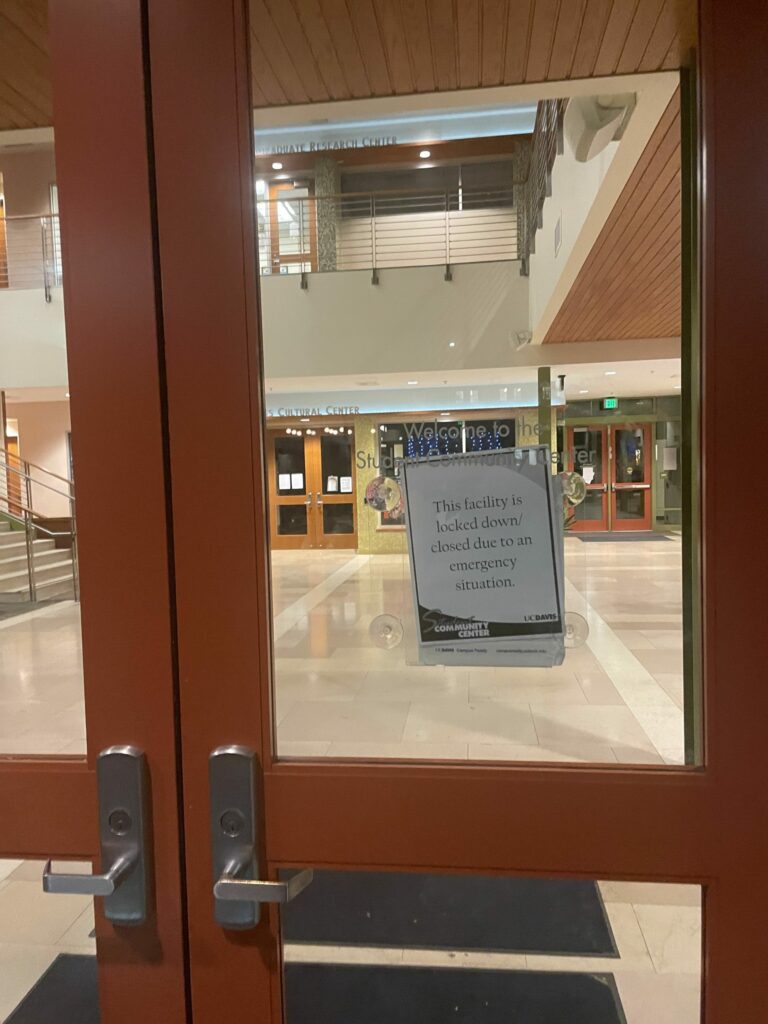
The Student Community Center (SCC) closed early because of the event, as well as other spaces on campus. Around 8 p.m., according to third-year clinical nutrition major and employee at the SCC Diana Li, a sign was posted on the front entrance that read: “This facility is locked down/closed due to an emergency situation.”

The university’s official statement denounces the violence on campus and states that it was “unfortunate that the event could not proceed as planned.”

As a public institution, UC Davis values and supports freedom of expression as rights guaranteed to every citizen,” the statement reads. 

The statement reiterates the university’s obligation to uphold the first amendment by allowing TPUSA to invite speakers on campus, as well as by protecting the rights of those who wish to protest against such events. The UC Davis Principles of Community were linked in the response, as well as resources available to students who were affected by the event.

Before the protest began, ASUCD President Radhika Gawde posted a statement on the @ucdpresident Instagram account calling on students to consider not attending the event and instead join in protesting the speaker. 

Gawde, along with ASUCD Vice President JT Eden and members of ASUCD student government, also released an official statement on Oct. 26 that expressed their solidarity with those who protested the speaker and called out the group of counter-protesters.

“We are horrified by the actions of the counter-protestors and condemn their hateful decision to resort to violence,” the statement reads. “Domestic terrorist groups, including the Proud Boys, have no place on our campus. Pepper spraying and engaging in assault and battery against students and security guards are not acceptable methods to voice your discontent with a protesting group.” 

The response went on to encourage students to “exercise their right to protest” and reminded students of the importance of protesting safely.

“We want to be unequivocally clear that the destruction of campus property and the surrounding environment is an inappropriate means of protesting,” the statement reads. “We ask that students protest in a manner that is safe and that avoids destruction without symbolic purpose. As always, please look after each other and ensure that we are keeping one another safe.”

Gawde was in attendance at the protest when she saw the conflict begin to escalate and said that she then “contacted the appropriate members of campus administration.”

“[I contacted them] just to make sure that things would be safe,” Gawde said. “Obviously, that didn’t work out.” 

Gawde and Eden have had meetings with administrators, including UC Davis Chancellor Gary May and have planned to further discuss the university’s response to the event. According to Gawde, one of their main concerns is a lack of direct condemnation by the university of the counter-protesters.

“Campus tends to be very worried about legal ramifications,” Gawde said. “We recognize First Amendment jurisprudence […], so we’re not expecting […] condemnation. However, we’re just asking them to say, maybe pepper spraying people is not a good thing.” 

Eden expressed similar thoughts and expressed a desire for the university to distinguish more clearly between the actions of the original protesters and the counter-protesters.

“There was some idea, I think, that both sides were brawling or something like that,” Eden said. “That’s just not an accurate reflection. I think it was definitely peaceful and then [there was] violence [from] that group of actors who were not there with good intentions.” 


Written by: Sydney Amestoy — campus@theaggie.org


UC Davis researchers contribute to study reconstructing the genomic sequence of mammals’ common ancestor 

The study sheds light on characteristics of the common ancestor

By YASH RATHI — science@theaggie.org 

All living mammals — from giant blue whales in the Pacific Ocean to small squirrels scurrying on campus — all have a common ancestor that existed 180 million years ago. There isn’t much information available about that common ancestor, but recently, its genomic set has been reconstructed with the help of computer software operated by an international team of researchers, including some from UC Davis. The complete research on the genomic data was published in Proceedings of the National Academy of Science on Sept. 30. 

The team first drew high-quality genome sequences of 32 living species, including humans, chimpanzees, rabbits, manatees, wombats, rhinos, bats, domestic cattle and pangolins. To map these sequences, they used the help of the Earth BioGenome Project, an international collaborative group that is dedicated to creating complete DNA sequences of individual organisms, along with other large-scale sequencing groups.

Dr. Harris A. Lewin, a professor of evolution and ecology at UC Davis, was one of the lead authors of the paper. He explained that the sample of the 32 mammals analyzed all fall under the same phylum or scientifically-classified “group.” They examined genomes of animals in the same group because it allows for similarities in their genomic sets to be more easily identified and the team can begin creating the potential DNA sequence of the common ancestor.

Their study found 1,215 sequences of genes that consistently occurred on the same chromosomes in the same order in the sampled species’ genomes. Lewin said that this finding aligned with the fact that these mammals have a shared appearance during the embryo stage of development. 

Joana Damas, a postdoctoral researcher at the UC Davis Genome Center and a co-author of this paper, explained why these findings are important to better understand the common ancestor of mammals. 

“Unlocking the genomic sequence showed that the mammal ancestor had 19 autosomal chromosomes [which are the vast majority of chromosomes found in the cells of organisms] and two sex-linked chromosomes used … in the process of reproduction,” Damas said.

These genomic sets, which were common for all 32 mammals, had multiple repetitive sequences which could easily break, recombine and mutate. According to the paper, the adaptive mobility of these sequences was the main cause of the genomic evolution seen in modern mammals.

They were also able to infer certain characteristics from the chromosome sets they mapped. They found that the rate of chromosome rearrangement was different for the mammal groups, which indicated that these groups evolved from the common ancestor at different rates and times. 

For example, the ruminant group, which includes cattle, sheep and deer, had a rearrangement of their genomic sequence 66 million years ago, which is considered to be fast on an evolutionary timescale. This could be traced back to the time when a cataclysmic asteroid hit Earth near present-day Mexico that covered the atmosphere in large amounts of soot and dust. This event caused blockage to sunlight exposure and hindered oxygen inhalation, which massively disrupted ecosystems and wiped out dinosaur populations. This disaster led to the rise of the ruminant group along with other mammal species. 

According to Lewin and Damas, the genomic data now available from the study can be used to help researchers better understand how mammals adapted to live on the continuously-changing planet over the last 180 million years.  

“Our results have important implications for understanding the evolution of mammals and for conservation efforts,” Lewin said. 

Written by: Yash Rathi — science@theaggie.org

UC Davis students weigh in on the connection between fashion and cultural heritage

0

Students from diverse backgrounds explain cultural appreciation and share what their cultural dress means to them

By UMAIMA EJAZ — features@theaggie.org 

Everyone has their own fashion style. Some people lean toward certain trends more than others, and some don’t even consider consulting trends in the first place. Whatever the case may be for a given individual, one’s fashion choices are a manifestation of who they are, and they say a lot about how one wants people to perceive them. 

Julia Dang, a third-year UC Davis student double majoring in English and design with an emphasis in fashion and the president of the Fashion and Design Society at UC Davis, said that she believes fashion is an extension of one’s true self.

“Fashion for me is really an expression,” Dang said. “A lot of people think that it’s a way to express yourself. It’s an art form. And I think it can also be a combination of all that.”

Julia Dang is the president of UC Davis’s Fashion and Design Society. (Julia Dang / Courtesy)

Many people’s fashion choices may have been inherited from those who raised them: parents, grandparents and other adults who were present in their childhoods. Fionna (who asked that her last name be omitted), a second-year UC Davis student double majoring in economics and viticulture and enology, said that her first memory of being enamored with fashion was at eight years old when she found a stack of Vogue magazines in her mother’s study — magazines that remain part of Fionna’s own collection to this day. Fionna said that her mother was always her main fashion inspiration.

“Even though my mom is not in fashion and wasn’t a design major, she’s always been really, really awesome in the fashion field,” Fionna said. “She has a really, really good view of how to style people. I can’t top it, but I at least want to be as good as her.”

Dang said that her cultural heritage defines her fashion in many ways today. People let their cultures speak through their fashion choices, and it is widely recognized as a beautiful thing for people of different backgrounds, beliefs and cultures to express those differences through their personal appearances. But when people wear clothing from a culture that isn’t theirs, it has the potential to be disrespectful. 

“I feel there’s a very thin line between cultural appreciation versus cultural appropriation,” Dang said. “If you’re appreciating one’s culture, you’re supporting them, raising awareness and you’re not modifying and changing it for yourself. Whereas cultural appropriation is really disregarding all of the traditions behind and the history behind it.”

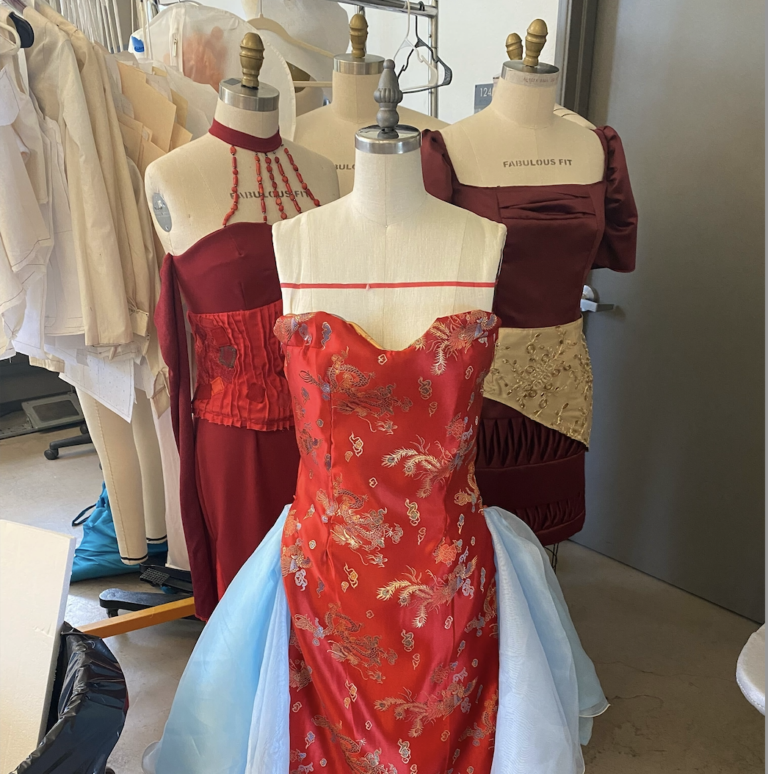
As a project for a fashion class, Dang recently designed a garment that was inspired by “áo dài” — a form-fitting Vietnamese tunic with long slits up both sides, typically worn over long flowing pants. She said that the dress represents culture, modesty and tradition. But just a few years ago, country singer and Grammy-winner Kacey Musgraves wore an áo dài dress without pants, attracting much criticism. 

“[The clothing] was very sexualized by her,” Dang said. “However, if a person who is not Vietnamese decides to wear it, and they wear pants — like, fully traditional wear — I think that is completely cultural appreciation. And it’s appropriate for [certain] occasions.”

Taking the time to understand why others wear the things they wear, and why they wear them in a certain way, can be the difference between blindly following a trend and expressing your appreciation and respect for a long-standing tradition.

Fionna lovingly recalled a memory from the time she spent visiting Dubai when she tried wearing a hijab for the first time. 

“It felt beautiful, not only because of how it looked, but also because I knew what it signifies for Muslim women,” Fionna said. “I asked the translator who was present at that moment so many questions, and did research on my own too because it was about appreciating it.”

Muslim women across the globe style their headscarves in many different ways — but that’s not the only way religion plays a role in Muslim women’s fashion choices. For Sheamain Khan, a second-year international relations major, Islam still influences her style to a significant degree even though she doesn’t wear the hijab. Khan mixes her modest style with more typical western looks, but doesn’t compromise her religious values.

“As a Muslim, I have always tried to dress modestly,” Sheamain said. “Whether I’m following western or South-Asian trends, I don’t show any of my skin at all. I have to be modest because of my religious beliefs. Even as I mix styles, I always stay within the boundaries of my religion.”

Saif Khan, a second-year computer science major, is super enthusiastic about street fashion, but, like Sheamain, he said that his Islamic faith is apparent in his clothing choices. His style is influenced by both Pakistani and American culture.

“I feel like I just use the western, like, inspiration,” Saif Khan said. “But I keep it under the limit, and I also don’t break my cultural boundaries or my religious boundaries. I feel like I just mix and match there, and somehow, it works out. […] For me personally, culture plays a huge part in my passions, so I feel like it’s the best collaboration.”

Fashion can reflect one’s identity, culture and life experience in a myriad of subtle ways. Students whose styles are influenced by their cultures urge others to think more consciously about this area of self-expression and to listen to diverse perspectives in order to appreciate, not appropriate, cultural dress. 

Written by: Umaima Ejaz — features@theaggie.org

Davis’s 2022 City Council election sees controversies, administrative errors

Important voting information, candidates’ responses to allegations made against them, descriptions of their platforms

By CHRIS PONCE — city@theaggie.org


Davis’s 2022 general municipal election day is Nov. 8. This year’s election will determine the city council representatives for Districts 1 and 4, as Council Members Gloria Partida (District 4) and Dan Carson (District 1) are up for re-election. 

This year’s election season has included some unusual obstacles so far. Recently, a section of Orchard Road was renamed Blue Ridge Road. Because of this, 110 registered voters — 101 of whom live at the Russell Park Apartments on Orchard Park Drive — were mailed incorrect vote-by-mail ballots, according to a statement by Yolo County. The press release explained that the issue had been resolved by resending the correct ballots with a letter detailing the error. 

The District 4 city council race has also featured controversy.  Incumbent and former Mayor Gloria Partida has been accused of not disclosing a criminal record, including a felony conviction, by residents. Partida said that she was expunged for these charges and that the incident was classified a misdemeanor in a guest commentary she wrote for the Davis Vanguard. 

“I did have a prior conviction from 22 years ago,” Partida wrote in The Vanguard. “That conviction was dismissed and set aside by the Yolo County Superior Court in 2005, based on my ‘continued law-abiding lifestyle, education and involvement in family and community.’  Simple fact: I do not currently have a conviction.”

She is running for re-election against Adam Morrill.

The city council candidates in District 1 are Bapu Vaitla, Kelsey Fortune and incumbent Council Member Dan Carson. Council Member Carson responded to the false accusations made against Council Member Partida, saying that there have been misleading attacks on both of them. He declined to elaborate on the attacks directed at him. 

“Actually, I’d prefer not to talk about them,” Carson said. “Because I’m not going to rehash what folks are throwing at me on social media.”

While it is unclear what accusations Carson was referring to, the Davis Vanguard has accused Carson of violating city policies. The Vanguard claims that emails reveal Carson used his official city email for campaign purposes relating to Measure H

Vaitla, who is a member of the Davis Social Services Commission, also responded to the claims made against Partida, saying that the efforts to defame her are associated with racist rhetoric. 

“It concerns me because there are also, I think, racial elements to this where we are sort of accusing a woman of color of this crime,” Vaitla said. “It just brings up associations that I think are, whether they’re intentional or not, […] unwarranted and [an] outside-of-the-lines attack on Gloria, so I’m really disappointed. I also think Gloria’s responded to this with grace [and] honesty.”

Vaitla said that two of the core issues of his campaign are climate change and the housing crisis, which he believes distinguishes him from the other candidates and are reasons he chose to run for the position.

“I don’t see vision on the part of [Carson], as far as the housing issue or the climate issue,” Vaitla said. “He’s sort of pitched in here and there with his ideas along the process on both of those issues, but in terms of coming up [and] leading the process and creating a five-, 10- [or] 20-year strategic vision for how we meet our housing needs and how we get to carbon negativity, that hasn’t happened. So I wasn’t happy with my choices in West Davis.”

Council Member Carson, who is endorsed by the Davis College Democrats, said that he decided to run for re-election to continue working on economic issues.

“I’m the only candidate [Davis College Democrats] endorsed in this race, and we have a history [of] working together on issues,” Carson said. “Particularly those regarding jobs and housing for our community. It’s one of the big emphases in my campaign […] The major reason I’m running is to help us resolve our fiscal challenges that our city has.”

Carson and the Davis College Democrats have been canvassing for his campaign, with an emphasis on getting students out to vote. 

“I think [the student vote] has the potential to be a game changer,” Carson said.

Students can register to vote on the Yolo Elections Office website or by directly visiting registertovote.ca.gov. More information about the districts or candidates on the ballot can be found on the city website. Voting Centers and Ballot Drop Boxes can be found at the Yolo Elections Office website.


Written by: Chris Ponce — city@theaggie.org


UC Davis Police Department using artificial intelligence to monitor students’ social media  

The software program ‘Detect’ scans social media posts for threats of violence and has potential to monitor student protests.

By LA RISSA VASQUEZ — campus@theaggie.org


         On Oct. 19, the UC Davis Police Department (UCDPD) released a statement confirming that it is using the software program ‘Detect’ to conduct “threat monitoring” of students’ social media accounts. In the official statement, the UCDPD stated its intentions with the software. 

“The UC Davis Police Department (UCDPD) uses a product called Detect (formerly Social Sentinel) to monitor publicly-available content on social media and websites for timely insights into such threats to our community,” the statement reads.

Joanne Zekany, a UCDPD lieutenant, said the program allows a select few members of UCDPD to discern genuine threats to individual and community safety.

“The software carries out searches based on keywords we supply,” Zekany said. “The goal of these searches is to find signs that someone is at risk of harming themselves or others. Using this software allows us to scan the many thousands of social media posts from our community for a few that are of genuine concern.”

On Oct. 27, 2020, Social Sentinel, a language-learning AI-based software designed to recognize signs of impending violence in organization-owned emails and public social media posts, was bought by Navigate360 and rebranded as Detect. According to the Navigate360 website, they are an umbrella company that acquires software and technology to monitor online activity in schools, workplaces and other public institutions. 

According to Zekany, UCDPD has been using the scanning software since 2015.

“Students should understand that this system can only look at public postings that are visible to any internet user,” Zekany said. “It cannot look at closed or private groups or pages, direct messages or private chats or email.”

The UCDPD Policy Manual does not provide any information on training or procedures that are used to ensure department transparency of the 24-hour automated coverage Detect provides.

The Oct. 19 release stated, “If an alert is sufficiently concerning, UCDPD would work with the social media platform or website involved to take any further action.”

In an investigation published last month by the Dallas Morning News, it was found that Detect marketed its services as a way of “mitigating” or “forestalling” student protests. Across the country, 37 schools, including UCLA, the University of North Carolina at Chapel Hill and the University of Texas at Dallas, have also purchased contracts with the company to use its surveillance services.

Howard Ku, a first-year graduate student studying computer science, commented on the university’s use of Detect.

“I think [it’s] a little [stressful] if there was someone monitoring my information,” Ku said. ”There should be some limitation to their power and privilege to our data.”

Written by: La Rissa Vasquez campus@theaggie.org