52.4 F
Davis

Davis, California

Tuesday, December 23, 2025
Home Blog Page 196

Decimation of amphibian populations in Latin America linked to surge in human malaria cases

A UC Davis retrospective study highlights the importance of preventing ecosystem disruptions to safeguard animal and human health


By BRANDON NGUYEN — science@theaggie.org 


From the 1980s to early 2000s, populations of amphibians, including frogs and salamanders, vanished from Costa Rica and Panama. The public did not notice their mysterious disappearance except for small groups of ecologists who later discovered the underlying cause for the amphibian decline to be a deadly fungal pathogen called Batrachochytrium dendrobatidis or “Bd.”

In a retrospective study published in the journal Environmental Research Letters, a group of UC Davis researchers found an alarming link between the amphibian decline and negative consequences for human health. During the spread of the fungus, there was also a spike in human malaria cases, highlighting the need for preserving ecosystem stability.

“For amphibians, the spread of Batrachochytrium dendrobatidis (Bd)—an extremely virulent fungal pathogen responsible for massive worldwide die-offs from the resulting chytridiomycosis—has arguably caused ‘the greatest recorded loss of biodiversity attributable to a disease,’” the paper reads. 

Dr. Michael Springborn, the lead author of the study and a professor in the Department of Environmental Science and Policy at UC Davis, described why the effects of the fungal pathogen on amphibians were so deadly.

“Bd wreaked havoc through disruption of amphibian skin function, such as affecting the amphibian’s ability to regulate water on the outside and inside of their skin,” Springborn said. “It laid waste to these amphibian populations in vast numbers across a large area, including Costa Rica and Panama.”

Joakim Weill, a co-author of the study and UC Davis Ph.D. candidate at the time, explained how the team discovered the link between the amphibian decimation and human health.

“We’ve known for a while that complex interactions exist between ecosystems and human health, but measuring these interactions is still incredibly hard,” Weill said. “We got there by merging tools and data that don’t usually go together as well as through collaboration with other experts including herpetologists, who specialize in the study of reptiles and amphibians.”

Furthermore, Springborn and his team highlighted how tragedies like the amphibian die-off often go unheard of but should receive more attention. 

“The loss of these amphibians is a tragedy in its own right, and unfortunately, it’s a tragedy that only gets so much attention when there’s no connection made explicitly to human welfare or to impact on human communities,” Springborn said. “So we were motivated in this paper by an interest in trying to identify whether there were discernible impacts on human communities, and if so, how do we build an understanding of this loss? Not just the direct loss of these species, but also the indirect loss we might feel by how this disturbs the ecosystem.”

Springborn and his team found that mosquitoes had the potential to carry vector-borne diseases. According to Springborn, because there were fewer amphibians that could feed on mosquito eggs, there was an unchecked rise in the population of mosquitoes, causing the spike in human malaria cases. 

According to the study, up to one in 1,000 people contracted malaria annually during this time who would not have if the amphibian decline did not occur. 

To attempt to remediate this, Springborn advocated for a preventative approach, underscoring the need to maintain ecosystem stability for the sake of both animal and human health.

“It’s important to understand that our human systems have evolved to take advantage of the particular ecosystems and environmental systems that we live in,” Springborn said. “We probably take for granted how that environmental stability is sort of built into almost everything in things that we have — the way that we live in our homes and the way that we travel from one place to another. As we gain an understanding of these perturbations like climate change and the movement of pathogens around the world that disrupt the underlying stability, it’s worth investing and taking costly measures […] to protect against these threats ahead of time.” 


Written by: Brandon Nguyen — science@theaggie.org

 

Culture Corner

The Art Desk’s weekly picks for movies, TV, music and more 


By KATIE DEBENEDETTI — arts@theaggie.org


Music: “Begging For Rain” by Maggie Rogers (2022)

It’s spooky season! Anyone who knows me knows fall is my favorite time of the year, and as soon as October 1 hits — no matter if it’s 90 degrees in Davis — it’s time to get in the spirit. Maggie Rogers’ music has gotten me through quite a few rainy falls, and though her new album, “Surrender,” has some more rock-y, upbeat tracks than her previous releases, she’s still sprinkled in some slower, acoustic songs like “Begging For Rain” (honorable mentions: “Horses” and “Anywhere with You”) that pair perfectly with staring out a window on a dreary day. 


Book: “The Silent Patient” by Alex Michaelides (2019)

In honor of Halloween month, I thought it was only right to recommend a thriller, and “The Silent Patient” is probably the best I’ve read. The story is set in a mental hospital, where narrator Theo Faber, a psychotherapist, has recently begun working in hopes of getting to hear the story of Alicia Berenson, a high-profile patient accused of murdering her husband. The only problem: Berenson is mute. Throughout the novel, Michaelides skillfully weaves Faber’s narration with Berenson’s journal entries and gives away just enough to keep readers on their toes at every turn. Plus, the final twist is guaranteed to shock you. As a thriller superfan (I’ve read at least 10 this year), I’ll say even I didn’t see it coming. 


TV Show: “Scream Queens” (2015)

Okay, this might be a somewhat controversial choice, but as a “Glee” fan (exposing myself here), I have an affinity for pretty much all of Ryan Murphy’s shows. Rewatching “Scream Queens” has become a tradition in my household, with all of my roommates pilling onto the couch to crack up at the poignant satire and not so poignant fake blood. With a star-studded cast featuring Lea Michele, Jamie Lee Curtis, Keke Palmer, Emma Roberts and so many more, the show feels nostalgic on the first watch — and the fifth. 


Movie:Hocus Pocus 2” dir. by Anne Fletcher (2022)

Truthfully, the entire Halloween theme of this week’s culture corner was to justify including easily the biggest movie release of the past month (no, it’s not “Don’t Worry Darling,” but you can read about that here). “Hocus Pocus 2” premiered on Disney Plus on Sept. 30th, and it did not disappoint. Almost 30 years after Max, Dani and Allison put an end to the Sanderson sisters’ immortality ploy, the trio of witches escapes once again and a new trio of highschoolers are tasked with stopping their evil magic. The film is fun, nostalgic and even features some musical numbers, making it a perfect October watch.


Written by: Katie DeBenedetti — arts@theaggie.org


Reducing the burden of the cost of college for U.S. college students and graduates

Students discuss Biden’s debt relief plan and other potential solutions to the debt crisis

By LEVI GOLDSTEIN — features@theaggie.org

On Aug. 24, President Joe Biden announced a plan for student debt relief. As part of their 2020 campaign promises, the Biden-Harris administration paused federal student debt payments during the COVID-19 pandemic. Now, to combat the rising costs of higher education amid decreasing government support, the federal government will forgive up to $20,000 for Pell Grant recipients and $10,000 for other federal loans for low- and middle-income borrowers. The plan also extends the loan payment pause to the end of 2022 and outlines new rules that reduce the burden of paying back student loans over time based on individual income. 

“[When] Joe Biden enacted the forgiveness for Pell Grant recipients — I almost cried when that happened,” Crystal Jimenez, a 2021 UC Davis graduate, said. “I didn’t believe it until he gave the speech.”

In his announcement speech, Biden said that higher education is a “ticket to a better life,” referring to its use as a tool for social mobility. He went on to express concern that it has become largely inaccessible as many Americans are saddled with huge amounts of debt, which is why loan forgiveness was a priority of the administration. For Jimenez, who is currently attending graduate school at Cal State Long Beach to earn a teaching credential, loans enabled her to attend school. 

“I’m an only child from a low-income community,” Jimenez said. “[UC] Davis was offering me the most financial aid. I saw an opportunity and I jumped on it. […] I don’t regret getting [loans]. They helped me pay for rent because Davis is not cheap. […] That’s how I bought my food […] That was my survival money.”

The various bills extending relief to those with loans during the COVID-19 pandemic, including the temporary pause on debt payments, have been helpful for Jimenez. 

“[Loans] didn’t really affect me [after college] because I graduated in June of 2021, and that was still during the pause, so I’ve never had to pay my loans back,” Jimenez said. “They’re always in my mind, that I have loans, but it’s not affecting my wallet yet.”

The student loan forgiveness bill will reduce the burden of loans for many students with federal aid. However, some are concerned that it isn’t the best solution for the college debt crisis. Jim Fein, a political science major at UC Davis and the executive director of Davis College Republicans, worries that debt cannot just be waived away. 

“The debt is transferred,” Fein said. “The fact that someone owed money isn’t gone. The debt doesn’t just disappear, it just goes into a different category where the government is going to pay it off instead of students themselves. By the government paying, that’s anyone who pays taxes. They’re kind of thrown under the bus in this situation.”

Fein has no student debt; however, many of Fein’s friends who have taken out federal loans have the same mindset, arguing that despite the short-term financial benefits to them, the government shouldn’t be responsible for paying off their student loans. 

Nevertheless, Fein acknowledged that college is a great financial burden for many students, and advocated instead for “lowering the cost of college.”

“At this point, [at] a lot of colleges, there’s more administrators than there are students,” Fein said. “Cutting some of those administrators would lower the cost of college, and therefore, tuition would be allowed to go down. Another way is student debt itself, actually. Student loans increase demand for college if you’re thinking of college as the product. When you have more student loans out there, more people want to go to college. It’s going to raise the cost of attendance because there are more people competing for the same number of spots.” 

Some might see Biden’s debt relief plan as an imperfect solution to a larger issue, but this doesn’t negate the fact that debt relief is positively impacting many college students and graduates. 

“[College] completely changed my life,” Jimenez said. “I’m extremely grateful and thankful for President Joe Biden to have erased federal loans for low-income [families] and pell grant recipients. […] A vast majority of my friends are now debt free.”

Written by: Levi Goldstein — features@theaggie.org

Biden’s loan forgiveness plan is a temporary fix to a bigger problem

Deeper issues in the American education system need to be addressed to make college education more affordable


By THE EDITORIAL BOARD


On paper, President Joe Biden’s Student Debt Relief Plan seems to guarantee loan forgiveness for millions of borrowers across the United States. Upon closer inspection, however, it appears that not only is loan forgiveness not guaranteed, but it also does not contribute to any meaningful long-term change.

Further, the current loan forgiveness plan could be delayed, or even in danger. At least three challenges from conservative groups and lawmakers attempting to block the bill have been filed so far, and while there doesn’t seem to be much merit to the current lawsuits, the legal action could, at the very least, delay forgiveness.

If you are eligible for debt relief through Biden’s plan, be prepared to request the form as soon as it’s available. It’s possible that even if the courts rule against the Biden administration, you could keep your loan forgiveness if your debt gets canceled before the ruling takes effect. Sign up on the Education Department’s website to stay up to date with related news.

These challenges aside, even if the bill does go through, it’s merely a bandaid — a one-time solution to a recurring problem. Forgiving loans does not make college affordable in the future, and higher education will continue to be expensive.

New students will start their college career, and many of them will be forced to take out loans to make ends meet. Even if their debt is forgiven, and that’s a big if, where does it end? To stop this cycle, a long-term structural change to the higher education system is needed. Continued, unsustainable loan forgiveness isn’t going to cut it (if this were to happen at all), especially because the money has to come from somewhere. Sources show that, in some states, the forgiven debt can be seen as income, and would therefore be taxed.

Additionally, it’s important to ask, “Why now?” when it comes to Biden’s plan for debt relief. With midterm elections coming up in early November, it’s possible that loan forgiveness is being strategically deployed now to win the votes of millions of Americans. When the elections are over, it isn’t guaranteed that college students will continue to be supported, even if the midterms have favorable results for the Democrats. Besides, Biden won’t hold office forever, and succeeding administrations could easily refuse to cancel debt. It’s important to advocate for change that is both easier to protect and more difficult to dismantle.

Everyone deserves the chance at a college education without being suffocated by crushing debt, and it’s understandable that college students with less financial resources may feel as if they have no power to change their own circumstances, let alone the entire education system. But that is precisely why it’s so important to make our voices heard.

We urge you to vote for candidates who will fight for access to affordable education, especially in your local and state elections. But casting your vote isn’t the only thing you can do. Attend protests, write or call your senators and spread the word.

Affordable education is possible — we see the proof in other countries around the world. And while we understand that every education system is different, the UCs themselves were free for California residents until 1970. Even though free college seems like a pipe dream, these are the kinds of things we must keep in mind as we advocate for affordable education. And it begs the question: are the UCs doing California residents the service they were created to provide as state schools?

We are not pretending to have the answers to the crisis that is the higher education system in the U.S., but we do know that something needs to change. Debt relief shouldn’t be the end — it should only be the beginning.


Written by: The Editorial Board


UC Davis researchers uncover new parts of the eukaryotic respiratory process in Tetrahymena 

Tetrahymena thermophila is a unicellular organism that relies on a cellular respiration that is slightly different from other eukaryotes like plants and animals


By YASH RATHI — science@theaggie.org 


Dr. James A. Lett is a UC Davis principal investigator in the Department of Molecular and Cellular Biology whose lab focuses on the electron transport membrane protein and structural bioenergetics. Recently, Lett’s team published research on a specific unicellular organism called Tetrahymena thermophila (Tt) to better understand the “diversity of eukaryotic core metabolism.” 

Tt uses oxygen in the process of respiration, but the respiratory chain’s role is different than it is in plants, yeast and animals. Tt is commonly found swimming around ponds and uses cilia (hair-like structures) for its locomotion. It falls under a diverse group of organisms called the SARS supergroup, which has not been studied much aside from a few exceptions like malarial parasites. 

Dr. Maria Maldonado, a UC Davis postdoctoral researcher at Lett’s Lab and a co-author for the study, explained how this research opened her eyes to all we do not know about respiration. 

“There is a whole lot of diversity,” Maldonado said. “In Tt, we were completely shocked and surprised about the protein structures used for respiration. They are much larger [and] they exist in the form of a dimer, which is when two small units of protein combine to form one big unit. This [Tt study] is really opening our eyes about the crux of respiration. And again, this is just one organism in the tree of life; what about the whole rest of organisms?” 

According to the published paper, Tt undergoes a series of chemical processes to complete its respiration with oxygen molecules used in the end of the reaction. For the most part, this is the same fundamental process of electron transport chain seen in humans and other eukaryotic organisms. 

Tt has a different mechanism in the process of respiration however. In the 1970s and 1980s, researchers concluded that there were two different proteins that functioned differently in Tt. The first one is an electron-carrying protein, cytochrome C, and the second one is an oxygen-consuming enzyme at the end of the chain, terminal oxidase. Lett’s lab did research to understand why these enzymes differ in Tt, even though these two proteins were present across other studied eukaryotes. 

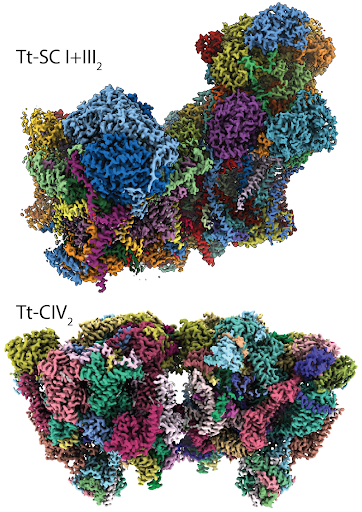
A new approach in structural biology, called cryo-electron microscopy structural proteomics, was used by the researchers to study the Tt electron transport chain. In this approach, a large number of protein structures are worked out in a mixed sample at the same time. Cryo-electron microscopy creates a high resolution image of the proteins by freezing the given slide at an extremely low temperature. Working with mixed samples of isolated proteins from mitochondrial membranes, the team of researchers developed an algorithm to recognize different related structures in the solution of proteins. 

Lett said that recent technology has sped up the process of analyzing proteins, and made it much more precise.

“New technology with respect to how we determine the protein structures has allowed us to work with much smaller samples and in new ways,” Lett said. “It has allowed us to essentially kind of explore the pathway very rapidly.”  

Maldonado explained the approach the lab took to analyzing protein structures before using the algorithm.

“Key to this approach in general […] is to express one protein and then get its structure, but what we are doing is flipping it around,” Maldonado said. “We are starting with a natural sample and seeing what is there. We then purify it, put that slightly-purified sample into cryo-electron microscopy, and then try to see everything present there. This makes it much more productive using structural biology as an exploratory tool.” 

Using the algorithm, they were successful in scanning hundreds of thousands of protein images and identified 277 protein structures in three large assemblies. They identified certain protein structures with specific genes that were not discovered before. These new protein structures are filling in the gaps of our previous knowledge about respiration and helping us to better understand this process. 


Written by: Yash Rathi — science@theaggie.org


New broadcasting duos take over Thursday, Sunday, Monday night football

0

Examining the new commentators on NFL prime-time programming for the 2022 season


By PATRICK FIGUEROA — sports@theaggie.org


A normal sports commentary booth usually has two experts: the play-by-play commentator and the color commentator. The play-by-play commentator provides live commentary of what is happening during each play while the color commentator goes more into more detail to help fans better understand the game and its players. Throughout the fifteen-week football season, these commentators become familiar voices in many American households.

One of the underrated storylines of the 2022 NFL offseason was that multiple well-known NFL commentators switched to different broadcast networks, while other popular sports commentators rose to new positions as prime-time NFL broadcasters. With so many new broadcast duos after this shuffling, NFL fans are examining new broadcast teams’ chemistry as they watch their favorite teams.

Thursday Night Football is almost exclusively on Amazon Prime Video now, but NFL fans are still able to watch Thursday Night Football games on cable television if they live in one of the two teams’ local markets. However, this still leaves most NFL fans needing an Amazon Prime subscription if they want to watch Thursday Night Football — not only for this season but for at least the next 10 seasons as well.

Thursday Night Football’s broadcasters this season are the iconic, longtime Sunday Night Football play-by-play voice Al Michaels and legendary college football analyst and color commentator Kirk Herbstreit. Both are being compensated more than $10 million a year for these new jobs. In addition, Herbstreit will still work for the ESPN show “College Football Gameday,” a college football preview show, and be a part of ABC’s Saturday Night Football. Michaels will no longer be on Sunday Night Football, but he will return to NBC as a commentator for the NFL playoffs.

While NFL fans are adjusting to viewing the prime-time broadcast almost exclusively on Amazon Prime, the platform offers a variety of new features. Along with the familiar voices of Michaels and Herbstreit, Amazon allows viewers to choose between their regular broadcast view or their “Prime Vision” broadcast. The “Prime Vision” broadcast offers a skycam view of the field so that fans can see every player on the field at once. It also provides live “Next Gen Stats,” such as a player’s sprint speeds, a team’s win probability and a graphic that recommends when teams should go for it on fourth down. These features appeal to both NFL experts who understand the Xs and Os of the sport and more casual fans wanting to learn more about the sport.

While Michaels focuses on Thursday nights, former ESPN broadcaster Mike Tirico will be taking over his role as the play-by-play commentator on Sunday Night Football. Tirico has been signed to NBC since 2016 but will now be a primary commentator alongside color commentator Cris Collinsworth. The former NFL wide receiver is a talented analyst — and is well-known for his notorious slide into the camera view on Sunday Night Football. 

With Tirico in the booth, Sunday Night Football’s commentary has a similar rhythm to last year’s with Michaels. Tirico adds excitement to each broadcast that balances well with Collinsworth’s insight. 

The final NFL primetime slot is Monday Night Football, which now features Fox’s longtime commentating duo Joe Buck and Troy Aikman. Both signed multi-year contracts with ESPN to be the new voices of Monday Night Football. ESPN had been experimenting with different commentary teams for the past few years since losing Mike Tirico and Jon Gruden. Signing Buck and Aikman will provide ESPN with stability for their Monday Night Football commentary in the years to come. 

While getting Buck and Aikman was important to ESPN, one of the most appealing viewing experiences for NFL fans is ESPN’s alternate Monday Night Football broadcast on ESPN2, the Manningcast. The Manningcast features brothers and former NFL quarterbacks Peyton and Eli Manning. The program debuted during the 2021 season during multiple Monday night matchups and was so successful that ESPN extended their contract through 2024

It also inspired ESPN to do an equivalent for Sunday Night Baseball, the KayRod Cast, which features Yankees’ play-by-play commentator Michael Kay and former Yankees’ third baseman Alex Rodriguez. 

It is evident that football is evolving both on and off the field with new voices and platforms changing the way the game is viewed. And it seems that NFL fans welcome these changes, as the NFL continues to achieve record viewership across all platforms. One can only wonder where the NFL will go next. 


Written by: Patrick Figueroa — sports@theaggie.org


Women’s volleyball is victorious in five sets against UC Irvine

The Aggies command a 15-3 win in final set, toppling the Anteaters

By GABRIEL CARABALLO — sports@theaggie.org

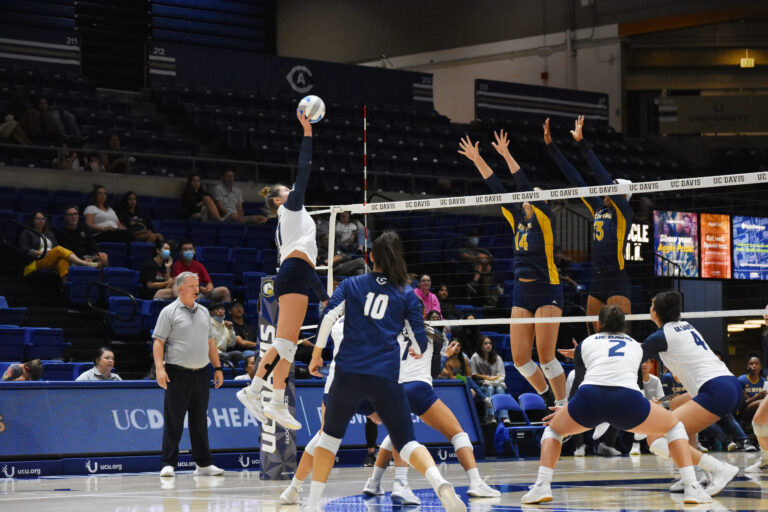
The opening set between UC Davis and UC Irvine set the tone for the entirety of the game that took place at UC Davis on Thursday, Sept. 29. The lead went back-and-forth between these two teams — the score was tied a total of seven times just in this first set alone. UC Davis accumulated 37 total attacks compared to UC Irvine’s 32, while Irvine would outdo the Aggies in kills with 18 compared to Davis’ 14, which would decide the first set in favor of the Anteaters. 

To start the second set, the Aggies scored three straight points, taking an early lead they would maintain for the rest of the set. The Anteaters battled back, tying the score three times, but the Aggies won the second set 25-23. UC Irvine piled up 17 kills to go along with 42 total attacks, compared to UC Davis’ 16 kills and 40 total attacks. 

The beginning of the third set looked a lot like the second set. The score was tied five times and had three lead changes as the teams fought for the lead. However, after UC Irvine scored its ninth point of the set, the Aggies scored five in a row without challenge, making the score 15-9. UC Irvine would only score seven more points in set 3, which the Aggies won 25-16.  In the first blowout set of the match, UC Davis racked up nine kills and 44 total attacks, while UC Irvine only had four kills, but 45 total attacks. What made this match a runaway was the Anteaters’ 14 total errors, which hindered their ability to score. 

Going into the fourth set of the game, the Aggies were in command and maintained a decent lead for about half the set, when the Anteaters tied the score 10-10 and went on a five-point scoring streak of their own. Once they had a 15-10 lead, the momentum swung to the Anteaters, and UC Irvine would go on to win the fourth set 25-14. UC Irvine accumulated 15 kills and 29 total attacks and UC Davis had 10 kills and 32 total attacks. 

The match was tied two sets to two, which meant the winner of the fifth and final set would take the win. The Aggies kicked up their horsepower and went on two separate five-point scoring streaks, leading them to victory. The Aggies won the set 15-3 and took the match three sets to two. 

According to UC Davis Head Coach Dan Conners, the team’s success in the match was in large part due to their defensive play.

“We played our defensive system better tonight than we have all year,” Conners said.

The Aggies had an incredible defensive output with 14 total blocks, half of which came from fourth-year middle blocker Josephine Ough, and an impressive 62 digs, 18 of which were shoveled out by third-year defensive specialist Shira Lahav. 

UC Davis’ offense was set up by second-year setter Cassie Newman who racked up a dominant 43 assists and was spearheaded by second-year opposite hitter Olivia Utterback, who had a game-leading 16 kills. 

“[Utterback] followed the game plan and executed really well … and took them [UC Irvine] out of what they wanted to do,” Conners said.

Since their victory against UC Irvine, the Aggies picked up another win against UC San Diego to give them an 8-6 overall record and 3-1 record in conference play. This weekend, they will be on the road to face California State University Bakersfield on Oct. 7 and Cal Poly on Oct. 8.

Written by: Gabriel Caraballo — sports@theaggie.org

Casen Goodman’s late goal helps the Aggies earn a draw against Cal Poly

UC Davis outplays Cal Poly but can’t close game


By MARLON ROLON — sports@theaggie.org


After scoring his first career goal on Sept. 20, helping UC Davis clinch their first win of the season, first-year striker Casen Goodman did it again, this time against Cal Poly on Wednesday afternoon at Aggie Soccer Field in Big West Conference play. 

Goodman’s header in the 77th minute helped the Aggies (1-5-3, 0-0-1) avoid a loss in their conference play opener, instead ending in a 1-1 draw. Prior to the game against Cal Poly, Goodman was named the Big West Freshman of the Week. In the team’s last three matches, he has scored two goals for the Aggies.

However, UC Davis’s offense as a whole has been a letdown so far this season. Creating goal-scoring opportunities isn’t the issue for the Aggies, but the Aggies have had trouble putting the ball in the back of the net all season long, scoring only seven goals in 10 games. 

This was evident in the game against Cal Poly. UC Davis dominated the entire game, shooting at the goal 16 times throughout the contest. 

In the first half, the Aggies came out playing with a sense of urgency, constantly attacking the Mustangs’ defense. In just the fourth minute of play, fourth-year midfielder Andy Velasquez crossed the ball into the box to set up senior defender Max Glasser for a shot, but the attempt was blocked by Cal Poly’s goalkeeper. 

Another goal-scoring opportunity came in the 19th minute for UC Davis. Third-year midfielder Ryan Dieter dribbled the ball toward two defenders while executing a brilliant pass to third-year striker Ethan Hoard, who was left open inside the box but could not finish on a one-on-one play against the goalkeeper.

UC Davis was awarded a corner kick immediately after Hoard’s shot. Dieter’s excellent corner kick was bounced around into a crowded box, ultimately hitting the goal post. 

At this point in the game, the Mustangs were held on one side of the field as they played defense for most of the half. 

Cal Poly’s offense rarely generated plays throughout the match, but when they did, they made them count. Third-year midfielder Tony Ruiz put the Mustangs ahead in the 23rd minute of the first half with a goal from a throw-in to the box.

UC Davis Head Coach Dwayne Shaffer and his team looked visibly frustrated due to the fact that the Aggies were dominating the pitch throughout the half, but could not seem to score a goal.

The first-half stats provided insight into the Aggies’ offensive dominance: UC Davis took eight shots while Cal Poly took only three. Additionally, Dieter played a fantastic half, creating goal-scoring opportunities for his teammates and controlling the midfield.

The start of the second half resembled the first half. Dieter came close to scoring in the fourth minute of action, shooting toward the bottom left of the net, but the Cal Poly goalkeeper once again made a fantastic save. 

With the Mustangs ahead 1-0, they attempted to slow the game down by playing the ball back to their defense, making the Aggies chase the ball. The tactic seemed to slow the home team down, and play was mostly in the middle of the field. 

As the game progressed, UC Davis came close to scoring in the 60th minute with a cross near the left goal post. Hoard headered the ball, narrowly missing the side of the net.

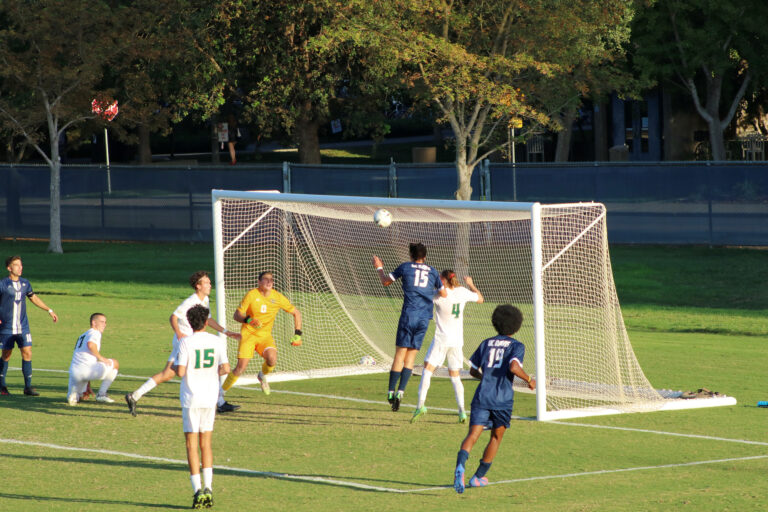
In the 78th minute, UC Davis finally caught a break. Second-year striker Keegan Walwyn-Bent sent a cross to the far left side of the box toward Hoard, who faked his shot and crossed the ball to Goodman, who sank the ball into the net, tying up the match.

The home crowd jumped out of their seats and erupted in relief while the entire Aggie bench ran onto the pitch to celebrate with Goodman.

The last five minutes of play were intense, as Walwyn-Bent once again crossed the ball and found Goodman inside the box. Instead of shooting, Goodman passed to Hoard, who was within five feet of the net — but a defender blocked his shot. It was a missed opportunity that left the crowd in disbelief. 

After this, the game seemed to be over, but with 29 seconds remaining, UC Davis had one last offensive opportunity. The ball was kicked into the box, allowing Velasquez to quickly touch the ball to Goodman. His shot was deflected by the goalkeeper’s foot and the ball bounced right into Hoard, who shot the ball to the side of the net but missed. 

The game was arguably the best offensive performance by the Aggies so far this season. While it seems they are coming together as a team, the Aggies are still learning how to close out games. 

The squad is in a new era this season, with 13 new players joining veteran leaders Velasquez, Glasser, Dieter and Hoard. Freshmen Goodman, striker Marcus Garcia and defensive midfielder Zack Lillington are improving with each game, and Goodman is the leading scorer with two tallies and an assist, while Garcia and Lillington have each scored one goal a piece. 

UC Davis traveled to Riverside on Saturday, October 1, where they lost to the Highlanders for only the third time since 2012. On October 5, the Aggies returned home to face UC Irvine and will be on the road again heading to CSUN this weekend.


Written by: Marlon Rolon — sports@theaggie.org


City of Davis seeking applicants for open advisory commission seats

Eight advisory commissions are hiring Davis residents 18 years and older


By CHRIS PONCE — city@theaggie.org


On Sep. 22, the city of Davis announced that it is seeking applicants for certain City Council Advisory Commissions. The requirements to apply include being a Davis resident and being 18 years of age or older. The commissions hiring are Human Relations; Police Accountability; Planning; Recreation and Park; Senior Citizen; Tree; Utilities and Bicycling, Transportation, and Street Safety.  

Applicants must submit an application form and participate in a short interview with the Council’s subcommittee and City Staff, according to the city website. The deadline for applications is Oct. 12.

The Davis Human Relations Commission functions to make recommendations to the City Council when issues of discrimination are involved, according to its website. NJ Mvondo, Chair of the Davis Human Relations Commission, discusses the function of city commissions in more depth. 

“As the ‘advisory’ label in their name suggests, a commission makes recommendations, from community members and community-based organizations, to the city council,” Mvondo said. “Commissions offer an opportunity for Davis residents to express concerns and offer solutions and (or) resources regarding city matters. They are a collaborative effort between residents and the City Council.” 

The Davis Tree Commission focuses on appeals regarding the movement, modification and removal of trees in Davis, according to the city’s website. Allen Lowry, a regular member of the Davis Tree Commission, elaborated on the importance of commissions.

Davis is a city where many people follow government activities and want to have a role,” Lowry said. “City council benefits from having a more ordered discussion about issues. Commissions can be seen as a way for the public to speak out as representatives for others. They also create a space for activists to speak in an ordered way.”

Lowry said that commissions play an important role in the local government processes and said that Davis residents interested in government should apply. 

“Committee membership is suitable for citizens who want to participate in government and who feel that they do not have a strong voice as individuals,” Lowry said. “It [gives] them a way to give ‘expert’ advice to city council in a format that is likely to be heard.”

Joining a commission requires a longer-term time commitment, as seats are held for three consecutive years. Another regular member of the Davis Tree Commission, Jim Cramer, elaborated on what prospective applicants should expect if chosen for a commission. 

I have little to say except that we need commissioners [and] being on a commission is a great experience and learning opportunity, but appointments are for three years so probably not suitable for undergraduates,” Cramer said. “Graduate students are most welcome and already there are several on various commissions.”

Though the time commitment is something to consider, Mvondo expressed the need for Davis students to be a part of Advisory Commissions. She talked about how relevant she believes it is for local students to have a voice in the local city process. 

“Their voice is needed, and often missing,” Mvondo said. “It is a form of community service and leadership experience students could add to their resume, and which could be helpful in future endeavors. It is also a great opportunity to network with community members with expertise relating to their commission’s focus and with the elected officials attending the commissions’ meetings.”

The city website describes the application process in more detail. After completing the form, applicants must deliver the form to the City Clerk, either via email at ClerkWeb@cityofdavis.org, or by mailing it to the City Clerk’s office at 23 Russell Blvd, Suite 1, Davis, CA 95616 or dropping it off at the City Hall drop box located in the City Hall parking lot. 


Written by: Chris Ponce — city@theaggie.org 


SR #33 was amended and passed during Sept. 29 meeting

SR #33 reaffirms the student body’s interest in eliminating the athletics portion of the CEI and SASI student fees in light of the Spring 2022 ASUCD election results

By KAYA DO-KHANH — campus@theaggie.org

On Thursday, Sept. 29, at 6:14 p.m., Vice President JT Eden called the Senate meeting to order and recited the UC Davis Land Acknowledgement. 

The seating of new interim senators Vaneza Gonzaga, Stephen Fujimoto and Aarushi Raghunathan took place. 

Senator Martinez Hernandez was confirmed as Interim Senate President Pro Tempore.

The senators then moved to unit senator adoptions, in which Aggie Reuse and other units were given adopted senators. 

Jahanvi Narwal was confirmed as the Research and Data Committee chairperson with no objections. 

Former senator Rashita Chauhan was confirmed as the Sexual Assault Awareness Advocacy Committee chairperson with no objections. 

Mehalet Shibre was confirmed as Ethnic and Cultural Affairs Commission Chairperson, and Serena Broome, Kristen Le and Zienab Fadul were confirmed as members of the commission with no objections. 

Next, the Student Health and Wellness Committee, the Aggie Housing Advocacy Committee, Fair Trade Committee and other committees were adopted by senators.

A presentation from the Student Government Administrative Office was given by manager Ella Vazquez. She explained the responsibilities of the office, such as dealing with legislation, organizing senate bills and updating the ASUCD senate website. 

Next, the senate table transitioned to elected officer reports, and the senators gave updates on their weekly progress. 

The senators reviewed the status of previous legislation, and Eden introduced new legislation SB #4 and SB #5. They then moved to consider old legislation.

SB #1, which enacts the ASUCD operational budget for the 2022-2023 fiscal year, passed unanimously. 

SR #1, which seeks to outline the overarching goals, priorities and business strategies of ASUCD for the 2022-2023 school year and beyond, passed unanimously. 

SB #2, which amends the hiring process for ASUCD Vice Chairpersons to be in accordance with hiring policy, passed unanimously. 

SB #3, which aims to improve the effectiveness and efficiency of ASUCD Senate meetings, passed unanimously. 

SR #33 reaffirms the student body’s interest in eliminating the athletics portion of the Campus Expansion Initiative and the Student Activities and Services Initiative student fees in light of the spring 2022 ASUCD election results, and reaffirms ASUCD’s interest in having the Office of the State Auditor review UC Davis’ usage of student fees. The resolution was amended to remove all recipients so that it would only be sent to the Senate table. 

Eden later said via email that it was amended “​​to reduce negative fallout from the resolution,” due to the fact that, “Admin has expressed they do not feel compelled to consider proposals made through resolutions and it was decided it would do more harm than good to send SR 33 to the full list.”

SR #33 then passed unanimously. 

Eden adjourned the meeting at 11:40 p.m.

Written by: Kaya Do-Khanh — campus@theaggie.org

Campus response to recent incident sparks analysis of the history of antisemitism at UC Davis

After releasing a statement condemning the recent antisemitic hate incident in Davis, Chancellor May published another statement detailing the administration’s response to antisemitism as a whole on campus over recent years 

By SYDNEY AMESTOY — campus@theaggie.org

On Aug. 28, a series of antisemitic banners were hung from the Highway 113 overpass by a group of four white men dressed in all black. The incident is still being investigated by campus police as of Oct. 3. 

Later that day, UC Davis Chancellor Gary May released a statement reminding students of the UC Davis Principles of Community, as well as sharing numerous counseling resources for students distressed by the incident. 

However, this event was not the first antisemitic act on campus in recent years. The list also includes the passing out of antisemitic flyers on campus in 2017 and an incidence in 2015 involving a swastika being painted on the side of the Alpha Epison Pi fraternity, a predominatly Jewish fraternity. 

A study done by the AMCHA Initiative in 2016 found that UC Davis, along with four other UC campuses, ranked among the top 10 in antisemitic activity in comparison to colleges across the nation. 

Hannah Holzer, a reporter for the Sacramento Bee and a UC Davis alumna, wrote an opinion piece about UC Davis’ response to the most recent incident and analyzing the other incidents that have occurred throughout the years. Her piece criticized the current administration’s response to antisemitic acts on campus, calling for action over statements.

May published a follow-up statement on Sept. 7 as part of his “Chancell-ing” column, which provides updates directly from him. The follow-up statement said that it sought to more directly point to “steps [taken by the university] in recent years to do more to combat 

antisemitism.” 

The statement went on to describe examples of collaboration between the administration and Jewish student groups on campus in recent years, including a collaborative workshop put on by ASUCD and Alpha Epsilon Pi known as “Combating Antisemitism as Student Leaders” in 2018 and the 2020 creation of a Jewish Student Life advisory council, which is made up of Jewish student leaders, Davis faculty and leadership, community representatives and others. 

May also referenced meetings between Jewish students and leaders at the UC Davis Cross Cultural Center, the Center for Student Involvement, the Division of Student Affairs, the Office of Diversity, Equity and Inclusion and the Middle East, North African South Asian Student Resources unit. 

“Through these meetings and relationships, we have worked with students to empower them to host forums and workshops,” May said in the statement. “We have listened to their concerns, referred them to appropriate offices for support, and worked to address issues that arose during our conversations.” 

Holzer responded to the Chancellor’s follow-up statement, which he published just days after her piece in the Sacramento Bee.

“I thought it was a little bit funny,” Holzer said, in response to the chancellor’s more recent statement. “If he had taken [my article] to heart, he would have seriously considered that these words of condemnation aren’t enough.”

Holzer went on to acknowledge the steps that the university has taken. 

“I do know that the chancellor and administration have been in talks with [the Jewish Student Life Advisory board], to their credit,” Holzer said. “The board has come up with easy, tangible steps to combat antisemitism on campus.” 

Sven-Erik Rose, an associate professor of German and comparative literature and the current interim director of the Jewish Studies program at UC Davis described his thoughts on May’s response.

“I was impressed with how quickly [May] responded to the incident,” Rose said. “[By] putting out a statement almost immediately on various forms of social media […] I felt that [May] clearly demonstrated that the administration takes antisemitism very seriously and condemns antisemitic acts and other acts of hate quickly, repeatedly and unequivocally.”

The chancellor, as well as campus police, were contacted, but did not respond in time for the publication of this article. 

If you want to report an incident of hate, discrimination, harassement or bias that you witnessed or experienced on campus to the university, you can do so here

Written by: Sydney Amestoy — campus@theaggie.org

A commuter’s guide to UC Davis

Even if you’re not a Davis resident, you can still enjoy the full experience this fun-loving cowtown has to offer


By JENA TUFAIL — jjtufail@ucdavis.edu


The beginning of the academic year is full of excitement and stress for everyone, first-year, transfer students and seasoned upperclassmen alike. And that stress is often compounded for those who commute to campus. 

Figuring out classes and becoming acclimatized to university life, not to mention the transition from other colleges or high schools is difficult for anyone, even if they’re not driving long distances to take part in university life. And although every commuter’s experience is different, as someone who drives three hours roundtrip each day to attend UC Davis, I feel like I missed out on many on-campus opportunities.

While individuals who live on campus have roommates and are surrounded by UC Davis students all day, many of us do not have the same opportunity. We have to work a little harder to find our niche on campus. Since I have now gained some experience, here are a few of my tips for commuter students at UC Davis.

The biggest obstacle for me has been parking. On my first day at Davis, I parked almost a mile away from my class and was nearly fifteen minutes late — despite arriving on campus over an hour and a half before my class began. The parking lots, full of “A” and “C” signs and restrictions, were a mystery to me. The lots were also so packed that it was difficult to find an area where there were empty places to park. Luckily, I realized a few weeks later that there were parking garages around campus, which can be found in this parking guide. Paying for parking directly through the “Park Mobile” app also saved me a lot of time and energy.  

Another challenge was finding and remembering where my classes were, but the UC Davis Campus Map helped me to find my way around. Using this tool, I was able to search for my classes, see the distance between them and visualize the buildings I was trying to find.

Logistics aside, it can also be difficult to find a community on campus as a commuter. Being on campus only two to three times a week — and having eight- to 12-hour days of classes and labs — I never had time to join clubs. However, by winter and spring quarters, I was able to find remote options and groups that did not require my presence on campus every week.

If you do some digging, there are many opportunities available. I was able to work with Fossil Free UC Davis last winter, and through this, I met some amazing professors and students. In the spring, I was able to be a part of the campus’s “Leadership Job Program” which allowed me to shadow an individual from the Campus council.

There are myriad opportunities available that can help you discover exactly what you are passionate about. Even if you are a commuter, this doesn’t mean you can’t reap the full benefits of the college experience.


Written by: Jena Tufail — jjtufail@ucdavis.edu 

Disclaimer: The views and opinions expressed by individual columnists belong to the columnists alone and do not necessarily indicate the views and opinions held by The California Aggie.


On my plate: Where to study in downtown Davis based on oddly specific autumn music moods

Welcome to fall quarter — find your next study spot here! 

By NADIA ANEES — nsanees@ucdavis.edu 

Early into fall quarter, the sunny weather and excitement of returning to campus make it easy to forget how quickly coursework and other activities can escalate. To keep up with your busy schedule, and rapidly growing to-do list, here are some great study spots around Davis to choose from, based on fall-themed musical moods. 

Philz Coffee

Song association: “The Less I Know The Better” by Tame Impala

I always imagine myself going to Philz on a sunny Friday afternoon, walking past the vibrant green lawns bordering the path from Young Hall after my last class of the week. When studying at Philz, you’re surrounded by sounds of soft chatter and excellent background music (90% of the time) and the smell of freshly-brewed coffee. Philz is your study spot if you prefer an active ambience while completing your work. When I have piles of work to get through, I order an “Ecstatic” iced coffee to keep me energized while I study. 

Temple Coffee Roasters 

Song association: “Nakamarra” by Hiatus Kaiyote 

With clean lines, earthy tones and a minimalist contemporary aesthetic, Temple is a well-loved coffee roastery with locations in its origin city of Sacramento, as well as in Folsom and Davis. Temple is a cafe for those who don’t mind paying higher prices for quality coffee and service. At Temple, I find that spots are often limited due to its popularity as a casual hangout and study spot. If you’re doing some typing on a laptop or reading and looking for a peaceful atmosphere, Temple might be the spot for you.

Pachamama Coffee

Song association: “Kids” by Current Joys 

Pachamama has a bright youthfulness that makes you feel at ease and baristas that will always make you smile. Holding a hot latte in one of Pachamama’s deep blue mugs while people-watching in front of the large windows is enough to bring your heart some glee on a gray day. And although I’m partial to stormy weather, I can affirm that the outdoor seating and sunny interior is equally as enjoyable in the spring or summer. 

Mishka’s Café

Song association: “Cheek to Cheek” by Ella Fitzgerald and Louis Armstrong 

Mishka’s feels like a quintessential Davis coffee shop. It is my favorite place to bring a book to read in the early morning accompanied by my generously sized triple-shot oat milk latte. Coming to Mishka’s feels like a warm hug, perfect for when it’s gloomy outside (or when you’re feeling a bit gloomy on the inside). It has a large menu with many variations of classic espresso beverages, so you’re sure to find a drink you love, no matter your preferences.

Peet’s Coffee

Song: “Oh Devil” by Electric Guest

This is a controversial opinion, I know, but when it comes to coffee chains, Peet’s is better than Starbucks. Peet’s is reliable when you find yourself searching for a feeling of familiarity and comfort in a coffee shop. Plus, their menu can meet the needs of anyone, from the “matcha-is-the-only-caffeine-I-consume” people to “I-need-a-good-cup-of-medium-roast-black- coffee-and-I-need-it-now” people. If trying out a new coffee shop feels scary, start here. 

Cloud Forest Cafe

Song: “Woodland” by The Paper Kites

My favorite part about this quaint cafe on D Street is, honestly, how it looks. It’s a small shop with nice patio seating that gives it a perfectly cottage-core feeling. It is, in my opinion, the perfect place to people-watch while sipping hot coffee. They offer a few breakfast and lunch options that I have found are not as unique or flavorful as they should be given the price tag. As much as I enjoy sitting at Cloud Forest, I don’t recommend this cafe as a study spot. Wifi is hard to acquire, and the vibes here are generally better for a break from studying than as a place to park yourself and catch up on calculus homework. 

Starbucks

Song: “Always Be My Baby” by Mariah Carey

I come here to study when it’s cold at Christmas time. That is the only time. I won’t lie though, I will take a grande Starbucks iced caramel macchiato any day. 

Written by: Nadia Anees — nsanees@ucdavis.edu

Disclaimer: The views and opinions expressed by individual columnists belong to the columnists alone and do not necessarily indicate the views and opinions held by The California Aggie.

The cow becomes official ASUCD mascot

After students voted to change official UC Davis mascot, leaders of the ‘Cow4Mascot’ movement, members of ASUCD and campus administrators compromise by making the cow the first ever ASUCD mascot

By SONORA SLATER — campus@theaggie.org

As of Sept. 30, the cow is now the official mascot of ASUCD, according to an Instagram post on the Cow4Mascot page

“HOLY COWWWW,” the caption of the post reads. “C4M is excited to announce that the official ASUCD mascot is a cow!!!” 

The change was brought about through collaboration between ASUCD and the “Cow4Mascot” campaign, which is a student-organized movement that originally sought to change the official UC Davis mascot to a dairy cow last spring. 

Following the 2022 ASUCD spring elections, in which 73% of students voted to change the UC Davis mascot from Gunrock the mustang to a cow, the leaders of Cow4Mascot entered into talks with campus administrators and alumni to discuss the feasibility of the switch and possible next step was. 

Mick Hashimoto, a fourth-year economics and statistics double major and the head of Cow4Mascot, said that the election gave legitimacy to their organization’s claim that a cow mascot was what the current students wanted. 

“We initially went to [UC Davis Chancellor Gary May] in his office and he was very welcoming of us,” Hashimoto said. “We were able to present the points that we were making about why this change should happen and about why current students don’t really feel that attached to Gunrock, and the election results speak to that. And he was like ‘sure I get it, let’s just say current students do think that, if you get alumni approval, we can move forward.”

According to Hashimoto, following the first meeting between Cow4Mascot leaders and the president of the Cal Aggie Alumni Association (CAAA), there were two concerns: the scope of the re-branding that would be required for the university to change the mascot and dissent from alumni who felt attached to Gunrock as the mascot. 

“We were like ‘okay, we totally understand where you’re coming from, but is there any way you guys could pass a vote or hold an election through the alumni?’” Hashimoto said. “We wanted them to get an alumni vote like we did with students, and they didn’t agree to that.”

Hashimoto then met again with May, who helped the Cow4Mascot team examine the first concern of the CAAA by directing them to the groups on campus that would be most affected by and involved in a branding change.

According to Hashimoto, these groups included Strategic Communications, UC Davis Athletics and UC Davis Stores. 

“UC Davis Stores is the one organization on campus that was extremely in favor,” Hashimoto said. “They really support the cow. Cow merchandise at the UC Davis stores sells by a 10 to one ratio [compared] to Gunrock, so it really goes to show that […] students associate themselves with the cow.”

Cow4Mascot leaders and ASUCD representatives then attended the CAAA annual board meeting and presented a new idea, having dual mascots, so that alumni who felt connected to Gunrock and students who favored the cow could be represented. However, according to Hashimoto, at the beginning of September he received an email signed by May and Scott Judson, the current president of the CAAA, saying that they did not approve of the mascot change and would not be moving forward with it at the moment. 

“One of the arguments they made was the cost, which is completely understandable,” Hashimoto said. “They also said that they want to reignite school spirit in other ways that don’t involve the cow. But they were still wanting to work with us.” 

Since then, Hashimoto said that he’s met with Judson to talk about restarting the student spirit club ‘Aggie Pack.’ Hashimoto has also been working on getting some form of a cow mascot another way. 

“I was thinking, wouldn’t it be cool if there was a student choice mascot, through the ASUCD mascot, and that would become the cow,” Hashimoto said. “Because it went through ASUCD, they obviously recognize their own elections as legitimate, so they said because the elections say that students want the cow, we will move forward with that.”

Former ASUCD President Ryan Manriquez shared his thoughts on using the cow as the symbol of ASUCD.

 “The cows are something that almost every freshman gets to know immediately once they step foot on campus,” Manriquez said. “Once you complete your four years here, you find yourself absolutely loving the cows — maybe [even] in your first couple of months. I know I was that way. I would take trips to go see the cows.” 

Manriquez went on to say that especially post-pandemic, ASUCD has struggled with name recognition with students, which he said he believes a mascot could help change. 

“So many people got behind the cow for mascot,” Manriquez said. “I can see that easily translating over to many people getting behind ASUCD and the services that we provide.”

Hashimoto expressed similar thoughts about how the mascot could impact ASUCD.

“ASUCD actually has such a big role on campus, and it’s kind of not known,” Hashimoto said. “I feel like they could be in a better spot in terms of student image and student voter participation, which can reflect on creating a better campus culture, campus spirit. All of those things make college life fun for a lot of people, so I’m all for that.”

Hashimoto said that he thinks the cow becoming the ASUCD mascot is “a great compromise” and that the Cow4Mascot group understands the alumni association’s position. However, he added that the way he sees it, they are still “playing the long game.”

“It’s hard to make such a large change at a public university so suddenly,” Hashimoto said. “If I can institutionalize the mascot by making it a part of the university by being part of the ASUCD constitution […] I’m thinking in 30 to 40 years, when our generation becomes the alumni, they’ll eventually just have to change the mascot to be a cow because everyone at that point would be more associated with the cow than with Gunrock.” 

According to Hashimoto, the next step will be naming the cow, as well as potentially creating merchandise themed around the new mascot. 

In the Cow4Mascot Instagram post that announced the change, the caption acknowledged that the original goal of the organization had not been met but encouraged students to celebrate the change regardless.

“Although this may not have been the outcome we initially voted for, we still take pride in these small victories,” the post read. “Let’s continue to make our unofficial mascot our official mascot little by little.”

Written by: Sonora Slater — campus@theaggie.org

UC Davis alum completes solo row from San Francisco to Hawaii

Carlo Facchino, a 1994 UC Davis graduate, rowed from San Francisco to Hawaii in attempt to beat record set in 2014


By JADE BELL – campus@theaggie.org


UC Davis alumnus Carlo Facchino set out on his 2,400-mile row from San Francisco’s Golden Gate Bridge to Hawaii at 8:30 a.m. on July 5 and completed it on Sept. 15, 72 days later.

Prior to this, Facchino competed in the Great Pacific Race with Team Uniting Nations from Monterey to Hawaii in 39 and a half days, a Guinness World Record, with a four-man crew. In 2017, Fachinno rowed to the edge of the Arctic ice pack — the northernmost latitude ever reached by an ocean rowing boat — with a six-man crew. But for this row, Facchino set out alone in an attempt to beat a prior record for the row across the Pacific.

“My primary goal is to safely cross the Pacific with the hope of completing the row between 50 and 70 days,” Facchino said on his website before the row began. “I would love to try and break the solo record set by Rob Eustace in 2014 at 52 days, 13 hours, and 17 minutes.”

The challenges Facchino faced on his row go beyond the sheer distance of the journey. Specifically, a big challenge was managing his nutrition on the row, according to his website. By partnering with the Nutrition Innovation Center in North Carolina, Faccino’s fitness was tracked by three factors: pre-row fitness, performance capacity and nutritional levels.

Facchino explained on his website that he collected weekly blood samples throughout the row in order to see how his body and immune system adapted to the extreme endurance event.

Betsy Everett, Facchino’s rowing manager, explained how Facchino prepared for the brown through nutrition management and a workout regimen. 

“We carefully planned and packed Carlo’s daily rations with the appropriate calorie and nutritional needs, which was a crucial step in helping him manage his nutrition for the row,” Everett said via email. 

Everett also shared that managing Facchino’s nutrition was a collaborative effort between Facchino and his team. He self-regulated his needs and was able to communicate those needs with his rowing support throughout the trip. 

“Land support and his medical director are in regular communication with Carlo and we rely on his self-reporting about what he has been eating,” Everett said while Facchino was in the middle of the row. “Each day’s food and nutrition is packed separately so it is easy for him to know what he should be eating each day. We check in regularly to talk through the amount of food he has left and what he has been eating each day, as well as how he is feeling and any [medical] issues that may come up.”

In addition to following a nutrition plan, Facchino maintains a year-round workout regimen that incorporates CrossFit workouts, running, erging and long-distance rowing, according to Everett. 

In addition to the fitness level required to complete long-distance rows, Everett explained that rowers have to learn to manage watercraft and navigate ocean waters.

“Carlo has had to become an expert at knowing how everything on his boat operates and works,” Everett said. “He has needed to learn skills to become a mechanic, electrician, navigator, doctor as well as an athlete.”

Issues that arise on the water, according to Everett, must often be addressed with creative problem-solving since they are hard to predict.

“I found myself watching a 60-minute video online at 11:30 pm one night trying to learn how to untangle a specific kind of parachute anchor,” Everett said. “So I could pass on the instructions to Carlo in the middle of the night, so he would be able to stabilize his boat again and hopefully avoid a capsize.”

Even with Facchino’s level of expertise, completing a row of this kind requires a large team. 

“The main, everyday team […] consists of his weather router who provides daily weather information and waypoints to get him into the best conditions to row [and] his medical director and backup EMT who helped plan Carlo’s med kit and training,” Everett said. “And then myself as his mainland support contact, as well as manager of communications, his social media, and logistics for his trip and arrival in Hawaii. This main team is essentially on call 24/7 for the duration of his trip in case of an emergency.”

Everett explained that in addition to providing practical support, this daily team focused on keeping morale up throughout the over two months Facchino was on the water. 

“Emotions can run pretty raw when out there on the ocean by yourself for so long, so it has been pretty easy to sense when Carlo may need a little pick me up,” Everett said. “We continue to remind him on a regular basis that he can, and is doing this! […] Carlo is an incredible man and for the most part, he has remained positive and determined throughout the row.”

According to his website, issues like bad weather conditions and a broken water maker contributed to Facchino’s inability to beat the 2014 rowing record during this trip. However, he did manage to complete the row. 

“I would like to thank everyone who has lent a hand, cheered me on, encouraged me and supported me in my endeavor,” Facchino said on his Facebook page. “Your support has meant the world to me. Making it to the start line of a grand adventure IS an adventure in itself.” 


For specifics regarding Carlo’s row, the FaceBook page linked here includes daily updates from Carlo himself that he posted during the row.


Written by: Jade Bell — campus@theaggie.org