54.1 F
Davis

Davis, California

Tuesday, December 23, 2025
Home Blog Page 240

Humor: Is it just me or does one of the Eggheads look slightly angrier than usual?

They’re definitely hatching a plan.

BY ANNABEL MARSHALL — almarshall@ucdavis.edu 

I know I said I would write an article about the Eggheads looking threatening and behaving in disturbing ways. However, I have changed my mind of my own volition and not under threat by any third party. What follows is my personal statement.

The Mrak Egghead did not frown at me last Monday, as I reported to campus police. I was lying and I apologize for fabricating information. The Eggheads do not draw power from human touch. Feel free to keep touching them. In fact, I read something that said it’s good for your hands, so you should probably do that.

I also apologize for my behavior when a student shouted, “Blink twice if they’re holding you hostage.” I attempted a poorly executed wink and my actions were misconstrued. I am not being held hostage. None of the Eggheads have rolled furiously toward me like a log in Donkey Kong. 

I have never been forcefully imbued with all of civilization’s knowledge and transported to a six-dimensional plane. If you saw me glowing and floating in the Quad last Tuesday, no you didn’t.

I also read that someone posted a “humor” article suggesting that the Eggheads receive Botox and various other cosmetic procedures. I think it is outrageous that the beauty standards of today dare insult a godly power that should be worshiped by lowly undergraduates. Even if an Egghead had opened its mouth and engulfed me into a surprisingly moist void, that would not change the injustice of this matter. 

I have no information on the mysterious deaths of key political leaders of the organization known as “Egghead Truthers.” If it were me, I wouldn’t go looking for their bodies. Also, there is no court-admissable evidence that the Bookhead is connected to John Lennon’s assassination. 

Hopefully, thE students of this coLlege will realize it is simPly hysteria That Has driven thEse unabashedlY insAne rumors about bronze sTatuEs coMing to life in the obscuritY of night and me Feeding them bobA and me being yelled at about not staMping my rewards card and crying loudly outsIde of the LibrarY.

Also, the Stargazer requests that someone scratch their left ear. You didn’t hear it from me.

By: Annabel Marshall — almarshall@ucdavis.edu 

Disclaimer: (This article is humor and/or satire, and it’s content is purely fictional. The story and or names of “sources” are fictionalized.)


Do the San Francisco Giants have their ace of the future?

Giants pitcher Logan Webb pitched like an all-star this season

By ALEX MOTAWI — almotawi@ucdavis.edu

SF Giants pitcher Logan Webb had a 2021 season worth remembering. As a 24-year-old coming into the 2021 season, most people would’ve pegged his season as a success if he so much as anchored himself in the San Francisco rotation, but he blew expectations away. 

Webb pitched to the tune of a 5.47 ERA during the COVID-shortened 2020 season and turned from a hopeful innings-eater into the late-season ace of the MLB-best, 107-win Giants. And then he still had the gas to shut down a top offense in the playoffs — twice. How’s that for a breakout season? 

The Giants as a whole crushed preseason predictions across the board and gave the world a magnificent five-game series against the Dodgers, which would’ve been impossible if Webb hadn’t pitched for over 14 innings of one-run ball across two dominant starts. 

The Giants as a franchise are awash with impressive postseason results from their ace pitchers, and Webb’s string of starts firmly entrenched him in the ranks of Giants postseason greats with pitchers like Matt Cain and Madison Bumgarner. However, the Giants did end the season with a first-round playoff exit and need to retool for next season, where Webb will be an integral part. Will the Giants be able to rely on Webb next season, and is he their ace of the future?

While prospect reports generally get thrown out the window once a player first sees quality time in the majors, it’s worth noting that when Webb lost prospect status in 2020, he was viewed as a four or five starter based on the predicted efficacy of his slider and changeup and had just developed a cutter. It was enough to get him to the majors, but the pitch package wasn’t cutting it against the top level of hitters, since his sky-high 5.47 ERA and peripherals weren’t much better. 

Going into his breakout season, he drastically changed his offerings to great results. The small change he made from 2020 was changing with the frequency of his off-speed offerings. He started throwing his knockout slider more compared to his changeup, especially to right-handed batters. His huge change was greatly cutting down on his four-seamers, effectively replacing it with his sinker as his main offering. These changes turned him from a below-average pitcher into an ace for at least the 2021 season.

Webb’s four-seam fastball was an average pitch at best, but his sinker was one of the best pitches in the MLB this season. It stood out because his sinker tunnels with his changeup and the fact that the pitch drops over eight inches above average, dumbfounding batters at the plate. In addition, having two plus off-speed offerings in both his slider and his changeup allows him to mix up batters and be effective against both lefties and righties, which is great for his MLB future. The other big change in 2021 Logan Webb is enhanced control. His BB/9 fell almost two batters (from 3.98 to 2.18), so if he can sustain the lower walk rate, he will be set up well for another great season.

The drastic change in Webb’s pitch mix and his increase in control feels like enough evidence to conclude that Webb as a pitcher has greatly improved, but I would be hesitant to grant him ace status for next season. While Giants fans are probably familiar with the concept of regression and the fact that it doesn’t always happen, being an elite pitcher in the MLB isn’t easy. 

While his peripherals suggest that he wasn’t especially lucky or anything this season, other MLB teams will have had a year to try and figure out the new Logan Webb. He will also be pressured to perform like an ace, especially if the Giants lose the other integral parts of their 2021 pitching core. It’s also important to note that Webb pitched a career-high in innings this season, so there is a possibility the increased wear-and-tear on his arm will build up, especially considering he only pitched 54 innings in the 2020 COVID-shortened season.

In the end, Logan Webb used this magnificent season to establish himself as a budding star on a team looking to win the World Series over the next few seasons and had a season and playoff performance that will be remembered for many seasons to come. Replicating a season like this would be a dream scenario and an achievement way too lofty to expect in 2022, but there is no reason to think the young upcomer can’t catapult into stardom over the next few seasons. 

All data used in the piece is courtesy of Fangraphs as well as Baseball Savant.

Written by: Alex Motawi — almotawi@ucdavis.edu

Disclaimer: The views and opinions expressed by individual columnists belong to the columnists alone and do not necessarily indicate the views and opinions held by The California Aggie.

Effort from ASUCD, students is needed to increase community engagement

Individuals already involved with ASUCD should actively encourage voting and promote awareness

Since Monday, undergraduate students have had the opportunity to vote in the ASUCD fall election on three measures and for candidates running for Senate, international and transfer student representatives and external affairs vice president. If you are reading this before noon on Nov. 11 and you haven’t already, we encourage you to log in to https://elections.ucdavis.edu and vote. Check out our endorsements here.

As of writing this, the Editorial Board expects to see yet another election with unsurprisingly low turnout. In the 2021 ASUCD spring election, fewer than 2,000 students voted for Senate candidates; to put that into some perspective, there are over 30,000 undergraduate students, all of whom are allowed to vote, making voter turnout for the Senate race under 6%. The 2020 ASUCD fall election had a similar turnout. 

Voter turnout peaked in ASUCD’s 2020 winter election, in which 35.82% of students — over 10,000 undergraduates — voted on the Basic Needs and Services Referendum. During that election, ASUCD employees and volunteers were everywhere, calling out from the MU patio, tabling in the CoHo and writing on whiteboards in lecture halls. The visibility of this effort clearly paid off with the referendum passing, yet even with record turnout, fewer than half of all students cast a ballot.

Low voter turnout in ASUCD is a major problem. An effective student government requires that the students it serves are active, informed participants. If over 90% of students are either unaware of the elections or apathetic toward voting, fewer than 10% of students are choosing the elected officials who represent all students. 

ASUCD employs over 1,000 students, which means that if each student employee voted and told three other students to vote, the number of voters would be more than double that of the two most recent elections. But to even do that, students not as closely tied to ASUCD first need to be aware of what ASUCD is. 

Increasing this awareness is a two-way street: Students need to care more and put in the work to learn more, but ASUCD needs to prompt that with more intentional and directed outreach. Both this year and in the past, multiple candidates running for Senate and other executive positions have told the Editorial Board that a lack of transparency and communication is the biggest issue ASUCD faces. We agree.

These same candidates have cited social media as a possible solution for increasing communication and transparency, but students already uninvolved with the association are unlikely to pay attention to or care about posts from an Instagram account they may not even follow. Investing time and resources into overdue publicity is necessary — tabling at the MU, making announcements in classrooms and hanging more prominent posters would be a good start. The effort that was put into increasing voter turnout for the winter 2020 election, when the Basic Needs and Services Referendum was on the ballot, should be repeated every election. 

ASUCD isn’t just the student government — units, such as the CoHo, Pantry and Unitrans, are core components of what makes ASUCD what it is. These are all services students use on a daily basis, and they should know that the senators they vote for — or don’t vote for — make decisions about the budgets of these units. They should also know the roles of the executive and judicial branches of ASUCD — what does it actually mean to be ASUCD president?

Some of the candidates in this quarter’s elections proposed holding events to publicize what ASUCD is and how students can get involved. The Editorial Board hopes that, if elected, these candidates work to implement this initiative. Additionally, for ASUCD to represent all students, especially those who aren’t interested in being involved, they should also hold and promote events intended to share information with the student body at large.

In an article in The California Aggie from 2009, a reporter wrote that “many students may find ASUCD difficult to penetrate, seeing it more as a clique or private club than a service,” a sentiment some students likely still share. In setting tangible goals for increasing students’ knowledge of ASUCD’s operations and making the association feel less exclusive, ASUCD can not only garner feedback from the students they serve but also welcome different perspectives.

ASUCD is for and by students. That doesn’t mean that all 30,000 students should have the ASUCD bylaws memorized and be ready to quote the constitution, but students should feel agency in making their voices heard through providing feedback and voting. 

Written by: The Editorial Board

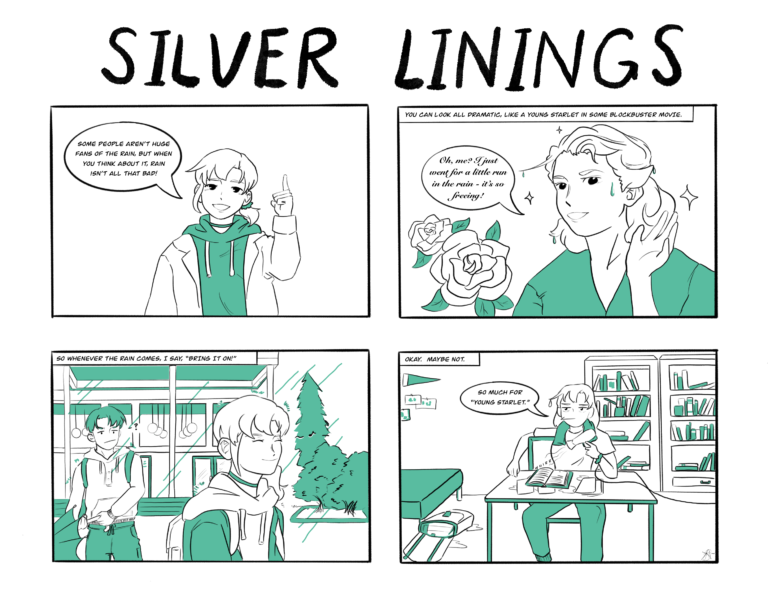
Silver Linings

By SEANNE JAVIER –– sajavier@ucdavis.edu


Drawn by: Seanne Javier –– sajavier@ucdavis.edu


Disclaimer: (This cartoon is humor and/or satire, and its content is purely fictional. The story and names of “sources” are fictionalized.)
 

October storm sets new records for single-day rainfall after years-long dry spell

0

Climate change and drought concerns persist despite record-breaking precipitation


By YAN YAN HUSTIS HAYES — city@theaggie.org


On Oct. 24, Sacramento received a total of 5.44 inches of rain. This marks the largest 24-hour precipitation in over 100 years, breaking the previous record established in 1880. The weekend of rain also provided the North Sierra half the amount of rain in just one weekend than the entire region has received over the entire last year.

While it is tempting to view the rainfall as a turning point in California’s ongoing drought emergency, it follows an extremely dry period beginning in 2019. Associate professor of climate change impacts, Erwan Monier, warned that we should not expect the rain to continue into the winter season.

“We expect these coming months/year to continue to be drier than usual—the 2019-2021 period has been extremely dry,” Monier said via email. “The recent precipitation is an anomaly and should not be seen as the beginning of a wet year.”

The rainfall on the weekend of Oct. 23 was an extreme event, but one that we should expect to see more of. With climate change, extreme events such as these will become increasingly common in the coming years, according to Monier.

“We don’t necessarily expect substantial changes in the total amount of annual precipitation in California, but we expect the rainy season to shorten, meaning we expect more intense precipitation when it falls,” Monier said via email. “Similarly, we expect a longer dry season, meaning Fall and Spring will experience less precipitation.”

In addition to more extreme floods and droughts, California should expect increased heat waves, major snowpack loss and increases in wildfire severity. Climate change has created conditions in which environmental events tend to become more extreme, according to Monier.

“Essentially, we expect increases in both flooding and droughts, however counterintuitive it may be,” Monier said via email. “Think: when it rains it pours, and when it’s dry it’s extremely dry. Climate change has been and will continue to intensify these two extremes.”

Fifth year computer science major Stephanie Do was glad for the rain after the dry conditions of the past years, but also noted how quickly the rain subsided.

“I definitely think the rain is super good because of this drought we’ve been having,” Do said. “It’s so weird because Sunday was so rainy, but then it was normal the next days.”

With an increase in wildfires, drought conditions and record breaking heat waves to name just a few extreme events, the past three years have been especially difficult and unpredictable. Do explained that the coronavirus pandemic changed her outlook.

“It’s crazy because you obviously never know what’s going to be next,” Do said. “With everything that’s happened, the most pressing issue is COVID. That has really messed up my perspective.”

In addition to her concerns about the drought, Do explained that the wildfires are also a primary issue.

“I feel like all of my social media there’s been at least one person who’s been affected by the fires,” Do said. “The past couple of years we’ve seen how climate change has affected our experiences especially with the fire[s].”

Like Monier, faculty professor and cooperative extension specialist in water resources, Samuel Sandoval Solis, stressed that the recent rain does not mean the end of California’s water problems.

“This rain is not breaking the drought,” Sandoval Solis said. “It is a good start and it replenished the deficit in moisture in Northern California but we are by no means in a position to replenish two years of below normal conditions.”

Sandoval Solis emphasized that fighting climate change and mitigating its effects are not easy fixes.

“Modifying legislation and making a change takes time, takes time for us to figure out how to take showers, it takes effort and a change of mindset,” Sandoval Solis said. “We need to start thinking about how to cut down our water use”

It is important that individuals recognize the small ways in which they can use water smarter, rather than looking to the rainy season to alleviate the stress from California’s drought. Sandoval Solis encouraged people to try and reduce their carbon footprint as best they can.

“Support local agriculture by buy[ing] local,” Sandoval Solis said. “Take shorter showers, use the dishwasher and maintain drought resistant landscapes. Your decisions will make a difference.”

The changing and increasingly extreme weather conditions that are worsened by climate change are not natural nor are they unique to California. Sandoval Solis explained that because of this it is important that we all do our part to combat climate change

“These [extreme weather] events happen once in a lifetime, not once in a decade,” Sandoval Solis said. “It is not normal. We easily forget that we’re in a drought, but no one can pull out.”

Written by: Yan Yan Hustis Hayes — city@theaggie.org

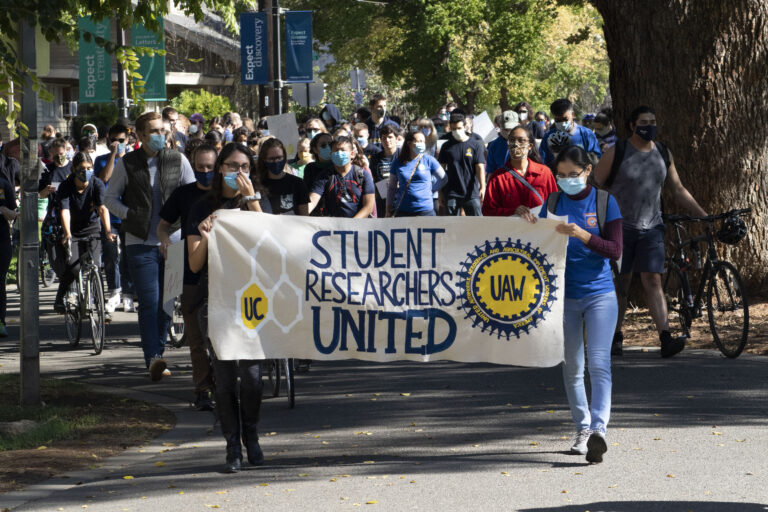
Student researchers, postdocs rally against union busting

The march led by Student Researchers United-UAW sheds light on the organization’s ongoing fight for union recognition 


By JENNIFER MA — campus@theaggie.org


On Oct. 28, student researchers and postdocs congregated on the corner of 2nd and A St. and marched to Mrak Hall to demand that the UC recognize Student Researchers United-UAW (SRU-UAW). This push for unionization began in May 2021, with over 12,000 student researchers submitting authorization cards to form the union.

According to those at the rally, the protest is a culmination of frustrations with financial instability, a lack of healthcare, longer work hours and no protection against discrimination and harassment.

The California Public Employment Relations Board (PERB) verified the right of all members of SRU-UAW to be recognized, but the UC stated that it is only willing to only recognize approximately 11,000 student researchers. The UC argues that student researchers funded by fellowships and training grants do not share a community of interest with other student researchers. The union refutes that all of the student researchers should enjoy the same rights because the work is the same.

“UC’s position is nothing new,” Aarthi Sekar, a sixth-year in the Integrative Genetics and Genomics Graduate Group, said. “They’ve spent 30-plus years trying to manipulate the law to avoid recognizing as many academic workers as employees as they can get away with.”

PERB clarified that the UC did not have the option to partially recognize SRU-UAW; the only options were to recognize the union in full or provide reasons for denial. This resulted in a complete denial of recognition from the university.

According to Maeve Parasol, a second-year international relations major, the actions of the system regarding workers’ rights are inconsistent with its stated values.

“The UC system says they’re so progressive and tries to be this beacon of a school yet they’re union busting at the same time,” Parasol said.

Veronica Suarez, a doctorate level two student from the Department of Land, Air and Water Resources, echoed Parasol’s statement about UC Davis.

“The university is hypocritical,” Suarez said. “They have all these slogans around like ‘You matter,’ ‘We care about you,’ ‘We are inclusive and diverse,’ but it seems to me that not saying anything is already denying that we are here and that we are important.”

Katie Porter, the U.S. Representative from California’s 45th congressional district, authored a letter addressed to UC President Michael Drake asking him to recognize SRU-UAW immediately and in its entirety. This letter was signed by 30 representatives, the majority of California’s congressional delegation, and substantiated that student researchers are a major reason why the UC received $3.7 billion in federal research contracts and grant revenue in 2020.

Ryan King, the associate director of media relations for the UC Office of the President (UCOP), provided a statement for UCOP regarding student researchers and union representation.

“We support our employees’ right to union representation,” the statement reads. “UC is in ongoing discussions with the United Auto Workers (UAW) and the Public Employment Relations Board (PERB) regarding the final composition of this new bargaining unit.

According to the statement, the university recognizes that graduate student researchers who are hired to work under the direction of the university should be a part of the new bargaining unit.

“However, there are differences in perspectives between UC and the UAW regarding other individuals included in the petition who are not University employees as defined by the Higher Education Employer-Employee Relations Act,” the statement reads. “We hope to resolve this matter in a timely fashion so that good-faith negotiations on the terms and conditions of employment with this new bargaining unit can commence.”

On Nov. 2, student researchers at UC Davis held an election, where they selected strike committee members. These members will decide if a strike is necessary and when it will be held, granted two-thirds of student researchers also authorize it. The actual SRU strike authorization vote began on Nov. 10 and will continue through Nov. 19.

“[Student researchers] are the ones who produce by far the most monetary research value for the university,” Adriana Postema, a first-year Ph.D. student in geology, said. “As a result, it gives us a lot of strike power.”


Written by: Jennifer Ma — campus@theaggie.org


UC Davis community grieves the loss of Compost, one of the famous felines who called the campus home

0

Students and staff share their experiences and memories of Compost and other campus cats

By MAYA SHYDLOWSKI — features@theaggie.org

Over the weekend of Oct. 23, UC Davis lost Compost, one of the beloved felines that has brought comfort and happiness to many students. Compost, who lived at the Student Farm on campus, died at the age of 13 as a result of various medical conditions, according to an Instagram post from the Student Farm. She was brought to the veterinary medical center on campus because of an ongoing problem, but died there after cancerous cells were found in her lungs.

The Student Farm announced Compost’s death and presented a memoir of her life via Instagram. According to the post, she was born behind the shop at the Student Farm and was known for her friendly nature.

According to the post, “a small number of Student Farmers lovingly buried Compost before the rains came in a bed of cardoon leaves and flowers under a tree near the picnic tables.”

Compost is said to have supported both student mental health and farm management during her life on the Student Farm. She was loved by everyone who visited the farm, except for the small rodents whose population she kept under control. She was often seen laying in the sun on the picnic tables next to the Ecological Garden, where students often gather between classes or work.

Julia Shreiber is the coordinator of the Ecological Garden at the Student Farm and helped take care of Compost. She shared why Compost was so important to so many staff and students.

“I think she just had a sort of very calm, sweet presence that reminded folks to slow down and look around and enjoy the sunshine,” Shreiber said. “I think she helped a lot of folks to let go of stress and be in the moment with her there in the garden.”

Shreiber said Compost would greet the staff and students every morning when they got to work and often jump up into their laps.

Many students have this same memory of the friendly black feline, including Adam Maiale, who is a fourth-year sustainable agriculture and food systems and Spanish double major and former intern at the Student Farm.

“I loved sitting down at the tables at the Eco Garden, and Compost would just come and lay down in front of me,” Maiale said. “I miss giving Compost belly rubs.”

Compost, like the other cats on campus, provided students and staff with emotional support and a break from the busyness of their lives.

Luckily, Compost is not the only cat to call UC Davis home. Multiple cats have been spotted roaming around near buildings and taking in food and attention whenever they can. While not everyone can have a pet in college, everyone can visit the friendly cats that reside around campus. They are technically feral cats, though they are taken care of by both students and faculty.

One student who knows these cats well is Tina Sorenson, a fifth-year art studio and computer engineering double major, who is doing a photography project on feral cats in Davis. She said that she chose to make cats the focus of her project both because of how much she misses her own cat and because of how much happiness the cats of Davis bring people.

“I wanted to do a more lighthearted, positive project because I feel like sometimes we all sort of need a break from the things around us,” Sorenson said.

Sorenson has collected photos of at least three cats on campus, including Cheeto, who is most likely to be found by the physics building. Cheeto has become something of a legend around there, as the first floor northeast hallway was recently named “Cheeto Way” in his honor. He was even featured in an article in The Sacramento Bee after a sign went up by the physics building warning students to stop feeding him.

“He has become far too overweight for his health, please do not feed him — no matter how much he begs! And he will beg. Because he knows we are suckers!” the sign reads.

Cheeto had gained a bit of weight but has returned to a relatively healthy size since the sign was posted.

However, Cheeto is not the only cat attracted to the physics department. A large, grey cat called Big Grey lived there before Cheeto, but was adopted. There are also currently two other cats who visit the physics building: Allie and Charcoal. They are far more shy and do not interact with students as much as Cheeto, but they are fed and taken care of by faculty in the physics department as well.

Cheeto, originally known as Tangelo, was discovered with another cat named Clementine, who now resides at the Art MFA studios on campus.

Other cats Sorenson has taken pictures of include Coco of Veihmeyer Hall and Newspaper, who lives by Voorhies Hall.

“I think it brings more people together because when I was taking photos of Cheeto, some other students came by and wanted to take photos of him,” Sorenson said. “They were telling me about other cats they’d seen. So it seems like when it comes to cute animals, people are very happy to share their stories about them.”


Written by: Maya Shydlowskifeatures@theaggie.org


Review: Lizzo was ‘Good as Hell’ in an unmatched set at Outside Lands 2021

The body-positive feminist pop star left a 200,000 person crowd screaming for more Queen energy on Halloweekend

By SIERRA JIMENEZ — arts@theaggie.org


The acclaimed singer, songwriter, rapper and flutist Lizzo dominated the stage Halloween weekend as Saturday’s headliner for Outside Lands 2021. Her skintight neon green leotard only accentuated her girl boss energy as she paraded around the stage, animating her 200,000 fans in the crowd.

Never a dull moment, she began her set with her new single, “Rumors” feat. Cardi B, followed by classic fan favorites such as “Good as Hell,” “Boys” and “Truth Hurts,” which she revealed was her personal favorite on stage.

“I have been touring since 2012, and San Francisco has consistently shown me love for nearly a decade,” she told the audience.

Lizzo, who made her debut at Outside Lands in 2018, told the crowd that she had previously performed at the 2 p.m. slot, and now she is headlining the festival, reminding her fans that anything is possible. Utterly grateful, she put so much heart and soul into her performance that she shed tears of joy, causing the audience to do the same.

She took multiple pauses in her set to sit and talk directly to her fans. She preached self-love and self-growth, having the audience repeat positive manifestations such as, “I love you, you are beautiful and you can do anything.”

Lizzo, known for her body- and self-positivity, was backed by an all Black female dance crew and band. Her dancers defied the idealized body image normalized in popular culture as they confidently strutted across the stage in their neon pink pleather jumpsuits. The admired popstar enthusiastically danced her heart out, twerking and making her curves known and loved by the screaming crowd.

Dancing along to the TikTok famous song from the popular children’s show, “The Backyardigans,” “Into the Thick of It,” Lizzo substituted the juvenile song lyrics to her own explicit, “I am a thicker b*tch,” further affirming her body positivity.

An avid TikTok enthusiast, Lizzo commemorated the moment by having the crowd participate in her own rendition of the “Food Dance” TikTok that she posted Sunday, Nov. 1 with the caption, “THIS IS THE RECORD FOR THE MOST PEOPLE TO EVER DO A SINGLE TIKTOK TREND—TO MY 200,000 NEW BESTIES.. TAG URSELF IF U WERE THERE.”

Lizzo personified popular culture last weekend as she dressed up in multiple extravagant costumes for this spooky season. Appearing at a Spotify concert in Los Angeles Friday Oct. 29, she dressed as Baby Yoda from the Star Wars franchise TV series, “The Mandalorian,” in which she joked with the crowd at Outside Lands that she still had traces of green on her butt — which, in fact, she did.

Incorporating the famed Netflix series “Squid Game,” Lizzo and her girls dressed up in appropriate costumes from the drama to perform Michael Jackson’s 1982 Halloween hit, “Thriller,” in her set. The dancers emerged as masked henchmen to the series’ theme music while Lizzo took stage as the robotic female doll, flawlessly executing the iconic “Thriller” dance.

Ending her set with a proper encore — satisfying the crowd’s ferver for Lizzo’s fire — she revealed herself once more on stage with her bestie, “Sasha flute.” Lizzo electrified the audience with a musical interlude of her song “Juice” from her 2019 album, “Cuz I Love You.” The crowd sang along to her final bang, ecstatic from Lizzo’s vibrant energy as fireworks concluded the night.

Lizzo gave an unforgettable headlining show not only through her continuous positivity and enthusiasm, but also for her evident appreciation for her fans and music. Even as a top chart artist, Lizzo remained humble while performing. By taking time on stage to soak in the glory of the night, this was not an experience she took for granted despite her substantial fame.

Her inclusion of a Black female band and back-up dancers along with her empowering female-centric music brought people together from all walks of life this Halloween weekend. Reflected through the diversity of her fanbase in the crowd, Lizzo is a staple artist for and with the people.


Written by: Sierra Jimenez — arts@theaggie.org

UC Davis Comprehensive Stroke Center receives Stroke Quality Achievement Award from the American Heart Association

UC Davis health professionals adhere to Get With The Guidelines-Stroke to provide high-quality patient stroke care


By BRANDON NGUYEN –– science@theaggie.org


Stroke is the No. 5 cause of death and leading cause of disability in the U.S., according to the American Heart Association. On average, an individual in the U.S. suffers a stroke every 40 seconds, and nearly 795,000 people suffer a new or recurrent stroke each year. Caused by blood clots (ischemic stroke) or blood vessel ruptures (hemorrhagic stroke), strokes result in brain cell death in areas where oxygen is no longer being delivered by the bloodstream.

Recently, the UC Davis Comprehensive Stroke Center was recognized by the American Heart Association as a recipient of the American Heart Gold Plus Get With The Guidelines-Stroke Quality Achievement Award. Developed by health professionals due to the alarming numbers that strokes present, Get With The Guidelines-Stroke is an in-hospital program that optimizes stroke care by promoting institutions to adopt the latest research-based technology and abide by the most recent scientific treatment guidelines.

Dr. Kwan Ng, the director of vascular neurology and the UC Davis Comprehensive Stroke Center, expresses gratitude on the behalf of the medical center for the award and recognition by the American Heart Association.

“UC Davis Health is honored to be recognized by the American Heart Association for our dedication to helping our patients have the best possible chance of survival and recovery after a stroke,” Ng said. “Get With The Guidelines-Stroke makes it easier for our teams to put proven knowledge and guidelines to work on a daily basis to improve outcomes for stroke patients.”

Dr. Alan Yee, a stroke neurologist at the UC Davis Medical Center, provides further insight into what the award means to the stroke team aside from its remarkable patient care.

“I think the award really signifies the high impact and high quality treatment that our medical center can provide both locally and even regionally to this area of California and in the U.S.,” Yee said. “The award highlights the cross collaboration and communication between departments, which I really think is a unique aspect of our center. We value each other’s input and expertise and how we can best care for each individual patient.”

The exceptional teamwork and open-mindedness to adapt to a patient’s needs deemed the UC Davis Comprehensive Stroke Center all-the-more deserving of the award for stroke care. To Yee, the award stresses the importance of successfully applying what is learned to what is practiced in the real world, and that requires, more often than not, the help among team members with their knowledge and input.

Alexandra Schrick, one of the four clinical stroke coordinators at the UC Davis Stroke Comprehensive Center, explains what distinguishes UC Davis from other medical centers and hospitals.

“We have a very robust program here where clinical stroke coordinators are here almost 24-7 to help coordinate the care for these patients from when they arrive to the emergency department or via ambulance all the way through their care here,” Schrick said. “We service the majority of northern California, so we’re basically a hub for a large area, […] and so our program is growing every single year. We have relationships with a lot of different hospitals in the area, including very far rural areas where we get patients flown to us. And I think that’s very unique to UC Davis.”

Recalling a memorable patient he recently had a check-in with, Yee opens up about how his patient’s journey under his guidance and adherence to the Get With The Guidelines-Stroke has been rewarding and sentimental.

“This young patient had had a very unusual cause of stroke, and it was due to what we call a blood vessel dissection that occurred in the person’s neck,” Yee said. “ And this was right when I started here about four and a half years ago and seeing how the emergency department and the residents that I work with addressed her needs urgently, we treated her for acute stroke management very quickly. She’s now functionally normal, and I think that made me very happy to see that what we do makes a big difference in a person’s life, and irrespective of age, seeing the individual walk back into my office really meant a lot to me.”


Written by: Brandon Nguyen — science@theaggie.org

UC Davis women’s basketball looks to repeat as Big West champions

0

The Aggies defeated Cal State East Bay in the opening exhibition of the season and now look to get rolling in non-conference play  


By MARLON ROLON — sports@theaggie.org


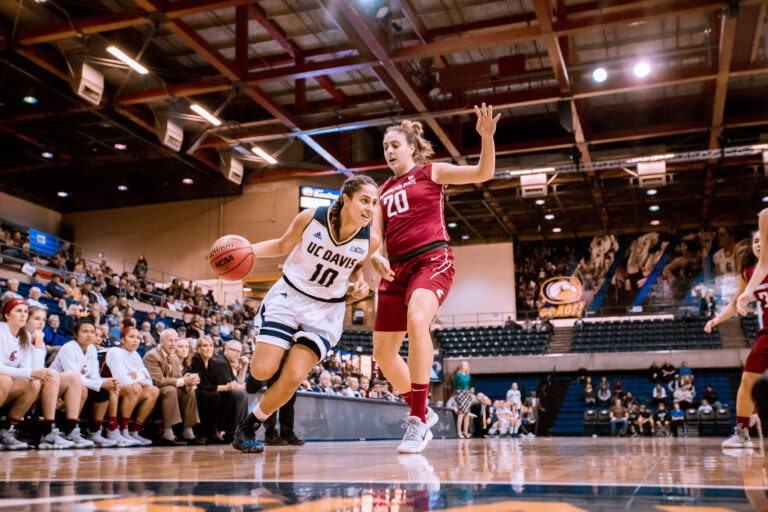
UC Davis’ Bria Shine and Sage Stobbart combined for 31 points to lead the Aggies past Cal State East Bay, 62-53 in an exhibition to open the season. It was the first time that fans were in attendance at the University Credit Union Center in Davis since the 2019-20 season.

“I think today kind of gave us some liveliness to the gym because last year, obviously we were lacking that, and it was super nice to just have some fans back in here and have some extra noise other than just our team,” Stobbart said after the game.

The Aggies were off to a slow start trailing 22 to 18 during the first quarter. After a long offseason Davis seemed to be out of rhythm as they were missing shots going 6-17 in field goal attempts, shooting 35% in the first quarter. Having five new players on the team for the Aggies is going to take some time for the players to mesh together as it was evident during the opening quarter.

“I think we’re still getting in the swing of things and just learning how to play with each other and with new players, but I think as a team, just getting stops on defense and limiting our turnovers is going to be key for us, and then we’re a really strong offensive team,” Stobbart said. “We have a lot of skill on our team and we just need to utilize all of our weapons.”

During the second quarter, the Pioneers from East Bay awakened a sleeping giant. UC Davis outscored East Bay 22-4 and shot 53% from the paint while shooting 40% from the three-point line. Additionally, UC Davis bullied the Pioneers on defense, as the reigning defensive player of the year Stobbart had three blocks inside the paint. Her defensive presence in the paint held East Bay to just four points in the entire second quarter.

The third quarter was more competitive with the Pioneers being aggressive, although UCD managed to outscore them heading into the fourth quarter.

UC Davis head coach Jennifer Gross pulled out her starters in the fourth quarter and provided playing experience to the freshmen on the team. For that reason, Cal State East Bay took advantage of the inexperience of the new freshmen players for the Aggies. However, their effort wasn’t enough as the Aggies came out victorious.

“We were really excited,” Gross said. “I think it was kind of a mix of a little bit of nervousness, a few jitters but more than anything just really looking forward to getting back to competing again.”

Three players finished in double figures for Davis with Shine leading the way with 17 points, Stobbart adding 14 points and Evanne Turner finishing with 12 points.

East Bay’s Mina Turner finished with a game high 22 points, the only player on the team to finish with double figures, but her outstanding effort wasn’t enough against the defending champions.


The journey to repeat begins

Winning the Big West Championship in 2020 and making an appearance in the NCAA tournament, the UC Davis women’s basketball team is favored to repeat as they look to claim their sixth straight regular season title in the Big West Conference and go back to the NCAA Tournament.

“We’ve always strived to get better every year, and having those accomplishments in the previous years just shows us how good we can be, and every year we’re just trying to get better and achieve those things again and again but improve while we’re doing it,” Stobbart said.

This season will be the first with fans in attendance since 2019-20, as the pandemic peaked during that time, barring fans from games. The once-empty arenas became stagnant during games, especially without the energy of the crowd that once electrified players. Surely, playing in front of fans was a surreal experience.

“Just the energy from the crowd, just seeing familiar faces, seeing people that really care about our team and have really missed being here — there’s nothing like that,” Gross said. “It’s going to be awesome so I hope the excitement for this team grows and grows, and we continue to get more people in here and provide more energy for this group.”

As the University Credit Union Center prepares for fans to fill the seats in the arena, the fans are in for a treat with the current roster. The Aggies have veteran star players who are expected to carry the load down the stretch as they prepare for a deep run.

Those veterans include the likes of 2021 Big West Player of the Year Cierra Hall at the forward position, star center Stobbart, guard Evanne Turner and power forward Kayla Konrad. Additionally, the Aggies have a new generation of players who are talented with a bright future ahead. They are learning from veterans who won the conference championship with a berth to the NCAA tournament.

Hall, who won Player of the Year in the Big West Conference, averaged 14.6 points and 6.8 rebounds last season while making the All-Big West first team and earning the MVP award in the conference tournament.

Stobbart, last season’s defensive player of the year, averaged 10.1 ppg, 8.2 rpg and 2.68 blocks per game, earning her place in the All-Big West first team, all-tournament team and all-defensive team.

Turner, a key player on offense, averaged 11.7 ppg and 3.7 rpg last season. Turner is a fantastic finisher at the rim and dangerous from behind the three-point line. Her relentless scoring abilities helped Davis secure the conference title last year. Turner earned a place in the Big West all-tournament team during the 2021 season. As for Konrad, her efforts earned her a place among the Big West all-defensive team, averaging 9.6 ppg and 4.0 rpg.

These veteran players are the foundation of the team who rose to prominence by leading the Aggies to a conference championship and an NCAA tournament berth again. These are the type of players who can change the culture of an entire program with their leadership, hard work and love for the game. The legacy that they’ll leave behind will enrich the basketball program in Davis for years to come.

“I think they have players like [Cierra] Hall and Kayla Konrad and Sage Stobbart to look to say, ‘Hey, this is how we do things in our program,’” Gross said in reference to the new players on the team.

“We’ve been successful because we come to practice with a great attitude, ready to work hard everyday,” Gross said on the importance of her veteran players giving back to the game of basketball by sharing their knowledge and elements of their game to the younger prospects on the team. “It’s fun to see those older players grab a younger player at practice and explain something and show them something, and so I think that’s what culture is about. It’s about leaving a legacy for the younger ones, and we have a really great group of veterans that’s doing that.”

A recent poll that involved votes from the media and coaches around the Big West Conference picked the Aggies to finish atop of the standings by the end of the season. These expectations can produce pressure, but championship teams thrive off pressure and always find ways to win.

The women’s basketball team has a tough road ahead as they embark on their quest to repeat as back-to-back champions. They open the regular season non-conference schedule on Nov. 9 against Academy of Art in Davis, then host Saint Mary’s on Nov. 13. The Aggies follow up with their first road game of the season on Nov. 18 as they take on San Francisco. Subsequently, Davis will travel to the Golden 1 Center in Sacramento to play against their crosstown rival, Sacramento State Hornets on Nov. 23.

The team will go back home to host Weber State at the University Credit Union Center and then get to measure their talent as they travel to Oregon to take on the Ducks on Dec. 1.On Dec. 4, Washington State rolls into town to play Davis at the University Credit Union Center. The last three opponents before UCD plays against their Big West counterparts are against Stanislaus State in Davis Dec. 13, at Stanford on Dec. 15, and finally against Gonzaga on Dec. 19.

“That’s why we scheduled those games because we have a veteran group. We are excited about the potential of this group but you need games like that to see where you’re at and to test yourself, and we have a team that is not going to back down from anybody. We’re going to be ready to compete no matter if that’s a conference opponent or if it’s a top 10 team on their home court,” Gross said regarding the schedule.

The schedule will then transition against Big West opponents as UC Davis faces UC Riverside (Dec. 28) to open conference play. Hawaii makes the long road trip to play the reigning champions at the University Credit Union Center (Jan. 1). UC Davis will then travel to play against UC Irvine (Jan. 6) and UC San Diego (Jan. 8) before coming back home to host CSU Bakersfield (Jan. 13), Cal Poly (Jan. 15), UC Santa Barbara (Jan. 20) and finally CSU Northridge (Jan. 22).

Following the four consecutive home games, they will travel to Fullerton, Calif., to take on CSU Fullerton (Jan. 27) and Long Beach State (Jan. 29). UC Riverside then comes into town (Feb. 1), and following that game, Davis travels to play Hawaii (Feb. 3). The team comes home to host two consecutive home games against UC San Diego (Feb. 10) and UC Irvine (Feb. 12), but then the schedule gets rocky as the Aggies will be on the road for four consecutive games against Cal Poly (Feb. 17), CSU Bakersfield (Feb. 19), CSU Northridge (Feb. 24) and UC Santa Barbara (Feb. 26). Finally, UC Davis hosts the last two games to close out the season against Long Beach State (Mar. 3) and Cal State Fullerton (Mar. 5).

Gross was hopeful and optimistic against the level of opposition they face this season with her veteran players providing valuable experience, great work ethic and championship pedigree within the locker room. Gross takes pride in her team’s preparation during practices with players testing each other in an effort to get the best out of one another.

“As a group, we just want to push each other everyday to be our best and if we can do that in practice, then we’re preparing ourselves as best we can to get better everyday and also to be in a position at the end of March where we have a chance to win another championship,” Gross said.

Gross enters the 11th season as the head coach of the Aggies women’s basketball team. With Gross at the helm, UC Davis has been perennial favorites to make a deep run in the postseason. Gross’ success has translated onto her players as Davis has won five straight regular season championships.

“That’s why I love coaching this team because it’s a group that really has no fear and is ready when we tip,” Gross said.


Written by: Marlon Rolon — sports@theaggie.org

City of Davis: a prime location in California for winter waterfowl observation

0

Six million waterfowl arrive every winter in California’s “Serengeti migration”

By RACHEL SHEY — city@theaggie.org


Every winter, birders flock to the Davis area to see the native waterfowl populations, according to UC Davis Wildlife, Fish and Conservation Biology faculty Robert Furrow.

“There’s a lot of managed wetlands in the Central Valley, that’s a specialty of the Central Valley in general,” Furrow said. “Historically, the Central Valley used to be a huge wetland in the wintertime. It used to be a riparian forest with big floodplains along the edges of creeks that flooded over and made big marshy areas.”

Now that California is largely developed, these wetlands have vanished. They’ve been replaced by special agricultural measures to ensure habitats for the flocks of migratory waterfowl.

“We don’t have anything like the natural wetlands that would occur anymore, but a lot of agricultural fields are flooded to prevent weed growth,” Furrow said. “It’s super water intensive but simultaneously has an ecological benefit, so it’s often done in conjunction with waterfowl management groups to make sure that there are certain fields flooded in the winter and spring for the ducks and geese.”

Huge flocks of waterfowl travel to the Central Valley every winter from their nesting grounds in Canada, Alaska and as far north as Russia, according to UC Davis Museum of Wildlife and Fish Biology Curator Andrew Engilis Jr.

“This is called the Pacific Flyway,” Engilis said. “There’s probably something around 6 million waterfowl that come and winter here over the course of a year. One of the best places to see them that’s close by Davis is the Yolo Bypass wildlife area. There’s an auto tour route so you can drive around a three or four mile tour route that, if the ponds are flooded, is a great bird watching location.”

The Yolo Bypass Wildlife Area is one of the managed wetlands that Furrow mentioned.  It is supplied by the water in Putah Creek, and intended as flood protection for people living in the Yolo Basin. It now has a secondary purpose as a “duck stop” for wild waterfowl to rest up and prepare to raise their young in the spring.

“While it retains its flood-control priority, [the Yolo Bypass Wildlife Area’s] seasonal and permanent ponds have been sculpted from fallow farmland, and they are designed to play a role in reaching the wintering population objective for the Central Valley of 4.7 million waterfowl,” Peter J. Hayes wrote for Outdoor California.

While the species that migrate here are not rare or unusual, such large numbers arrive every winter, which makes their arrival into a fascinating spectacle of nature, Engilis said.

“I think of the Pacific Flyway as California’s Serengeti. In the Serengeti you have wildebeest and zebras that migrate and the predators follow them. It’s kind of similar to here, except the birds are the animals,” Engilis said. “The geese and ducks come down by the hundreds of thousands and the eagles and hawks and falcons follow them down, so they’re here as well. They’re an important component to the migration that we see here in the Central Valley.”

Furrow explained that much of the waterfowl diversity is in ducks.

“In terms of what we actually have breeding here, in most patches of wetland that we have year round, we’ll have mallards,” Furrow said. “And we also have wood ducks along Putah Creek, in part supported by efforts at UC Davis to install a bunch of nesting wood duck boxes along the creek. In winter, we have more than twenty species. You can open a field guide and almost every species of duck, you can find in some number here.”

Geese are also represented in the Davis area. The five common species are widespread in the Pacific Flyway.

“At the Yolo Bypass, you can see snow geese and greater white-fronted geese, sometimes tundra swans, a smaller number of Ross’s geese and cackling geese,” Furrow said.

What’s the difference between geese, ducks and swans? These three main groups of waterfowl generally differ in neck length, with swans having the longest necks, geese having an intermediate neck length and ducks having the shortest necks. They also differ in bill shape; geese tend to have conical bills, whereas ducks have wider, flatter bills, according to Furrow. Furrow also delineated the two categories of ducks.

“Dabbling ducks typically feed on the surface, on vegetation, and they do a sort of upending and pluck on vegetation, browsing and filtering through muddy water,” Furrow said.  “That contrasts with diving ducks which typically will be eating animals of some sort, invertebrates, molluscs, some fish [and] amphibians.”


Written by: Rachel Shey — city@theaggie.org

Harper Junior High School unable to use fields due to squirrel infestation

Studies suggest ways to curb squirrel infestations and explain how personality affects squirrel behavior 


By SHRADDHA JHINGAN — city@theaggie.org


Harper Junior High School, located in the Davis Joint Unified School District (DJUSD), has had a squirrel infestation that led to three of its fields becoming unusable, according to an article from the Davis Enterprise.

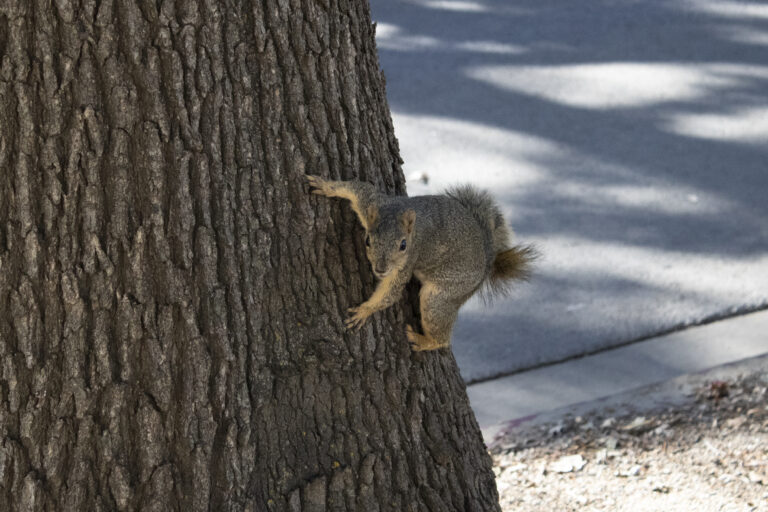
In 2008, UC Davis launched a research program to investigate how to stop a large increase in squirrel populations, specifically in tree squirrels that are non-native. Sara Krause, a doctoral student at UC Davis who led the project, explained in the news statement that at the time, there was a large increase in the number of eastern fox squirrels, to more than 400.

“This is an introduced species that has demonstrated elsewhere that it is prolific, adaptable, invasive and problematic for many reasons,” Krause said in the news statement.

The news statement also lists the impacts that the eastern fox squirrels could have on the campus, such as competing with other plants and native plants or damaging facilities on campus. Though Harper Junior High School did not identify the breed of squirrels that was causing the infestation, the article explained that the infestation has prevented students from using the affected facilities, and thus, they are trying to find a solution, according to interim superintendent Matt Best.

“Since the summer, we’ve been working to mitigate the squirrel problem,” Best said in the Davis Enterprise article. “It’s a challenge that if you don’t have the infestation under control, you’re just throwing money away for maintenance.”

In the 2008 research program, division director Sal Genito explained that the aim was not to hurt the squirrel or wildlife.

“Our goal is not to hurt the animals that find our grounds so attractive,” Genito said in the news statement. “It is to limit their ecological and human-health impacts as effectively and humanely as possible.”

According to the Davis Enterprise article, the school board has been trying multiple methods to help curb the squirrel infestation, such as putting water and sand in the burrows, live-trapping and more. A recent UC Davis study, for which the news statement was published on Sept. 10, detailed that squirrels have personality traits, which can affect how they use space.

These four personality traits are “boldness, aggressiveness, activity and sociability,” according to the study’s YouTube video. According to the study, these traits can have an impact on “wildlife management,” especially when considering the additional impact that human activities can have. Jaclyn Aliperti, the lead author of the study, detailed this idea further in the news statement.

“This adds to the small but growing number of studies showing that individuals matter,” Aliperti said. “Accounting for personality in wildlife management may be especially important when predicting wildlife responses to new conditions, such as changes or destruction of habitat due to human activity.”

Abigail Garofal, an energy and environmental stewardship educator at the University of Illinois Extension, explained in a webinar part of the reason why squirrel populations are so extensive.

“Starting in Central Park, actually in New York City, they introduced gray squirrels, flying squirrels and chipmunks, and then they actually started doing this in other cities as well,” Garofal said. “And so these squirrels were so successful in this urban landscape that they actually ended up having to coal a few of the species back because they were actually causing damage to some of the park landscapes, but at that point, it was too late […] so we started incorporating new trees into new neighborhoods as cities expanded.”

Dirk Van Vuren, a professor of wildlife biology at UC Davis, explained that the habitat may be conducive for squirrels and that from Google Earth, there seems to be “some great squirrel habitat on the south side of the school.”

“California ground squirrels prefer open, grassy habitats,” Van Vuren said via email. “They need open habitats. Their food is herbaceous vegetation such as grasses, and the seeds they produce. They especially like grazed areas, but looking on Google Earth, it seems there are plenty of ag fields nearby, which might be a source of the squirrels.”

Van Vuren said that the increase in squirrel populations was in response to the environment. A good habitat can lead to an increase in the number of squirrels.

“These squirrels don’t often dig burrows in lawns, but they certainly like to live in nearby burrows, and feed on lawns,” Van Vuren said via email. “So, the setting of Harper seems to have provided good quality habitat for California ground squirrels, and they responded accordingly.”


Written by: Shraddha Jhingan — city@theaggie.org


Dammit, they rearranged Safeway again

0

I just wanted some granola and now I’m trapped in “The Maze Runner”


BY ANNABEL MARSHALL — almarshall@ucdavis.edu


I’ve got a list. That’s the way to do it, I think, to have a list. That way you can go in, get what you need and get out. God knows I’ve spent a few hours of my life procrastinating Chem 2C homework in the cereal aisle.

So I’ve got a list. Eggs, bread, bananas. Oat milk to put on my oatmeal to make it extra oaty. One lonely avocado because I want to make guacamole and pretend I’m having a party, but I don’t want to have anyone over because then they’ll eat my guacamole. My roommate wants bagels, so I added that too. Shaving cream.

I start with the oat milk because having non-dairy milk in my basket makes me feel superior to the layman. Layperson. It’s 2021; I’m superior to the layperson. It should be right over…

Oh no, they’ve done it again. They’ve rearranged. Why they do this, I’ve never understood. Wouldn’t it be easier to keep the dinosaur chicken nuggets in a permanent position? What if I were having a dinosaur chicken nugget emergency? Like yesterday? Or the five consecutive days before that. Come to think of it, I was here six hours ago. How did they rearrange everything?

Let’s get this over with. Oat milk. Maybe it’s among the breakfast foods? Pop-Tarts make a mac and cheese flavor? And who knew there were eight different kinds of shredded Parmesan? And since when was beer next to the sushi counter?

I think I’m losing it. It begins to snow. Wait, those are just receipts. They burn to touch. They are made of seaweed. Biodegradable, nice. Good to see companies working toward the common good.

I look up. The ceiling unfolds and I catch a glimpse of Hell. The floor is flooding with non-fat Greek yogurt. The Hispanic foods whisper obscenities. Eggs, bread, bananas. Surely the eggs would be in the refrigerated section, but I’ve been past the dairy four times and the Moth people are rude to me every time.

Oat milk. I see it in the distance. I run. I am sitting in my Safeway shopping cart and wearing a watermelon as a helmet. You are there. It’s nice to see you. Did you do the sociology homework?

We reach the oat milk, but when I reach out, I find a single unwrapped glazed donut. It was just a mirage.

I begin to laugh hysterically and a nearby customer reaches out to me, but their fingers become Barilla Angel Hair Spaghetti, 20% off when you buy five. Do the thumbs count as spaghetti? Because I’m not paying full price for thumbs. Honey, will you Google it? Honey? I think she’s taking an ice bath in the frozen spinach.

“This is what we wanted,” the workers say in unison. They chant in Portuguese. I am beginning to understand Portuguese and also time and space. Eggs, bread, bananas. My list has caught fire. When I let go of it, it turns into a bird. The bird is trapped in the store. The bird is my soul. I cannot find the bagels.


Written by: Annabel Marshall — almarshall@ucdavis.edu 


Disclaimer: (This article is humor and/or satire, and its content is purely fictional. The story and the names of “sources” are fictionalized.)
‘Guardians: Spirits of Protection’ explores healing after facing loss

Professor emerita and artist Ann Savageau shares the process and inspiration behind her installation


By CLARA FISCHER — arts@theaggie.org


“Guardians: Spirits of Protection,” an installation by professor emerita and artist Ann Savageau, is now open for anyone in the community to view. Located in the UC Davis Design Museum in Room 124 of Cruess Hall, the installation is open to the public free of charge. Showing times are 12-4 p.m. every weekday until April 24.

Featuring 17 sculptures — each a unique guardian — the installation is an exploration of grief and humans’ unique ability to create beauty out of tragedy. Following extreme personal loss, Savageau started work on her collection. Soon after, the COVID-19 pandemic hit, providing even more inspiration for her to pull from.

Together, the guardians work to represent the overall theme of the exhibit, but upon closer inspection, the details of each individual piece jump out at the viewer.

For example, one of the pieces holds an intricately etched COVID-19 virus sculpture in its hand and boasts the Rod of Asclepius (a trademark symbol of the medical field) on its chest. Another has two hearts etched in its palms, facing the back so that the viewer has to really interact with the piece to even notice this.

Thoughtful little things like these provide each piece with its own personality, and while viewers can interpret each guardian as they like, these small details do provide more context and offer viewers a starting point that they can then individually expand on.

As someone who has very little knowledge of anything to do with art, it can sometimes be difficult to truly appreciate all the work that has gone into creating a collection. However, it’s clear even to an art novice that Savageau has finesse and puts incredible dedication into her work.

“It’s a difficult process,” Savageau said. “I would usually lay [the materials] out on the floor and play around with the different materials that I had, finally decide on one that I liked and then put it together from there.”

The exhibit also has an eco-conscious aspect to it — it’s made entirely from recycled materials that the artist collected herself. “The materials are gleaned from all over the place, especially the beaches of Northern California,” Savageau said. “These are all things that are seen as worthless, with no value, that nobody else wants, but then if you put them together, you have a new object that is a composite of a lot of different objects from different places.”

And that’s what’s really striking about her work — this ability to capture poignant emotions through an amalgamation of pieces that others may view as junk. Her work clearly resonates deeply with her audience, and to demonstrate this impact, the gallery also features an interactive component. Just beyond the sculptures, there is a smaller, slightly hidden area where viewers are invited to write down any thoughts, prayers or other comments they might have.

“I chose the topic of guardians to explore my feelings and to think about how all of us need protection from what’s going on in the world,” Savageau said.

It’s true — everybody has, in some way, experienced a loss in the past year. Whether that be lost time, a lost job or even the loss of a loved one, we all are in need of healing and protection, now more than ever.


Written by: Clara Fischer — arts@theaggie.org

UC Davis researchers conduct critical research on improving child malnutrition rates

Small-quantity lipid-based nutrient supplements improve child health, growth and development


By AARYA GUPTA — science@theaggie.org


Malnutrition, or a lack of proper nutrition, affects approximately 150 million children globally and increases risk of illness and mortality, said Christine Stewart, the director of the Institute of Global Nutrition and Corinne L. Rustici Endowed Chair in Applied Human Nutrition at UC Davis, via email.

“Deficiencies in specific nutrients are associated with impaired child development,” Stewart said. “Further, malnutrition in early childhood may also predispose individuals to a greater risk of longer-term adverse outcomes in later life, such as poorer performance in school, reduced economic opportunities as adults, and greater risk of chronic disease.”

Researchers at UC Davis analyzed data gathered from over 37,000 individual participants — between the ages of six months and 24 months old — across 14 randomized controlled trials conducted in nine countries, to determine the effects of small-quantity lipid-based nutrient supplements on child growth, anemia and mortality, Distinguished Professor Emerita Kathryn Dewey said via email. This study was published in the American Journal of Clinical Nutrition.

According to the study, small-quantity lipid-based nutrient supplements provide energy, protein, essential fatty acids and macronutrients.

“Lipid-based nutrient supplements are a family of products that have been developed for the treatment or prevention of malnutrition,” Dewey said. “They provide the full set of daily vitamin and mineral requirements in a ready-to-use food-base with lipid (fat) as the main ingredient (such as soybean or canola oil), because this protects the nutrients and allows for a long shelf life at room temperature.”

Stewart emphasized that the results of the study demonstrate that tools — like this supplement — which can improve child health, growth and development are in fact available.

“We found that small quantity lipid-based nutrient supplements provided to 6-24 month old children significantly improved child health, growth and development,” Stewart said.

Stewart elaborated on these results, explaining that when compared to children who did not receive the small quantity lipid-based nutrient supplements, children who did receive such supplements were 12% less likely to have stunted growth, 14% less likely to experience acute malnutrition, 16% less likely to have anemia and 50% less likely to suffer from an iron deficiency or vitamin A deficiency.

Stewart mentioned that the results remained “relatively consistent” across study characteristics like geographic region and study sites, among other factors.

Strategic decisions must be made when it comes to implementing potential programs in different countries and contexts, according to Stewart.

“Our next step is to calculate the benefits [versus] costs of distributing small quantity lipid-based nutrient supplements through one or more national programs,” Stewart said. “We have already begun this next phase of the project and hope to be able to share those results soon.”

Nonetheless, Stewart said that this intervention moves the dial on multiple Sustainable Development Goal targets and reaffirms the three pillars of the UN Global Strategy for Women’s, Children’s and Adolescents’ health.

According to an article published by UC Davis, this study was supported by the Bill & Melinda Gates Foundation.

“Driven by the vision that all women and children have the nutrition they need to live healthy and productive lives, the foundation invests in nutrition to reduce preventable deaths and improve maternal and child health — empowering individuals, families, and communities to achieve their full potential,” the media relations team at the Bill & Melinda Gates Foundation said via email.

One way this vision manifests itself is through this project.

“SQ-LNS is one of those solutions we have supported and for which the results are powerful,” the media relations team at the Bill & Melinda Gates Foundation said. “The significant impact of SQ-LNS on reducing the incidence of stunting, wasting, underweight and anemia in children is a strong outcomes by any measure—and that’s in addition to the potential for a 27% reduction in all-cause mortality in children aged 6 to 24 months.”


Written by: Aarya Gupta — science@theaggie.org