57.6 F
Davis

Davis, California

Tuesday, December 23, 2025
Home Blog Page 273

Culture Corner

0

The Arts Desk’s weekly pick of movies, TV shows, books and art

TV Show: “The People v. O.J. Simpson” (2016)

Watching the 10-episode series “The People v. O.J. Simpson” already knowing the defendant would be found innocent was still engaging (and at times stressful) to watch. Although the trial occurred more than 25 years ago, the central issues of the case regarding race and domestic abuse are nevertheless incredibly topical today. The series allows the case to unfold through a relatively unbiased lens, offering insight into every step of the judicial process, including the politicized jury selection, which differentiated it from other courtroom dramas I’ve seen before. The ultimate verdict, although I knew it was coming, felt incredibly shocking and outrageous, given the amount of evidence against the defendant. Even if you do not usually have a craving for true crime, “The People v. O.J. Simpson” is skillfully made and provides a close-up look at the intersection between celebrity politics, race and the criminal justice system in one of the most highly publicized trials from the 20th century.

Artist: Carson Ellis

Although slightly unconventional for The Aggie’s Culture Corner, I wanted to highlight a contemporary artist I’ve admired for many years. As an avid listener of “The Decemberists,” a folk-rock band from Portland, I first came across Carson Ellis’ work on their album covers and band posters. Beyond art for the band, Ellis has illustrated picture books, written a drawing tutorial for The New York Times, created quite a few art pieces to accompany articles in the New Yorker and created artwork for the visually stunning 2020 film “Emma.” Ellis’s unique, quirky artistic style is easily recognizable, and she demonstrates incredible skill and detail in each of her works of art. She often shares many of her creations on her Instagram, in addition to her other artistic hobbies, including whittling and quiltmaking.

Movie: “Rope” dir. by Alfred Hitchcock (1948)

One of Hitchcock’s lesser-known works (but my personal favorite) is “Rope.” The film was adapted from a play with the same name, and Hitchcock retains a theatrical feel through the use of several long takes to create the illusion of a single shot. The film has been compared to Edgar Allen Poe’s “The Tell-Tale Heart,” as the two main characters grapple with the guilt of committing murder and their own hubris. They invite friends over for a dinner party, serving food atop a chest in which they’ve hidden a corpse. Throughout the film, the audience is painfully aware of this fact, although most of the characters are not, creating tension and intrigue. Chilling and suspenseful with several gasp-inducing moments, “Rope” is sure to become one of your favorite classic films.

Book: “The Mirror and the Light” by Hilary Mantel (2020)

You might not think that a book with a page and a half describing plum cultivation in the 16th century would be the most riveting reading material, but “The Mirror and the Light,” the third and final chapter of Mantel’s trilogy about the life of Thomas Cromwell, is a fascinating read. The author’s astute observations about people, the fickle nature of politics and, of course, her portrayal of Cromwell as a complicated, fiercely intelligent and largely sympathetic character are incredibly interesting. I was amazed by the sheer amount of intricate detail that filled each page, from the food people ate during the period to the very fabric that made up their clothes. Although somewhat slow-paced, Mantel takes time to establish a feel for the era in a way I have yet to experience in any other novel. “The Mirror and the Light” is a beautifully crafted conclusion to Mantel’s masterful trilogy.
Written by: Sophie Dewees — arts@theaggie.org
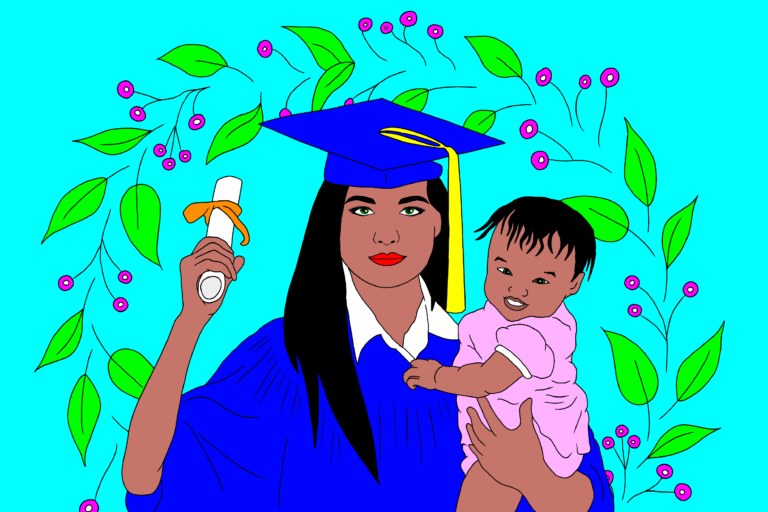

Workshop fosters solidarity among student parents, strives to retain women with children in the academic pipeline

0

UC Davis student parents can find resources and support through WorkLife, the Women’s Resources and Research Center, the Student Disability Center and Safety Services

Kira Tiedge, a postdoc in the Department of Plant Biology, hosted a workshop on April 9 to support Ph.D. students and postdocs with children. The workshop, supported by the ‘Professors for the Future’ fellowship, featured talks from representatives from UC Davis WorkLife, the Women’s Resources and Research Center (WRRC), the Student Disability Center and Safety Services. It also featured a discussion where advisors discussed what they can do to support the needs of Ph.D. parents and their hopes to further improve the work-life balance of these students.

“The idea for this workshop first occurred to me when I moved to Davis 18 months ago with two small children to start my postdoctoral research,” Tiedge said. “I was surprised to learn how tough it is here to have children as a grad student or postdoc. But when I started to dig a little deeper, I found a multitude of resources for parenting Ph.D. students and postdocs at UC Davis.”

Tiedge opened up the workshop by sharing that the academic pipeline for women in higher education does not feature a linear structure. Women represent 53% of female bachelor graduates, 43% of female Ph.D. graduates and 28% of female researchers, according to Tiedge.

Tiedge added that almost half of all women in science, technology, engineering and math leave after having children.

By holding this workshop, Tiedge said she hopes to embrace solidarity among working parents.

“I decided to organize an event to bring together all those different people and institutions on campus and to send a signal to parenting Ph.D. students and postdocs to let them know that they are not fighting alone,” Tiedge said.

The first talk was given by Sandy Batchelor, the WorkLife and Wellness coordinator. 

“[WorkLife supports students] through our student parent child-care grants, student parent childcare grants, our resource pages, a lactation support program and [we are also] a part of Healthy UC Davis [Together] which promotes a healthy lifestyle,” Batchelor said. 

Batchelor also shared that the lactation program at UC Davis allows students to have free private consultations with a lactation consultant, access to classes and support groups and the opportunity to use the numerous lactation rooms across campus.

Vanessa Segundo, a Ph.D. student in the department of education, presented next on behalf of the WRRC.

“Everything that we do, the way that we lend our resources and services, is through a gender equity lens,” Segundo said. 

The WRRC offers a student parent closet with baby supplies, a lactation space and toddler and teen activities. During COVID-19, the student parent program in the WRRC has been offering virtual events for children with an upcoming farming and gardening event which will be held on Saturday, April 17. They are also hosting bi-weekly graduate virtual writing rooms and student parent mixers. 

Jennifer Billeci, the director of the Student Disability Center, presented next.

“The Student Disability Center can provide support to students at any stage during their pregnancy and during the postpartum period, and that’s regardless of whether it’s a typical pregnancy or a pregnancy with complications,” Billeci said.

The center can assist with schedule adjustments, rides to classes and employment support if the student is working on campus. They have a wide variety of services they can offer to meet the needs of the individual student. 

Veronica Thron, the supervisor of the Laboratory Safety Program, then presented on behalf of campus’ Safety Services. 

“We have the opportunity to work with researchers, graduate students and undergrads to identify the hazards in the workplace and, most importantly, mitigate those hazards,” Thron said.

After the talks, the discussion portion of the workshop allowed mentors to share advice regarding how to best support student parents.

“[As mentors] we should always ask our mentees what they need and not assume that they need anything,” said Natalia Deep-Sossa, a professor in the Chicana/o studies department. “Pregnancy is not a disease. We need to make sure that they know what their rights are and what laws and policies exist through the university and in California.”

Tiedge said she hopes the workshop allows attendees to feel a sense of solidarity and encouragement from the plethora of support available to them as they work tirelessly to achieve their career goals.

“We, as students or postdocs, all want to be here and do the best we can,” said Lidor Shaar-Moshe, a postdoc in the Department of Plant Biology and the genome center. “We just need a bit more flexibility in order for us to really shine and really be able to do what we want to do.”
Written by: Maddie Duley — campus@theaggie.org

Phoebe Bridgers comes to UC Davis for a virtual performance and live Q-and-A for students

0

The indie-rock musician gave an intimate concert, opening up about her image and her music

On Friday, April 9 ASUCD Entertainment Council (EC) hosted Phoebe Bridgers right in everyone’s homes. This virtual concert and Q-and-A featuring indie music’s current reigning melancholy queen was the most appropriate quarantine alternative to the usual Spring Quarter concert. 

According to Galit Hara-Salzberg, the head of ASUCD EC, whether Spring Quarter would have an event at all was shrouded in uncertainty in the fall due to considerations of safety restrictions as well as budget cuts. Luckily, ASUCD EC partnered with and got funding from Healthy Davis Together for this event and the “Lean into Local Life” series from Winter Quarter—allowing Hara-Salzberg to search for an artist students would be excited about.

With about 500 people in attendance on the Zoom and over 150 questions submitted to the Q-and-A, there really is no denying that the “Pharbz”—the self-proclaimed name of Bridgers fans—were happy to have her in Davis, no matter if it was through a screen. It felt as if after every single song there were at least ten people in the Zoom chat claiming that they were “literally crying,” which is definitely not an unbelievable feat considering Bridgers incredibly emotionally charged discography. 

The event was aptly promoted all over Facebook and every other person’s Instagram story as a chance to “Come Hang with Phoebe Bridgers,” as her usual laid-back demeanor was clear to see throughout the show. Between her guitar-tuning breaks between songs, the jokes and bits of trivia about each song and her engagement in the Q-and-A, it really just felt like a chill Zoom call with a friend (who has the voice of an angel) and an incredibly active chat. With the open chat and added direct Q-and-A between Bridgers and students, this Zoom call was practically as close as anyone could (safely) get to an in-person event right now. 

As Bridgers sang her especially hard-hitting (and chart-topping) songs such as Motion Sickness, Moon Song and Kyoto, the participants in the chat (as well as myself) were in shambles. As Bridgers so eloquently puts it in her song Motion Sickness, “there are no words in the English language,” for this fairly intimate, yet remote, live performance. It is safe to say that the ASUCD EC entirely succeeded in their mission to find “someone who could connect, and be a friend,” as Hara-Salzberg said. 

After 40 splendid minutes of music, Bridgers answered a few live questions from students and made time to introduce her beautiful pug puppy, Maxine, to the audience. At one point Bridgers discussed the frustration sexism in the music industry induces, pointing out the painfully overused “Sad Girl Musician” monolith that has so often been used to group any woman making emotional music together, disregarding the myriad of genres and topics broached by the artists placed under this umbrella. According to Hara-Salzberg, it was of great importance to find an artist from a genre ASUCD EC had not previously hosted, and landing the woman currently dominating not only the indie scene but the music industry at large perfectly fit that bill. 

While Bridgers is the creator of some of the best cry-inducing music, she is one of the most personable, giggly and witty people in a Zoom meeting, and one can only imagine how electric her truly live performances could be (even if they are usually sans-Maxine, the perfect pug). With the immensely positive reaction this event received from the student body at Davis, it begs the question of if we might get another interactive show, whether virtual or in some other form, further down the line. It looks as though this may be the case: “It will definitely be something to consider next year […] we don’t know how things will look but the next [ASUCD EC] Director should definitely factor [events modeled like] this into their plans,” Hara-Salzberg said. 
Written by: Angie Cummings — arts@theaggie.org

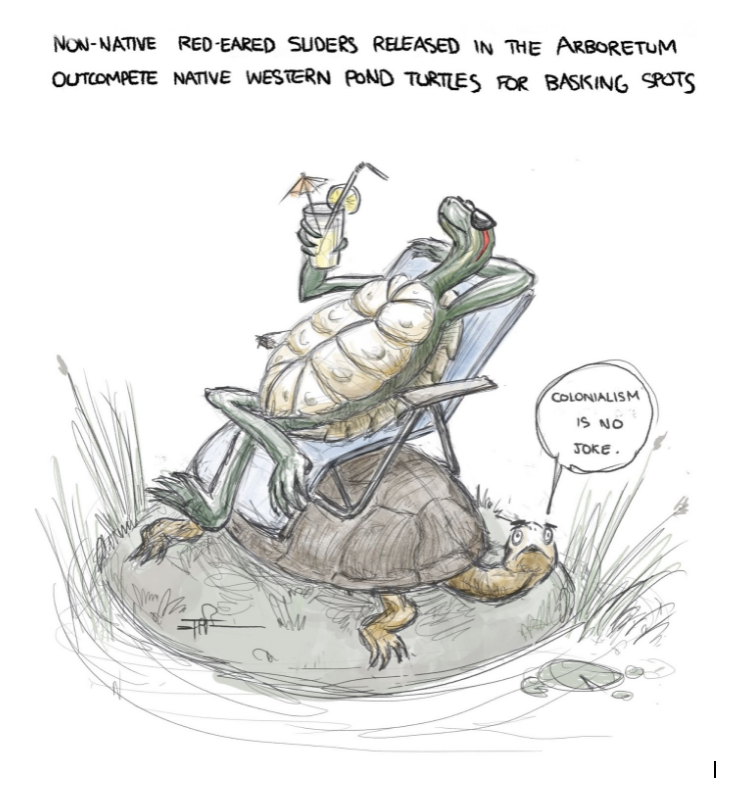
Don’t release your pet turtles in the Arboretum

0

Drawn by: Rushi Tawade –– rntawade@ucdavis.edu 
Disclaimer: (This cartoon is humor and/or satire, and its content is purely fictional. The story and names of “sources” are fictionalized.)

TikTok: the champion of the common man

0

The world’s most controversial app should continue to uphold its legacy

If you’re like every other person that’s gone through 2020, you’ve either heard about, downloaded or loathed TikTok. Personally, I’m a TikTok fanatic. I’ll tell myself I want to scroll for five minutes and end up with my cornea inches from the screen for hours.

The more traditional social media platforms seem to have their express purposes: Facebook is for life-sharing, Snapchat is for messaging and Instagram is for photo-sharing. There’s no doubt that between all of these basic functions, the notoriously infectious internet trends are one of the most exciting and rewarding parts of scrolling around.

Chain messages, mannequin challenges and Harlem Shakes are the bread and butter of internet culture. Despite the staleness of being a one-in-a-billion social media user, these trends allow us to band together under huge inside jokes.

TikTok is in a league of its own in that it takes out all of the usual fluff that Facebook or Instagram have and just feeds you trends. The app is a constant stream of dance renditions and shared sounds––and it works. TikTok trends aren’t just part of the app; they are the app. 

What’s most fun about internet trends is that users can partake in something that everyone else is doing with the added challenge of trying to make the trend their own. It’s like the internet’s version of riffing on jokes with your buddies. We’re all trying to come up with the funniest or craziest version of the same thing. 

The original Harlem Shake video, for example, was just four people thrashing in a closet-sized dorm room. As the trend grew in popularity, however, people gathered in lecture halls and office buildings to try to one-up everyone else’s thrashing. That’s the beauty of internet trends; we’re trying to fit in and simultaneously stand way out. 

TikTok, unlike most social media platforms, has found a way to not only overload you with trends but also makes sure that everyone has a shot at reaching the top. 

The TikTok algorithm isn’t entirely driven by what’s most popular in a general sense, it’s mainly driven by each users’ unique video taste. It’s a step above other social media platforms because your average, everyday Joe-Schmoe can go TikTok viral without much more than a skateboard, Fleetwood Mac and some cranberry juice

 In an article by Wired, it’s revealed that the TikTok algorithm “relies on a complex set of weighted signals to recommend videos, including everything from hashtags and songs to the kind of device a person is using.” So if you’re into, say, frogs riding tortoises, you’ll get plenty more frog videos on your For You page. 

If a frog video becomes popular amongst its target audience, then it has the chance to balloon into a larger trend and cross over the threshold between niche and mainstream. TikTok, then, has the unique ability to deliver information that might normally be filtered out on other platforms. This is a huge opportunity for us to stir up trouble amongst us—“the masses.” 

“The masses” (meaning the large population of commoners in society) as a sociological concept was defined by elites and intellectuals of the early 20th century as groups of people who were written off as irrational, untrustworthy beings. It was also said that we should be quelled and silenced.

 A lot of this ideology hasn’t really changed. Take Georgia, for example. The newest round of restrictive voting laws in the peach tree state is a direct reflection on the ill-conceived concept that we, the average Americans, do not know what’s best for us. 

TikTok, then, could be one of the many new modern-day conglomerations of the masses that can emerge in the digital age. 

A perfect example of this idea in practice was the TikTok-led dunking on former-President Donald Trump’s ego at his campaign rally in Tulsa, Oklahoma. TikTok users joined forces with K-Pop stans and bought over a million tickets for Trump’s rally—and didn’t show. They employed a masterful manipulation of the algorithm to spread information on the prank without letting any major news outlets find out until after the fact.

It’s no coincidence that Trump, a billionaire, tried and failed to have TikTok banned in the U.S. during his presidency. The former president recognized the power that the app has in fomenting passions amongst us and sought to destroy it. 

TikTok truly has the best chance of uniting the modern-day masses via the internet. TikTok’s celebration of the little guy can only spell trouble for those in positions of power. Every single user has a relatively easy ability to cultivate a platform, and this gives us the most chances to truly make some waves. 

Written by: Isabella Chuecos — ifchuecos@ucdavis.edu 
Disclaimer: The views and opinions expressed by individual columnists belong to the columnists alone and do not necessarily indicate the views and opinions held by The California Aggie

Everyone should have equal access to COVID-19 vaccines

0

As disparities in the vaccine rollout become increasingly apparent, the Editorial Board encourages everyone to help others stay safe and get vaccinated

On April 6, 2020, President Joe Biden announced that all Americans would be eligible to receive the COVID-19 vaccine by April 19, roughly two weeks earlier than the previous deadline set by the administration. After a year of isolation and loss, what once seemed unimaginable for many Americans—widely accessible vaccines to protect against COVID-19—are now closer than ever, bringing hope to many that the end of the pandemic is near. 

In California specifically, Governor Gavin Newsom announced that all Californians over the age of 16 would be eligible to make a COVID-19 vaccination appointment starting April 15. Many vaccination clinics were able to open their appointments to those over 16 much sooner, including UC Davis Health, which recently expanded its eligibility to all those over 16 on April 6.

Yet while the vaccine rollout has brought hope and protection to many, it has been wrought with issues that continue to highlight the disparities within our healthcare system. Racial and ethnic minorities, who are at an increased risk of getting sick and dying from COVID-19 due to longstanding health inequities, are receiving smaller shares of vaccinations in comparison to their share of the population and their COVID-19 infection and death rate. For example, only 23% of vaccinations have gone to Hispanic people in California, while they make up 40% of the population, 55% of COVID-19 cases and 47% of deaths.

Meanwhile, white people consistently are receiving more than their fair share of vaccinations. Data from 41 states compiled by the Kaiser Family Foundation indicate that the vaccination rate for white people is 1.8 times higher than the rate for Hispanic people and 1.6 times higher than the rate for Black people.

These differences are often attributed to disparities in access to vaccine infrastructure, as Black and Hispanic people are less likely than white people to have access to reliable internet for booking appointments or flexible work schedules to attend their appointment. Vaccination rates also align with socioeconomic status; according to a press release from the Office of Gov. Gavin Newsom, 50% more vaccinations have gone to California’s wealthiest populations than the poorer and more vulnerable. 

On a global scale, vaccinations have almost exclusively been given to wealthier countries that were able to buy vaccines sooner. As of March 30, 2021, 86% of shots administered worldwide have been given to individuals in high- and upper-middle-income countries, whereas only 0.01% of doses have been given to individuals in low-income countries. At that time, 30 countries had not been able to administer a single vaccine dose, and it was estimated that many developing countries will not be able to vaccinate their entire population until 2024.

Though the U.S. was able to secure vaccine doses earlier than other countries, the fragmented vaccine rollout within the U.S. created noticable differences on a state and county level. Many eligible individuals who were able to receive their vaccinations in the last few months heard about available appointments through word of mouth, making it difficult to book highly elusive appointments which vary based on personal connections. 

While California’s My Turn website has centralized the process for booking a vaccination appointment, appointments are still challenging to find and availability is limited. Though the state’s increase in vaccine supplies in the coming weeks should alleviate some of those challenges, Newsom warns that, “it is expected to take several months for willing Californians to be vaccinated.”

The state of California has implemented some measures intended to alleviate the disparities in vaccine distribution, including funding local programs aimed at vaccinating the state’s most vulnerable communities and partnering with community-based organizations to vaccinate farmworkers. UC Davis Health has also worked on distributing the vaccine to individuals experiencing homelessness in Sacramento and providing COVID-19 outreach and educational services to farmworkers.

The Editorial Board urges all students and community members to get the vaccine as soon as they are eligible and able to book an appointment. In light of these systemic disparities, it is important for those who are vaccinated to acknowledge the privilege they have in receiving the vaccine. This includes assisting others who may have a harder time accessing vaccine appointments by helping them book appointments and spreading the word about vaccination clinics. 

While many health disparities revealed by the vaccination rollout need to be addressed on a state-wide and national level, these individual actions can help those who face unfair challenges get access to vaccines sooner—leading to more protection for our entire community.

Even with vaccination rates on the rise, be sure to follow the guidelines set by the Centers for Disease Control and Prevention, social distance and wear masks in public. 

If you or anyone you know has concerns about the COVID-19 vaccine, there are resources available. The CDC has information about vaccine safety and effectiveness at https://www.cdc.gov/coronavirus/2019-ncov/vaccines/effectiveness.html. You can schedule an appointment through https://covid19.ca.gov/vaccines/
Written by: The Editorial Board

What will study abroad look like post pandemic?

0

Global Learning Hub discusses plans for study abroad programs in fall 2021

Among the many experiences lost as a result of the COVID-19 pandemic has been studying abroad. Given the stay-at-home orders and health directives, the prospect of students traveling overseas became dangerous and study abroad programs have been canceled or moved online since March 2020. However, as vaccines begin to be distributed, hope for a travel-filled future lingers in the air and provides possibilities for students dreaming of a study abroad experience. 

Zachary J. Frieders, the executive director of UC Davis’ Global Learning Hub and Global Affairs, shared that the Global Learning Hub is continuing to navigate the uncertainty of these times as they determine the best decision for student safety. Frieders said that a decision about in-person fall programs will likely be made in May. 

“Hopefully things will continue to evolve [and] we can send our students this fall,” Frieders said. “But if not, we want to get back out there as soon as we possibly can, and so we’ll just keep looking at the evolving guidances, the vaccination program rollout and how the virus is impacting different parts of the world differently. But we certainly intend to send study abroad as soon as we feel like it’s safe to do so.”

Joanna Regulska, the vice provost and dean of Global Affairs, shared that the decision-making process involves a variety of careful considerations. 

“As always, we will be following guidance from the CDC [Centers of Disease and Control and Prevention], public health officials and others to adjust logistics and/or accommodations as necessary and we will continue to plan programs that have high quality academic and experiential rigor,” Regulska said via email. 

Regulska shared that beyond the in-person study abroad programs, the Global Learning Hub also offers remote opportunities such as the Global Career Development series and the Global Ambassador Mentorship Program that provide students with experiences from their own homes.

“Study Abroad is an excellent way to gain global perspectives and experience the world, but it isn’t the only way,” Regulska said via email. “Global Affairs is here to help, especially our Global Learning Hub, which is linking students to existing global learning opportunities across campus and developing new ones.”

Additionally, many students choose a study abroad program outside of the selection UC Davis offers: University of California Education Abroad Program (UCEAP) provides UC students with study abroad opportunities across the globe and functions separately from the Global Learning Hub. Emma McNeilly, a second-year global disease biology major, is planning on studying abroad with UCEAP in Denmark during the fall semester of 2021. 

McNeilly has always planned to study abroad and is choosing to do so during her junior year before she starts doing research or taking more complicated major requirements. While the program has not been fully confirmed due to COVID-19, McNeilly shared the factors she took into consideration when making the decision to apply for the program. 

“I’m a global disease biology major, so traveling in a pandemic is kind of a once-in-a-lifetime opportunity to see health policies and practices in another country,” McNeilly said. “I wasn’t going to go if I wasn’t vaccinated, but I recently got vaccinated so that was a priority for me.”

While McNeilly is hesitant about potentially encountering new strains of the virus while overseas, she trusts the program directors to make a decision that is safe for all students. Overall, she looks forward to the potential experiences to come if the program is approved for this fall. 

“I am just looking forward to going to another country; I’ve really never left the U.S.,” McNeilly said. “I’m just excited to see how different countries structure their education.”

Looking forward, Regulska encourages students to stay informed about study abroad opportunities and plan ahead by speaking to advisors. 

“We look forward to having more opportunities for connecting with each other, learning and creating together in person, whether on campus or around the world, as soon as it’s safe to do so,” Regulska said via email. “I encourage students to reach out to advisors in our Global Learning Hub to ask questions and learn more about programs and opportunities that are best for them for both the short and long-term.”
Written by: Nora Farahdel — features@theaggie.org

California expands vaccine eligibility to those age 16 and older

0

Health professionals discuss vaccine supply and demand as California expands eligibility

On April 1, the state of California expanded the eligibility for COVID-19 vaccines to residents over the age of 50. As of April 15, all adults over the age of 16 can receive the vaccine, and on April 6, UC Davis began administering vaccines to anyone 16 and older. Despite this dramatic increase in the number of eligible individuals, the actual number of people who can get vaccinated depends on the vaccine supply. 

Dr. Brad Pollock, the associate dean of public health sciences at the UC Davis School of Medicine, noted that there were vaccine shortages even when eligibility was more restricted. With a greater number of eligible individuals, the wait time for scheduling a vaccination appointment may increase to a few weeks.

“Even though you’ve increased the eligibility to a whole bunch of other people, it doesn’t mean that the supply will be there,” Pollock said. “There will be even more shortages, but we hope that as the manufacturers produce more vaccines, [those shortages] will be made up for. The vaccine supply is increasing steadily, and I’m optimistic about that.”

Pollock said that allowing more young people to get vaccinated is an important step in ending the pandemic. According to the California Department of Public Health, while those aged 50 and older accounted for the majority of COVID-19-related deaths, the highest number of cases were found in the 18-34 age group.

“While the older people need to be protected because they’re at higher risk for having bad outcomes, most of the spread has been coming from younger people,” Pollock said. “If you’re able to get vaccines into the arms of younger people, it’s likely to have an even more accelerated impact on curbing new infections.”

Pfizer is currently working to get the vaccine to even younger age groups. In a study on participants aged 12-15, the Pfizer-BioNTech vaccine showed 100% efficacy.

Although people 16 and older will now be able to receive the vaccine, priority will still be given to high-risk individuals due to the limited vaccine supply. According to My Turn.ca.gov, a site launched by the state of California that allows eligible individuals to schedule vaccination appointments, “people with a high chance of exposure and people 50 and older” are being prioritized.

Natasha Abadilla, who is in her final year of medical school at the Stanford School of Medicine, said that even with the increased eligibility, there will still be populations that face barriers to receiving vaccines. For example, those who do not have internet access or who face literacy challenges can experience difficulty signing up for an appointment online. 

To address these disparities, community organizations are working to get vaccines to underserved populations. Healthy Davis Together has launched mobile units to administer vaccines to more remote populations.

“For the vaccines in general, you need to be on the ball in terms of signing up online,” Abadilla said. “That’s a big barrier to receiving the vaccine. Luckily, there are some really good organizations that are going out within underserved communities with the one-dose Johnson & Johnson vaccine.”

Abadilla advised those who are vaccinated to continue exercising caution and following Centers For Disease Control (CDC) guidelines. This includes following social distancing protocol, maintaining proper hygiene and waiting two weeks after your final dose to allow your body to build up immunity.

“I also advise them not to feel entitled when you have the vaccine because so many people in underserved communities do not have the vaccine,” Abadilla said. “The vaccine does not make anyone morally better than anyone else because lots of people have barriers to getting it.”

Christina Tran, a full-spectrum family medicine physician at Kaiser Permanente in Roseville, also commented on the barriers to getting vaccinated, such as a lack of access to healthcare or vaccine education. She stated that My Turn is a helpful tool for those who have internet access, as the site informs people where vaccines are being administered. This includes local pharmacies, such as Safeway or CVS, or hospitals that are distributing vaccines to anyone regardless of insurance status.

“At Kaiser, we even give vaccines to those who are not Kaiser members,” Tran said. “Even if you’re not insured under Kaiser, you can always check our website at kp.org/covidvaccine.”

Tran said that it’s important for as many people to get vaccinated as soon as possible to reach herd immunity before new COVID-19 variants have the chance to spread. While the vaccines that are currently being distributed are effective against common variants, they may be less effective as newer variants arise.

Knowledge about the vaccines has become more widespread, but some may still be hesitant to get vaccinated. Tran assured that all three vaccines have been Food and Drug Administration-tested and proven safe. While the specific vaccine that one receives will depend on the supply that’s available, all three are highly effective against COVID-19.

“To get any of the vaccines would be great for this pandemic, as well as for your own health and safety,” Tran said. “I encourage everyone to get the vaccination as soon as possible so we can end this pandemic.”

UC Davis students, staff and faculty can visit MyUCDavisHealth or Health-e-Messaging to make a vaccination or COVID-19 testing appointment.Written by: Liana Mae Atizado— features@theaggie.org

Local nonprofits adjust operations to follow pandemic safety guidelines

0

Community faces an increase in overall need due to pandemic-related hardships

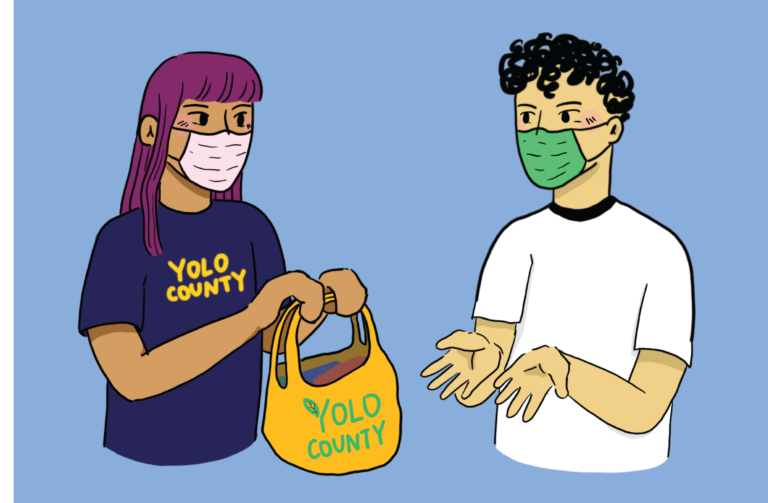
Just over a year into the COVID-19 pandemic, nonprofit organizations such as Yolo Food Bank, Yolo County Children’s Alliance and Progress Ranch have experienced significant changes, including an overall increase in need. 

Yolo Food Bank’s official website states that it serves to “coordinate the storage and distribution of food from a network of growers, manufacturers, distributors, wholesalers and grocery stores, while simultaneously cultivating new sources of food.”

Yolo County Food Bank Director of Philanthropic Engagement Joy Cohan described the two categories of needs for food assistance during the pandemic. The first category is needs caused by factors such as job loss and business failures, and the second category is pre-existing needs in the community. 

“We are permanently at an increased level of service, so now our challenge is to sustain that level of service over the long-term,” Cohan said. “There’s going to be years of socioeconomic fallout from the pandemic. We are very keenly focused on how we sustain this level of service.”

Cohan further explained how Yolo Food Bank collected and distributed six million pounds of food per year before the pandemic. During the pandemic, 10 million pounds of food were collected and distributed. 

“We have the opportunity to look more deeply at what it really takes to have a local food system,” Cohan said. “Not just giving people food because they’re hungry, but really getting into the systemic issues that cause people to be chronically food-insecure or to come in and out of food security.”

Cohan expressed her gratitude to the community for their support. 

“We’re incredibly grateful at Yolo Food Bank to the community for prioritizing food security and meeting basic human needs during this pandemic,” Cohan said.

Yolo County Children’s Alliance’s website writes that it works to “help families, particularly non-English speaking families, access services, learn valuable parenting skills and find support.” 

Yolo County Children’s Alliance (YCCA) Director of Programs Jeneba Lahai described how YCCA was impacted by the pandemic.

“It has affected us a lot because we are a people-facing organization with the majority of services conducted in person,” Lahai said. “We are embedded within the community to serve families, individual adults and seniors.”

Lahai further explained that various YCCA’s services—such as parenting classes, home visits and other client services with the family resource center—have been conducted over phone, Zoom or FaceTime because of the pandemic. In some cases, in-person meetings were conducted one-on-one with clients in order to provide needed resources.  

Lahai noted how the pandemic has had a negative impact on income equality.

“Income inequality has widened because of the pandemic,” Lahai said. “As an organization, we are really looking at how we can support families at the other end of this pandemic.”

Lahai explained how YCCA is currently focusing on housing stability for families as well as on the family resource center in general.

“We want to make sure that every child, every family—no matter what you look like, what language you speak, where you come from—we want to make sure that you have access to resources that are available to you in order to thrive within Yolo County,” Lahai said. “We also want to make sure that there’s racial equity, equity all across the board in everything that we do.”

Progress Ranch, a Davis-based nonprofit, writes on its website that it specializes in “treating young male children who have experienced trauma and attachment disruption.”

Executive Director of Progress Ranch Wendi Counta explained how Progress Ranch faced difficulty in transitioning to online learning. 

“We got very innovative, but I would say that the hardest part was on our kids,” Counta said.

Counta described how the pandemic caused Progress Ranch to adjust their method of operations. 

“We need to do some realignment of our current situation of staffing and just making everything run more efficiently,” Counta said. “COVID really took us two steps forward, one step back. We’ve got a lot more work to do to clean up after that.”

Counta added a final note regarding the importance of nonprofit organizations during the pandemic. 

“While some businesses have seen a drop in what they need, the services they provide, I would say nonprofits are seeing an increase in needing to support and help the community,” Counta said.
Written by: Jelena Lapuz  — city@theaggie.org

In its sixth year, UC Davis Global Tea Initiative continues sharing tea and history

0

The founding director and a panelist discuss holding annual colloquium online and the versatility of their research through tea

The Global Tea Initiative (GTI), the first broad-based program for tea research in the world, is now in its sixth year at UC Davis. Even through the pandemic, the initiative has found a way to continue hosting their annual colloquium and has even expanded to a two-part event with over 30 speakers in 2021.

In 2012, Katherine Burnett, the initiative’s founding director, became the chairperson of the Department of East Asian Studies at UC Davis. After a somewhat unexpected conversation with a colleague, Burnett decided to pursue institutionalizing the study of tea to increase awareness of the East Asian studies department.

“One thing led to another, including a chance meeting with a collector in the area who collects Japanese art […] over dim sum, at which I happened to bring a bunch of little teapots and things that look like teapots,” Burnett said. “In the middle of this lunch, the gentleman, Darrell Corti, […] picked up one of the little teapots, and he said, ‘Catherine, what I don’t understand is why does UC Davis not study tea?’”

Burnett saw UC Davis as the perfect place to pursue the study of tea because it is a channel to learning more about many other topics.

“You literally can study tea from almost any different perspective,” Burnett said. “You can study the science, you can study the plant, […] you can study the literature in China, Japan, Korea, other places in India, literature and songs that are written that engage tea and talk about people’s lives. The list goes on and on.”

Once Burnett shared the idea to begin a tea research group at UC Davis with her provost at the time and the deans of the East Asian studies and art history departments, she was given seed grant funds and within six months of beginning her research, the initiative had gained a lot of attention. Burnett said that the new development officer, Assistant Dean Charlene Madison, approached her about how they could further the research in hopes of eventually institutionalizing GTI. 

They began holding yearly colloquia to bring awareness to the initiative, with a different theme each year that allowed GTI to explore tea from a different perspective. Held on Jan. 21, 2021, this year’s colloquium was called “The Stories We Tell: Myths, Legends and Anecdotes about Tea.”

Since the COVID-19 pandemic forced the colloquium to move completely online, GTI was able to have over 30 presenters on Zoom, making it a jam-packed day of panels and discussions. Burnett said that while it was amazing to have so many participants, attendees missed the conversational aspect of past in-person colloquia.

“At least there’s time at the lunch break or between panels for people to chat with each other and comment and network and share ideas, learn from each other and get that kind of personal engagement that you can do onsite,” Burnett said. “What everybody always says is, ‘You know what I’d like the most: I’d love the opportunity to meet other people and talk about this.’ The students love the opportunity—and the industry members love the opportunity—to network.”

In response to this feedback, GTI decided to plan a second virtual event for this year, called “Talking about Tea: Myths, Legends and Anecdotes,” to allow for further discussion of the research presented at this year’s colloquium. This event will be held over Zoom on April 23 from 3-5 p.m. and will be more of a casual, conversational event. Beforehand, various pre-recorded presentations from the January event and newly recorded presentations will be posted on GTI’s website for attendees to pre-screen.

One of the January panels that will be available online is a roundtable about tea in 17th century British culture. Hosted by UC Davis English professor Frances Dolan, this panel includes four graduate students—Ben Fond, Grace Hayes, Mikhaila Redovian and Himali Thakur—who offer presentations on various topics, from poetry and early writing about tea to the creation of spaces for consuming tea and a comparison of tea plantations in Assam today to the tea gardens in London in the 17th and 18th centuries.

According to Dolan, she first became involved with GTI as a tea drinker and attendee of past colloquia, but when the colloquium went virtual this year, she saw an opportunity to involve the graduate students in her global consumption seminar, which has a unit focused on tea.

“Once the seminar began, I asked students if they’d like to conduct some of their research on tea and present it for the symposium,” Dolan said via email. “We were able to film their presentations just after our seminar discussions about tea. Then they fielded questions ‘synchronously’ [during the colloquium in January]. As it turned out, doing it virtually was actually great for grad students early in their careers because we had a bit more control of the timing.”

According to Dolan, she knew she wanted to discuss 17th century British culture because that was when tea and coffee first came into the English diet, and many parts of British culture at the time could be explored through the consumption and discussion of tea.

“While coffeehouses excluded women, tea quickly became associated with women who presided over tea tables in their own homes,” Dolan said via email. “So you had, at first, gendered spheres: men drinking coffee in public coffeehouses, which were also hubs of news exchange and political intrigue, and women drinking tea at home with more intimate circles of friends.”

The beginning of trade relations between Britain, the East Indies and India were also traceable through studying tea, according to Dolan.

“One of the first references to tea in English texts is a poem dedicated to Queen Catherine of Braganza, wife of King Charles II, who supposedly brought a trunk of tea with her from Portugal and popularized tea drinking,” Dolan said via email. “As part of her marriage settlement, she also brought Great Britain trading rights in the East Indies and India—trade routes that would encourage the English production and consumption of tea (among other things). I think that the [17th] century association of tea with women and private table talk haunts the use of the word ‘tea’ to mean gossip now.”

Presentations from Dolan’s students and their roundtable question-and-answer session can be found on the GTI website, as can many other panels that will be discussed at the upcoming event on April 23. To preregister for the event or view the panels from this year’s colloquium, visit GTI’s website

Written by: Katie DeBenedetti — features@theaggie.org

Workplace Reimagined workgroup plans to reinvent the office

0

A diverse group of employees have come together to discuss how remote work may become a long-term solution for UC Davis staff

As COVID-19 has impacted the practices and places of work, UC Davis staff has responded by establishing a university working group to consider what work at the university could look like after the pandemic. The workgroup, Workplace Reimagined, aims to find solutions for employees who are looking to continue full remote or partial remote work environments after the pandemic ends, as well as develop new solutions to office spaces at the university.

Christine Lovely, the associate vice chancellor and chief human resources officer, said she’s excited to see what the workgroup comes up with. 

“We’re really looking at how we can leverage what we’ve learned over the course of the past year,” Lovely said. 

The Workplace Reimagined Workgroup, which began on Jan. 28, consists of a cross section of staff from around the Davis campus who are looking at ways that the university can develop more flexible working arrangements for staff.

The working group is still in its early stages, but Lovely said one potential benefit in the future could be saving the university money.

“In time, I could see us saving on leasing space,” Lovely said. “Maybe even in time, [I could see us] eliminating the need to lease space, because if we have people kind of rotating in through space, we don’t have one office or one desk for each person.” 

Hamid Fonooni, the director of the ergonomics program on campus, has been working with the group since its inception as part of the Resources/Finances subgroup.

 “I’m pretty confident that the return on investment would be substantial,” Fonooni said. “In monetary terms, but also employees’ job satisfaction, productivity, morale—a lot of soft measurements.”

Michael Gunnarson, a fourth-year aerospace science and engineering major, said having remote options for staff is important for staff to attend to sick children for example, but he simultaneously worries about the administration’s other motivations. 

“That flexibility is important, but I think that if cutting costs is involved and if that’s the driving factor, they’ll use that as an excuse to give [students] worse service,” Gunnarson said. 

Currently, the full remote positions that are being discussed would not be for positions that typically involve face-to-face interactions, such as student advising or faculty.

Lovely said that providing remote work options can be a positive tool for recruitment.

“I have had a couple of people in my own organization hired away by other universities that are willing to say now that they could work 100% remote,” Lovely said. 

One option presented would consist of a bullpen-style working area for employees that could be shared by anyone who needed a working space, but wouldn’t be assigned to a particular employee.

“A lot of people have individual offices, but maybe we need to be thinking about that in a different way, like having coworking spaces where different people can come in and work at different times using the same space,” Lovely said.

The workgroup has a deadline to present a big-picture plan by May.

“Basically the group is supposed to come up with a high-level plan—we don’t get into the details,” Fonooni said. “Is it a good idea? If it’s a good idea, what would be the scenarios?”

The workgroup has a suggestion form on its website that can be used by anyone interested in providing feedback to help inform the process.

“I suggested the name ‘Workplace Reimagined,’ because it would be helpful for the group to think of the whole way we work and how we work from a different lens,” Lovely said.

Written by: Kathleen Quinn — campus@theaggie.org

Yolo County Fire Safe Council members discuss year-round fire prevention efforts

0

Organizations across Yolo County address seasonal increases in fires and continue to address fire prevention

On March 24, the Yolo County Fire Safe Council had its second meeting, during which council members discussed fire preparedness and prevention with other community leaders. 

The Fire Safe Council was formed under the Yolo County Resource Conservation District to provide support for wildfire prevention, wildfire response and post-fire recovery efforts by implementing projects in the Yolo County Community Wildfire Protection Plan (CWPP). The meeting and the formation of the Council mark Yolo County’s efforts to address fire safety issues in light of the recent increases in wildfires across California. 

California Senator Bill Dodd talked about the importance of the Fire Safe Council at the Feb. 23 introductory Fire Safe Council meeting

“There is an unfortunate reality of needing to have a Fire Safe Council and these councils can help prepare local communities for the wildfire season,” Dodd said. “These councils can do great work in fuel reduction projects and increasing the insurability of property which is incredibly important.” 

In the same meeting, Executive Director of Yolo County Resource Conservation District Heather Nichols explained the importance for the creation of the Fire Safe Council. 

“We knew there was a trend toward annual wildfire, particularly west of Winters,” Nichols said. “There was the Monticello fire in 2014, the Rag fire in 2015, the Cold fire in 2016 and then the Winter fire and the nearby catastrophic Tubbs fire in Santa Rosa in 2017. That next year, the Camp fire destroyed the town of Paradise.” 

Nichols explained that to address these issues more directly, the Yolo County Resource Conservation District adapted their experiences and ongoing efforts in fire conservation efforts. 

“We have over two decades of experience working with residents and landowners and leading stakeholder drive planning, which is what is needed here,” Nichols said. “We’ve done weed management plans for Putah-Cache Creek on farm and ranch technical assistance addressing issues like erosion and vegetation and habitat management. And in town, we do educational workshops with residents.”  

The Fire Safe Council is projected to provide input on the draft of the Wildfire Risk Assessment, which is presented by the CWPP steering committee in fall of 2021, Nichols explained.

“[The CWPP steering committee] will provide a draft of the wildfire risk assessment this fall,” Nichols said. “Once that is finalized, the RCD will hold a series of public meetings in Winters, Dunnigan and Esparto to identify projects for the CWPP.”

More information about the Yolo County Fire Council and its mission can be found on its website, along with information on its upcoming meetings, which are open to the public. 

 In addition to fire prevention efforts at the county level, more localized year-round fire prevention efforts are being led by the UC Davis Fire Services. 

Lead Deputy Campus Fire Marshal Jim Patterson explained via email how UC Davis Fire Prevention has been successfully continuing its mission of fire safety and prevention and education despite the mostly-remote nature of campus operations. 

“During the fall we still worked with student housing to conduct in-person fire drills for all student resident halls while following all guidelines for face covering and physical distancing,” Patterson said via email. “We are currently working with Student Housing and West Village on a cooking safety campaign targeting unattending cooking. We use Zoom to continue getting the word out.” 

In addition to the other fire prevention efforts UC Davis Fire Prevention heads, it works with other campus organizations to ensure fire safety as well, Patterson explained via email. 

“Fire Prevention collaborates with the UC Davis Fire Department, Campus Planning and UC Davis Grounds and Landscape Services to identify and provide weed abatement around campus property,” Patterson said via email. “This helps to prevent fire hazards created by vegetative growth and combustible debris.” 

Patterson offered up additional tips to use either on or off campus for individuals to stay fire safe. 

“At home you should always make sure you have properly working smoke detectors and a fire extinguisher, never leave cooking unattended, and make sure you have an escape plan,” Patterson said via email. “At school or work, know two ways out of the building you are in, the location of fire extinguishers and fire alarm manual pull stations.”

Written by: Yan Yan Hustis Hayes — city@theaggie.org

Vaccine passports can be used as a means of encouraging vaccinations, but a U.S. program may face considerable obstacles

The pros and cons of vaccine passports: explained

As of April 5, 2021, more than 18% of the U.S. population is fully immunized against COVID-19. Though many who are eligible and eager to get vaccinated struggle to find an appointment, public health officials are starting to look for ways to incentivize those who are less interested to take the vaccine as more doses become available. 

One such way is through so-called “vaccine passports,” a document issued by public health agencies confirming that an individual has been vaccinated. This document could then be used to gain access to bars, concerts, air travel and other higher-risk activities. The implementation of such programs is similar to how UC Davis students currently access campus facilities through the UC Davis Daily Symptom Survey. The difference being that vaccine passports would verify the person’s vaccination status rather than relying on a recent negative COVID-19 test like the current UC Davis Symptom Survey does. 

Over the last three months, Israel has emerged as a global leader in their COVID-19 vaccination rollout. According to Matan Zamir, the deputy consul general of the Israeli Consulate in San Francisco, over 50% of the total population of Israel has been fully vaccinated. Since children and people recently infected with COVID-19 are currently ineligible for vaccination, fewer than 10% of the eligible Israeli population has yet to receive their vaccination. 

The Magen David Adom, Israel’s national emergency service, began vaccinating the nation’s vulnerable populations in December 2020 before expanding to the general public in early 2021. Zamir credited the quick vaccine rollout to their relatively small population of approximately 9.25 million citizens and their universal healthcare system. Their healthcare system “is very concentrated/centralized and highly digitized,” which allowed their four health maintenance organizations (insurance organizations frequently referred to as HMOs) to easily monitor the vaccine status of all citizens, according to Zamir. Because there are only four different insurance plans with one central health system in the country, keeping track of everybody’s medical records to know who is vaccinated is much easier for the Israeli ministry of health. 

To continue encouraging Israelis to get the COVID-19 vaccine, the Israeli government recently implemented a vaccine passport program called the “green pass.” 

“The green pass is an app which is operated by [Israel’s] ministry of health where you put your ID number, the dates where you got the vaccine doses and the certificate confirming that you vaccinated with either the Pfizer or Moderna COVID-19 vaccines,” Zamir said. “Then the ministry of health confirms this and gives you back an image of green people, who are very happy because they can return back to life. With that, you can go to a restaurant, hotels and cultural performances.”

Israel’s green pass program has been increasing the number of people choosing to get the COVID-19 vaccine, according to Zamir. 

“Luckily, there are very few people in Israel that are 100% opposed to getting the COVID-19 vaccine,” Zamir said. “But there are still many people who are in between [on the decision to get the COVID-19 vaccine] or are looking for motivation to get the vaccine, other than the media campaign. For them, I think, the green pass is also a strong motivator to get the vaccine to see their favorite soccer team or go to a spa.”

While Israel has nearly 90% of their eligible population vaccinated, according to Zamir, the U.S. is closer to 18%, according to NPR. While the U.S. has a much larger population (roughly 332 million to Israel’s 9 million), adding to the complexity of the rollout, the vaccine rollout in the U.S. has largely been criticized for being inequitable. Because of this difference in equity of vaccine delivery in the U.S., Raquel Aldana, a professor at the UC Davis School of Law, believes that implementing a similar vaccine passport program in the U.S. would be “premature.”

“One issue is that the government is responsible for the dysfunction and messiness of creating a system that is inaccessible for people who don’t have access to a computer and the internet,” Aldana said. “There is also a historical reason why people are skeptical. It crosses race. There is a big mistrust of government, particularly among poor people, who feel a sense of abandonment and also a sense of betrayal.”

Aldana believes that the U.S. government needs to find a way to motivate people to be vaccinated against COVID-19. Aldana described how vaccines were historically mandated by the government, and while “that may not be politically feasible today,” Aldana believes there are still efforts that the government should make to encourage trust in the vaccine. 

Meanwhile, other countries such as the U.K. plan to begin testing vaccine passports as early as next week. The U.K. will begin easing COVID-19 restrictions, such as their ban on overnight domestic stays and outdoor patio dining, provided that the customers can prove their vaccination status. Importantly, 50% of adults have received one dose of the COVID-19 vaccine in the U.K. with the government hoping that all British adults would have at least one dose by the beginning of July. It is also important to note that the U.K. has a socialized healthcare system and a population of roughly 68 million people which makes the distribution of the COVID-19 vaccine in the U.K. fundamentally different from that in the U.S..

According to CNN, the Biden administration is currently working to develop standards to prove vaccination in the U.S., implying that there is some discussion about vaccine passports eventually being implemented in the U.S. However, this is much more complicated in the U.S. than in other countries due to the lack of a centralized healthcare system, among other obstacles—one of which is that the COVID-19 vaccines currently available only have an emergency use authorization (EUA) rather than full approval from the Food and Drug Administration (FDA). Though the vaccines have been shown to be safe and effective, the process for getting full approval takes much longer and the government likely cannot mandate any vaccinations prior to full FDA approval. 

As for UC Davis, even with universal vaccine access coming soon in California, it remains unclear if COVID-19 vaccinations will be required for students to return for in-person instruction. For now, UC Davis will continue to rely on the Daily Symptom Survey and frequent testing of students, staff and the community—something the university has worked hard to ensure is universally available and based in equity. 

Written by: Justin Weiner – science@theaggie.org

UC students call for UCPD policy changes, budgetary reallocations during second UC Campus Safety Symposium

0

Many prospective campus proposals to reimagine campus safety and security were discussed at the symposium

During the second live University of California Campus Symposium on March 24, students, staff and faculty members met to discuss the future of campus policing and the role of the university’s police departments. UC students from the UC Student Association (UCSA), the UC Graduate and Professional Council (UCGPC), No UCPD Coalition and more called for policy changes and budget reallocation to the UCPD.

The symposium began with opening remarks from UC Regent John A. Perez and UC President Michael V. Drake. Drake reflected on the past symposium and the months of discussion between students, staff and community members about their experiences with policing on and off campus, acknowledging that these experiences and perspectives are important.

 “We want to assure you that we are listening, learning and committed to real change,” Drake said. 

He mentioned that despite the symposium having no prescribed or fixed outcome, as there is currently no fixed procedure on how campus safety looks, the discussion is “guided by the same desire” to create a more respectful and safe community within the UC. A proposed summer action plan is designed to inform campus plans for the fall and to envision the future of campus safety and policing. 

Due to a lack of student involvement from the last symposium, the discussion began with a presentation from Naomi Riley, the UC Council of Presidents co-chair and an undergraduate student at UCLA, and Naomi Waters, the vice chair of the UCSA Racial Justice Now at UC Riverside. Other students provided opening remarks, including UCSA President Aidan Arasasingham, an undergraduate student at UCLA, and UCGPC President Gwen Chodur, a graduate student at UC Davis.

“The problem of over-policing at the UC in our communities is not new, and students, faculty and staff are justifiably tired of discussing the problem every few years with only Band-Aid solutions on the table,” Arasasingham said. “This symposium asks us to think older, to think and to ask, ‘What solutions truly re-envision [what] campus safety looks like from the ground up?’”

Citing the aftermaths of the 1965 Watts Rebellion and the 1992 Los Angeles uprising, Arasasingham mentioned how solutions to campus safety exist if a similar model to the solutions to both uprisings is followed. The solutions that resulted from both events called for an investment in basic needs instead of over-policing, according to Arasasingham. 

“By the end of these symposium discussions, we have either the opportunity to be a mirror reflecting the failed status quo policies and thinkings that have guided racialized over- policing for decades, or [we have] a window into a new and transformative view of campus safety that breaks from our past and lights the way to our future,” Arasasingham said. 

Chodur added how most of the student position is “overwhelmingly abolitionist.”

 “This is not a radical position, this is not an uninformed position,” Chodur said. “Our stance is informed by the lived experiences of our community and by rigorous scholarship performed by faculty at our institution.” 

She further mentioned how the UC system adopted a new framework which examined basic needs beyond food and housing for students to succeed academically. Chodur called for the UC to approach a similar idea to campus safety to see what needs to be changed so all students feel safe and secure. 

Riley and Waters provided a list of student demands, which included policy changes regarding UCPD policing, and safety and budget reallocation to address student needs like combatting student homelessness, food security, mental health services and more. 

They further cited how the UC campuses spent $136 million on policing alone in the 2019-2020 school year despite other programs going unfunded. They called for a reduction in the number of officers by at least 40%, the elimination of mutual aid between municipal and state police and shared governance over campus operations between faculty and students. 

Riley mentioned how despite many attempts of state and local programs to reform the police department through body cameras, anti-bias training and more, none can get at the roots of policing as it is an “inherently oppressive institution that must be abolished.” 

Riley referred to Graduate Center Professor Ruth Wilson Gilmore, who has emphasized protection through life-affirming institutions. 

“Building life-affirming institutions at the UC looks like investing in students’ basic needs: Providing housing for all students, creating institutions that believe and support survivors, increas[ing] recruitment and retention efforts for those most marginalized [and] challenging notions of criminality, power and justice,” Riley said. “In the upcoming months, the UC has a chance to put this theory into practice, to lead the nation in reimagining campus safety, to repair harm that silencing and systemic racism has inflicted on our communities of Black, Indigenous and people of color, and to build a university [that] truly allows its students, staff and faculty to thrive.”

Liz Halimah, the associate vice provost of Student and Equity Affairs at the UC Office of the President, shared prospective campus proposals to re-imagine campus safety and security. Some campuses are thinking of creating mental health police/crisis teams for wellness checks or crisis response, having students serve as community service officers, introducing public safety officers, using data to better inform resource allocation and de-emphasizing enforcement of minor traffic violations.

The proposals have also included reconciliation methods, such as UCPD outreach to historically marginalized communities, acknowledging past harms and trauma and integrating campus anti-racism initiatives. 

Halimah shared that there are undergraduate and graduate students who already serve on police advisory boards and campus safety task forces, but the hope is to further engage students through town halls, focus groups, personal security training and task forces.  

Further faculty and student discussion touched on reconciliation, accountability and data transparency, as well as the current and future roles of police and non-police. 

Jack Clarke Jr., the chair of the Task Force on Campus Safety at UC Riverside, commented on the re-examination and re-assigning roles of campus police.

“The concept of policing should be more [of] a movement of community and in this case, campus safety overall,” Clarke Jr. said. “That would require considering and implementing a series of campus elements that could address mental health concerns, address people who are simply in crisis [and] address situations where force is not being used. The [UC] Riverside Campus is considering and making efforts to create a department that reflects those concepts.”

Martin Reed, the assistant vice chancellor for Student Life and Residence Education at UC Merced addressed the UCMPD’s role in helping to address Title IX cases and helping to deal with students of concern, stating that the removal of the campus police could be harmful.

“They’re not perfect, but I prefer them over Merced City and Merced County police,” said Reed.

Nicole Green, the executive director of CARE and the director of Counseling and Psychological Services at UCLA, touched on stigmatization and criminalization of mental illness at the UC and the role the police play. 

“What has happened is that police have been used in a lot of ways to sort of mitigate and respond to mental health crises,” Green said. “When UCPD is often called, the assessment is rudimentary in a lot of ways, restricted to a few basic questions and officers can’t really go on in a more sophisticated way like a mental health clinician [could]. There is no real intervention being offered at the moment beyond just de-escalating a crisis and maybe a referral.”

Kerby Lynch, a graduate student at UC Berkeley and the co-chair of the Independent Advisory Board, mentioned personal incidents with the UCPD and called attention to Black student lives lost due to hostile campus climate at Berkeley, specifically. 

“The role of UCPD is that we have to invest in internal affairs, we have to invest in people in the department who have the actual skill-set in accountability,” Lynch said. 

In the closing remarks, Drake thanked those in the discussion and highlighted how the UC is impacted by issues of our society. 

“We know that [the issues discussed] also exist across the street from our campus and our broader cities and we have to work in ways to address these issues of oppression and systemic racism that exist throughout our society,” Drake said.
Written by: Annette Campos — campus@theaggie.org

Review: ‘Falcon and the Winter Soldier’

0

The series takes a new approach to superheroes, giving fans something to look forward to every Friday

Warning: Spoilers ahead. 

“Falcon and the Winter Soldier” is Marvel’s newest addition to Disney+ featuring Falcon Sam Wilson (played by Anthony Mackie) and Winter Soldier Bucky Barnes (played by Sebastian Stan). The series takes place after the events of “Avengers: Endgame,” when Steve passes the title of Captain America onto Sam. However, in the series, fans see that Sam doesn’t want the title and instead donates the shield to the Smithsonian, which ultimately results in a disappointing attempt at a replacement for Captain America. This series focuses on Sam as he tries to readjust his life after being gone for five years due to The Blip, his attempts to save his family’s business and Bucky readjusting to life with post-traumatic stress disorder (PTSD). 

I’ve always been one to appreciate less action-packed episodes in TV shows. I love when the audience can take a break from the main action and get to know the characters; this is why I immediately loved “Falcon and the Winter Soldier.” We were given minimal fight scenes in the show, and instead showed events that happened after The Blip. We see Bucky dealing with his PTSD and seeing a therapist, trying to make amends for his actions that occurred when he was under hypnosis working for Hydra, and we see Sam trying to reconcile with his family. 

I’ve always wondered what happens to superheroes after a big event and how the physical damage caused affects civilians. The Blip was an especially intriguing event considering that for five years, half of the Earth’s population completely disappeared, which had to have had some drastic effects on just about everything. What I love about “Falcon and the Winter Soldier” is that they address those effects. The entire series revolves around an anarchist group that prefers the way things were when The Blip took effect. The plot line is exactly what I’ve always craved; it doesn’t simply give us a minimal nod to the past. It is exploring the aftermath of a mess that was created. 

Although I would have loved the characters to get the peace and quiet they deserve, it wouldn’t have been a Marvel show without adding some unnecessary pain into their lives. That is where the Flag Smashers come in. The Flag Smashers is the anarchist group that our beloved superheroes are up against in this series. Instead of the usual superhero vs. supervillain plotline, we see our heroes fighting against an ideal. There is an entire group dedicated to the belief that the world was better when The Blip occurred, where there was a nation without borders. 

Like all villains, the Flag Smashers blatantly ignore the consequences of their actions and do whatever they can to achieve their own goal. But with an entire group being set on this ideology, it’s hard to see how Sam and Bucky will conquer this new villain. Taking out the leader of the group only solves a piece of the puzzle. The followers of the cause still remain and the ideology persists. With this type of villain, it doesn’t look like an easy fight, and I am extremely excited to see how it plays out. 

The series also sheds light on villains, which is appealing to me. The Flag Smashers are a group with superpowers that mimic the super-soldier serum Captain America was given, but fans predict that they could be mutants, and this may be how Marvel introduces the X-Men series into their productions. All predictions aside, we detect a few good features in our villains, and this builds a conflicting relationship with them. In one scene, a member of the group altruistically gives up his life so that his friends can get away, commiting an ultimate sacrifice where viewers are left wondering if Flag Smashers are really the villains at all in the show. 

I’m hoping to see a potential plot twist surrounding this anarchist group and the new Captain America called in an attempt to replace Steve. The replacement is introduced as a seasoned veteran with multiple medals and a kind heart—maybe it’s A-plus acting, or maybe it’s the fact that I wanted to see Sam become Captain America, but something about the new Captain makes me suspect that he isn’t going to be the good guy he’s portrayed to be. 

All of this combined with my favorite bickering duo, the show was bound to steal my attention. Sam and Bucky have always fought like siblings and their small scenes of anger toward each other are the light chuckle needed in a dark show. However, while their arguing was once about moving the seat forward in a crouched Buggie, it’s now about never talking to each other again. As Sam gave up the shield and didn’t step into the Captain America role, they found a washed-out replacement for our star-spangled superhero. 

But the replacement is everything that Captain America isn’t. When Steve was chosen to be Captain America he was chosen for his heart; he wasn’t the strongest or the toughest man but he was the most clever and he had pure motives. This is also why the shield was passed onto Sam—he was supposed to be Captain America for his shared morals with the original Captain. Instead, a replacement was found in another blond, blue-eyed soldier that doesn’t hold the same qualities that fans love in Captain America, and he is everything that Steve wouldn’t have wanted. 

This is why I’ve always supported Steve’s decision to bring Sam in as the newest Captain America. I admired Sam’s willingness to do the right thing and I loved the friendship he had with Steve; it made sense that he became the new Captain. This change also helps establish the representation that is desperately needed in popular media. A Black man as Captain America gives the writers a platform to talk about racism, to speak about prejudices and to touch on heavy topics that are often ignored. 

A mere two episodes in and viewers are able to witness the blatant discrimination and systemic racism that Black men face. During the second episode, the police see Sam and Bucky arguing on the street and ask Sam for his ID while making sure that Bucky is okay. This short interaction in the series not only shows the injustice that people of color face but also the white privilege that is pervasive and often overlooked. Examples of privilege acknowledged in the episode include when Bucky is asked by the police if Sam was bothering him and Bucky insisting that Sam just show the police his ID. These types of conversations are important to have and I’m looking forward to seeing how the rest of the season evokes similar discussions. 

“Falcon and the Winter Soldier” is a perfect addition to Marvel’s collection of superheroes. It gives the audience an interesting storyline, two beloved characters and a new type of villain, and all of this combined gives me something to look forward to on a Friday in the midst of a pandemic. 

Written by: Itzelth Gamboa — arts@theaggie.org