59.1 F
Davis

Davis, California

Wednesday, December 24, 2025
Home Blog Page 277

Culture Corner

0

The Arts Desk’s weekly pick of movies, TV shows, books and music

Album: “Fetch the Bolt Cutters” by Fiona Apple (2020)

There are almost no words to convey how strongly I feel about Fiona Apple’s latest album. “Fetch the Bolt Cutters” came out almost exactly one month into the stay-at-home order last year (April 17 to be exact), and it was absolutely the highlight of my entire Spring Quarter and summer. Apple so deservingly won Grammys for both Best Alternative Music Album and Best Rock Performance for the song “Shameika”—coincidentally one of my favorites. With every single track, you can hear the pure emotion Apple poured into this homemade album. What is especially notable is the fact that I’m pretty sure even if there were only nonsensical lyrics in any of the songs, you could still feel everything she put into it. I personally would not complain about an entire album of just her animalistic vocalizations at the end of “I Want You to Love Me.” I don’t want to sound annoying, but this album should be considered a piece of avant-garde art. It embodies one of the best things in the world: a woman scorned by the world getting back at everyone by simply bodying what she does. If you somehow have not listened to this album yet, please go do it now and see if it doesn’t make you want to run and scream out into the middle of a field. (That might just be me, but still it is a great album.) 

Movie: “Forgetting Sarah Marshall” dir. by Nicholas Stoller (2008)

This movie is one of (what feels like) hundreds of rom-coms produced by Judd Apatow in the mid-2000s—and just like most of them, this one is a huge success. “Forgetting Sarah Marshall” (along with many other films produced or directed by Apatow) is where nepotism in Hollywood really worked out—he consistently only casts his friends, and they make some really funny and easy-to-watch movies. “Forgetting Sarah Marshall” has definitely stuck with me partially because I watched it for the first time when I was far too young. I recently rewatched it (instead of studying) and found myself laughing just as hard as before. This movie has Hollywood’s favorite rom-com trope, the insanely mediocre middle-aged white dude (played by Jason Segel) who somehow wins over the incredibly gorgeous and witty new girl (Mila Kunis) and, in this movie, is trying to get over his equally beautiful and talented ex (Kristen Bell). Rewatching this movie, I was shocked at how star-studded even some incredibly minor parts were, like Jonah Hill playing the hotel employee in some of the best scenes of the movie or Paul Rudd playing the airhead surf instructor, both actors probably only having a combined 10 minutes of screentime. While there is no doubt that this movie will make you laugh, it is definitely a product of its time (just 13 years ago), packed with casual sexism, some underlying hints of racist tropes and not-so-subtle fake tans. I definitely caught myself picking out these questionable decisions and just wondering “why?”—my favorite one being the fact that Kunis was consistently put in an extreme push-up bra and half-unbuttoned, too-tight white top every time she was behind the desk of the hotel she worked at. Was there a real reason for her to be so sexy at work? Nope, but someone decided it was crucial to her character development. All in all, a super funny movie with what are now obviously problematic aspects. 

Book: “I Love Dick” by Chris Kraus (1997)

Yes, the title of this book might be a bit much, but that’s not really what it’s about. Kraus somehow managed to blend her real-life experiences and emotions with fiction, in addition to perfectly stitching a narrative around sequences of letters. In this book, Kraus details her somewhat unhealthy and oftentimes highly cringe-worthy infatuation with a charismatic sociologist friend of her husband’s, who she has renamed Dick to keep his true identity hidden. Over the course of countless letters to Dick and months after her first interaction with him, it is clear that “Dear Dick” is simply a stand-in for “Dear Diary.” This is not necessarily a book about the man a woman is obsessed with—this book is an (at times uncouth) expression of female desire, unafraid of being entirely honest about it. One of my favorite parts is the way it entirely flips the script of attraction. “Dick” is a powerful and dynamic man that Kraus reduces down to only what she wants from him, essentially making him her muse and nothing more. Kraus is more than her “love” for Dick, and her story in no way solely revolves around the men she writes. 

TV Show: “Curb Your Enthusiasm” (2000)

I don’t think there is any way around saying that this is the funniest and smartest “cookie-cutter” sitcom on television. Not only is Larry David an amazing comedy writer—as he has proven as a writer for “Saturday Night Live” and “Seinfeld”—but he is also the perfect, unlikable “underdog” in his own show. I have always loved “Curb Your Enthusiasm,” consistently going back to rewatch old episodes instead of finding a new (and most likely half-as-funny) show to watch before bed, and when I found out the vast majority of each scene was improvised, my admiration shifted into awe. Knowing this while revisiting some of my favorite episodes, my respect for David, and every single person he shares a scene with, goes through the roof. This is the kind of show where, even if you’re just watching alone in the middle of the night, you’ll laugh harder than you will watching sitcoms like “Modern Family” or “Friends.” David plays an incredibly unlikable version of his already pessimistic and dry-humored personality that will make you wince at the awkward situations he gets himself into, but you won’t be able to look away as he just keeps messing things up episode after episode. 

Written by: Angie Cummings — arts@theaggie.org

NBA’s injury issues make MVP race more unpredictable

0

Recent injuries to some stars have made this season’s MVP much harder to choose

After a short 71 day offseason, the National Basketball Association (NBA) was determined to make this season work and be successful even with COVID-19 still being a major factor worldwide. But, what the league failed to realize when the decision was made was the possible implications this could have on players’ bodies. With injury problems plaguing the league, they have found their way into the Most Valuable Player (MVP) discussion, as recent events have only made it even harder to pinpoint the favorite.

For the majority of the season so far, Philadelphia 76ers star center Joel Embiid has been the frontrunner for MVP. Averaging just under 30 points, 11 rebounds and 1.4 blocks a game, Embiid has elevated his game and his team to the first seed in the Eastern Conference. Highlighted by a 50-point game earlier in the season against the Chicago Bulls, Embiid has been spectacular on both ends of the floor. Although he has an impressive resume, his durability reared its ugly head again. 

Embiid has not played more than 64 games in a season throughout his career. He missed the first two years with a foot injury and in early March, the injury bug caught him again. Embiid suffered a knee injury which later was officially called a left knee bone bruise. This injury will sideline him for a couple of weeks at the very minimum, and he has now missed 15 games in this season alone as it stands. That means that he will unlikely get the MVP barring something unforeseen, as NBA voters are more likely to pick someone who did not miss extended periods of time. Once seen as the clear front runner, Embiid may have once again lost his chance at the MVP trophy.

Someone very familiar with MVPs is Los Angeles Lakers star LeBron James, who owns four of those himself. The 18-year veteran and four-time champion has had to carry the load himself as his co-star Anthony Davis heals from his own injury. James has done that and more, as he averages 25 points a game and seven rebounds and assists while shooting 50 percent from the field. With his Lakers near the top of the Western Conference standings, James’ path to his fifth MVP was clear—until it wasn’t.

On March 20 in a game vs the Atlanta Hawks, James suffered a high ankle sprain after Hawks’ Solomon Hill fell on his lower leg, causing it to bend outward. Due to this, James has been listed as out “indefinitely” and will miss anywhere from four weeks to possibly more. It is a brutal injury for a player who has been able to battle for 18-years with minimal injuries, but his recent occurrence may cost him one of his last runs at MVP.

With Embiid and James out for the foreseeable future, Denver Nuggets center Nikola Jokic has emerged as one of the odds on favorites. According to FanDuel, Jokic is now at +115 odds to win MVP, climbing his way atop the rankings. Averaging 27 points a game, Jokic has dazzled everyone with his ability to do everything on the offensive end. His ability to pass is not common for 6’11 players, but his 8.6 assists a game puts him sixth in the league. His consistent improvement yearly is not shocking, but with his team on the rise in the standings and the most recent injuries, it seems as though Jokic is in control at the moment. If he can continue his impressive season and lead his team to one of the top three seeds in the Western Conference, it will make his chance at MVP that much greater.

There are many more MVP candidates that have gotten their well deserved recognition, like Portland Trail Blazers guard Damian Lillard. His 30 points, 7.6 assists and 4.4 rebounds a game has kept his team afloat while they battle through some injuries to key players. Currently at sixth in the Western Conference, Lillard will need to climb the standings into the top half of the playoff teams if he wants to have a legit shot at the award. Nonetheless, his impressive numbers and ability to carry his team has caught the eye of many, as he tries to claim his first MVP of his career. 

For now, it seems like it will come down to a battle between Jokic and Lillard. But, that does not mean that they are the only two with legit arguments. Rather, a sense of voter fatigue and situation has blocked some players from possibly getting into the race up until this point. 

When it comes to former MVPs James Harden from the Brooklyn Nets and Giannis Antetokounmpo from the Milwaukee Bucks, it is possible to make an MVP case for them every year. Harden was traded from the Houston Rockets midseason in a situation that got very messy, so it is possible that his good graces with the voters may not be there this season. But, he is averaging 25.7 points, 11.5 assists and 9.1 rebounds a game—a near triple-double. With fellow star Kevin Durant being sidelined the majority of the season, Harden’s play has kept the Nets as one of the most dangerous teams. It is unknown how his situation in Houston will affect how voters look at him, but there is no doubt that he has been one of the better performers this season.

In Antetokounmpo’s case, the two-time MVP won both his awards the last two seasons, which could explain why he might not get much attention. Putting up nearly what he did in his MVP years, Antetokounmpo has put together a great year, averaging nearly 29 points, 12 rebounds and a career-high six assists a game. With Milwaukee currently near the top of the Eastern Conference, Giannis’ argument could get stronger as the season goes on. But, voter fatigue may become an issue, as his last two consecutive awards may sway some voters to go in another direction. If he does in fact win his third straight MVP award, he would be just the fourth player in NBA history to have done so, joining hall of farmers Wilt Chamberlain, Bill Russell and Larry Bird, who was the last to do it from 1983-1985.

There is a solid case for every one of these individuals, but for one reason or another, they all have something that may hinder them from doing so. With less than two months left in the regular season, the battles for standings and playoff positioning will only begin to intensify as the year progresses. As it stands, it seems like the candidates are narrowing down. But as everyone has learned so far in this season, you never know what twists and turns are yet to come. 

Written by: Omar Navarro — sports@theaggie.org

Twelve UC Davis faculty awarded the 2021 Early Career Grant

0

UC Davis assistant professors shed light on how their projects will revolutionize the future of science

Twelve members of UC Davis faculty were awarded the 2021 CAREER grant, an early-career award from the National Science Foundation (NSF). 

“All NSF grant proposals have some aspects of research, intellectual merit, educational activities and impacts to society,” said Laura Starkston, a CAREER grant recipient and an assistant professor in the Department of Mathematics. 

The award allows faculty to focus on a single principle of investigation and develop ways to promote education and scientific research over the span of five years. 

Katerina Ziotopoulou, an assistant professor in the Department of Civil and Environmental Engineering, is researching soil liquefaction and will be developing new approaches to reduce earthquake damage. 

Ziotopoulou said that she has been working in the field since her Ph.D. for years and has developed numerical tools that help predict hazards in the soil.

“After I trained myself [and] attended multiple workshops, I started getting more and more convinced that [this project] really does have the potential to reshape the way we do liquefaction,” Ziotopoulou said. “Even if the five years that I do this project don’t reshape [liquefaction], I was convinced that it would pave the way for newer developments.”

The project will also be implementing education to include the community in the change and inform them about liquefaction and earthquake damage prevention. 

“We are looking at developing workshops for teachers from the broader Yolo County and seeing how we can help them develop new demos and tools for the classes to propel their ability to talk about geotechnical earthquake engineering,” Ziotopoulou said. 

Tran Nguyen, an assistant professor of environmental chemistry, was awarded a CAREER grant for her research project on sulfur radicals, a simple radical molecule consisting of one hydrogen and one sulfur atom. Nguyen was inspired to pursue the idea when her students noticed an unusual reaction inside the classroom.

“We found that when we photolyzed [used light to break down molecules], the sulfate solution close to the concentration that they would be found on atmospheric particles, [the solution] generates reactive radicals and it started to react with all of our organics,” Nguyen said.

Surprised by the reaction, Nguyen was interested in pursuing this further.

“Sulfate is everywhere in the environment, and it’s thought of as very stable,” Nguyen said. “We photolyzed it, and it produced a bunch of organosulfate products, which is the sulfate anion turning into something reactive enough to start attacking organics and attaching itself to the organic molecule, becoming organic sulfate.”

When atmospheric particles have organosulfates on them, the organosulfate goes to the surface of the atmospheric particle, allowing the particle to interact with water better. As a result, aerosol particles with organosulfates can nucleate clouds more efficiently. “Cloud aerosol reactions and interactions have been identified by the IPCC [Intergovernmental Panel on Climate Change] as the biggest uncertainty in our human understanding of anthropogenic climate change,” Nguyen said.

This project may shed light on the new chemistry’s effects on climate.

“It could be that it makes aerosols a little bit easier to nucleate clouds, and therefore maybe we’re underestimating the cooling effects of aerosol or underestimating the lifetime of clouds,” Nguyen said.

The project investigates how some of the chemistry has the potential to be very metastable—a stable state lasting for a relatively long time—in the environment. 

“We need to do these reactions and get the fundamental constants that can come out of it,” Nguyen said. “Then, we need to plug it into a global atmospheric model and see how it changes.”

Nguyen plans to share this project with the community by making chemistry more accessible to students.

“I plan to integrate open access data into undergraduate education,” Nguyen said. “I also plan to work with a group that uses social media to distribute more accessible information about environmental chemistry to people around the high school age and parents who do homeschooling.”

Laura Starkston, another grant recipient and an assistant professor in the math department, plans to use math to break down four-dimensional spaces in a way that is easier to visualize.

“We are not very good as human beings at visualizing four-dimensional space,” Starkston said. “The goal of the project is to give some concrete, hands-on ways to mathematically represent or get a visual handle on these spaces that are inherently unvisualizable.”

Starkston shared an analogy to show how this project will express four-dimensional spaces as two or three dimensions. 

“It’s kind of like if you’re building some giant piece of architecture or a bicycle,” Starkston said. “You’ve got a bunch of little pieces, a simple piece of metal or a simple piece of wood, and you put them together in a complicated way and that builds something complicated.”

Starkston plans to provide tangible ways to mathematically visualize these four-dimensional spaces.

“The goal with these four-dimensional spaces is to break them down into pieces and encode the way that they fit together in some kind of drawing that serves as an instruction manual for those connections,” Starkston said.

This project will be applicable in the realm of physics and areas where the marriage of math and science is necessary to better explain the four-dimensional spaces that represent space and time.

“A lot of times with abstract math, mathematicians explore it because it’s interesting and there’s something that we don’t understand that we can try to learn,” Starkston said. “Over time, science runs into problems where they need an abstract idea to explain what’s going on, and they look to the math that’s been developed.” 

Starkston plans to use the grant money to fund research, employ graduate students and hold workshops for experts all over the country who are interested in the project.

“I [also] want to use the grant money for a program that will connect graduate students and undergraduate students who are interested in math,” Starkston said. “This is a reading program to prepare them to get some extra experience with some specialized topics that they might not find by just taking classes.”

Other recipients of the grant include Jonathan Herman, Ambarish Kulkarni, Xinfan Lin, Scott McCormack, William Putnam, Marina Radulaski, Nitzan Shabek, Aditya Thakur and Jesús Velázquez.

The recipients are hopeful that COVID-19 restrictions will be lifted in order to safely access university equipment for their research.

“We’re hoping everything goes back to normal with COVID so that we can be in the lab a little bit more and access more instruments and do more experiments,” Nguyen said.

Written by: Maddie Duley — campus@theaggie.org

UC Davis Medical Center launches stem cell clinical trial for spina bifida treatment

Fetal Surgery Department and researchers collaborate to combine surgery and placental stem cell therapy

A UC Davis Health research team, in collaboration with the Fetal Surgery Department at the medical campus, recently announced the first-ever stem cell clinical trial to treat in-utero patients with a birth defect called spina bifida. 

Dr. Aijun Wang, a trained bioengineer and an associate professor of the department of surgery for the UC Davis School of Medicine, describes the birth defect, the focus of a bioengineered therapy project he has been working on for over a decade.

“Spina bifida is a birth defect, specifically a spinal cord injury that happens early in gestation,” Wang said. “During normal fetal development the spinal neural tube folds early in gestation to cover the spinal cord and protect it. But spina bifida causes the exposure of a part of the spinal cord, usually in the lumbar area. The most severe form of spina bifida, called myelomeningocele, causes an extrusion of the spinal cord during gestation and even after birth.” 

For most patients, the babies are born paralyzed and rendered unable to walk. The current standard treatment of care for babies detected with spina bifida had been solely fetal surgery. However, the surgery alone did not serve as a guaranteed cure.

In close collaboration with Wang on this project, Dr. Diana Farmer, the chair for the department of surgery as well and a trained fetal surgeon, is the principal investigator of the clinical trial and describes the significance of the stem cells to be applied for the first time on fetal patients. 

“We use placental stem cells because we think and have been able to show that they have unique and special properties compared to bone marrow-derived stem cells and other stem cells,” Farmer said. “They are specially cultured and engineered to secrete growth factors important to nerve growth and development.”

Dr. Jan Nolta, the director of the stem cell program at the UC Davis gene therapy center, describes her role in aiding Farmer and Wang’s clinical trial.

“The stem cells come from the placenta of different qualified donors, whom we have tested their blood, screened and made sure they do not have any viruses,” Nolta said. “Here at UC Davis, we are very lucky to have a Good Manufacturing Practice facility, where we can take a small amount of those placental stem cells and grow them into a big batch of stem cells. That also gets qualified, tested, cleaned and purified from which we thaw out a small amount from that batch for fetal surgery.” 

Farmer further highlighted the properties of these stem cells and how exactly they participate in the healing of the fetus.

“The placental stem cells have regenerative and antiinflammatory properties that help reverse apoptosis, cell damage,” Farmer said. “If you think about it, the fetus is constantly making new cells–eyeballs, fingernails, heart cells, skin and everything in nine months. We think the fetus is the perfect target for this particular regenerative stem cell therapy because the fetus is always regenerating itself.”

The preparation of this project, through previous animal studies that both Farmer and Wang have conducted and through analysis and qualification of these placental stem cells will continue to pave the way for future stem cell research. 

“We hope that we can cure spina bifida—that these children will walk,” Farmer said. “That is what we saw in our animal studies, and we worked with the veterinary school to treat dogs born with spina bifida and we saw improvement there as well. So we are very optimistic, hoping that every win in the stem cell therapy arena will advance other stem cell research and therapy for other diseases. I think it is a very promising field for future scientific work.”

Wang further highlighted the optimistic future for stem cell therapy and what he hopes people will gain from this pivotal stem cell clinical trial. 

“This is a very important study, being able to apply this lab-grown technology from the bench to the bedside,” Wang said. “Spina bifida is, relatively speaking, a rare condition. But the paralysis associated with this disease is more like many other conditions that can cause spinal cord injury. If we can apply this to neuron injuries and damages, it could have a pretty broad impact on many patients actually, including those with neurological degenerative diseases.”

Written by: Brandon Nguyenscience@theaggie.org

In the age of online learning, do proctored exams undermine students’ privacy?

0

Students say proctored exams make them feel uncomfortable and more stressed

As the world scrambled to acclimate to life at the start of the COVID-19 pandemic, schools and colleges turned to an online learning format: Zoom learning. 

A major adjustment for students also has been online proctored exams, where students are watched by an individual from the other side of a camera as they take a test—and it’s oftentimes a person they have never met or whose identity is unknown.

Exam proctoring sites such as Examity, ProctorU and Proctario have risen considerably in use in the last year. These exam methods use real-life proctorers (over Zoom), software that detects and flags suspicious behavior (like Proctorio) or a mixture of both. Zoom proctoring, Examity and ProctorU are all services that have been used by UC Davis.

Proctoring sites such as Examity require the use of a webcam, audio, photo ID, full name, email, a snapshot of one’s test taking area and even a biometric template of students’ keystrokes.  

Other proctoring services use a mixture of a students’ webcam and access to their whole computer screen and browser to monitor them while testing. Some even go as far as using biometrics, which is like artificial intelligence, and uses eye tracking to determine “suspicious” actions to catch for cheating.

Eleanor Bemis, a fourth-year design and communication double major, said that proctored exams add extra stress to an already distracting test taking environment. 

“With online exams it’s just difficult in general,” Bemis said. “With an in-person exam… [there are] no other external factors you’re really worried about. In a proctored exam, there are external factors you have to worry about. You have to be aware of noise during a pandemic, if something goes wrong with the internet. You have to worry about more than just testing taking.”

Another worry for students is if they will somehow accidentally be flagged for cheating. 

“I find myself constantly worrying about if the proctor is trying to find something that’ll disqualify my test results,” said Hamad Arif, a third-year political science and economics double major.

Tahla Bahnasy, a second-year cognitive science major, agreed.

“It always adds the extra pressure of being flagged or the professor emailing you for something that is out of your control in your current living situation or for something that isn’t cheating,” Bahnasy said.

Students’ privacy comes into concern because they don’t really have a choice in the decision of taking a proctored exam, as it is often up to the discretion of professors. 

“I have never felt comfortable taking proctored exams but after a full year of online school, I am used to opening up a software or logging onto a Zoom call to complete an exam,” Bahnasy said.

These proctoring sites generally have students reveal their living arrangements, give access to their computers and browsers and have their camera on while someone watches them. In addition, many of these proctoring sites have students record themselves while taking the exam, and there is a lack of transparency regarding what happens to the recordings once the student hits submit. Bahnasy expressed concern with the proctoring sites for that reason.

 “[I’ve] taken both proctored exams via online programs and via Zoom, and if I had to pick between the two, I prefer Zoom proctored exams,” Bahnasy said. “It doesn’t feel right to have a software with full access to everything you are seeing, hearing and doing on your laptop and have a record of those recordings.”

Bemis said that for her, proctored exams are more a question of comfort than of privacy. 

“It feels uncomfortable to show the camera around,” Bemis said. “It’s not a safety issue for me. It’s a little off putting, but I understand why they do it.” 

Arif shared Bemis’ sentiment as he doesn’t “think my privacy is a concern, but I do feel uncomfortable when proctors have control of my computer.”

Another potential issue with proctoring services is that they require a student to have an almost ideal testing environment. Others cannot be in the room while the exam is taken, and it must be quiet and without disturbances. Emulating this environment is potentially difficult as many students live either at home with family members who may not want to be shown on camera or with other college student roommates in small apartments where it is difficult to control these outside factors. The reality is that not everyone has equal access to a quiet, disruption-free environment. 

In an effort to combat cheating and academic dishonesty by schools, students’ privacy—and their ability to focus solely on their test—seems to have become an afterthought for some classes. At the end of the day, most students are doing the best they can to continue adjusting to this strange academic environment, where many factors are outside of their control. 

With the pandemic still raging on, which has been accompanied by uncertainty and anxiety, having to worry about privacy is now another major concern tacked on for some students.

Written by: Muhammad Tariq — arts@theaggie.org

Yolo County Office of Education holds annual education forum

0

Superintendents and teachers work to provide quality educations despite pandemic challenges

The Yolo County Office of Education held their annual Yolo County Elected Community Leaders Forum, in which the county superintendents gave residents and community leaders an update about the status of education.  

Public Information Officer of the Yolo County Office of Education Anthony Volkar detailed that the purpose of the meeting was to share information about education with the public. 

“The goal was for the superintendents to share an overview of the past year and carry the voice of students into that platform,” Volkar said. 

Volkar said that leaders of education are facing a challenge as they plan to welcome students back into the classroom. As some students are facing “learning loss,” educators are thinking about how students could be supported, according to Volkar.

“We’re going to have students who’ve been learning math online for over the last year, and maybe they didn’t really fully grasp everything in distance learning,” Volkar said.

According to Volkar, the forum included about 70 viewers, which included parent groups and school district staff on top of school board members.

Davis Joint Unified School District (DJUSD) Superintendent John Bowes presented the Phased Return to Campus Plan. Phase One was full-distance learning. Currently, they are in Phase Two, which he explained involves small student cohorts.

“We’ve brought back small cohorts of students,” Bowes said. “Right now, we have over 30 cohorts with about 300 students. These are students who have not had success in distance learning, whether it’s because of attendance, social, emotional considerations or not finding success in the virtual learning environment.”

The District will be entering the Phase Three Hybrid Model in the week of April 12, which Bowes explained will still allow for a full-distance learning option.

“If you’re a family that wishes to continue in distance learning, your student will be with the same teacher but will be participating online while other classmates are in the classroom with the teacher,” Bowes said.

Bowes also discussed the reopening actions to make sure that the campuses are safe, such as installing filters with a Minimum Efficiency Reporting Value of 13 on heating and air conditioning systems and purchasing two air purifiers for every classroom. 

In addition to implementing physical safety measures, Bowes described that many DJUSD staff are eligible for the COVID-19 vaccine.

“But we believe that over 90% of staff have had access,” Bowes said. “We continue to advise staff about vaccine clinics.”

Joanie Bryant, a second-grade teacher at Waggoner Elementary School, described that some students may struggle with “spotty internet,” hotspot issues or other technological problems even if they have a Chromebook.

“Not everyone has the sort of tech skills at home to troubleshoot and update their devices,” Bryant said. 

Despite some setbacks, Volkar explained that he saw school districts improving in online education as the pandemic has progressed.

“Most of our school districts saw dramatic improvement throughout the pandemic in the way that students were able to better improve their ability to educate students online,” Volkar said.
Written by: Ellie Lee — city@theaggie.org

UC Davis researcher finds stress is correlated with increased rates of intimate partner violence during the pandemic

0

Resources such as CARE and Empower YOLO are available to offer free services to survivors

The initial COVID-19 lockdown in March 2020 forced the world into a new isolated way of living where many Americans have dealt with job loss, housing insecurity and financial hardship. Recently published studies conducted by UC Davis Professor Clare Cannon and colleagues suggest that these stressors may be behind the increased rates of intimate partner violence (IPV) reported during the pandemic. 

“When COVID-19 happened, my colleagues […] and I got together to do research about stress resilience and intimate partner violence during the pandemic,” Cannon said. “We were interested in what stressors might be brought on by the pandemic that might exacerbate intimate partner violence. We have research that indicates IPV is on the rise during the pandemic. We set out to try to understand what were the push and pull factors.”

The researchers used validated scales to measure perceived stress and resilience, finding that as reported stress levels are up, resilience is down. Specifically, their data revealed that nutritional stress, income stress and rental stress were all higher in the group reporting intimate partner violence. Cannon said that they were surprised to discover that reliance on friends and neighbors was negatively associated with resilience which is atypical for disasters. 

“There’s something unique about COVID,” Cannon said. “We argue that as an infectious disease characterized by the spread of contagion, that if you think you are going to need help from friends, family, neighbors then you are going to be less resilient. Because if you need help from those people, they can also infect you.”

Unfortunately, because of safety measures employed to slow the spread of the virus, people experiencing intimate partner violence may be stuck at home with their abuser. 

Sarah Meredith, the director of UC Davis’ Center for Advocacy, Resources & Education (CARE), said that people experiencing domestic abuse can have immense difficulty seeking help, especially during the pandemic. 

 “I notice that many survivors in our own community have a hard time making connections with some services because of the isolation and monitoring that is often associated with intimate partner violence,” Meredith said via email.

Resources available for survivors have adjusted in response to COVID-19 restrictions. CARE provides services to all UC Davis students, faculty and staff, and its staff are available to provide services remotely in a manner that is safe for survivors. 

“CARE staff are still available to provide all services remotely,” Meredith said via email. “The advocate will work with the survivor to find a way to meet remotely that feels most safe for the survivor, whether that’s a video conference meeting, phone call, or simply communicating via email. We are still available for 24/7 in-person emergency response.”

Empower YOLO offers free services for survivors of intimate partner violence (including counseling and legal services) that are not limited to UC Davis affiliates. Natalia Baltazar, the director of development and community relations of Empower YOLO, said that in the first few months of the pandemic, the organization had more clients report feeling unsafe in their homes.

“We had several clients feeling like prisoners in their homes,” Baltazar said. “Lockdown was not safe for them.”

Cannon and her colleagues have proposed using COVID-19 infrastructure to screen for intimate partner violence, similar to what is often done at doctors’ offices. 

“Now, particularly in the U.S.—but this could also work globally—we have this COVID-19 public health infrastructure: testing sites and vaccination sites,” Cannon said. “We could use that to triage and identify those at risk for experiencing intimate partner violence.”

At Empower YOLO, there are a wide range of services available—from childcare to food services. Baltazar said that domestic violence often comes to the surface during intake. 

“[Clients] come in for an array of things,” Baltazar said. “Sometimes they come in just for clothes, they’ll come in for food or diapers. In their intake process, we found out there has been abuse there and they actually want services for that. We’re really proud that we have these wrap-around services for clients, and with the pandemic obviously things have gotten so stressful for many of our clients.”

There is concern about the underreporting of intimate partner violence as bias comes into play using self-report measures like surveys used in Cannon’s research.

“We fully expect with all of our work on intimate partner violence that things typically are more dire and more prevalent than our data suggests,” Cannon said. “So we say what we’re finding is probably a conservative estimate given the difficulties in people being able to report, acknowledge and express. [This is] both because of internal processes, such as shame, but also because of external consequences: The very real threat of, ‘If I tell someone, that might make it worse.”

Meredith said via email that survivors who are also members of historically marginalized groups are at higher risk of trauma from several different causes. However, intimate partner violence in sex and gender minority communities is vastly underresearched, according to Cannon. 

“Another really important dynamic at play here is the compounded trauma for BIPOC survivors, LGBTQIA survivors, undocumented survivors, unhoused survivors and survivors from other marginalized communities,” Meredith said via email. “Not only are they experiencing trauma related to the abuse, but they are also vulnerable to trauma associated with experiencing racism, xenophobia, cis-sexism, poverty, etc.”

Many community members in Yolo County may not recognize, or may not have seen first-hand, their friends and neighbors dealing with issues like intimate partner violence. 

“One really important takeaway for the general public is the ongoing silent epidemic of intimate partner violence,” Cannon said. “In the U.S., research suggests that one in four women will experience some form of IPV in their lifetime, and one in five men will experience it. So this is something that is affecting our family, our friends, our neighbors, our community—whether we know it or not. And usually we don’t know it.”

Baltazar said that she would like people to learn about these topics and be mindful, and that she is constantly impressed by the strength of her clients at Empower YOLO.

“Our clients are super resilient,” Baltazar said. “It amazes us how even though they are under all of these stresses, they are trying to move forward and be positive in their lives; that ability to survive and be resilient and healthy is pretty amazing.”

Written by: Rebecca Gardner — campus@theaggie.org

Efforts of Black Child Legacy Campaign help reduce African American child mortality rates in Sacramento

UC Davis and Sacramento State researchers bring to light the historically rooted disparities in Sacramento neighborhoods and the impact of the initiative on African American communities

Although the Black Lives Matter movement has become more widespread in the past year, bringing pre-existing systemic racism and racial disparities into the spotlight, efforts toward equity for the African American community locally have been in progress since much earlier. One organization that has been actively addressing such disparities in Sacramento is the Black Child Legacy Campaign (BCLC). According to the organization’s website, the Steering Committee on Reduction of African American Child Deaths created the movement to address the disproportionate child mortality rate in African American children and to reduce it in Sacramento County. 

Kindra Montgomery-Block, the associate director of community economic development at the Sierra Health Foundation and lead of the BCLC, explained that when developing the campaign it was important to think about ways to reclaim the narrative around Black children and their families and to speak life into the community.

“When you’re talking about morbidity, something that’s deep and hurtful in the community, it’s really important that you build positivity and life around it,” Montgomery-Block said. “And that is why we called it the Black Child Legacy Campaign, to really put that future life and affirming health and justice out there.” 

Montgomery-Block expressed that the African American community has been suffering from health disparities that have been long-standing, but exacerbated by COVID-19. The campaign has striven to not only help the families suffering from the impacts of COVID-19, but also from the health justice and health equity issues they have continually faced.

Vajra Watson, a professor of educational leadership and racial justice in the College of Education at Sacramento State University, explained that as the Black Child Legacy Campaign began to build momentum, she and her colleagues were recruited by the Sierra Health Foundation to further study the impact of the campaign’s work and where there was room for improvement. The team recently published their two-year evaluation titled “Transformative Justice Community: A Countywide Evaluation of the Black Child Legacy Campaign” examining the implementation of five strategies used by the campaign to reduce Black child deaths.

In addition to examining the Black Child Legacy Campaign itself, the research team also investigated the history of the Sacramento neighborhoods with the highest reported African American child mortality rates. Lawrence “Torry” Winn, co-founder and co-director of the Transformative Justice in Education Center at UC Davis, explained that it is important to understand the history of how these issues came about and to see that racial inequities are a result of rooted racial policies and practices.

“Every city has a story that can be told through the lens of race and racism,” Watson said. “Even though Sacramento is incredibly diverse—it’s one of the most diverse cities in this country—diversity does not mean equity.”

The paper highlights how each of the neighborhoods were historically discriminatory towards African American people and did not receive adequate resources. Watson elaborated that these structural inequalities affecting people’s access to healthcare and other resources greatly influence a child’s ability to succeed in Sacramento. 

Winn explained one example of this influence through sleep-related deaths in children; families who have no access to pre-child programs oftentimes do not have the knowledge to design their homes in a way that will protect their child while they are sleeping.

“It all comes to the knowledge, the resources [and] the education prior to having a child,” Winn said.

The paper reported that because of the strategies the BCLC had implemented, the rate of African American child and infant deaths in Sacramento in 2021 has been reduced by 25% and 23%, respectively, and the rate of disparity in infant sleep-related deaths has been reduced by more than 50%. Winn expressed that what stood out to him was the collaboration of entities, who had never worked together before, to improve the quality of lives in the city.

“To have the government entity, the county, the philanthropic communities, which is Sierra Health, and these nonprofits to work together with community leaders, […] to see how all these different entities came together is so unique to Sacramento which is a blueprint for other cities, how they can work together to improve the quality of life for some of the most marginalized communities,” Winn said

Montgomery-Block especially highlighted that at the core of the movement is the work of the African American community and the community partners. She emphasized that the BCLC is not only striving for preventing death in the present moment, but is also working toward sustaining a long-term public health goal to create life and bring justice to these communities. Winn added that it is important to invest in non-profit organizations and community leaders that have been seeking justice for years in order to sustain their work.

“The entire initiative, […] it’s really owned and has been built by the African American community and these seven neighborhoods and their leadership […] which led to its impact and success,” Montgomery-Block said.

Watson emphasized the importance for those working in the academic field to understand the history of their surroundings and be able to partner with the community to use research in service of social change. She encourages students to become more involved with community-based organizations to help support causes addressing these disparities.

“Sometimes our greatest power is in our presence,” Watson said. “Just showing up and saying, ‘I’m here to work. I’m here to learn. I’m here to help.’ Those bridges really can lead to deeper understanding in and with community.”

Winn also expressed that regardless of where someone is from or what their ethnicity is, the only way to effect change is to work together. 

“I think everyone has a role to play,” Winn said. “I think it’s all about supporting local efforts and figuring out your knowledge, your expertise, your abilities and how you can be plugged in to be part of that change.”

Written by: Michelle Wong — science@theaggie.org

Aggies’ rollercoaster journey comes to an end in San Antonio

0

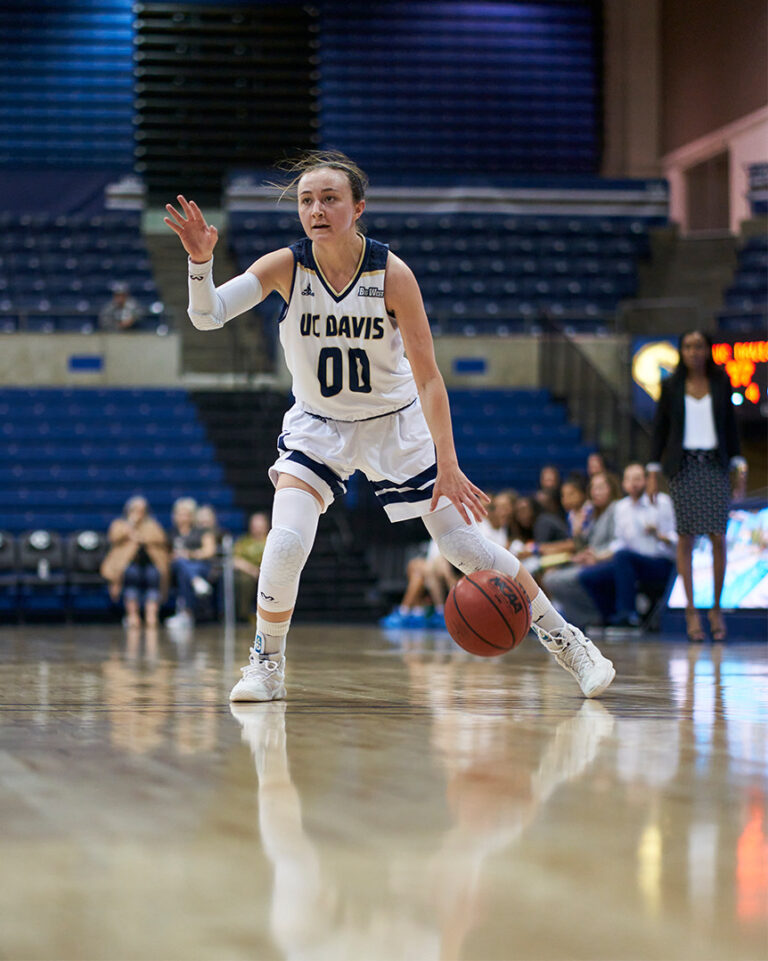
The UC Davis Women’s Basketball team falls to Missouri State in the first round of the NCAA Tournament.

The long and eventful season has come to an end for the UC Davis Women’s Basketball team. 

Because of county restrictions, the Aggies’ season was put on hold and they did not play a game from Nov. 25 to Jan. 22. After that nearly two month pause, the team was able to finish off the regular season with no interruptions, and captured their fifth-straight Big West Conference regular season title. Not only that, they managed to turn it into an NCAA Tournament berth for the second straight season—after being unable to compete for that opportunity last year. In the most difficult of circumstances, the team was able make their opportunity count. 

“It would’ve been easy, when things got shut down for 59 days for us to be like ‘Okay, things are getting hard let’s pack it up and leave’,” said Big West Conference Player of the Year Cierra Hall postgame. “But that was never even a thought in anybody’s mind. We were in this to win it and get back to the position we are in right now. We had 100 percent sacrifice, 100 percent heart. Everyone was dedicated to winning and celebrating those little moments.”

Entering their third NCAA Tournament in school history, the Aggies were hoping to capture their first victory in a matchup against the Missouri St. Lady Bears of the Missouri Valley Conference (MVC). The Lady Bears were undefeated in MVC play and entered the tournament as a No. 5 seed. UC Davis was going in as a No. 12 seed—the highest in school history. 

At the tip, the intensity was evident, as both teams were sprinting for loose balls and defending the best they could. A quick three by redshirt junior and Big West Defensive Player of the Year Sage Stobbart and a jumper by sophomore guard Evanne Turner gave the Aggies a quick 5-0 lead to start. Some great defense was being played by both sides, and for the first three minutes and a half, those were the only five points scored in the game.

Little by little, Missouri St. began to get a feel of the UC Davis defense and slowly began making their shots and went on a run of their own. The Bears went on a 16-3 run, highlighted by their senior Elle Ruffridge, who had half of the 16 points scored in just over four minutes. The Aggies needed to respond, as their high amount of turnovers led to Missouri St. points, and back to back buckets gave them just that, narrowing it to just an 14-11 Bears game. But, a turnover and a bad foul gave the Lady Bears some more opportunities to score, as they finished the first quarter leading 19-11.

After trading baskets to start the second, Missouri St. began to display their offense that led them to the No. 5 seed. The threes began to fall for the Bears and nearly at the midway point of the quarter, they had grown their lead to 15 with a score of 29-14. 

UC Davis was in danger of going into the half well out of this game, so whatever they needed to do to get a hold of this game, they needed to show it with under four minutes remaining in the second quarter. A jumper by redshirt junior Kayla Konrad was then followed by a huge three pointer and the foul for Big West Conference Player of the Year Cierra Hall, her first field goal of the game. In the matter of a minute, the Aggies had managed to cut into the deficit and get it down to single digits. Hall did not stop there, as she drained yet another three and assisted on a Stobbart layup. In the blink of an eye, it was a four point game. The Bears finally broke off the scoreless drought and managed to score four points in the final minute to keep them up 33-25 at halftime.

Despite being down eight points, UC Davis began to regain confidence throughout that stretch. That confidence carried over to the third quarter, as they began on a 9-0 run thanks to three straight threes made. For the first time since the early first quarter, the Aggies regained the lead, 34-33. Dating back to the second quarter, the Aggies were on a 20-4 run to completely flip the game around. 

The lead did not last long however, as the Lady Bears responded with a big layup to break their long third quarter scoring drought. From then on, Missouri St. began to get good looks at the basket and their jump shots began to hit the bottom of the net. Whereas for UC Davis, their last three pointer that gave them the lead was their last good shot of the quarter. Being unable to make any shots and turning the ball over due to the defensive pressure, the Bears took full advantage, closing the third quarter on a 16-0 run to enter the final frame up 49-34.

All throughout the season and even in this game, the Aggies had shown that they were not going to be put away without a fight. With one last quarter to make something happen, they needed to start seeing some shots go in. Their 8:34 drought finally came to an end after Konrad drained a three to stop the bleeding momentarily. 

Even then, they still couldn’t buy a bucket. The Bears began to take over the game, getting an easy shot or second-chance opportunities that continued to chew away at the clock. 

They went on another run, this time 7-0, to make it a 20 point lead, the largest of the game. And still, the Aggies would not back down, bringing the full-court trap on the Bears offense that led to turnovers and a quick run of their own, cutting it back down to a 12 point game. With limited time left every possession counted, but the Bears were once again able to get their own offensive boards that just ran down the time. In the end, UC Davis was unable to get back into it, falling in the first round of the tournament, 70-51. 

“Obviously we didn’t play our best, and it’s always hard when it’s the game that ends your season where you didn’t play your best,” said five-time Big West Conference Coach of the Year Jennifer Gross after the game. “But, we asked our team to empty the tank before the game and I feel like we did that. We played really hard, we found ourselves in holes and just kept fighting and coming back. I really applaud our kids for that.” 

A resilient effort by the Aggies came up short, as they were just not able to overcome the bad shooting night. They shot just 31 percent (18-58) from the field and added 16 turnovers as well. On the other side, Missouri St. shot 37.3 percent from the field, and capitalized on their size advantage, dropping in 32 points in the painted area. 

“We came to play and the ball just didn’t fall for us sometimes,” said Hall. “But, i’m so proud of our team and the heart we played with. We really left everything on the court and we gave it everything we had so i’m really proud of my girls and what we accomplished.”

Turner led the Aggies in scoring with 16 and Hall was just behind her at 14 to go along with her eight rebounds and four assists. Stobbart recorded five blocks and Mackenzie Trpcic added eight rebounds of her own. Overall, the Aggies size difference became a biggest factor in the end result, as the Bears were able to gather 20 offensive rebounds that were crucial throughout the game. 

“We knew [rebounding] was going to be a key to the game,” Coach Gross said. “Before the game we said we had to limit their easy post catches and we have to rebound. It wasn’t for a lack of effort. I really applaud our kids. They pushed, they shoved. The ball just didn’t go our way.”

With Hall, Trpcic and forward Emma Gibb all seniors, the Aggies will have a lot of questions to answer from important positions. Still, their ability to recruit impactful players and make the most out of their talent has led them to the dynasty they have created in the last five years. 

“I’m telling you, there is some talent in our program,” said Coach Gross in a look towards the future. “We’ve got great size, young players that can shoot the ball, can get to the rim, can defend and we saw bits and pieces of it throughout the year. I love that this team is hungry and ready to get better. I think we’re going to be an extremely strong team in the future because we have kids that buy in and want to improve and we have a coaching staff that wants to help them become the best version of themselves.”

It wasn’t an easy season for the team whatsoever—mentally and physically. The uncertainty of whether they would even have a chance to play or not was always there. But even throughout, they showed their ability to stick together and show why they have been Big West Conference regular season champions for five straight years. Although their season ended, the resiliency and fight throughout the year—on and off the court—will make this one of the most memorable UC Davis Women’s Basketball seasons in a long time. 
Written by: Omar Navarro — sports@theaggie.org

Healthy Davis Together opens new COVID-19 testing center in South Davis

0

Screening for COVID-19 variants and testing Davis wastewater are also under way

On March 1, Healthy Davis Together opened a new COVID-19 community testing site at Marguerite Montgomery Elementary School in South Davis. 

UC Davis Health Director of Business Development Tod Stoltz explained that this is one of the smaller COVID-19 testing sites.  

“It’s a small site, so we’re not going to get a ton of people there,” Stoltz said. “Last week, we had it open four days, and just a little over 400 people were tested there. We didn’t have any test sites in South Davis, and that was a good site to open to make it convenient for people in South Davis.”

Healthy Davis Together is considering opening another testing center as well, based on the success of this latest one, Stoltz said.

“The natural choice would be [in] West Davis, where we also don’t have a lot of test sites,” Stoltz said. “So that’s where we’re thinking about, but we’re going to see how Montgomery goes for another week or so.”    

Some may wonder about the accuracy of the polymerase chain reaction (PCR) tests being administered. Stoltz clarified via email that the sensitivity and specificity rates of the tests are both “north of 95%.” Sensitivity is the true positive rate, whereas specificity is the true negative rate.  

Stoltz elaborated that Healthy Davis Together is screening all positive testing samples for three different variants of COVID-19.  

“There are three variants of concern, and these are published by the CDC. We are screening all positive samples for those variants of concern,” Stoltz said. “We are also working on screening wastewater for variants as well.”

Healthy Davis Together screens Davis wastewater for COVID-19, and it recently posted its wastewater screening data.

Hannah Safford, a fourth-year environmental engineering Ph.D. student and core member of the wastewater team, explained via email that wastewater screening data can show COVID-19 infection ratios in different areas.  

“The same level of detected SARS-CoV-2 is more alarming if it comes from a region with relatively few people (since that means that the ratio of virus to people is high) than if it comes from a region with a lot of people,” Safford said.  

The goal of the wastewater testing is to assess which parts of Davis may be experiencing increased amounts of COVID-19 infection, according to Safford.  

“We’ve recently scaled up our [wastewater] sampling to include additional sites, including some that ‘zoom in on’ smaller, higher-risk areas of the City,” Safford said. “If we see trends in these areas that are alarming (i.e., if COVID levels increase or stay constant while overall levels in the City are going down), it could motivate [Healthy Davis Together] to take interventions such as deploying mobile testing sites to those areas, focusing messaging on those areas, etc.”

Written by: Rachel Shey — city@theaggie.org

14 activities to do before graduating this year

0

With only one quarter left at UC Davis for students in the class of 2021, seniors share their favorite memories and things to do in Davis

With two Picnic Days and a multitude of other UC Davis traditions canceled during the pandemic, it has been difficult for many students to experience normal college life. Although many indoor activities are still not permitted due to safety restrictions, The California Aggie has compiled a list of 14 COVID-19-safe activities, recommended by UC Davis seniors, to participate in with a friend or housemate before graduating. 

Visiting the Davis Farmers Market

Rain or shine, the farmers market is a quintessentially Davis experience. Open on Wednesdays from 3 to 6 p.m. and Saturday mornings from 8 a.m. to 1 p.m., the farmers market is located at Central Park. Fourth-year political science major Sasha Feuerstien recommended trying the apple juice from Apple-A-Day and the kettle corn from Kettlepop. 

Visiting the Root of Happiness Kava Bar 

For those who are between the ages of 18 and 21, Root of Happiness Kava Bar in downtown Davis can provide an exciting new experience. Kava is a popular drink that induces feelings of sleepiness, wellbeing and muscle relaxation. Although the initial taste might come across bitter, fourth-year neurobiology, physiology and behavior (NPB) major Haris Terovic noted that the experience parallels visiting breweries but with a different taste. 

Watching the sunset from Hutchinson parking garage 

Another favorite among UC Davis students is the roof of the Hutchison parking garage to watch the sun set or rise. The highest floor of the lot is often filled with students, many of whom are skateboarding, rollerblading or simply watching the sunset from afar. According to Feuerstien, if students have not had a chance to check out the sunset, this should definitely be at the top of their list.

Getting an Ali Baba’s breakfast burrito

Day or night, an Ali Baba’s breakfast burrito always hits the spot according to fourth-year biochemistry major Kritika Sharma. The burrito is filled with a combination of scrambled eggs, fries, cheddar cheese, bacon, gyro meat, honey and Tapatío hot sauce. Ali Baba also offers a vegetarian breakfast burrito which substitutes bacon and gyro meat for grilled tomatoes and mushrooms and avocado.

Visiting the campus horses and cows

Visiting the Tercero cows is an essential Davis experience for many students starting freshman year. With the supervision of the caretakers, visitors can pet the cows and feed them grass. UC Davis also has many horses located near the School of Veterinary Medicine. According to Terovic, the cows and horses are friendly and a sweet reminder of the quirkiness of the cow town that is Davis.

Walking through the greenbelt

The greenbelt comprises over 10 different paths for both bikers and pedestrians that connect throughout the city. Throughout the belt, there are sculptures of dominos, animals riding bicycles, painted sidewalks and more. 2020 UC Davis graduate Tobi Ayo-Ajibola lives right across from the greenbelt. According to him, the stretch of parks is a great way to safely go out and enjoy fresh air during quarantine. 

Make-your-own Trinity 

Many 2021 graduates have been unable to experience the true chaos that is the Davis Trinity. The Trinity is a Davis undergraduate ritual that entails getting three alcoholic drinks from local bars including: the Wicky Wacky Woo from Cafe Bernardo, the FML from Red 88 Noodle Bar and the Devastator from Bistro 33. Although Bistro 33 has closed down during COVID-19, students over 21 can attempt to revive this long standing tradition by visiting other bars with outdoor seating including G Street WunderBar and Woodstock’s Pizza. 

Visiting the Häagen-Dazs Honey Bee Haven

The Häagen-Dazs Honey Bee Haven, located near West Village apartments, is an outdoor museum that provides safe and resourceful environments for local bee pollinators. According to Feuerstien, it has a beautiful garden with the option of guided tours by entomologists.

Biking towards Winters and Lake Berryessa 

Although it may seem like Davis is surrounded by only farmland, there are a few cities and attractions that students can visit nearby. Winters is a small town located about 20 minutes west of Davis, close to Lake Berryessa. It has a quaint downtown area with various eateries, breweries and wine-tasting venues. Terovic noted that the lake is a good location to go swimming or rent boats with friends during the warmer months.  

Swimming and fishing in Putah Creek 

Putah Creek is another beautiful natural landmark close to Davis that is highly recommended by students. It has astream that extends over 85 miles, walking trails, fly fishing grounds and small waterfalls. According to Feuerstien, the creek is ideal for swimming during the summer.

Day trips within a three-hour drive from Davis:

Point Reyes

Point Reyes is a beautiful cape along the Northern Pacific coast which has also been identified as the cleanest seashore in all of California. The national seashore is located about an hour and a half from Davis and offers beautiful ocean scenery, extensive sand beaches and cliffs that are perfect for watching the sunset or sunrise, according to Sharma. 

Burney Falls

For a picturesque trail or ideal Instagram moment, Burney Falls is the best place to be according to fourth-year NPB and English double major Taylor Silva. The waterfall is located in Shasta County and has a height of 129 feet. Silva noted that the falls are an ideal swimming location for the warmer months. 

Table Mountain 

For fans of flowers and nature hikes, Table Mountain is a perfect location to visit, featuring scenic views of various waterfalls and colorful wildflowers. For those looking for a beautiful outdoor adventure, Table Mountain provides an easy walk and is only an hour and a half drive from Davis, according to Sharma.

Written by: Sneha Ramachandran — features@theaggie.org

An ode to ‘Jersey Shore’

0

A piece of TV history, best left that way

In the second most viewed episode of “Jersey Shore,” watched by nearly 9 million people during its first airing, couple Sammi Giancola and Ronnie Ortiz-Magro nearly tear one another apart. Giancola punches Ortiz-Magro in the face in retaliation for his newly formed friendship with another female cast member. Two episodes later, Ortiz-Magro, after seeing Giancola dancing with someone else at the nightclub Karma, returns home and smashes her things in a flurry: her glasses, medicine, jewelry, the contents of her closet. He throws her clothes and bed onto the patio. 

When Giancola returns, they embark on a screaming match for the ages, with the six other tenants of the Shore House as the only force stopping them from (physically) killing one another. Giancola is visibly crying at multiple points during the on-the-fly (OTF) interviews that editors place throughout the episode, which serve as a clever tool of framing to ensure that the viewer can correctly interpret the events without too much brainwork, providing context through the questions that cast members have been instructed to answer in the present tense (to allow for seamless integration). Giancola spent much of Season 3 crying, and producers allowed her to leave the Shore House for two episodes following the altercation.

According to a story producer who worked on the show’s first three seasons, the couple’s most violent fight appears choppy and chronologically confused because the other cast members of the show pleaded directly into the cameras for production to intervene or to call the police, accosting the silent cameramen who had flooded the room like hungry strays once the first shout rang out. The editors decided to cut this, as the cast’s desperate SOS threatened the sanctity of the fourth wall.

“We were seeing incredible television being made before our eyes but at the detriment of two kids,” the anonymous producer wrote. “It still doesn’t sit right with me.” The fight was “horrible and far more intense than what aired.”

It appears that the producers of “Jersey Shore” operate under a mantra akin to the Prime Directive from “Star Trek”—no interference, no matter what. It seems to have worked out quite well, since all but 16 episodes of “Jersey Shore” had higher ratings than the series finale of “Mad Men.”

Nicole “Snooki” Polizzi’s favorite moment on the show was apparently getting punched in the face at the end of the fourth episode, a moment MTV ultimately decided to censor with a cut-to-black in the broadcast version, but which nevertheless generated enough buzz to breathe real life into the show’s viewership after an anemic debut. Controversy seems to have been a mechanism of advertisement for the show, with sponsors like Domino’s pulling advertisements before the show’s debut after complaints from Italian-American organizations like UNICO about the show’s use of the phrase “Guido” in advertising and its apparent desire to exoticize the Italian heritage of its cast in tandem with their hedonic lifestyles. Despite the show’s marketing, a quarter of its cast isn’t even Italian, including Polizzi and Jenni “JWoww” Farley.

A gigantic Italian flag and “Scarface” poster serve as gaudy centerpieces in the Shore House, silent observers of alcohol poisoning, violent breakdowns and heartbreak. A runthrough of the cast’s house during Season 2 with creator SallyAnn Salsano reveals that castmate Paul D. DelVecchio Jr. keeps 11 cans of hairspray on the floor next to his bed. Mike “The Situation” Sorrentino was addicted to painkillers during the show’s first five seasons and was sentenced to federal prison for tax evasion in 2018. Cast member Vinny Guadagnino is now a Chippendales dancer.

According to what evidence exists, the show’s first few (and most influential) seasons were mostly uncoerced. Tan lightning in a bottle—the product of exquisite casting and luck dooming eight strangers to the maximum amount of strife and conflict possible—or as the anonymous producer from earlier put it, “incredible television.”

The show’s soundtrack sounds like a Xanax-snorting Blink-182, predominantly distorted electric guitars playing power chords in major keys, acquiescing to “Keeping Up with the Kardashians”-style strings and xylophone when a scene is branded as comic relief. The show wants you stimulated in all ways all the time.

One-third of the show’s cast gets arrested on camera over the show’s six seasons. One cast member, Guadagnino, suffers an anxious breakdown and leaves the show for several episodes. Ortiz-Magro punches a stranger unconscious in the streets of Seaside Heights under the watchful eye of an MTV camera. Seven out of the nine cast members are shown crying.

Before leaving, Guadagnino tells DelVecchio Jr., “Every day I am suffering.”

“Jersey Shore” prompted MTV to produce a number of imitation programs, including “Geordie Shore,” “Каникулы в Мексике,” “Warsaw Shore” and “Acapulco Shore.” None have come close to the viewership of “Jersey Shore.”

Written by: Jacob Anderson — arts@theaggie.org

Legislation passed to help with ASUCD structure, campus layoffs, proctored exams at ASUCD March 4 meeting

0

Commission chairs and senators discussed the rise in anti-Asian hate crimes, among other things.

Vice President Emily Barneond called the meeting to order at 6:10 p.m. 

Barneond introduced and assigned four new bills, including SB #58 to outline procedures for consolidation of ASUCD units, SB #59 to edit Chapter 23 of ASUCD bylaws, SB #60 for hiring practices for ASUCD unit directors and executive office staff and SB #61 to legitimize executive task forces and redefine their purpose. 

Old legislation included SB #56 to differentiate between special committees and executive task forces, SB #57 on commission schedule cancellation and rescheduling notifications and SB #62 to clarify the role of the student government administrative office in maintaining the format of ASUCD bylaws. Additionally, SR #9 to oppose campus and systemwide labor layoffs during the COVID-19 pandemic and SR #11 to limit proctored exams on campus were considered. 

Commission Chair Yalda Saii of the Ethnic and Cultural Affairs committee (ECAC) commented on SR #9, stating that the ECAC is “agreeing with the authors that layoffs during a pandemic that has exacerbated financial strain particularly on marginalized communities is inherently immoral and it’s not something that benefits anyone during a pandemic.” 

Senator Maahum Shahab who introduced SR #11 spoke about how proctored exams harm different communities and are “intrusive, discriminatory and ableist.” Along with research, she hopes this bill will get professors to acknowledge the research and speak on it to limit proctored exams.  

All five passed unanimously. 

Of those bills was SR #10, which urges the university to update ASUCD when guidelines and policies change. It was introduced by the Gender and Sexuality Commission Chair Jane Casto. 

“One of the problems that we’ve come across frequently in our work is the fact that the policies we have set in place do not actually follow through the bylaws,” Casto said. “One of the common instances we saw happening within the bylaws [is] we would be referred to Section X, Y and Z of the UC Davis proposal manual for example, and when we went to go look for that manual, that section no longer exists. When they’re talking about something as serious and severe as our policies for sexual misconduct that is incredibly vital that we have that information readily accessible.”

While President Kyle Krueger mentioned respecting the authors’ intentions, he also said that this, “was not the right way to go about it.” 

“I think the administration is going to read some of [the whereas clauses] like this and think, ‘It sounds like ASUCD is telling us they can’t handle their own policies,’” Krueger said. “I think as a 501(c)(3), it is our job to handle our own affairs.”

Senator Kabir Sahni and Environmental Policy and Planning commission (EPP) Chair Hunter Ottman commented on the resolution’s language used, with Sahni saying it was “volatile” and Ottman saying that the table needs to be cautious of how it writes resolutions to not come off as “callous.” 

SR #10 was tabled. 

Controller Alexis Lopez-Perez recommended Vice Controller nominee Isabelle Poux and was granted the position with no objections.

For quarterly reports, the Housing Advising Undergraduates’ projects included assessing student needs and connecting them with guidance and resources through Housing Week. For next spring, they are planning on working toward centralizing housing resources and holding educational events. 

The EPP presented their quarterly report and announced the projects they have been working on including: the Fair Trade project, which has a goal of enacting a UC-wide policy that encourages campuses to earn and maintain a Fair Trade University certification, which provides food and catering services for UC students. E-Talks, a virtual form of Toilet Talks, which shared informational posters on bathrooms on campus, provides educational graphics on sustainable living and environmental justice and a sustainability Webinar series. 

They have also been providing support for the Office of the External Vice President’s bill amendment which, according to Otterman, will allow for a more timely review process for student housing projects.

“There are significant hurdles with getting student housing projects approved,” Ottman said. “A huge portion of it has to do with misreporting or using the [California Environmental Policy Act (CEQA)] process. So, this bill will provide student housing projects not to have an exemption from CEQA but a more fair review process, one that has a timeline in site.” 

ECAC reported on their work including committee reviving and SB #53 on the Institutional Animal Care and Use Committee Restructuring; SR #8 on caste discrimination, anti-Asian discrimination signage and resources and Black History Month resources; and an ethnic studies expansion project. 

Internal Affairs Commission Chair Julian Garcia reported on the commission’s bylaw references clean-up project as well as their search for a new chair due to him graduating. 

Senator Ryan Manriquez reported on hiring Evan Rodricks for Chief of Staff and co-authoring SR #11. 

Senator Kristin Mifsud reported on attending and conducting interviews for Student Government Administrative office manager and meeting with the Disability Task Force to discuss disabled students’ needs on campus. 

Senator Tenzin Youedon reported on fundraising planning and holding space with Sigma Omicron Pi, the Asian-American sorority due to the rise of hate crimes nationwide. 

Krueger worked on the Police Research Task Force, discussed the issue of P.E. with the Vice Chancellor and posted more unit director vacancies, interim senator vacancy. Krueger also reported on a vacant senator spot next quarter. 

External Affairs Vice President Maria Martinez reported on lobbying Congressman Garamendi about COVID-19 relief and the Double The Pell panel and movement.

DREAM Committee Chair Alejandro Cervantes reported on the committee’s food voucher program, scholarships and finding a permanent place for the lending library. 

During public comment, Nico Gist, the campus organizer for CALPIRG, announced CALPIRG’s lobby day with 150 student leaders who met with 70 legislators to advocate for bills to fight climate change and clean electricity. 

Martinez announced an upcoming lobby day for transfer students on April 27-28. 

The ASUCD meeting was adjourned at 10:01 p.m.

Written by: Annette Campos — campus@theaggie.org 

International students discuss the challenges of F-1 visas in the post-Trump era

0

Many challenges remain for international students at UC Davis amid the pandemic

International graduate students at UC Davis continue to face obstacles to conducting their research, and these problems are exacerbated by both the pandemic and the challenges of working under an F-1 visa. 

According to U.S. Citizenship and Immigration Services, the F-1 visa permits people from abroad to study in academic institutions in the U.S.. Students must be fluent in English and must support themselves financially for the duration of their course of study. They cannot work outside of their academic institution of choice, meaning that international graduate students at UC Davis are unable to pursue off-campus jobs or U.S.-based projects outside of the university, even if they are research-related. 

According to a fourth-year doctoral student who spoke to The California Aggie about his experiences on the condition of anonymity, the stringency of these visa guidelines, as well as the complexity of the U.S.’s relationship with his home country of Peru, has made conducting research difficult. 

He talked about the challenges of undertaking research with indigenous leaders in Peru, who were denied entry to the U.S.. 

“When [a visa] gets rejected, you never get any explanation,” he said. “It’s not even that they tell you that you’re missing something.” 

He noted that the rejection of his research collaborators occurred under the administration of former President Donald Trump.  

“This is me speculating, because there is no official record, but I assume they saw these indigenous leaders not as leaders working with a university, but just as poor people from a poor country,” he said. “Maybe [the government] thought they were at risk of staying illegally.”

Federal and state funding is also largely off-limits to international students. 

“By coming here and doing my Ph.D. here, I am promoting and I am benefiting U.S. academia in the same way that a student who is not international is,” the student said. “So why am I not eligible for that kind of funding? I pay taxes here like everyone else, and I don’t get the right to vote or anything like that. It’s taxation without representation, literally.” 

A doctoral student from China also spoke about a lack of access to federal funding in her field of cultural anthropology. 

“I feel like I’m in a weird position,” she said. “My home country doesn’t recognize me as someone foreign living in the U.S., and the U.S. doesn’t recognize me as a resident living here.”

She explained that non-U.S. citizens are ineligible for prestigious grants and fellowships like the Fulbright or the MacArthur Innovation Grant.
“I was thinking, since I’m here, I should contribute to society here, but it hasn’t included me so why should I even bother?” she said. 

COVID-19 has also complicated international students’ efforts to undertake research. Last year, the doctoral student from Peru was unable to conduct research at his field site since Peru’s borders were closed due to the pandemic. 

Because his research is based on performance practices there, the pandemic has delayed his degree progress. 

An eighth-year doctoral student in performance studies spoke about a similar experience. Her F-1 visa mandates that she be employed solely by the university, making it impossible for her to be a part of art initiatives happening outside of the UC, despite the fact that these initiatives are at the core of her research and artistic practice. 

“Even though I have invitations from people in the States to do art, legally I’m not supposed to,” she said. “I’m not supposed to get paid or be doing work outside of the umbrella of the UC. It’s hard to develop my art and my network of art practices here, which then hinders my visa.” 

The student’s spouse is under an F-2 visa, meaning that they are a dependent of someone with an F-1. According to the Department of Homeland Security, a dependent can enroll at an accredited institution in the United States provided that they aren’t pursuing a full course of study. 

Dependents are unable to work or apply for a social security number in the country. Because of this, the student’s spouse has been unable to work for five years.

Additionally, due to the collaborative nature of her work and the challenge of teaching performance classes online, the student has taken an extra year to complete her dissertation.

Having been diagnosed with cancer at the beginning of her doctoral studies, she is now one quarter over the time frame that UC Davis is able to fund, meaning that she can no longer benefit from the non-resident supplemental tuition fellowship (NRST) waiver which extends to the fourth and fifth years of doctoral studies post-candidacy.  

In a previous article by The California Aggie regarding the limitations of the NRST waiver, Performance Studies Chair Joe Dumit said that the waiver doesn’t account for complications like illness or family emergencies despite the extension it offers.

 Although the university has offered individual solutions to some graduate students regarding funding during COVID-19, visa-related issues mostly remain up to the federal government. 

“I don’t think the university can do something tangible other than filling the gaps of the federal government in the short run,” the doctoral student from Peru said, referring both to the limitations of his student visa and the complicated relationship the U.S. has with Latin American countries. “But in the long run, I think there should be an organized push towards integration rather than highlighting the differences between national and non-national students,” he said.

Though his department has supported his studies despite limited funding available in the humanities, federal regulations have proven to be quite different. 

“[The relationship between the U.S. and Latin America] has never been a collaborative space, the way I’ve seen it, in which everyone comes as an equal,” he said. “I think there’s this strong discrepancy between what my department is trying to put forward and create and what the federal government allows people to do.” 

Written by: Rebecca Bihn-Wallace — campus@theaggie.org 

Yolo County moves to red tier, reducing restrictions for indoor services

0

Local businesses and community centers balance efforts to reopen indoors and safety concerns

On Feb. 24, state guidelines allowed Yolo County to move into the red tier. The move allows local businesses to either expand capacity or resume indoor operations. 

Fitness centers and gyms can now operate at 10% maximum occupancy, places of worship can operate at 25% maximum occupancy and restaurants can operate at 25% maximum occupancy. A full list of all changes can be found on Yolo County’s website.

 Assistant general manager at Woodstock’s Pizza Alexandria Yon explained that having more indoor dining space in addition to outdoor dining, pick-up and delivery has had a positive impact on operations. 

“Currently, we’re still doing pick-up and delivery and outside dining as well, but on busy days it’s helpful to have added indoor seating options available with the 25% capacity,” Yon said. 

Yon explained that ensuring the safety of workers and customers is a top priority, so Woodstock’s Pizza enforces safety precautions such as wearing masks. 

“We have masks for team members, and we have QR codes for customers to scan for our menu,” Yon said. “For tables, we have signs that our bussers flip depending on the availability of the table. For example, red signs are for unavailable tables and green means a table is ready.” 

The expanded indoor capacity helps customers regain a sense of normalcy in their dining experience, according to Yon. 

“It’s another level of normalcy, to be able to sit down with your family as opposed to only being able to order pick-up or delivery,” Yon said. “We hope to find a balance between safety and bringing back a level of normalcy.”

Yon explained that while it is important to remain cautious, opening even at a limited capacity is ultimately a positive step forward for the local economy. 

“Opening back up more and supporting local businesses helps the economy,” Yon said. “I don’t think we should shift everything back to what it was all at once, but this is a move in a positive direction.”

Associate Superintendent of Support Services for the Davis Joint Unified School District (DJUSD) Laura Juanitas explained that the move into the red tier brings DJUSD closer to the possibility of in-person learning. 

“The Board of Education set up parameters for a hybrid reopening,” Juanitas said. “As a county, we would have to be in the red tier for two weeks before we could return to any kind of in-person learning. We hope to reopen more sometime in mid-April when more teachers have been vaccinated.” 

In addition to local businesses, places of worship are now allowed to operate indoors with 25% maximum occupancy. Despite the increase in allowable occupancy, Reverend Dr. Brandon Austin from the Davis United Methodist Church explained that the church is not reopening in-person services just yet. 

“There’s a chain of command—we’re abiding by direction from leadership from the California-Nevada United Method Church office in Sacramento,” Austin said. “Currently, we are considering an outdoor in-person worship service, but we’re playing it conservatively.” 

Austin explained that the Davis United Methodist Church is taking great care to put measures in place to ensure the safety of congregants when in-person worship does resume. 

“We’re being very cautious partly because of the variants,” Austin said. “When we do have in-person services, we will be monitoring for temperature, requiring face masks and making sure that seating is at least eight feet apart. We also don’t allow for singing.”

Reverend Austin explained that while they have been cautious about in-person activities, even with the move to the red tier, the congregation has found other ways to worship and stay connected. 

“We’ve offered worship services every Sunday since the restrictions were put in place via live streaming, pre-recorded services and Zoom,” Austin said. “There is a silver lining though. Our online presence has made it possible to reach others who weren’t necessarily able to join us in previous years, so we hope to continue some of these services in collaboration with other congregations.” 

While they are proceeding with caution, Reverend Austin explained that he is excited about the prospect of in-person worship. 

“Church is very much about community and about being together,” Austin said. “We miss singing with each other and enjoying each other’s presence. Ultimately, though, we are being very patient.”

Written by: Yan Yan Hustis Hayes — city@theaggie.org