


Drawn by: Rushi Tawade –– rntawade@ucdavis.edu
Disclaimer: (This cartoon is humor and/or satire, and its content is purely fictional. The story and names of “sources” are fictionalized.)
Drawn by: Rushi Tawade –– rntawade@ucdavis.edu
Disclaimer: (This cartoon is humor and/or satire, and its content is purely fictional. The story and names of “sources” are fictionalized.)
A discussion of the Sexual Assault Awareness Advocacy Committee organization occurred, updates from The Pantry and The California Aggie
The ASUCD Senate meeting on Jan. 21 was called to order at 6:10 p.m. by Vice President Emily Barneond.
The first agenda item was the quarterly report for The California Aggie, presented by Editor-in-Chief Anjini Venugopal.
“With all the benefits that come with print, we, like all publications, continue to search for ways to expand digitally,” Venugopal said. “I am currently working on our long-range plan, and some of my ideas about digital expansion will be made more clear there—creating staff positions for people who are particularly interested in multimedia storytelling through audio and video for example.”
After Venugopal’s presentation, elected officer reports, followed by ex-officio reports, were discussed.
In his elected officer report, Senator Ryan Manriquez said that a new chairperson was
hired for the Student Health and Wellness Committee.
Senator Michael Navarro said that he, along with Senators Lauren Smith and Roberto Rodriguez Ibarra, met with the director of the Coffee House (CoHo) to determine action items following the CoHo’s indefinite closure.
During public announcements, The Pantry Director Ryan Choi provided updates.
“Across the state we are seeing an increased need among UC students who have returned to their hometowns but are still in need of resources,” Choi said. “Across the UC system—throughout all 10 UCs—and the UCDC program, we have discussed in our […] monthly calls about the ability for us to share resources.”
Choi said that basic needs resources on the UC Davis campus, like the Aggie Compass Basic Needs Center, will accept all UC students.
“All of the resources [students] will have obtained at their home UC campus, we would be able to support them with,” Choi said. “The only exception is for direct financial aid, money, doctors and things like that.”
Additionally, Choi said that an increase in donations allowed The Pantry to support students during Thanksgiving and winter breaks.
“With partnership with the Aggie Compass Basic Needs Center, we’re able to serve 270 students across our UC Davis campus with food vouchers and gift cards through statewide funding,” Choi said.
No comments were made in public discussion.
After a break, the Senate reconvened. When discussing the status of previous legislation, President Kyle Kreuger said that he “signed everything.”
No new bills were introduced at this senate meeting. ASUCD Senate Bills #47 and #52, and ASUCD Resolution #6, were discussed by the table.
ASUCD Senate Bill #47, which was introduced on Jan. 7, was tabled due to author Senator Roberto Rodriguez Ibarra being absent during this senate meeting.
This bill intends “to allocate $9800 to the DREAM Committee for the purpose of a relief fund for basic needs, specifically for DREAMers,” according to the bill.
ASUCD Senate Bill #52, authored by Senator Maahum Shahab, was introduced as emergency legislation.
Shahab said that this will likely be the first of many bills passed to ensure that the Sexual Assault Awareness Advocacy Committee (SAAAC) has a specific structure that can be sustained long term. According to the ASUCD Senate Bill #52 background, SAAAC “has faced many challenges in its ability to remain active, transition and train members who could adequately lead the committee in the future.”
“This is basically a bill that helps us specify within the SAAAC some of the positions— specifically the chair and vice chair—which weren’t previously stated on here explicitly,” Shahab said. “These are positions that will be assigned to students so that there can be a lot more structure.”
This bill was passed unanimously.
ASUCD Resolution #6, authored by first-year political science-public service major Cole Murdoch from the External Affairs Office, was introduced.
“I am introducing this resolution because, first and foremost, we are the last [in the] UC system to not have a resolution in support of a non-mandatory day on election day, which in my opinion is a little embarrassing,” Murdoch said. “We should be promoting student engagement when it comes to our elections. College students are one of the largest voting blocs in the country, let alone in California.”
This resolution passed unanimously.
After approval of the previous meeting’s minutes, the meeting adjourned at 7:39 p.m.
Written by: Aarya Gupta — campus@theaggie.org
Through Hearts Over Hands, students serve as one-on-one mentors for children all over the country
During the COVID-19 pandemic, students have had to adjust to virtual classes and the cancelation or postponement of most summer camps and after school enrichment programs. This has left many caretakers struggling to keep their kids busy and engaged in learning for the past 10 months. Hearts Over Hands is an organization that connects these families with college-aged tutors to help mentor and teach their children while physical tutoring or daycare centers are closed.
The child mentorship program started in April 2020, when the COVID-19 pandemic was just beginning. Its creators wanted to build a program that would help the families most affected by the pandemic: essential workers, parents facing illnesses and single parents. Hearts Over Hands created a “Big Sib” program, in which college students are matched with a family and take on a combined role of tutor, playmate and mentor.
UC Davis created its own club for students looking to get involved with the program during spring 2020, and now more than 10 UC Davis students are active “Big Sibs” to these struggling families.
One of Davis’ “Big Sibs” is Sonam Sehdev, a third-year neurobiology, physiology and behavior (NPB) major. She decided to join Hearts Over Hands last spring after seeing a Facebook post about the club. She was matched with a family in New York with a newborn and two young boys, so she became a virtual playmate and babysitter for the two boys twice a week. Sehdev said that she initially worried that she wouldn’t be able to be much help over Zoom, but she was surprised by how much she and the boys benefited from the experience.
“Before I joined the program, I was kind of reluctant because I was like, ‘I don’t know about meeting a random family and trying to help them virtually,’” Sehdev said. “It seemed kind of like that would be tricky, but it was surprisingly very easy. They were super friendly. I’m glad that it helped them because it helped me to have a designated time where I get away from school and just do something completely different.”
McKenna Ma, a third-year NPB major, was also surprised at the relationships that she formed with her mentees. Ma has two “little sibs,” a 5-year-old boy from New York and a 16-year-old girl in Southern California. She shared that when she began working for Hearts Over Hands, she was mostly looking for a way to give back to the community, but she has now formed a much deeper friendship with her older mentee, Alex, than she expected.
“I figured ‘Oh, you know, [I’m] just helping a kid out,’ but her mom let me know that I was a lot more,” Ma said. “I feel like at that point, I kind of transitioned our meetings to being a little bit more open.”
Ma said she also feels like she has created a sibling-like relationship with her younger mentee. She shared that usually in their sessions they played board games like “Battleship” or “Guess Who?” and talked about Harry Potter. She was even able to get him a shoutout from one of his favorite YouTube video creators that he told Ma about in a session.
“He loves watching YouTube, and so I actually got one of his favorite YouTubers to record a little video for him saying hi and all that sort of stuff,” Ma said. “He flipped out.”
Valerie Betsis, a fourth-year NPB major, had a similar story as Ma and Sehdev, finding that she connected with her mentee in a really special way. Last spring, Betsis was paired with a middle-school-aged girl from New York, who made her a heartwarming gift when they finished their sessions together.
“She made me a little PowerPoint thanking me, which I totally didn’t expect, but it was just so wholesome and so nice to see that what I was doing was actually worthwhile,” Betsis said.
Betsis said that she joined the club while she was at home during spring quarter as a way to give back during the pandemic.
“As someone who wants to go into the health field after graduating, I thought that this was a really great thing that I can do […] without any sort of prior medical experience, to kind of help with the pandemic,” Betsis said. “I think that I just wanted to do anything I could, and I thought that this is a great opportunity for me to kind of give back.”
Liliana Wilf, a fourth-year human development major, also joined Hearts Over Hands because of her job intentions post graduation. Wilf plans to pursue teaching and said that the pandemic has made it difficult to get experience teaching and interacting with children in person.
“It’s really a great way for me to still have interactions with children while I can’t be in a classroom or at a camp to watch kids,” Wilf said.
Wilf taught cooking and dance classes at some of the program’s larger events, in addition to working as a “Big Sib” for siblings in middle school. She also shared Betsis’ sentiment pertaining to giving back during the pandemic.
“I think a lot of students feel like they want to give back but they don’t know how because it’s really hard to give back without meeting in person,” Wilf said. “So this is a really nice way to help people all over all over the country and just to say thank you to the first responders and to people who are putting their lives on the line.”
The program has over 200 volunteers from different universities and have been able to serve over 200 families. Sehdev also said that they are still enrolling new families to further expand Hearts Over Hands. The program is also accepting applications for new “Big Sibs” through their website. Betsis said that she believes the work that the program is doing is extremely important at this time.
“I think what Hearts Over Hands does so well is it provides you [with] that one-on-one interaction, where even though it is online, you still get that human interaction with somebody else,” Betsis said. “I think that that’s so necessary for a child and for development. And I think that it provides them [with] an individual to talk to who may not necessarily be their parent […] it gives them that social interaction that they so desperately need right now.”
Written by: Katie DeBenedetti — features@theaggie.org
All the world is an Instagram grid, and all the people are merely posing
In July 2010, Instagram co-founder Mike Krieger made the first-ever Instagram post. His shot of a random marina marked the birth of an app that will rule our generation, but, ironically, it also breaks every unwritten rule our generation has created when posting on Instagram. The tilted angle of the marina, the somber Instagram filter and lack of caption betrays the typical Instagram shot you would find today.
That same day, roughly two hours later, Krieger made the second-ever post on Instagram—a candid shot of co-founder Kevin Systrom working, aptly captioned “Kevin hard at work.” Today, this photo would not make it as a sufficient post, much less an Instagram story. There are many unwritten rules of Instagram, but perhaps the most important rule of all: photos are not just posted, but curated for a purpose.
There is no envy or storytelling involved in Kevin being “hard at work.” Whereas in 2010, Instagram shots were grounded in spontaneity—a careless selfie or blurry shots of frozen yogurt—they are now a polished portfolio of our lives. The photos we choose to post add to a narrative about ourselves, and funnily enough, most of us seek to share the same narrative: that our lives are awesome. After all, the proof is in the Instagram feed.
More than ever, our curated and real lives are constantly intersecting. The politics of Instagram have affected the way we derive enjoyment. Memories are created solely for an Instagram shot or memories are whittled down into a pretty shot “good enough for the feed.” These come with the anxiety that if we don’t post, the memory of a good night vanishes as a private memory instead of public evidence of a fun time.
In response, a burgeoning campaign to “Make Instagram Casual Again” has surfaced, calling for a return to the landscape of Instagram in 2010—posting on a whim, a form of “digital anarchy” where you post whatever you think is cool, “without trying to impress anyone.” However, the good intentions behind it inadvertently aestheticize authenticity. Posts casual in nature do not signal a return to authenticity. And if we are not careful, making Instagram casual may become as much a trend as it is a movement.
Influencers have hopped onto the trend of making Instagram casual as well, abandoning one aesthetic for another. Content marketer Lexi Carbone remarks that “everyone is trying to be more authentic” since after all, “you don’t want to see the same girl standing in front of a wall you’ve seen thousands of times. We need something new.” The movement of making Instagram casual signals our value in authenticity in the photo-sharing app, which some influencers have picked up on.
But before we re-negotiate our posting habits on Instagram, we need to acknowledge that truly returning Instagram to a “casual” state means relinquishing some control.
The power of Instagram no longer lies in just the connectivity it provides, but also the control it gives us. As a photo-sharing platform, Instagram offers a hard-to-argue-with visual narrative about our lives and also serves as a point of reference, cutting through small talk and allowing the photos we choose to speak for ourselves. Most of all, it gives us an omniscient control over our lives: all the best moments replicated into neat, square grids.
The problem with making Instagram “casual” again, as Stanford University student and lifestyle blogger Maddie Rose points out, is that casual Instagrams are just another version of what we have now: “While before it was apparent that someone was working to portray their life in a certain way, now you can barely tell if what they are showing you is real or fabricated.”
For example, there was a trend to use the photo-editing app Huji Cam, with 16 million downloads, to edit high-quality photos taken on an iPhone to photos reminiscent of a grainy, digital camera. Although photos in a casual feed may appear to be less curated and diverge from the “life is awesome and here’s proof” narrative, it feeds into a different kind of aesthetic—that of mirror selfies and photos taken at grocery stores
There are many parallels in the effort to make Instagram casual and the app’s landscape we have today—and branding polished photos as disingenuous and grainy, candid photos as authentic just represent another set of unwritten Instagram rules. Within these two modes of posting, the mindset of curation instead of spontaneity remains. We cannot undo the more toxic aspects of Instagram by disguising our largest unspoken rule: Sometimes we post because we have something to prove.
Making Instagram casual does not mean that we should give up polished photos to establish a popularized sense of authenticity. To truly make Instagram a casual place, first we need to write our own rules.
Written by: Renee Wang — reswang@ucdavis.edu
Disclaimer: The views and opinions expressed by individual columnists belong to the columnists alone and do not necessarily indicate the views and opinions held by The California Aggie.

Those pesky teens are hanging out on the rooftops again!
January 5
“Respondent got into an argument with his friends who have since left; however, prior to leaving they smashed a microwave in the street.”
January 9
“5-6 subjects on the roof with flashlights.”
January 11
“Locked out on balcony, has keys, wonders if she could pass them to officer to unlock door and let her in.”
January 13
“2 male teens on roof of middle building.”
January 15
“2 subjects with flashlights walking on the roof of the school.”
January 19
“Female patron refuses to leave, 41 years of age, long, blonde, curly hair, lavender shirt, white cowboy boots with lots of property.”
The production studio’s wholesome themes are meaningful to children and adults alike
It’s safe to say that most of us love a happy ending—even the most despicably cynical human can appreciate tearing up every once in a while, right? And we all know that children’s movies almost always give us that happy ending that we crave in life. I believe that that craving stems from the uncertainties in our lives. We never know where we will end up, if we will be happy or just content or who will stay with us, and that is just the beginning of the unknowns. These questions can send me into a downward spiral filled with endless fear and anxiety, and Pixar movies help me get away from that.
We all have this desire to achieve a certain ideal in our lives. We want the job, we want the house, we want the lifestyle. But something that Pixar movies do amazingly is show us that we don’t have to reach that perfect ending to have a happy life. Below are some movies that perfectly highlight what Pixar does best.
Warning: spoilers ahead.
“Monsters University” is my favorite Pixar movie. Although it did introduce a few holes into the plot of “Monsters Inc.,” I loved seeing the slow progression of friendship. But the best part of the movie was the way it ended. Both Wazowski and Sulley are expelled for cheating and thus can’t get a scaring job at their dream company. However, they still get to work there. They start off as mailmen, then move up as janitors and continue climbing up the ropes from there until they finally land jobs as scarers. All of this happens in a mere minute of the movie when the credits are playing, but it’s the perfect way to end it. They got what they wanted, it just wasn’t exactly how they pictured it and I loved that. “Monsters University” shows that achieving your goals doesn’t have to happen in a straight, continuous line; there can be breaks, detours and loopty loops. It’s an important reminder that success isn’t measured by how fast we get to where we want to go.
In “Onward,” a Pixar movie released just last year, brothers Ian and Barley go on a magical quest to resurrect their dad for a day. Because the magic went awry, the duo have to go on an adventure to find the missing pieces for a spell and save whatever time they have left with their dad. Ian soon sees through his own pain of not being able to meet his dad, and recognizes that his brother was also hurting because he never got to say goodbye to his dad when he was dying in the hospital. Towards the end of the movie, Ian gives up his chance of meeting his father so that Barley gets the opportunity for closure. Ian saves the day by giving Barley a little more time and conquering a beast they accidentally unleashed in the process of the resurrection. I’m tearing up just thinking about it. At the end of the day, Ian realizes that his brother had been with him through everything in his life; his brother had become his father figure. This sort of ending where a character acknowledges that other people’s needs are more important than their wants is a beautiful addition to Pixar’s heartwarming movie themes.
Similar to “Onward,” “Up” is a good example of the concept of wants versus needs. In “Up” Russell earned his elderly badge and completed his training as a wilderness explorer, but his dad never made it to the ceremony. However, he did gain a fatherly figure in an unexpected individual: 78-year-old Carl Fredricksen. And once Mr. Fredricksen relocated his house to Paradise Falls, he realized—with the help of his beloved wife—that he needed to continue his life despite her being gone. He still needed to be happy and if that meant completely giving up their lifelong dream to live near the falls, then that’s what it had to come down to. Pixar gives their characters these hard decisions and child and adult viewers alike can empathize with them, internalizing their struggle and learning important lessons.
While I love these themes that pull on our heartstrings, Pixar’s newest release outshined the rest. “Soul” places emphasis on the beautiful moments in our everyday life. It teaches us to throw out the idea that life is about accomplishing one big thing. It rejects the notion that we are put on this Earth for one sole reason and embraces the cliche that “life is short.” The movie forces the audience to realize that everything we do in our life doesn’t have to have a meaning behind it; there doesn’t have to be a bigger picture. We sometimes get so busy and wrapped up in our own emotions, problems or goals that we gloss over everything that is good because it seems too minute to be meaningful. Small moments like when we are laughing with our family, where we see a random rainbow or when our friends pick us up to go on a random adventure to In-N-Out often go unnoticed because they’re “mere moments.” But “Soul” pointed out that those things matter—they are what make us human and make us feel alive. There is no one important meaning in our life; it’s the small things that make the difference.
Pixar continues to weave existential themes into their movies, which is what makes them special. A lot of us watch children’s movies for the escape—life gets a little overwhelming and sometimes the best way to destress is to focus on some silly child’s problem for an hour or two. But when Pixar makes movies like these—movies that completely contradict the way we are taught to view life—it makes us stop for a second, breathe and appreciate what we have, and the need to escape doesn’t feel so overwhelming anymore.
Written by: Itzelth Gamboa — arts@theaggie.org

In addition to its remarkable handling of the pandemic, the university has had many incredible achievements
UC Davis’ efforts to bring free and accessible COVID-19 testing to both its own students and the broader Davis community were recently recognized in an article in The New York Times. The Editorial Board agrees that the university’s mass testing initiative has been remarkable, and we wanted to take a moment to acknowledge some of its programs and accomplishments.
On top of its robust testing campaign, UC Davis Health in Sacramento has launched a Novavax COVID-19 vaccine trial. This trial will prioritize participants from groups disproportionally at-risk from COVID-19, such as people from Latinx, African American and Native American populations. The Editorial Board commends this effort, especially considering that people of color are severely underrepresented in U.S. clinical trials and receive a lower quality of healthcare than their white counterparts.
A vaccine clinic opened on the UC Davis campus on Feb. 1, helping to expand vaccination infrastructure in the county and increase vaccination opportunities as more people become eligible. Given California’s slow vaccine distribution, it’s vital that UC Davis uses its resources to expedite the process.
The university also started a $3 million initiative to decrease COVID-19 risk for California farmworkers. Agricultural workers are among the most vulnerable groups for COVID-19 transmission, and this program will offer them safety training and information.
Aside from its efforts addressing the pandemic, UC Davis is a global leader in environmental sustainability—it has ranked first in the U.S. in the GreenMetric World University Ranking for four years in a row. Its future environmental goals are to become zero-waste, reduce its greenhouse gas emissions and design new buildings that prioritize energy efficiency.
We’ve also had many alumni with remarkable achievements. Charles M. Rice (class of 1974) won the Nobel Prize for medicine in 2020 for his success in culturing the hepatitis C virus and received his undergraduate’s degree from UC Davis. Two NASA astronauts Stephen Robinson (class of 1978) and Tracy Caldwell Dyson (class of 1997) are UC Davis alumni, and Robinson is now a professor for the university.
On top of these initiatives, UC Davis has accumulated top academic rankings in a variety of subjects as the fifth U.S. public college. It’s ranked as the No. 1 veterinary medicine school in the world and has the No. 1 agricultural program in the U.S.
It also has an ongoing commitment to make its programs widely accessible. Nationally, UC Davis ranks first for diversity and internationalization and ninth for having graduates of color. Although attending UC Davis is still astronomically expensive, it placed second for Affordable Elite Colleges in the U.S. These top rankings likely helped to attract the record-breaking 105,850 freshman and transfer applicants hoping to become Aggies in 2021.
Though our university isn’t perfect and we will continue to hold them accountable, every member of the Editorial Board is proud to be an Aggie. Despite the challenges of the pandemic, UC Davis has cemented itself as a global leader in public health and embraced its responsibility to both the students and the wider Davis community.
Written by: The Editorial Board
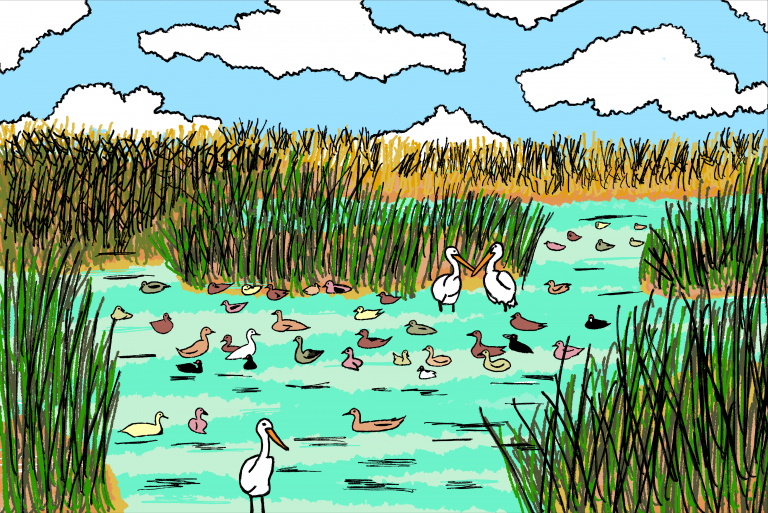
Local leaders explain how the plan will protect local species without hindering agriculture
In November 2020, Yolo Habitat Conservancy’s Regional Conservation Investment Strategy/Local Conservation Plan (RCIS/LCP) was approved by the California Department of Fish and Wildlife, becoming only the second approved plan in the state.
The Yolo Habitat Conservancy is a joint powers agency dedicated to the conservation of natural and working landscapes as well as wildlife throughout Yolo County. According to a press release, Yolo Habitat Conservancy’s RCIS/LCP is a voluntary, non-regulatory conservation plan that guides both private and public conservation actions and investment including habitat restoration and protection.
Yolo County District 1 Supervisor Oscar Villegas explained via email that the RCIS/LCP is part of Yolo County’s longstanding commitment to agricultural growth and the conservation of natural habitats.
“The county is very proud of the efforts by the Yolo Habitat Conservancy in advocating natural resource conservation in conjunction with managing sensible economic growth,” Villegas said. “Yolo County is primarily an agricultural county and respects all aspects of the wildlife that accompanies our land.”
These efforts at the county level are particularly important because, as Woodland’s Environmental Sustainability Manager Ken Loman explained via email, local governments are uniquely positioned in their ability to address climate change and sustainability in their communities.
“Climate change is a global problem, but how it affects each of us depends in part on the conditions in our local communities,” Loman said. “With over 39 million people and the world’s fifth largest economy, California is incredibly diverse. Only local governments are able to determine how to address climate and sustainability issues for their communities.”
Yolo Habitat Conservancy Board member and Yolo County District 2 Supervisor Don Saylor explained via email that Yolo County’s RCIS/LCP is a comprehensive plan resulting from a nearly eight-year process that began in 2013.
“The Conservancy agreed to develop the voluntary, non-regulatory Local Conservation Plan (LCP),” Saylor said. “[The LCP] would cover over 100 additional species and propose biological goals and objectives to advance conservation for these species.”
Saylor explained that as a voluntary, non-regulatory plan, landowners and developers who choose to participate are afforded benefits such as a simplified approach to environmental mitigation and a streamlined permitting process.
Saylor further described how the plan will help to protect local species and habitats.
“[The] RCIS/LCP establishes biological goals and objectives at the species level and describes conservation actions and habitat enhancement actions that, if implemented, will contribute to those goals and objectives,” Saylor said. “The Yolo RCIS/LCP […] will ensure conservation actions are coordinated across Yolo County, increase the likelihood of receiving state and federal funding for conservation work, increase the total amount of acreage conserved in Yolo County, and improve species outcomes.”
Saylor explained that while widespread regulation is an important tool for affecting change in regards to conservation, community engagement is especially important.
Looking forward, Saylor explained that Yolo County will maintain its commitment to environmental conservation in its continued support for the implementation of the Yolo Habitat Conservation Plan.
“The climate and environmental challenges we face are shared challenges that are not limited by jurisdictional boundaries,” Saylor said. “It is our hope that the 50-year Yolo Habitat Conservation Plan serves as a model for other communities to promote conjunctive use of land for both agriculture and habitat conservation.”
Written by: Yan Yan Hustis Hayes — city@theaggie.org
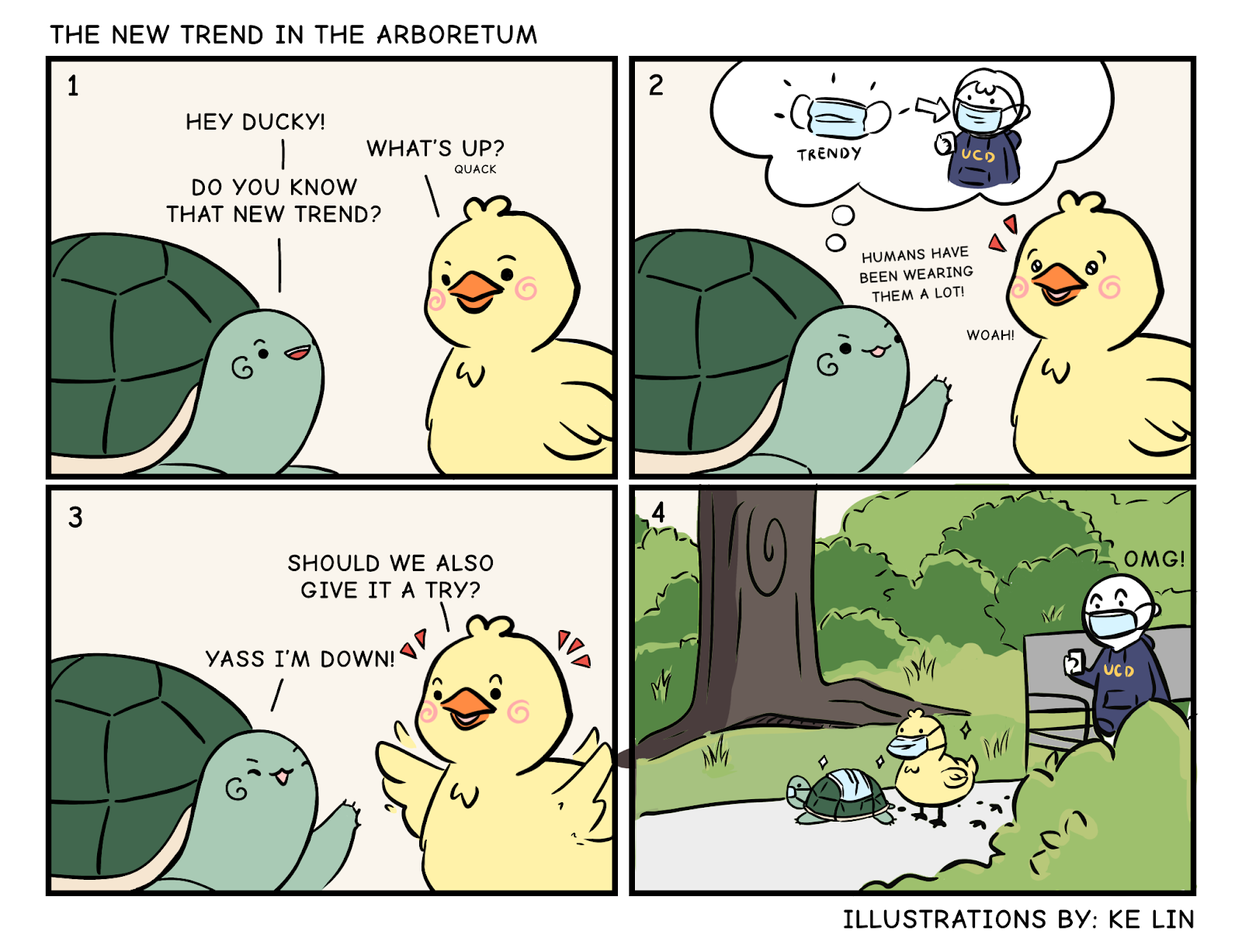
Drawn by: Ke Lin –– keylin@ucdavis.edu
Disclaimer: (This cartoon is humor and/or satire, and its content is purely fictional. The story and names of “sources” are fictionalized.)

The swift deportation of an American influencer in Bali highlights a phenomenon of “digital nomads” who bypass immigration rules and perpetuate wealth inequality
Kristen Gray, an 28-year-old American woman in Bali, Indonesia, has recently come under fire after her Twitter thread encouraging other foreigners to move to the island during the pandemic went viral. In a series of now-deleted tweets, Gray describes how she went from being unemployed and financially struggling in Los Angeles to living luxuriously in one of Southeast Asia’s most well-known tourist destinations.
Since moving to Bali in 2019 with her girlfriend Saundra, Gray has made a living working as a graphic designer and travel influencer. She calls herself a “digital nomad”—an increasingly popular occupation that allows individuals to travel the world and dictate their own working conditions. For Gray, this means leveraging her online business and being able to work remotely from the comfort of her Bali treehouse, which she boasts is an inexpensive $400 in rent.
She praises Bali for its low living costs, “queer-friendly” community and an “elevated lifestyle” affordable to lower-middle-class Americans—even crediting the island with healing her physical and emotional health. The thread ends with Gray promoting her and Saundra’s $30 ebook, “Our Bali Life is Yours,” which offers a detailed guide for those who wish to follow in their footsteps and even includes “direct links to personal visa agents” and tips for “how to get into Indonesia during COVID.”
Gray’s dreamy Bali life came to an abrupt end following backlash from Indonesians and neighboring Southeast Asians who criticized her for flaunting a lifestyle only accessible to foreigners, while locals remain vulnerable to displacement and poverty. She was also called “tone-deaf” and irresponsible for carelessly advertising Bali as “queer-friendly,” not paying Indonesian taxes, profiting from tips on how to cheat the immigration system and encouraging people to bypass travel restrictions—especially as Indonesia grapples with the most COVID-19 cases in the region. Gray’s tweets caught the Indonesian immigration office’s attention, and in less than 48 hours, she was detained and repatriated back to her home country.
Against the backdrop of Indonesia’s immense wealth inequality, barely liveable minimum wage and an influx of foreigners in Bali driving up living costs, Gray’s tweets underscore a much darker issue concerning gentrification and “foreigner privilege”—a far cry from the idyllic spiritual-healing experience Westerners romanticize.
Bali, often referred to as Indonesia’s “Isle of Gods,” boasts scenic natural landscapes and a vibrant nightlife that have long attracted wealthy tourists, foreign investors and expatriates. Its reputation as a premier tropical vacation spot is one they not only cherish but desperately depend on. Bali tourism constitutes a significant source of income for the Indonesian government, contributing roughly $3.8 billion annually to foreign exchange and accounting for 80% of the island’s economy. Because of this, the island has grown to accommodate Western tourists more and more in the past few decades, raising concern from Indonesians about a loss of Balinese culture and, more controversially, claims that foreigners have contributed to gentrification.
A major downside of tourism is that locals are relegated to low-paying service jobs and driven out of their homes to make room for restaurants, nightclubs and luxury hotels in hopes of attracting wealthy tourists. On average, Indonesians have a monthly minimum wage of Rp. 2.5 million, or $177 U.S. dollars—pale in comparison to Gray’s “affordable” $400 a month rent. As locals struggle to afford basic necessities and continue to suffer disproportionately in the pandemic, Westerners like Gray bragging about their lavish lifestyles come across as insensitive and disrespectful.
The story gets complicated when Gray, a queer Black woman, accused her critics of being homophobic and anti-Black, sparking a heated Twitter debate between Indonesians and Black-Americans.
Gray’s assertion of a “queer-friendly” Bali outraged Indonesia’s discreet LGBTQ community. One Indonesian woman expressed frustrations at foreigners who vaunt their openly queer lifestyles when queer locals such as herself are forced to remain “in the closet”—referencing how LGBTQ acceptance is a privilege afforded exclusively to foreign nationals, while locals are ostracized and even jailed.
Gray later claims that her deportation was unfairly motivated by her race and sexual preference, contradicting her original praise for Bali’s tolerance. Black-Americans defending Gray have argued that Indonesians wouldn’t be as quick to call out white tourists, while others insisted that their experiences with gentrification and colonization in America have rendered them incapable of perpetuating it elsewhere.
In response, Indonesians have stressed that their concern was for broken visa regulations and a lack of cultural awareness, regardless of race and sexuality. It’s important to note that systems of discrimination in America and Indonesia are fundamentally different, with the latter targetting religious and ethnic minorities—unrelated to the ongoing anti-Blackness in the West.
Gray, and digital nomads like her, is symptomatic of a much larger issue with loosely-regulated tourism and wealth inequality. While foreigners of all races and sexualities are capable of perpetuating gentrification in Bali, uprooting their presence alone will not solve long-term grievances. Increasing minimum wages for locals, enforcing stringent tourism regulations and protecting Balinese culture must be done in conjunction.
Gray’s deportation has incited important conversations on race, sexuality, privilege and discrimination, as well as debates on whether foreigners living for extended periods in Indonesia should pay taxes. Hopefully, these open discussions will contribute to a higher standard of tourism practices and better living standards for Balinese peoples.
Written by: Amara Putri — aputri@ucdavis.edu
Both contact tracing and tracking COVID-19 deaths help to inform Yolo County public health guidelines
Although contact tracing can be a useful tool for identifying and contacting people who might have been infected with COVID-19, local officials explain that current California contact tracing databases are experiencing difficulty in keeping up with the current surge.
A UC Davis Health information page detailed that contact tracing could be used to identify “[…] where there might be an increased risk of a COVID-19 outbreak.”
Yolo County Public Information Officer Jenny Tan explained that while the county uses contact tracing as a resource for fighting the spread of COVID-19, the data is often incomplete and difficult to obtain.
“We are doing contact tracing, we are definitely looking at where these people are working, or what they’ve done, but it’s hard to know exactly where someone got COVID-19,” Tan said. “It’s hard for a person to say sometimes, if they’re going to work, or if they went to a gathering. Plus, the data that we get from the state [databases] is often incomplete. There’s only a few questions that are mandatory in contact tracing, so a lot of people will choose to say that they don’t want to say or they don’t know.”
Tan also said that the California Reportable Disease Information Exchange (CalREDIE) system is another issue, as it was never designed to handle the scale of data being added. Tan also described that many areas have multiple local sources of data, with varying programs and clinics administering different kinds of tests, which contribute to the lack of transparency.
“One of the issues is that the CalREDIE system, which is the state system, was not intended to be used at such a level,” Tan said. “It was a program that was available when COVID-19 first started. We’re adding thousands of data points—if not millions—statewide, to this system every day. So there are issues that come out from that, plus there’s so many different ways that we can get data, spreadsheets and things like that.”
In addition to contact tracing, Yolo County is also counting COVID-19 deaths in order to track the spread of the virus. Yolo County Chief Deputy Coroner Gina Moya stated via email that COVID-19 deaths are reported to the Yolo County Public Health Office.
Yolo County District 4 Supervisor Jim Provenza explained via email that all available data is considered in making local public health guidelines.
“All information received by the county is made available to the Board to help us formulate policy,” Provenza said. “For example, we have focused upon large gatherings in our prevention efforts because outbreaks have been traced to private parties and other gatherings of household members who are not related. Tracing is now more difficult because of the current surge of cases.”
Written by: Rachel Shey — city@theaggie.org

The Arts Desk’s weekly pick of movies, tv shows, books and music
Movie: “Howl’s Moving Castle” dir. by Hayao Miyazaki (2005)
“Howl’s Moving Castle” is a Japanese animated movie produced by the critically acclaimed production company Studio Ghibli. The story is set in a fictional kingdom where technology, magic and war all collide into a constellation of vivid colors, heart-warming dialogue and an unlikely love story. The film follows a young hat maker named Sophie who has never seen herself as anything special or beautiful, just an ordinary girl making an honest living. However, a wizard named Howl quickly swoops in and adds a little sparkle and a whole lot of danger into her life. Soon she becomes cursed and turns into an old, withering lady by an envious, greedy witch who had been obsessed with Howl. If you like love stories, unnecessary proclamations of self-sacrifice, magical fighting and colorful chaos, this movie is for you. I was 10 years old when I first watched this movie, and rewatching it as an adult made me realize how stunning it is. It reminded me that in life there’s still hope even during the darkest or most chaotic times. I felt like I was a carefree kid again watching a movie that made me feel like life is still magical.
TV Show: “Bridgerton”
In the recently released Netflix original series “Bridgerton,” produced by Shonda Rhimes, viewers are brought into the 1820s Regency Era of Great Britain. During the eight-part Netflix special, we are introduced to the Bridgerton family as its daughters and sons try to find love in aristocratic Britain. The series has handsome dukes, a meddling queen, way too many balls and a mystery “Gossip Girl”-esque character who keeps busy revealing the ugliest skeletons in everyone’s expensive closets. Modern hits are given a new spin with classical orchestras, pianofortes and trumpets playing covers of songs by pop stars like Ariana Grande and Billie Eilish. A cover of Taylor Swift’s “Wildest Dreams” plays above an enchanting ballroom with exquisite gowns, multi-colored feathers, a pastel-neutral color palette and romantic one-liners that can make the coldest heart melt a few degrees. “Bridgerton” is a good show to distract yourself from the chaos of the first month of 2021.
Song: “This Feeling” by Alabama Shakes
“This Feeling,” a track from the Alabama Shakes’ 2015 album “Sound and Color,” is a hopeful yet sad song. The sentiment expressed is that there are a lot of difficult phases of life, but that “it feels so nice to know I’m gonna be alright.” The feeling of surviving hardship is synonymous with how many are feeling while entering 2021, where the world has collectively suffered a lot of tragedies—all the political, social and personal chaos of 2020—on top of a deadly pandemic. When listening to the song, you get a feeling of hopefulness while also being reminded that life is hard. Oftentimes, we are trying to get to the other side of hardships with as much of ourselves as we can, and if “[we] just kept going, just kept going/And hoping [we’re] growing near,” that “If [we] wanted to, [we’d] be alright.” Entering 2021 when the vaccine is finally being distributed and plans to move back to a more “normal” life are being made, it finally feels like we have found “this feeling.” When I’m listening to this song, usually when I feel very overwhelmed and as though my life is crumbling all around me, it reminds me that I’ll be alright.
Book: “The Color Purple” by Alice Walker (1982)
This Pulitzer Prize-winning piece of literature introduces the world to Celie, a Black girl living in a racist community in Georgia who survives abuse, the negative effects of enforced gender roles and the oppression of being Black in a white privileged world. I recommend this book now more than ever because of its cultural relevance as we enter a new period with a new president and our first Black vice president leading an extremely divided American society. We have to remind ourselves where we came from and where we are going because lasting change does not occur without acknowledging systemic racism and addressing the intersectionality of race and gender.
Written by: Muhammad Tariq — arts@theaggie.org
UC Regents are now the new trustees of the SFAI
This month, the University of California announced its purchase of the San Francisco Art Institute’s (SFAI) debt for approximately $19.7 million. According to UC spokesperson Stett Holbrook, the SFAI was originally purchased by the UC in 1924 with proceeds from a property donation by Edward Searles, who was a prominent benefactor of the university at the time.
“The University of California has a 97-year history of support for the San Francisco Art Institute (SFAI) and its artistic mission,” Holbrook said via email. “In spite of the dire financial challenges the UC faces due to COVID-19, the University has stepped in to help SFAI and save it from foreclosure.”
Holbrook explained that the University of California owned SFAI’s property in trust until 2010, facilitating loans and supporting the growth of the school, though the two institutions remain unaffiliated academically. The trust and property were then transferred to the institute so that they could benefit from the land’s property value.
The UC “retained a ‘contingent remainder interest,’” in the property, Holbrook said. The terms of the agreement also stipulated that if SFAI stopped operating as an art school or used its property for purposes other than fine arts instruction, the property would revert to the UC Regents.
In recent years, the institute struggled with declining enrollment due to living costs in San Francisco and the rising costs of higher education. It was also affected by the economic downturn in 2020.
This prompted the Boston Private & Trust Company to move on the institute’s foreclosure in July 2020. A public sale of the institute, however, was precluded by the reversion of the property to the UC Regents in the following months. The Regents will now function as the new trustees of the art school.
“The Board of Trustees of [SFIA] have a fiduciary responsibility […] to secure the school’s future so that we can continue our mission to provide our students with a rigorous education in the fine arts,” said Pam Rorke Levy, the chair of the board of trustees at the institute, via email.
The institute will still accept undergraduate and graduate applications in 2021, and the UC’s purchase of its property will have no bearing on its curriculum.
A return to financial stability could be helped by contributions from major donors, by the sale of artworks from the institute’s collection or by endowing the art college’s famed Diego Rivera mural, Levy said. She stressed that no decisions had been made to that effect yet, particularly regarding the mural, which has been the source of much attention in the art community.
According to Mark Kushner, the interim chief operating officer at the SFAI, the institute anticipates purchasing the property back in six years so that it can continue to operate indefinitely.
“The lease of Chestnut Street Campus goes through October 2026 so SFAI has a total of six years to repurchase […] the property from UC in the amount of the original debt, $19 million, plus interest and minus lease payments,” Kushner said via email.
Written by:Rebecca Bihn-Wallace— campus@theaggie.org
And it’s not for the reason you think
It was Jan. 4 when I walked into that Bed Bath & Beyond. I wasn’t satisfied with the pillows in the bed section, but as I was about to leave I accidentally stumbled into the beyond section. It was there waiting for me. When I bought it that day, I didn’t realize that this pillow would wreak havoc on my life in the months to come.
“Martial law in Georgia” began the whispers in early November. At first I thought my roommate was having alt-right dreams. One night I lay alone in a room, finally some peace from the murmurs, but I couldn’t handle the truth. They only continued. When I tried to find respite by covering my head with my My Pillow, but the murmurs only grew more intense. That’s when I realized that my pillow, specifically my My Pillow, was the source of these whispers.
The whispers change. One night it might be “Foreign powers rigged the voting machines.” Other nights it’s “Oleandrin cures COVID-19.” It doesn’t stop though. I’m not sure it ever will.
I can’t function. Partly due to the sleep deprivation and partly due to the fact that my pillow, manufactured by My Pillow Inc., is whispering to me in bed. I show up to work, and my co-workers tell me I look haggard, terrible, even disturbed. I can’t tell them the truth. How would that look? I’d look insane if I told them the horrifying truth, “I can’t sleep at night, BECAUSE MY MY PILLOW SPEAKS OF COUPS!”
Most recently the whispers have been about how it was actually antifa who stormed the capitol. I tried to stop using it, but it radicalized the other pillows I had. I can’t just throw it out and unleash this whispering pillow out into the wild.
The foam blend that allows this pillow to keep its shape, yet stay so soft, will likely allow this pillow to disturb me to my dying breath. What have you done Mike Lindell? What have you done?
Written By: Ean Kimura — etkimura@ucdavis.edu
Disclaimer: (This article is humor and/or satire, and it’s content is purely fictional. The story and or names of “sources” are fictionalized.)
In the last weeks of his presidency, Trump’s Administration just barely recalled a decades long policy by the EPA despite outcry from the scientific community
As President Joe Biden attempts to turn a new leaf and focus on the future, the Trump Administration’s final decisions continue to cast a shadow over many of his choices. Even from Inauguration Day, most of the media focus has still been around Biden reversing Trump Era policies. Because of former President Donald Trump, Biden has a laundry list of things to do and chief among his priorities has been environmental justice. Keeping this in mind, the best thing he can do right now is reform the Environmental Protection Agency (EPA) and reimplement the supposed “Secret Science” rule that the Trump Administration barely was able to repeal weeks before they left office.
Getting rid of what the Trump Administration has dubbed the “Secret Science” rule would disallow the EPA from taking into account studies which don’t have their data available to the public. As usual, this isn’t a new idea. For decades, tobacco and fossil fuel companies have attempted to fight the EPA from establishing air quality standards by repealing this policy and branding it as a “lack of transparency.”
So you might think, why does the data need to be secret in the first place? Privacy. Many studies on public health don’t release their data because it would break patient confidentiality, and this would generally disallow the EPA from using these studies. Basically, the EPA repealed a rule that allowed it to make informed decisions on public health during a global health crisis.
Back in 2018, when repealing the rule was first proposed, the EPA’s own independent science advisory board questioned the motivations behind the rollback among the dozens of other environmental regulations repealed by the administration. Although the proposal may seem to make sense on the surface, forcing transparency and the release of data to the public for every decision, the fact that many of the officials on this board were actually appointed by Trump himself should speak for itself.
“Given the gravity of these concerns, which are echoed by a chorus of other scientific societies, health advocacy groups, universities, stakeholders, and member scientists of EPA’s own Scientific Advisory Board, we urge the EPA to rescind this rule,” stated a letter that was sent to the EPA signed by dozens of health organizations and colleges, including Harvard University. “This proposal would diminish the critical role of scientific evidence in helping to make decisions that impact the health of Americans. Excluding the best available science, as this proposal would, puts public health at risk.”
Take it from me, there are plenty of things wrong with the EPA but this rule is not one of them. It should be immediately telling when dozens of nonpartisan science organizations and countless states and cities have already legally challenged the rule less than a month after its finalization. Among those involved in the lawsuit is Xavier Becerra, California’s own attorney general. Becerra, who founded the environmental justice branch of the state’s Department of Justice, has sued the Trump Administration 122 times since succeeding Vice President and former California Attorney General Kamala Harris in 2017. He has consistently been a fierce advocate for the environment, among other social justice issues, especially in the face of the Trump Administration.
“As the coronavirus pandemic continues to reach new heights, the Trump Administration has plowed ahead with a devastating policy that forces the EPA to downplay or ignore robust, independent scientific research in favor of industry-backed propaganda,” remarked Becerra in an official statement. “We won’t let this one slide through the cracks. There’s too much at stake. We’re going to court today to uphold the rule of law and to protect the integrity of the science that informs our decision making.”
The finalization of this rule marked the last of the many environmental regulations overturned by the Trump Administration. Fortunately, the Biden Administration has already signaled an intent to reimplement the policy as soon as possible. Unfortunately, this may take some time because this is not something that can be undone simply. It took the Trump EPA several years to get rid of it while taking every shortcut possible. Although it may take some time to undo this, I do think that it is important that the Biden Administration take the long bureaucratic road to fixing this.
Proper procedures and channels must be followed by the new administration to prove conclusively that they have science and facts on their side. I might believe that they do, but that doesn’t really mean anything until they can prove it to the general public. Trying to do things as quickly as possible sends the wrong message and it is up to Biden’s Administration to change things for good and do it the right way.
Written by: Joe Sweeney — jmsweeney@ucdavis.edu
Disclaimer: The views and opinions expressed by individual columnists belong to the columnists alone and do not necessarily indicate the views and opinions held by The California Aggie.

©2021, ASUCD. Designed by Creative Media.