55.9 F
Davis

Davis, California

Tuesday, December 23, 2025
Home Blog Page 322

Undergraduate students can retroactively switch grading mode for Spring Quarter 2020 classes

Academic Senate announces that current students, regardless of academic standing, and Spring Quarter graduates can switch grading modes for Spring Quarter classes

The Academic Senate announced on June 30 that students, including those who graduated during Spring Quarter, will have their retroactive grade change petitions approved — with some exceptions — for classes taken during Spring Quarter. The petitions allow students to switch their course grading mode from Pass/No Pass (P/NP) to letter grading or vice versa.

The change only applies to undergraduates. All classes taken during previous quarters are subject to the regular policies around retroactive grade changes, according to an email from Kristen Lagattuta, chair of the Academic Senate, Jens Hilcher, chair of the Grade Changes Committee and Erin Crom, the university registrar, that was sent to all UC Davis undergraduate students.

The exception to normal grading mode policies follows the Academic Senate’s decision to let students switch grading modes until the last day of instruction. Usually, students must make that decision by the 25th day of instruction. Senate’s decision to let students switch grading modes until the last day of instruction.

“In recognition of the multiple stressors on academic performance during Spring 2020, which became especially magnified during the end of the quarter, the Academic Senate is allowing greater flexibilities for retroactive grade mode changes for courses taken Spring 2020,” Lagattuta, Hilcher and Crom wrote.

Students who were in good academic standing during Spring Quarter can submit a retroactive grading petition to switch from letter grading to P/NP grading and will be granted approval.

Students who were not in good academic standing during Spring Quarter have different requirements to meet, depending on which grading mode they are switching to. 

Switching from P/NP to letter grading is ordinarily not allowed for such students, but the Academic Senate previously mandated that they could take classes P/NP during Spring Quarter should they receive permission from their dean’s office. Students not in good standing who received that permission can submit a retroactive grade change petition without additional requirements.

Students not in good standing who wanted to switch from letter grading to P/NP, however, need to get the permission of their college dean before submitting a petition. 

Repeated courses, courses where a student has a “Y” and courses only available P/NP are not eligible for grading mode changes.
The deadline to submit petitions is Sept. 30 for Spring 2020 graduates, while other undergraduates have three quarters to submit the petition and must do so before they graduate.

Instructions for petitions and impacts of switching to a Pass/No Pass grading mode can be found on the UC Davis COVID-19 Frequently Asked Questions page.

Written by: Janelle Marie Salanga — campus@theaggie.org

Former top-ranked UC Davis gymnast Alexis Brown speaks out about racism on team

Review may be conducted by Harassment and Discrimination Prevention Program on campus

Alexis Brown, a decorated alumna of the UC Davis women’s gymnastics team who graduated in 2018, recently came forward about her experiences with racism and microaggressions on the gymnastics program. 

Brown, who was an animal science major, took to Instagram on June 2 to express these concerns following the police killing of George Floyd, a Black man, in Minneapolis. For Brown, this incident signified an “accumulation of […] 400 years of oppression” in the Black community, and the national tragedy inspired her to speak out about her experiences as a Black woman in the athletics department. This led to an article in the Davis Enterprise detailing the difficulties she faced in the program.

On June 1, UC Davis Athletics Director Kevin Blue issued a statement on behalf of the department, responding to Floyd’s murder and the subsequent protests nationwide. Blue acknowledged that while he had tried to work against racial discrimination, he could never fully understand it due to the color of his skin. 

“UC Davis Athletics has a history of building ‘trust, unity, and togetherness’ among people from all backgrounds,” Blue wrote. “As an organization, we have tried to acknowledge that racism exists in sports and be an athletics department that works against it. However, over the weekend, I came to the realization that we haven’t done enough […] We recognize the tremendous emotional and psychological impact that these discriminatory tragedies have created for our African American student-athletes, coaches, and staff.” 

Indeed, particularly disconcerting to Brown in her early years at UC Davis was the murder of Michael Brown in Ferguson, Missouri, in 2014. 

“That was devastating to me, to my mental health,” Brown said. “And no one in college talked about it or was understanding the gravity of the situation.” 

During her first two years at the university, more police killings followed. Brown became aware that other Black athletes were struggling with current events, too. 

Meanwhile, on the gymnastics team, Brown was facing microaggressions from some of her teammates. 

“Even on my official recruit visit [to UC Davis] as a high school student, I was asked by the team if I was adopted because my mother is white,” Brown said. “I was asked where I was from, and I told them I was from California.They were like, ‘Where are you from, like really?’ [I was like], ‘I don’t know, because my ancestors were enslaved.’” 

Similar comments persisted throughout her time on the team. Brown said that older girls that she “respected as a freshman” would comment that she was “really pretty” or “a really good gymnast for a Black girl.” Some people also used the N-word when referring to Black athletes on other teams. Brown added that while these remarks were “hurtful”, she “didn’t feel like [she] had the strength to speak up against them.” 

Members of UC Davis Athletics were unaware that the N-word was being used by team members, Kevin Blue said in an email to The California Aggie. 

“The Enterprise article contained new information and allegations that did not arise during our work to support Alexis in 2017,” Blue wrote. “One especially troubling new allegation is the report that the N-word was used ‘very regularly’ by student-athletes. Any manner of hate speech is not tolerated at UC Davis, and regularly occurring use of racist language is obviously particularly problematic.”

 Allegations raised in the article are being reviewed by a university process separate from Intercollegiate Athletics (ICA) and Blue said he looks forward to the outcome of that review.

Blue explained that a review — based on Brown’s allegations in the Davis Enterprise article — would likely be undertaken by the Harassment and Discrimination Prevention Program (HDAPP) on campus, which is outside of the athletics department.

During her junior year, Brown was inspired by former quarterback for the San Francisco 49ers Colin Kaepernick’s practice of kneeling during the national anthem in a public call for racial equality. She decided to use her platform as a college athlete to speak out about the injustices Black people were facing both on-campus and off. Her actions were met with fierce backlash, however.

“I remember after my first meet no one noticed at all, so I thought okay, maybe it wouldn’t be as big of a deal as I thought it would,” Brown recalled. “I didn’t tell my coaches and teammates beforehand. But the second meet was a home meet, and I kneeled again, and people were staring with very confused faces.”

Brown’s experience on the team worsened during that period. 

“One time in particular I went up to a couple of parents that were mocking me in the stands after the meet, to see if they wanted to know about the protests,” Brown recalled. “I thought I might as well have a conversation with [them], why not open up the dialogue? I had parents jumping in, telling me how disrespectful it was to kneel and telling me to smile and take my award and just walk away. My teammates and coaches said I was being disrespectful and causing violence.” 

In 2017, Brown’s coach, John Lavallee, expressed support for Brown’s right to free expression in The California Aggie, describing her as an “intelligent, articulate individual.” 

However, Brown alleges that after the first home meet she kneeled in, Lavallee expressed frustration with her and accused her of setting a bad example for young gymnasts and children, mentioning a possible backlash from the parent community and gymnastics clubs. 

“He didn’t understand why I was doing it in the first place and when I tried to explain he was really dismissive,” Brown said. “Having that first interaction with the protest set the tone for how much worse it would become throughout the 2017-2018 season.” 

Brown believes that her position as the top-ranked player on the team prevented her from being asked to leave. Despite “silent hostility” from some teammates — they would move away from her during stretches or avoid her during meals when they were traveling — she didn’t bring her concerns to the Title IX commission on campus, fearing that no one would do anything about them. While some teammates would help her as she knelt and sent supportive texts to her after meets, Brown said they feared “stirring up trouble” and that these acts of support were limited to “the background.” 

Given how close she’d been with many of her teammates, training “together 20 hours a week, 5 days a week,” this presented a dilemma of its own. 

“It’s difficult because I want to like them as a person, [but at the same time they were] complicit in racism,” Brown said. 

Since then, Brown said, several of these teammates, who she “still [has] love for,” have reached out to her and apologized for their previous hesitance to support her publicly. 

Brown says that she privately messaged Lavallee twice to no avail before publicizing her concerns on Instagram this month.

She added that they had a productive conversation on June 16. Lavallee confirmed in an email that they had spoken, but asked that the contents of their discussion remain private. He referred to the 2017 Aggie article, in which he said that he and his colleagues “voiced full support of her freedom of expression.”

Katy Nogaki, another former member of the team and a human development major who graduated in 2017, said in an email that she acknowledged and respected Brown’s work surrounding social justice issues and recognized the need to address these problems. She disagreed, however, with the way that Brown portrayed Lavallee and the UC Davis gymnastics team in the media. She was particularly concerned with Brown’s allegation in the Davis Enterprise article that some of her teammates were concerned about Black faculty and students attending Senior Night and spoke to her about it.

“During my five years as a member of the team (2012–2017), Alexis never personally expressed to me any of her concerns, hardships, difficulties, problems, etc., with regard to her experiencing any type of racism by the coaching staff or teammates,” Nogaki said. “If she had done so, I know I would have taken the time to try to understand her, empathize with her, and help her to the best of my ability, and I would still do the same today.” 

Other members of the team could not be reached for comment.

On June 7, the UC Davis gymnastics team posted on their Facebook page, pledged to be anti-racist and expressed support for the Black Lives Matter movement. 

The following day, Lavallee posted on the page as well. 

“As the Head Coach of UC Davis Gymnastics, I firmly stand with the Black Lives Matter movement,” he wrote. “We must use this opportunity to implement strong and lasting change. While I do not have all the answers, I will continue to look inward, listen and learn so we can move forward together. As a team, we will seize the opportunity to reject racism, celebrate diversity and commit to a safe, inclusive and welcoming environment.”

Responding to Brown’s allegations in an email, Kevin Blue wrote that Athletics “expressed regret for failing to take proactive anti-racist action and for at times not providing enough support to our Black student-athletes.” He said that his June 11 communication outlines “action steps, and future steps that we are planning to take, to increase the intensity of our efforts to combat racism.” 

The athletics department has also publicly committed to a more rigorous diversity plan, outlined in the June 11 statement. Dwight Smith, the director of Diversity, Equity, and Inclusion (DEI), is currently involved in the athletic department’s efforts to prevent these incidents from occurring again. Smith, who played for the UC Davis football team, was hired as an advisor in 2018 and stepped into the DEI role in 2019. 

“As a black UC Davis football alum, I deeply appreciate the brave knee [Brown] took and her unwavering commitment to awareness-building and progress, both during her time at UC Davis and now,” Smith said via email. “Since I joined the department we have been taking aggressive action to systematize our department’s holistic commitment to diversity, equity, and inclusion which includes our resolve to combat anti-black racism specifically.”

Brown commented that while she appreciates Smith’s hiring as a “great first step,” diversity work should not be solely his responsibility as a Black man.

She hopes that white members of the department will help “amplify Black voices,” perhaps by reaching out to Black athletes individually to gauge what their experiences have been.

“The [department] is trying to […] make great change, but we have to remember that we can’t ask white folks to head the Black revolution no matter how well-intentioned they are,” Brown said. 

She also expressed concern about the scarcity of Black coaches, staff and professors at the university, and emphasized that the racism she faced isn’t unique to the UC Davis gymnastics team.

 “Although my experiences were in gymnastics, [they also extend] to the community at large at UC Davis,” Brown said. 

Written by: Rebecca Bihn-Wallace — campus@theaggie.org


Graduate students won’t vote on a state-wide COLA strike

UAW Local 2865’s bargaining team voted 10-8 to not call a strike vote, increasing current discontent with union leadership

Hundreds of phone calls and countless emails hounded members of the United Auto Workers (UAW) Local 2865 Bargaining Team, asking them to call an Unfair Labor Practice (ULP) strike vote. Wildcat grade strikes — unsanctioned by the union — that called for a Cost of Living Adjustment (COLA) ended by May, with graduate students instead building toward an Unfair Labor Practice strike vote.

The vote to authorize a ULP vote happened on June 2, resulting in the union’s bargaining team 10-8 vote to not call a ULP strike vote, leaving many hoping for a statewide strike demoralized, frustrated and angry.

UAW Local 2865, in March, promised the vote by early April. It would’ve given rank-and-file union members the chance to vote on a strike around two ULP charges filed by UAW Local 2865 against UC: the UC circumventing the union’s attempts to bargain over a COLA and the termination of graduate students withholding grades at UC Santa Cruz.

When the pandemic forced campus shutdowns, elected officers in the union held a meeting open to all members to discuss what a Spring Quarter strike would look like — if it began at all. Sixty-one out of the 81 elected officers representing nine UC campuses voted in favor of calling a strike should 5,000 current workers sign a pledge indicating their commitment to striking. By June 2, around 2,300 strike pledges were signed. 

The 10 members of the bargaining team that voted against calling a strike vote released a letter explaining their decision in response to irate union members. In it, they cited the importance of having a supermajority of members who wanted to strike.

“Militant stands by a ‘vanguardist’ minority union of grad workers in the social sciences, arts and humanities who strike, without the support of the majority of their co-workers, will not generate the power needed to beat our state’s largest employer, the University of California,” the team wrote.

But the letter wasn’t formally distributed — the UAW 2865 website, at the time of writing, still had the strike pledge on its front page, never released a formal statement about the vote’s results and its Twitter contained one thread about the decision the day after it was made. 

Sean Arseo, an eighth-year sociology PhD candidate at UC Davis who was involved in COLA organizing in his department, said via email that he and other student-workers were baffled to stumble across it online. 

He alleged that there were nearly 4,000 ULP Strike Pledge signatories and added that none of them — including him — ever received an officially-shared rationale. 

To Arseo, the bargaining team’s argument about supermajorities was faulty and could be countered with examples of previous worker strikes.

“People show up when there is something meaningful to fight for and they see the urgency and significance of their own participation,” Arseo said. “In fact, we have evidence for righteous action’s snowball effect in the wildcat strike at UC Santa Cruz — once they set the tone, thousands of coworkers across the state stepped up alongside them.” 

Arseo added that he wasn’t surprised by the vote given the union’s initial response to the movement, saying that when UC Santa Cruz workers launched the movement they were met with union ignorance. 

“After the strike grew to other campuses, they tried to slyly claim it for themselves by buying domain names associated with COLA and hosting poorly attended symbolic ‘days of action’,” he said. “I initially felt disempowered [by the results of the vote] — that when I and thousands of others desperately wanted to take action to defend our coworkers, our elected leaders stood in the way.” 

His frustration speaks to a broader pattern of workers’ growing disenfranchisement with union leadership.

Even UAW 2865’s UC San Diego unit chair, Muhammad Yousef, acknowledged that the union had structural issues that made it seem opposed to worker organizers on campuses. Yousef was one of the eight bargaining team members who voted in favor of calling a strike vote and said that the pressuring of pro-strike union members often contained harsh sentiments. 

“A lot of folks are fed up because they feel like the union isn’t working for them, and I resonate with that because I felt like that before I joined union leadership,” Yousef said. “The union is very top down, meaning the board has an immense amount of power and control over information and resources. One big issue is the campuses’ lack of autonomy.” 

Yousef also said that he’s seen a strong push within parts of the union — who are now part of statewide leadership — to focus solely on economic issues, including wages, immediate benefits, healthcare and childcare.

He didn’t disagree that they were important, especially given that COLA itself was an economic issue. But to Yousef, that laser focus was harmful. 

“What we see historically is that issues of race, gender, sexuality and immigration status get pushed aside to the detriment of folks who are the most vulnerable in the union,” Yousef said. “Some people have said that when we focus on broader social issues, it detracts from a COLA, but the counter to that is that when we’re not just looking at one dimension of COLA, you start to see that there are sexualized, gendered, racialized costs of being in grad school.” 

Yousef also noted that the wildcat strikes diverged from “mainstream” tactics of organizing, such as signing petitions and calling legislators, calling them “minority actions.” 

He echoed Arseo’s sentiment that a vocal minority would create a snowball effect and said it stemmed from union leadership’s lack of faith in the vote even passing.

“We never had a chance to figure out what a remote, statewide strike would even look like because conversations got derailed, and this kind of pessimism hampered our ability to ideate and be creative,” Yousef said. “You have to keep in mind, though, that the union doesn’t get a majority opinion on anything.” 

That includes the contract UAW 2865 currently has with UC, ratified in 2018. About 4,500 union members across UC voted 58.6% to ratify the contract.

The contract fell short of UAW Local 2865’s initial demands, which included access to affordable and well-maintained housing — arguably the driving force that sparked fights for a COLA — despite providing paid leave for workers to attend immigration-related appointments and establishing a committee to address sexual harassment issues. 

For many union members, however, the contract’s ratification birthed their frustration toward union leadership. At some campuses, dissent was particularly strong. In an interview with the Los Angeles Times, UC Santa Cruz UAW Local 2865 unit chair Veronica Hamilton said 83% of UC Santa Cruz workers voted against ratifying the contract.

Yousef said he remembered around 55% of UC San Diego workers voting against ratifying the contract, which resulted in two appeals filed by rank-and-file members alleging that the vote was undemocratic and held in bad faith, but neither resulted in the contract’s revision. 

Emily Breuninger, eighth-year sociology doctoral student at UC Davis, was part of the bargaining team that voted to settle the contract in 2018. Though she thought that it was the right decision at the time, she now thinks otherwise. 

Breuninger, unlike Arseo, was surprised that the bargaining team didn’t call a strike vote and was upset about how the decision was announced — she said it was sent out at the very bottom of a UAW Local 2865 email.

“That’s something out of the admin playbook — that’s how Gary May informs us what’s going on with fall classes,” she said. “It’s just such a gross tactic […] I feel betrayed by the fact that those who are supposed to be democratically representing us blocked basic democracy. It wasn’t voting to call a strike. It was voting to let us vote.”

The dissenting bargaining team members addressed similar allegations and said that they had seen representative democracy dismissed in favor of a “distorted” democracy characterizing the wildcat strikes.

“A strike conducted by about 200 workers [started] to monopolize the entire focus of a union that represents 19,000,” they wrote. “We’ve heard testimonies from rank-and-file members who’ve been bullied and harassed both in-person and online for questioning and/or not immediately supporting their tactics. How is this democracy?”

Still, Brueninger said she thought the bargaining team’s decision broke the agreement of what a union should be. 

“A union is about workers supporting other workers, about workers supporting workers’ backs,” she said. “Whether it’s a weak strike or not, the fact that we have each others’ backs and can show that is important. […] I think we do need supermajorities, but we also need bravery and the ability to distinguish between the times when they’re needed. I don’t think that a supermajority was holding them back.” 

Moving forward, the dissenting bargaining team members called for the union to be part of a broad coalition focused on defunding and disarming police, passing ACA 5 to allow race and ethnicity to be considered in California public university admissions, redistributing billionaires’ wealth and demanding full public institution funding.
Brueninger said the vote would’ve held a symbolic role in both general terms of worker solidarity and toward the identities of the strikers, who she noted were largely students from marginalized communities. 

“I don’t want to see any more statements coming out of the union about police brutality, immigration, the international students,” she said. “I don’t want to hear any of it because you all had your chance and it was a very low bar, and you didn’t even let us vote.”

After its June 3 Twitter thread about the Strike Authorization Vote decision, the UAW Local 2865 Twitter feed has been filled with calls to organize around defunding and disarming the UC Police Department. 

But it’s faced criticism for disenfranchising Black demands. Yousef said that he saw  many people of color choosing not to engage with the union because they didn’t feel their concerns were heard.
Blu Buchanan, a Black former head steward for the union, called out UAW Local 2865 for its anti-Blackness in a Twitter thread responding to the union’s latest solidarity statement.

“I […] crafted the first police disarmament contract language with a working group of UAW 2865 comrades, only to see it be tossed aside as something that wouldn’t ‘appeal to the majority of our [white] members’,” Buchanan said. “I’d also like folks who are new to the UAW leadership to know that you may not have enacted this historical anti-Blackness, but you’ve got to deal with the continued effect it has on the present.”

The UAW Local 2865 Twitter account never responded to Buchanan.

Conversations about abolishing police — and what that looks like — are increasingly juxtaposed with defunding and demilitarizing police. At UC San Diego, Yousef said that there had always been an abolitionist tint to COLA organizing: student leaders wanted to look at abolishing police, prisons and the university. 

But he, like Buchanan, said that the union had a history of anti-Blackness. Instead of using the union as a vehicle to hold Black Lives Matter events, he and other union leadership at UC San Diego are connecting people to local Black-led organizations.

Arseo acknowledged that he wasn’t always cognizant of the intrinsic connection implied in the common chant by striking UC student-workers — “Cops off campus, COLA in our bank accounts” — but said that articulating the connection between those demands and fighting for both was more important than ever.

“As another rank-and-file member put it, Black, Indigenous and other people of color suffer additional costs of living beyond wages and toil of system-wide exploitation,” Arseo said. “One of these costs is concerns about our safety around police in all forms.”

Yousef, Arseo and Brueninger all believe the COLA movement has a future. They, however, have different visions for what disgruntled student-workers should do. 

Conversations about continuing the struggle and finding creative ways to engage in movements are happening at UC San Diego, but Yousef said that student-workers there are still recovering from the vote as a whole. 

For some union members, that recovery looks like dropping their union membership to demonstrate their anger toward union leaders. Brueninger said that she thought it was the worst way to achieve their goals.

“If we don’t like the way the union is functioning, we need to stand up and run for leadership,” she said. “We don’t just drop out and weaken it further so when the folks who are ready to do the hard work of rebuilding the union are rebuilding it, they aren’t in a weaker position than they could’ve been.” 

Arseo, however, sees the union’s elected leaders as impeding social movements’ progress. To him, if rank-and-file workers could unite their demands of a COLA, smaller administrative paychecks and demilitarizing and defunding the police, they could create a movement that neither administrators or UAW Local 2865’s elected leaders could stop.

“Are COLA organizers going to take control of the union?” Arseo asked. “The answer to that is that the union has always been ours; we’re just reclaiming it.” 

Written by: Janelle Marie Salanga — campus@theaggie.org 

UC Davis announces plans to partially reopen campus for fall, students voice mixed reactions

University will offer some classes, services in person, based on health guidelines, instructor preferenceBy

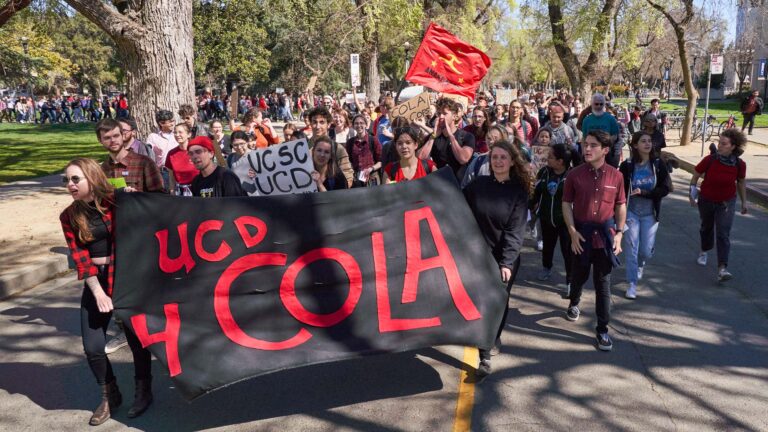
UC Davis announced on June 16 that it will welcome students back to campus for Fall Quarter, depending on county and state health guidelines, and will offer some in-person classes and services while making most classes available remotely. 

The university will have in-person classes available based on health guidelines and instructor preference, according to the press release announcing the partial reopening. Live performance and hands-on experience classes will also be delivered in-person. 

In the press release, Chancellor Gary May said the benefits of a residential education were more than just classes and instruction. 

“We look forward to providing that experience for our students — all in keeping with the guidance of our health authorities,” he said. 

To allay concerns about COVID-19, university and county health officials are developing protocols for symptom surveys, temperature checking and virus testing the community. UC Davis will operate all campus spaces — like the MU and the CoHo — according to public health guidance and will require face coverings. It will also regularly clean all common spaces and make sanitizer stations readily available.

Considering the circumstances, some departments, like the Department of Religious Studies, have already decided to hold all Fall Quarter classes online.

“The spring term has been a learning experience for us all, and we will put what we have learned to use when we return in the fall,” said Archana Venkatesan, chair of religious studies, in an email sent to the department listserv. “We are committed to teaching at our usual high standard, prioritizing student engagement and building a community of learners and teachers.” 

Carly Winters, an incoming first-year majoring in mechanical engineering, said she thought UC Davis did a great job keeping the campus community updated and didn’t rush to make a decision about partially reopening the campus.

“After losing our senior year, it was great to know that my first year of college will be in person,” Winters said via Twitter direct message. 

On-campus residence halls and in-person classes will have reduced density; student services like academic advising will continue to offer remote services alongside in-person ones and accommodations will be made for students who cannot return to campus for Fall Quarter. 

Winters said she was eager to find out how the dining commons would work and which of her classes would be in-person or online, but added that she wished there were more certainty.

“They said the density of the dorms would be lowered but not [in] too much detail after that,” she said. “I understand this situation is new to all of us.”

Third-year Steven Le, a psychology and philosophy double major, said the announcement just repeated what the university had been saying throughout Spring Quarter.

Le also said he didn’t think that fully opening UC Davis was a good idea, especially given the rise of new COVID-19 cases in the past weeks and the widespread reopening of businesses around the country.

“It’s definitely a problem because people aren’t taking it as seriously as they should,” Le said. “I don’t think they’re reopening because it’s better — they’re just reopening because people complained.” 

Le added that it was a huge risk having international and out-of-state students possibly come back, especially if they were in the dorms.

“College students aren’t known to be the cleanest,” he said. 

Winters, however, said she thought UC Davis made the right decision in accommodating both those who wanted in-person classes and those who couldn’t return to campus.

“It’s tough to say whether students will follow the rules, no matter how strict,” she said. “In order to finally return back to normal, we would have to be on campus eventually so starting the process […] partially makes it an easier transition for the staff and students.”

Winters also said that overall, she is excited to come to the campus in the fall and proud to be part of a university that cares about student education and students’ health. 

Le was more skeptical.

“This sounds bad, but I feel like the university is using this as some sort of way to show it’s better and come through this [pandemic] as a functioning university, to overcome it and brag about it,” he said. “If you really cared about your students, you wouldn’t open it in the first place. Preventative measures are there for a reason and an environment where you can spread it is probably not the best environment to be in at all.”

The press release noted that the campus is prepared to return to reduced on-site operations at any time.

“There is certainty that the pandemic and public health guidance will evolve,” the statement said. “Working in close collaboration with public health officials and UC Davis Health experts, UC Davis will evolve too.”

Campus News Editor Kenton Goldsby contributed to this report.

Written by: Janelle Marie Salanga — campus@theaggie.org 

UC joins community colleges, CSUs in endorsing ACA 5

If passed, ACA 5 would allow voters a chance to repeal Prop. 209, ending California’s ban on affirmative action

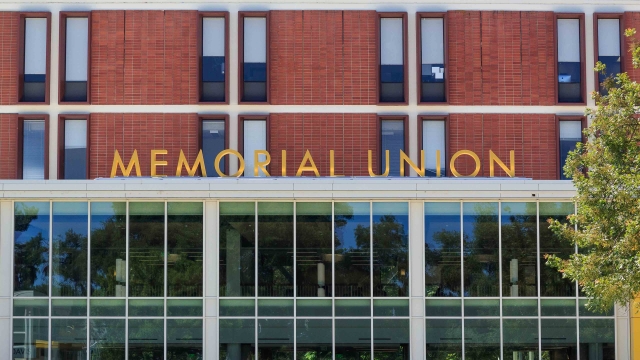
The UC Board of Regents voted unanimously at its June 15 meeting to endorse Assembly Constitutional Act 5, which passed assembly this month and now goes before the Senate, where it must pass with a two-thirds majority by June 25. 

If it passes — which it’s expected to — California’s voters will have a chance to vote on repealing Proposition 209, paving the way for reimplementation of affirmative action in college admissions at California public colleges and universities. Proposition 209, passed in 1996, amended California’s Constitution to prohibit the state from discriminating against or giving preferential treatment to anyone based on race, sex, gender or ethnicity. It expanded on the precedent set by Bakke vs. UC Davis in 1978, which ruled specific race or gender quotas unconstitutional. 

A press release from the UC Office of the President said that the results of the Regents’ vote are indicative of UC’s commitment to proactively addressing systemic inequalities in public education. 

“There is amazing momentum for righting the wrongs caused by centuries of systemic racism in our country,” said Chair of the Board of Regents John A. Perez in the press release. “I am proud UC endorsed giving California voters the chance to erase a stain, support opportunity and equality and repeal Proposition 209.” 

The UC is the last of the California higher education systems to endorse ACA 5. Eloy Ortiz Oakley, chancellor of the California Community Colleges, signed a letter of support for ACA 5 on May 25, and on June 8, Timothy White, chancellor of the California State University, wrote his own letter of support for the act. 

The UC Student Association previously expressed support for the act’s passage, with ASUCD Vice President Akhila Kandaswamy and External Vice President Maria Martinez previously meeting with Assemblymember Cecilia Aguilar-Curry to talk about the effort to repeal Proposition 209 on May 15.

In a text statement for The California Aggie, Martinez said she hoped ACA 5 speedily passed through the California Senate, adding that including race in admissions decisions is essential for the UC’s student population to reflect California’s diversity.

“ACA 5’s unanimous endorsement by the UC Regents is a huge win for marginalized communities in the fight against systemic racism,” Martinez said. 

According to a CalMatters infographic, the enrollment of Black, Latino and Native American freshmen across UCs declined after Proposition 209’s passage.

Regent Debby Stegura said during the meeting that many tools after Proposition 209 were established for admitting “a better balance of students,” including holistic review, which she called a poor way to achieve a student body representative of California.

“I will note that many people of color are first generation students,” Stegura said. “I think there’s no better way to […] serve better all demographics of California.”

Still, there has been strong opposition for the repeal. At the Regents meeting, representatives from the California Federation of College Republicans (CFCR) allegedly attempted to engage in the meeting’s public comment period but were denied the opportunity to speak, according to a Facebook statement from the federation.

“CFCR represents thousands of UC students and is deeply concerned about the apparent censorship of opposing viewpoints by the Board of Regents this morning,” the statement reads. “We remain committed to fighting both ACA 5 and any and all attempts by UC and other institutions of higher learning to silence opposing views.”

All public comments made during the meeting were made in support of the Regents endorsing ACA 5.

Others that have pushed against the repeal include predominantly Chinese American and white groups. In a national survey of Asian Americans from 2016, 63% of Chinese residents surveyed said they believed affirmative action programs were a bad thing — the highest percentage among Indian, Filipino, Japanese, Korean and Vietnamese Americans surveyed. When asked whether they favored or opposed affirmative action, Chinese Americans surveyed had the closest margin of favor/oppose — 4%, with 41% of respondents favoring affirmative action and 45% opposing it. 

Assemblymember Phil Chen (R-CA), one of the 14 assemblymembers on the Asian American Pacific Legislative Caucus, voted against ACA 5, asserting that it legalized racism and sexism.

“I do not want to live in a state where the color of my skin or my race or my sex or my national origin determines my qualifications for a position, a job or entering to college,” Choi said, as reported by LAist. “I came here to this country to get away from ideologies like that.” 

Regent William Um, who formerly voted to abstain, acknowledged during the meeting that the Asian American community was often portrayed as being on the fence with regard to affirmative action and expressed worry that the board was getting ahead of the Senate.

“I would like this body to promise me that it will — in the event that it comes before the voters, if and when the Senate approves it — […] once again have this conversation in this body with similar enthusiasm and personal stories and the like,” Um said before giving his support for the endorsement. “That’s the pivotal time period where the vote will really matter.”

The fight to repeal Proposition 209 began in 2013, with Senate Constitutional Amendment 5, put forth by then-Senator Ed Hernandez; it failed in the Assembly.

Abigail Fisher, who is white, sued the University of Texas over its affirmative action policy in 2013 — a case that intended to challenge race-based policies across the nation — though the district court and U.S. Court of Appeals for the Fifth Circuit both ruled that the admissions process was constitutional. 

The decision draws on a precedent set by the U.S. Supreme Court that schools may use race as a factor in admissions decisions under certain circumstances, while Proposition 209 barred California schools from doing so at all. 

UC President Janet Napolitano said it made “little sense” to exclude consideration of race in admissions, given the university’s goal was to understand and evaluate applicants holistically.

“The diversity of our university and higher education institutions across California should — and must — represent the rich diversity of our state,” Napolitano said. 

Written by: Janelle Marie Salanga — campus@theaggie.org 
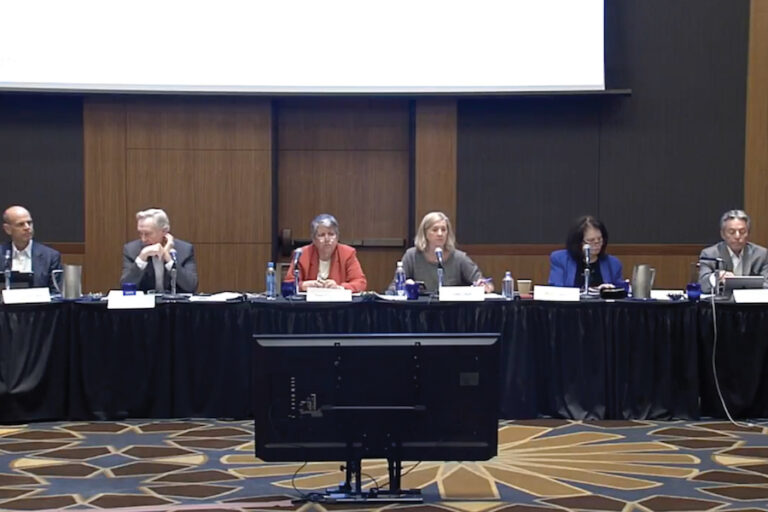
Tensions high at last Senate meetings of the quarter as controversial BDS resolution passes, is later vetoed

Thrive faces criticism for not consulting members of the Black campus community when deciding to skip last Senate meeting of the quarter in solidarity with the BLM movement

Before the June 4 ASUCD Senate meeting officially began, Jailen Graham, the president of the Black Student Union at UC Davis, read a statement on the killings of George Floyd, Breonna Taylor and Ahmaud Arbery and the resulting Black Lives Matter protests that have resurfaced.

She said those looking to reach out to their Black friends should say “I’m thinking of you” instead of “How are you?” given the community rehashes that multiple times a day. 

“Unfortunately, these events are not new,” Graham said. “A lot of us [in the Black community] are experiencing a lot of pain and turmoil. If you want to change the system, you have to change the hearts of the people who built it.”

Members of the Thrive slate, along with Senator Roberto Rodriguez-Ibarra, who is unaffiliated with a slate, issued a statement on June 3 announcing they would not attend the June 4 Senate meeting in solidarity with the Black community and those protesting. 

“Instead [of attending ASUCD Senate], many of us will be attending peaceful protests in our own cities to oppose these atrocities, using this valuable time to reflect on the injustices occurring in our society and to actively be allies to the Black community,” the statement read.

Though all members of the Thrive slate, except Senator Mahan Carduny, joined the meeting around 6:20 p.m., former Senate Pro Tempore Shondreya Landrum, who attended the meeting, noted that the Senate had not reached quorum, calling it “sad.” It was noted that no members of Thrive reached out to officials from the Black Student Union or to other Black student organizations.

“BASED is here, Thrive is not,” Landrum said. “If you’re not here for the people who elected you [and] if you’re not going to sit here and stand in solidarity with us […] you might as well go and impeach them. If they’re not going to do their job, then they shouldn’t be.”

When the meeting was called to order, Senator Juan Velasco and Carduny were absent; Velasco joined late. Quorum was thus established.

After Senate Resolution #24 was passed, the table moved into public discussion to further discuss Thrive’s statement. 

Senator Shreya Deshpande first asked how the Senate could be present for the Black community and how it was falling short, noting that there was lots of animosity on the table that they didn’t want to spill over into the community.

Landrum said she thought the community needed to see that the Senate was there for them, despite whatever was happening in their own personal lives.

“I’m not asking you to make any type of radical change,” she said. “You know me. You know people in the Black community. Educate yourself about what’s going on. Put yourself in the forefront to protect us. Come 10 minutes before and say ‘I want to hear you speak’ — that’s you acknowledging your privilege.”

Former Ethnic and Cultural Affairs Commission (ECAC) chair Jonina Balabis added that support for Black Lives Matter shouldn’t be just for a trend or for clout, given that no members of Thrive reached out to any Black student organizations.

“For you to say you support the Black community but you didn’t reach out to them, you didn’t come to our meetings — did you just find out we had Black students at UC Davis?” Balabis said.

Maria Martinez, Rodriguez Ibarra and Senator Lucas Fong apologized for having their name on the statement. Fong — who is Black and Filipino — shared an experience where a visibly white person said “What’s up, my n-words?” He asked Landrum for advice about educating those around him while learning to handle such situations.

“This is more educating you,” Landrum said. “I will say that if you are Black, you need to research your Blackness. I didn’t grow up with Black people, but I had to research it, what it meant to me. Have the hard conversations.” 

She acknowledged that Fong and Martinez showed up to Senate earlier than other members of Thrive. 

Academic Affairs Commission Chair Naomi Reeley said it was heartbreaking to see how the quarter turned out for the table, adding that it reflected ASUCD as a whole.

“It’s really annoying and hurtful to see people fighting about stupid shit, unless it matters,” she said. “The stuff we’re talking about, it matters. To me, it seems people only do that on this table as a political means. Slates don’t frickin’ matter.”

Senator Pro Tempore Samantha Boudaie said she only received the Senate agenda an hour before the meeting and thought she and Thrive could be better activists if they went out as a group to support the Black community. 

President Kyle Krueger and Vice President Akhila Kandaswamy explained that they had met with Boudaie and Velasco at 2 p.m. before the Senate meeting and brought up the fact that Black students would be attending, but they said Boudaie told them she was still not willing to attend. 

“I asked, ‘Is there anything Kyle and I could say to you, anything at all that would make you want to attend?’” Kandaswamy said. “She answered, ‘I don’t know.’” 

Boudaie said she didn’t want to speak on behalf of her entire slate, but as soon as she found out Black students would be at Senate, she and Velasco were doing everything they could to figure out how they would handle the situation. 

“We weren’t doing it out of the malice of our heart, we were doing this because we wanted to be activists,” she said. “I’m really genuinely sorry that this ended up being something that came up as disrespectful, and I’m hopeful that we can move past and learn from this.” 

Landrum and Reeley called the apology an “excuse,” with Deshpande asking Boudaie to retract the statement if she was really sorry. 

“All you have to do is say ‘I’m sorry, my name was on it [the statement]’,” Landrum said. “That was all you had to do, and then you do better. When you want to speak on the Black community, you talk to someone you know.” 

Kinu Koide, chair of the Aggie Public Arts Committee, said Boudaie was pushing her agenda.

“You are here to advocate for students,” Kolde said. “It’s always turned into these selfish conversations about your personal agendas and hearing you apologize over and over again.”

Senator Tenzin Youedon called for Thrive to publicly apologize, take the statement down and have Boudaie resign.

“I can’t recount how many times I’ve broken down from these Senate meetings, and I’m shaking right now talking about this,” Youedon said. “Part of it has been because of you. A good pro temp would be able to bring the table together and you haven’t. If anything, you’ve divided us more.” 

Kolde, who is in the Greek community, similarly criticized Boudaie for hiding behind technicalities and criticized prospective Senators who have entered Greek meetings asking for votes, regardless of their platform. 

Arielle Zur, a member of the public, and Senator Martinez came to Boudaie’s defense. 

“Sam represents the Jewish community,” Zur said. “She voices our concerns. She is needed on this board and we support her fully.” 

June 4 Senate

The June 4 Senate meeting was called to order at 6:28 p.m.

The table moved to confirm the nominee for the Academic Affairs Commission (AAC) chair, Navreet Hundal, a second-year international relations major. Hundal has served on the AAC for the past two years.

Academic Affairs member Justin Hurst and External Affairs Commission (EAC) Chair Shelby Salyer recommended Hundal, and the motion to confirm her passed with no objections.

Next, the table moved into ex-officio reports.
Controller Kevin Rotenkolber said he met with the elections committee to discuss budget logistics and how remote elections would work in Fall Quarter.

ECAC Chair Yalda Saii said the commission wrapped up interviews for potential vice chairs and commissioners and hosted a Virtual Tunnel of Resistance, during which folks representing student organizations shared stories about resisting the status quo. 

Environmental Policy and Planning Commission (EPPC) Chair Hunter Ottman said he presented at the Sustainability Summit. And in EAC, Salyer said that while commission members had worked on legislation this week, they primarily participated in Sacramento and Davis protests to show solidarity with the Black community.

The next item on the agenda was EPPC commissioner confirmations; six nominees were confirmed without objection.

Elected officers then delivered their reports.

Krueger and Kandaswamy worked on the executive office statement in support of the Black community. Kandaswamy added that she had been speaking with Black community members committed to taking action.

“We recognize it is time for us to move past solidarity,” Kandaswamy said. “We have to be here and use this platform. I was incredibly disappointed to see some members of the table did not join until several minutes before the Senate meeting.” 

ASUCD External Affairs Vice President Maria Martinez said she finalized the application for the DREAMER scholarship, which intends to provide additional support for DACA and undocumented students, and released it this week. She also said she sent off a letter to the UC Regents — with over 8,800 signatures — urging them to remove budget cuts to undocumented student programs from consideration.

Senators Deshpande, Fong, Youedon and Rodriguez-Ibarra said they attended one protest. Rodriguez-Ibarra added that he went to Mexico for an appointment with the National Commission for Indigenous Rights, which has been working with him for several years to promote global education.

Boudaie said she had left the protest at the Los Angeles City Council to be an active listener to the Black community.

“Today is about listening and providing a platform to Black students,” she said. “I don’t want to make it all about us.”

The table moved to the Student Sustainability Career Fair Committee Chairperson confirmation. 

Julia Pano, a third-year environmental science and management major, said she was excited to open possibilities for different sustainability career paths for students on campus.

After Ottman’s recommendation, Deshpande said they had heard lots of questions from engineering students not having sustainable career options and asked how Pano planned to get started with the career fair.

“I plan to get different professors from different fields and hear their stories about what happens in the workforce,” Pano said. “We’ll post Q&A’s on social media and see from professors’ perspectives instead of just reading company descriptions online, then start to email different companies and invite them to career fair.”

Pano was then confirmed without objections.

Four committee members for the career fair were then confirmed without objections.

Saii and Balabis delivered the ex-officio report for ECAC, starting off with a moment of silence to recognize “the recent murders of too many.” 

Balabis said ECAC began the quarter with 11 planned projects, ultimately completing eight, including hosting Tunnel of Resistance and updating the ECAC Facebook page at least once a week. She also said ECAC met with AB540 students, members of the Jewish community and the American Indian Retention & Recruitment center.

Deshpande and Youedon both commended Balabis, and Youedon said she admired and looked up to Balabis.

The table then moved to Transfer, Reentry, and Veterans Committee (TRVC) member confirmation. Third-year biochemistry major Wasim Sandhu, who said he thought the position would be perfect for him to help connect transfer students to communities, was confirmed with no objections.

Business and Finance Committee (B&F) commissioner confirmations followed. Kasra Soltani Nia, a third-year neurobiology, physiology and behavior major, and Isabelle Poux, a first-year managerial economics major, were confirmed without objections.

Jenna DiCarlo was then sworn in as a member of the Judicial Council. 

The table went into a 10-minute break and called the meeting back to order at 7:56 p.m. Former ASUCD president Justin Hurst stood in for IAC Chair Emily Barneond. 

As per the consent calendar, Senate Bills #51, #70, #71, #72, #73 and #74 were passed unanimously. No new legislation was introduced, pushing the table into consideration of old legislation.

Boudaie asked to call a motion to table Senate Resolutions #24 and #25 in favor of “time and other reasons.” 

“We all came out here tonight to support the Black community, and we’re just seeing legislation that’s completely irrelevant — we need to focus on more urgent legislation,” she said.

Reeley objected, asking for her resolution — SR #24 — to at least be seen. Deshpande also objected, asking to amend the agenda to enter into public discussion. 

Kandaswamy seconded the motion, but Boudaie’s motion still stood, pushing the table into a roll call vote.

Landrum interrupted the vote to say that the meeting had already run so long that she was the only Black member of the public able to stay.

“If it’s about us, we’re not worried,” she said. 

Reeley added that senators were also here because they had a duty to the student community.

“Every student is important and there’s no excuse for why we shouldn’t finish the agenda,” she said. “Yes, it doesn’t pertain to what’s going on, but you all signed up and ran on a platform to help all students. If you wanted to hear the Black community today, they were able to talk at the beginning of the meeting.”

The roll call vote to table SR #25 was 3-5-3; the motion remained on the agenda. 

Reeley then commented on SR #24, explaining that the resolution calls to order things that students wanted to see in the library space. 

Member of the public Nancy Juarez said she agreed that the resolutions were important but that they shouldn’t have come before Black voices. 

“I’m extremely disappointed in how this all turned out,” Juarez said. “If you can figure out how to undo that and still do the resolutions but allow these voices to be heard, I suggest you do that.” 

Senator Laura Elizalde acknowledged that though Graham spoke earlier, the conversation with the Black community was not a two-second item but instead a dialogue.

Krueger steered the conversation back to the resolution by saying he thought it was incredibly relevant.

“It’s making sure we have an essential resource to come to for connectivity and quiet space that’s as well-funded as possible,” he said.

The resolution was approved with no objections and the table moved into public discussion, as described in the first section.

Heated discussion over resolution supporting the Boycott, Divestment and Sanctions (BDS) movement

The table moved back to consideration of legislation, starting with SR #25. 

Noor Al-Deen, a member of the public, introduced the resolution — co-authored by the Muslim Student Association, ECAC and EAC — and said the resolution urged UC to divest from corporations that aided in the Israeli occupation of Palestine. 

“This is expressing concern of where the UC money is spent and is not meant to discount personal and political beliefs,” Al-Deen said. “The facts show that these companies are complicit in crimes against humanity — we can’t sit silently while this happens.”

Salyer noted that EAC passed the resolution unanimously.

“We don’t want our tuition dollars going to corporations going to militarized bulldozers that kill Palestinian students and destroy their homes,” they said. “Human rights shouldn’t be a debatable topic.”

Mohammed al-Messra, a member of the public, said the resolution was headed a good direction but was very discriminatory toward Israel.

“I just don’t get it — why focus on this when there’s so many issues in this country you should be focused on?” al-Messra said. “You guys are children. This drives a wedge between Israel and the U.S. Two great allies! I don’t get it, folks! Above all, just vote no. This is against everything I came to the states for.”

Deshpande retorted that there was no real harm done beyond finding another construction company. 

“People matter over profits and we can have a conversation with people when they actually have the space, power, privilege and ability to be here,” they said.

Member of the public Justin Weiner, a previous candidate for both ASUCD vice president and senator, questioned why the table was “singling out Israel.”

“Why aren’t you singling out Taco Bell, which donated a bunch to Donald Trump’s re-election campaign?” Weiner asked.

Former Senator Alisha Hacker, who ran for ASUCD president alongside Weiner, said ASUCD pushes for unity and change to directly impact students and that she had talked repeatedly about how it hadn’t accomplished that.

“The Jewish community is here asking Senators not to vote yes, and they need to listen to all members of the Jewish community — for too long, their voices have not been heard on campus,” Hacker said. 

Former ASUCD President Michael Gofman said it was silly to say Israel was committing genocide against anyone, especially Palestinian people, and called the resolution an anti-Semitic statement. 

“It may come as a surprise that since 1967, the Palestinian population has doubled,” he said. “If you say Israel is committing a genocide, it is the worst genocide in history.” 

He said he couldn’t definitively say whether any mainstream Jewish organizations or Jewish leaders on campus had been contacted about the resolution before it was passed, pointing to the previous Judicial Council ruling on a similar resolution passed in 2015 that called it unconstitutional.

“This makes Jewish students feel uncomfortable, expressing one of the tenets of their religious beliefs, and it’s disgusting,” Gofman said. 

Former Muslim Student Association President Muaz Aznan said he had worked to get interfaith dialogue between Jewish, Muslim and Palestinian students but added that “interfaith” was a distraction from the ethnic cleansing of Palestinians.

“Freedom and liberty are not given from the oppressor to the oppressed — the oppressed must demand their freedom,” Aznan said. “Anyone who thinks that they can say how Palestinians ask for freedom is quite simply a fool.”

Member of the public Danielle Younai said the Jewish community only learned about the resolution 10 minutes before, saying ASUCD had zero transparency.

“The only senator who made a genuine effort to reach out to Jewish students is Senator Boudaie,” Younai said. “All other ‘efforts’ are performative — the Jewish community showed up and are being routinely silenced.” 

Younai called for the resolution to be tabled until all people could read it.

Rudy Rochman, an Israeli rights activist based in Israel, said the only way to move forward was to acknowledge such resolutions were a part of the problem, calling SR #25 a zero-sum solution.

“If you’re pro-Israel, you must be pro-Palestinian and vice versa,” he said.

Gofman added that no one in the meeting — including him — knew the whole state of Israel or Palestine.

Beshara Kehdi, a graduate student in ethnic studies, countered Gofman’s statement and said students aren’t stupid. 

“You don’t need to have a degree in Palestine Studies to have an idea of what’s going on and to say something about it,” Kehdi said, adding that 100% of Palestinian refugees who moved out of their homes were denied the ability to return. 

A roll call vote was then called. Senators Amanjot Gandhoke, Boudaie, Martinez and Velasco voted no, Fong and Carduny abstained and Deshpande, Rodriguez Ibarra, Youedon, Khalil Malik and Elizalde voted yes. The resolution passed with a 5-4-2 vote.

The day after the meeting, on June 5, Krueger vetoed SR #25, calling the resolution problematic because it was written with minimal to no input from the Jewish community beforehand and noting that the Jewish students he had spoken to after the SR #25 vote expressed hurt over its passage.

“Our respect for the Palestinian community cannot come at the expense of the respect of the Jewish community,” he wrote. “If the authors are passionate about divestment from companies involved in human rights violations, I would encourage them to write a resolution that more holistically requests the UC’s divestment from companies involved in human rights violations.” 

Close of the Senate meeting

SR #26, which supports the Davis Innovation and Sustainability Campus given its job creation and lack of negative environmental impacts, and SR #27, which supports the development of affordable housing in the University Mall area, both passed without objections.

Senators then made closing remarks. Velasco asked senators to share information about the DREAMer vouchers. And Boudaie expressed dismay about the vote for SR #25 and said she wanted to apologize for her leadership as pro temp.

“Being pro temp in a pandemic on Zoom isn’t necessarily very easy,” she said. “I’m really sorry if you all felt like I wasn’t trying my best. I’m extraordinarily offended that some of y’all want me to resign because of this.”

She said she had experienced frustration for her past efforts in standing up for the Jewish community on campus, but affirmed that she would continue to do what she could to support them.

“I know if I wasn’t here, none of you would do anything for the Jewish community,” she said. “I’m sorry that my leadership has not been perfect. I’m 19 and I’m still learning. But I will not apologize for doing what I can to stand up for a community that has historically been attacked by ASUCD.” 

At the end of the day, she said, albeit those calling for her resignation, it had been a wonderful quarter,

Velasco and Martinez both expressed discontent with the atmosphere in ASUCD this quarter, with Martinez saying slates have no purpose in the system. 

“ASUCD is not fun for anyone,” Velasco said. “It stems from a lack of communication and a lot of virtue signaling from social justice warriors, saying everyone is oppressed and using buzzwords to bring even more division. I hope you all will stop making this organization into the disgusting organization it has become.”

Krueger concluded by saying he wasn’t as collaborative and empathetic as he could have been and was looking forward to doing that moving forward.

The meeting ended at 1:40 a.m.

Written by: Janelle Marie Salanga — campus@theaggie.org 

Senate fails to fill Judicial Council vacancy for third consecutive week

Controversial closed session called over appointment

Editor’s Note: At the time this article was written, the May 14 ASUCD Senate Meeting had not taken place. At that meeting, Jenna DiCarlo was confirmed as a member of the ASUCD Judicial Council, and the ASUCD Senate was able to conduct regular business.

The May 7 ASUCD Senate meeting was called to order at 6:11 p.m. on May 7 by Vice President Akhila Kandaswamy. 

The Senate had not met for the previous two weeks due to a vacancy on the Judicial Council (JC). Senate President Pro Tempore Samantha Boudaie began the meeting by introducing the recommended candidate, Jenna DiCarlo, a second-year international relations major, to fill the vacancy.

After her introduction, controller Kevin Rotenkolber, who arrived late, motioned to move the Senate into a closed session that included DiCarlo. The motion was seconded by Kandaswamy.

The closed session lasted more than an hour. DiCarlo was not appointed during the closed session, so the meeting was forced to end early. Under the ASUCD Bylaws, the Senate cannot meet if a vacancy exists on the JC for more than four weeks.

The closed session concerned DiCarlo’s appointment to the JC. According to Senator JB Martinez, the closed session focused on DiCarlo’s alleged partisanship, as she previously ran for Senate on the UNITE slate, and whether or not the Senate should be able to meet with all applicants directly to choose a candidate for the vacancy.

Interview committees usually meet with potential applicants before selecting the candidate that best fits the position requirements. This candidate is then introduced to the Senate where a public hearing takes place, and the Senate votes on whether or not to confirm the candidate.

“I personally believe the incident was politicized,” DiCarlo said. “I was discriminated against because of my personal political leanings that have nothing to do with my ability to be fair and impartial on [the] Judicial Council.”

Kandaswamy said the closed session was called in accordance with section 2105.(C)(2) of the Bylaws. 

According to this section, however, “the ASUCD senate must motion for a closed session regarding personal matters, investment matters, or litigation matters. That motion must be seconded and approved by a majority of voting members of the ASUCD Senate. At this time, a closed session will be placed on the agenda of the next regularly scheduled meeting of the ASUCD Senate, unless otherwise specified in the motion.”

While the closed session was moved and seconded, there was no approval by the majority of voting members of the Senate. The session was also not planned in advance and, therefore, not scheduled in the agenda.

Kandaswamy said there were no objections raised to the closed session. According to Boudaie and DiCarlo, however, neither Rotenkolber nor Kandaswamy asked if there were any objections before moving into a closed session. They also said the reason for motioning for a closed session was unclear at the time. As a result, the senators did not vote on whether to move into a closed session, nor was there an opportunity to raise objections.

“The closed session was not a ‘planned closed session’ and was therefore not a part of the agenda,” Kandaswamy said via email. “That being said, the agenda did include ‘closed session’ as one of its items and was released over 48 hours in advance, so that was satisfied.”

The closed session that was on the agenda was meant to handle a different subject matter according to Kandaswamy, so it is unclear whether that section of the bylaws was satisfied as Kandaswamy claimed it was.

According to Boudaie, Kandaswamy’s claims that the closed session was released beforehand are also incorrect. 

“The closed session was not announced 48 hours ahead of time, and without the general reasoning for holding the closed session also made public,” Boudaie said. 

DiCarlo was also not informed that she had the right to a public hearing, according to Boudaie, Kandaswamy and DiCarlo.

Bylaw section 2105(C)(3) states that “the appointee or employee shall be given written notice of their right to have a public hearing. This notice shall be delivered either in-person or via email at least forty-eight hours before the closed session to the appointee.”

“I definitely was not notified 48 hours in advance,” DiCarlo said.

According to Bylaw section 2105(C)(4), “if notice is not given, any disciplinary or other action taken against any appointee or employee at the closed session shall be null and void.” 

As of the time of writing, the issue has been sent to the Judicial Council for review, and as of the time this article went to press, the ruling was not available on ASUCD’s website.

Written by: Ally Russell — campus@theaggie.org 

Bistro 33 closed, ending Davis “Mojito Night” tradition

COVID-19 leaves negative impact on another Downtown Davis business

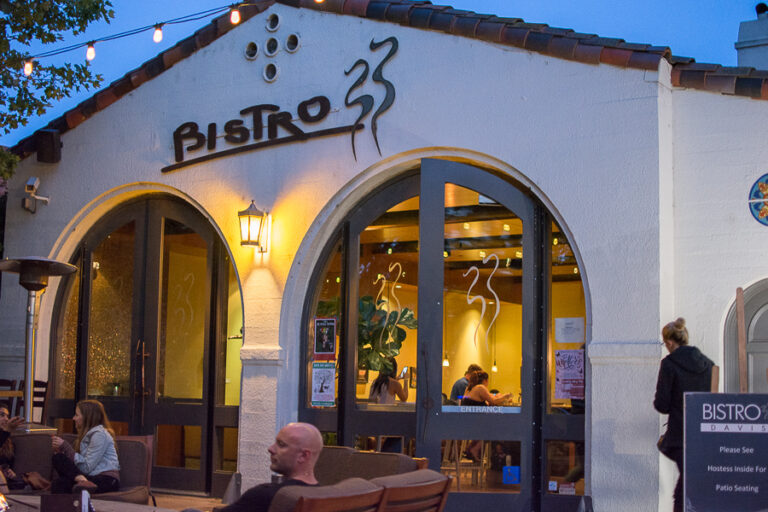
Bistro 33’s “Mojito Night” has long been a staple of the Davis community and of the UC Davis student experience. Each Thursday night, dozens, if not hundreds, of students and community members gathered at Bistro 33 from 6 p.m. to midnight to buy mojito cocktails at $12 per pitcher, dance to live music from DJ Smilez on the second and fourth Thursday of the month and hang out with friends. This tradition, however, has been discontinued, as Bistro 33 recently announced it would be closing.

Both Bistro 33 and the adjacent establishment, City Hall Tavern, initially closed temporarily due to social distancing protocol. Both restaurants have now closed permanently. 

The official website, however, released an updated statement on June 19.

“Due to the COVID-19 and not being able to come to lease terms with the new property owner we are sad to announce the Bistro 33 Davis will not reopen” the website reads. “Thank you to all the incredible employees that made this a special place! Also thank you to all of our loyal customers, we appreciate your business!”

Mark Engstrom, the president of Engstrom Properties, released a recent statement regarding the lease expiration of Bistro 33. 

“Bistro 33’s lease is set to expire in August,” Engstrom said to The Davis Enterprise. “We would like to thank Bistro 33 for their service to the community for the last 15 years.”

Rafa Razo, a UC Davis alumnus from the class of 2019, described a typical Mojito Night.

“Mojito Night was always full of fun and good times with friends,” Razo said via email. “It was a good stress reliever to forget about schoolwork and just get the weekend started.”

Razo said Bistro 33 was “more than just a bar for Davis students and the community,” saying the event was a motivating factor that helped him get through the week.

“Mojito Night was always full of good memories, many laughs and fun times with friends,” Razo said via email. “Mojito Night was truly part of the whole ‘Davis Experience.’” 

Engstrom echoed this sentiment, writing in his statement that Bistro 33 became “a local gem.”

“When it’s safe to do so, we will be working with their leasing agents to market the property and find an operator who can retain the charm and sense of community that Bistro 33 brought to the Davis Downtown,” Engstrom said to The Davis Enterprise.

Written by: Jelena Lapuz — city@theaggie.org

Letter to the Editor

Chancellor May responds to calls from UCD faculty to disband campus police

To the Editor: 

Re “Guest: Disband the UC Davis police force now” by guest contributors (opinion, June 14): 

The history and persistence of racism, and especially anti-Black racism, touches me deeply and personally. I have reflected publicly and repeatedly on the history of police violence in the United States directed disproportionately at marginalized populations, especially African-Americans, and of the understandable fear so many of us live with. I grew up less than two miles from Ferguson, Missouri, where Michael Brown was killed by police in 2014. I clearly understand the police are one of several critical institutions, including our justice and penal systems, that have perpetuated and continue to perpetuate systemic racism in the United States.

I acknowledge that the signatories of the guest opinion advocate for a radical break, not just reform. While I question their approach, I share a belief that we have today an opportunity for significant and truly meaningful change, and that we must seize it. 

The signatories dismiss my formation of the task force “Next Generation Reforms to Advance Campus Safety” as insufficient. Under co-chairs VC-DEI Tull and King Hall Dean Kevin Johnson, the task force will engage in serious reflection, taking into account a broad range of views — the co-signers of the guest opinion column among them — and deliver recommendations for action. The creation and charging of a task force is not the end in itself but a first step. I am action-oriented and have a record to prove it: every task force that has been formed under my administration (e.g., housing, food insecurity, mental health) has resulted in substantive recommendations that have been adopted.

While I think it is generally bad form, and usually unproductive, to make assumptions about the likely reactions of one’s interlocutors, I would like to think that the signatories would be surprised at the degree to which I am open to significant, even radical reimagining of “campus safety,” to cite the phrase chosen carefully for the name of the task force. One reality, though, that I am very mindful of, is that we are part of a larger system, and there are certain changes we cannot make independently. For me, that means that I want UC Davis to model and then drive significant change across the entire UC system, and we will continue to push the boundaries as we did in constituting the first Police Accountability Board for a UC campus (perhaps any university campus in the US); in creating a cadet program that has brought many diverse UC Davis graduates into our ranks so that they can embody our shared community values; and in supporting and collaborating with the Yolo County Neighborhood Court Restorative Justice Programs. 

These are just a few of the innovative ways in which UC Davis is moving in what I feel is the right direction. Indeed, I want us to go much further, as does Chief Farrow, and enacting what the task force will recommend and advocating for change across the UC system and with the state legislature especially, which in some areas frankly holds us back sometimes, is in my view the only way to make for real change that would ensure the safety of our community. Faculty, students and staff are not only on our campuses: they and their families and friends live and work in Davis, Sacramento and surrounding communities. Until we change policing across the region, state and nation, we will not have achieved what we need.

In sum, “abolishing the UC Davis police” would be a nationally visible gesture, but not necessarily a constructive or complete one. Even municipalities that have ostensibly taken such steps have wound up reforming and recreating policing in models similar to our own current trajectory. I am deeply convinced that the pathway on which we are now embarked is the right one: of imagining new forms of public safety, far beyond policing and into realms of social work and mental health — there I believe we are in agreement — and then engaging through dialogue with other UC campuses and other jurisdictions across California and beyond to advocate for the universal adoption of these practices.

Gary S. May, Chancellor

US Supreme Court rules Trump administration improperly ended DACA program

DACA program must resume accepting applications, Trump administration could attempt to end program again

The U.S. Supreme Court released its decision on the Deferred Action for Childhood Arrivals (DACA) program today, June 18, ruling in a 5-4 decision that the Trump administration improperly ended the program, but that the administration could attempt to end the program if it followed the correct procedure.

In September of 2019, the UC became the first university to file a lawsuit against the rescission of the program. DACA, launched in 2012 under President Barack Obama, is a program that grants people who entered the U.S. as young children protection from deportation, the ability to apply for work permits and the ability to get a driver’s license. DACA does not create a pathway for legal citizenship or give a person official legal status, and was only available for new applications until 2017, when then Attorney General Jeff Sessions announced the Trump Administration’s call for the end of DACA.

Approximately 4,000 undocumented students and 1,700 DACA recipients attend UC schools.

Claiming that the Trump Administration acted illegally by terminating the DACA program without offering any valid justification for doing so, the UC and other groups across the nation filed a lawsuit against the U.S. government. In June of 2019, the Supreme Court agreed to review the challenges, then heard oral arguments in November of 2019, ending in the release of the decision on Thursday.

In a statement released in the afternoon on the day of the decision, Chancellor Gary May said “Today marks a significant victory in the name of social equity.”

“This ruling is a huge relief to so many valued members of our UC Davis community,” May said. “While UC Davis — and the entire UC system — has been consistent in its support for DACA, our undocumented community has faced incredible stress and uncertainty as they awaited this decision over the past two years.”

The AB540 and Undocumented Student Center on campus has been working to support DACA and the influx of undocumented students unable to apply for DACA because applications are no longer being accepted. 

“We have a partnership with the nonprofit Immigrants Rising, which offers webinars and toolkits on subjects like understanding entrepreneurship and independent contracting work,” said Mayra Llamas, executive director of the Community Resource and Retention Centers. “We’re trying to explore how we can coach students who might be losing other ways of earning wages and thinking of how we can unpack this for our students.”

Written by: Jessica Baggott — campus@theaggie.org


After SHCS furloughs, counselors voice yearslong frustrations with university leadership

Six SHCS counselors say they feel devalued, voice frustrations with management

This article fits into the context of a previous article by The California Aggie titled “UC Davis Counseling Services staff at odds with SHCS leadership over summer furloughs.” All six counselors who agreed to an interview spoke on the condition of anonymity in order to protect themselves — and their jobs — from any type of retaliation. They are referred to as Counselors A, B, C, D, E and F. 

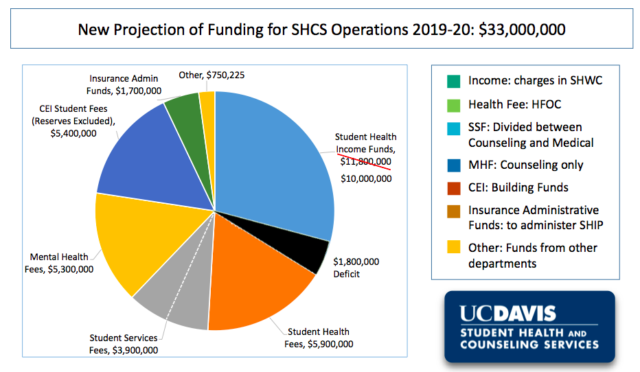
Six UC Davis counselors who recently spoke to The California Aggie emphasized frustrations over a curious duality when it comes to the services they provide. On one hand, university leaders, including the chancellor, have encouraged students to take advantage of UC Davis’ mental health resources during this difficult time. At the same time, however, nine counselors have been made to take mandatory furloughs, despite the fact that Counseling Services was staffed at 75% capacity even before the pandemic.

“I think it’s misleading to the students — their actions are contradicting what they’re saying,” Counselor B said. “Counseling Services has already been understaffed, and we have been really grinding this year. We’ve been very overwhelmed. A lot of students reach out to Counseling Services and want to initiate mental health treatment, which is wonderful. But on the other hand, […] support to students is not then being backed up by financial sources. So it’s just mixed messages.”

The counselors who spoke to The Aggie, some of whom are being furloughed, said UC Davis is effectively cutting back on its scope of mental health resources during a pandemic and a time of national and global crisis. They feel that this will ultimately make it more difficult for students to access the care they pay for through student fees when they need these services the most.

Student Health and Counseling Services (SHCS) leadership, however, disagrees.

“We are continuing to provide our full range of services,” said Counseling Director Paul Kim. “We moved very quickly to make sure our students were able to access mental health services, especially during this pandemic.”

UC Davis and SHCS leadership told The Aggie that mental health resources have been expanded upon during the pandemic (counselors deny this); that the furloughs are a regular and yearly occurrence (counselors deny this); that they have gone out of their way to be fully transparent about the budget (counselors disagree); that the furloughs are not a result of budgetary directives given by Student Affairs (counselors say they were told otherwise) and that the furloughs are not COVID-19-related (counselors say they “obviously” are).

These furloughs, and the disagreements over the reason for and consequences of them, are just one of numerous examples of a perceived lack of clarity and transparency on the part of management, specifically in regards to the budget, that is and has been felt by some members of UC Davis’ counseling staff for years.

After acknowledging that SHCS management cannot predict the future and are dealing with many uncertainties, Counselor B said if the furlough situation had been approached differently, with proactive clarity and transparency on the part of management, “we could have avoided a lot of this mistrust and feeling like our jobs are not secure at this point.”

Furloughing essential workers — “a slap in the face”

As defined by UC Davis, healthcare workers — including mental health workers — are essential. That means that even after Yolo County had implemented its shelter-in-place order on March 18, counselors continued to come into work and have in-person sessions.

Margaret Walter, UC Davis’ executive director of Health and Wellness, explained that in-person appointments continued while SHCS worked on launching telehealth services for students. Counselor B said some counselors raised concerns about continuing in-person services, “and we were reassured, ‘You’re essential staff, so [you] have to be here.’ And that was kind of the extent of it.”

Counselor B acknowledged that management was working hard behind the scenes to get telehealth services up and running so that counselors could provide mental health care through secure video calls.

“I’m really proud of how we responded,” Counselor F said. “We had to transform our entire model of service delivery in a shockingly short amount of time. And that involved tremendous planning on behalf of counseling, leadership and management and staff.”

Other counselors, as well as both Walter and Kim, emphasized how proud they were of the fact that it took only two weeks to launch telehealth services.

“Everybody jumped on that,” Walter said. “I am thrilled how quickly that worked.”

Counselor F said that counselors “didn’t miss a beat in terms of being able to deliver these services to students,” so then to be furloughed “was just a slap in the face.”

     “That’s the contradiction: ‘You guys are so essential. You have to continue your services while the tele-mental health aspect is being figured out,’ and then, a few weeks after that, the furloughs happened,” Counselor B said. “The message to both employees and to students is mental health is going to be the first thing to be cut, which is really frustrating. It’s very frustrating.”

A disagreement over priorities

SHCS is still moving forward with plans to hire an additional 2.6 full-time equivalent (FTE) psychologists to supervise pre-doctoral interns and post-doctoral residents in the Counseling Services Training Program. According to Dr. Cory Vu, the associate vice chancellor for Health, Wellness and Divisional Resources, these positions are currently under review by UC Davis’ recently convened Vacancy Management Program, which assesses the necessity of creating, replacing or backfilling positions.

Some counselors disagree with plans to move forward in filling those positions, given the current situation in SHCS.

“While it is invaluable to provide training, […] we need permanent senior staff,” Counselor E said. “Students need to be able to connect with a counselor when they first come in to UC Davis if that’s needed and, if they’re struggling, be able to reach out to that same person and have continuity of care.”

Counselors also pointed out the fact that the Community Advising Network (CAN) counselor position for the international student community and the Middle Eastern, North African and South Asian (MENASA) student community have remained unfilled for over 18 months. During this same period of time, three management positions were filled, Kim said.

“We wanted to ensure that we could post those positions both for masters clinicians and psychologists, and to be able to do that, there were some processes we had to go through, some that took time for us to figure out,” Kim explained. “The UCPath transition was also a part of the equation. Really, we have a value and strong belief that we get the best qualified counselors.”

Additionally, Walter said technical issues resulting from union negotiations led to changes in title codes that then halted the recruitment process system-wide.

“It does take time to hire the best possible person,” Counselor E said. “It takes even longer when the position is not posted in order to recruit a pool of candidates. This position has been open for more than a year now, and I find it unacceptable that title codes cannot be established within a 14-month period of time. What is the plan then to establish these codes? Who is working on this? These are questions that remain unanswered.”

International student Xiaotong Wang, a fourth-year statistics and economics double major, said she was aware that students paid for these CAN positions and was “upset” to learn that “we did not have what we should have.”

Qiuying Lin, a third-year mathematical analytics and operations research and managerial economics double major, is also an international student. She said she was also not aware of the CAN position for international students, and said she would take advantage of this service if it was made available to her.

“International students have different problems from local students, and we need advice to get accustomed to [our] new life in America,” Lin said. “[A] specific counselor may help us to build more confidence in our college life. And I know some students left UC Davis or can’t concentrate on academics because of mental health problems.”

Ultimately, some counselors feel that there are differences in the priorities of counseling staff versus those of management. Counselor B said the furloughs send a message that “supportive services for students are going to be hit first, given the financial difficulties the university faces.” 

“It highlights the value of generating income, which is important, but in times of literally national emergency, when that’s going to be prioritized over people’s well-being, [that] is a little concerning,” Counselor B said.

There may even be differences in the priorities of management versus those of students. Fifth-year history and English double major Katrina Manrique, a former co-director of the Mental Health Initiative, pointed out that in 2018–19, students paid for the majority of the university’s athletic budget — around $23.5 million — and said there “needs to be a re-assessment over where the university is choosing to place its priorities.”

“Imagine if a portion of this funding could go towards improving student services meant to support and retain students, like Counseling Services?” Manrique said via virtual communication. “I want to see them be more intentional in what they are choosing to fund and what they are choosing to cut especially when it’s services that rely on student fees. How well do those budgetary decisions actually align with what students are asking for? At the end of the day these are student-paid fees and its usage should align with what students are, and have been, asking for.”

“It feels like we are disposable.”

In addition to expressing a sense of not being on the same page as management, all six counselors expressed a sense of feeling devalued by the university. 

“On the face of things, [university leaders] constantly try to validate — in every email, when there’s a crisis, it always says, ‘Please seek counseling,’” Counselor C said. “That’s all nice and fine, but it’s how they actually do their actions and their advocacy which speaks louder to me. It feels like we are disposable.”

There was a feeling voiced by some of the counselors that if the managers or university leaders could only see the types of cases counselors handle, they would recognize their contributions to the university.

Walter, Kim, Vu and Interim Vice Chancellor of Student Affairs Emily Galindo all voiced their continued support of counseling staff. Galindo said she welcomes “any and all opportunities for folks to share what it is that they feel like that we could do to make them feel more supported and more valued.”

In discussions over the current state of Counseling Services, Walter, Kim, Vu and Galindo all said that since the start of the pandemic, the utilization of counseling services has actually gone down. This fact was also recognized by the counselors.

“Students are at home, they’re in a comfortable place, they’re not experiencing the same kind of loneliness that we will see when students are on campus,” Galindo said. “Not to say that there aren’t still the need for the services, because there certainly is.”

Yet, counselors say some of their students are returning to unsafe, dysfunctional or abusive homes. Although there has been a decrease in the amount of new students seeking care this quarter compared to previous years, Counselor E said they have “seen an increased acuity just over the course of the quarter,” and “for some students that were managing okay, [now] they’re doing worse and worse.”

“The university really doesn’t want to recognize [that] students are not coming into the university with just, ‘I’m living away from home for the first time, I don’t know what I want to study and I’m really stressed because of the quarter system,’” Counselor D said. “We have a growing population of people with neurodiversity that, because of great advocacy in the primary levels, are now making it to school, but we don’t really hold them in the way they need to be held. And they often have behavioral issues and pretty severe psychiatric problems. Their cases are complex.”

Both Counselor D and Counselor A noted that college counselors are specialized counselors who work in the ecological framework of the institution.

“My goal is to uphold the chancellor’s mission, which is to promote the opportunity and ability to not just get admitted, but to graduate,” Counselor D said. “We’re doing that and they don’t appreciate it. I just find it asinine, like, ‘Anybody could do your job.’ No, not everybody could do our job.”

Counselors say they remain in SHCS, despite their frustrations, because they are extremely passionate about serving students and appreciate the shared dedication among their colleagues to support students’ well-being.

“Within counseling services, I’ve never gotten the sense that people come into this job as a temporary position, usually it’s because folks are really excited to join the team and they want to work with this population and they plan for this to be a career position,” Counselor B said. “Given all that’s been going on, [I am] feeling very devalued within the UC system as a counselor. I feel that way. I feel very devalued.”

What counselors would like to see from management

In the interview with Kim and Walter, the significance of the fact that six different SHCS counselors spoke with The Aggie to express their frustrations over the furloughs, a felt lack of transparency and the overall current state of affairs was noted. In response, Kim and Walter said they are prepared to receive feedback and respond accordingly.

“Especially with everything else that’s going on in the world, our counselors are serving our community, but our counselors are part of our community,” Walter said. “On top of all of the change that we’ve had this term, to support students and each other as we grieve and protest as a community is significant.”

The COVID-19 pandemic represents a unique time for college counselors, as UC Davis counselors and students — like all other mental health workers and their patients — are living through the same traumatic experience.

“A student asked me, ‘Do you think we’re going to be okay? Do you think that we’ll be able to have classes?’ and my answer is, ‘I don’t know,’” Counselor A said. “‘And this is really difficult. And we’re in this together. And I’m just as scared as you are right now. And this is really a difficult time.’ And that’s all I could say.”

All six counselors said additional clarity, communication, transparency, flexibility, more frequent staff meetings and as much assurance from management at this uncertain time as possible would help. 

Other counselors want bigger commitments, like market-level salaries, from the university.

Finally, Counselor A said they just want the university “to do what they said they were always going to do, which is provide proper staffing.”

Written by: Hannah Holzer — campus@theaggie.org 

UC Davis Counseling Services staff at odds with SHCS leadership over summer furloughs

Six counselors claim furloughs are unprecedented since 2008 recession, SHCS leadership says furloughs are normal and in no way related to COVID-19 budgetary concerns

All six counselors who agreed to an interview spoke on the condition of anonymity in order to protect themselves — and their jobs — from any type of retaliation. They are referred to as Counselors A, B, C, D, E and F. 

“I think there [are] some strange things going on with the money trail,” Counselor D said.

Leadership within UC Davis’ Student Health and Counseling Services (SHCS) recently and unexpectedly decided to furlough 37 employees within the department. During a global recession, furloughs are to be expected — yet university leaders adamantly deny that the furloughs are COVID-19-related. Even so, losses to revenue are to be expected — yet the student fees that fund SHCS were collected at the beginning of the year, pre-pandemic, and have been unaffected.

“Where’s the money?” Counselor D asked.

Budgetary explanations don’t add up

Citing uncertainties concerning what SHCS’s budget holds for the future, the SHCS Executive Team decided in April to furlough 37 partial-year employees. As SHCS is composed of a medical and counseling team, the 37 partial-year employees taking one- or two-month furloughs include eight counselors plus one supervisor, who is also a counselor, as well as employees from the medical team.

The furlough notices, given on April 9 and 10, came as a shock to staff, as department leaders had told employees throughout March that furloughs were not going to be necessary, according to all six counselors who spoke to The California Aggie for this story.

Partial-year employees have 10- or 11-month appointments with the expectation that they work during the academic year and not during the summer months, when there is less student demand.

For the SHCS medical team, spring is typically a busy — and profitable — time of year. Before students graduate, some seek to fill prescriptions, such as birth control, or get a new pair of glasses while they still have insurance, Executive Director of Health and Wellness Margaret Walter explained. And COVID-19 has directly impacted projected springtime income, with fewer students seeking out, and paying for, these types of services.

Photo Courtesy Margaret Walter

A slideshow presentation created by Walter and given to counseling staff shows a breakdown of SHCS’s operational costs pre- versus post-COVID-19. SHCS shows a $1.8 million estimated deficit.

That estimate, according to Walter, is based on two main factors: 

  • Money spent on expenses that were not initially budgeted for: personal protective equipment, rental tents set up in the SHCS parking lot for outdoor COVID-19 testing and iPad purchases for clinicians to provide telehealth visits
  • A reduction in the number of appointments requested and offered as well as a reduction in the number of prescriptions filled

Whereas other university’s health departments rely upon income generated from sources like prescription refills, UC Davis’ SHCS is unique in that it is funded entirely through student fees, thanks to a referendum passed by UC Davis students, Walter said.

“Funding for mental health comes from student service fees and also mental health fees and some mental health initiative fees,” explained Dr. Cory Vu, the associate vice chancellor for Health, Wellness, and Divisional Resources. “Ninety-seven or 98% of that pays for staffing and 2 or 3% pays for operations.”

These fees were collected at the beginning of the year and have not been impacted by COVID-19, according to Walter. 

Furthermore, Walter said it would be a “stretch” to say that the furloughs are COVID-19-related: “I guess you could say it’s related to COVID because COVID sent our students away,” Walter said. Vu also confidently and repeatedly denied that the furloughs are COVID-19-related. 

Counselors, however, say “obviously” the furloughs are COVID-19-related.

“We have been told in staff meetings that we are in a major budget deficit (like most departments in UC),” Counselor C said via email. “Obviously, this is due to Covid 19. I think anyone would be hard pressed to even say that furloughs are not related to Covid 19. We have never had so many staff placed on furlough with little notice and involuntarily. And we are told “we don’t always do this” (in reference to multiple furloughs) in the same breath of telling us of budget deficits and uncertainty.”

Vu, Walter and other university leaders interviewed for this story claim that summertime furloughs for partial-year staff are a regular and annual occurrence.

“This year, it is what it is, and it’s not because of COVID-19,” Vu said. “It would’ve been a normal course of action that would’ve taken place anyways.”

All six counselors, however, said this is not an annual occurrence — even for partial-year staff. Counselor E said, “it was understood [that] there was never really a need for furlough,” with the exception of those furloughs enacted after the 2008 recession. As recently as March, counselors with partial-year appointments were told it would not be necessary for them to furlough this year. 

Counselor C echoed this, saying partial-year staff “were told their positions included possibility of furlough but were reassured at hiring this never happens involuntarily.”

In response, Vu said that, in previous years, there might be different or unusual budgetary circumstances — such as staffing shortages — which then provide SHCS with financial opportunities that enable the department to employ partial-year employees for all 12 months. In the past, SHCS has been short-staffed, and that has provided a budgetary surplus, “but right now, we’re pretty much very close to full capacity,” Vu said.

That was disputed by Counseling Director Paul Kim, who said counseling was 75 to 80% staffed before the pandemic and remains at these levels. According to Counselor E, Counseling Services lost two full-time counselors this academic year — and this is on top of other, existing vacancies. These multiple vacancies have left “students underserved,” Counselor E said.

In her response, Walter said enacting the furloughs this year was a financially prudent move.

“We have funded these partial-year positions to pay the salaries as they are, [and] when we choose not to furlough someone, we have to find that money to pay them,” Walter said. “During this time, it was prudent of us to not try to find those resources, […] especially given that summer is remote.”

When asked what funding sources were previously used to fund those additional months of work, Walter said SHCS has “a whole bunch of funding sources” and “it just depends on where we have the savings at that time.”

Yet counselors also say it doesn’t make sense why the current fiscal year’s budget would be impacted, given that Counseling Services is funded through student fees that were already collected pre-pandemic.

“The budget is July 1 to June 30, [so] even with the pandemic, there’s no fundamental changes to that budget,” Counselor E said.

Additionally, current projections for first-year enrollment for fall are “surprisingly strong,” according to UC Davis Chancellor Gary May in a recent interview. And because SHCS is supported by student funds, funding levels should be more or less maintained moving forward.

How Student Affairs factors in

All six counselors said that in department meetings, Walter and Kim pointed to huge financial losses in Student Affairs as a reason for a change in SHCS’s expected budget for the current fiscal year. 

If student funds meant for Counseling Services were being redirected to Student Affairs, as all six counselors say they were told, these student funds would seemingly be being used in an inappropriate manner

In that recent interview, May had said that the campus’ move to suspended operations impacted the university’s budget by $125 million. This included both costs unique to the COVID-19 pandemic and lost revenue, with $35 million of that coming from “returned Housing and Dining contracts from students who went back home.” The division of Student Affairs includes Housing and Dining Services as well as SHCS.

Counselor F said there was discussion by management about the Student Affairs’ budget “being really hit,” and the message conveyed to staff by SHCS management was that “basically, we’re making up for some deficit in the Student Affairs’ budget.” 

Counselor A said Walter had told counseling staff that because Student Affairs is in “the red,” funds that “were going to be utilized for mental health have to go in other places.” Walter denied that she said this.

“Student service fees [are] a big fee that students pay, [and] they pay for athletics and a lot of Student Affairs stuff, and a slice of that is the mental health fund and another slice of that is the fee we get in SHCS and that fee gets split in half — half to counseling and half to medical,” Walter explained. “Those are directed by Student Affairs, but we haven’t seen any change in those fees.”

All six counselors, however, say it was either directly stated or strongly implied on at least one, if not multiple, occasions that these furloughs were tied to Student Affairs losses. Counselor F said staff brought up concerns with management about why Student Affairs losses would affect counseling finances.

“How is it that their losses affect us?” Counselor F asked. “Plus, there are vacancies and salary savings with that, so how is it there’s no money to pay people through the end of the fiscal year? There just wasn’t enough clarity. I don’t know that there’s something shady going on, but answers thus far about why this is happening are just sort of lacking.”

Vu, Kim, Walter and Interim Vice Chancellor of Student Affairs Emily Galindo, however, deny that funds from SHCS were moved to Student Affairs and have said no new budgetary directives were given to SHCS by Student Affairs or by any other university department.

According to Walter, the only new budgetary directive given to SHCS since the pandemic began was from UC Davis Budget and Institutional Analysis, which told SHCS and all other university departments not to change any line items in their budgets ending in a negative. This directive came so that the pandemic’s financial impact could be documented and so that the university could then request funding specific to the pandemic, such as funding provided through the CARES Act.

But to Counselor B, the idea of SHCS “willingly cutting services [for] students at a time where mental health needs are higher than ever” feels like “a big mismatch.”

“We were told in staff meetings that Student Affairs as a whole is losing a significant amount of money due to dorms being nearly empty as a result of COVID-19 campus closure,” Counselor B said. “Within our meetings, we were also informed that CS [Counseling Services] is not income-generating, as our student services are covered within registration fees. Therefore, our budget should have been set for the year. However, following COVID-19 closures and student refunds, CS furloughed staff. It seems difficult to untangle these two events.”

Budget transparency

All six counselors noted that a lack of budgetary transparency within SHCS is a trend that has continued for years. Some counselors said that when their colleagues have requested copies of the budget from SHCS management, these requests went unfulfilled.

“If they’re wanting to build more trust, they’re just going to generate more speculation if they’re not transparent,” Counselor C said. “What are the reasons behind not sharing this? Is this a trust issue? [Are they] planning to use the money in ways that they’re anticipating we’re going to disagree with? It starts building more mistrust about what actually is going on.”

In response, Vu, Kim and Walter said the budget is routinely presented to employees at staff meetings. Vu also said the budget is presented in meetings with the Council on Student Affairs and Fees, which is composed of both students and faculty members.

“I don’t know what those counselors are referring to,” Vu said. “Budgets are talked about quite a bit, even with students, too, because a large chunk of the budget is coming from fees from students. So everyone knows how we’re spending those funds.”

Recognizing that it was an anxious time and that additional information and transparency would be helpful, Kim organized a staff meeting on May 20 — and a follow-up meeting on May 26 for those unable to attend the earlier meeting — focused on budgetary transparency.

“Margaret [Walter] and I wanted to take time to give our staff information about the different funding sources — the student service fee and the mental health fee,” Kim said. “We wanted to explain both funding services as well as expenditures so that our staff had an idea about where we were in terms of our budget.”

Although Counselor F acknowledged that the meetings were helpful, they said the meetings occurred “a full month after furloughs were announced.” Counselor B also pointed out that these meetings “transpired following persistence from staff.”

In Counselor C’s eyes, the pie charts and “data speak language” used both in and out of the meetings when it comes to the budget are “difficult to decipher” and reminiscent of “smoke and mirrors.”

“It is cultural incompetency to assume they are transparent when we don’t understand the language and aren’t given time to engage,” Counselor C said via email. “This is a systemic problem […] not unlike other institutions built on bureaucratic levels of decision making and communication styles vs. “reasonable” collaborative inclusion in the process.”

How the furloughs will impact the availability of counseling services

When asked whether it would be fair to say that UC Davis is effectively cutting back on its scope of mental health services during a time of crisis, Vu, Walter, Kim and Galindo all gave a resounding no. Kim even ventured to say that the university had expanded its scope of services, justifying this by pointing to five new podcasts added to the SHCS website.

All six counselors, however, disagreed. Counselor C said “anyone would be hard pressed to say ‘no’ that the ‘scope’ of services have not been reduced.”

“When you anticipate having […] providers being out for 1-2 months at around the same time, I’m not sure how you can argue that we are [not] cutting back on our scope of [mental health] resources,” Counselor E said via email. “I’m not sure how podcasts, as useful as they are, can replace staff and other resources that are typically offered.”

All six counselors also said the counseling staff being furloughed have a heavier caseload of students than others in Counseling Services, meaning their absences will “result in a decreased availability for students, given that we were already short-staffed,” Counselor B said.

Although some of the furloughed SHCS staff will be taking their furloughs at different times, the furloughs will occur in the summer. Despite summer session enrollment at UC Davis being up by over 30%, Galindo noted that there will still be less demand for counseling services over the summer as compared to the academic year because overall student enrollment will be significantly smaller.

“For the summer, we also have the ability, if we saw a surge at some point, to look at how we would change our staffing,” Galindo said. 

What will happen to the students being seen by furloughed staff

According to furloughing counselors, directives about what to do with their current student caseload while they furlough were not readily given by the management team when the furlough decision was announced. 

“We’re the ones asking these questions like, ‘Okay, so what’s the plan? What do we do?’” Counselor B said. “‘We’re already short staffed, [so] how are our remaining colleagues going to maintain our caseload?’” 

The lack of clear direction from the get-go, in addition to the late furloughing notice, made it seem as if the furlough decision was made “in haste,” Counselor B said.

All six counselors have said it seems like management did not plan the furlough decision well and that the consequences of the furloughs were not fully taken into consideration. In response, Walter and Kim said because some counselors have not furloughed in the past, this might seem like an unusual process.

  “But if that’s the feeling, that is our responsibility to make sure they have the support, given that they haven’t done it before,” Walter said. “To say that we had a plan doesn’t excuse the fact that they might not have known about it, and that’s on us.”

Ultimately, in terms of what to do with their student caseload, counselors were told to either wrap up sessions with students for good or refer them to colleagues, off-campus providers or LiveHealth Online.

“Time in sessions with students is then being taken up by transitioning them,” Counselor B said. “The responsibility is then put back onto the clinicians being furloughed versus management stepping up and making plans on how they’re going to deal with this.”

LiveHealth Online

In explanations of why they feel students will now have less access to mental health services, counselors point to the understaffing and the furloughs, but all six also pointed out that students who are not on the UC Student Health Insurance Plan (SHIP) will no longer be able to access LiveHealth Online (LHO) at no cost to them after June 30.

LHO is a contracted service that gives students the ability to speak with non-UC doctors and psychiatrists who are available 24/7. 

“Currently, both SHIP and non-SHIP students are asked to enter their insurance information when signing on to Live Health Online,” Walter explained via email. “The coupon code signals LHO to charge SHCS any out-of-pocket costs instead of sending the bill to the student. The UCD SHIP committee voted this year to include LHO as a benefit with no copay beginning […] this fall.”

Because LHO changes its coupon code annually, and because that coupon code is set to expire on June 30, non-SHIP students will need to receive the new coupon code from the university or else they will be forced to pay out of pocket for this service.

All six counselors say they were told that, due to recent budget constraints, SHCS does not have the money to cover the new coupon code for non-SHIP students after June 30. This is an issue, they say, because they were told to refer more and more students to LHO.

In response, leadership gave conflicting information. Vu said, “yes, from all indications,” LHO will “be renewed,” given that “it’s been very well accepted and embraced by students.” Walter, however, said the new coupon code will be made available for non-SHIP students for the summer, but that no assurances have been made for the fall.

“Now that Counseling and Psychiatry are offering video visits (medical providers will soon), we believe that students may be better served by our SHCS staff, who have access to their health records and can make video visits a part of a longer-term provider relationship,” Walter said. “LHO is great, but now we can encourage visits with our providers as well.”

Counselor E said one important benefit of LHO is that it ensures that students in other states and even other countries have access to care. Some UC Davis providers have state-specific licenses and can thus only provide care to students located in that state.

“We know students use this, we direct them to use this and now this service will not be offered, despite the fact it provides access to providers in other states and even countries at a time when students are dispersed throughout the world and unable to access SHCS services due to regulatory restrictions,” Counselor E said.

UC Davis operates on a brief therapy model — meaning that the number of counseling sessions provided to each student is capped. This is not unusual for a university. Because “demand will probably always be higher” than the scope of resources the university is equipped to provide, other resources, established referrals and contracted services are developed to fit the need, Counselor C explained.

Yet, some counselors say the increased reliance upon LHO reflects a larger trend in SHCS of relying upon contracted services in place of actually hiring more counselors. Additional services like podcasts can be helpful, but they are not a replacement for “a licensed professional,” Counselor E said.

“It’s like, ‘Just refer them to LiveHealth Online,’ but […] that’s not sufficient,” Counselor E said. “Maybe [that] feels less safe than seeing a counselor that is within your institution — the institution that you pay a lot of money to attend. It doesn’t sit well and it doesn’t seem right.”

How the furloughs will impact staff

“In March, before that decision of obligatory furloughs was made, staff was reassured that there was not going to be any furloughs, and people were making financial decisions given that information,” Counselor B said. “When that’s revoked and folks have already gone off and made financial decisions because they thought that they were going to be employed or had job security, that puts people in really difficult situations.”

In addition to the significant financial burdens posed by these furloughs, Counselor B said they feel that their job is not secure and fear “what’s going to happen after this summer.”

“I’ve lost trust,” Counselor E said. “[I] lost trust in my department and in UC Davis and in the UC system in general, in terms of really putting their money where their mouth is […] In a department that hails social justice and had us work on a mission statement that totes this ideal, saying I’m disappointed is an understatement.”

Written by: Hannah Holzer — campus@theaggie.org 

UC Davis nursing professor named as fellow in American Medical Informatics Association

Katherine Kim regarded as “pioneer” in field of medical informatics

Katherine Kim, an assistant professor for the Betty Irene Moore School of Nursing, has worked in the field of health informatics for 25 years. To recognize her efforts in applying information science and technology to healthcare, Kim was recently named a fellow of the American Medical Informatics Association (AMIA).

Along with 153 other professionals, Kim was inducted at the AMIA 2020 Virtual Clinical Informatics Conference on May 19. These professionals were recognized in the Fellows of AMIA Applied Informatics Recognition Program for their excellence in practicing informatics, according to a press release from the Betty Irene Moore School of Nursing.

Founded in 1988, AMIA is a professional scientific association that aims to lead the way in transforming health care through trusted science, education and the practice of informatics. AMIA connects a broad community of professionals and students interested in informatics, said Karen Greenwood, the executive vice president and chief operating officer of AMIA.

Founded in 2018, the Fellows of the American Medical Informatics Association (FAMIA) is a recognition program for members who apply informatics skills and knowledge within their professional setting, Greenwood said via email. 

“Fellows of the FAMIA recognize professionals who apply informatics skills and knowledge towards the goals of enhanced personal and population health, improved organizational performance and learning and individual empowerment in their health care and research,” Kim said. 

Fellows must demonstrate professional achievement, leadership and a sustained commitment to the betterment of AMIA, according to Greenwood.

“To be a fellow, it means that you’ve achieved a certain level of experience and expertise in the application of informatics to healthcare,” Kim said.

Even before she became a professor at the nursing school in 2014, Kim demonstrated professional achievement and leadership. She has led numerous projects studying the use of information technology in improving public health and advancing clinical research, said Stephen Cavanagh, the dean for the Betty Irene Moore School of Nursing, via email.

“Dr. Kim is a talented and enthusiastic researcher who has considerable skill in researching and communicating the importance of data in patient care decision making,” Cavanagh wrote.

Much of Kim’s work involves designing and implementing mobile health and digital health technology that help patients and clinicians collaborate in improving healthcare. She is one of two UC Davis faculty members who oversee the UC Davis arm of the National Institutes of Health’s monumental nationwide All of Us Research Program.

“Apart from personal recognition for being an expert in the field of medical informatics, this fellowship also highlights and illustrates the distinguished work that Dr. Kim and her

colleagues are doing both within the Betty Irene Moore School of Nursing and UC Davis as a whole,” Cavanagh said. 

Kim not only designs technology systems, but also participates in implementing them within public health. Her systems are used throughout entire countries like Singapore and Thailand and within individual hospital systems. 

“Kathy is hard-working and forward thinking,” said Janice Bell, the associate dean for research and a professor for the Betty Irene Moore School of Nursing, via email. “She moves quickly and decisively. She has a lot of disparate interests and a knack for pulling them all together in support of patient-engaged, user-centered technology, design and research.”

As a professor and an entrepreneur, Kim knows how to run both research projects and businesses, said Susan Hull, the chief health information officer of Careloop, who wrote Kim’s recommendation for the fellowship. 

“She’s really pioneering participatory health information technology and experiences to develop new models for health delivery and research,” Hull said.

Some of Kim’s colleagues describe Kim in a similar manner. The complexity and depth of Kim’s background make her unusual in academia, said Jill Joseph, a professor of epidemiology and a physician for the school of nursing. 

“She has a broad application of a very specific interest in assuring that technology is useful and can be used by many groups that are oftentimes not considered,” Joseph said.

This broad range of experience, in addition to her work’s progression over 25 years, made Kim a competitive applicant for the FAMIA fellowship. 

“I could actually demonstrate that I knew what it took to actually have those systems be in the real world,” Kim said. 

She further explained that this fellowship gives her credibility as an expert in health informatics and the ability to share her expertise and research with other contributors in the field. Being surrounded by others trained in informatics who have also applied it in practical settings are some other benefits of this fellowship.

“[It] gives you lots of opportunity to continue learning, and to share what we know with each other,” Kim said. “It’s kind of like being part of a club where people care about the same things that you do, and you get to learn from those people.”

Kim is continuing to work on several research projects in which her team goes out to the community to educate about health informatics. Kim urges undergraduates to become involved, as many students are unfamiliar with the field. 

“Health informatics is a great field that combines all kinds of people,” Kim said. “If you have an interest in technology or information science and care about healthcare or public health, it’s a great field to think about.”

Kim’s team currently studies food security for pregnant women and their families in the Yurok tribe in Northern California. Kim is teaching these people to create home gardens, preserve the food they grow and use technology to evaluate their programs. The team members will also be implementing a subscription food delivery service in their neighborhood for food that cannot be grown in the area. 

“We are helping [the Yurok people] learn what computer tools they need to collect data on this and evaluate whether their program is effective,” Kim said. “We will be teaching them about program evaluation [and] about mobile tools that you can use on a smartphone or a tablet to collect data as you’re out in the field and then how to analyze that.”

Kim’s team is also working on a mobile health system discovery application to collect information about signs and symptoms of COVID-19.

“It’s actually trying to understand […] all the things that are happening in the body when someone’s affected with COVID-19,” Kim said.

Both projects illustrate Kim’s involvement in numerous communities, one reason she was named a FAMIA fellow, according to Hull. 

“[Kim’s] very grounded in communities of practice and with the people who actually need to participate in creating these interventions,” Hull said. “She’s also got this very wide range of leadership on national initiatives that are spanning many years and many people.”

Written by: Margo Rosenbaum — science@theaggie.org

Watch Hayley Willams bloom

“Petals for Armor” pulled up her roots, but she’s headed for the sky

Paramore lead singer Hayley Willams released her debut solo album on May 8. The teenage punk icon has turned over a new petal, silently expressing her loud message of self-liberation through pain and self-confrontation. The teenage punk-rock icon has shed her tough exterior and found her strength from the inside outward.

The album begins with the lead single “Simmer,” in which Williams starts by singing about rage and learning to tame it in a low and quick tempo. It contrasts with the soft image of flowers in the album’s title. There is a consistent tonal style across the album in which Williams bathes in debilitating vulnerability, apart from the moments of upbeat optimism in “Over Yet” and “Sugar On The Rim.” She admits she is perhaps unaware of her own abilities and does not yet know the boundary between wrath and mercy. It’s a sign of a maturity acquired through recognition of her effect on others, and vice versa. 

Despite the surface-level stylistic chaos of the album — ranging from indie-alternative to nearly pure pop — the album’s lyrics thread a common message of beautiful optimism in dark places like that of a rose pushing its way through the surface of the dirt. She speaks of struggling with depression in “Dead Horse,” during which a recorded voicemail by Williams reveals that she had trouble putting together the album. The listener hears the bark of William’s dog and pulls back the curtain to reveal that despite her position in society, she is human. 

In the struggle of humans, particularly women, Williams uses “Roses/Lotus/Violet/Iris” to address the constant expectation of society for women to spare each other and compete — a mere smoke and mirror attempt of a patriarchy to which Williams pays no mind. 

She sings, “But I am in a garden / Tending to my own / So what do I care / And what do you care if I grow?” She also compares herself to a wilting flower that struggles to find sunlight and pulls its own petals until she decides to bloom, implying an agency unmatched when she takes care of herself to better a greater fight for equality. 

Williams knows who she is now and expresses that long search in “Watch Me While I Bloom” and “Cinnamon.” The former features raspy, electrified vocals which make clear there’s more than one side to her. Much like a sculpture in a museum, it takes a few paces around to get the full picture. “Cinnamon” shows that Williams is unbothered by being alone, knowing how it differs from loneliness. In a fulfilled manner, she describes her home as a place where she gets to make her favorite tea and eat her breakfast while talking to her dog. More importantly, she is free.

The album features nearly unrecognizable styles that are not at all reminiscent of her Paramore era. “Sugar On The Rim” has elements of ethereal pop honed by that of Kimbra and even mid-discography of Madonna. “Over Yet” has the most synth-presence on the album and has a feel-good disco lightness of artists like Kylie Minogue. 

The album takes great care in each track, as they are an unseemingly purposeful mix of emotions that express the pain that can be used as fertilizer in our rose garden if one sees that possibility. 

“Petals for Armor” is available on all streaming services. 

Written by: Josh Madrid — arts@theaggie.org

UC Davis Pre-Health Conference shifts to free, live virtual event due to COVID-19

More diverse workshops, speakers, exhibitors planned 

The 18th annual UC Davis Pre-Health Conference, the nation’s largest pre-health conference, will take place as a live virtual event on Oct. 17, 2020 due to COVID-19 concerns. The virtual conference will now be free of charge and all previously registered attendees and sponsors will be issued a full refund. 

“We know a lot of families and people in general have been affected by this pandemic, so we wanted to make [the conference] as accessible as possible for everyone,” Pre-Health Conference Co-Coordinator Lillian Wu said. “Our conference is definitely not about making profit.”

According to the conference website, the event provides community college, university and post-baccalaureate students, as well as pre-health advisors, with the information and skills necessary to succeed in the health professions school admission process. The conference invites representatives from a wide variety of health professional programs and organizations to network with attendees and offers the opportunity to explore options in pursuing a health career. Over 250 health professions schools from across the nation and over 100 speakers from various health careers attend the conference every year. 

Although all interactive workshops were removed from the schedule, the Pre-Health Conference Planning Team plans to host more workshops. It will also maintain the Pre-Health Fair part of the program, where attendees are able to network with exhibitors from health professional schools all over the nation on a virtual platform. The rest of the program will be structured similarly to previous in-person conferences. 

“Instead of doing interactive workshops, we’re expanding on the number of workshops we’re offering every hour and we’re also offering four workshops blocks [rather than three] with each block having around 30 to 40 workshops,” Pre-Health Conference Co-Coordinator Shivani Patel said. 

Wu said the planning team is working to offer more diverse workshops, such as mental health and gap-year related topics. 

“We want to have more health professions represented and implement more mental health related workshops because that’s been really popular in terms of people pursuing a career in [mental health], so just expand to a more diverse range of health professions and more diverse topics beyond admissions panels,” Wu said.

In addition to more workshop options, Pre-Health Conference Co-Coordinator Sare Kilic said she hopes the number of participants for the virtual conference will increase by thousands. 

“Since it’s all online and there are no travel fees, I’m hoping that we can reach people across the country now,” Kilic said. “We’re hoping for at least the same amount as previous years of 3,500 to 4,000 attendees, but we think it might increase even more up to 10,000 [attendees].” 

Pre-Health Conference Co-Coordinator Linda Chen said the biggest benefit is being able to reach a wider audience.

“Because [previous conferences] were in-person and in the small town of Davis, only a select number of people around the area could come, mostly in California,” Chen said. “Now, anybody can come from wherever they’re living, like rural Ohio or even upstate New York.”

Chen said she hopes the team will be able to recruit speakers, exhibitors and representatives from schools in different parts of the U.S. that have never attended the conference before. 

Although organizing a wide scale virtual pre-health conference for the first time comes with challenges for the planning team, UC Davis Pre-Health Conference Advisor and Director of Health Professions Advising Joanne Snapp said she still welcomes the thousands of prospective participants. 

“While we’ve gotten pretty good at golf-carting people around campus, we’re excited to try to orchestrate all of those people through hundreds of private links and online presentations,” Snapp said. “We’re up for the challenge and we hope that the UC Davis and national pre-health population will join us for this exciting event.”

Registration for the Pre-Health Conference is now open for attendees and exhibitors with more information on the official website and social media accounts on how to get involved. 

Written by: Graschelle Fariñas Hipolito — campus@theaggie.org