55.9 F
Davis

Davis, California

Tuesday, December 23, 2025
Home Blog Page 41

New Gorman Museum exhibition ‘Olé Ham Nees: We Call Him Coyote’ chronicles lifework by Harry Fonseca

The exhibition was made possible by the Shingle Springs Band of Miwok Indians, which Fonseca was an enrolled citizen of


By SAVANNAH ANNO — arts@theaggie.org


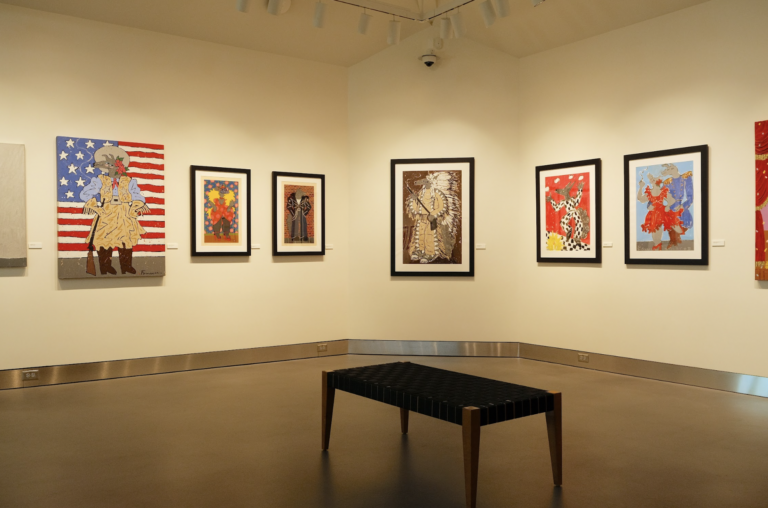
The Gorman Museum of Native American Art will be showcasing the work of Sacramento-born artist Harry Fonseca (1946-2006) from Feb. 12 to Aug. 31. Influenced by his Nisenan Maidu, Hawaiian and Portuguese heritage, Fonseca’s work — while shifting stylistically over the decades — at its core, works to challenge and expand pre-existing Western conceptions of what it means to be Indigenous.

The solo-exhibition chronicles Fonseca’s lifework, with pieces ranging from the mid-1970s to the early 2000s. The work is arranged to reflect Fonseca’s versatility and development as an artist, weaving a story between his meticulous paintings of Maidu dancers, his popular “Coyote” series, rock-art inspired “Stone Poems,” political pieces centered around the genocide of California’s native people and finally his transition to abstract art toward the end of his life. 

The Gorman Museum was able to display such a wide selection of Fonseca’s work thanks to the Shingle Springs Tribe who, in 2023, brought over 1,000 of the artist’s paintings, drawings and sketches into their collection. 

Fonseca was a citizen of the Shingle Springs Tribe located just east of Sacramento where he was born. Fonseca was also a student at California State University, Sacramento under Nomtipom Wintu native Frank LaPena, whose work has been shown across the country since the 1960s. 

In many ways, the first exhibition of the tribe’s recent acquisition being curated at the Gorman Museum was a homecoming for Fonseca’s work back to Northern California, the largest collection previously being held at The Autry Museum of the American West in Los Angeles. 

“The important thing was that we worked closely with the Shingle Springs Tribe,” Executive Director and Curator of the Gorman Museum Veronica Passalacqua said. “I’ve wanted to do a show of [Fonseca’s] work for a very long time. I was thinking I would use some from their collection and some from these other collections, but the Shingle Springs Tribe acquired so much in such a wide range, we decided to keep it within their collection and present it together.” 

The Fonseca exhibit stretches across about half of the Gorman Museum’s gallery space, the rest being filled with works from their permanent collections of Native American, First Nations and Indigenous artists. 

“My selection was from what I saw, knowing our space and how I could highlight each area,” Passalacqua said. “It was important to me to really emphasize the California works, even though the ‘Coyote’ series is his most popular.” 

Through the strategic placement of walls and title cards in order to create physical distance between each section, visitors are able to easily grasp the various stages of artistic creation and thinking Fonseca moved through during his career. 

The series Passalacqua mentions, Fonseca’s “Discovery of Gold and Souls in California,” takes up a separate wall in which visitors are able to take their time examining each small, mixed-media piece. Different from the rest of his works in which the focus is usually a detailed human or animal form, these pieces speak to the genocide of California’s indigenous communities with images of gold, crosses and handprints. 

“It is a direct reference to the physical, emotional, and spiritual genocide of the native people in California. With the rise of the mission system, and much later the discovery of gold in California, the native world was fractured, and with it, a way of life and order devastated,” Fonseca said in a quote featured within the Gorman Museum’s wall text. 

The exhibition includes written descriptions of each section of Fonseca’s work, with most, if not all, featuring quotes by Fonseca himself. 

“We wanted those panels to be first-person quotes directly from the artist because he’s no longer with us,” Passalacqua said. “That’s part of how we operate, we’re artist-led. I’m not speaking for the artist, or asserting my education over what the artist has to say, and that’s always been important, especially when you’re talking about Native artists. 

Fonseca’s words also influenced Passalacqua’s curation, paying special attention to the way he wanted pieces exhibited in the past. His “Stone Poems,” large paintings on sheets of canvas inspired by rock art and petroglyphs he studied in the West and Southwest, stand out in the exhibition’s far corner, away from the rest of the smaller works in the collection. 

 “Harry never wanted them on stretcher bars, he wanted them flat on the wall, so we did that per his wishes,” Passalacqua said. “But then, I also hung them a little higher than I normally would for that same idea — to emphasize that when you come up to it, you have to look up. That was how he experienced the paintings, so I thought that was important.” 

With thoughtful curation, an inside look into Fonseca’s own descriptions of his artwork and the usage of a local, Native American art collection, the Gorman Museum highlights the importance of regional artists and their voice within art history. 

Visitors of “Olé Ham Nees: We Call Him Coyote,” are able to experience a decades-long evolution of Fonseca’s technical skill and artistic motivations. 

Centered by way of the exhibition’s name, Fonseca’s “Coyote” figure is the subject of his most-celebrated series. Beginning to draw Coyote in 1979, visitors can follow Fonseca’s sketches and watercolor prints of the dancing figure to his popular iterations of Coyote in various outfits and settings, such as the San Francisco Mission District and a performance of “Swan Lake.” 

Colorful and adventurous, described by Fonseca as “a Native American folk hero,” Coyote — dressed in leather jackets, jewelry and sneakers — fights for the Native American identity to be perceived as nonstationary, as explained by the Gorman Museum’s artist biography

Open until Aug. 31, prospective visitors have plenty of time to catch this all-encompassing exhibition of Harry Fonseca. Accessible to every kind of audience, Fonseca’s work speaks to both the playfulness and complexity of human nature. 

“It’s a fabulous show and you don’t have to have Native history to appreciate it,” Passalacqua said. 


Written by: Savannah Anno — arts@theaggie.org 
‘Following Your Heart’s Compass: Cultivating Your Authenticity’: UC Davis student Aidan Hyman’s TEDx talk

The recognized marathon runner and United Nations delegate hosted a campus event through TEDxUCDavis


BY SHREYA KUMAR — arts@theaggie.org 


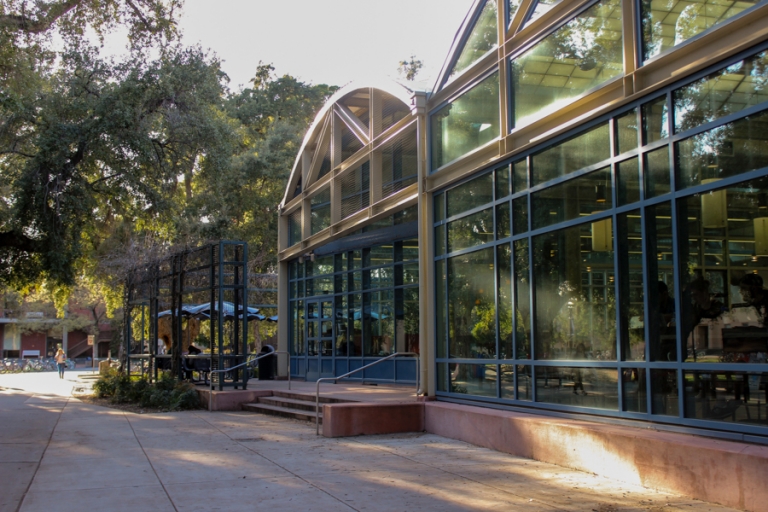
On Mar. 6, TEDxUCDavis held an interactive pop-up TEDx Salon event at the ASUCD Coffee House from 6 to 8 p.m. Featuring Aidan Hyman as the keynote speaker, the event provided a space for thought-provoking discussions on authenticity and personal growth. Attendees enjoyed an evening of reflective, interactive workshops while indulging in free snacks in a warm and welcoming environment. 

Hyman, a third-year agricultural and environmental technology major at UC Davis, is also a queer social entrepreneur, humanitarian and renewable energy advocate. His talk, “Following Your Heart’s Compass: Cultivating Your Authenticity,” included him speaking at length about his perspectives on motivating himself and others to face uncertainty head on, as well as his experiences with learning how to conquer fears that hold you back from doing what you want. 

Shriya Nagulapally, a fourth-year music and physics double major and the director of the TEDx Speakers Team, worked closely with Hyman to write and develop his speech, helping refine his experiences and ideas into an engaging message. 

“With this being our first pop-up TEDx event, we were not sure how everything would go, but between [Hyman’s] talk and the workshops, it was a great success,” Nagulapally said. 

Outside of the TEDxUC Davis event, Hyman has modeled energy efficiency projects and conducted research on nuclear fusion trends for UC Davis’ Bodega Marine Lab. Beyond academia, Hyman has taken on extreme challenges, such as skydiving and climbing K2, the second-highest mountain on Earth. 

Along with his studies, Hyman holds the title of a Three-Star World-Marathoner in the Abbott World Marathon Majors series. He has also completed marathons in Boston, New York City and Chicago. Additionally, he has competed in Ironman 70.3 Hawaiʻi and was nominated to be one of Attitude Magazine’s most influential queer trailblazers of 2024. Hyman is also an Athlete for Equality with the Human Rights Campaign and has worked in environmental affairs as an intern at the United Nations Economic and Social Commission for Asia and the Pacific (ESCAP) headquarters in Thailand. 

The TEDx event served as a preview of an upcoming larger-scale TEDx event, UncharTED, which will be a full-day conference featuring a diverse array of speakers from across the country. Although TEDxUCDavis has held conference events before, such as their successful WholehearTED conference last year, a TEDx Salon event has never been held at UC Davis. 

“Salon events are often small weekly or monthly events that keeps […] community engaged between regular TEDx events,” the TED website reads. 

Unlike the standard conference events, which feature mainly professionals and researchers on a grand stage, Salon events highlight student voices in a more casual setting. The welcoming format allows for more interactivity and encourages an open dialogue between the speaker and the audience. 

Hyman’s talk was followed up by a Q&A session that allowed attendees to directly engage by asking questions and sharing their own insights related to the topic. After a short break, Hyman led participants in a guided journaling session, asking them to reflect on their own experiences with uncertainty and discovery to understand how to apply his philosophies to their own life experiences. 

Afterward, attendees mingled during a social bingo workshop. Each bingo card contained questions in the spaces, and everyone had to find someone who could fill in each space based on which prompt they had personally experienced. 

Neha Kaul, a fourth-year cognitive science major and president of TEDxUCDavis, discussed what makes TEDx the opportunity it is. 

“I love TEDx because it truly brings communities together,” Kaul said. “It’s inspiring to see the passion not only from our team members but also from the speakers and attendees. The opportunity to exchange ideas with some of the brightest minds is truly a once in a lifetime experience.”

The Salon was more than just an event — it was an invitation to explore the uncharted. For those who attended, the evening served as a powerful reminder that stepping into the unknown often leads to the most transformative discoveries, and for those who missed it, don’t worry — the journey is just beginning. You can watch Hyman’s talk on the TEDxUCDavis YouTube channel, along with talks from last year’s conference. 

Additionally, Hyman will be representing the Ironman Foundation and competing in Ironman Texas this April, for which he is currently raising funds. Visit his website or his Instagram @aidanhyman to learn more and offer your support. Be sure to mark your calendars for this year’s conference, UncharTED, taking place at California Hall on April 26.


Written by Shreya Kumar — arts@theaggie.org 


Review: ‘Short n’ Sweet (Deluxe)’ is a twang, innuendo-filled pop album

Sabrina Carpenter expands on her 2024 ‘Short n’ Sweet’ album, with hints of country influences


By AALIYAH ESPAÑOL-RIVAS — arts@theaggie.org 


On Feb. 14, singer Sabrina Carpenter released “Short n’ Sweet (Deluxe),” the extended version of her 2024 album. After the album won two Grammy awards for “Best Pop Vocal Album” and “Best Pop Solo Performance,” the deluxe version was announced two days later on Feb. 4 on Carpenter’s official Instagram page

The album features five new songs, “15 Minutes,” “Please Please Please (Remix) (Ft. Dolly Parton),” “Couldn’t Make It Any Harder,” “Busy Woman” and “Bad Reviews.” While the original iteration had hints of country sound in songs such as “Please Please Please” and “Slim Pickins,” the deluxe version takes the country influence to a new level and showcases Carpenter’s unique pop sound with other strut-worthy beats, heart wrenching ballads and synth tracks. 

In the opening song, “15 Minutes,” Carpenter juxtaposes sexual innuendos and the concept of “15 minutes of fame,” with lyrics such as, “But I can do a lot with fifteen minutes,” “Take a couple bucks, turn ‘em into millions” and “Only gonna take two to make you finish.” The song has an upbeat tempo with a prominent synth sound, especially heard in the bridge. 

The following song is a remix of the single “Please Please Please” with a feature from legendary country singer Dolly Parton. While the original version of the song was more of a bubblegum pop song, the remix is a slower country song with acoustic guitar and violin in replacement of the original synthesized sound. While Parton’s solo vocals in the song are a great addition, the mix of Carpenter’s and Parton’s vocals is understated amongst the stronger instrumentals. 

The next song, “Couldn’t Make It Any Harder” is reminiscent of Olivia Newton-John’s “Hopelessly Devoted to You,” which Carpenter covered during her 2024 “Short n’ Sweet” tour. The ballad discusses Carpenter’s difficult dating past, with lyrics such as “Your arms are reachin’,” “And your eager heart is throbbing” and “Would’ve folded, but I can’t now.” As a result, her current lover feels frustrated and detached from her. In response, Carpenter expresses her hesitancy to fall in love again throughout the song with beautiful soft vocals that showcase her range. 

After, the album takes a tone shift to another fun pop synth song with “Busy Woman.” The song describes Carpenter’s busy life, though she’s willing to clear her schedule for one special person. Flirty and fun lyrics such as “Maybe for you, though, I could accommodate,” “I wouldn’t let you come into my calendar any night” and “I’m flexible, so just tell me what you like,” show her back and forth thought process between trying to seem busy for everything but one person. 

The final song of the album, “Bad Reviews,” is a sultry, country-inspired song about Carpenter ignoring the criticisms of the public in regard to her lover. While she’s heard the naysayers, she chooses to still be in love with them. Lyrics such as, “If I close an eye, it’s almost like your red flags are blue,” “And I’m fresh out of any good judgment” and “I’ve heard all the bad news and all the bad reviews,” shows Carpenter’s self-awareness and ignorance. But then again, ignorance is bliss, right?

“Short n’ Sweet (Deluxe)” is a fun extension of the original album, with all the same components that made the original catchy and charming. While upon first listen many lyrics can raise an eyebrow or two, Carpenter’s sneaky insinuations masked under her angelic vocals whisk listeners into believing otherwise.

Written by: Aaliyah Español-Rivas — arts@theaggie.org

The corrupt and ridiculous jurisprudence of the John Roberts Supreme Court

The Supreme Court majority does not value your basic human rights


By CALEB SILVER — chsilver@ucdavis.edu 


The ruling of Wardlow versus Illinois (2000), put succinctly, is evil and has a malicious lack of foresight. Sam Wardlow was walking in what was pre-conceived by police officers as an area in Chicago with higher crime rates than average. He saw a police van and then fled. The officers pursued Wardlow, detained him and found an illegal firearm on his person. 

This case went to the Supreme Court, because Wardlow argued that the actions against him were in violation of his Fourth Amendment right, which protects an individual from unlawful search and seizure. The majority argued that, though running away from police is not enough to permit reasonable suspicion — which is what is needed to detain and search a civilian without a warrant according to the Fourth Amendment — doing so in a high crime area is. 

Essentially, the Supreme Court of the United States (SCOTUS) made it known that civil liberties vary depending on the location. In this particular case, there is no substantial evidence that Wardlow was running because of the police. Could there have been someone behind the police van? Was he running away simply because this was, as labelled by the police, a “dangerous” area? Does he not have the right to do so? Or, if you don’t wish to humor me, is it not okay for Wardlow to just run from the police for no reason whatsoever? The police can be pretty terrifying, especially when they are present in these so-called dangerous areas (case in point).

This 25-year-old case is not an outlier. In fact, it’s probably somewhat sane considering the makeup of the current Supreme Court. Since 2020, SCOTUS has had six Republican-appointed justices, leading the court with a majority over the three Democratic nominees. The six include “thinkers” like Clarence Thomas, who “failed to disclose years of lavish trips from wealthy conservatives,” according to MSNBC News.

Corruption is actually a core tenet to this SCOTUS jurisprudence, as demonstrated by their ruling in Snyder versus United States. In this case, the majority, written by Chief Justice John Roberts, claims that a gratuity (which is essentially a bribe given as a sort of unofficial “gift” after the fact) given to a government official is, apparently, allowed — despite 18 U.S. Code § 666 specifically prohibiting such gifts or bribes if they exceed $5,000. For context, James Snyder accepted a $13,000 gratuity from a company for giving them a city contract, and he was found guilty in a jury trial. Snyder then appealed his case until it rose to the Supreme Court, which is currently full of judges who accept gratuities like it’s a part of their job

This is not to mention Grants Pass versus Johnson, a case that decreed that the Eighth Amendment outlawing cruel and unusual punishment does not apply to banning unhoused people from sleeping outside; I should not have to describe why that one is wrong. Banning people who don’t have a house for not sleeping in a house is the definition of cruel and unusual. There is no reason why this shouldn’t fall under the Eighth Amendment, besides the fact that many conservatives do not care about unhoused people and believe punishing them is an effective way to end homelessness. 

The jurisprudence of the Roberts Court seems to not be defined by any actual legal, logical or progressive decision-making. Similar to the decision made in the Wardlow case, they seem to work backward from preconceived political ties. The court consists of judges who have strict right-wing partisan ties and practice bizarre forms of textualism and constitutionalism — trying to twist the facts of the case to appease their billionaire buddies and keep steadfast preconceived ideologies. This is how the Supreme Court was designed to operate, and unless we have justice reform, this will continue to strip us of our civil liberties and erode our country’s democratic systems. 


Written by: Caleb Silver — chsilver@ucdavis.edu


Disclaimer: The views and opinions expressed by individual columnists belong to the columnists alone and do not necessarily indicate the views and opinions held by The California Aggie.


The death of hobbies

College kills students’ time for passion projects and extracurriculars


By SABRINA FIGUEROA — sfigueroaavila@ucdavis.edu


“What do you like to do for fun?” 

If I was still in high school, I would be itching to answer this question with all of the hobbies I was actually doing, but ever since I started college, I hate answering this question. Instead of excitedly describing all of the projects I’m working on, I have to answer with hobbies I dream of doing when I eventually have time or am not overcome by exhaustion. 

I used to be obsessed with painting, drawing and sketching when I was younger. I still have sketchbooks full of slightly ugly art that I refuse to throw away because they are proof that I was once unafraid to “waste” time. And if I did it once, I can do it again — eventually. There’s a sketch book from the year I graduated high school waiting for me, which I stopped drawing in around the time I began my first year at UC Davis — I still keep it in hopes that I’ll pick it back up again. 

One of my friend’s birthdays was over the past winter break, and I wanted to be crafty and save money. So, instead of going out and buying a card from the store, I sat down to watch the second season of “Squid Game” and made her a card. I followed tutorials, cut paper and colored with colored pencils and then it hit me: The card was still mediocre and plain at best. I sat there and wondered where all of my creativity and innovative risk-taking had gone. Most importantly, I realized that I had forgotten how fun it was to simply create things, even if my work wasn’t on par with Picasso’s or one of the other greats. 

And it’s not just me, either. After I gave my friend the homemade card, we began to talk about how college and the pursuit of great careers deprived us of time to “waste” and create. Not that people don’t have time to do other things; Many students have time to hang out with friends, go to the gym and even go to parties, but those are not creative hobbies — some are not hobbies at all. There are little to no instances where we allow ourselves to just sit and create random things that don’t necessarily have a purpose outside of amusing ourselves. As students, we are conditioned to do or create things for two reasons: to achieve a grade or to further our career goals. 

It’s good that we have this obligation to put school and our careers first, since education is fundamental to our society, but it’s insanely stressful to think about school, our careers and the future all the time. This is also not the way we were meant to live our human lives. We were meant to simply exist at first, so we owe it to ourselves to pick up random hobbies — drawing, knitting, crocheting, coloring books, scrapbooking, woodworking, cosplay, metalworking, origami and more — that remind us how to bring our heads down from the clouds and live in our present lives. They also remind us that we are creatures whose abilities allow us to be innovative and creative in the first place, which is something that cannot and should not be taken away. 

Sometimes, I wonder if I will ever pick up those sketchbooks again. I surely hope I will, but the one thing that stops me is how to start. I could sit here and write about how to get back into pursuing your hobbies in the midst of work and school, but I genuinely don’t know how — I’d be a liar if I tried to pretend like I did.

I suppose that this is something we will all eventually learn in our own time, and if you already know how, cherish your hobby and your ability to do it freely. If you don’t, remember that it’s okay to not do a million things at once — seize that spare moment of time just to create for yourself and no one else. 


Written by: Sabrina Figueroa — sfigueroaavila@ucdavis.edu

Disclaimer: The views and opinions expressed by individual columnists belong to the columnists alone and do not necessarily indicate the views and opinions held by The California Aggie.

12 visas for UC Davis students, recent alumni revoked without explanation

The news came as other UC campuses reported similar visa terminations made by the Trump Administration


By VINCE BASADA — campus@theaggie.org


UC Davis announced on Saturday, April 5 that the federal government had terminated F-1 visas for seven international students and five recent graduates, revoking their eligibility to stay in the United States.

In a statement, Chancellor Gary May said that no community members were in custody and that federal agents had not entered campus, but also acknowledged that the number of visas terminated may change. May also said that the federal government had not provided reasoning behind the terminations.

“We reiterate our strong support for our international students and want all of our students, staff and faculty to know we support your ability to work, learn, teach and thrive here,” May said. “International students are an essential part of this university, and we will continue to advocate for your rights and well-being.”

F-1 visas are non-immigrant visas that allow international students to stay in the United States to pursue higher education, according to U.S. Citizenship and Immigration Services

Some 9,000 international students are currently enrolled, and the total undergraduate population is around 30,000, according to UC Davis Global Affairs

May also asserted in the April 5 communication that campus police officers will not “undertake joint efforts with federal immigration enforcement authorities to investigate, detain or arrest individuals for violation of federal immigration law.”

The news was joined by similar visa terminations across the University of California system, including six at UC Berkeley, five at UC San Diego (along with one border deportation) and several more at UC Los Angeles. U.S. Secretary of State Marco Rubio said in late March that he has signed some 300 visa terminations, including those of students, as part of a larger Trump administration effort to expel individuals based on political and foreign policy views and criminal records.

ASUCD President Gaius Ilupeju, head of the undergraduate’s student government, told The California Aggie that the ASUCD was coordinating with university administrators to keep students up to date with federal developments.

“We’re just trying to coordinate with [administrators on] how we can best spread the information so that people don’t spread misinformation,” Ilupeju said. 

Ilupjeu also said that there will be a town hall on the developments; UC Davis’ Services for International Students quarterly town hall is planned for April 16.

UC updates on federal policy, including weekly briefs, can be found on their website.


This is a developing story. Follow The Aggie for continued updates.

Written by: Vince Basadacampus@theaggie.org

UC Davis students discuss what they did over break

Students reflect on their travels, time with friends and family and working


By AMBER WARNKE — features@theaggie.org


As students return to campus after spring break, many have exchanged stories of their week-long escapades. Students have spent time traveling, visiting friends and family and working, relaxing in a brief but meaningful break from the demanding academics of the quarter system. Whether their adventures have been far or close to home, spring break has given students the chance to spend time reconnecting with their life outside of school. 

Matt Frost, a third-year human biology major, spent his week off sightseeing in San Francisco, including walking on the Golden Gate Bridge and attending a San Jose Sharks hockey game. 

“My team won,” Frost said. “It was great to see live.” 

Frost also visited his dad’s side of his family, who he finds it difficult to spend time with due to his busy college schedule. 

“It was nice getting to talk with all of them again,” Frost said. “I haven’t really seen my dad’s side of the family in some time. It was good to reconnect.” 

Meera Putz, a third-year environmental science and management major, also took spring break as a time to reconnect with the people important to her. Putz flew to Montana over break to visit a friend she met at an internship with the Tahoe Environmental Research Center over the summer. 

Visiting her friend also gave Putz a chance to engage in outdoor activities, which she finds is the best way to relax from the stress of college life. 

“It was a perfect window where we could go skiing because there was tons of snow on the ground,” Putz said. “It was my first time skiing, and [my friend is] an instructor, so I got a private lesson, basically. I was on the bunny hill, but it was still super fun.” 

After skiing at the Bridger Bowl Ski Area, Putz spent time trying out more outdoor activities Montana is famous for, with the state being a popular site for rock climbing as well as skiing.

 “We had to cross this icy, snow-laden creek [with] this icy log to get to the crag and we did some outdoor rock climbing,” Putz said. 

A first-year master’s student in preventative veterinary medicine, who wishes to remain anonymous, similarly took the break as a chance to spend more time outdoors, exploring Diablo State Park in Clayton, which is just over 70 miles away from Davis.

 “The hike was one kilometer, so, like, 0.8 miles, vertical,” the student said. “It was 17 miles in total, so that was a fun ride.” 

The student said that doing hikes such as this is one way they are able to relax, which they were very intentional about doing over the break. 

“I was able to do lots of outdoor stuff, I think that that’s resting although not physically, but in my body and mind,” the student said. 

In addition to spending time engaging in pastimes, the student also worked on research for his master’s program. 

“We got some new data — we were basically doing some mapping, trying to identify some climate factors that can indicate some bigger chances of diseases and outbreaks,” the student said. 

Regardless of how they spent their breaks — traveling, exploring the local area, or working — spring quarter awaits all Aggies with numerous events they can look forward to now that they are back. Students can expect a busy and exciting quarter to come, with Picnic Day recently wrapping up and the Whole Earth Festival soon to begin.


Written by: Amber Warnke — features@theaggie.org

Aggie Mental Health Ambassadors urge ASUCD Senate’s support after recent budget cuts

The April 2 meeting also saw Umar Shaikh be elected as pro tempore


By JORDAN POLTORAK— campus@theaggie.org


Four ambassadors from Aggie Mental Health addressed the ASUCD Senate during their April 2 meeting about plans to defund the program and asked for support.

They urged senators during open forum to take the issue to UC Davis Student Affairs.

Daniel Mojica, a fourth-year political science and psychology double major as well as former ASUCD external affairs commission chair, addressed the table first.

“Our biggest concern is to get the help for students across campus,” Mojica said. “We do not just support students, we also support faculty and those who come to Davis’ campus to receive our services.”

The ambassadors emphasized that they were not asking for financial support but rather for senators to use their voices and advocate for the importance of the organization. 

“I know a lot of you [ran campaigns] on mental health,” Mojica said. “Now is the time to do something about those promises made to the students.”

The organization focuses on peer-to-peer support “to ensure that mental health resources are accessible to all students and ensure their academic success,” according to a statement posted on the Instagram page, @save.amha, dedicated to saving the program.

“I understand that it is a hard time to be a university in America,” Alyssa Reid, a third-year psychology major and mental health ambassador, said. “However, public health is not where we can take cuts. Students now more than ever need access to mental health resources.”

The Aggie Mental Health Ambassador (AMHA) program is set to be centralized with the Student Wellness Liaison (SWL) program, according to UC Davis Student Affairs. Both programs will be supervised by the Health Education and Promotion (HEP) team in Student Health and Counseling Services. Initially, there was confusion among Aggie Mental Health Ambassadors, as they thought that their program was being defunded entirely. These details were clarified after the April 2 meeting.

The AMHA and SWL programs will remain separate and one full-time staff member will be in charge of both programs. Student Wellness Liaison had already been under HEP, but the AMHA program was run by Public Health Sciences and Student Affairs.


Senate Pro Tempore confirmation and other business

Two nominations were proposed to be the ASUCD Senate Pro Tempore, the legislature’s official representative, succeeding Senator Dhilena Wickramasinghe. They were Senator Umar Shaikh, a second-year political science major, and Senator Amrita Julka, a second-year political science — public service and human development double major. After a vote, Shaikh was elected to the position for this quarter. 

The Senate then moved into unit adoptions. The Executive Advisory Council typically has one senator representative, but when presented with his options, ASUCD President Gaius Ilupeju chose both Senator Ezra Rubin and Senator Zack Dollins. 

Senate Bill #67, which allows ASUCD commissions to turn in a written quarterly report rather than a presentation, also passed unanimously at the meeting. 

During open forum, Senator Solana Rodriguez shared that she is working on a list of immigration resources that she will be presenting to classes in the following weeks. 

The meeting was called to order at 6:18 p.m. and adjourned at 7:26 p.m. 

Written by: Jordan Poltorakcampus@theaggie.org

Turning Point USA event results in multiple physical altercations

UC Davis to open independent review into incident between protestors and the conservative group, who were hosting right-wing commentator Brandon Tatum


By RIVERS STOUT and JORDAN POLTORAK— campus@theaggie.org


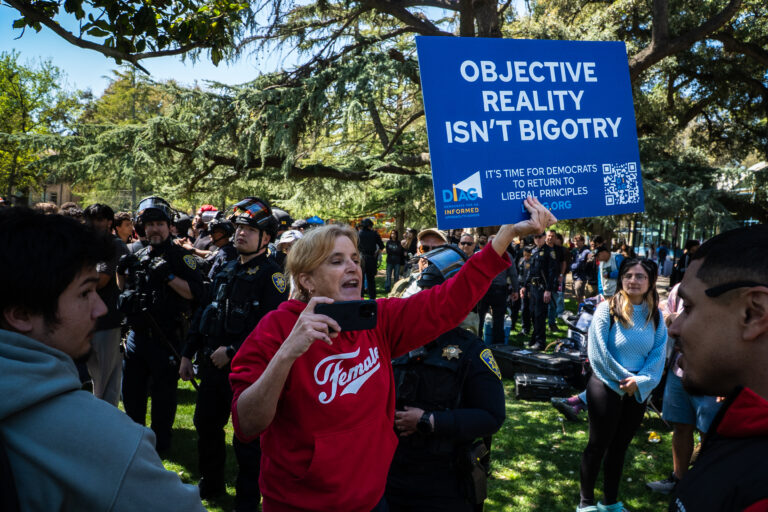
A Turning Point USA (TPUSA) event held on the Quad on Thursday, April 3, resulted in several physical altercations between protestors, members of the conservative group and other members of the UC Davis community, including students.

On Friday, April 4, UC Davis Chancellor Gary May said that the university will open a “full independent review” into the incident and threatened disciplinary and legal action to individuals involved in the incident.

The event, hosted by the Davis chapter of TPUSA, a registered student organization dedicated to advocating for conservative politics on college campuses, featured right-wing influencer and TPUSA contributor Brandon Tatum as a guest speaker. Tatum had also come to film debates and discussions with students for his social media platforms and had set up a booth and tent alongside his production team around 11 a.m. for the event at 12 p.m.

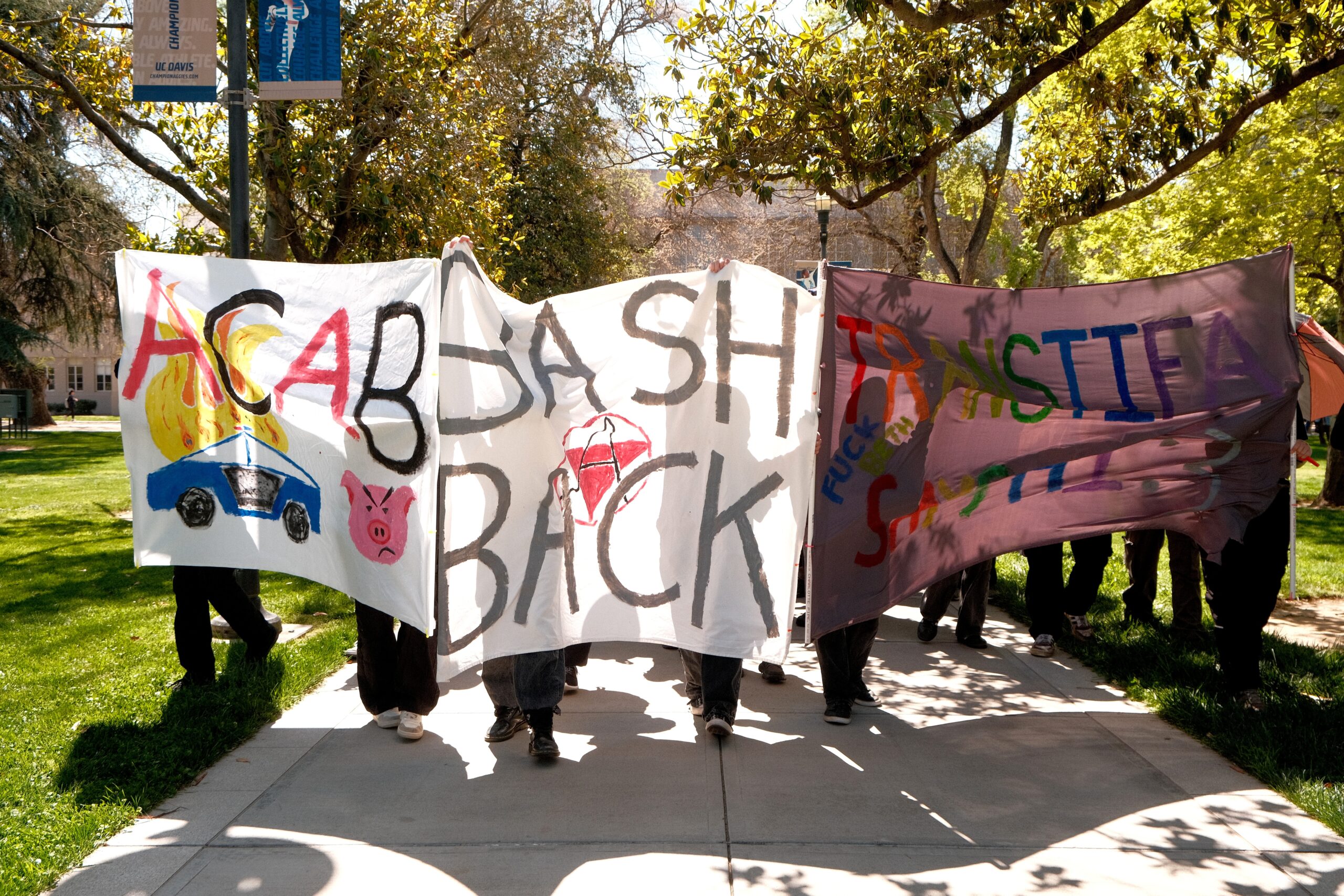
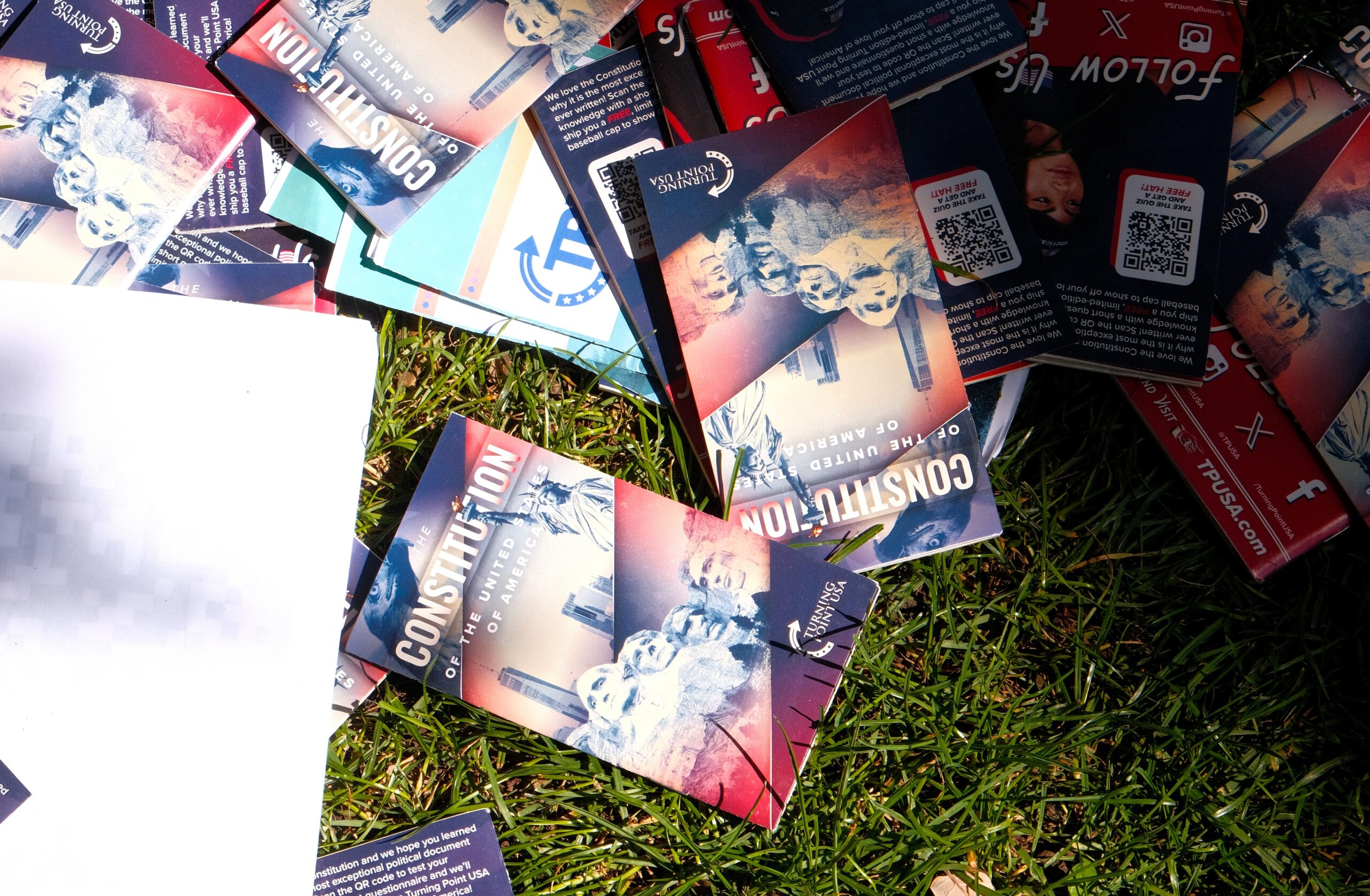
Some 30 protesters, organized several days prior in part by the promotion of student group Cops Off Campus, began to march toward the Quad shortly before noon. On arrival, protestors threw water balloons at the tent and knocked stand-alone banners and flyers to the ground. An attendee of the TPUSA event approached the protestors and attempted to get into the group while another individual from the TPUSA booth walked around protestors with their dog on a leash and reproached them. 

Cops Off Campus holding a sign, counter-protesting the Turning Point USA event.(Christian Cendejas / Aggie)

After shortly retreating, protestors made their way back to the booth again. As documented in a video of the event posted on Reddit, local Moms For Liberty chapter chair and UC Davis employee Beth Bourne, known for her anti-transgender rights activism, approached the group and was hit on the back of the head by a protester.

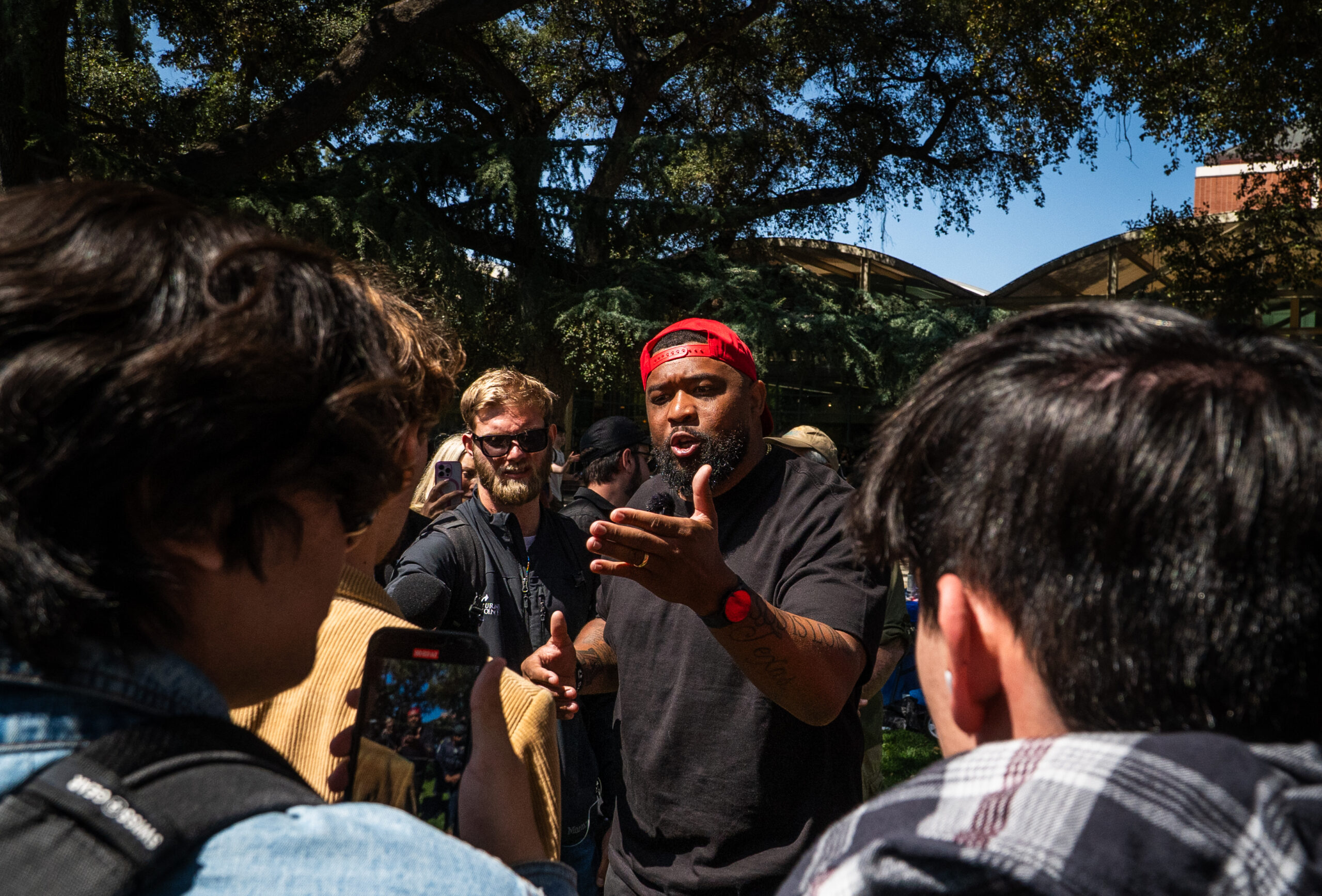
Once the group of protesters reached the booth, a protester advanced toward Tatum  and after being pointed at, was pushed to the floor by him. UC Davis Chief of Police Joe Farrow, nearbyTatum, attempted to move Tatum away from the protester. Meanwhile, other protestors tore down the canopy and stand-alone posters, which they broke along their second retreat toward Shields Library. They continued toward Olson Hall, where the initial protestors disbanded. 

One student, who wishes to leave her last name anonymous, recounted how she felt watching the events unfold.

“From what I saw, it got a little more rowdy,” Vanessa, a second-year student, said. “Brandon [Tatum] physically pushed — my heart dropped when I saw it — Brandon pushed one of the protesters…their bike fell [on them] and they fell down to the ground.”

The incident was documented in a video released by TPUSA on X. It, and other videos of the event, have since been circulated on several national news channels and by several leading conservative figures, including Elon Musk and TPUSA founder Charlie Kirk.

Tatum provided a statement to The California Aggie.

“It ended up well because it was crazy because people attacked us, they assaulted a couple people at our booth,” Tatum said. “They stole our tent, which you see is missing, and they were very evil. [They] made it a dangerous situation, but we finished alright.”

Tatum denied assaulting any demonstrators unprovoked. 

“They attacked people, they attacked our thing,” Tatum said. “I pushed them out of the way, and that’s it.”

Turning Point USA speaker Brandon Tatum speaking at their event on the quad. (Sacha Chickering / Aggie)

Additionally, Bourne laid hands on a student after a prolonged verbal altercation. Bourne attempted to hold the student back after having had one of her demonstration signs taken away, but ultimately was unsuccessful.

“She was kind of instigating the event and went closer to the protestors as she was walking, so they physically clashed and one of the protestors took her sign,” Vanessa said. “Once that happened, she went to physically attack one of the protesters, like swung her hand.”

In a comment given to The Aggie at the demonstration, Bourne defended her actions. 

“[That sign] is my private property, and we should have free speech on a college campus,” Bourne said. “That person ran away with it so I just went to get it back. I think this person should be arrested for stealing my sign.”

While there was an existing police presence during the initial confrontation, Tatum told The Aggie that event organizers had called the police after their tent had been stolen. A small contingent of approximately 15 officers in riot gear was present for the remainder of the event, though they did not interfere in the altercation between Bourne and a student.

A university spokesperson acknowledged to The Aggie that an attendee, Bourne, was hit, but made no note of an altercation between Tatum and a protester or Bourne attempting to restrain a student.

The university makes every effort to ensure that events on campus are safe,” the spokesman said in a statement. “Student Affairs coordinated with Turning Point USA at UC Davis, Safety Services and other campus departments to create a safety plan for the event. The campus is reviewing its preparations for this event.”

“UC Davis condemns all forms of violence,” the statement reads. “The university affirms and supports the right of our students to invite speakers to our campus, to express their views, and to peacefully protest speakers whose views they find upsetting or offensive.”

The spokesperson confirmed that while UC Davis police were investigating the incident against Bourne, no arrests had been made as of late Thursday. 

In a separate statement announcing the independent investigation, May condemned the violence and said that the university would continue to support free expression.

“What happened was appalling and completely unacceptable,” May said. “There is zero tolerance for violence on our campuses — zero.”

“Those who were attacked did nothing but express themselves, in a non-violent manner.” the statement reads. “They were peacefully expressing their views — as is their right — and they should be able to do so without fear, intimidation or violence. We are firmly committed to supporting free expression and open dialogue on our campus. That commitment does not — and will never — extend to acts of violence or intimidation.”

Nick Mollat, a third-year anthropology major who observed the demonstration, commented on the protest.

“Honestly, with the way this country is going, I respect people’s rights to the First Amendment and free speech,” Mollat said. “But, when that speech has been harmful to other groups and other minorities, I don’t think it’s fair. I think if they wanna preach what they wanna preach that’s fine, but they better expect bitches like us back.”

The aftermath following a Turning Point USA event on campus that was met with several physical altercations. (Christian Cendejas / Aggie)

Despite the commotion, Tatum continued to one-on-one debate with students, while members of his production staff recorded. 

The remainder of the event occurred without incident, though a large crowd continued to watch and jeer at Bourne. By 2:30 p.m., TPUSA organizers had packed up their equipment and the remaining observers had largely dissolved.


Vince Basada contributed reporting to this piece.

Written by: Rivers Stout and Jordan Poltorakcampus@theaggie.org

This is a developing story. Follow The Aggie for continued coverage.

Last updated: April 05, 6:45 p.m.


‘We’re the frontline workers — we make it happen’: AFSCME 3299 holds solidarity strike with UPTE-CWA on April 1

About 50 workers gathered at Hutchison Field as part of a systemwide strike, the third of its kind this academic year


By KHADEEJAH KHAN — campus@theaggie.org


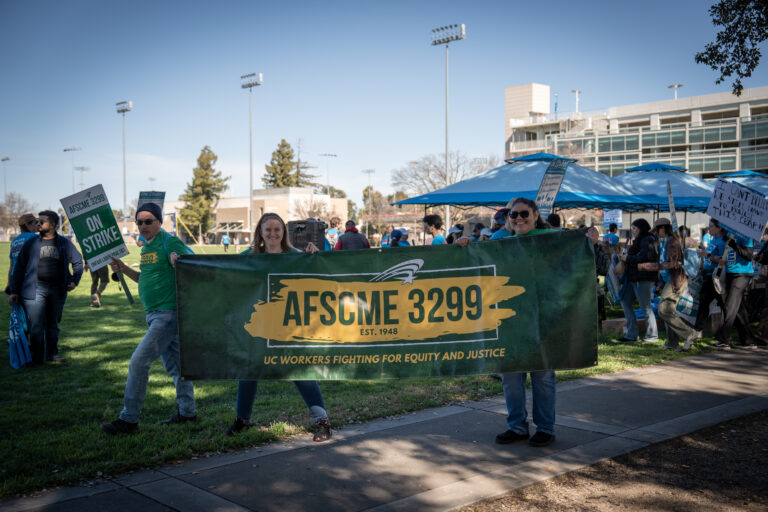
Some 50 workers at UC Davis went on a one-day strike on Tuesday, April 1 over the University of California’s alleged unfair labor practices, cost of living issues and staffing shortages.

The demonstration was part of a systemwide strike across the UC system, including 10 campuses and five medical centers. The workers are members of the American Federation of State, County and Municipal Employees Local 3299 (AFSCME 3299) and the University Professional and Technical Employees Local 9119 (UPTE-CWA), representing some combined 50,000 service and healthcare workers across the system.

While UPTE-CWA was first to announce their strike, AFSCME-3299 executive board member James Clark believed it was vital for AFSCME-3299 to hold a solidarity strike due to shared struggles with bad-faith bargaining, staffing shortages and rising healthcare co-pays.

“We’re standing in solidarity with UPTE today and anytime they have a need for our assistance,” Clark said. “We’re the frontline workers — we make it happen.”

In a statement, the UC claimed to have offered “generous wage increases” and other favorable proposals in bargaining with the two unions.

“UPTE and AFSCME are not being forthright in their characterizations, which is upsetting since we’ve made sincere efforts to find mutually beneficial solutions,” the statement reads. “Regardless, we are hopeful AFSCME and UPTE will make meaningful efforts to settle these contracts soon.”

For Gina Hernandez, a cook at UC Davis’ dining halls, this strike’s impact extends beyond the demands of UC staff. She believes that going on strike is an investment into students’ futures, uplifting frontline workers who take care of students on a day-to-day basis. 

“We just want UC Davis to take care of us so that we can take care of them,” Hernandez said. “We want UC Davis to see us as humans, not just a bunch of workers or a bunch of equipment that they own. The workers are raising the next future.” 

AFSCME 3299’s picket line in solidarity with UPTE-CWA began at 6 a.m. on Hutchison Field, where strikers shared coffee and bagels in preparation for a demonstration. Cars at the intersection honked to express solidarity with the workers.

Strikers chanted, “UC, UC you’re no good, treat your workers like you should,” and “UC, UC you can’t hide, we can see your greedy side.”

AFSCME and UPTE had previously held joint strikes in February of this year and in November 2024 over similar concerns. Turnout at this most recent UC Davis demonstration was lower, and union members did not hold a march throughout campus as they had done in past strikes.

Clark, who works at UC San Francisco and commutes around 50 miles for his job, criticized UC administrators for not addressing the housing and staffing issues he believes to be at the core of worker’s problems.

“We got people commuting over an hour or an hour and a half, and they are making pennies,” Clark said. “We’re overworked, understaffed and doing more for the same pay, and we won’t stand for it. It won’t change until the UC invests in things that make them flourish, like enough front line workers to get the job done right.”

In a statement to The California Aggie, a spokesperson for the UC Office of the President denied claims of a staffing shortage.

“Data that we’ve already shared with the union shows that the number of UPTE-represented headcount is increasing, separations are declining, and turnover is flattening,” the spokesperson said. “For AFSCME, headcount is also increasing, turnover is decreasing, and separations are flattening.”

Since the last strike on Feb. 26-28, UC has continuously communicated with AFSCME and UPTE to try to close these contracts,” the spokesperson said. “UPTE and UC are progressing through the impasse process, with fact-finding sessions completed last week and a recommendations report coming soon. AFSCME and UC are continuing to communicate and are scheduled to meet in the coming weeks to discuss the next steps.”

Workers also demonstrated at the UC Davis Medical Center in Sacramento, though university officials said they did not expect any disruptions to patient care. At the main campus in Davis, some dining options and venues were closed or open with limited hours, however there were no disruptions to class instruction.

At the strike, student members of the Spartacus Youth Club distributed flyers and held signs to express solidarity with the unions, distributing fliers calling on their peers to “respect the picket line and shut down the campus.”

“We are now being targeted by the government and administration for protesting the genocide of Palestinians,” the flyer reads. “The way to defend our classmates is not by making moral appeals to the administration, but to build an alliance with workers who are striking against the admin. Although the unions’ demands are economic, the way to beat back repression will be by building winning pickets that no one crosses.”

By 2 p.m., the strike at Hutchison and La Rue Road had packed their gear away, and the demonstration had ended.


Written by: Khadeejah Khan — campus@theaggie.org

UC Davis Law students hold protest over university’s suspension of Law Student Association

The protest came as over one hundred alumni signed letter in support of the suspended graduate student government


By RIVERS STOUT— campus@theaggie.org


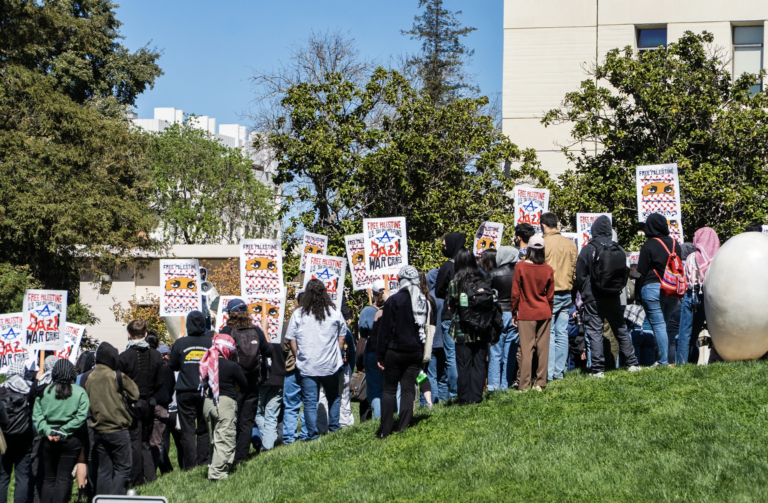
A group of protestors demonstrated outside Mrak Hall, Wednesday, April 2, over the recent suspension of the Law Student Association (LSA) by university officials. Gathered near the See No Evil/Hear No Evil eggheads, speakers lead chants and read speeches to the crowd of roughly 100 people.

UC Davis suspended the LSA, the student government of the school’s some 600 law students, after it passed a constitutional amendment divesting from Israel-connected companies and speakers as part of the larger Boycott, Divestment and Sanctions (BDS) movement. Since the March 24 announcement, administrators have taken control of its funds, saying the legislation had broken university policy.

“The [suspension] decision follows the vote by LSA, the law school student government, to knowingly violate University of California policy by seeking to implement a discriminatory resolution intended to boycott people or entities with ties to Israel,” a university spokesperson said in a statement. “UC policy requires student government organizations to support activities on a viewpoint-neutral basis. UC Davis is committed to providing an environment free of discrimination, harassment, antisemitism and other forms of hate.”

Protestors called for the LSA to be reinstated and expressed desire that it have the ability to act as a democratic body without retaliation from administrators, make statements and pass legislation in line with its mission. Protestors also called for the university to protect students from immigration authorities.

Speakers, who did not identify themselves, called on Chancellor Gary May to resign from Leidos, as well as for both May and Law School Dean Jessica Berg to resign from their positions.

During the two-hour protest, attendees recited chants, including, “Gary May what do you say, how many kids have you killed today?” and “Up up with liberation, down down with occupation.” For a few minutes, protesters turned to directly face King or Mrak Halls to shout some variation of “Listen up Dean Berg, BDS is here to stay,” or “Listen up Gary May, LSA is here to stay.” 

“This walkout is to protest the suspension of the LSA as well as the school’s repression more broadly,” Randy Bucky, a third-year law student at King Hall and protestor, told The California Aggie. “We stand in solidarity with students across the country who’ve been made to feel unsafe. We stand in solidarity with students who’ve been punished for expressing their free speech, particularly for expressing solidarity with Palestine and we speak out now because the moment demands it.”

The university maintains that the decision to suspend the LSA is not an infringement of students’ free speech.

“While student governments have the right to address and take positions on public issues as long as the statement does not purport to represent the views of the University, the Resolution goes beyond this by restricting University funds based on viewpoint,” a university Frequently Asked Questions statement on the issue reads. “The University is committed to ensuring that all students may exercise their constitutionally protected rights of free expression, even in instances in which the positions expressed may be viewed by some as controversial or unpopular.”

Shasun Sulur, a second-year graduate student and external vice president of the LSA before its suspension, criticized UC Davis’ position on the issue.

“We’re saying that when it comes to genocide theres no such thing as viewpoint neutrality and supporting genocide is not a valid viewpoint that should be funded,” Sulur said. “The [University of California] itself, after arresting hundreds of students, divested from apartheid South Africa in the ‘80s and ‘90s. In 2005 after similar pressure, the UC divested from the genocide in Sudan. On the UC and various other universities’ websites, they tout and brag about their support for these liberation students, all while ignoring how many students have been expelled, beaten or arrested by the police that we fund with our own tuition dollars, in order to make that change happen.”
The LSA’s suspension has garnered a reaction from King Hall alumni, including a letter sent to the law school administration and Chancellor May signed by over a hundred former UC Davis Law students on March 31. 

“We, the undersigned King Hall alumni, are hereby withdrawing all material support from King Hall until the LSA is reinstated with full funding and allowed to enact its own democratically passed measures,” the letter reads.

Their reasons included the belief that the LSA’s suspension made the school less democratic, that the university’s actions equated to the silencing and criminalization of dissent and that an independent LSA has a vital role in students’ learning experience.

As of time of publication, LSA funding remains under the control of administrators, though the future of the organization and its responsibilities remain undetermined.


Written by: Rivers Stoutcampus@theaggie.org


This article is part of a continuing series on UC Davis Law and the Law Student Association. Follow The California Aggie for updated coverage.

The Editorial Board urges you to protect student speech

Censorship is never acceptable, but particularly in spaces intended to uplift the tenets of free speech


BY THE EDITORIAL BOARD

Universities have historically fostered a vibrant marketplace of ideas, but with political polarization on the rise this freedom of expression is at risk. From the national stage to right here at UC Davis, students are facing unprecedented magnitudes of censorship.

Federally, the Trump administration has been waging war on the immigrant population in the United States. Though the State Department’s revoking of lawful visas is not indiscriminate, many of the individuals targeted have expressed pro-Palestinian viewpoints and protested the ongoing violence in Gaza.

Most notably, the Trump administration sought to deport legal U.S. resident and green card holder, Mahmoud Khalil. Khalil earned a master’s degree from Columbia University’s School of International and Public Affairs in December. Additionally, Khalil led protests at Columbia University against the enormous loss of Palestinian life that has occurred throughout the Israel-Hamas conflict. 

Secretary of State Marco Rubio accused Khalil of supporting Hamas and said, “Foreigners who come to the United States and do such things will have their visas or green cards revoked and be kicked out.”

Rubio is weaponizing a provision in the Immigration and Nationality Act of 1952 to suppress immigrants’ freedom of speech. The provision reads, “[Any] alien whose presence or activities in the United States the secretary of state has reasonable ground to believe would have potentially serious adverse foreign policy consequences for the United States is deportable.”

Nine other individuals have been targeted on the grounds of supporting Palestine, and it’s clear the Trump administration is going to continue to suppress the speech of immigrants who oppose the regime through detention or deportation. The Editorial Board unequivocally condemns these infringements upon freedom of expression.

Another recent significant attack on student free speech occurred at Harvard University. Harvard is at risk of losing $9 billion as Trump cracks down on their “far-left extremism” and alleged anti-semitism. These large budget cuts may have dire consequences. 

“If this funding is stopped, it will halt life-saving research and imperil important scientific research and innovation,” Alan Garber, the president of Harvard, said in a written statement.

Even the University of California system at large is experiencing the shock waves from the Trump administration’s attempts to attack and censor higher education institutions. The UC Board of Regents recently voted and passed a decision to no longer require diversity statements in hiring across the UC system. This decision is reflective of a harrowing shift in the current political climate toward cultural erasure.

As censorship of student speech proliferates across the nation, UC Davis recently suspended the Law Student Association for passing legislation that divested from Israel-connected companies and speakers. The King Hall student government budget is now entirely under the administration’s control after the passing of a constitutional amendment that implemented Boycott, Divestment and Sanctions policies.

The Editorial Board denounces this attack on student speech and the complete withdrawal of student democratic processes. 

UC policy requires student government organizations to support activities on a viewpoint-neutral basis,” a spokesperson for the university said. “UC Davis is committed to providing an environment free of discrimination, harassment, antisemitism and other forms of hate.”

Providing support to Israeli-connected companies and speakers is not viewpoint-neutral to begin with. Israel has killed over 50,000 Palestinians, a third of which were under 18 years of age. It’s hypocritical and repressive to disband a student government for refusing to support a nation actively committing war crimes during an illegal occupation.

Although it may be jarring to see censorship on this scale, it’s critical to advocate for and protect the rights of students moving forward. Censorship often begins at the academic level, and the attacks on speech by the Trump administration signal a descent into authoritarianism and is fascist by definition. It is important to remember that infringements on freedom of speech in educational settings are indicative of a dangerous precedent spreading rapidly across the country. 


Written by: The Editorial Board


UC Davis Anthony Padilla look-alike contest ends in six arrests

Questioning continues as local law enforcement attempts to uncover the identity of the real Anthony Padilla


By TARA ROMERO — tcrome@ucdavis.edu


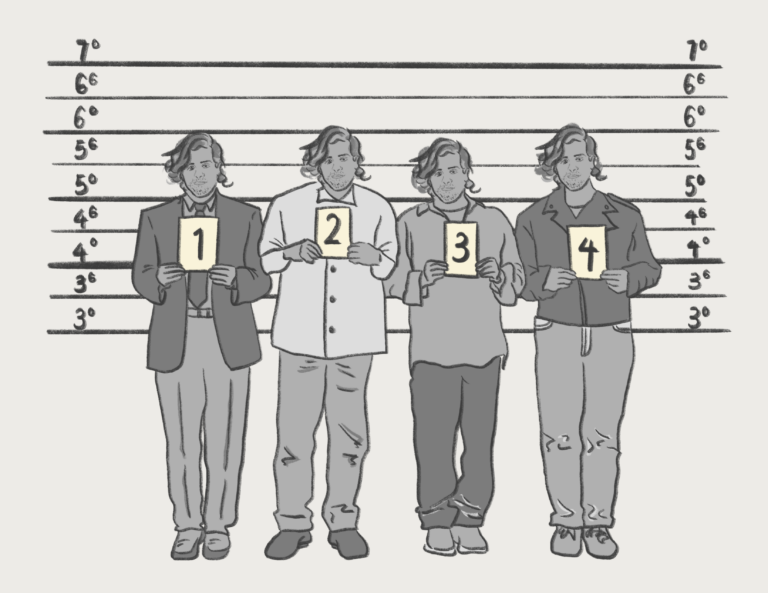
Ever since the October 2024 Timothée Chalamet look-alike contest took the Internet by storm, hundreds of celebrity look-alike contests have popped up all over the country. A bit late to the trend as always, UC Davis students decided to commemorate local Sacramento YouTube celebrity Anthony Padilla in a look-alike contest in the Memorial Union Quad yesterday afternoon.

The student who organized the event and asked to remain anonymous made the following statement: “Honestly, I just thought it’d be funny — I never thought it would’ve turned out like this.”

At 3 p.m. on March 31, 2025, the Anthony Padilla look-alike contest was up and running. It was a sad start — with only two contestants and roughly eight people in attendance. However, three last-minute applicants joined the contest upon realizing their uncanny resemblance to the other men. By 3:30 p.m., there were over 200 onlookers gathered to see these five Anthony Padilla look-alikes.
“I didn’t even know who Anthony Padilla was, but when I saw five men who looked exactly like one another…I could not look away,” Abigail LeMiller, a second-year theatre and dance major, said. 

At 3:45 p.m., the unexpected happened. The real Anthony Padilla made his appearance at his own look-alike contest. Residing in Los Angeles, this YouTuber was allegedly visiting his hometown, Sacramento, when he saw that he was tagged on X about this contest. Upon further investigation, Padilla did, in fact, travel to UC Davis with the sole purpose of making an appearance at this contest after searching “Anthony Padilla look-alike contest” into the TikTok search engine every day since the first contest in October.

When Padilla first arrived, students assumed he was another last-minute contestant and pushed him up front to sign up for the contest. In front of the crowd, Padilla attempted to admit that he was the real Anthony Padilla, but the other contestants followed suit in an “I’m Spartacus”-esque fashion — all claiming to be the one true Anthony Padilla.

One of the potential Padillas claimed: “I’m here to film an ‘I spent 24 hours with my look-alikes’ video.” 

Another claimed: “I came here not knowing the meaning of Anthony Padilla, but I believe I’ve found my identity thanks to the men here before you.” 

Before anyone knew it, UC Davis was home to six Anthony Padillas — and none of them were backing down.

There are various reports on what exactly caused local police to get involved. Some claim that one of the Anthony Padillas started throwing punches. Others claim that all the Padillas had an identity crisis and burst into tears. 

All we know is that at 4:32 p.m., six men claiming to be Anthony Padilla were detained for questioning by the Davis Police Department (PD).

In a press release this morning, April 1, 2025, the Davis PD released the following statement:

“The past 12 hours have been a troubling time for our small town community. We went from having zero to six Anthony Padillas in mere moments, and we have the whole country’s eyes on us. We take our responsibility of finding Sacramento’s ‘emo golden boy’ very seriously. 

As many of you would expect, naturally we checked the collar of the suspect’s shirts first, to see if their owners wrote their name on it. To our shock, each of the suspects had the initials ‘A.P.’ sewn into the collars of their shirts. We have reason to believe that some suspects either happened to share these initials, are affiliated with the Aeropostale clothing brand or took Advanced Placement biology in high school very seriously; There’s no way to know for sure.

We next tried to decipher the real Padilla from his tattoos, however, during the chaos, a broad-tip Sharpie marker was passed around amongst the contestants. Only time will tell which tattoos are truly permanent.

Late last night, we attempted to fly in some of Padilla’s close friends and family for questioning. Upon calling Padilla’s childhood best friend and co-owner of their company Smosh, Ian Hecox, he simply told us to ‘just pick one and mail him back to me.’”

A reporter asked if they checked each suspect for identification or driver’s licenses. Davis PD reported that they are in the process of investigation and appeared to nervously motion to one of their officers to go check. As of the date of publication, the identity of the real Anthony Padilla is still unknown. Campus officials are moving to ban both look-alike contests and Anthony Padilla from UC Davis, in hopes that nothing like this ever happens again. 


Written by: Tara Romero— tcrome@ucdavis.edu


Disclaimer: (This article is humor and/or satire, and its content is purely fictional. The story and the names of “sources” are fictionalized.)

My day was ruined by Cybertrucks

They are just so ugly and unlucky


By SABRINA FIGUEROA — sfigueroaavila@ucdavis.edu


It was a beautiful morning. The sun was glistening and rays beamed through the tree leaves, making odd-shaped shadows on the sidewalk. I was walking to Trader Joe’s, listening to “Unwritten” by Natasha Bedingfield in my headphones and humming along. I pushed the crosswalk button to cross the street and waited for my turn along with many others on their bikes. The cars were still zooming past us, and because we were waiting, I decided to start counting the cars. 

One…two…three…four…five…six…seven…eight…nine…te-

The 10th car changed the demeanor of the world around everyone who saw it. It was dingy, gray and Roblox-shaped — it was a Cybertruck. “Unwritten” stopped playing in my headphones; In fact, my entire phone began to overheat so badly that it was close to exploding in my pocket. The shadows of the leaves on the concrete sidewalk turned into skulls, people’s bikes and cars suddenly had flat tires, and drivers started to crash into each other left and right.

The walk signal finally turned on, and as people were crashing into each other all around me, I ran as fast as I could into Trader Joe’s. It was safe. It was peaceful. It was Trader Joe’s. I could finally shake off that terrible feeling that the Cybertruck was coming for me — it could not catch me in here.

I needed to buy Everything but the Bagel Sesame Seasoning Blend and maybe some flowers, so that’s what I did. Even though my morning was marked by a traumatic event, I could still move on. After I picked up the seasoning and hydrangeas, I went to pay for my items. I walked up to the register, excited for the employee to flirt with me. But it didn’t happen. He threw my hydrangeas in a brown paper Trader Joe’s bag — I practically heard them call out for help. He then held up the Everything but the Bagel Seasoning bottle, told me “This is disgusting,” and threw it in the same bag as the hydrangeas. Like, what was going on? I don’t know if he was coked out or what. This was NOT my Trader Joe’s; This was HELL. 

I paid and left, making my way back to my apartment. The sun had gone away, and everything had turned a light gray. No one was smiling, and people were still trying to pick themselves up from their crashes. That Tesla truck left the small town of Davis in complete chaos. If the dinosaurs were still around, they’d go extinct all over again — it was that bad. 

PING! I received a notification on my phone from Canvas, alerting me that one of my midterms, which was 50% of my grade, had been graded. I had studied for weeks for that exam — day and night, 24/7 — and I felt great about it when I turned it in. I opened the notification as I walked to my apartment and it showed that I got 100%! 

I was so happy, and I smiled and thought about how my day was finally starting to look up. I looked up from my phone, feeling like a girl who was going to be okay.

ZOOOMM! From the corner of my eye, I saw the same Cybertruck pass me by. But, nothing happened that time. I looked back down at my phone and suddenly my grade turned into a big fat goose egg — a zero. May Tesla go bankrupt, and Elon Musk, may your life be as pleasant as you are. 


Written by: Sabrina Figueroa — sfigueroaavila@ucdavis.edu

Disclaimer: (This article is humor and/or satire, and its content is purely fictional. The story and the names of “sources” are fictionalized.)

One must imagine Sisyphus unhappy

Will Sisyphus succeed in ending his story?


By ABHINAYA KASAGANI— akasagani@ucdavis.edu


Sisyphus is having trouble conceiving an ending for his latest story, unable to shirk the feeling that his current draft leaves something to be desired. 

As a man once condemned to roll a boulder up a mountain for the rest of eternity, he finds himself stumped at the prospect of ending a short story for a class at university. He tries regardless, attempting to carry these words up a hill with immense intention and care: nothing.

His professor suggested that he try to leverage the use of Freytag’s Pyramid — which essentially divides the structure of a basic story into categories of exposition, rising action, climax, falling action and resolution — to do the job for him. Great: a second mountain to climb. Sisyphus is tired. 

He goes to consult others on his story, and they tell him it reads wonderfully — that his exposition is solid, that he has a great narrative voice and that his story consists of phenomenal turns of phrases that are individuals in their own right. They also asked what the ending would be. To Sisyphus, this felt like a taunt — they are all privy to the fact that he is incapable of resolution, and so, the boulder of narrative structure rolls back down and out of reach. Maybe they chalked his dismissal from the mountain up to incompetence and not exoneration? He is too tired to prove any differently.

Sisyphus sits back down at his desk, writing and rewriting drafts that are stale, unintelligent and either too abrupt or tangential. 

He considers tying up loose ends, then loses focus. Tying things up with a bow dilutes the piece, while not doing so cheapens it, leaving everything he means to say ambiguous and unclear. He considers the traditional approach, circling around Freytag’s Pyramid a few times, throwing several ideas against the mountainous structure and hoping one sticks. 

Hours of modifying his story to fit another medium force him onto a road to nowhere — he tries making it a poem, a short film, an illustration, a comic and ultimately a song — and he is miserable by the end of this, pleading that he be sent back to the mountain and that a creative writing class is too exacting for his liking. 

He sends an email to his professor, likening pushing a boulder up a mountain to being a writer. He admits to a directional change of his tendencies — what was once striving upward is now a downward spiral. School, he admits, requires from him the same energy and dedication as his previous punishment, but spreads him too thin and in too many directions. At least then, all he had to concern himself with was a singular boulder. Chasing a grade takes more from him than it gives. 

His professor emails him back: Everything in the world is an uphill battle, simply try again.

So, he does. Attempt 15: He writes an ending that mirrors the beginning. Story of his life. One can only write what they know. Attempt 36: The climax precedes the falling action and is then succeeded by the exposition. This subversion makes the story illegible. Attempt 56: He debates the use of Artificial Intelligence and then is embarrassed by his desperation, deciding against it. Maybe he would prosper as a stonemason or something. 

Attempt 542 ends up being another iteration of his inability to finish a story, or anything else for that matter. His story is set in Boulder, Colorado as a subtle nod to his decreed punishment. He is not fully sure if he is proud of his work, but one must imagine Sisyphus happy to have finally seen something through. 

Sorry again if this is a cop-out of an ending. I, too, have trouble with the Sisyphean task of resolution. 


Written by: Abhinaya Kasagani— akasagani@ucdavis.edu


Disclaimer: (This article is humor and/or satire, and its content is purely fictional. The story and the names of “sources” are fictionalized.)