55.7 F
Davis

Davis, California

Monday, December 22, 2025
Home Blog Page 416

Cooking with Wine

Chicken Provençal

Returning home after a long Monday, I promptly marched to the kitchen, grabbed a wine glass and poured myself the last of the bottle of Chardonnay I had left over from the FarMar last Wednesday. I settled into the couch and took a sip to find a stale and unpleasant taste in my mouth — the wine had oxidized, a true tragedy. “What a waste,” I thought. It wasn’t a particularly expensive bottle of wine, but it wasn’t a two-buck Chuck either. I couldn’t bring myself to drink the rest, but it also hurt to pour it down the sink — my Monday dilemma.

Most wine is only “good” for three to five days after opening because once you remove that cork, the wine is introduced to oxygen, thus beginning the process of oxidation. Oxidation is inevitable; “We live in an environment of air, so any time the juice or wine is exposed to air, [oxidation] can happen,” said Andrew L. Waterhouse, a professor in the Viticulture and Enology department in SevenFifty Daily. When oxygen is introduced it causes the alcohol to convert to acetic acid, think vinegar, resulting in changes to color and flavor. Though usually implied negatively, introducing oxygen during the fermentation process can be a purposeful technique used by winemakers to produce a desirable “oxidative” or nutty flavor — however, I am referring to the unwelcome oxidation that happens after you open a bottle.

Back to my quandary, the perfect way to not waste your oxidized, week-old wine is to cook with it!

Chicken Provençal — saucy, boozy and utterly delicious. Impress your next date, or meal prep for a week of dinners that will turn your roommates into green eyed monsters.

Originating in Provence, France, Provençal is style of cooking in a sauce of tomatoes, garlic and olive oil — also commonly found in Provençal dishes, olives and capers.

This recipe is all about the sauce, and the chicken graciously plays the supporting role. This recipe makes enough sauce to beautifully cover four average-sized breasts, I ended up making just two chicken breasts because the sauce is so damn delicious and I like to spoon heaps of it over a serving of rice, pasta or, my favorite, quinoa. Heck, you could double up on the sauce ingredients and keep it in a tupperware container to add to a variety of dishes throughout the week.

Ingredients:

2-4 boneless, skinless chicken breasts

½ white onion, diced

2-3 large garlic cloves, minced

2-3 tablespoons olive oil

⅓ cup of white wine

1 can of diced tomatoes (14.5 oz)

½ cup pitted kalamata olives

¼ cup drained capers, roughly chopped

¼ cup basil, torn or roughly chopped

Salt and pepper to taste

Warm a large pan or deep skillet on medium heat before adding the oil. Always heat the pan before adding your oil, something I learned from Samin Nosrat’s, “Salt Fat Acid Heat.” Add half the oil and increase to high heat. Salt and pepper both sides of the chicken breasts and add to pan. Reduce heat to medium-high and cook for three to five minutes on each side, depending on the size of the breasts. Here, we are looking to brown both sides, not cook all the way through because they will finish cooking in the sauce later. Remove chicken from pan and place on a dish, cover to keep warm — I just used an upside down bowl.

Add the rest of the oil to the pan and reduce to medium-low heat. Add the onion and garlic, season with salt and pepper. Leave to sweat, stirring occasionally. Sweating means to cook the onion until it releases liquid and turns translucent. Do this for about two minutes. Then add the can of tomatoes and wine, increase to medium heat and bring to a simmer. Stir occasionally for about two minutes.

While the sauce simmers, measure ½ cup of olives and slice half of them lengthwise, leaving the rest whole. Return chicken to the pan and add olives. Bring to a boil, cover and reduce to a simmer. Let cook for 10 minutes.

Drain and measure out ¼ cup of capers, roughly chop. For the basil, you can either tear the leaves, or what I like to do, roll up 3-4 leaves at a time lengthwise and chop so you end up with little thin spirals.

Uncover and check to ensure chicken is done, if pink, continue to cook. When cooked through, remove from pan and let rest on the same plate. Stir in capers and basil and bring sauce to a boil one last time — I swear it’s worth it. Reduce to a simmer to let the sauce thicken, about four minutes. Remove from heat and let sit for a few minutes.

Pour sauce over chicken and serve with a carb of your choice and a side salad. Or go full French and boil some potatoes and sauté some green beans.

Bon appétit!

Written By: Grace Simmons — arts@theaggie.org

Guest: UC Davis climbs ladder to a carbon-free campus

UC cannot meet sustainability goals without students’ help

Besides being unbelievable, it’s also heartbreaking to see the results of our negligence of the environment. We constantly hear about how climate change is affecting other people or other species in other places. Although it’s very saddening to hear, in most cases we are typically not affected by it, at least not immediately or directly. We tend to be more understanding of consequences only once they directly affect us, as has become the case recently.

During this year’s winter months, we directly experienced these consequences with freezing temperatures throughout the U.S., especially on the east coast. The states felt the freeze and weren’t just hearing about it occurring elsewhere. Living in California my entire life, I never thought I would see it hailing only a few months ago here in Davis and Sacramento. Perhaps it’s most incredulous that these changes are occurring in California, a place where the weather is usually beautiful but is now ravaged not only with unusually cold weather but also drought and catastrophic fires. Universally, though, we still have not reached a limit extreme enough for ourselves to decide to drastically change our habits. While we have yet to make global changes for the most rapid turnaround, all levels of effort are crucial to help combat these consequences with devastating effects.

The University of California recognizes the importance of addressing these issues in order to ameliorate and combat the consequences of living unsustainably. That is why in November of 2013, UC President Janet Napolitano announced the Carbon Neutrality Initiative. This initiative commits all UC campuses to emitting net zero greenhouse gases from not only buildings but also from vehicle fleet by 2025.

A goal of this scale will greatly alleviate the effects of carbon emissions on our environment, once we achieve it. While there are many ways to achieve this goal, including purchasing carbon offsets, UC is giving priority to strategies that will increase our energy efficiency, use more renewable energy and conserve energy.

Since the announcement of this initiative, UC Davis has taken on several different projects to achieve this goal by 2025. One step was the purchase of an anaerobic digester. While its purchase was only two years ago in 2017, the biodigester has been operating since April of 2014 under previous ownership from CleanWorld. This biodigester takes in all of our campus organic waste from the dining commons and “digests” it to generate power from the methane gas released in the process. The process greatly helps reduce our greenhouse gas emissions by using cleaner energy and decreasing our reliance of non-renewable energy.

Another major step UC Davis took toward carbon neutrality was the construction and development of a 62-acre solar power plant. The Large Solar Power Plant was completed and began running in August 2015. This project has since contributed to reducing our carbon footprint by 14,000 metric tons, or 9%. For a better understanding of what 14,000 tons of gas looks like, imagine the size of a hot air balloon. Now imagine being surrounded by 14,000 hot air balloons. That is a huge amount of gas! So while the Large Solar Power Plant does not meet all of our large campus needs, it’s greatly helping reduce greenhouse gas emissions and their effect on the environment while also reducing our carbon footprint overall.

An ongoing effort toward carbon neutrality at UC Davis is not only meeting but also exceeding the UC’s minimum requirement for all new buildings to be Leadership in Energy and Environmental Design (LEED) Silver certified. The U.S. Green Building Council’s LEED certification levels are: Certified, Silver, Gold or Platinum. UC Davis also exceeds in meeting the California Energy Code (Title 24) minimum energy efficiency standards by setting the goal at a higher 25% instead of settling at exceeding energy savings by the 20% requirement. One example of our strategy to increase energy efficiency in buildings is with the recent remodel of the Memorial Union, which earned LEED Gold. With the addition of this latest certification, UC Davis now has 31 LEED certified buildings, and this number will continue to increase as we complete current projects and undergo new ones, too.

Among one of our largest efforts to help achieve this goal and encourage sustainable behaviors was the Cool Campus Challenge, which took place from April 1 to 26. This month-long challenge was a friendly competition between UC campuses designed to motivate and reward students, staff and faculty who took actions and learned more about sustainable practices to reduce their carbon footprint. Our campus finished strong in the top six. Here are some of our stats:

●  UC Davis participants saved or reduced a total of nearly 1.8 million pounds of CO2 equivalent during the challenge.

●  This equated to 1,134 pounds saved per participant — the third highest amount for a UC Campus.

●  UC Davis Health had the second highest number of participants and points earned in the healthcare category.

With all of these major efforts and exciting changes, UC Davis is working steadily toward achieving carbon neutrality by 2025. The UC, however, would not meet this goal without student involvement and engagement efforts that align with these values. Such efforts to reduce one’s carbon footprint and to live more sustainably can take shape in many different forms and from people of every kind of background. Every effort toward reducing your carbon footprint is a significant step toward living a greener life and allowing our planet to replenish itself.

Written by: Sheila Michelle Perez

The writer is a fourth-year student majoring in sustainable environmental design and Carbon Neutrality Initiative fellow at UC Davis.

Humor: Tercero to convert into Japanese-style capsule hotel for maximum profits

Pod save America

As we all know, UC Davis is a pyramid scheme designed to make money off of gullible Californians and even more gullible out-of-staters. You say you’re here to get your degree in neurobiology, physiology and behavior so that you can fulfill your dreams of becoming a pediatric neurosurgeon? That’s what the government wants you to think.

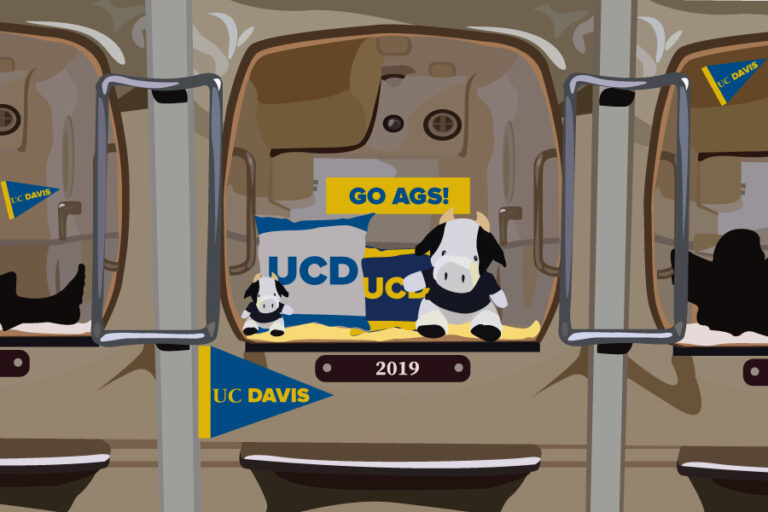
Knowing this fact, not a single Aggie was surprised this past week when UC Davis admins unveiled plans to convert the Tercero dorms into a Japanese-style capsule hotel. For those who hear the phrase “capsule hotel” and think it must be slang for a motel littered with pharmaceuticals, allow me to shed some light on the subject.

Capsule hotels, popular in Japan, are known for their small rooms that only have space for a bed. They’re perfect for the on-the-go businessman, or a person who’s ever wondered what it would be like to be a dead body chillin’ in the walls of a morgue.

This change in floor plan would mean that the school could fit an additional 10,000 freshmen in the dorms.

“I just think it’s a great idea,” said Frances Houseman, vice president of housing at UC Davis. “So $ many $ more $ students $ can $ experience $ the $ magic $ of $ UC Davis.”

Administrators are not the only ones excited about this change.

“I love anime,” incoming freshman Tim Smith said. “I’ve always wondered what it would be like to go to Japan, and I also think about what it must feel like to be trapped inside a Pokéball. With these changes to Tercero, I can experience both at the same time.”

Houseman hopes that students are as excited for the pods as she is.

“I know the kiddos are just gonna love them,” Houseman said. “Will they be cramped? Yes. Would it take only a single puff to hotbox the entire capsule? Absolutely. How much money will we make off all the additional students? Let’s just say that our country could get out of its deficit and then some. Will there be loud construction for the next five years? Without a doubt. Go Ags!”

Written by: Madeline Kumagai — mskumagai@ucdavis.edu

(This article is humor and/or satire, and its content is purely fictional. The story and the names of “sources” are fictionalized.)

“Heaven helps those who help themselves” — for $25!

If “self-help” worked, there would be no self-help industry

Lean In: Women, Work, and the Will to Lead” is a self-help book that exploded back in 2013 by once-chief operating officer of Facebook, Sheryl Sandberg. It’s going to teach me how to succeed as a woman in the workplace for $23 (but a lot of feminists sure as heck don’t think it is helpful to the self to cater to male corporate culture). The Secret is an $8 film, $11 book combo that contains the great mystery of the universe and will bring joy to all areas of my life, but a large mob may run me out of town for deriding it, such is its rabid fan base. “He’s Just Not That Into You” was such a helpful self-help book ($9), it was made into an ensemble romcom ($10) starring everyone ever.

How embarrassing for us that these books are often best sellers. Dr. Phil (not an actual doctor) is now a ubiquitous self-help household name who got his start from Oprah. Anthony Robbins, the motivational speaker who now boasts an entire self-help empire, charges $3,000 for a weekend seminar. Need I mention every diet fad ever? (I was totally into South Beach once upon a time.)

I found out the self-help book has been around since 1859. A guy named Samuel Smiles started all this ridiculousness when he published an aptly titled book, Self-help, containing the adage, “Heaven helps those who help themselves.” How very American.

We are still — I want to say, “for better or for worse,” but it just feels like “for worse” — a staunchly Puritan society, pathologically prude and hardworking. I’m pretty sure we all have a “pull yourself up by your bootstraps” meme tattooed somewhere on our bodies whether we know it or not — a kind of obligatory patriotic birthmark. Every American knows, if you fail at anything, it’s obviously your own fault for not working hard enough. If you had only applied yourself harder, put in more overtime, sweated at the gym more, you could have succeeded. Poverty, homelessness, illiteracy, disease — you are clearly lazy and unpatriotic. Unhappy? It is your own fault. Get off your butt!

Enter the self-help industry. It’s a $12 billion dollar money-maker that thrives disproportionally on women. Over 13 million relationship self-help books, for example, were sold in 2007 alone. Eighteen thousand life coaches work in the United States, over whom there are no official oversight regulating credentials, as in, anyone can call themself a “life coach.”

The worst offending self-help titles can be identified by their cliche soundbite advice. Their easy fixes to all of life’s problems turn into phenomenon that operate awfully similar to addictions. With an endless virtual Amazon aisle of selections to choose from, there is always another Finally-I’ve-Found-The-Answer-To-ALL-My-Problems (for $20) sweet relief to get high on. These books, audio recordings and weekend retreats are lies and escapes from the reality that the solutions to our problems are complex and messy and nonlinear and perhaps counterintuitive and uncomfortable.

Instead of false dead ends that repeatedly deplete our bank accounts, we can instead get connected to the human beings around us (terrifying, I know) and solicit advice from the living and breathing — for free. I googled this strategy, also an option — and corroborated it — for free.

We can ask a friend. Or, we can find someone who has done what we want to do, been through what we are going through and talk to them and capitalize on their lived experience. Just flip the script. It feels good to be helpful, to have our own expertise, whatever that may be, sought out. In helping ourselves get outside the pages of a book that seeks to exploit us, we have the power to give others a very cool feeling of being needed.

If self-help worked, there would be no industry. No one would remain unhappy with their weight, their relationships, the states of their closets, their level of anxiety and so on. What precious few publications or “gurus” mention is that true personal development is messy and does not necessarily feel good. Making lasting positive change takes a long time, and that is a hard sell on a glossy hard cover jacket (“BE FRUSTRATED AND UNCOMFORTABLE WHILE YOU SLOWLY CHANGE YOUR LIFE FOR THE BETTER”).

Another more recently trending alternative is the anti-self-help self-help movement, which states that by focusing on what we want to improve about ourselves all the time — what we don’t like about ourselves — we are making ourselves miserable. This version of self-help says stop helping and just accept your own mediocrity. This is the key to happiness! But it’s still a book you have to buy. Counter culture is still culture.

Written by: Lauren Frausto — lrfrausto@ucdavis.edu

Disclaimer: The views and opinions expressed by individual columnists belong to the columnists alone and do not necessarily indicate the views and opinions held by The California Aggie.

New study shows significant increase in cost of California universities

UC Davis works on programs to help students with basic needs

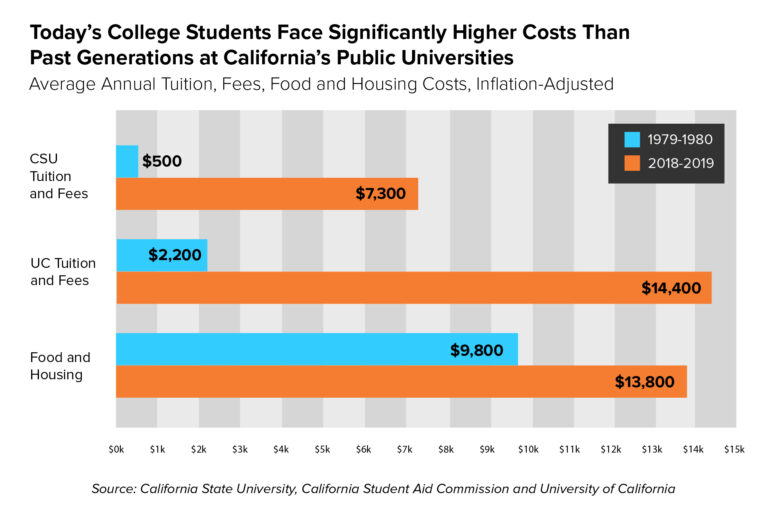
A new study by the California Budget & Policy Center has shown that University of California students pay over six times more in tuition now than they did in 1979-1980 when adjusted for inflation. California State University students pay $6,800 more in fees.

Living costs, which add to the cost of a college education, have increased by 40%. These costs are mostly made up of food and housing costs. UC Davis has taken steps in recent years to combat these issues.

“UC Davis is devoting a lot of attention to providing for students’ basic needs, including food security and affordable housing,” said Julia Ann Easley, a news and media relations specialist for UC Davis, via email. “We know that having these needs met is important for students’ physical health, emotional and mental well-being, and their academic success.”

In February of 2018, three task forces made up of students, faculty and staff were established by Chancellor Gary May to make recommendations and report on students’ needs in mental health care, food access and security and affordable housing.

Among the actions taken in response to the task force’s recommendations was the commitment of Student Affairs to ensure that the Aggie Compass receives funding on an annual basis.

The Aggie Compass, located in the Memorial Union, is a place where students can receive information about basic needs resources available to them. It also has a CalFresh representative available to help students find out if they are eligible for the program and help them with the application.

“Our goal is to lift students out of crisis and into a position of more stability,” said Leslie Kemp, the director of Aggie Compass.

During its first year, Aggie Compass mostly focused on the issue of food security. One of the programs that they offer is Fruit & Veggie Up! which provides students with free produce at the Memorial Union two times a week. It also provides students with information about free food on campus through the UC Davis NOW app.

In the coming year, Aggie Compass plans to launch a mobile pantry, as well as satellite pantries around campus. They will also expand to working more on the issue of housing in the fall.

Before the Aggie Compass had a physical location, there was a website that brought together all the food resources on campus. Knowing they could more effective as a place where students could go seek help in person, the Aggie Compass Memorial Union location was born.

“If you have a hungry student and the only thing you can give them is a URL, it doesn’t really help,” Kemp said.

According to Kemp, all University of California campuses are now working on providing food resources to students, whether it is a website or a pantry.

Written by: Andrea Esquetini— campus@theaggie.org

The sports world continues to be plagued by ‘The Drake Curse’

International music icon supposedly dooms teams by repping gear, posing with star players

Since being dubbed the “global ambassador” of the Toronto Raptors in 2013, Canadian hip-hop artist Drake has brought excitement, glamour and swagger to the lone Canadian team in the National Basketball Association (NBA). Boosting the charisma of a young, surging team has largely coincided with unquestioned success — with the exception of the actual playoffs. Although on the surface it would appear Drake was a catalyst to the Raptors’ success since officially joining their organization, history has progressively portrayed the opposite.

From 2013 to the present day, there has been a rising trend surrounding teams or athletes seen with the Toronto-born star and their subsequent failures. This phenomena began as a joke on social media, poking fun at both the rapper and the losing team, but has now evolved into a transcendent curse that haunts the sports world. Currently, there are some professional sports teams, most notably AS Roma, who quite literally forbid their players from interacting or taking any photos with the rapper. But how exactly did Drake become so doomed by the sports gods?

Although the Drake Curse snowballed into a spectacle that is as far fetched as it is precise, it began quite simply with Drake cheering on an old friend who believed and supported him before he was the sensation he is today: University of Kentucky men’s basketball Head Coach John Calipari. 10 years ago, Calipari, who was far more well-known than Drake at the time, let Drake perform during occasional Wildcat games. The two have since been constant supporters of each other, so much so that after Kentucky won a National Championship in 2012, Drake gifted the team with engraved rings. But since then, the Wildcats have yet to win another title.

In 2015, Serena Williams was on the verge of capturing a grand slam, the most illustrious award in tennis. In the semi-finals match of the final tournament, with Drake in attendance, Williams suffered a career-worst upset in the US Open that will forever be one of the most notorious upsets in tennis and sports history. Striving to achieve the fourth-ever calendar-year singles Grand Slam for a female player in tennis history, Williams shockingly fell short to the 43rd ranked player in the world.

The University of Kentucky is not the only college team whose fate Drake has possibly had a hand in. This past January, the University of Alabama Crimson Tide unsurprisingly made it to the 2019 College Football Playoff National Championship Game to take on the Tigers of Clemson University. The team’s official Twitter account posted a video of Drake repping Bama gear and speaking encouragingly to the Crimson Tide players before the game. The curse, however, got the best of the Alabama team, as they went on to lose to the Tigers 44-16 — one of Bama’s worst losses in team history, and the worst loss under the Nick Saban Era.

Somehow, those are not the only two historic upsets that Drake has been directly linked to. Last year, he walked out with professional fighter Conor McGregor before his bout with Khabib Nurmagomedov at UFC 236, draping a long Irish flag across his body and around his back like a cape. As per usual, the curse kicked in and McGregor looked like anything but a superhero and suffered one of the worst beatdowns of his career.

Recently, Drake attended the Toronto Maple Leafs Game 7 of the opening round of the National Hockey League (NHL) playoffs, only to bring upon an inevitable, excruciating defeat.

Drake seemed to acknowledge the curse and his undeniable reflection of all things unlucky when he wore a custom sweatshirt that featured the logos of all four National Football League (NFL) teams competing in the 2019 AFC and NFC Championship games. However, his outgoing support of players and teams has yet to cease. As he has grown older and wiser, however, he has had the self-realization that if any team he associates himself becomes cursed, why not just reverse the curse?

At this year’s NBA Eastern Conference Semifinals, the top-selling artist decided to fully embrace the mind-boggling voodoo and take matters into his own hands. When his Toronto Raptors made it to the final game of the series against the Philadelphia 76ers, Drake wore 76ers shorts while watching Game 7. Drake’s trick could not have worked better, as the Toronto team ended up beating the 76ers with the Raptors’ Kawhi Leonard sinking a a heart-wrenching, time-stopping, buzzer-beating shot that bounced on the rim three times before falling in. This gave the Raptors and Leonard the first ever game 7 buzzer beater in NBA history.

After the game’s thrilling end, Drake logged onto Instagram, where he posted a video flashing the camera between his TV’s screen that showed the end score of the game in Toronto’s favor, and the logo on his 76ers basketball shorts. Toronto is now battling it out in the Eastern conference finals, where Drake and Raptors fans alike hope with all their might that Drake can continue to control the curse — at least until the end of the playoffs.

Written by: AJ Seymour — sports@theaggie.org

Small farming finds its niche

Farmers emphasize a values based agricultural community.

During my spring break, I set aside time to visit my grandparents farm. We did what we normally did: we walked out to the “sump,” an ugly, moldy body of water just a short walk through the almond orchards. It serves the purpose of irrigation on the family farm.

We set out, walking under the tall brittle branches of decades old almond trees. The same trees that my mother and aunt spent summers raking rows of almonds and pulling weeds. When my mom went to sleep at night, she’d see undulating rows of cotton and waving arms of almond trees, and it was the same in the mornings and throughout the day.

While we walked, the two farm dogs — BD, for “Black Dog”, and Sam — followed along, sniffing and eating grass and leftover fallen almonds. They knew just how to crack them open to get to the nut inside.

In normal salt of the earth parlance, my grandpa Lloyd Bowman would say, “Yeaaah”  — pause — “been no rain lately,” and in the distance my grandmother would sing hymns with a sweet gentle alto range. My grandpa could tell you about crop yields, weather, farming techniques and who owned what land, going back to 1945. He’s 95 years old, and yet nothing seems to escape him.

Finally when we arrived at the sump, the dogs eagerly splashed around in the water, and we talked about old times of when my brother, my cousin and I would stay weekends here, throwing dirt clods at farm equipment and taking walks through the long endless rows of blooming, fragrant almond trees.

Eventually it was time to head back. Walking through the orchard didn’t have the same feeling it used to, because it wasn’t ours anymore. A large scale grape grower had bought all of it up from us. It wasn’t a great loss. It was just time.

My grandpa had started farming when he married my Grandma after WWII. Farming had been something he had always wanted to do.

“I grew up on a farm,” my grandpa said in a phone interview. “I started driving tractors when I was about seven or eight years old. I didn’t go to college  — I didn’t want to go to college. I wanted to farm, it was in my blood.”

They had 150 acres of land and primarily were farming alfalfa and cotton  —- the land was rented from his father, who had been farming in the Central Valley for a long time.

“I was working with my dad and he bought the property. So, it wasn’t too difficult. We started out with small acreage, and we didn’t have a lot of money, but the price of property, land — farms were pretty cheap then.”

For the first year of farming, they had to pick the cotton crop by hand. It was labor intensive and taxing, but soon a mechanized cotton picker became more widely used, and by the second year the farm had already become more mechanized.

And mechanization, he reflected to me, was one of the most profound developments in the life of a farmer. The ability to produce more with less back breaking labor was key to making farming a more efficient occupation.

As for farmers today, he thought that it might be more difficult if one were to try to begin to get started in the business. “The cost of operation is so much greater than it was 75 years ago. The cost of development, drilling wells, getting water. To get started nowadays would be really hard. They developed a lot of new equipment and it’s costly.”

I talked to a local Davis farmer, Sarah Davis, to get some insight in what it is like to be operating a farm right now.

“We have a really unique situation. My husband grows all this stuff, and he loves to do the actual work. Most farms, once they get to a certain size, they make money by growing and by paying somebody else to do all the work. He loves to do it.”

As for the viability of farming for an average family, Davis had doubts.

“It’s a really hard living for a family. I had a job at the university, so I have benefits and a pension. That made it possible for us to buy a house. You could do it [farming], but it’d be a meager living for a family.”

UC Davis researcher and lecturer Shermain Hardesty gave insights on the challenges small farmers face, and the strategies they may employ to overcome those challenges. Much of her research and work focuses on helping small to mid level producers differentiate themselves and establish stronger supply chains and marketing techniques.

“It’s a very competitive environment now. It’s not just domestic producers, you are also competing with imported producers as well.”

Further, small farmers are simply unable to compete with the competitive pricing of imported goods.

“People are looking for the cheapest priced food because that’s all they can afford. Grocery stores have been consolidated to the max. They squeeze every penny out of a farmer when they’re making contracts,” Hardesty said. “The type of producer that can do it obviously is the bigger one. They often sell directly to the grocery chain.”

The agriculture economy in California, in particular, has become structured in such a way as to be less local.

“California agriculture really developed as a supplier for the rest of the country and even much of the world. It’s always been about exporting to other places, not being local,” Hardesty said.

But it is exactly the fact that large producers are less focused on local sales that helps small farmers find their niche.

“The main difference I see happening is that these small farmers, the only way they can really be viable is if they are going to be selling locally […] They need to specialize, to be able to have an identity,” Hardesty said.

Small local farmers have to actively differentiate themselves. This can be done through practicing environmentally friendly farming practices or being non-GMO and non-pesticide. Further, fostering connections with the community is an important way for small farmers to be able to differentiate themselves from large scale producers.

“It starts with farmer’s markets. But then they usually have to find other ways of expanding their marketing efforts.” This is because farmer’s markets only have so much space for growers. This space is filled because of the great advantages of farmers markets being an opportunity for community engagement and connection.

While interviewing Sarah Davis at a rainy Wednesday Davis Farmers Market, there were multiple times when we had to pause the interview for Sarah to have conversations with her customers.

“We get to know people and their kids growing up. You have a 10 second conversation with hundreds of people, but some people come back every week and you get to know them.”

This sort of community engagement is an important part of what Shermain Hardesty is attempting to do in her own work.

“Working with a bunch of people, what we are trying to do is create value based supply chains. From the farmer, to the seller, to the consumer, you have those values passed on so that people really understand and appreciate and are willing to pay for those values.”

“Over the longer term, we have to realize that in order to take care of our environment and our cultural values, we are going to have to pay a lot more for food than we currently do.”

Paying more for the food at farmers markets can mean more than just paying for environmental and cultural values. It can also mean giving back to the community in an economic way. Shermain Hardesty claims that small farming can have important local economic benefits.

“Smaller farms are more labor intensive, but the other side of that is that they contribute a larger economic benefit to the community. They generate more economic activity because their labor is local,” Hardesty said.

Davis pointed out that connecting the consumer to the food they buy will make them more knowledgeable about farming. Exclusively shopping at big stores, with out of season food imported from other countries, can sometimes warp a consumer’s expectations about farming.

“We’re used to cheap food. We’re used to having everything all the time. People say, ‘Why aren’t there tomatoes here’, and well, it’s May. But people don’t know, they’re used to seeing what they see in stores,” Davis said.

But ideally, engagement with local farmers will help consumers feel more connected to the food they eat.

“People come to Farmer’s Markets because I think they’re really eager to have a connection,” Davis said. “If you come here every week, you learn what’s in season and what to expect. That’s key to the future of small farmers, having customers like that. Who are knowledgeable and who care. Who think it’s worth something to maybe pay the same or a little more for things that are really fresh and local, and taste really good.”

Hardesty hopes that this kind of education about farming will occur in the future.

“My dream is that we still have our regular grocery stores, but we would have broader availability of locally grown produce that was advertised for what it is, and why it costs more,” Hardesty said.

Hardesty and Davis both agree: Through community, knowledge and values around farming can be fostered and increased.

My grandparents farming days are long gone. The farm has been sold, as have their friends plots of land around them. When one friend across the street sold, and their almond trees were cut down, my grandma cried. After decades, those familiar trees were gone. It seems like everytime when we walk to my car as I’m about to leave, she shrugs and says “Isn’t that so sad?”

But even as small farmers move on and sell their land, people like Sarah Davis and Shermaine Hardesty work hard to ensure that the values of local farming remain.

Written by: Aaron Levins  — features@theaggie.org

Outstanding Student Awards

Updates to the outstanding student awards that honor students and registered student organizations

Every year, the Outstanding Student Awards honors members of the Davis community  that have made impressive contributions to UC Davis and its student body. Only students and organizations can be nominated for these awards, and recipients are handpicked during a competitive application process. Awards honor students of different seniority and for various reasons, including for outstanding leadership display, service and goodwill.

Jaime Allen, the Leadership Development and Outreach specialist at the Center for Student Involvement, oversees some of the awards  students and organizations can apply to.

“[This year], the Outstanding Student Awards will take place on May 13 at the Mondavi Center,” Allen said. “It’s sort of the end of the year culmination of all of the things students on campus have been able to accomplish this year. We recognize students for their individual accomplishments and student organizations for what they’ve contributed to campus. Outstanding seniors for most of the majors are represented, in addition to CSI leadership awards, Principles of Community Award, Civic Engagement Community Service awards and Student Affairs awards like the Winslow award or Social Justice award. The big award is the university medal, which goes to the outstanding graduating senior.”

Specifically, Allen manages the awards that fall under the Center for Student Involvement, including awards such as the Adams Award, Balanced Leaders Award and Global Engagement Award among several others. In addition to the prestige bestowed upon receiving an award, individuals and organizations can receive cash awards to advance their impactful registered student organizations.

“The CSI awards are coordinated through the Center for Student Involvement,” Allen said. “We recognize student organizations for their specific contributions such as global engagement. Another award recognizes balanced leadership, so organizations that promote academics and wellness among members, not just focusing on the organization itself being successful. Other awards, like the Adams Leadership award, recognizes an outstanding student organization officer for their contributions to the organization.”

Receiving an award is an extremely prestigious honor, as it only recognizes several impressive students out of the tens of thousands in the entire student body. Additionally, organizations recognized for their accomplishments are handpicked out of the hundreds of registered student organizations on campus for their important contributions.

“It’s important to know about the awards so that students and organizations can get the recognition they deserve for all of the great work they’re doing,” Allen said. “It’s really impressive reading over the applications and seeing how much students and student organizations have been able to accomplish, and their impact on their members and the community as a whole. So it’s just really fun giving them to have a moment in the spotlight that they deserve.”

While the award ceremony takes place once every year, new additions to the awards ceremony this year made receiving an award even more enticing than in years past.

“A new addition this year is a pre-reception before the actual ceremony that will happen in Jackson Hall in the Mondavi Center,” Allen said. “The pre-reception is for the recipients to be able to meet senior administrators like the deans of colleges or the interim vice president of student affairs, so this is a great way for students to interact more closely with senior administrators across campus and be recognized across campus for their accomplishments. Unfortunately, this is just open to the award recipients but this is another great reason why students should apply to be able to have this great opportunity.”

Any student making contributions to the UC Davis campus or student body should consider applying for an outstanding student award in years to come, or consider nominating individuals that they feel do so as well.

“I think there’s definitely a way for all students to have a chance to be recognized at the awards, whether its for their academic success or success outside the classroom, there’s different ways to be represented,” Allen said. “Organizations and individuals both have chances. The application and nomination process is different depending on the award, but most of that happens in late January and early February, so everyone look out for the Outstanding Student Awards in 2020.”

Visit the Outstanding Student Awards Page to find out more about the various available awards and to learn more about the application process.

Written by: Alyssa Hada – features@theaggie.org

Research using new robotic technology improves agricultural techniques

Professors and Ph.D., graduate and undergraduate students all work together to invent robots to automate crop production

It’s the year 2030 in the agricultural fields surrounding Davis. The fields look about the same, still dotted with orchards and fruit trees. But, alongside the people picking the fruits are machines, carrying trays of strawberries to and from trucks, as well as lifting people into the air to pick the highest, hardest-to-reach peaches. These newly developed aids are known as harvest assist robots. They greatly reduce the amount of manual labor and number of laborers needed to harvest fruit.

Stavros Vougioukas, a professor in the department of biological and agricultural engineering, runs a lab where research is conducted with robots, automation technologies and mechatronic technologies in relation to agriculture. With the goal of developing automated crop production to produce labor savings in the field or post-harvest, workers in the lab focus on creating these technologies for specialty crops.

Involved with Vougioukas’ research is Dennis Sadowksi, a research and development engineer in biological and agricultural engineering, as well as several Ph.D. students, graduate students and some undergraduate students completing internships. The lab also collaborates with other universities as well as specific growers. The researchers are able to test their equipment in the growers’ fields and receive feedback and advice.

“The main mission of our lab is try to make robotics to not replace but to be part of the labor,” said Zhenghao Fei, a fourth-year Ph.D. student in agricultural robotics who works in Vougioukas’ lab. “The agricultural work is also usually very intense and hard work so people would rather work somewhere else. Robots can replace that harder part and make our lives easier.”

According to Vougioukas, demographics show a labor shortage for farm work since there are not enough workers to meet the high demand. Developing technologies to aid in farmwork will help fix this problem.

“We are not really designing technologies to steal jobs away, we are covering a void because the supply is not there and will not be there even more,” Vougioukas said.

For pickers who will be replaced by the technologies, Vougioukas said they can always find work for different crops since not all foods can be harvested mechanically.

“Overall these technologies are not stealing jobs, they are making sure that we will always have fresh fruit and produce grown locally in safe and environmentally friendly ways, and this is what the technology does,” Vougioukas said. “It is not only picking, it is using less chemicals, less energy, doing it more safely. I think this is the bigger picture.”

According to Sadowski, the university is in the business of developing and using the latest research to develop the latest generation of machinery and robots. For agricultural robots, the process involves building a prototype, showing that it works properly and then a company pays for the licensing rights to manufacture it if they are interested in it.

“The university is not in the business of manufacturing things,” Sadowski said. “Our mission is to help the greater good, help the general public, not specific companies [that want to] get an edge over their competitors by tapping into our research.”

Funding for the research conducted in Vougioukas’ lab comes from government funds, private industries and occasionally specific companies looking for a new technology, according to Sadowski.

One of the main mobile robots the lab has been working on is a strawberry tray transporter. This robot will work alongside people by transporting full fruit trays to other locations and bringing back the empty trays to pickers. Currently, pickers must carry these trays, which wastes time and energy. Instead, this tray can do all the deliveries, according to Vougioukas.

“[Pickers] don’t like to stop picking, they make money when they pick, they don’t make money when they’re carrying trays of strawberries,” Sadowski said.

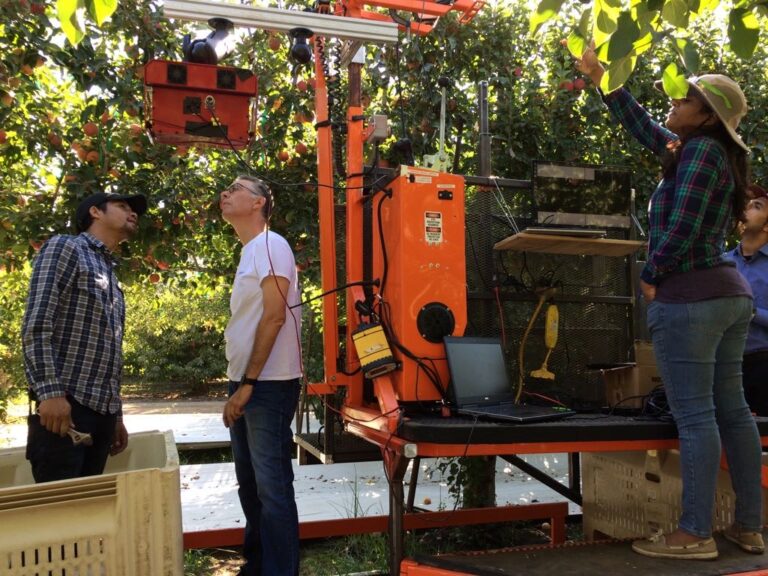
Another robot being developed is an automated orchard platform on which people can stand. According to Sadowski, the machine drives itself automatically, and it looks for fruit on the trees. It adjusts the heights of the pickers on the machine to match where the fruit is, so the workers do not have to reach high or bend low to pick it. The machine drives itself through the orchard at slow speeds, allowing workers to pick apples or peaches and dump them into large bins. Like the strawberry tray transporters, this machine also carries the full fruit bins, drops them off and then returns the empty bins so people do not have to do the hard manual labor.  

The strawberry decapping machine is another robot that the lab has developed. This machine automatically removes stems off of strawberries, which previously had to be done by hand. This machine is already being commercialized by a company in California. According to Vougioukas, either this year or next year it will be a commercial product.

“This is applied research, but hopefully in the next few years some of it will be out there,”  Vougioukas said. “Of course it’s also not just my lab, there are other places working on the research. This has been going on for decades and now you see some machines coming out. It’s not always very fast because going from a concept to a prototype takes some time.”

According to Sadowski, researchers in the lab face many challenges and technologies often fail, since what they are designing are new and unique concepts. Because of this, the lab must test and make alterations to the robots all the time.

“It is a very challenging job,” Sadowski said. “Here it’s like, you have to get inspired and have some brilliant brainstorm in order to solve a problem because farmers have been trying to solve some of these problems for hundreds of years.”

The biggest difficulties arise from these machines being used in a variety of outdoor environments, according to Fei.

“I think the most difficult part is that the agricultural environment is an ecological environment, so there are very high variation among different plants and different seasons,” Fei said. “There’s not like a controlled environment inside a factory, so when we do our algorithms, we can not too much rely on some artificial structure. We have to let our system be more intelligent and more general for the different environments.”

However, according to seventh-year Ph.D. student in agricultural robots Rajkishan Arikapudi, all these challenges become worth it when the robotic system is successful.

“We could foresee that the system could be used in the orchards as a real prototype that could be turned into a harvester soon,” Arikapudi said. “That’s the good part of seeing the efficiencies and the throughputs that the system could achieve.”

According to Sadowski, pretty much everyone will benefit from the research conducted in Vougioukas’ lab.

“Those who will benefit include the growers of fruits and vegetables, the processors, the people who have to work in the fields and pick and ultimately the consumer who will be able to continue to get their fresh fruits and vegetables at reasonable prices,” Sadowski said. “If you can’t harvest the fruit because you can’t find pickers, [fruits and vegetables] just are not going to be available or they will have to be imported from another place. They’re going to be much more expensive or not as fresh. Just about everybody is going to benefit from what we do.”

Written By: Margo Rosenbaum — features@theaggie.org

City recruits for advisory commissions

Davis residents, UC Davis students invited to help plan city’s future

In Davis, advisory commissions promote the preservation of the city’s natural resources, advise park and recreation matters, advocate educational anti-discrimination activities and make public art recommendations. This month, the city encourages citizens 18 years of age and older to apply for these volunteer commission positions, through which they will make recommendations to Council about their given subject areas.

Those interested can choose from 11 specialized commissions: bicycling, transportation and street safety, civic arts, finance and budget, historical resources management, human relations, natural resources, personnel board, recreation and park, senior citizen, social services and tree.

A city press release promises that serving on a city commission means helping plan Davis’ future and describes commissions as a conduit for citizen input.

“Commissions […] provide an important avenue for determining the community’s feelings about issues and extending the reach of the democratic process,” the press release reads.

Mayor Brett Lee echoed this idea when discussing why commissions are important.

“They do outreach to the community, and also [they] have the ability to sort of dig in depth on a few specific things,” Lee said. “For instance […],  when there’s a new development built, we plant trees, and what type of tree should we plant? This would be a perfect thing for trees commission to dig into.”

According to Lee, commission service is open to those with various levels of experience with the commission’s subject. Recreation and park, for example, might have someone with a graduate degree in planning and who has studied recreation, as well as someone who has firsthand knowledge of the parks at which their children play.

“It’s good to have some people who have some academic or professional background in the area, but it’s also important to have people who are more enthusiasts in nature,” Lee said. “I think that if the commission is too heavily weighted toward academic or practical, or the flip side […], then it doesn’t make as good of a commission. We kind of aim for a diversity of experience and just also in terms of ages and backgrounds and things like that.”

UC Davis students are welcome to apply, and some currently serve on commissions — either independently, or through ASUCD, which appoints students to serve on commissions directly. For example, students have been appointed to the Unitrans Advisory Committee and the Police Accountability Commission by ASUCD instead of through the typical recruitment process.

Lee recommended that students apply if they are planning on remaining in the Davis area for at least the next few years.

“Obviously, we hope that [current UC Davis students] are going to stay for a while, because it takes a little bit of time to get up to speed,” Lee said.

Georgina Valencia, who serves on the social services commission, also encouraged student involvement. Valencia said this is a beneficial opportunity for students who want to understand how local government works, adding that it can also serve as a step toward a career in politics.

Although Valencia has not worked with UC Davis students, she said she would like to and suggested more collaboration with the UC Davis campus. Valencia also explained what prospective commission members can expect from the experience.

“I think there’s times when it feels really good, and there’s times when it feels really frustrating,” Valencia said. “Whoever decides to serve on a city commission does so because they see somewhere where there could be change.”

Valencia elaborated on some of the positive and difficult parts of her experience. The local government’s slow pace and the process of familiarizing oneself with governmental processes can take some time to adjust to, a challenge Valencia identified. Among the positive, Valencia counts the chance to hear from community members who want to present opinions about agenda items.

“I think that can be really rewarding to get to engage with people that way,” Valencia said.

With the exception of the personnel board — which works on an “on call” basis — commissions meet monthly. Lee estimates most meetings take about three hours, with about three hours of preparation time required.

“They’re volunteer positions — they’re not paid — but most people I’ve talked to feel like they get a lot out of it in terms of what they learned from being involved, [and] helping move the city forward,” Lee said.

The application period closed on May 20, but applications may still be accepted within a short amount of time after its end. Otherwise, those interested can look out for the next recruitment period this fall. Applications can be downloaded, or picked up at the city clerk’s office at City Hall.

Written by: Anne Fey — city@theaggie.org

Police Logs

Missed calls, empty lines on the other side

May 9

“Open line with nothing heard then disconnect.”

May 10

“Group of teens in the parking lot playing music.”

May 11

“Reporting party allowed someone to borrow her vehicle on May 8 and they took it to Los Angeles without her permission.”

May 12

“Incomplete call with nothing heard — no answer on callback.”

May 13

“Came over yelling at reporting party about her pounding on the floor, reporting party advised she just arrived home, reporting party requested police department contact.”

May 14

“Male subject locked inside a bathroom stall sleeping. Request he be moved along.”

“Brief open line prior to disconnect — nothing heard in background.”

“Immediate hang up.”

Should you take an online class? Here are the pros and cons

Students share their experiences with taking online classes

At UC Davis, there are many classes offered that students can take to satisfy GE requirements, major requirements or just fill up their schedule. These classes include in-person, lecture and/or discussion based classes, hybrid classes (consisting of both online material and in-person meetings) or classes administered solely online. While many students are used to the traditional in-person classes, some also choose to take online classes. There are many reasons for offering these virtual classes as are the reasons for students choosing to take these classes. Every student has a unique experience in these types of classes. For students considering taking online classes, here is what two students have to say.

“It was okay,” said Erin Klausen, a first-year biological sciences major, in response to her experience taking an online class at UC Davis. “I think it was a lot more work than I expected it to be because I kind of just assumed that it would be the same amount of work as a regular class, but in truth, it’s not. It’s way more because you’re spending more hours doing work at home than you would be (like those hours you would be [spending] in class).”

Many students believe that online classes are beneficial because it is easier for them to manage their time and learn at their own pace.

“It’s definitely more of a flexible schedule,” Klausen said. “You don’t have a set time to be anywhere, you just have a deadline to finish your assignments.”

Brandon Jetter, a third-year political science major, agreed with Klausen’s statements regarding the benefits of taking an online class.

“There’s more time flexibility in the sense that you can spread it out throughout the week instead of having a certain time slot allocated to that class,” Jetter said.

There are still some students, however, who do not take these classes for the right reasons. Some students assume that online classes are easier, an assumption that can lead to procrastination. Some students also find loopholes which allow them to cheat on online exams.

“The drawback is that you can definitely ‘cheat the system’ in a way,” Klausen said. “And if you don’t try really hard, you can kinda learn less because you’re not present in a classroom; you don’t have a teacher that you can really ask questions to.”

With no strict schedule, it has never been easier for students to not only procrastinate on assignments, but also on learning the content of the class.

“It’s easy to procrastinate,” Jetter said. “It’s easy to fall behind and not hold yourself accountable. Communication is a little hard because you can’t just ask the professor during office hours.”

Online classes can also be taken for credit across the UC system through cross-campus enrollment during the school year or over the summer to satisfy degree requirements or to explore areas of study outside one’s major. For example, a student at UC Davis may take an online course offered at UC Irvine for credit.

According to the University of California’s Cross-Campus Enrollment website, “you have access to a growing list of quality online courses taught by expert faculty across the UC system. These convenient and flexible online courses offer the same great education you find in your campus classrooms.”

In conclusion, if you are considering taking an online class, consider your learning style and if taking an online class would complement it or not. Experimenting with different classes is an effective way to determine what classroom setting is best suited for you. Keep in mind that not every class is available as an online course.

Written by: LINH NGUYEN — features@theaggie.org

Ranking the best months of the year for sports fans

The Aggie’s guide to the best (and worst) months to watch sports

Most “regular” people in society plan their lives around events and responsibilities involving work, family, school and friends. But life is vastly different for those of us deeply devoted to the world of sports.

The following rankings represent many of the reasons why sports fans feel the need to skip “important” life events like birthday parties, weddings, dance recitals and family gatherings. For the most avid of sports fans, there are simply no days off. The grind never stops.

Each one of the 365 days of the year represents an opportunity to do what you were put on this planet to do: watch your favorite teams and players compete. Nothing else in the world compares to basking in these moments and reacting to them in real time. When your life revolves around sports, you will do anything and everything in your power to make sure you don’t miss a minute of the action.

So, without further ado, here are the rankings of all 12 months of the calendar year from a sports fanatic’s perspective.

#12: July

There’s a reason why July is the busiest month of the year for traveling, and it’s not just because the kids are out of school and the weather is nice. July is typically the most uneventful month of the sporting calendar by a country mile, mainly due to the lack of sports in season.

Major league baseball is right in the midst of the “dog days of summer,” where the weather is scorching hot in ballparks across the country and the season starts to feel like a drag. The home run derby and MLB All-Star Game have grown progressively less interesting and meaningful in recent years, so the trade deadline is one of the only exciting things to talk about — assuming your team is still in contention and not preparing a fire sale of its best players.

Once every four years, we get treated to the single largest sporting event in the world, the FIFA World Cup. But the rarity of that tournament and final game isn’t enough to move the needle for July in the overall rankings.

Other than the WNBA, NFL training camps, NBA summer league and free agency and tournaments such as Wimbledon and golf’s British Open, there isn’t too much to get excited about during these 31 days — especially relative to the rest.

#11: August

August follows closely behind for many of the same reasons. The introduction of preseason NFL football gets fans excited for about 20 minutes before many realize how poor the quality of play is and how completely meaningless the games are.

Baseball season is still stuck in the dog days of late summer, as the season has yet to hit its final stretch.

One of the only things to look forward to in this month is the beginning of domestic soccer seasons in Europe and the return of your favorite superstars to the pitch after a couple months of much-needed rest.

#10: February

February does indeed possess the biggest sporting event in North America, the Super Bowl, in its first week. But after that, everything is far less enticing. The first weekend after the NFL season ends might be the cruelest weekend of the entire year for football fans, as they wake up on Sunday morning with absolutely nothing to do for the first time in about six months.

For soccer fans, the UEFA Champions League finally makes its return after a two-month hiatus, beginning the ever-so-dramatic knockout stages.

The only other highlight of the month is the NBA All-Star Weekend, a congregation of the best basketball players in the world and pop culture icons that features entertaining events like the dunk contest and skills challenge.

#9: March

The word “March” pretty much says it all. The first two days of March Madness, the thrilling 64-team men’s college basketball tournament, are arguably the best days of the entire year, as well as the least productive when it comes to work and school. Over the course of 12 consecutive hours of live hoops, basketball fans across the country watch in dismay as their brackets burst into flames before their eyes. The sight of longshot mid-major schools upsetting the blue bloods, and all the passionate emotions that coincide, has a truly powerful way of uniting all fans, regardless who they root for.

March is also crunch time for teams in the NBA, NHL and NFL rosters start to take shape with the advent of free agency and the Scouting Combine.

#8: May

May can be a very enjoyable month if the NBA and NHL playoffs end up as intriguing as promised. There’s nothing better than a weekend afternoon jam-packed with multiple game sevens and watching teams lay it on the line to save their seasons.

The European soccer season comes to a close at this time, as title races and relegation battles reach their peak. The Champions League also reaches its conclusion in May when one special team is crowned the greatest club in Europe.

Whether it’s the outlandish horse names, fashionable outfits in the stands or controversial officiating decisions, there’s never a shortage of drama and unique storylines in the famous horse races, such as the Kentucky Derby and Preakness Stakes.

#7: September

Nothing marks the beginning of fall like the start of football season. College football enjoys the first weekend of the month to itself, with five straight days of non-stop action and rare non-conference matchups.

After Labor Day weekend, the NFL takes center stage and kicks off its own season, usually with the defending Super Bowl champion grabbing the spotlight on the opening Thursday night. The act of waking up on Sunday morning, flipping on the NFL RedZone channel for the first time in eight months and staying glued to the couch for the ensuing seven hours is a tradition like no other. As if that wasn’t enough, getting to hear Carrie Underwood’s new song for Sunday Night Football and watch Cris Collinsworth’s smooth Sunday night “slide-in” is the perfect way to signal the start of a new NFL season.

Baseball obviously takes a back seat in September, but not for a lack of exciting action, as the pennant races in each league come down to the wire.

#6: January

New Year’s Day is one of the top sporting days of the year, whether you’re watching a New Year’s Six college football bowl game, the NHL Winter Classic or Premier League soccer.

The first Monday night of the month presents the College Football Playoff National Championship, a game that always promises late drama and unexpected twists.

January also marks the start of conference play in college basketball and the return of classic rivalry matchups. The rest of the month is dominated by the NFL playoffs each weekend, while the basketball and hockey seasons are the main source of entertainment during the week.

#5: December

December is more about quantity rather than quality, as games from nearly every sport come fast and furious throughout the holiday season.

College football is seemingly on television every night of the week, with conference championships, bowl mania and the two playoff games. Is there anything better in life than watching a Mid-American Conference versus Sun Belt showdown in an empty baseball stadium at 1 p.m. on a Tuesday? I don’t think so.

As the weather gets colder and colder, the NFL season hits its stretch run and fantasy football leagues wrap up. Meanwhile, the NBA gifts us with a full slate of hoops on Christmas day, the perfect excuse to avoid making conversation with family members you only see once a year. The English Premier League also undergoes its busiest stretch of the season, as clubs are pushed to the limit with a demanding, non-stop set of grueling fixtures.

#4: June

Anytime you get to enjoy a championship series in two of America’s four major professional sports, it’s a pretty awesome month. The NBA Finals and Stanley Cup Finals alternate each day for about two weeks, before each league heads into the offseason. The NBA draft typically produces a fair amount of intrigue late in the month, setting the stage for free agency and the summer league. The MLB season still continues to chug along, in addition to the always-electrifying College World Series.

#3: November

November is truly the “Promised Land” for football fans in America. Just last year, the month started with 20 straight nights of live football.

The ultimate prize of the month, Thanksgiving week, is somewhat of a seven-day bender for sports fans. High-profile college basketball tournaments like the Maui Invitational keep you entertained early and often throughout “feast week,” in preparation for the copious amounts of football that awaits fans on Thanksgiving day and beyond.

After eating yourself into a food coma on Thursday, you get to wake up on Black Friday and enjoy a rare slate of weekday college football games. If that wasn’t enough to get the juices flowing, historic rivalry games like Michigan versus Ohio State and the “Iron Bowl” will keep you stuck on the couch for the third consecutive day on Saturday. Week 13 of the NFL season is the cherry on top, distracting you from your responsibilities for one final, glorious day. That night’s edition of Sunday Night Football provides the backdrop to what is arguably the worst version of the “Sunday scaries,” as reality begins to set in and you frantically try to get your life back in order before returning to work or school the following morning.   

#2: April

April is a time for new beginnings in more ways than one. Major League Baseball finally emerges from its winter-long hibernation and fans can savor the smell of freshly-cut grass, roasted peanuts and hot dogs on the grill. It’s hard to deny the feeling of optimism for all 30 teams, regardless of who’s jogging out from the dugout during team introductions.

At the same time, college basketball prepares to wave goodbye to another thrilling run of March Madness games, and the top four teams in the country compete to determine a champion over the first weekend of the month.

Some other notable events include the Master’s, Wrestlemania and NFL draft, in addition to the start of playoff basketball and hockey.

#1: October

October is hands down the greatest month of the year in the sports world. It is the only time where you can watch all four major professional sports in the same day, known as the “sports equinox.” This phenomenon has only occurred 18 times in American sports history, but has occurred for the past four consecutive years.

There isn’t a single night of the month devoid of at least one attractive game to grab your attention. The entire MLB postseason takes place during October, culminating with the World Series. Football season begins to heat up at both the collegiate and professional levels, and you start to find out which teams are contenders or pretenders. To top it all off, you get your first glimpse at the NBA and NHL since early summertime. No matter what sport you prefer to watch, October won’t let you down.

Written by: Brendan Ogburn — sports@theaggie.org

The State of Officiating: Where does justice become entitlement?

Relationships with referees are as tense as ever, but where does our pursuit for justice become entitlement?

Are professional athletes – and their fans – like preschoolers?

They play games, they throw fits, they fight, they can be petty — and they are incredibly concerned with injustice.

In a This American Life podcast released in April, host Ira Glass peeled back the layers on what makes people so distressed by minor injustices. The episode, titled “No Fair!”, begins with the implementation of what the hosts call a “tattle-phone” into a Pre-K classroom. It’s a large, red phone with an outgoing message: “Hey there, you’ve reached the tattle phone. OK, tell me what happened after the beep. Tell me the whole story.”

The messages reveal what goes on in a four year old’s brain — and it is adorable. ‘My friend did this,’ ‘my friend did that.’ ‘so-and-so kicked me,’ ‘so-and-so lied to me.’ Small, trivial injustices for the outside world… but for children?

“It is everything,” said Kathleen Jones, a Pre-K teacher and purveyor of the tattle phone. “And rules. They live by the rules. They can sit down to play a game and that whole playtime will be nothing but arguing about the rules. And then there’s no playtime left, and they feel good about it.”

Journalist and author Michael Lewis, who joins “No Fair!in Act One, described this concern with injustice as a growing phenomenon in America today. “Americans don’t trust the refs,” he said. “In all walks of life. They don’t trust their impartiality.”

And not necessarily just the ones who call close-out fouls on James Harden’s three’s, or who call balls and strikes or pass interference, but the refs who control our systems, who make the rules.

“Police, Supreme Court justices, journalists, the people who regulate the banks and Wall Street and student loans, the people setting medical costs, judges,” Lewis said. “So many people feel the system is rigged. I mean, Bernie Sanders and Donald Trump both ran on that. So many people feel that […] it’s not fair.”

And what do we do when it’s not fair? We want to make it right. We want to pick up the tattle phone or open up social media and tell the world. And that may not be a bad thing when it comes to our inevitably unjust world. But in sports, at what point do we step back and check ourselves?

In February, The Aggie profiled some of the worst blown calls in sports history. The article came in the aftermath of a missed pass interference call in the 2019 NFC Championship game that likely cost the New Orleans Saints a trip to the Super Bowl. In the days after, Saints fans screamed injustice to the point of filing a lawsuit against the NFL on behalf of Saints season ticket holders. Saints Head Coach Sean Payton said the team would “probably never get over it.”

Or, again, just a few weeks ago, when an ESPN report revealed that the Houston Rockets audited game seven of the 2018 Western Conference finals, claiming that NBA referees cost them a championship (and an estimated $20 million in revenue).

People deserve that which is due. Certainly. That’s justice. And in any sport, fairness should always reign supreme. But the line between justice and entitlement — between what’s a foul and what isn’t — is becoming increasingly unclear. And this mentality is seeping into the cracks of all levels of sport.

It’s something third-year managerial economics major Edrees Yaqubi, who officiated both intramural basketball and football at UC Davis, admitted is becoming a dangerous trend.

“Look, man, everyone wants a scapegoat,” Yaquibi said. “But people are looking at the game differently. It still comes down to the player, you still gotta score, a player still gotta make his shots. The calls are becoming everything.”

As a youth basketball coach now, Yaquibi understands how toxic it can be for the game when the focus switches to the refs.

“They have all the power,” Yaquibi said. “At the end of the day, it’s their game. But as the coach, I gotta tell the kids now, ‘don’t even worry about the refs.’ When you’re looking to the refs like that, you’re putting your future in someone else’s hands — you lose morale off of that. If you’re always looking for a foul call and you don’t get it, it drags you down.”

It’s a fine line, and one that leagues across the world are trying to toe carefully as technology develops and scrutiny heightens. Almost every major American sport has instituted some form of replay review. But the NBA, often on the forefront of such progress, is the first to take aim at transparency. The day after a close game, the NBA publicly releases what is known as a two-minute-report, a review of all of the calls within the last two minutes of a game. Its aim is transparency and accountability, but there is a degree of dilemma between following the rules and preserving the integrity of sport — of competition.

Last year, the Warriors’ Kevin Durant called out the NBA for its approach. “I think it’s bulls— that the NBA throw the refs under the bus like that,” Durant said. “Just move on, man. You don’t throw the refs under the bus like that […] What about the first quarter? What about the second quarter, third quarter?”

Despite the league trying to move in a direction of clarity, Durant presents a valid point. Who’s to say that a call in the first quarter doesn’t change the outcome of the game as much as a call in the last two minutes? It’s impossible to calculate how one single call can impact emotion or momentum or any of the other countless intangibles, whenever it occurs. To even consider those alternate realities may be damaging to the fabric of the game.

In 2010, when MLB umpire Jim Joyce infamously missed a call that would have secured Detroit Tigers’ pitcher Armando Galarraga a perfect game, Joyce’s family received death threats from Tigers fans, and he needed a police escort to get back to his hotel. But the following day, Tigers fans welcomed Joyce to the field with a standing ovation, and he wiped tears from his eyes as Galarraga handed him the team’s lineup card prior to first pitch.

“It’s the human element,” Tigers manager Jim Leyland said at the time. “We all make mistakes.”

But when TVs capture a missed call late in a game that costs your team a chance at a championship, or a young pitcher a perfect game, it’s hard not to reach for that large, red phone.

OK, tell me what happened after the beep. Tell me the whole story.

The whole story is that referees are human. Regardless of how we treat them, they are intermeshed in the DNA of sport as much as players and coaches are. They bring protection, stability and balance to what would otherwise devolve into chaos. And like the rest of us, sometimes they mess up.

This doesn’t mean that we shouldn’t continue to hold refs (and ourselves) to a high standard, or that we can’t be upset when a call doesn’t go our way. But we also can’t expect absolute justice, or always leap for the tattle phone when we are wronged. And we shouldn’t sterilize sports to that point either, because where is the joy in perfection, in predictability?

Even Galarraga recognizes this reality. He and Jim Joyce co-wrote a book two years later. Its title? “Nobody’s Perfect”.

Written by: Carson Parodi — sports@theaggie.org

CCLASS hosts Patio De Colores

The colorful event has come to an end

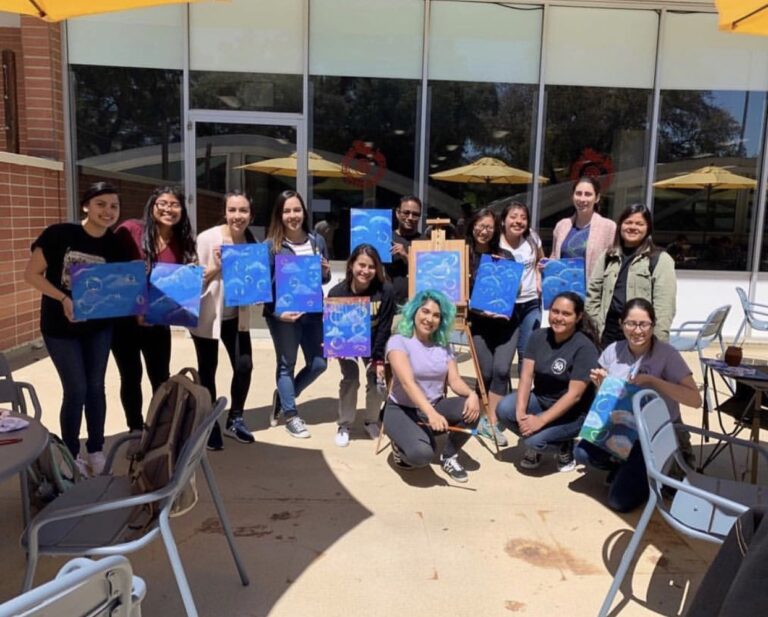
The Center for Chicanx and Latinx Academic Student Success held their final Patio De Colores of the quarter on Friday, May 17. Patio de Colores was a weekly event that took place every Friday from 12 to 2 p.m. outside of the CCLASS on the patio. Students were able to take time from their busy schedules to paint their worries away.

The supplies included a variety of paints, brushes and mixed paper. Umbrellas were set up to give students shade and Samantha Monter, a fifth-year studio art and theatre and dance double major, led the way as an instructor. Every week had a different theme to it. This past Friday, the theme was positive affirmations. The small crowd drew a colorful background and were encouraged to write words of positivity that put a smile on their face. While most students followed the theme, some took this last day as an opportunity to paint freely.

“I wasn’t trying to do anything complicated like Bob Ross landscapes,” Monter said. “[The goal] is to just have everybody chill out, zone out for a bit. And painting is just a nice way to get lost.”

Roxana Reyes, a Community Advising Network counselor, said she came up with the idea for Patio de Colores and was happy with the overwhelming support and participation.

“Painting has a way of requiring an artist to be adaptable, flexible, fluid and free,” Reyes said. “The colors flow together and we see meaning as all the unpredictable lines intersect. This is much like life. Whatever we intend, we sometimes need to practice flexibility and positive mindset as we experience the outcome of our choices.”

The name, while clever, also has meaning behind it.

“[The name] Patio de Colores seemed to communicate the image of color, creativity, freedom and joy that we were hoping to achieve in hosting the event,” Reyes said.

The stress-free event allowed students to use as many resources as they would like.

“Painting supplies are costly for students and preparation and clean-up can be time consuming,” Reyes said. “I didn’t want students to have to worry about that. I wanted them to be able to come, enjoy themselves and not have to worry about setting up or cleaning up.”

Patio de Colores took six weeks to plan, but with positive attitudes, the CCLASS team was able to set it in motion for Spring Quarter. With roughly 25 students, Patio de Colores gifted the students were a complimentary canvas.

“I proposed the idea of Patio de Colores to our CCLASS staff and students,” Reyes said. “I wanted to help create a space on campus that would encourage students to socially engage, practice self care and explore art as a means of expression.”

Reyes spoke to students and asked around to find the best fit for an instructor when she found Monter. Although Monter is still a student, Reyes spoke positively about her contributions.

“She was exciting to work with,” Reyes said. “I truly appreciated the joy she brought to the space and how assuring and positive she was in her coaching”.

Monter mentioned that painting has always helped her de-stress.

“When I go home, I’ll be painting on my own things that aren’t assignments,” Monter said. “And that’s just how to de-stress. Kind of like how people listen to music or read a book. So I wanted to bring that here.”

Although the last Patio de Colores was her first one, Reina Garza, a fourth-year cognitive science major, said she wanted to go since the event was announced.

“I’m really artistic and I haven’t really drawn in a while so it was something fun to do,” Garza said.

As the quarter comes to an end, Monter reflected on her time at UC Davis and how similar events have shaped her.

“These kinds of events are important for the university because they impact student’s emotions,” Monter said. “This event had led to much positivity and unity at the university. As the instructor, it was nice to see strangers become friends and laugh over conversations while making art. It brings people together to do something wholesome.”

The event will return in the spring of 2020.

Written by: Itzelth Gamboa — arts@theaggie.org