53.5 F
Davis

Davis, California

Tuesday, December 23, 2025
Home Blog Page 458

Feminist Research Institute To Host Art Exhibit

UC Davis Feminist Research Institute looking for artists to showcase their artwork

The Feminist Research Institute is looking for UC Davis students to submit their artwork for an upcoming exhibition, to be named later. The exhibition calls for 2D and 3D artwork that reflects their theme: feminism, justice and transformation. Applications for the exhibit can be found on the Feminist Research Institute website. The application includes an artistic statement of 300 words or less and a short response on how the submitted piece reflects the theme of the exhibition.

The Research Institute wanted to have an artistic environment that would embody their beliefs. The idea of feminism is wanted specifically for the exhibition.

“There isn’t one definition for [feminism],” said Jessica Lam, a fifth-year design student and events and sustainability designer at the Feminist Research Institute. “And there’s a lot of debates going on throughout the world as to what that means because feminism is a western invention and so we want works that talk about marginalized experiences whether that is race or gender or sexuality. If there’s a justice-oriented side to it, we love that. If it’s transformative, it’s pretty much in line with what our research institute tries to do, that’s pretty much what we’re trying to do through hosting this exhibition.”

The Feminist Research Institute awards grants and hosts workshops for graduate students and UC Davis faculty. Grant receivers speak about their experience and the research they are doing with the grant provided by the Institute.

“It feels like really important work in the sense that I really believe in the importance and the power of feminism,” said Sarah McCullough, the associate director at the Feminist Research Institute at UC Davis. “But feminist research in particular and particularly as a sort of an intersectional project so thinking about gender as it relates and as it intersects with other systems of power such as race and class and ability, religion [and] sexuality.”

With this exhibition, the institute is hoping to stray away from its usual target population and focus their attention on undergraduate students, encouraging them to send in their work.

“We wanted to engage the undergraduate community a little bit more,” Lam said. “So this exhibition is meant to showcase undergraduate students who have done artwork that is feminist-inspired and this is our attempt to not only reach out to undergrad communities but also to start supporting it a lot more than we have been.”

Along with focusing on undergraduates, the Feminist Research Institute is aiming to bring in more STEM students to the program. The institute’s mission is to support feminist research on campus and spread the information to different areas.

“Traditionally feminist research has really had a strong hold in the social sciences and humanities,” McCullough said. “But there is a real recognition that those sort of insights could really benefit STEM fields and so part of what we are doing is making more bridges work with STEM faculty and graduate students and undergrads to help them understand how some of the training that comes from feminist research could help them to do their research better.”

The exhibition will be held in the gender, sexuality and women’s studies office in Hart Hall. The office shares similar values as the Feminist Research Institute so the two complement each other. Although the exhibition will have an opening reception, the institute aims to keep the art pieces up for a month in order to give students the opportunity to appreciate the artwork on their own time.

“The exhibition was the idea of Rebecca Bihn-Wallace,” McCullough said. “One of the members of our creative undergrad research team, a studio arts major and a practicing artist. [She was] really enthralled by the idea of creating a student art exhibit that featured work that fosters some of our core values.”

The exhibition is optimistic about seeing artwork that engages in the possibility of transformation and creativity to make change in the world.

The deadline to submit artwork is Thursday, March 21. Students have all of Winter Quarter to create new pieces that could represent the values the Feminist Research Institute aims to embody.

When submitting work for the exhibition, Lam has a piece of advice for the creative undergraduates.

“Be confident with your work and your intention,” Lam said. “A part of our Google Form involves a personal statement involving your work but while that helps us interpret your work a little easier, we do have a great respect for art that speaks for itself and we are looking for as many voices and perspectives and expressions as possible.”

The date of the exhibition is to be determined, but updates can be found on the Feminist Research Institute website.

Written By: Itzelth Gamboa arts@theaggie.org

Lunar New Year: How students are celebrating the year of the pig

0

Students of different backgrounds share how they celebrate the Lunar New Year

Every year, millions of East Asians welcome the new year of the lunar calendar with a number of traditions. This year, falling on the first new moon of the lunar calendar, which would be Feb. 5, those who celebrate this holiday welcome the year of the pig. Also known as Chinese New Year, the Lunar New Year is generally celebrated by those of Chinese, Vietnamese, Laos, Singaporean and Korean cultures. Lanterns, cherry blossoms and red envelopes are generally associated with Lunar New Year. Traditional gowns are worn, families come together to celebrate, firecrackers pop, smiles beam on the faces of the young and old.

For most students who would normally celebrate, however, being away from home and family during Winter Quarter means that celebrating might not be exactly how it used to be before college.

Enoch Fu, a first-year electrical engineering major from San Jose, noted that he may or may not be going home for the holiday. He said that he usually celebrates with family and will only celebrate this year if he goes home to be with them. In the past, Fu noted that he used to celebrate with family by coming together, eating and receiving red envelopes. Being of Taiwanese and Chinese descent, Fu associates the holiday with eating traditional, home-cooked Chinese and Taiwanese food and receiving hong baos (red envelopes filled with money), which he noted is his favorite part of the Lunar New Year.  

Thanh Le, a Vietnamese fourth-year neurobiology, physiology and behavior major from Clovis, Calif., said that she and her family have already established a yearly routine.  

“I usually celebrate Lunar New Year at my grandma’s house,” Le said.

She stated that because this is how she has always celebrated, it hasn’t made much of a difference now that she has moved away from home. She also noted that because her grandma lives in Fairfield, Calif., a 30-minute drive from Davis, it is not hard for her to gather with family.

“All of my family and extended family gather there for traditional religious rituals with a special lunch or dinner afterwards,” Le said.

Raised in a Buddhist household, Le said that the “religious rituals” her family practices include paying respects to the deceased family members at the altar as well as the Buddhist deities.

“There’s also a part of the celebration where all of the kids in the family give their well wishes to the elders. In return, red envelopes are handed out,” Le said.

In Vietnamese, these red envelopes are called li xi, which are also filled with money. Le’s favorite part of the holiday is that it is a very “family centric” holiday.

“With all of our busy schedules, it can be hard to make time for family. But with an event like this, we get a chance to catch up,” Le said.

While many students who would usually celebrate might not find the time to gather with family for the holiday due to classes and distance from home, Le noted that it is always nice to take time away from school to reunite with family for a tradition.

“Another thing with celebrating Lunar New Year is that it allows us to keep a family tradition as well as our heritage alive,” Le said, emphasizing how important it is for younger generations to uphold family values and carry on traditions that have been present for many, many years.

For students looking to celebrate locally, the city of San Francisco will host its annual Chinese New Year parade on Feb. 23. The event will also be streamed for viewing on TV. On Feb. 9, the Chinese New Year Cultural Association in Sacramento will have a program celebrating the holiday.

Written by: Linh Nguyen – features@theaggie.org

Cartoon: Trans Rights Are Human Rights

ROSEY MOREARTY / AGGIE


By: Rosey Morearty — rosey@morearty.org

Yolo County begins drafting 2020 Strategic Plan

0

County Board of Supervisors seeks input from students, community members

This year Yolo County will develop a vision for the community’s future through the creation of the 2020 Strategic Plan. This plan “is a guiding document used by the County Board of Supervisors to set policies and prioritize resources for the organization for the next three to five years,” according to the Yolo County website.

The document will inform supervisors as they direct the county’s actions in governmental and safety net services, land use planning and environmental health efforts. It will identify broad goals for the county as well as how to achieve and measure them.

The 2016-2019 Strategic Plan presented four broad objectives: thriving residents — which included goals of homelessness reduction and community health improvement — safe communities, sustainable environment and flourishing agriculture. Part of creating the 2020 Strategic Plan will be deciding whether to keep or reword the existing goals or to include additional goals. The board has discussed adding operational excellence, “health in all” and economic activity.

The plan is currently in the engagement stage, which will be followed by plan development, a step involving workshops and workgroups of the board of supervisors. This will be followed by the last stage: approval, which is expected to happen Dec. 17.

Engagement efforts will consist of public meetings and workshops, pop-up booths at community events — there are plans to host one at the Davis Farmers Market on March 2 — and surveys for both advisory bodies and the public. All county community members, including students, are encouraged to participate in the public survey.

Don Saylor, the county board supervisor and board chair, explained that one of the plan’s ultimate goals is to engage county workers and residents.

“[W]e’re trying to have everybody who is involved with Yolo County have a sense of what we’re doing together for the people and the planet that we’re charged with serving,” Saylor said.

Saylor also explained how the planning process itself will affect community members.

“More important than the piece of paper is the work that goes into it and the degree of people investing themselves in it, because in the end, it only works if we have a bunch of people excited and committed and interested,” Saylor said. “Through the course of these public workshops and surveys, I hope that we engage people in ways that they haven’t been before.”

Already, public input has produced changes — community members who visited the pop-up booth at Woodland’s Dr. Martin Luther King Jr. celebration expressed the need for the public survey to be in Korean and Chinese in addition to the original English, Spanish and Russian. Now, the survey is in all five languages.

Saylor looks forward to receiving feedback from UC Davis students and involving them in the strategic planning process.

“Having students have a sense of what the county does and having them participate in the decision-making processes of Yolo County is the right thing to do — it’s fair,” Saylor said. “At a time when we have so many people disenfranchised, we have every interest in involving folks.”

Jessica Jones, the assistant deputy to Saylor, also brought up the role of the county advisory bodies in the engagement efforts stage. She gave an example of what this engagement looks like.

“Health council, for instance [will discuss,] ‘What are the leading health issues that we should be thinking about?’” Jones said. “Do we want thriving residents or do we want a new way to phrase it? And what are the most leading policy issues that we’d like the board to think about? That’s just one example, but there’s many advisory bodies, so that’s the other kind of outreach.”

Carolyn Jhajj, a senior management analyst for the Yolo County administrator’s office, said that the 2020 Strategic Plan will be unique from previous plans because of these more intensive engagement efforts.

“We’re really trying to do a larger involvement from the public, trying to really outreach and get [as many] people’s thoughts and inputs as possible,” Jhajj said.

The new plan will also be formatted differently in order to increase measurability.

“As we have it now, when something’s completed, you can check it off, [but] it isn’t necessarily easily measurable in terms of data,” Jhajj said. “We’re looking to try to format it so that we have clear outcomes that we can try to associate with data, [so] that we can show progress every time we report it out.”

The county, according to Jhajj, is looking to keep the public involved throughout this data-driven process as well.

“We’re hoping to be able to connect that to kind of a dashboard that the public can see and they can check in on,” Jhajj said. “A dashboard that would be on our county website, that’s our vision.”

Written by: Anne Fey — city@theaggie.org

Paid parking spaces added in Downtown Davis

1

Implementation of paid parking as effort to reduce traffic congestion

The City of Davis will add paid parking spaces in the downtown area to alleviate traffic issues. At the time this article was written, City Council was scheduled to finalize the plan to proceed with increasing metered parking options on Feb. 5.

Discussions about paid parking started in 2012, when the City of Davis considered that demand for parking increased during lunch hours and in the evenings, creating traffic congestion, noise, air pollution, aggressive driving across intersections, and an uncomfortable environment for pedestrians, according to a press release.

Meanwhile, downtowndavis.org, an online organization composed of small businesses, has congregated together in solidarity against paid parking.

According to the website, this DowntownDavis group is “a loose association of small businesses and others who are invested financially and emotionally in downtown Davis that have joined together to advocate for the benefit of downtown Davis […] formed, in particular, to stop paid parking from being put in throughout downtown [… believing] that paid parking will drive customers away from the downtown [they] have all put so much effort into making welcoming.”

Despite lack of approval from the businesses, Brian Abbanat, the senior transportation planner for the Transportation Division, confirmed that the paid parking plan will still move forward as specific details are finalized for the City Council’s review.

“In November of 2017, [City Council] gave broad policy direction supporting paid parking in the southeast quadrant and asked us to come back to them for specific policies and ordinances that would enable them to take the next step forward,” Abbanat said. “We have been working on a paid parking implementation plan for the last 10 or 11 months. And so now that it’s complete, we have more details related to paid parking and how we plan to actually implement it — that’s what they’re taking action on in February.”

Brett Lee, the mayor of Davis, understood the concerns people may have with paid parking. However, he urged others to think about the context of the problem.

“When you ask someone whether they’re in favor of paid parking, people say, ‘No,’” Lee said, according to The Davis Enterprise. “Why would they be in favor of paid parking? The problem with that is the context. Ask them if they are happy with the current parking situation downtown and they say, ‘No, absolutely not.’ Am I in favor of paid parking to address the terrible parking situation that we have downtown? Yeah, absolutely.”

Abbanat noted that there are some positives to implementing paid parking.

“We are expecting it to improve traffic in Downtown,” Abbanat said. “One of the problems we have right now — particularly during our peak — is that we have high occupancy rates. Most people driving around downtown are actually looking for parking space. What paid parking will do will ensure that parking space is available because we intend to price it at rates at which we will achieve about 1 to 2 parking spaces available.”
Abbanat expects the paid parking modifications to cover a chunk of Downtown Davis.

“This is primarily the southeast quadrant which is roughly First Street to Third Street and D Street to H Street, but not including H Street itself,” Abbanat said.

He also noted that that the process has taken a very long time, in part due to concerns from the Davis community.

“This has been a topic of discussion for a really long time,” Abbanat said. “We understand that there are some community concerns about it. We’re hoping that this sorts out higher priority users from lower priority, and we hope to ensure that parking is prioritized for customers.”

Furthermore, Abbanat said that although paid parking is just a small part of the recommendations, it plays an essential part so that other recommendations could be implemented.

“Paid parking is one of the recommendations,” Abbanat said. “We have been trying to implement other recommendations from that plan, as paid parking is a critical component of the plan for other recommendations to be effective. We are asking our City Council on Feb. 5th to make some final parking policy decisions related to paid parking so we can start to work towards installation of the meters themselves. That process will take quite some time, so I wouldn’t expect to see any meters on the ground before fall of this year.”

Written by: Stella Tran — city@theaggie.org

Concert Review: Hippie Sabotage

Local duo returns home, bigger and better than before

Brothers Kevin and Jeff Saurer returned to Sacramento — back to the city of their humble beginnings to give a prelude to their North American tour, Beautiful Beyond. On Jan. 31, EDM duo Hippie Sabotage performed The Park Ultra Lounge unapologetically.

The illuminated State Capitol building was the perfect backdrop to accompany my fellow smokers and I in the outdoor lounge area. A man across from me wore a tie-dye T-shirt with a marijuana leaf and the words, “Keep Calm and Smoke It,” and bumped into another man, who sported a blue velvet blazer as he lit his cigarette.

“Every tour brings a different group of fans and energy to the shows,” the duo said via email.  “Also, we have a new set full of unreleased music and a brand new visual set to make people trip out.”

Audience members in the first few rows were in the beer splash zone when one of them, in their excitement, threw their arms and whipped their hair around like the inflatable tube men often seen outside of local used car dealerships. The two periodically chanted “I don’t give a f***!” — a feeling we can all relate to at times.

The duo’s new single, “Caught Up,” carries that energy as it talks of letting go of the unimportant things and fixed things of the past —  the things in life that can leave one caught up in their mind.

“We were just inspired by our lives,” Hippie Sabotage said via email. “At times you f**k up, but you can’t dwell on past mistakes if you want to move forward and grow in life. And to always trust your gut despite your inner doubts.”

Hippie Sabotage resurfaced their early hit remix of Tove Lo’s “Stay High” — arguably the remix that jump started their stardom. The fans in the crowd felt the history associated with the duo’s progression from then until now. It was clear that their Sacramento fans were proud.

Sabotage says they want their music to make people feel inspired, relaxed and better. The duo plans to continue making music and say they will let their emotions drive them throughout the rest of their career.

The Hippie Sabotage discography is available on all major streaming services.

Written by: Josh Madrid – arts@theaggie.org

Women’s basketball win streak continues

0

Clash of top Big West teams results in win for surging Aggies

To kick off the final month of the regular season before the beginning of the Big West Conference tournament, the UC Davis women’s basketball team took on the CSU Northridge Matadors in a rematch from last year’s Big West tournament championship game.

UC Davis entered the contest on a five game winning streak, largely in part to junior forward Nina Bessolo’s sharp shooting over the stretch, connecting on 54 percent of her three point attempts. In its previous matchup against Northridge in January, UC Davis came out on top, 60-49. Saturday’s game was no different as the Aggies cruised to a 70-54 victory and captured their 13th win in their last 14 games.

The Aggies started off strong behind the hot hand of senior guard Kourtney Eaton and the leadership of senior center Morgan Bertsch. The Aggies’ star forward had her work cut out for her on Saturday afternoon, as her center counterpart from CSUN, senior Channon Fluker, is an MVP-caliber player in her own right and looked to push her team to the top of the Big West Standings.

Through the first five minutes of play, Betsch controlled the paint and the pace of the game, drawing two fouls, forcing Fluker to the bench and showcasing an elegant skyhook. As the Matadors began to crowd the paint in attempts to shut down Bertsch, the Aggie offense took notice and quickly transitioned to its three-point game. Eaton drilled all five of her three point shots in the first half, which helped to put UC Davis up 47-25 at the break.

The third quarter mainly consisted of many whistles and stoppings, and the flow of the game came to a noticeable halt. Eaton and sophomore forward Cierra Hall both picked up their fourth fouls in the third, partly contributing to a CSUN surge. At the end of the quarter, the Matadors had turned a 23-point deficit into only nine points, putting a little more pressure on the Aggies as the game entered the final frame.

The fourth quarter ended up being rather uneventful, as Bertsch and the Aggies responded by thwarting any CSUN chance at a comeback. Between scoring a putback layup, reverse layup and converting a three-point play, Bertsch’s last quarter helped her amass a game-high of 20 points to go along with her six rebounds and three assists. Bertsch is now only 29 points away from being number five on the all time Big West scoring list. Eaton also did her part on the offensive side of the floor, adding in 19 points of her own on six of seven shots in her 30 minutes of playing time. She also recorded a game-high four assists.

“I was feeling good and I was in the zone,” Eaton said. “Sometimes you just have that feeling, and my teammates were finding me for wide open shots, and thankfully I was able to hit them.”

Eaton also stressed the importance of the team continuing to start upcoming games with the same defensive urgency and energy that it has displayed during its win streak.

Saturday’s game was the eighth of the year where the Aggies have scored 70 or more points. They were undefeated in those games.

“There might be some games where we don’t score 70,” Eaton said. “And we’re going to need to have our defense step up and have a championship mentality. So even when we aren’t hitting our shots, we can still win games.”

Head Coach Jennifer Gross also had a championship mentality on her mind, as she noted how Saturday’s contest felt much like a championship game and how her team played up to the challenge.

“This is the kind of effort it’s going to take for the rest of the year if we want to make it to the Big West Championship,” Gross said. “I was really pleased with how we started the game, how we bounced back from adversity in the third quarter and that we finished strong. We have a ton we need to work on from this game, but I thought we did some things well. It’s nice to get a win and also be able to improve.”

Now sitting at 7-1 atop the conference, the Aggies will head out on the road for a two-game trip down the coast to take on UC Santa Barbara and Cal Poly. Their next home game will be Feb. 14 against UC Riverside.

Written by: AJ Seymour –– sports@theaggie.org

Nutrition education for farming families

Gender-inclusive, agricultural and nutrition extension programs lead to healthier international farming communities.

Nutrition is not the same across all farming communities. Some farming communities encounter mixed nutritional messages, which challenges their health and agricultural development. Extension programs, funded by the United States Agency for International Development, find solutions that match country and culture-specific realities for international farming communities.

“In most countries, like Zambia, women are doing most of the farming work,” said Amanda Crump, a lecturer in the UC Davis Department of Plant Sciences. “However, women have not benefited from previous agricultural extension practices.”

Crump partnered with USAID’s Integrating Gender and Nutrition within Agricultural Extension Services (INGENAES), an initiative that promotes women empowerment in household incomes, to improve agricultural productivity and nutrition outcomes for farming families. INGENAES operated within several USAID Feed the Future countries, such as Honduras, Nepal, Uganda and Zambia.

INGENAES was recently completed in 2018. UC Davis, along with the University of Illinois at Urbana-Champaign, the University of Florida and other partners, collaborated with USAID missions, government officials and farmer organizations in write-shops. All together, they created focused, culturally-sensitive and relevant messages for men and women.

“INGENAES’ predecessor relied on country-level extension programs, missing women’s involvement to improve the way they farmed,” Crump said. “Women are treated differently in each country, we need to adjust our nutrition tools for each experience. In Zambia, we worked with local partners who created a plate game, asking women to put the foods they ate on a plate. It told us a lot of information, we could assess which nutrients they were getting in their regular diet and which nutrients were missing.”

The UC Davis team produced five consistent nutrition messages for Zambian families embedded in keychain rings. In Uganda, calendars worked well to determine which foods were accessible based on the harvest season, along with messages printed on grain sacks describing agricultural food loss.

Changing nutrition habits also involves changing the mindset of farming communities.

“A lot of people were not receptive when you mentioned one gender or the other,” said Nikki Grey Rutamu, the assistant director of the UC Davis Global Affairs Humphrey Fellowship Program and the UC Davis College of Agriculture and Environmental Sciences International Training Programs. “They respond to whole family approaches.”

The UC Davis team reviewed agricultural technologies for gender inclusivity.

“We reviewed the treadle pump— a hand pump lifting water from wells for irrigation — and interviewed women, asking them how they accessed it, financed it and whether it alleviated their workloads,” Grey Rutamu said. “If she did save time, what did she do with that time?”

In Zambia, the post-harvest season brings problems with drying crops. When crops were not dried enough, aflatoxin, a potent carcinogen, was stored inside crops.

“People use the Perdue Improved Crop Storage bags and wicks away the moisture preventing aflatoxin from settling into the crops, but we found it was an expensive technology for some farmers,” Grey Rutamu said.

In poor, rural communities in East African countries, such as Tanzania, chickens serve as a reliable income and nutrition source for women.

“10 to 35 percent of women’s income in these communities is from chicken,” said David Bunn, an assistant adjunct professor in the UC Davis Department of Animal Science. “85 percent of chicken production in these areas is by small scale production.”

The chicken market is easily accessible. A woman can borrow a hen from a neighbor, start a flock of 24 hens in 18 months and therefore, create a constant source of income. Women were then able to use their income on health, education and food for the members of their families.

“Egg, chicken and meat are considered a luxury,” Bunn said. “Women would sell all of their chicken, meat and eggs to build income, buying starches for their families to eat. We found that it would [be] effective to couple nutrition education with the chicken business. In Ghana, we educated women farmers about consuming eggs and the nutrition benefits for their families. We found they will make that shift with family education, saving some of their eggs and meat for their family and improving their nutrition.”

Another extension strategy incorporated chicken production lessons into primary school curriculum. Women attend school at lower rates than men, creating language barriers and preventing access to information. Their children, however, can learn to manage chickens and build chicken coops at school, translating their skills to their mothers, families, neighbors and the chicken businesses.

“We’ve had interviews about inequities in intrahousehold food distribution,” Grey Rutamu said. “The order of who got what may adversely impact members of the family. A woman would feed her husband and children before herself, leaving her with a diet of limited nutrients.”

By empowering women with agricultural and nutritional knowledge, women are more adept at making decisions that shape their families’ well-being and their own, improving the nutrition and economic development of their communities.

Written by: Foxy Robinson — science@theaggie.org

More than economics

Research reveals how increasing minimum wages can improve public health

When the topic of income is raised, the issue is conventionally associated with the field of economics. Current research, however, suggests that a correlation exists between income and public health, specifically between minimum wages and smoking addiction. According to a recent study entitled “Minimum Wages and Public Health,” led by Paul Leigh, a professor emeritus in the Department of Public Health Sciences at UC Davis, there is a link between increasing minimum wages and the reduction of smoking prevalence among low-wage and low-skilled workers.

Though Leigh has written several papers on the correlations between wages and public health, it was only two or three years ago that he began looking at minimum wages specifically. After contacting Juan Du, an associate professor of economics at Old Dominion University, the two began a systematic review of various medical literature pertaining to minimum wages through scientific websites, such as PubMed and Web-of-Science.

Leigh mentioned that a very time-consuming aspect of the research was determining which literature was reputable and relevant to the question they were exploring. Some studies simply had the words “minimum wage” in their abstracts but were not looking at the issue specifically. He stated that his team spent almost two years narrowing down the data. Once the set of studies were established, the researchers conducted a meta-analysis to further analyze the data.

According to Leigh, meta-analysis means analyzing numbers from different studies in order to obtain an average estimate that is then examined to determine if it is statistically significant.

“The biggest challenge [in compiling the data] is that health outcomes are diverse,” Du said. “There are about 20 outcomes that are related to health and health behaviors. Different studies also have different samples. How to compare them and synthesize information from them and organizing results is very difficult.”

In addition to the unexpected number of health measures, Leigh explained that the lack of consensus among the studies on the various measures of health was also surprising. While some studies would argue in favor of an apparent effect, other studies would claim there was none. There was a strong consensus, however, about one health group in particular: smokers.

The estimates in Leigh’s study revealed that a $1 increase in minimum wage was associated with a 1.4 percent reduction in smoking prevalence among affected groups. According to Elisa Tong, an associate professor in the Department of Internal Medicine, smoking is disproportionately represented in people with low socioeconomic status. Although a health provider does not have direct access to a patient’s income, their healthcare coverage can suggest their socioeconomic status.

As those of low socioeconomic status may work minimum wage jobs, this potentially leads to stress, which is a dominant reason for why people smoke. Tong further explained that though many people want to quit smoking, the nicotine in tobacco products is a highly addictive substance that takes multiple tries to quit entirely. In revealing the correlation between an increase in minimum wage and a decrease in smoking prevalence, Tong hopes that this will lead to support for increases in minimum wage and have a broader impact on behavior change.

“It’s very hard to reduce smoking prevalence, but population-level policies like tobacco taxes and smoke-free policies are thought to have the strongest impact,” Tong said. “Policies can support quitting and change social norms about the acceptability of smoking outside of a doctor’s office.”  

Despite the lack of a general agreement between studies, there were no consistently harmful effects associated with increasing minimum wage. This led Du to come to the conclusion that the positive effects of raising these wages dominates the negative effects.

Leigh explained that middle income wages have been stagnant for the past 30 to 40 years, though those on the lower end have experienced a decrease. If the minimum wage is increased significantly, the wage structure can be improved so that, by increasing the wages of low income workers, economic pressure will be put on middle income wages that will allow them to drift upward. Therefore, by increasing minimum wages, a significant effect can be produced on improving income inequality.

While minimum wage and the wages of low income people tend to spark economic questions, Leigh believes that people should begin looking at minimum wage as a public health issue.

“The major thing I would like for people to think about is […] there’s this secondary effect we haven’t thought about. There’s a secondary effect here that you can improve people’s public health,” Leigh said. “Then it becomes an argument in favor of raising minimum wage, a different argument in favor of raising minimum wage.”

Written by: Michelle Wong – science@theaggie.org

Patriots dynasty rolls on with sixth title

0

Defense dominates in lowest-scoring Super Bowl ever

The 2018 NFL season was undoubtedly the greatest offensive showcase in league history. A record 1,371 touchdowns were scored in the regular season and quarterbacks absolutely feasted on opposing defenses, setting records for touchdown passes, completion percentage and passer rating.

With all of that said, Sunday’s Super Bowl proved that the old adage “defense wins championships” still rings true in the game of football. In the lowest scoring game in Super Bowl history, the New England Patriots captured their sixth Lombardi Trophy with a 13-3 victory over the Los Angeles Rams.

It was a rather dull affair for fans, relative to some of the heart-stopping games witnessed all year long and throughout the playoffs, but that didn’t stop the Patriots from further cementing themselves in the history books and extending one of the greatest dynasties ever seen in professional sports.

New England is now tied with the Pittsburgh Steelers for the most Super Bowls won ever. In addition, Head Coach Bill Belichick and quarterback Tom Brady stand alone with the most Super Bowl titles of any single coach or player in NFL history.

Sunday’s game got off to a rough start for the Patriots, as quarterback Tom Brady threw an interception on the opening drive and kicker Stephen Gostkowski missed a 46-yard field goal on the team’s second drive.

Meanwhile, the high-flying Rams offense was completely stifled by New England, as the team’s first eight possessions resulted in punts. Los Angeles never ran a single play from inside the red zone the entire night.

A 42-yard field goal by Gostkowski in the second quarter was the only scoring play in a completely uneventful first half.

Following a halftime show that featured the likes of Maroon 5, Travis Scott and Big Boi, the second half got underway and Los Angeles finally put points on the board with a field goal late in the third quarter.

The action didn’t start to heat up until midway through the fourth quarter. New England quickly drove down the field in five plays, on the strength of two key receptions by tight end Rob Gronkowski, and scored on a two-yard touchdown run to make it 10-3 with seven minutes left on the clock.

The Rams responded with a pass-heavy attack and threatened to tie the game, but quarterback Jared Goff was picked off on an errant throw at the New England four-yard line.

The Patriots effectively sealed the victory with a pair of 26-yard runs that set them up in field goal range. With just over one minute remaining, Gostkowski nailed a 41-yard attempt to wrap things up.

New England wide receiver Julian Edelman received the Super Bowl MVP award after a 10-catch, 141-yard performance. On the defensive side, cornerback Stephon Gilmore was equally as deserving with five tackles, three passes defended, one forced fumble and the game-sealing interception in the fourth quarter.

Looking ahead to next season, the Kansas City Chiefs are the early favorites to win the 2020 Super Bowl, per the Westgate Superbook in Las Vegas, followed closely by the Patriots, Rams and New Orleans Saints.

Written by: Brendan Ogburn — sports@theaggie.org

Dena Beard lectures at the Manetti Shrem

Visiting Artist Lecture Series invites The Lab executive director

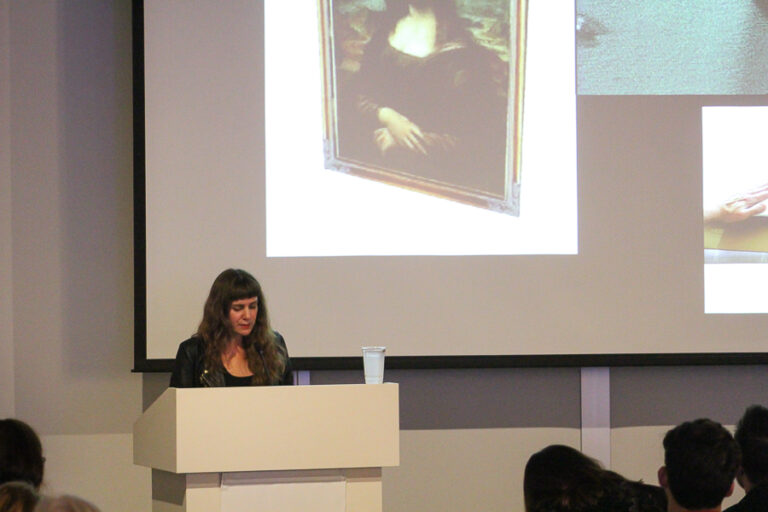
On Jan. 31, the Department of Art and Art History invited Dena Beard to the Manetti Shrem Museum as a part of the Visiting Artist Lecture Series, which holds events throughout the year. Beard is the executive director of The Lab, a nonprofit experimental music and art space in San Francisco.

Beard began the lecture by explaining the origins of her personal philosophy and how it affects the way she experiences and works with art.

“I’m an anarchist,” Beard told the audience within the first few moments of her lecture. She explained how she’s interested in “dismantling systems of oppression” through the art she helps produce with The Lab.

“My work hinges on the idea that great art dismantles these norms,” Beard said.

She also explained her interest in the “subjectile,” which she defines as the support structure for any artistic work. In particular, her interest lies in subjectiles that “bite back” and force the artist to struggle a bit. She believes that there should be conflict between what an artists wants their piece to be and what it ends up becoming.

When The Lab hosts an artist, Beard opens up the space completely in order for it to become a subjectile space that the artist can quarrel with.

Ariana Shevchuk, a third-year design major and studio art minor, said that Beard’s opinions on the subjectile resonated with her own personal work. Shevchuk said that as an artist, she wants to let go of the pursuit of perfection and “let the work do what it wants to do.”

“It’s about letting your art be what it wants to be, as opposed to designing something and having it come out how you envisioned it originally,” Shevchuk said.

Before Beard began working at The Lab, she earned a master’s degree in art history, theory and criticism from the School of the Art Institute of Chicago. She also worked as an assistant curator at the Berkeley Art Museum and Pacific Film Archive for six years.

Her work as a curator, however, did not stimulate her creatively or intellectually. She felt like a “cog in the machine” and yearned for more meaning in her life. This is why when she was offered a position at The Lab in 2014, she decided to jump straight in.

The Lab is a space that has existed for 35 years but had been severely struggling when Beard was brought in. The space was poorly run, $150,000 in debt and lacked a cohesive purpose. It was a massive undertaking, but Beard knew she was the person for the job.

As Executive Director, Beard decided to “wipe the slate clean” and reconstruct the entire space. She had hardly any money to work with and utilized fundraisers and a Kickstarter campaign in order to get the organization out of debt and back on its feet.

While she wanted to maintain the punk edge that the space had cultivated over the last 35 years, she wanted to add a level of professionalism that would turn the space into a respected and financially solvent business. This would benefit the space and the artists they work to support as well.

Since taking over, Beard has made The Lab a successful non-profit that brings in around $360,000 a year.

This money then goes right back to the artists. The Lab gives out four grants to underrepresented artists each year, ranging from $25,000 to $100,00. When considering the recipients of the grants, Beard works to find artists and pieces that challenge systems and forms found in everyday life. She is interested in tackling systems in life that she sees as oppressive or detrimental to the good of the world.

“I choose people who will change me,” Beard said. These chosen artists then get to completely take over the space during their allotted time with The Lab.

Kayla Sabella-Sandhagen, a second-year art studio major, found the lecture and Beard’s words inspiring.

“I’m ready to go create,” Sabello-Sandhagen said.

Amanda Flowers, a fourth-year English major, said that Beard’s philosophy and what she does with The Lab is inventive.

“It is an interesting use of theory that was applied to art in a way I haven’t seen it,” Flowers said.

More lectures will be held throughout the year for this series. Public lectures are held at 4:30 p.m. in the Manetti Shrem Museum in the Community Education Room. Lectures are free and open to the public. A schedule can be found at the Manetti Shrem website.

Written by: Alyssa Ilsley — arts@theaggie.org

Cafe Walter opens inside the Mondavi Center

0

New cafe is named after the late “Chief Executive Cat” of the center

Inside the Yocha Dehe Grand Lobby of the Mondavi Center is a new site — Cafe Walter — named after the center’s “favorite cat” who used to wander around the Arboretum and near the Mondavi Center before his death in September. According to the Walter’s Instagram page, he was the “Mondavi Center Chief Executive Cat.”

Gia Hellwig, the director of operations for the cafe, has been a member of the Davis community for over 15 years. She graduated from UC Davis in 2007 with a degree in human development, and during her undergraduate studies, she saw the development of the south end of campus, including the Mondavi Center and the development of the new King Hall. After graduating, she interned in Oregon before moving to San Francisco. She returned to Davis in 2009 as events manager at the law school. In Hellwig’s nine years as events manager, she encountered Walter quite a few times.

“When we would have events over here, Walter would be hanging out by the back or in one of the Mondavi staff’s offices,” Hellwig said. “He was here for two or three years before they found him in the Arboretum. They think he had a heart attack, I believe.”

The cafe had a soft opening on Jan. 14, and the Mondavi staff practiced making espresso drinks and ensured that all the machines were working. The next day, the cafe was open, offering special drinks, snacks and baked goods. New items have been rolling out since, and two weeks after opening oatmeal and scones were added to the menu. The cafe hopes to add breakfast burritos, salads and paninis soon. The cafe’s food and beverage offerings are through a partnership with Capitol Garage, a Sacramento restaurant. Once a week biscuits with honey butter from Porch, Capitol Garage’s sister restaurant, are brought to the cafe. According to Hellwig, the scones are “delicious” when warmed up.

Capitol Garage manages concessions and a full-bar for night-time shows, in both Jackson Hall, with a capacity for 1,800, and the Vanderhoef Studio Theatre, with a capacity for 250. Café Walter plans to offer a limited coffee menu for smaller night-time shows.

“We will use the espresso machine […] usually just for the shows that are going to be in the Vanderhoef Studio Theatre,” Hellwig said. “Otherwise, it backs up the line when you have 1,200 or 1,500 people.”

The Mondavi Center houses Jackson Hall, where undergraduate classes are taught throughout the day on Tuesdays and Thursdays, and once a day on Mondays, Wednesdays and Fridays. According to Hellwig, traffic at Cafe Walter has being slowly picking up, and it already sees visits from students, staff and faculty who aren’t already inside the Mondavi Center and are nearby on campus.

Lisa Illes, a fourth-year biological systems engineering major, has a class across from the Mondavi Center in the Graduate School of Management once a week. Illes said that it makes sense to have an additional coffee shop there, as it’s easier to access, specifically for people at the Manetti Shrem Museum, the Welcome Center, the Alumni Center, the Conference Center and the Graduate School of Management.

“It’s really convenient to get to just hop across the quad and grab some coffee during the lunch hour,” Illes said.

Illes never interacted with Walter, but she thinks that it’s “cute” that the café is named after him, and that there’s a framed picture of him.

Third-year economics and statistics major Stephanie Lu went to Cafe Walter for the first time because she had an interview in the Conference Center. Lu thinks that the cafe will attract people who are willing to go out of their way to get there. She described it as less crowded than the Coffee House in the Memorial Union, where many students gather to meet or study. Lu thinks she will go to Cafe Walter maybe once a quarter.

“I live in downtown, so it’s kind of far for me to come here, but maybe if I want to [go] to the Arboretum or somewhere around here, I might come,” Lu said.

Despite Lu describing it as not too crowded, Hellwig thinks that might change soon.

“We’re pretty steady throughout the day,” Hellwig said. “But I think once we get our full food menu up and going, we’re going to be pretty busy all day long.”

Written by: ANJINI VENUGOPAL — features@theaggie.org

Students bring their hooved friends to college

0

Students’ equine partners accompany them to college to be stabled and ridden at the UC Davis Equestrian Center

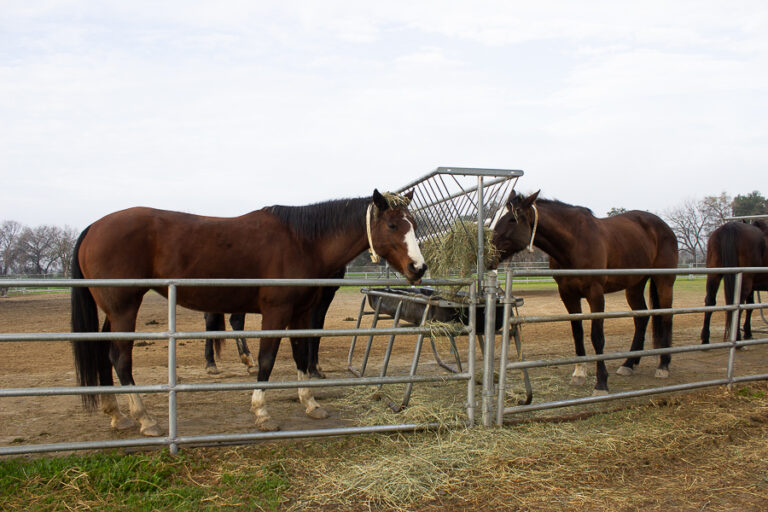
Hiding at the south edge of the Arboretum, just a short walk or bike ride from the heart of campus, sits One Equestrian Lane, where student and university-owned horses live together. Certain horse-loving students choose not to leave everything behind when they move away to college. On move-in day, along with their backpacks and books, they bring their thousand pound animals to live at the UC Davis Equestrian Center (EQC).

Many students choose UC Davis because they can continue riding and owning a horse here, according to fourth-year animal science major Kathlene Cotti, who keeps her horse Osiris at the EQC.

“I had a better chance of owning [a horse] if I went to UC Davis than somewhere else,” said Clarissa Sunderland, a first-year animal science major, who keeps her horse Madison at the EQC. Clarissa shares Madison with her twin sister Katherine Sunderland, who is also a first-year animal science major. “I read that they had a barn on campus, and you don’t really need a car.”

The EQC is located right on campus, so many students are drawn to its convenience, since it is close to student housing and classes. The demand for students to bring their horses to college is high, so if students want to bring their horses to the EQC, they must put their horse on a waitlist.

For many, the price of keeping boarding one’s horse at the EQC is less expensive than what they paid at home, or what they would pay at other places in the area. For the 2018-2019 school year, boarding a horse in a pasture is $275 a month, and boarding a horse in a stall is $450 a month.

“It is really cool that we have a facility here that you can have your horse, is easily accessible, right on campus and is cheaper than most facilities,” Cotti said.

Students want to keep riding their horses in college for a number of reasons. For Katherine Sunderland, she said it helped her not feel homesick. For her sister Clarissa, she said it was nice to have an activity to do besides her schoolwork.

“It’s nice, if you have a good ride, then you have a good day even if your classes stunk,” Clarissa Sunderland said. “It’s good for me to have a break from studying. I don’t have as much time to do other things. I can’t join any other clubs or anything at least for now, but it’s worth it.”

For first-year animal science major Kylee Rush, bringing her horse Flicka was a priority.

“She is my baby,” Rush said. “She is sort of my ride or die, so she is coming everywhere with me.”

According to Rush, she also wanted to bring her horse to be an distraction from school and studying, as well as a way to meet other people.

“She is great for getting out of the dorm, getting involved,” Rush said. “She is the reason why I joined the eventing team, which has helped me create a community in the horse world. I have made good friends on the team and has bettered my college experience.”

For Cotti, the reason she brought her horse to college was to boost her mental health.

“I don’t think I would be the same person without a horse,” Cotti said. “When things go bad in your life, your horse is always constant. [For] some people that comes from working out or a sport, and I think that for us, your horse is your sanity plug and that has really helped me.”

When Cotti first brought Osiris to the EQC her freshman year, she said it was difficult to learn how to balance taking care of him with her school work. Over the last two years, Cotti has figured out how to better manage and plan her time.

“I feel like when you come to college you get involved in other things,” Cotti said. “As time went on, I feel like I came back to [riding], as I really need this. I should go every day, see him, love him, spend time with him, and just growing as a person has helped that.”

According to Cotti, she said she has really enjoyed the overall experience of keeping her horse on campus with her and joining the UC Davis horse community.

“It is the same community as people in my animal science classes but in a different way, which is a really cool thing,” Cotti said. “Some of my best friends are people who have horses, so I always have someone to look after him. I see them on campus, and I have people I can talk about weird horse girl things with, which I think is fun.”

Written by: MARGO ROSENBAUM — features@theaggie.org

Everybody may have their different political parties, but everybody hates Tomi Lahren

Everybody Hates Tomi Lahren!

So if you guys haven’t heard, the bold and suburban political commentator and former Fox News host Tomi Lahren emerged from the fiery pits of white privilege to tweet “5 billion spent on a wall will be the BEST $5 billion taxpayers EVER spent!”

After the longest government shutdown in U.S. history, you might be wondering why the republic isn’t more focused on repairing what Cheeto-in-Chief Donald Trump has once again damaged beyond recognition. It seems, however, that everyone has redirected their anger and attention to Tomi Lahren’s furious idiocy.

‘Twas the night after future-politician Cardi B’s popular government shutdown Instagram speech went viral, concerning the thousands of federal employees who are forced to go to work without pay, when Tomi Lahren scrolled through her Twitter feed on her MAGA laptop only to find positive comments about the Bronx rapper’s rant.

Enraged with white rage, Lahren weighed in on the situation by tweeting, “Looks like @iamcardib is the latest genius political mind to endorse the Democrats. HA! Keep it up guys #MAGA2020.” Lahren, whose lack of knowledge is made obnoxiously obvious every time she opens her overused mouth or sends out a tweet, was soon met with a legendary rebuttal.

Cardi “the people’s champ” B hit back with, “Leave me alone I will dog walk you.” She then landed a Tekken-style TKO by tweeting, “You’re so blinded with racism that you don’t even realize the decisions the president you root for is destroying the country you claim to love so much. You are a perfect example on no matter how educated or smart you think you are you still a SHEEP!” If you know who Cardi B is, I hope you read that in her nasally voice for the 4D all-around experience.

The tweets of Chun-Li “the street fighter’s” nemesis alone racked up more than 1.6 million likes, thus showing how people will come together to defeat what they hate most. No, not Donald Trump but Tomi Lahren — that is, the same white lady who admitted to benefiting from Obamacare while in fact slandering Obamacare. The same lady who is anti-black and pro-black, anti-choice and pro-choice, anti-NFL and pro-NFL, even though she can’t tell the difference between a goal and touchdown. Just like her orange father, Lahren says whatever she can come up with to garner retweets and likes.  

Written By: Hilary Ojinnaka- hiojinnaka@ucdavis.edu

(This article is humor and/or satire, and its content is purely fictional. The story and the names of “sources” are fictionalized.)

The problem with “woke capitalism”

How the marriage of market capitalism with social progressivism trades the interests of the worker in favor of profit

While it may have already fallen out of relevance in our ever-accelerating news cycle, Procter and Gamble Co.’s Gillette ad targeting so-called toxic masculinity stirred up yet another culture war frenzy last month. The commercial, praised by some and the target of scorn for many more, was yet another entry in a growing list of corporate adverts aimed at promoting social justice. Yet the main takeaway from the ad may be just how hypocritical and exploitative the relentless force of “woke capitalism” is.

In an era when a burgeoning populist right has grown increasingly hostile to the free market and an anti-capitalist left is emerging as a legitimate electoral force, major corporations have found themselves facing increased scrutiny. In turn, these companies have found a winning formula in the adoption of socially progressive branding. By co-opting social justice movements, major corporations have been able to largely absolve themselves of the responsibilities they owe their workers while simultaneously adopting a type of broadcasting with increased appeal to Millenials. You can now get away with wage suppression and union-busting, so long as you adopt the right corporate messaging.

In decades prior, the relationship between major corporations and their workers was largely dominated by collective bargaining. Trade unions, long a bastion of economic leftism, represented workers’ common interests against the powerful onslaught of corporate elites. This was especially true in the era succeeding the New Deal, when unions had accumulated significant political capital. This in turn forced companies to come to the bargaining table by making them pay breadwinners and their families living wages.

As de-industrialization has diminished the political influence of unions, however, corporations have no longer found themselves obligated to answer the needs of their workers. Furthermore, the decline of economic leftism and the increased focus on identity issues borne out of the culture revolutions of the 1960s and 70s has allowed corporate America to rebrand itself through performative wokeness.

Accordingly, capitalism has become entirely compatible with left-wing identity politics. Therefore it should come as no surprise that the president of the Women’s March Alliance is an ex-Goldman Sachs banker, or that defense contractor Raytheon — which has profited extensively from the ongoing slaughter in Yemen — is lauded by the Human Rights Campaign for making efforts towards LGBTQ inclusivity in the workplace.

Workers in developing countries are similarly exploited and hidden behind the curtain of corporate social progressivism. Consider ice-cream maker Ben & Jerry’s, whose Pecan Resist flavor won over the hearts and minds of those who felt disaffected by the Trump administration. Nevermind that Ben & Jerry’s is a subsidiary of the multinational mega-corporation Unilever, an organization that, alongside none other than Procter & Gamble, has been indicted by Amnesty International for its use of child labor in Indonesia.

Similarly, Nike’s Colin Kaepernick-inspired advert earlier this year became a rallying cry for progressives in the culture war, paying the company dividends — Nike sales increased 31 percent after the ad campaign. Missing from the national debate was the fact that it came out at the same time Nike was fending off allegations from United Students Against Sweatshops over worker exploitation. Ironically, Nike did little to reciprocate the political action of their consumers — they immediately proceeded to donate hundreds of thousands of dollars to congressional Republicans during the 2018 midterms.

Ultimately, the appropriation of social justice by major corporations has done little to benefit these movements themselves. Instead, it has traded the interests of the worker in favor of the shareholder, allowing corporate giants to pursue relentless capitalism. But as corporate exploitation becomes increasingly apparent, it is debatable just how long this tactic can last. Unfortunately for now, it is a winning strategy.

Written by: Brandon Jetter — brjetter@ucdavis.edu

Disclaimer: The views and opinions expressed by individual columnists belong to the columnists alone and do not necessarily indicate the views and opinions held by The California Aggie.