54.1 F
Davis

Davis, California

Tuesday, December 23, 2025
Home Blog Page 459

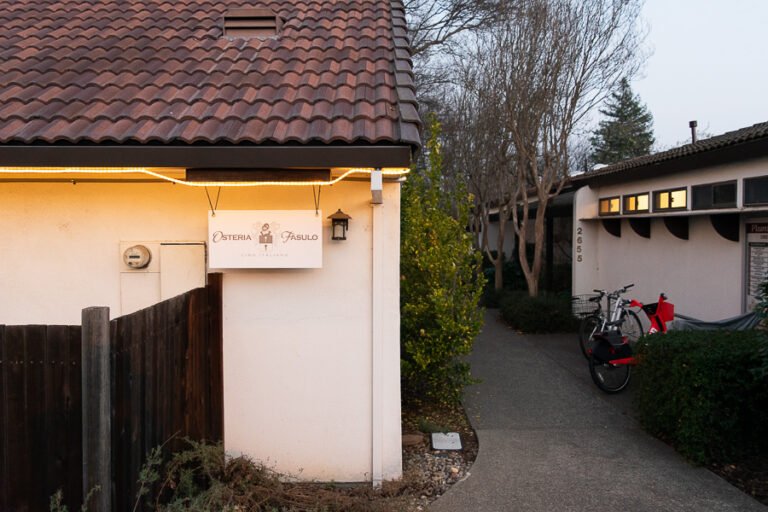
Former employee of Osteria Fasulo claims she was fired for speaking Spanish

Owner of the upscale Davis restaurant denies allegations of discrimination, racist comments through attorney

High-end Davis restaurant Osteria Fasulo made national headlines this month when a former employee filed an official complaint alleging that the owner subjected her to a racist tirade, before telling her she needed to leave the restaurant if she didn’t “learn English.” The restaurant owner, Leonardo Fasulo, is disputing the complaint through legal representation.

The Center for Workers’ Rights in Sacramento announced it was filing an official complaint with the California Department of Fair Employment and Housing on behalf of former Osteria Fasulo employee Francisca Perez. The workers’ rights organization forwarded to The California Aggie an unofficial copy of the complaint that they submitted. The alleged incident occurred around dinner time on May 31, 2018, when Fasulo overheard Perez discussing a food order in Spanish with another co-worker, according to the document.

“Mr. Fasulo got upset that we were speaking Spanish and interrupted our conversation by telling my coworker ‘we do not speak Spanish here,’” Perez said in the complaint. “He kept yelling and arguing with my coworker while I walked back to the kitchen to continuing preparing the food.”

Perez claimed that Fasulo continued to argue with her coworker before following Perez into the kitchen and asking her why she was speaking Spanish, saying, “This is America” and “We only speak English here.” The complaint alleges that Fasulo then told her he might as well start serving Mexican food and change the menu to Spanish since she and her coworker liked to speak Spanish. Perez clarified Fasulo’s purported comments in an interview with The Sacramento Bee.

“[Perez alleged] Fasulo screamed at her, pounded a table, mockingly asked if she wanted him to add burritos to the menu and told her she needed to learn English to keep her job,” The Bee reported.

Perez claimed she then told Fasulo that he was discriminating against Mexicans, who are “the very people making your food.” At this, Perez alleged, Fasulo became even angrier and told her to leave the restaurant and that she could no longer work there if she didn’t learn English. Perez alleged that Fasulo refused her request for her final paycheck.

“I asked him if he was going to pay me my final paycheck and he replied that he was going to pay me whenever he felt like it,” Perez said in the complaint.

The Bee reported that the altercation allegedly occurred in front of Perez’s 11-year-old son, who had just walked into the restaurant to wait for his mother to finish her shift.

Daniela Urban, an attorney at the Center for Workers’ Rights, said that Perez did eventually receive her final paycheck, but is seeking financial compensation for the delay — under the California labor code, wages earned and unpaid must be paid at the time that an employee is discharged, or the employee may be entitled to compensation from a “waiting time penalty.”

“[There is a] waiting time penalty for failing to issue it immediately, which is required,” Urban said. “The damages from that, as well as her missed rest breaks, are part of our claim for wages, [as well as] compensatory damages for the time she was out of work that we also feel she would be entitled to.”

Urban said that Perez is also seeking an apology from Fasulo and assurance that the restaurant will implement a system to ensure that incidents like this don’t occur in the future. Urban said that such incidents were more common than one might think.

“We see national-origin discrimination happen far more frequently than the Davis community or the Greater Sacramento community […] would expect,” Urban said. “We think of our communities as more progressive, being in California, but there is this blatant discrimination — it often happens in places like kitchens and laundries where customers aren’t seeing the discussions that are happening between the employees and the boss.”

Fasulo’s lawyer, Matthew Smith, disputed Perez’s account of the incident. On Jan. 18, he said that he and Fasulo had not received any official notice from the state or Perez’s legal representation. Urban also said the request was submitted to the Department of Fair Employment and Housing on Jan. 8 and that the official complaint would be filed either that week or the next.

Smith alleged that Perez was never fired but quit by leaving her shift early that day. He claims Fasulo attempted to provide her final paycheck by mailing it to her home address as registered with the company.

“We don’t know why she left, she didn’t explain the reasoning for leaving, but she never returned,” Smith said. “When she didn’t return, Mr. Fasulo cut her final check […] and when she didn’t come for it, he mailed it to her last known address.”

Smith claimed that Fasulo never made the alleged racist comments and that his restaurant does not have an “English-only” policy. Policies prohibiting other languages in the workplace are considered unlawful national-origin discrimination by the federal Equal Opportunity Commision and the California DFEH, unless the owner can prove it is justified by “business necessity.”

According to Smith, the only altercation that day occurred with another employee, contradicting Perez’s account of events.

“He didn’t make any comments to Ms. Perez,” Smith said. “There was an altercation between a waitress and Mr. Fasulo. Ms. Perez was not a party to that conversation. Mr. Fasulo doesn’t even know if she was in earshot of that conversation.”

Smith alleged that Fasulo was training the waitress at the time, when he heard the waitress-in-training speaking Spanish loudly in the dining room.

“Mr. Fasulo said to this waitress, ‘Look, we need to speak English in the dining room, because when guests are present, they feel uncomfortable with people speaking languages they don’t understand,’” Smith said. “We don’t believe that was taken as a statement of policy, because it’s not a policy. It’s courtesy, and Mr. Fasulo was trying to teach this young lady about courtesy when she is serving.”

Smith said that he believed that the waitress in question was Janet Ruelas-Nava, a third-year nutrition science major at UC Davis, who was also formerly employed at Osteria Fasulo. The alleged complaint from the Center for Workers’ Rights includes a declaration from Ruelas-Nava corroborating Perez’s account of events.

According to Smith, Fasulo is an Italian immigrant who is fluent in five languages — including Spanish — and not a native English speaker himself. Fasulo was close with Perez throughout her off-and-on employment spanning over a decade at Osteria Fasulo, Smith said, and was hurt by her accusations. He expressed some skepticism that Perez was the sole party behind the accusations.

“Mr. Fasulo would babysit Ms. Perez’s children as they were growing up,” Smith said. “They were very, very close, and he’s very hurt by the actions that are being taken. He feels they are only being taken because she wants money.”

Written by: Tim Lalonde— city@theaggie.org
Jan. 22 ASUCD open forum begins in protest, ends without resolution

Controversy over “Blue Lives Matter” movement leaves Davis community, ASUCD in opposition

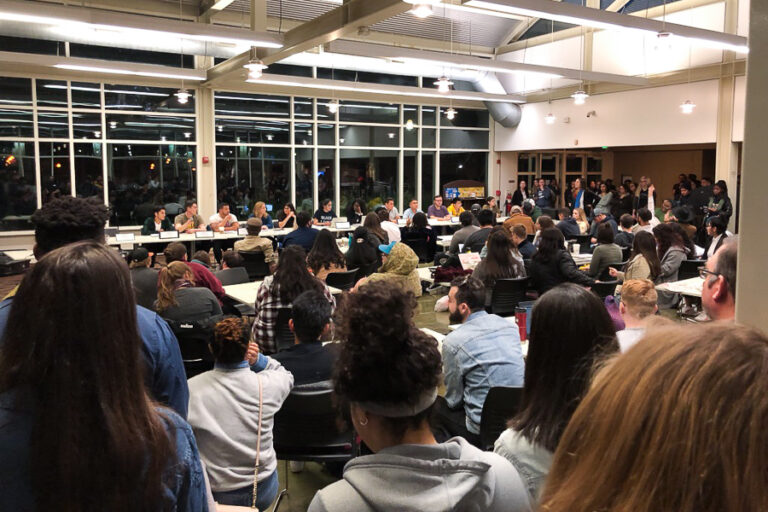
ASUCD hosted an impromptu open forum in the CoHo on Jan. 22 in response to the backlash that followed a Facebook post from ASUCD’s Ethnic and Cultural Affairs Commission (ECAC). The post, which gained national attention, criticized Davis students and community members for using a photograph of slain Davis Police Officer Natalie Corona with the “Thin Blue Line” flag to honor her.

The forum allowed the community to discuss the heightened attention drawn to the “Blue Lives Matter” movement and flag, as well as unpassed ASUCD legislation recognizing Corona’s death.

The ECAC’s now-deleted post referred to the flag “anti-Black and disrespectful,” highlighting the commission’s belief that police presence may be triggering for certain individuals. ASUCD President Michael Gofman quickly countered this with a post of his own.

“I wholeheartedly condemn the Ethnic and Cultural Affairs commission for this disgusting post, and urge them to take it down and issue an apology,” Gofman wrote in the post. Gofman’s post sparked further controversy and incited more than 1,300 comments, which included threats of violence and offensive language.

Throughout the forum, Gofman was repeatedly asked to take the post down and condemn the disrespectful language in the comments section. He publicly committed to authoring a post condemning the hateful words on Facebook that same night. A post was subsequently published the next morning.

Prior to the public forum, the Senate tried to pass a piece of legislation to honor Corona during a special session meeting on Friday, Jan. 18. This resulted in further discourse among the public, with several individuals feeling that if ASUCD was drafting a resolution to honor the death of a policewoman, they should draft resolutions for every victim of a tragic death.

The open forum sought to resolve these issues and provide a space for the public to voice their opinions. Around 100 individuals attended, filling up the entire southwest wing of the Coffee House.

Before beginning, ASUCD Vice President Shaniah Branson reminded the crowd of the UC Davis community agreements and requested that individuals form lines in front of designated microphones when making their questions and comments — an effort apparently made in vain, for a majority of participants opted to yell their concerns from the crowd.

The first figure, who kicked the meeting off with complaints directed at Gofman, was KateMarie Bocconi, the vice chair of the Young Democratic Socialists of America Club.

She expressed her discomfort over the police presence outside of the CoHo — which was unrelated to the forum — and accused ASUCD of failing to create a safe environment for people of color to express their opinions, stating that the Senate did nothing to mediate the harm that Gofman allegedly caused the ECAC.

“If you are going to pass a resolution on [her] death, I need you to pass a resolution about every worker who dies in construction, in lumberjacking, in any industrial capacity,” Bocconi said. “I need you to pass a resolution every time a homeless person in Davis dies, every time a veteran in Davis dies, and honestly, I couldn’t find a resolution on Stephon Clark’s death on the ASUCD website. Where are the resolutions for people of color shot by the police?”

This inquiry echoed many of the concerns that other audience members had, as each time Bocconi made a statement, she was greeted with clapping and cheering. She ended her address by asking the Senate to remove Gofman as president, a plea that evoked verbal support from the crowd.

Concerns over the resolution to honor Corona did not stop there, for many other community members stood up in the crowd during the forum, shouting out grievances. Shreya Deshpande, a fourth-year sociology major and a member of the ECAC, opted to wait in line to formally direct a question to the Senate.

“I just want to ask the authors of the resolution why multiple narratives weren’t considered,” Deshpande said. “This is obviously an issue that has multiple experiences for different types of people.”

Deshpande, along with others who voiced their support for her, felt that the resolution did not represent the sentiment of the entire student body.  

Mohammad Qayum, a co-author of the resolution, said he was more than willing to open up a dialogue over the revision of the legislation. Two days after the forum, Qayum was sworn in as an interim senator.

Additional concerns, such as ASUCD’s choice to hold a forum after the resolution was drafted instead of before, were also articulated.

Others felt that the Senate was using Corona’s death as a political tool, and that Gofman’s reaction to the ECAC’s post was a method to delegitimize the commission. It had been speculated both previously and in the forum that Gofman’s beliefs and those of the ECAC do not perfectly align.

One speaker at the forum said that Gofman used his “whiteness” to hurt others, and that his “frat brothers” bearing “white supremacist symbols” in the front row were the only reason he got elected. Discussions surrounding Gofman’s stance on the Israeli-Palestinian conflict and his alleged support — or lack thereof — for transgender individuals was also brought up.

At one point, ECAC Chair Rina Singh opened up about the threats she and her commission faced after the commission released its statement about the Blue Lives Matter flag, which she called “a racist flag,” online following Corona’s death. Singh read from a prepared statement, announcing that the committee strongly stands by its Facebook post — “we do not apologize for it,” she said.

Going off script, Singh focused her attention on Gofman, specifically on an instance that occurred last quarter. Following the posting of anti-Semitic fliers on campus, the ECAC organized a processing space to talk about the fliers and discuss a potential response. Before the event took place, Gofman, who is Jewish, posted a status on Facebook discouraging Jews from attending the event, writing: “the organizers of this event did not contact a single Jewish leader on campus.”

In her off-script speech, Singh attempted to call Gofman out for this post and asked him, “Why do you lie?” She failed to mention that she had previously apologized for this event, saying the commission should have done a better job reaching out to Jewish students beforehand.

Toward the end of the forum, one speaker voiced his feeling that passing a resolution for a fallen police officer felt unfair, especially when taking into account the thousands killed by police brutality. The individual argued that ASUCD had never made statements regarding police violence and how it affects different groups within the UC Davis community.

ASUCD Senators were then encouraged to “read the readings” to gain perspective on the narratives that black and brown individuals experience daily. All of them agreed to do so, save for Michael Gofman who had already departed for a class he had at 6 p.m.

ASUCD Vice President Shaniah Branson concluded the open forum around 7 p.m., thanked all attendants for coming out and stated that if community members wanted directions on how to impeach Gofman, they should approach her after the meeting.

Written by: CLAIRE DODD — campus@theaggie.org

NFL exploits civil rights leaders for PR gain

Super Bowl highlights league’s hypocrisy in addressing racial issues

Last Sunday, about 100 million people tuned in to watch Super Bowl LIII and witnessed the New England Patriots defeat the Los Angeles Rams, 13-3, in the lowest scoring Super Bowl in history. While the game itself was rather uneventful, the National Football League nevertheless used its biggest day of the year to stage a massive public relations effort amid ongoing controversy.

It has been less than three years since former San Francisco 49ers quarterback Colin Kaepernick first took a knee during the “Star-Spangled Banner” in protest of racial injustice and police brutality. To this day, Kaepernick is a free agent and hasn’t played a down in the NFL since 2017, even as other less-talented quarterbacks continue to make professional rosters. This prompted Kaepernick to file an ongoing lawsuit against the NFL, claiming that the league and its team owners colluded to keep him from signing with a team following his protests.

While Kaepernick has spent the last two years effectively ostracised from the NFL, players and personnel have continued to emulate the demonstrations that Kaepernick started. Faced with criticism from President Donald Trump and others who disapproved of the protests, the NFL approved a policy in May of 2018 that required players to either stand during the national anthem or remain inside the locker room while it’s played. The change was never actually implemented, however, after it was put on hold following backlash from the NFL Players Association.

Before the 53rd Super Bowl kicked off, the NFL proceeded to open the game in ironic fashion. First, legendary soul singer Gladys Knight sang the national anthem after telling Variety that she aimed to “free” the song from its association with Kaepernick’s divisive protests. The NFL then ran a video featuring images of and speeches from civil rights activist Martin Luther King, Jr. His daughter and CEO of The King Center, Dr. Bernice A. King, was accompanied on the field by civil rights leader Andrew Young and Congressman John Lewis as she conducted the game’s official coin toss. Even though King’s explanation as to why she chose to participate alongside Young and Lewis was rooted in the admirable mission of justice for all and building bridges, it’s obvious that the NFL lobbied the services of King and others to give the appearance of an entity sympathetic to issues facing people of color.

Just a mile away, meanwhile, a local artist’s mural depicting Kaepernick lay in a pile of rubble after it was destroyed days prior to kickoff. As of now, there is no evidence to suggest that the NFL was responsible for the destruction of the mural, but the hypocrisy of the league in regards to its treatment of social justice advocates is clear. For a league that has tried so hard to distance itself from a player who peacefully protested against racial inequality, the NFL’s attempt at honoring the legacies of those who have dedicated their lives to combating injustice is completely disingenuous. It’s doubtful that the NFL has learned its lesson and now suddenly wants to right the wrongs of its recent hostile treatment of politically outspoken players.

If the NFL sincerely desires to honor the legacy of the civil rights leaders it chose to recognize on Sunday, it must address its suppressive actions in response to player expression and promote equality for people of all backgrounds. The Super Bowl’s opening spectacle will remain an empty and inadequate gesture unless Commissioner Roger Goodell and the league’s cohort of owners can make tangible changes to put player dignity over profit.

Written by: The Editorial Board

Interactions between students and professors

0

How students and professors can work together to change the restricted atmosphere of college

When transitioning from high school to college, students may find it challenging to interact with their professors. Instead of being able to stop by during lunch hour or after school, college students have to make time for their professors’ assigned office hours, which may not always coincide with their free hours.

Most of the professors that college students meet during their academic careers also have hundreds of other students taking their courses, so names and faces are often forgotten. According to a study facilitated by UC Davis professors Michal Kurlaender and Scott Carrell, students who lack the close interaction that was once familiar to them prior to college see this change as an obstacle that hinders their academic progress and can lead to poor performance in the classroom. What can students do to overcome the stress of visiting the “daunting” office hours of a professor? How can professors extend a hand and make themselves more available aside from the two hours a week outside of class? While no concrete answer exists yet, recent research has helped shed light on this important topic.

Recent experiments, published in an article by Inside Higher Ed, have found that when professors take the time to send individualized emails to students regarding tests results and overall performance, students tend to appreciate the gesture and improve their working habits with the knowledge that the professor is monitoring their progress. After these experiences, struggling students felt much better about reaching out for help either to their professor or a teaching assistant. This method of interaction seems only applicable to certain situations, however. Graduate classes, where class sizes are generally smaller, are the perfect place to implement this idea of giving each student personalized feedback. In a regular lecture hall, however, sending hundreds of personalized emails may be as practical for professors.

Sandra Carlson, a professor in the earth and planetary sciences department, shared her thoughts on what could be done to improve interactions between students and instructors. She recalled her time in college and her frequent visits to office hours.

“I would go when I felt comfortable going,” Carlson said. “I talked to a lot of my professors, especially the ones I enjoyed for the subject. I wouldn’t say I went to a huge amount, but I definitely talked with them.”

As a student, Carlson had a range of opportunities to meet with faculty members in her desired field, which gave her a great avenue to make connections and network with people that would be integral to her future success. Working as an established professor, Carlson believes it has become harder for students to feel comfortable talking to professors.

“I think [office hours] are nice, both for the student and the professor,” Carlson said. “For the professor, you’re teaching, you go home and do your research, but I think it’s good to stay in touch with students and find out where they are, what their background is, and what they’re interested in. I don’t think it’s good to be too separate from your students.”

Carlson also mentioned how students can learn a great deal from professors since they can offer different perspectives on maneuvering through college. Students have an incredible opportunity to learn more about their field of interest through interacting with professors who have dedicated years to their craft. Conversations are not always limited to academics; sometimes it can be useful to simply talk about what a student has going on outside of class or is currently going through.

Carlson believes that students should take a look at the classes they are currently taking and really find out how much they can learn both inside and outside of the classroom.

“Students should make a point of setting aside 20 min. or half an hour and saying, ‘Okay, I have some time free, I’m gonna go introduce myself and talk to my professor,’” Carlson said. “They should come with a question, and it can even be a question about current events, but make a point of doing it.”

Although student schedules are always in flux, Carlson mentioned that students can reach out via email to set up separate appointments with professors. Students should search for the value that can be gained from these simple conversations and the knowledge that can be shared. In a research institution as large as UC Davis, Carlson also stressed that there is so much diversity in students and professors backgrounds and disciplines that information can be found seemingly anywhere.

Stephen Brown Mayfield, a third-year nutrition science major, noted how difficult it can be for professors to make more time for students, but proposed his own idea for how professors can maintain a personalized interaction through 10 to 15 min appointments set aside for each student. While this would be difficult in a lecture setting, smaller classrooms and graduate classes, Brown Mayfield believes, would benefit greatly from this type of interaction.

When attending office hours for his own professors, Brown Mayfield mentioned how he used that time to chat with his professors and spend valuable time learning in a personalized space.

“I utilized office hours pretty well last quarter,” Brown Mayfield said. “I would say two-thirds of it was because I needed help, but also just to further my understanding of a topic that isn’t necessarily being covered. I usually will always go to office hours at the start of a quarter to introduce myself.”

Brown Mayfield also said that he is fully aware that most students do not have the desire or motivation to visit office hours but finds that it has become an asset to his learning experience. When choosing to talk to either the professor or the TA, Brown Mayfield finds it easier to approach a TA first.

“I personally find it more inviting to talk to the TA,” Brown Mayfield said. “You have that connection since you’re still in that same realm of being a student. My TA in my biology course, we’ve already talked a ton and have gotten to know each other well.”

In many of Brown Mayfield’s courses, a TA will lead discussions and labs, which has helped him find familiarity with the subject and the TA as well. Professors do not always have the opportunity to lead hands-on learning like TAs do, which may also explain why TAs are considered more approachable, a sentiment Carlson also shared in her experience as a student.

Brown Mayfield noted that talking to professors in his discipline is more daunting than talking to professors outside of his major.

“In my humanities classes, like sociology and psychology, I feel like [the professors] have been easier to approach,” Brown Mayfield said. “Since science is my major, I feel more intimidated because first impressions are big and all that. With other professors, I’ll only see them once and that’s it.”

Linda Covarrubias, a second-year sociology and psychology double major, hasn’t taken advantage of office hours as much as she would like to. She attributed this to her time in high school and the lack of preparation she received about how to approach professors.

“We weren’t shown how to interact and talk to a professor,” Covarrubias said. “I’m not really comfortable trying to talk to a professor, so I usually just go to my TA.”

Although Covarrubias prefers to visit her TAs, she still feels the same intimidation that most students feel when approaching these instructors for the first time. But now that she has experience with it, Covarrubias is trying make the most out of these interactions.

“I’m trying to push myself to find resources through my instructors,” Covarrubias said. “I’m not having much trouble in classes right now, but I’m still trying to go and talk to them.”

Covarrubias also found that having a TA led discussion setting has helped her become comfortable reaching out to her TA. She described the experience as exciting since her TA is always helpful and willing to answer any and all questions she may have.

Professors have so much on their plates already that finding extra time to interact with students can be difficult. While some situations lend themselves to personalized interactions, it is not always possible to go that extra mile. Students and professors should work together to find time and create a space where greater interaction can flourish. While many students find it easier to approach TAs, this should be viewed as a stepping stone to the ultimate goal of fostering student and professor connections. Professors are valuable assets waiting to be tapped into by their students, and this can only be achieved if both parties make this a priority.

Written by: Vincent Sanchez – features@theaggie.org

Humor: Student takes wrong turn in Death Star and ends up in Narnia

She didn’t C. (S. Lewis) it coming

“Where… Where am I?” Wanda Her asked, looking at the forest surrounding her. An equine figure trotted menacingly towards Her from the shadows.

“You’re in Narnia,” Gunrock said, emerging from his blanket of darkness and leaning against a lamppost.

“How can that be?” Her asked. “Just a second ago, I was looking for my philosophy professor’s office hours in the–”

“–Death Star,” Gunrock interjected. Her nodded, in awe.

“There’s a lot of lore you hear about that place — that the architect made a horribly designed building so strangers would ask each other for directions,” Gunrock continued. “Or that hormonal freshman make out on the fifth floor. Or that the building was designed by MC Escher. But you never hear the truth: that hidden among this concrete jungle of despair and discarded sporks is a portal to Narnia.”

At that moment, Her noticed hundreds of young adults wearing backpacks, milling about in the distance, looking high and low with maps in their hands. “Who are they?” she asked the prince of ponies.

“Oh, them? They’re social sciences and humanities students who, much like yourself, took a wrong turn on the way to demanding points back on their assignment.” Just then, a woman bedecked in scrunchies and denim sauntered up to the pair.

“Hey, I’m totally lookin’ for my econ professor’s room. You seen it?” she asked. Gunrock and Her shook their heads. “He said I’m gonna flunk this class. Ugh, as if! Anyway, whaddya think of this dude, Clinton? I’m totally stoked for this prez. It’s lookin’ like it’s gonna be a scandal-free presidency, which I am totally down for in this, the year 1995. Anyway, smell ya later!”

Her turned back towards Gunrock. “How can I get back to my own world so I’m not trapped like ‘Miss Clueless’ over here?”

“Easy,” Gunrock replied. “You just have to give up and tell yourself you’ll go to office hours next week.” He winked, then said, “But we all know that ain’t happening.”

As Her grabbed her backpack from the forest floor and prepared to throw in the towel, Gunrock gave her some last advice. “Stay out of the Death Star. IT’S A TRAP.”

Written by: Madeline Kumagai — mskumagai@ucdavis.edu

(This article is humor and/or satire, and its content is purely fictional. The story and the names of “sources” are fictionalized.)

Local businesses, community members contribute to memorial fund for Officer Natalie Corona

Davis Police Department receives thousands in donations from community in memory of slain officer

The Davis Police Department created a memorial fund in honor of slain police officer Natalie Corona, and community members and local business have stepped up to contribute.

Corona was shot and killed in the line of duty while responding to a car accident on Jan. 10 at the corner of Fifth and D Streets in Davis. On Jan. 18, thousands of mourners gathered in the ARC Pavilion at UC Davis to remember her life and service. The Davis PD announced on Twitter and its website on Jan. 15 that a memorial fund would be created in her name.

“The Davis Police Department appreciates all of your continued support during this difficult time,” the tweet read. “In response to this tragedy, we have created a Memorial Fund in Natalie’s honor.”

Lt. Paul Doroshov of the Davis PD confirmed that the memorial funds raised would go to Corona’s family. He also urged those who wish to contribute to be wary of fake charities and scams posing as alternative memorial funds. To ensure the donations went to the official Natalie Corona Memorial Fund, Doroshov recommended contributing through the sources listed on the Davis PD website.

“In times like this, unfortunately — as in disaster — it does happen where people set up fake stuff and there’s scams out there,” Doroshov said. “We’re not telling people where to donate, but we can vouch for the official [memorial fund].”

Local business held a number of special events to raise money for the memorial fund. Dutch Bros Coffee announced on its website that $1 from every coffee sold at 26 different local Dutch Bros locations on Jan. 17 — including the Davis location, where Corona was a beloved regular customer — would be donated toward the fund. Dutch Bros announced after the event that it had raised over $82,000 in Corona’s memory.

Dos Coyotes Border Cafe, a local Mexican restaurant, also held a fundraising event in Corona’s honor at both of its Davis locations. On Jan. 23, the restaurant announced on its Facebook page that 100 percent of its sales that day would go to the memorial fund. A second post later that day celebrated huge crowds at both locations, and video footage posted in the comment section shows long lines and full seating at one of the restaurants.

“Standing room only,” wrote commenter Aimee Conner Hasson. “I’ve never been so happy to see a long line. Thank Dos and our community for supporting Officer Natalie Corona and her family.”

Sudwerk Brewery also held a fundraising event in Corona’s honor, featuring live music from Julie and the Jukes and Doc Tari. All the proceeds from the taproom during the event were contributed to the memorial fund, according to co-owner Trent Yackzan. The musicians donated their time free of charge. The food truck at the event, Street Cravings, also donated a percentage of its proceeds to the fund. Prior to the event, Yackzan spoke of his business’s connection to the wider Davis community.

“The root of the word — it’s a German word, a slang word —’Sudwerk’ means community, community brewery,” Yackzan said. “We just felt compelled to give back to her family and to [the] community.”

A link to the Paypal for the memorial fund was included in the original tweet. Those who wish to contribute can also use Venmo to send donations to @NatalieCorona-MemorialFund, or drop off or mail checks at the Davis Police station at 2600 Fifth St., Davis, CA 95618. Checks can also be dropped off at any Umpqua bank location. Davis PD requested that checks be made payable to “Natalie Corona Memorial Fund.”

Written by: Tim Lalonde — city@theaggie.org

Students make choices to live alone in dorms

0

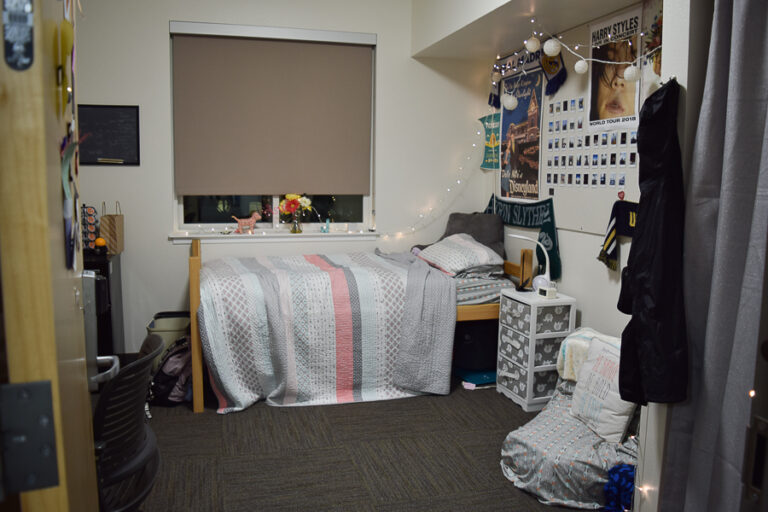
Certain students choose to live in single dorm rooms without roommates, still obtain the social college experience

Most students come back from class to find their dormmates, whether they are a friendly face or a mortal enemy. Some students, however, come home to silence, since they are the only ones living in the room.

When deciding whether incoming first-year students want to live in dorms, they have the option of choosing to live on their own in a single room or, more commonly, with roommates in a double or triple. Certain students decide to live on their own, despite the higher price and solitary aspect.

“I had a lot of friends who had roommates and had bad experiences with that, and I was looking for having my own space and avoiding that,” said Olivia Lasecke, a first-year neurobiology, physiology and behavior major, who lives in a single this year in Segundo.

Living alone gives students freedom to control their schedules and how they use the space in their room.

“You can make your own schedule,” said Carlo Safra, a first-year computer science major, who lives in a single in Tercero. “You don’t have to worry about waking up early and waking other people up or being cautious like that. Or you can stay up studying for as long as you want.”

According to Luisangel Sanchez, a first-year communication major and another single dorm resident in Tercero, he benefits from using his room for whatever he wants without needing to coordinate with his roommates.

“There’s nobody disturbing me from doing my homework,” Sanchez said. “I use this as a study place, a hanging out place, everything. Also as a benefit, I can call my friends over and I can do a movie night here, and I don’t have to ask anybody else for permission.”

Additionally, students living in single dorms get more freedom since they can move their furniture and decorate their spaces however they want, without having to get approval from roommates.

“I get to have control of how I have everything in here,” said Jack-Thomas Lee, a first-year undeclared major, who lives in a single dorm in Tercero. “I get to set up my own space.”

The single dorms are significantly smaller than the double and triple rooms since only one person lives in them. According to Lasecke, her room is about half the size of the double rooms in the building.

“When I came in here, I was like ‘aww it’s a little bit smaller than I thought it would be,’ but I still feel like it is big enough to move around and have all my friends come in and everything,” Sanchez said. “I feel like it’s perfect.”

Despite their smaller size, single rooms are more expensive per person, according to the UC Davis Student Housing and Services website. For the five-day meal plan, single rooms run at $16,221.59, and for the seven-day meal plan, they are $17,731.81. To compare, double rooms are $14,701.22 or $16,211.44 and triple rooms are $13,303.07 or $14,813.29 per person for the academic year.

“As long as it is financially viable for [a student], sure, do it,” Safra said.

To live in a single dorm, students must be good at being independent, according to Sanchez.

“If they need somebody to do everything with them, then don’t do it,” Sanchez said. “I can do everything by myself, but then I also like to have my group of friends.”

Similarly, Lee says he has to figure things out on his own instead of always relying on help from others.

“Sometimes, you don’t have someone to always talk to,” Lee said.

Lee recommends getting a single room if the student feels comfortable going out and making friends.

“Just make sure that you are not a shy person because then you aren’t going to enjoy it as much if you’re always locked in your room,” Lee said. “You might as well go around, be social, make friends, be able to put yourself out there, because if not, it is not as much fun.”

When Lee first moved into his room, he went around his hall and other floors in his building to make friends, he said. Living without roommates pushed him to meet new people.

“I was kind of worried it would affect my experience,” Lasecke said. “But I have so many friends in my buildings, it’s no different than having a roommate, no different experience. It is a little bit better. I have friends who have roommates and wish they had singles.”

Similarly, Safra feels he has not missed out on the social aspect of college by living in a single dorm. Lasecke disagrees with the stereotypes about single dorm students and their antisocial tendencies.

“I definitely think there is a stigma around having a single, and not having any friends, but that really has not been my experience,” Lasecke said. “It is really nice to get my own space to have my own time, [otherwise] you never get that time to be by yourself, and be yourself.”

Written by: Margo Rosenbaum — features@theaggie.org

Police Logs

Lost and Found

January 19

“Male customer inside the store taking pictures of other customers and saying that people are stalking him.”

“Sounds of toddler playing with phone.”

“Pile of brand new clothes with tags behind the enclosed dumpster area on the Planet Wash side of plot, unknown if stolen and dumped.”

“Dark-colored sedan driving erratically and at high speeds traveling westbound on Russell.”

January 20

“Reporting party claims someone put chemicals in her car and she can no longer drive it.”

January 21

“Male subject loitering between the side of the building and the front door bothering customers. Reporting party requested he be moved along.”

“Dogs barking for three days now on the side of the house.”

“Cardboard box full of empty whippit containers left in the middle of the parking lot.”

January 22

“Reporting party was charged and knocked down by a transient’s dog.”

“Long-haired white cat with a white collar lost in the area.”

January 23

“Reporting party heard noises inside resident and thinks he heard his roommates yelling.”

Governor’s proposed state budget increases funding for UC system, mental health initiatives

State budget has $36.4 billion allocated for UC, CSU, Community College systems

Newly-elected California Governor Gavin Newsom released his state budget proposal on Jan. 10, 2019. Within the $209 billion budget, $36.4 billion was allocated to higher education — with funds going to the UCs, CSUs and California Community Colleges. This marks a $1.4 billion increase from Jerry Brown’s previous budget, reflecting a 4.1 percent rise from the 2018-19 year.

Newsom hopes that this hike in funding across all of California’s higher education systems will allow for an overall increase in access to schooling, an improvement of graduation rates and a tuition freeze.

In the budget summary, Newsom clarified that $240 million would be set aside as an ongoing General Fund augmentation specifically for the UC to “fund operating costs, [make] efforts to increase student success, improve student mental health services, and better address student hunger and homelessness.”

An additional $138 million was allocated to serve as a one-time General Fund for the UC to assist with its “deferred maintenance backlog.”

Newsom is investing in the UC system with the expectation that tuition will be frozen at current levels and that graduation times will improve.

He also recognized a need for additional support for student-parents, creating supplemental awards for students in any higher-education institution in California who have dependent children, in an attempt to improve the affordability of college.

Lande Ajose, the chair of the California Student Aid Commision, praised Newsom in a press release for the education reform.

“The struggle to afford child care keeps many low-income Californians from attending and completing a higher education,” Ajose said. “By investing in additional grant aid for students with dependant children, Governor Newsom has proposed a path out of poverty.”

Within the outlined 2019 – 2020 budget, Newsom also designated $5.3 million for an ongoing General Fund specifically for mental health services within the UC system.

The supplementary funding is slated to go toward meeting recommended staffing ratios as well as improving services available to students. This show of support contrasts with former Governor Jerry Brown’s actions surrounding mental health initiatives. Brown vetoed a bill for mental health requirements last year over concerns related to budgeting allocations.

Last legislative session, State Senator Dr. Richard Pan proposed the bill (Senate Bill 968) which would have required all CSU and UC schools “to have one full-time equivalent mental health counselor per 1,500 students.” Pan spoke to The California Aggie in October about the bill after it was rejected.
“Lack of access to mental health services can have significant consequences on the students — everything from, on one end, trying to reduce suicide rate […] to unmet mental health needs leading students to drop out or delay their education,” Pan said. “We do know there’s a high percentage of students who do develop significant mental health challenges and that if they had access to treatment, they would be able to manage them and progress and address those.”
Pan is considering reintroducing SB 968, according to The Sacramento Bee. Newsom’s budget team also told The Bee that the UC has “yet to hire 15 more counselors and three psychiatrists,” and funds will be allocated to help the system finish the hiring that it committed to doing, although student enrollment is now outpacing the UC’s projections for its five-year hiring plans.

While Newsom’s proposed budget for higher education may seem like a significant increase over last year’s, not everyone is happy with it, according to the Los Angeles Times. The LA Times reporting suggested that Newsom’s proposal was disappointing to the UC Regents, given that they requested an increase of $447.6 million and were only granted $240 million.

Others have expressed hope for what this funding may look like for the UC system. Assemblymember Cecilia Aguiar-Curry, a representative for District 4 which encompasses UC Davis, commended Newsom’s efforts in an email sent to The California Aggie.

“I applaud Governor Newsom for reaching even further toward the accessibility goal and for his sensitivity to the fact that we are graduating a generation of students with an increasingly crushing burden of debt before they even contemplate their working lives,” Aguiar-Curry said. “We should not give up on the dream of removing all financial AND non-financial barriers to post-secondary education.”

Additionally, some UC officials have expressed their gratitude for the “substantial investment” in higher education in a statement distributed immediately after Newsom’s budget plan was released.

“We are pleased the governor has affirmed his commitment to not only the university, but also the students and families across California who rely on adequate state investment in the outstanding education at UC,” said the UC Board of Regents Chair George Kieffer and UC President Janet Napolitano in an email. “Gov. Newsom’s budget represents a welcome step and a solid down payment in addressing priorities of the university’s 2019-20 budget plan.”

Written By: CLAIRE DODD and JOHN REGIDOR — campus@theaggie.org

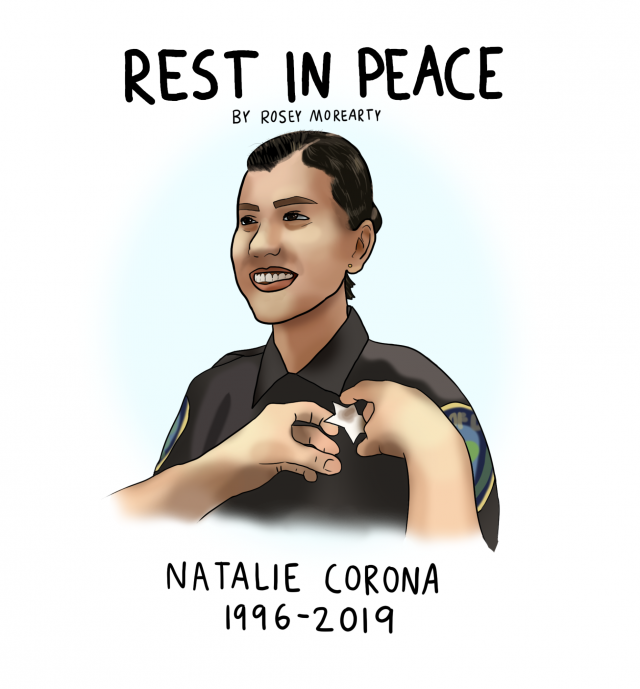
Cartoon: Rest In Peace

ROSEY MOREARTY / AGGIE

By: Rosey Morearty — rosey@morearty.org

Yolo Community Foundation provides more opportunities for youth

Center for Land-Based Learning, other organizations receive grants

Nine Yolo County programs received grants to help with youth education. Through the Buck Education Grant program, which is part of the Yolo Community Foundation, the dispersed amount totaled $73,000.

Meg Stallard, the president of the board of the Yolo Community Foundation, noted how the organization prides itself in being able to help others, such as youth, with their grants.

“The Yolo Community Foundation is delighted to be able to continue to make these grants to support our youth and the organizations that work with them,” Stallard said to The Davis Enterprise. “We look forward to seeing impacts from these innovative programs throughout the county.”

Babs Sandeen, the executive director of the Yolo Community Foundation, mentioned that the Buck Education Grant program allowed a large investment in a broad range of education programs.

“The Frank H. and Eva Buck Foundation provided the Yolo Community Foundation with over a quarter million dollars in 2016 and 2017 and gave it for the Yolo Community Foundation to share with the Yolo Community on education programs,” Sandeen said via email. “The Yolo Community Foundation has focused these grants of up to $10,000 each on Science, Technology, Engineering, Art and Math (or STEAM) programs, as well as programs that support and enhance parent engagement and literacy.”

One of the organizations that received a grant was the Center for Land-Based Learning. Christine McMorrow, the director of development and communications at the center, elaborated on the organization.

“The Center for Land-Based Learning started 25 years ago,” McMorrow said. “Our founder, Craig McNamara, started the farm leadership program out of the concern for what he saw — that high school students did not have enough opportunities to connect to the land and more specifically farmers. He decided to start a program where students from cities can get onto working farms and ranches to learn more about agriculture.”

The grant provides assets for The Student Landowner Education and Watershed Stewardship program, where students will be able to work on agricultural land and gain experience.

“That grant will be used for a specific project that we call SLEWS,” McMorrow said. “It’s a class of high school students and their teacher, where they visit a project site usually on private property and working agricultural land. Specifically, they are planting native plants to increase the habitat of bird populations and biodiversity populations. Students will also build and install bird nesting boxes.”

McMorrow also indicated that the students’ activities will help them gain more knowledge and practicality.

“Students come out three to four times onto these projects, and they learn about the native plants, how to plant them and they install irrigation if needed — they will also install bird boxes,” McMorrow said. “They’re gaining a lot of practical skills.”

Furthermore, the students will have access to mentors to help them with their own ambitions.

“Each classroom has a group of mentors — many of them are community members or ex-teachers or grad students — and they work with the students,” McMorrow said. “They answer questions about careers and they build support.”

Sandeen noted that the Yolo Community Foundation hopes to provide more grants to organizations like the Center for Land-Based Learning to empower youth.

“The Yolo Community Foundation has previously given out mini-grants to teachers in Yolo County and, with the funding provided by the Frank H and Eva Buck Foundation, there was an opportunity to provide larger grants that could really make a difference in the community,” Sandeen said. “We are excited by the first two rounds and look forward to giving out our final two rounds of funding in the coming year. The process is incredibly competitive, and it is heartening to see the kind of projects being contemplated in the county for Yolo County youth.”

Written by: Stella Tran — city@theaggie.org

Unprecedented Platforms: A Flux in Music Acquisition

Streaming outlets provide musicians with means for true recognition

Last year was good for the hip-hop supergroup Migos. Their most recent album, “Culture II,” debuted at No.1 on the Billboard 200, while 13 songs from the album charted Billboard’s Hot 100. “I Get the Bag” by Gucci Mane, which features Migos, also charted, giving them 14 appearances on the Top 100 chart. To put this into perspective, the last time a feat like this was accomplished was in 1964, when The Beatles became the first musicians to have 14 of their songs featured on a Top 100 chart.

There have been other solo artists to match this level of popularity (give it up for Post Malone), but for a group of musicians The Beatles and Migos have been the only two. This speaks volumes about the popularity of rap music in the new era as well as the means to become a chart topper in the age of streaming music.  

Quavo, Offset and Takeoff, the members of the trio and close relatives from Lawrenceville, Georgia, have been making nothing but money moves from the get-go. Honing in on their rap potential and aesthetic flare, Polo Club (the name they went by originally) started filling Atlanta nightclubs in pre-2010. Now their arena shows sell out regularly.

In their decade of activity, the rappers have seen many changes in the music industry. The means by which their music is heard has changed dramatically, as they are receiving copious amounts of attention due to the ability to stream their music in an instant. Unlike the old days, when passing out CDs and hoping for radio plays were the way to get recognized, these musicians can now watch their numbers grow by the millions on any given streaming outlet, sit back and collect the check.

This universal shift in how music is acquired began with the earliest efforts to stream in 2003, via Apple’s iTunes. Flashforward to 2019, and there are upwards of 200 million music streaming subscribers worldwide. Hard copy sales are down, while streaming is way up. However, for the sake of nostalgia, there remains a hot surge in vinyl sales. Other than that, CDs and tapes are near extinction.

Migos has first-hand experience with this transition in music acquisition. At the start of their career, they were passing out CDs on the street and buying drinks for DJs in exchange for playing one of their songs in the club. Since those days and the switch to streaming devices, Migos have enjoyed a deal with Spotify that allows their music to be streamed instantaneously with every new release. Not to mention the countless services (Apple Music, Soundcloud, Youtube, etc.) which offer their music free of charge.

Despite streaming capabilities, Migos’ most recent album went double platinum, selling 2 million certified units. It would not be wrong to expect the same for their upcoming album, “Culture III,” in which there is rumored to be over 50 songs, full of features and full of fire.  

It’s hard to imagine where Migos would be today without Spotify, but to entertain such an idea is to imagine a world without streaming altogether. An easier concept to wrap one’s head around is where The Beatles would be today without the following outlets. On Spotify, The Beatles sit at No.108 on the world’s most streamed artists charts and the last song they released was in 1969. Think of where the Migos are right now, andimagine where they’ll be in the next fifty years — probably somewhere still on that chart.

In light of the endless ways to stream and promote music online, the approach that Migos once took to be recognized may seem a bit old school. Now, take a walk down Hollywood Boulevard and rappers are no longer passing out their mixtapes, but instead business cards with links to their Soundcloud or Spotify pages. This allows them to easily rack up more followers and their followers don’t feel bad when they can’t slide them a 5 dollar bill for their CD.

In the age of dreamers, a career in music no longer seems so unattainable, especially with rappers like Skepta, Noname and Chance the Rapper who have had the ability to release music and make money doing it, all without signing any kind of record deal. Before, a career in music would’ve required the traditional record deal route, which is now far from the case.

The implications of streaming for future artists is unprecedented. Anybody can break into the industry and amass a fan base regardless of the style of music they release. Datpiff.com, a website that solely offers free mixtapes, has an incentive for artists, who can pay 50 dollars for a sponsorship and their mixtape will sit on the front page of their website for a number of days, depending on its popularity.

This new wave of rap does not sit well with everybody though, especially the rap elders. Migos, along with Future, have pioneered “mumble rap,” and inspired tens of dozens of artists.

Mumble rap has connotations that there is a lack of lyrical ingenuity in comparison to classic rap. How, then, can rappers with such negative connotations reach the level of stardom once only attainable by those who walked the Abbey Road?

One explanation, is that times have changed. More important than a hyperspeed flow is having a group to vibe with; more important than a lyrical novella is a taste of the culture. It’s not that expectations have lowered to where listeners are more concerned with 808s knocking their hearts rather than a rapper’s message, but instead, what’s more important now is the culture associated with “mumble rap.” The story is there, no matter the song, no matter the musician.

Another explanation: the means of acquisition for this music is much easier than that of the 1960s. A song can be uploaded to Soundcloud, and in the blink of an eye, the next day it could be a hit. That being said, anybody with a flicker of flame inside them can accomplish the same feat as the Migos or The Beatles. The tools to get there are readily available and the inspiration to use them are in the air.

A final theory: people love triplets. No, not three related rappers dressed in Versace, but the unique rap flow that happens when three syllables are rapped over one beat. Although the triplet is often referred to as the “Migos flow” its roots can be traced back to Tommy Wright III and Mac Dre. To hear the triplets in effect, load up the Migos song, “Versace,” (or almost any of their songs) and listen to the chorus. Rap fan or not, the triplet is catchier than it may seem.

But on the topic of mumble rap, Migos were sure to level the playing field in their last album, where they sing in the chorus of their song, “Narcos,” “Straight out the jungle / This real rap, no mumble.” And right they are, for there is no such thing as the derogatory “mumble rap,” only rap, only music and its evolution to a brighter generation.

Written By: Clay Allen Rogers — arts@theaggie.org

Humor: Davis Bike Blammer spotted targeting Jump Bikes in latest attacks

He’s back, maybe for good

Last year, The California Aggie issued a report on the dirty deeds of the now-infamous Davis Bike Blammer. After a manhunt with no resolution and a large number of minor injuries and emotional scars, the Davis Bike Blammer disappeared seemingly permanently.

That is, until today.

Several bike accident reports from TAPS this week identify a perpetrator yelling “BLAM!” as loud as humanly possible before kicking students off their Jump Bikes and scurrying away. He has been described as a “bearded white male, 6’2” with shaggy, brown curls and wearing glasses, Vans and a distinctive green ski jacket barely covering his English major ‘It’s Lit!’ T-shirt.” Jump Bikes have been a popular alternative for students who wish to get between home and campus without owning a bike themselves. To the Davis Bike Blammer, apparently, this simply will not do.

“It was 4:34 p.m. on a Wednesday,” said third-year The Student Formerly Known as Sally Wakeman (TSFKSW). “I woke up late that day, so I didn’t have time to make it to the bus. Since I needed to get to my statistics midterm, my only option was a Jump Bike. So I’m pedaling and pumping as fast as those red, plastic masses can go when this bloodcurdling ‘BLAM!’ hits me just before the foot does. When I wake up, I’m in the hospital, the red frame wrapped around me like a plastic coffin. It took them two days to pry it off of me. But what they’ll never be able to pry away are the night terrors and phantom ‘blams’ that I hear every time I see one of those bikes.”

Based on other witness testimonies similar to TSFKSW’s, it is not only clear that the Davis Bike Blammer is responsible for these targeted attacks, but also that he is still at large. Many witnesses also surmise that he may be using the campus sewage system to escape arrest, citing the sound of a manhole being uncovered, then recovered after a crash occurs. Other than this new tidbit of a lead, evidence is thin and answers are few.

“The Blammer’s back,” said ex-Chief of Bike Division Police-turned-vigilante, Guy Sogud. Sogud turned to his own sense of justice after the Davis Police Bike Division called his extreme methods of investigating the Bike Blammer “unorthodox, inhumane and frankly, unnecessary on every level.”

“I’ll hunt him down until the day I die if I have to,” Sogud continued. “Whether this is a copycat taking up the mantle or the same Blammer from before, his days of ‘blamming’ folks are numbered. And when I catch him, I’m gonna rub it in the faces of those motherblammers in the Davis Police force. The last thing that bastard will hear from me is ‘Tim Tam Kablam’ before I slam him and jam him into the ground.”

Written by: Conner Shaw — cjshaw@ucdavis.edu

(This article is humor and/or satire, and its content is purely fictional. The story and the names of “sources” are fictionalized.)

TOMS works to create better tomorrow

Philanthropic company turns focus to gun violence

In a capitalist society, it’s easy to grow cynical about corporate greed and depravity. Some businesses, however, have molded their brands to manipulate capitalism for the greater good. Corporate responsibility is an increasingly important factor for these multimillion dollar conglomerates. In a movement toward corporate benefaction and activism, one simple shoe company has taken the torch to incite real change in the world.

For-profit retail company TOMS began with a simple idea to help those in need and has grown and expanded to benefit the lives of millions of people. The brand was originally founded on the idea of creating a better tomorrow. The name TOMS is based on the word tomorrow. In 2006, founder Blake Mycoskie was on a trip to Argentina and noticed local polo players wearing alpargatas, a type of shoe native to Argentina. Mycoskie also saw many children in impoverished areas of the country who didn’t have any shoes at all. Recognizing a problem in the world, the young entrepreneur set out to fix it.

The original concept was simple: Mycoskie wanted to develop and sell a similar type of alpargata shoe for the North American market, while also donating shoes to impoverished countries. The company follows a “one-for-one” business model, so with every purchase of their shoes, TOMS donates a pair to someone in need. They currently donate to several countries including Argentina, Ethiopia, Mexico, Rwanda and South Africa.

The shoes were massively popular when they were released. Along with the comfortable and unique style, people also respected the business model and enjoyed the fact that they could become benefactors for the company with a simple purchase.

Caitlyn Liu, a second-year English major, was a huge fan of the shoes when they first came out.

“I had a pair in middle school and I loved them,” Liu said. “Their brand was a casual wardrobe staple and I loved how they gave one pair of shoes away for every pair bought.”

Since its founding, the company has expanded its merchandise to clothing, handbags, coffee and eyewear. While still following the “one-for-one” model, each type of apparel has a certain cause to which TOMS donates. For example, in 2014, TOMS Roasting Co. partnered with different organizations to give a week’s supply of clean water to a person in need with every purchase of their coffee products. For their sunglasses, the company donates funds toward medical treatment of eye diseases and the distribution of seeing glasses in impoverished countries.

First-year biological sciences major Lana Alamamreh respects the “one-for-one” business model, both morally and from a commercial perspective.

“From a business point of view, it would probably be very beneficial because it would encourage more people to buy from their products,” Alamamreh said.

Along with making donations for every purchase, Mycoskie and the company also invest in for-profit entrepreneurial businesses that seek to give back to the community.

For example, the company invested in a Boston startup called ArtLifting. This organization sells artwork by homeless and disabled artists in galleries and helps employ the artists as well. Mycoskie also mentors young entrepreneurs and encourages their ideas if he believes they will spark change in the world.

While TOMS has been lauded for its philanthropic efforts and donations, it has also received criticism: some argued that the only way to truly help those in need is to create jobs within their country that allow people to support themselves. Mycoskie listened and changed his business model accordingly.

In an interview with Lewis Howes, Mycoskie explained how he worked to fix this issue. He told Howes that he made a promise in 2013 that “by 2016 [the company] would create 25% of all TOMS giving shoes in the countries [they] give them in.” The company not only accomplished that goal, but ended up increasing it to 50 percent of their business.

While morality and philanthropy has been at the company’s core from its founding, Mycoskie took the idea of being a corporate leader to the next level in 2017 when an event triggered him to look internally into the issues plaguing America.

Last year on Nov. 7, a horrific mass shooting took place in Thousand Oaks, Calif. There were 12 victims and the entire nation felt the effect of their loss.

This was not an isolated incident, either. There were over 300 mass shootings in America in 2018 alone. Mycoskie told Howes that news about shootings is becoming a natural part of life in this country. However, news of such a horrific event happening so close to his home in Los Angeles was the tipping point for him.

Mycoskie spent three days convincing his team and executive board to speak out on the issue of gun violence and begin campaigning to end it. The company then went public with their new mission. Mycoskie appeared on “Late Night with Jimmy Fallon” and discussed what he and the TOMS brand were going to do to fight for change.

TOMS made a donation of $5 million to organizations that fight to end gun violence, including March for Our Lives, Everytown for Gun Safety and Moms Demand Action. This was the largest corporate donation to this cause in the country’s history.

The company then set up a postcard writing system on their website that allows people to send postcards to their local congresspeople, asking for universal background checks on all purchases of firearms. It takes less than 30-seconds to fill out a online postcard. The program debuted on the homepage of the TOMS website just days before Black Friday and Cyber Monday, but Mycoskie claimed he was willing to lose sales in order to make a difference.

Over 700,000 postcards have been collected already. On Jan. 8, House Democrats introduced HR #8, which would further regulate background checks for any purchase of firearms, such as those sold at gun shows.

Recently, TOMS arranged “The End Gun Violence Together Tour,” an event to rally around the bill for universal background checks. TOMS and their partners will hold community events and reach out to those affected by gun violence. The tour will travel across the country and end in Washington D.C., where the company will deliver the postcards they have collected directly to Congress. They will also host a rally in Washington on Feb. 5.

Second-year English and communication major Matthew Pimley thinks that the brand has a model by which all other companies will be influenced.

“I’m proud of TOMS for stepping up and supporting a good cause,” Pimley said. “They are an excellent example to other companies. It is my hope that other companies who follow in these steps will also educate themselves and offer support to those who truly need it.”

Written by: Alyssa Ilsley — arts@theaggie.org

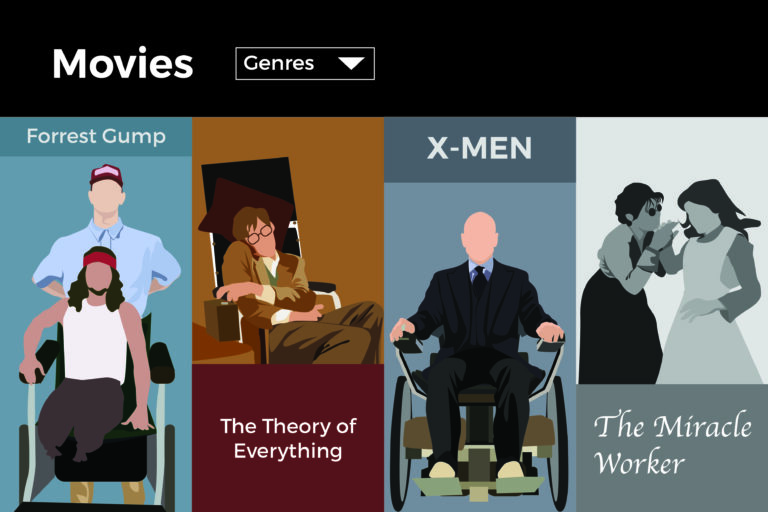
To watch or not to watch “Glass”

How movies like “Split,” “Glass: can be damaging to people with disabilities

Movies are meant to entertain. Some make the audience cry, some make the audience laugh, but for the most part, people watch movies to enjoy themselves.

“Glass,” the third installment in M. Night Shyamalan’s “Unbreakable” trilogy, introduced a different genre of villains and follows the popular 2016 movie “Split.” “Split,” directed by Shyamalan, focuses on Kevin, played by James McCoy, as he kidnaps three girls and switches between his personalities, each posing a different scenario that the girls have to survive. While the girls do their best to stay alive, they learn that the personality they need to be wary of is the Beast. The Beast is an alleged superhuman being that will murder anyone that is ‘undamaged.’ Kevin, the villain, is diagnosed with dissociative identity disorder.

Director Shyamalan confessed that he has always had a fascination with dissociative identity disorder, according to The Guardian. And seeing how “Split’s” opening weekend brought in 40 million dollars, the public is obviously fascinated with the idea as well.

But when movies like “Split” and “Glass” are produced and their villain is a person with a disorder, it can affect people with these disorders in real life.

Milly Judd, a senior animal science major and co-director of the Mental Health Initiative, addressed the impact that these movies can have on those within the communities they are misrepresenting.

“You could be triggered because it’s inaccurately representing you,” Judd said. “Also if other people know you [have a mental disorder] … and then someone you know sees that movie, they’re going to think differently about you and that’s so unfair.”

Jennifer Billeci, director of the Student Disability Center, shared her thoughts on how difficult the situation can be for an individual with this disorder.

“I think it would be a really hard position to be in,” Billeci said. “In general, I would liken it to bullying. If you’re a person that is afraid that someone is going to think things about you that are negative or intrude you are probably less likely to be open with them and communicating freely.”

Many people learn about mental illness through the media. Mainstream media, however, has an undeniable reputation of stretching the truth, and when people with disabilities are represented in extreme circumstances, it’s no different.

“Culturally sometimes when people think of other people’s disabilities they think of them as being so different that sometimes they assign all kinds of personality traits that are no more true in a disabled community than as non-disabled people and sometimes it’s being a villain,” Billeci said.

Despite the number of movies that misrepresent people with mental illnesses, there are movies that are applauded for the way they deal with the subject.

“There are some movies like ‘Silver Linings Playbook’ that deal with it well,” Judd said. “I think we are getting better at it but I think that there are still the small amount that villainize it.”

The movie “Split” depicts dissociative identity disorder as a disorder that is potentially  dangerous and harmful to others. The stereotype that people with disorders are violent and have criminal tendencies is ultimately spread through movies like “Glass” and “Split”, but people with mental illnesses such as dissociative identity disorder are less likely to commit crimes and more likely to be victimized, according to U.S.News.

“They can compound misconceptions and misunderstandings when you paint the villain as somebody with a psychological disability or psychiatric diagnosis,” Billeci said. “When the reality is that people with a psychiatric diagnosis are not any more likely than anybody else in the population to display criminal behavior or things along those lines.”

The media is a powerful tool in spreading information, or in this case misinformation. While movies continue to be released based off of people with real disabilities, more individuals are misinformed.

“Movies are a great financial industry,” Billeci said. “When audiences go and applaud those types of messaging that it keeps the motivation going to have storylines along those kinds of thoughts and people are curious people so if you don’t know somebody with mental illness you might find this fascinating, but you might start taking some of the fantasy of the movie as being fact. Then that can be destructive too.”

With the right background knowledge and a deep understanding of the disabilities, movies and television can help people see beyond the stereotypes that have been forced onto others and give them the rights that they deserve, according to the United Nations.

“Things are more known about mental health illnesses” Judd said. “And so if you’re making something that kind of makes it in a bad way, makes fun of it, makes it seem unnatural, anything like that, it might not be consciously intentional but subconsciously it might be because they don’t accept it.”

Individuals with disabilities are not the only group dealing with being portrayed as villains by the media. The media loves to paint people that are different as the antagonists, and it hasn’t been any different with marginalized groups in the past.

“If you look back at history we portray groups in an unfair and an unfavorable light and as society, I would hope, becomes more enlightened is reduced,” Billeci said. “If you look back at how women were treated in movies, people of color were treated in movies, which still happens but not the same way culturally we found acceptable a few decades ago.”

People should take away several things as they leave the theater.

“Keep in mind, not everything you see on the surface is what is really happening and not everything appears as it is to be,” Judd said. “You shouldn’t judge by their inaccurate representations and if you do identify with [the disorders] then just know that that’s not real and you’re not alone and you’re not this weird outsider, villain outcast kind of thing.”

Written by: Itzelth Gamboa — arts@theaggie.org