48.7 F
Davis

Davis, California

Saturday, December 27, 2025
Home Blog Page 534

Student protesters deserve genuine university support

CAITLYN SAMPLEY / AGGIE

Students face disciplinary hearings following Mrak sit-in

For over a month in 2016, students occupied Mrak Hall to protest then-Chancellor Linda P.B. Katehi. It was intrusive, it was vocal and, most importantly, it was effective.

Students occupied Mrak again in January of this year, this time in protest of proposed tuition hikes throughout the University of California. It, too, effected change, but in a response initiated by the UC Davis administration, students from the second protest are now facing disciplinary action due to a violation of campus policies — namely, the occupation of a university building after regular business hours.

It stands to reason that the administration didn’t seriously reprimand students during the 2016 Katehi protests. An administrative response during such a high-profile case could cause irreparable damage to the university’s image if the public viewed it in a negative light. Now, when faced with a protest that hasn’t had as much media attention, the administration has begun to enforce the campus policies it overlooked during 2016.

To decide when to enforce campus regulations based on the national attention of a particular event is deceptive at best. The administration cannot decide to enforce the rules based on the possibility of public backlash. This action by the university to reprimand student protesters seems an unfair leveraging of administrative power over the student body. The administration wouldn’t be here if not for the students, and must support these peaceful protests, regardless of the situation.

Protests don’t just happen on a whim. They happen when people have their backs against the wall, when people fear for their safety or worth as an individual. Protests happen when other forms of diplomacy have failed.

The administration has affirmed its support for student protest and, in large part, that is likely true. But to say the administration supports student protesters while it steps in during peaceful sit-ins is to qualify the administration’s support for students on the basis of convenience.

The Editorial Board calls for a swift revision of the campus guidelines regarding explicit restrictions placed on peaceful sit-ins. Members of ASUCD must also use their collective voices as elected student representatives to support students in their various forms of opposition.

The point of a protest is to make people uncomfortable. If it was convenient for all parties involved, nothing would ever change. The students of UC Davis deserve better than an administration that uses its authority to stifle student expression.

Student protesters already sacrifice class attendance, sleep, public scrutiny and more. To threaten them with disciplinary action is to deprive them of the power they have as students. It’s unbecoming of UC Davis and mustn’t be allowed to continue.


Written by: The Editorial Board 

How one bacterium could fight mosquito-borne diseases

DAVID CLANCY / COURTESY

Certain wolbachia strains could spread rapidly through mosquito populations, block transmittance of viruses to humans, UC Davis study shows

Wolbachia, a parasitic microbe found in up to two-thirds of insects, was discovered only a few decades ago and is not fully understood. A new study from UC Davis analyzed the interspecific spread of Wolbachia across different species of fruit flies. The bacteria’s ability to select for infected offspring and provide immune benefits to its host allows it to spread rapidly throughout populations.

“Wolbachia don’t necessarily spread through increasing relative fitness of their hosts, rather they interfere with reproductive abilities,” said Kevin Kim, an undergraduate biochemistry major and co-author of the study, in an email. “During host reproduction, wolbachia are transmitted via the mother to their offspring, so male-killing Wolbachia increase the rate of production of infected females, which can go on to produce infected offspring. Similarly, [cytoplasmic incompatibility] prevents uninfected females from producing their ‘maximum’ number of offspring — except in cases where both parents are uninfected — and thus promotes the spread of wolbachia.”

In this study, Michael Turelli, a professor of evolution and ecology at UC Davis, and his associates looked at the similarities between Wolbachia strains in eight different types of drosophila, or fruit flies, to determine how the infections spread between species, rather than through them.
“Our results demonstrate that certain Wolbachia strains rapidly spread horizontally between divergent species, suggesting these strains have evolved mechanisms to efficiently establish in new host lineages,” said Brandon Cooper, an assistant professor of cell, molecular, and microbial biology at the University of Montana, in an email interview.

Wolbachia can spread to a new host three different ways: inheritance by sister species during speciation, hybridization and introgression from a closely related species or horizontal transmission.

The frequency of these methods are unknown, however. According to Turelli et. al, hybridization is common during speciation, and introgression often occurs, but horizontal transmission cannot be determined or excluded. It is possible that vectors such as parasitoids or mites aid intraspecies transfer.

Over a hundred wolbachia infections found in the eight drosophila species studied suggest that many wolbachia infections are young, and may replace each other in hosts. These strains are similar to a strain of Wolbachia called wRi which is called a “super spreader.” They jump between species more easily than other strains, although the method is again indeterminate.  

“Of course if you have a strain that jumps species barriers, that means it’s going to be pretty easy to potentially introduce into new species,” said Ary Hoffmann, a professor at the University of Melbourne. “Some wolbachia strains are probably very good at jumping species, some wolbachia strains are probably not. They might just stay with one species for a few million years.”

The ability of a strain to jump to another species is highly relevant to Wolbachia research, as introducing Wolbachia to new hosts will help block the spread of viruses. Currently, various projects such as the World Mosquito Program are introducing Wolbachia into mosquitoes in laboratories and releasing them into the wild. If the bacteria is compatible with its new host, then the host has an advantage over uninfected mosquitoes, and will spread Wolbachia throughout the population. This will lower the rate of mosquito-borne diseases. Programs like these target diseases such as West Nile virus, yellow fever, and malaria, among many others, which are dangerous to people across the world. The more effective Wolbachia may be in transferring to disease-carrying mosquitoes, the more effective these measures may be.


Written by: Kira Burnett — science@theaggie.org


Aggies bounce back in in conference play, come out on top in close match

KAILA MATTERA / AGGIE

Women’s water polo setting tone for conference play

The stands were nearly full at the Schaal Aquatic Center as water polo fans watched the UC Davis women’s water polo team edge out a tough number 7 UC Irvine, 9-8 on April 7 in a measure-for-measure exchange. Neither team was able to extend its lead by more than one in this matchup. The Aggies now have a 17-8 overall record and are 2-1 in Big West Conference play.

The victory over the Anteaters followed a tough road loss to a number 5-ranked Hawai’i exactly one week before, 12-7.

“We had a good week of practice,” head coach Jamey Wright said of the team’s preparation. “Irvine is always good, last time we played them they [beat] us here at conference a year ago.”

Wright noted the required effort of the team because of the exclusions early on in the game.

“The vibe of the team is strong, their work ethic is amazing and everyone is contributing,” Wright said. “In this game there was exclusion, exclusion, exclusion and people had to come in that usually don’t come in right away.”

Senior center Greta Kohlmoos lead the Aggies in scoring with three goals, making this her second straight game with a hat-trick.

Sophomore attacker Kathleen Schafle took nine total shots on goal and scored twice, stole the ball twice and had one assist.

Sophomore goalkeeper Caitlin Golding had a total of 12 saves and three steals.

Junior utility Annie Kutt was the first Aggie to put points on the board in the first quarter at 6:56, but the Anteaters’ Corrida Toledo answered back about a minute later.

The teams then both played at a fairly even tempo and exchanged goals at an even rate, ending up tied with three goals apiece at the end of the first period.

It took a while for both teams to find their groove in the second period. The Anteaters scored first at even strength in the second period after over half of the second period elapsed at 3:50, making it 4-3 in favor of the Anteaters.

Kohlmoos answered with an even-strength goal on a breakaway to tie it up at four with 2:57 to go. But then the Anteaters managed to get in front of the Aggie defense and take the lead 5-4, with 1:07 left in the second period.

With nearly a minute to go before the first half expired, Wright decided to put Kohlmoos back in. Wright’s instinct was correct, as Kohlmoos scored an even-strength goal with 39 seconds left to tie it up at five, earning herself a hat trick.

“It felt really good,” Kohlmoos said. “But it would have not been possible if my teammates hadn’t been working their butts off and making sure those opportunities were there, it felt good because the teamwork was just great today.”

It seemed the first half would end in a tie, but the Anteaters’ Toledo fouled an Aggie with 12 seconds to go in the red-zone. This gave Schlafe a penalty shot, which she skipped into the left corner and gave the Aggies the lead going into the second half of play.

The Anteaters set up scoring chances that were broken up by the Aggies’ concerted effort on defense toward the center.

“Today our teamwork was amazing — our communication on defense,” Kohlmoos said. “And not letting their center get shots off, and working hard to foul and drop back”

Irvine started out the second half quick with a goal on a power-play to tie it up at six, and the Anteaters followed it up at 5:05 with a go-ahead goal, putting the Aggies behind 7-6.

The following Aggie possession had Schlafe nearly losing the ball, which she narrowly recovered as the shot clock ticked. Kutt eventually fired from a distance, only to have her shot blocked before reaching the five-meter mark.

Junior utility Emily Byrne then put the team’s efforts back on track with her first goal of the game at 4:21.

After the teams traded possessions, senior utility Carla Tochinni gave the Aggies the go-ahead goal with 2:58 to go in the third, 8-7. This was the last goal of the third period.

In the fourth period, the Anteaters tied it up, 8-8 with 4:38 to go in regulation. After managing to break up a play at the center, the Anteaters swam down and fired a shot. Golding tipped the ball, preserving the tie.

Wright noted one of the keys to victory was making sure the Anteaters couldn’t score easily.

“When you keep a team with that many weapons to eight goals, it’s pretty fantastic,” Wright said.

With 2:41 left to go in regulation, Wright called a timeout to strategize with the women.

When play started again, sophomore goalkeeper Caitlin Golding scanned the pool for openings and possible holes in the defense, and then passed it to Schafle.

Schafle fired left and found a narrow part of the goal near the bottom in what would be  the game-winning goal, leaving 2:28 on the clock in the fourth quarter.

This play, according to Wright, was added to the women’s arsenal only two days before the game.

“She’s such a good shooter,” Wright said. “You have got to find ways to get her the ball, and that worked out pretty good.”

From that point on, the Aggies switched to a defensive posture to prevent quick Anteater shots on goal.

The women will travel to southern California to play CSU Northridge on April 14 and UC Santa Barbara on April 15.

“From here, it can only go up,” Koohlmos said. “This win is going to really boost our confidence. We’re going to go in really hard against CSUN and UC Santa Barbara. We’re not going to accept a loss, we’re going to keep pushing through.”


Written by: Bobby John — sports@theaggie.org

Aggies defeated by Gauchos in weekend series

NICHOLAS CHAN / AGGIE

Softball team loses 2-1 in weekend series against UC Santa Barbara Gauchos

On a sunny day with the stands packed at La Rue Field in Davis on April 8, the UC Davis softball team was defeated by the UC Santa Barbara Gauchos 4-0 in the third game of play of the weekend. Going into the weekend series, the Aggies possessed a 20-12 overall record and a 2-1 conference record. The Gauchos were 13-23 overall and 0-3 in conference play coming into the series.

A first game 2-0 win the previous day and a second game 2-1 loss for the Aggies tied the weekend series, and with just 30 minutes to prepare for the second game of the day and the final of the series, UC Davis was trying to notch that second win.

In the first game of the series that took place on April 7, the Aggies showed big bats at the plate. Freshman catcher Riley Siegel and sophomore second baseman Isabella Leon knocked the ball over the fence in the third and the sixth innings, respectively. Sophomore starting pitcher Katie Kibby shut down the Gauchos, pitching a full seven-inning game shutout, earning her eighth win of the season and bringing her earned run average to an impressive 2.00 to give UC Davis the 2-0 win.

The second game of the series the next morning showed a different outcome for the Aggies. On RBI singles in the third and the fifth innings, the Gauchos put two runs on the board. Sophomore right fielder Frankie Mendoza earned a groundout RBI to put the Aggies on the board, but the team was not able to string together a hit with a runner on third base in the bottom of the seventh, giving the Aggies the 2-1 loss.

In the first inning of the last game of the weekend, two quick hits for UCSB look troubling for starting pitcher Kibby. However, her ability to paint the corners of the strike zone with the ball is not only difficult for a pitcher to do, but allowed for the next two batters to be out and end the inning tied at zero.

The top of the third inning proved tough for the Aggies, as the Gauchos were able to string together four hits, and drive in three runs, having UC Davis trail 3-0 going into the bottom of the inning. In the top of fourth inning, the Aggies continued to struggle, as UCSB loaded the bases and drove in another run to increase the lead to 4-0. Freshman relief pitcher Brooke Yanez came into the game for UC Davis with the bases loaded and one out on the board after the Gauchos scored, striking out one batter and making another batter hit a fly ball out to end the inning.

Following the fourth inning, the rest of the game was stagnant for both teams, as the Aggies and the Gauchos both left runners on base throughout the remainder of the game, but couldn’t notch the hits for them to cross the plate, giving UC Davis the 4-0 loss.

“It was a rough day,” said head coach Erin Thorpe. “It was just one of those days where you keep trying to push through and it doesn’t come through for you but everyone in conference is so tough and we just weren’t able to push any [runs] across.”

The Aggies are now 3-3 in conference play and 21-14 overall. UC Davis continues conference play away against Cal Poly on April 14.

“I think that we just need to continue to gain confidence in ourselves,” Thorpe said. “We [the team] are so young and still have some pretty inconsistent performances along the way. We have some key players that are injured and some other girls that we are giving opportunities to step up, so it is just them kind of feeling it out and gaining confidence in themselves.”


Written by: Ryan Bugsch — sports@theaggie.org

Studio 301 to produce “Swimmers”

RYAN GERBERDING / COURTESY

Student-run group shares love of theater in new show

Theater is often visualized thick with grandeur, the large lights and long coattails of Broadway. Such an art isn’t restricted to vast stages, though, and can also be performed under humbler roofs. The work of UC Davis’ Studio 301 is a perfect example of said simpler, yet equally moving theater.

“Swimmers,” Studio 301’s upcoming production, exemplifies a more bare-bones style of theater. It’s an organization looking to create genuine and entertaining shows. Ryan Gerberding, the director of “Swimmers” and a fourth-year theater and dance major, explained Studio 301 as a student club.

“We’re an undergraduate-run theater club,” Gerberding said. “Every show is directed, acted and teched by all undergraduates. Every quarter we either do a professional show, like a published show, like ‘Swimmers’ […] or we do some other sort of performance, like last quarter we did a musical revue.”

Daniel Hollar, a fifth-year political science major and actor in “Swimmers,” mentioned that while Studio 301 may be a theater organization, it brings in a wide swatch of individuals sharing a common hobby.

“It’s a bunch of incredibly talented people from all different majors and walks of life,” Hollar said. “It’s a great club and I enjoy the people.”  

Such a small student-run organization faces an issue that parallels many students: funding. A production is not solely actors and a script, but also a set, props and costumes. Members of “Swimmers” hinted at some of the extra work required to see their play into a production.

Caitlyn Sampley, the show’s stage manager and a second-year cinema and digital media and theater and dance double major, joked about holding parts of the set in her car and elaborated on the difficulties of pulling it all together.

“Setwise, I have a rolling desk in the back of my car, because we have no place to store things,” Sampley said. “Typically we’ll thrift. We bought a bunch of chairs off of the SPCA. We’re renting some tables and things. So, everything is very small, very minimal.”

Hollar shone light on similar lengths in regard to costumes.

“We’re trying to make a fat suit,” Hollar said. “The clothes that I’m wearing are obviously way over my size, and we’re going to have a belt right under my chest and then a shirt underneath that belt. Beneath that shirt we’re going to stuff it with like padding and things to kind of make it look as if I have extra fat and skin in certain areas so it doesn’t just look like I shoved a t-shirt underneath my bigger shirt.”

Rachel Bonds’ “Swimmers” is quite new, being produced less than a handful of times. Gerberding discussed some benefits of producing a young play.

“I like working with new pieces because there’s not that whole history that you have to build upon,” Gerberding said. “If you’re working with something classic, if we were doing something like Shakespeare or Arthur Miller, something older, then, you know, you have to take into account that for generations and years and years people have seen these shows and have lots of expectations. But, with something new like [“Swimmers”] people have never heard of it, never seen it before, so you can make it entirely your own.”

Sampley, on the other hand, mentioned some of the downsides.

“It’s kind of a double-edged sword when you do a new play, because typically when you do stuff it is really common to get compared to past productions of things, especially if they’re really well known,” Sampley said. “In a way it’s nice to do a new thing, but at the same time you can learn some things from past productions. You can look at costume designs. You can look at the kind of look people are going for […] It’s really helpful to look for cast photos and production photos, look at the lighting and what the sets looked like and more of the technical side of things.

In regard to the play, Sampley explained the boiled-down essence of it.

“[The audience] is walking into an office space,” Sampley said. “‘Swimmers’ is a normal day in the life at an office, so a lot of dark humor, a lot of intersecting storylines, very vignette style. So, you meet different characters in every scene that may or may not pop up again. […] Just people working together and the shenanigans they get into.”

Hollar elaborated, highlighting the value of the show.

“[The show] is kind of sad, but overall it is happy, because with every scene it airs a specific kind of dilemma for every character,” Hollar said. “It’s uplifting. At the end you think maybe they’ll turn out okay. So although it’s a little bit on the sad side, I think it comes away with a very realistic optimism.”

Opening April 13th, “Swimmers” will be performed by a dedicated group of Aggies who want to see a production grow from start to finish. Studio 301 is designed to gift their own infatuation of theater to the audience from hardwork and dedication. What “Swimmers” will show isn’t the bang of Hollywood, but instead an exhibition of an ensemble who simply love the craft of theater.


Written by: Nicolas Rago — arts@theaggie.org

UAW, UCOP bargaining session

UC STUDENT WORKERS UNION – DAVIS / COURTESY

Bargaining teams for UAW, UCOP meet at Wyatt Pavilion

The UC Student-Workers Union Local 2865, a labor union representing undergraduate tutors and graduate student workers, recently had one of its bargaining sessions with representatives from the UC Office of the President at UC Davis. The 12 demands of UAW, which can be found on its website, were discussed during this session and many graduate students gave testimony as a signal of how important certain demands were to them.

The UCOP bargaining team arrived half an hour later than the scheduled start time. Emily Breuninger, a Ph.D. candidate in the sociology department, said that this behavior has been a trend at multiple bargaining sessions.

“I was just bargaining in San Diego yesterday, and on the first day we were supposed to start at 10 and we didn’t even start until 11:30,” Breuninger said. “I think that this is a reflection of the university’s attitude toward its workers in terms of how they value their own time more than ours and they don’t see any problem with wasting our time. Repeatedly, the university treats us like we’re children and this is a reflection of that attitude toward graduate students.”

Members of the UAW bargaining team introduced themselves, and the co-chair of the UAW bargaining team, Alli Carlisle, a graduate student from UCLA, asked the UCOP bargaining team to introduce themselves with their gender pronouns. Most of them refused.

“I think if I were to ask someone what their gender pronoun was, […] I don’t think that’s appropriate,” said Rick Firtel, the associate dean of Biological Sciences at UCSD.  

Following introductions, the UCOP bargaining team pushed for the establishment of ground rules, particularly emphasizing the unwelcome presence of the media.

“We are not interested in the media,” said Nadine Fishel, the chief negotiator for UCOP. “I don’t want to be learning about your proposals in the media. The media is not welcome [at bargaining].”

According to the Brown Act Pamphlet created by the California Attorney General Office in 2003, however, the law “guarantees the public’s right to attend and participate in meetings of local legislative bodies.”

A group of Solano Park residents arrived shortly after the meeting started, chanting for affordable housing in a show of solidarity. Graduate students, particularly Solano Park residents, proceeded to give testimony on how the issue of affordable housing is particularly significant for them.

“[My daughter] has been in daycare since she was nine months old,” said Matthew Thompson, a Ph.D. candidate in the sociology department. “[My other daughter] has been in daycare since she’s four months old. Their daycare alone takes up 113 percent of my stipend. That’s unsustainable [and] it’s wrong. We need to prioritize childcare for our grad students.”

Caroline McKusick, a Ph.D. candidate in the anthropology department, explained the issue of high vacancy rates at a housing complex like West Village, one that, according to her, many graduate and undergraduate students at UC Davis would not consider affordable.

“The city of Davis had a 0.4 percent vacancy [rate] in housing in 2014,” McKusick said. “West Village has a vacancy rate of 17 percent. Much of the rent money from Solano and Orchard Park went in housing reserves. Where is this money going? UC Davis was willing to commit money to tear down Orchard Park, but not to rebuild it. The UC unquestionably has the money and the means to support affordable housing.”

After a lunch break, the UCOP bargaining team had a few responses to the initial demands of the UAW.

“Demand number one was to improve standards of living,” Fishel said. “University is looking into the costs of living before we give our proposal. We have an extensive process that we go through to develop that proposal.”

Fishel moved on to specifically address the issue of affordable housing.

“Demand number two is to ensure access to affordable housing,” Fishel said. “Priority number one for the university is to provide housing. Our campuses are in excellent locations and many of those locations are in costly cities. The university is looking at that.”

However, Fishel further claimed that housing is a student issue, not a worker issue, and that it is off the table for bargaining.

“Workers come to the university every day from all over, and they don’t bargain over housing,” Fishel said. “We do want to make it clear, however, that we understand the importance of housing. We see housing as something that your compensation pays for like every worker’s compensation. Therefore, we are not interested in providing housing subsidies or anything like that in the contract.”

In response to this, Ellie White, a Ph.D. candidate in the Department of Civil and Environmental Engineering, said that she’d “like to ask for a 100 percent raise and then we’ll get affordable housing that way.”

UAW’s sixth demand is to expand access, affordability and comprehensiveness of health care coverage. Fishel said that the university is not in a position to meet this demand.

“The university is not in the position to provide health care remissions to undergraduates,” Fishel said. “We will, however, be making a presentation in a future bargaining session about health care. We are specifically talking about UC SHIP. We again express to you that the remission process for the UC SHIP is part of the contract, not the content of the UC SHIP itself.”

Testifying to the mental health issue, White responded to the claims that the university will not be fulfilling the sixth demand.

“Why do I have to stand here, be anxious, take days to recover from this and have that be okay?” White said. “I grew up in a family that has and still has mental health problems on both sides. UC Davis’ mental health services are absolutely inadequate. I have waited a month for an appointment. The providers are not well trained — they tell me they are not well-trained. They’re Ph.D. students in psychology. This is not a blow at them, but at the university who does not hire experts and does not pay them well enough and does not do anything to keep them here. We pay in and we don’t get anything back, and now we’re hearing you don’t want to discuss it.”

The tenth demand of the UAW is the expansion of union rights, including the demilitarization of the police. Fishel said that it was an inappropriate subject for bargaining. Eric Gudz, a former UC Davis graduate student who was pursuing a Masters degree in transportation, technology and policy and former Army Lieutenant, testified to this issue.

“I can tell you from my personal experience that weapons of war have no business on our colleges campuses,” Gudz said. “I know exactly what these tools are for: they’re for warfare. I am asking you to take the time to consider how these weapons of war need to be and fundamentally [are] an issue of worker safety.”

UC Davis faculty members have drafted a letter of support for the UAW local at UC Davis. Breuninger explained why their support is important.

“It all ties back into the distant power position of academic student workers at the UC,” Breuninger said. “The faculty have more respect and more clout than we do and also have more power within the system to leverage than we do. Our key mechanism for getting things done is banding together, but that’s stronger when we have people with a bit more power and respect within the system backing us up. Also, this contract is about how we work with and relate to faculty, because they are our supervisors. If we have faculty support for the changes in our contract going into this, that will send the image that aspects of the contract are something that both the supervisors and workers agree upon.”

The bargaining session eventually ended with one UAW member chanting “Whose university?” as the rest of the members present responded with “our university.”


Written by: Sabrina Habchi  — campus@theaggie.org

Janet Napolitano visits UC Davis, addresses UC issues

KARIN HIGGINS / UC DAVIS PHOTO

UC President toured School of Veterinary Medicine before sitting down with The Aggie

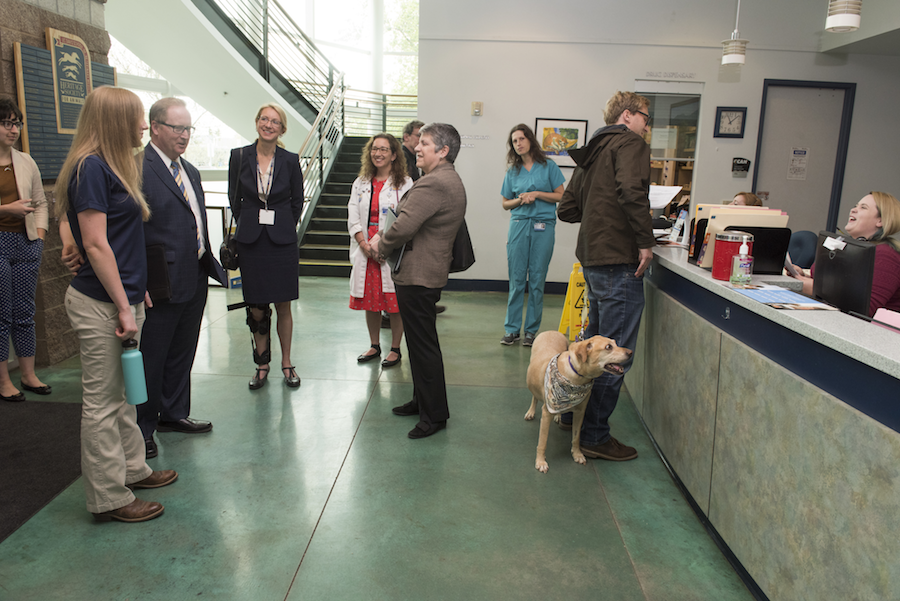
A few individuals and their dogs, waiting in the lobby of the UC Davis Small Animal Clinic on a Thursday morning, were visibly surprised to see a group of formally dressed officials walk through the door. UC President Janet Napolitano was at the forefront of the group, full of smiles and laughs as she toured UC Davis’ veterinary medicine buildings, where eager veterinary students and staff members seemed to be positioned around every corner to greet her.

The former secretary of Homeland Security visited the UC Davis campus on April 5, just one day after protesters shut down a busy intersection in Westwood near UCLA and marched at UC Berkeley regarding a recently published study commissioned by AFSCME — a union representing over 24,000 UC employees — which revealed “growing income, racial & gender disparities” throughout the UC.

During her visit to UC Davis, Napolitano met with a group of graduate students before her tour through the Veterinary Medicine facilities. The tour was led by Dean of the School of Veterinary Medicine Michael Lairmore, who gave a brief presentation and overview of the school and its current research, technology being used and future construction and fundraising plans.

“We have a very simple mission, which is a one health approach,” Lairmore said. “It’s really that interface of animals, people and the environment. We expect to lead veterinary medicine, which is what we are doing, but the important part that separates us out and definitely makes us unique is we address societal needs.”

Lairmore talked about the current work of recent UC Davis graduates, including an alumnus currently working for the Department of Homeland Security — “which I’m familiar with,” Napolitano replied. He also mentioned the work of former students who were at the frontlines of the Ebola crisis in Sierra Leone and who Napolitano briefly met with later in the tour.

Napolitano walked through multiple buildings with a group of faculty, university officials and at least one veterinary student, speaking very briefly with other faculty and staff along the way. Later in the tour, Napolitano visited the Equine Athletic Performance Laboratory and watched a horse on a treadmill gradually increase its speed from a run to a full-speed gallop over the course of six minutes. Associate Professor of Molecular Biosciences Heather Knych explained that the act is “part of our exercise research.”

The hour-long tour ended for a luncheon attended by UC Davis Chancellor Gary May. Before she ate, Napolitano answered questions from The California Aggie for approximately five minutes, the full transcript of which follows:


The California Aggie: First and foremost, I want to address the protests which occurred yesterday in Westwood and on the Berkeley campus following the study commissioned by AFSCME which revealed growing income, racial and gender disparities in the UC. How does the UC plan to address these disparities moving forward?


Napolitano: Obviously, we’re going to make sure our workforce is well paid and it’s inclusive and it’s equitable. We’re in contract negotiations with AFSCME now, so some of these issues will be addressed at the bargaining table.


TCA: In light of the four-year, $18 million UC-wide mental health initiative that began in 2016 and will end in 2020, each UC campus was supposed to hire a specific number of counselors — at UC Davis, it was 12. Since that time, we’ve had a net gain of a half full-time employee. What is your response to student concerns that student fees are not being spent to increase the availability of mental health resources?


Napolitano: Like you said, we distributed the funds to the campuses. We provided that half of the increase in student fees would be dedicated to mental health. Unfortunately, a lot of our campuses have good intentions, but the availability of the workforce makes it difficult. We’ll keep at it, we’ll keep trying to improve it.


TCA: I understand part of the funds amassed through the tuition hike — or hikes, if the in-state hike is approved in May — will be allocated toward mental health resources. Is this correct?


Napolitano: The tuition hike is related to the core operations of the campus and primarily the undergraduate educational experience. The increase in the student fee, half of that increase will go toward improvement.


TCA: I wanted to address your announcement recently that public universities should guarantee admission to qualified California community college students. Why do you feel this should be a focus of the UC?

Napolitano: I think it’s a function of the master plan of higher ed in California […] — the idea in the master plan is that students could start at community college, do two years there and transfer. We already accept a large percentage of our transfer applications. This just puts the period at the end of the sentence and makes sure that qualified community college transfers — these will be students who have done one of the pathways, and they have to get a certain GPA which will be set by the UC faculty — will be guaranteed a seat somewhere in the UC system.


TCA: Recently, Chancellor May announced that the UC Davis police department has made de-escalation a priority. Do you think it should be a commitment of the UC that UC police departments should be focused on de-escalation or at least police reform?


Napolitano: Yes, in fact I have formed a president’s working group on policing practices throughout the UC. It’s chaired by Alex Bustamante, who is our chief audit and compliance officer, but he was former the inspector general of the LAPD, so he’s had a lot of experience in this area. We have student representation, we have administrative representation […and] some of the police chiefs are on it as well as some of the police officers themselves. I’ve asked them for recommendations on how university policing is conducted, what are the best practices and I’ll have those recommendations by the end of the calendar year.


Written by: Hannah Holzer — campus@theaggie.org

Leave nothing but footprints

Tourist litter causes ecological, economic devastation

The Philippines announced on April 5 that the island of Boracay, a popular tourist destination known for its bright blue water and white sand beaches, would be closed to tourists for six months due to sustained environmental damage.

The closure is in large part due to infrastructure problems and a sewer system that has failed to keep up with an influx of tourists, but the Philippines isn’t the only place suffering the ill effects of travellers. Last year, picturesque Cinque Terre, Italy cited environmental concerns when releasing plans to cap the amount of people allowed to visit. In April 2015, the Seychelles announced that plans were underway to limit the number of annual visitors. Santorini began limiting the amount of cruise ship tourists in 2017. And in October 2016, Thai authorities stated that Koh Tachai would be closed indefinitely to tourists and that travel to three other islands would be heavily restricted, citing severe damage to the fragile coral reef ecosystem.

Even destinations closer to home are feeling the effects; residents of San Francisco’s Mission District are regularly incensed by the hundreds of pounds of trash left in Dolores Park after sunny days. When speaking to SFGate, San Francisco Parks and Recreation spokesperson Sarah Madland said, “The issues with trash are not issues of infrastructure, this is about entitled and appalling behavior.”

Every year, careless tourists descend on vacation destinations, trash them for a long weekend and head home, leaving formerly beautiful beaches completely blanketed in crushed beer cans and red cups; in some places, the sand is barely visible under the thick coat of plastic. This means the locals — and the local ecosystem — are forced to deal with the mess. Litter from tourists, especially in popular destinations and areas that have seen recent rapid growth in the volume of visitors, can destroy animal and plant life, devastating ecosystems and the people who depend on them.

This behavior is particularly repugnant when viewed in the context that many of the tropical paradises popular with travellers, like the Caribbean, Hawaii and Southeast Asia, are still suffering from the lingering effects of European colonialism. Such destinations have remained cheap to visit, in large part because imperial rule and resource extraction over the 19th century rendered tourism the only viable economic base after colonized nations gained independence. Another generation of Europeans and Americans taking advantage of the Global South’s economic precarity doesn’t just add insult to injury. Treating entire nations the way rock stars treat hotel rooms does real, lasting damage to the people who have to live with polluted water and poisoned wildlife after the party’s over.

Memorial Day weekend will be here before long, and hundreds of UC Davis students will flock to Lake Shasta for Houseboats. In past years, the annual debauchery has drawn the ire of the National Forest Service for the mess left behind by houseboaters. Adults — that means you, dear readers — shouldn’t have to be reminded to pick up after themselves, but year after year, public lands are left covered in garbage.

The Editorial Board urges travellers, whether they’re heading across the globe or just to a local park, to treat the places they visit with respect, leave as little trace as possible and remember that the mess doesn’t go away when you go home.


Written by: The Editorial Board 
From the California Chronicles

CHRISTIE NEO / AGGIE

He was clearly going to be the responsible one…

It’s never like the movies. I knew this much as I unlocked the door to my second floor dorm room in Segundo. I found my roommate already settled on one not very decorated side of the room (the side that I would have preferred, but it wasn’t the end of the world). My overly enthusiastic mother introduced herself first and hugged my roommate, who introduced himself as Paul once my mother stopped restricting his airway. I knew that every depiction of college I had seen on TV and in movies was complete bull, but that somehow, I’d find a way to have fun in cow town — on my own terms.

I’m from Los Angeles and contemplated turning back several times on the long road up The 5 (not “I-5,” to be clear). I’m from a beach town in south county, and most of my décor is clichéd and very telling of my nautical upbringing. My lack of effort isn’t because it reminds me of home — I just never cared.

Both families went to the dining commons to eat together because everyone was in the mood to talk to each other after a long day of traveling. No one knew what to get, so we all stuck to the salad bar and pizza. Paul and I said goodbye to our parents (that we would be seeing at every possible break) and awkwardly walked back to our dorm. I forgot my ID, but Paul didn’t. He was clearly going to be the responsible one. We both plopped on our beds. Paul pulled something out of his pocket and offered it to me, but I couldn’t see what it was behind the desk shelf and leaned forward to catch a glimpse.


Next week: There were two of him


The print version of this article was written in third person, not first person.


Written by: Terry Hudson

Disclaimer: The views and opinions expressed by Terry Hudson are completely fictional and do not necessarily indicate the views and opinions held by The California Aggie. The story is fictionalized, as is Terry Hudson.

Femikit: making zero waste easy

SHEREEN LEE / AGGIE

A monthly subscription box you don’t want to miss out on

Accumulating a mere 16 ounce jar-full of trash in the course of two years is an achievement most people can’t fathom. While Youtuber Lauren Singer’s lifestyle might seem unattainable, there are feasible ways to minimize your environmental footprint — in this case, one subscription box at a time.

Nicole Garcia, a fourth-year communication major, used her passion for zero waste, graphic design and business to found Femikit, a brand new start-up with curated items to help women develop environmentally sustainable habits.

“Our goal is to connect women with resources to live zero waste,” Garcia said. “I really wanted to create a product that helps women understand how to live zero waste and not have to compromise their lifestyles too much. Another aspect that’s important to bring up is that [Femikit] isn’t just intended for women, even though that’s one of our main audiences. We really want to make it as inclusive as possible because it’s something that everyone can benefit from.”

Garcia is actively involved in UC Davis organizations such as Aggie Reuse, Davis Women in Business and PERIOD. Drawing from her experiences with these organizations, she was able to make her dream come to life.

“Working with young women has shown me that it’s really important that someone addresses this need,” Garcia said. “I think my time at Aggie Reuse has been the most informative part of college because it’s the first taste I had of zero waste and sustainability. I’ve been able to experience how difficult of a business model that is to work in, but at the same time, it’s something that’s really fulfilling and necessary.”

Femikit launched its first box focused on food and grocery shopping. It includes Bee’s Wrap, a Baggu grocery bag, a Hummingbird glass straw and brush and two Leafico produce bags. By carefully selecting these items from small businesses, Femikit demonstrates how waste reduction can be chic and doable.

“We did a lot of research in terms of different suppliers and vendors and ultimately decided on the products we have now because they meet a certain criteria,” Garcia said. “All our items are plastic-free and made from local and family-owned businesses. These products do last over the long-term, so we really want to emphasize that you’re not buying something that’s temporary.”

Garcia admits living completely zero waste is nearly impossible, and that living sustainably doesn’t necessarily mean fitting years worth of trash into a mason jar. According to her, the first step is to look at the products you currently buy. Then, choose products from ethical companies and reduce your plastic.

To Miuccia Halim, a fourth-year managerial economics major and Femikit’s director of business development, zero waste is a step-by-step process.

“Zero waste is a journey,” Halim said. “For me, it means making efforts throughout the day and over the months to reduce my waste. I first started out by simply eliminating the use of plastic bags, so whenever I go to the grocery store, I have my high quality, reusable shopping bag. These small changes really create impacts on communities.”

To make eco-friendly living more attractive, Femikit’s primary marketing strategies are design and social media. The team connects with millennials through use of graphics, photos and videos on Instagram, ultimately reframing the meaning of zero waste. By implementing visually appealing methods, the start-up is able to effectively deliver the concept as something desirable as opposed to boring or stagnant.

“We’re definitely looking at people around the ages 17 through 30 because these are the people who are getting independent lifestyles and learning how to do things on their own in terms of what to purchase and how to live,” Garcia said. “It’s important to start there so we can start forming those eco-friendly habits before they get into adulthood. We’re the generation that’s responsible for solving climate change. We need to start making decision as individuals and as a community about what we can be doing better.”

So far, Femikit has evoked positive responses from its targeted audience. Lois Kim, a second-year environmental policy, analysis and planning major, also aims to make environmental change on campus by being chair of ASUCD’s Environmental Policy and Planning Committee and Vice Chair of The Green Initiative Fund. At home, Kim alleviates her environmental footprint by using public transportation and as little plastic as possible. For those like Kim, Femikit is an innovative product to look forward to.

“I think that Femikit is an amazing way to kick-start people into becoming a little more environmentally conscious,” Kim said. “Femikit makes it a really approachable process and it makes it an appealing one because everything is so cute and affordable. That’s a subscription that I never thought was necessary, but now I think it really is. I’m excited to see what Nicole will add to Femikit.”

Another objective for the subscription start-up is to create a community full of supporters and to inspire leadership in women.

“We’re definitely looking to build and foster a community around zero waste because it’s something that’s difficult to do on your own,” Garcia said. “You really need people around you to get there. We want to make sure that we’re forming strong ties with people that support our mission and connect those people with each other so they can help each other and hold each other accountable to living zero-waste.”

Additionally, Femikit strives to educate, provide and build communities. In turn, it brings real-life business skills to the table. Femikit proves there are no limitations — that zero waste and female leadership are not just plausible, but definitely possible.

“If you believe in your cause, just go for it,” Halim said. “Find mentors and create a supportive environment where you can accomplish your goal. […] There are so many resources out there. If someone has an idea, they can always reach out to people like Nicole for advice. There are so many people out there that will be happy to help someone else’s dreams, especially if it makes a positive impact.”

Purchase your first kit at Femikit’s website.


Written by: Becky Lee arts@theaggie.org

Police logs

NICKI PADAR / AGGIE

How did the cat get stuck in the storm drain?

March 19

“Male who sent threatening emails in 2015 is now recontacting company members via email. Concerned subject is decompensating.”


March 20

“Repeat call, transient male and female yelling.”

“Occurred 9 minutes ago, delivery vehicle was parked and driver stepped out and vehicle was driven away.”

“Reporting party has shotgun shells he wants to turn in for destruction — shells are in the vehicle.”


March 22

“Male was sleeping in front of store, woke up and entered store and threw items around, now outside.”

“Occurred overnight — vehicle taken from driveway, garage door opener inside vehicle.”


March 23

“Reporting party saw two subjects in black hoodies appeared to be trying to break into the storage units in the back parking lot. When the reporting party walked passed the subjects turned their faces so the reporting party couldn’t see them.”


March 24

“Male subject has come into store repeatedly, yelling and threatening customers.”

“Returned home and noticed light on inside apartment, reporting party sure she turned off all lights before leaving this morning, housemates are all gone for the weekend, reporting party standing by in complex gym.”


March 25

“On the bike path directly behind residence; cat stuck in storm drain.”

Isle of Dogs: A Review

ALLYSON KO / AGGIE

Wes Anderson’s newest undertaking reaches new imaginative heights

Unlike anything of its kind, Isle of Dogs is uniquely imaginative, enthralling audiences into the world of its fictional dystopian-esque Japanese land. True to form, Wes Anderson delivers a cinematic experience full of hilarity, deadpan wit and emotional charm. As Anderson’s second venture into the realm of stop-motion, the cinematography of Isle of Dogs is impressively detailed, with every scene mapped out with expert-level precision. The star-studded cast of the film bring Megasaki City’s inhabitants to life, featuring iconic voices from actors such as Bryan Cranston, Edward Norton, Bill Murray, Jeff Goldblum, Greta Gerwig, Scarlett Johansson, Liev Schreiber and more.

Following the outbreak of a massive canine flu, all dogs of Megasaki City are exiled to Trash Island by the authoritarian regime of Mayor Kobayashi (played by Kunichi Nomura). In an attempt to rescue his lost canine, Kobayashi’s young nephew Atari (played by Koyu Rankin) embarks on a journey to Trash Island to save the banished pups. Adventure ensues as Mayor Kobayashi’s rival searches for a cure to the epidemic, Atari seeks out his lost pup and then attempts to save the entire species of dogs before it’s too late.

While watching this film, what struck a chord with me the most was Anderson’s use of Japanese culture as one of the most centermost aspects of not only the story’s narrative, but also the logic of the film itself. From a Western point-of-view, many audience members are not aware of the intricacies that lie within Japanese culture, myself included. This allowed Anderson to take creative liberties with the plot and setting of Isle of Dogs — a tactic the director has often demonstrated in his past projects — whether that be to further the story along, smooth over plot holes, or simply allow for the film to evolve within its uniquely crafted and bizarre sphere. However, this also has raised the question amongst many critics of whether or not Anderson has accurately depicted Japanese culture in its rightful form. Granted, although it is a fantasy film about talking dogs, Anderson does indeed stretch beyond the limitations of what may be considered politically correct, from the mainly American voice cast to the Japanese puppets utilized within the animation.

But Isle of Dogs does not solely exist to entertain with its stop-motion animation and a few laughs. Although it does just that, there is also a deeper, if not simpler, overarching aspect of the story itself surrounding the corruption that can occur amidst the ranks of good and evil. Although they’re only dogs, the characters undergo a very human level of internal struggle, while battling against Kobayashi’s sinister plot to destroy them. And there lies one of Anderson’s greatest skills as a filmmaker: his ability to tap into humanity’s greatest universal flaws. So, whether you’re a die hard Wes Anderson fan, an indie movie aficionado or you simply love dogs, Isle of Dogs will not disappoint, leaving you with some thought-provoking insight by the end of its adventure.


Written by: Sydney Odman — arts@theaggie.org

American Crime Story: The Assassination of Gianni Versace

SHEREEN LEE / AGGIE

Life, death, inspiration to live life out of a baroque closet

The second season of the renowned FX mini-series, American Crime Story, premiered on Jan. 17 and centered around the death the one of the most iconic and openly gay fashion designers — Gianni Versace. “American Crime Story: The Assassination of Gianni Versace” tells the story of Versace’s death that happened 20 years ago, but needed to be retold through a different lens in a different time.

Andrew Cunanan, played by Darren Criss, is the serial killer that shot Gianni Versace in front of his home in Miami, Florida. The show carefully uses flashbacks to and from the present to reveal pivotal moments in Cunanan’s life that inched him closer to killing Versace.

Gianni Versace, played by Edgar Ramirez, channeled the love of life and passion that followed Versace wherever he went. This outlook on life is reflected in the clothes that he produced — bright colors, baroque patterns and sensual design that aimed to encourage women to feel empowered.

In an interview with Vogue, Donatella Versace (or Medusa herself) opened up about her brother’s story and reminded herself of the tragedy of his death. According to her, twenty years have passed and it was finally time to share his story. Versace’s death still holds considerable relevance given the current political climate surrounding LGBT rights and equality.

Versace was a strong supporter of women, but he also became a role model for the gay community when he publicly came out in an interview with The Advocate, an LGBT magazine in 1995.

The show uses Versace’s story as a way to address several LGBT related issues that existed then and, unfortunately, still do today. Donatella Versace, played by Penelope Cruz, voices her concern to Versace when he was deciding to come out. She was afraid he would no longer have clientele to sell to.

Cunanan is shown having signs of HIV/AIDS which was not an acceptable disease for most people at the time. Ronnie, played by Max Greenfield, suggests that the FBI did not care to track down Cunanan before a public figure like Versace was killed because of his condition.

The legacy of Versace can be seen in a tribute collection recently released that was inspired by his 1992 spring show seen in the show.

This season consists of nine episodes that are available for streaming on FX Now.


Written by: Josh Madrid — arts@theaggie.org

Religion needs an organizational reformation

JORDAN CHOW / AGGIE

Division and cognitive dissonance often stem from religious institutions

Religion can be a saving grace for some — a gleam of hope, a source of comfort, enlightenment and guidance. But it can also be the source of guilt, division and cognitive dissonance — which is derived from the organization of religion.

Ironically, for a system of belief trying to explain a confusing universe, religion often asks followers to turn off their brain or ignore science, logic and even compassion and humanity.

Religion has a hierarchical structure of every individual’s role. In religious communities, the clergy, such as priests, imams and rabbis, are at the higher end of the spectrum, with followers at the very bottom. Rather than the religion or clergy conceding that they are just humans who are not ordained with some secret knowledge — that they have ideas and thoughts and theories, but in the end they are as lost as the rest of us — they talk with authority and certainty, and tell followers what is and what is not permissible. Empowering clergy to this extent often requires that followers ignore basic science and logical evidence in support of evolution and embrace ideas for which there is no evidence, save scripture or personal ideologies.

As a progressive society, we’ve embraced the fact that men and women are, and should be treated, equally — and yet religion has failed to progress alongside us. The organized religions that we adhere to can very much shape the way we interact in the world beyond our religious communities. In mosques, men and women are separated, with women sitting in the back, covered. This shapes the way Muslim men and women view gender roles, creating a culture in which women are always secondary, rather than equal.

As a member of the Muslim community, I’ve witnessed firsthand the manipulation that can take place among preachers and religious followers. While living in Qatar, my father and brother would visit the mosque (a Sunni mosque) from time to time. On one particular occasion, the preacher argued that it was necessary to rid the world of the Shia sect — and no one protested.

The issue with organized religion is that a man like that particular preacher can say something so heinous to a room full of people and face zero backlash. This is because we, as religious followers, actively give these people legitimacy by subscribing to the way in which they systematize religion. Rather than reading the scripture or determining answers through our own morals and compassion, too many people readily accept extremist notions due to the dogmatic mentality that many organized religions have established. If an individual whom you hold in high regard is telling you something — and you already believe everything he says to be true — then you’re going to have a difficult time disregarding what they’ve advocated for, even if it’s something you may not have accepted coming from someone else. Most people take things with a grain of salt, but when they’re spoken in a religious setting, it’s as if God himself was relaying a message directly to his followers.

This creates a culture of incurious people who comply with teachings, laws and rules without question. Countries like Saudi Arabia and Qatar suffer from extreme inequality between men and women, and a reversal of such gender norms will likely not be found within the mosque or from preachers in that region.

The same logic can be applied to those who attend the Westboro Baptist Church; I too would find it hard to believe that frequenters of that church are unaffected by the hate speech espoused within that building.  

Religion was intended to be a personal matter, yet we’ve allowed ourselves to become sheep to religious organizations that should’ve been serving us, encouraging us to seek answers and guidance. Priests and preachers of all religions have the power to shape the way total strangers view the world and what kind of values and morals they hold. People should form a more intimate relationship with religion, rather than rely on a third party to tell them what is right and wrong or depend on rituals to guide the way they view life.


Written by: Hanadi Jordan — hajordan@ucdavis.edu

Disclaimer: The views and opinions expressed by individual columnists belong to the columnists alone and do not necessarily indicate the views and opinions held by The California Aggie.

Cartoon: Happy Studying

DIANA OLIVARES / AGGIE


Written by: Diana Olivares — deolivaresvalencia@ucdavis.edu

Disclaimer: The views and opinions expressed by individual cartoonists belong to the cartoonists alone and do not necessarily indicate the views and opinions held by The California Aggie.