45.8 F
Davis

Davis, California

Saturday, December 27, 2025
Home Blog Page 533

Women challenging underrepresentation in politics

CAITLYN SAMPLEY / AGGIE

Why women are banding together to say that enough is enough

In 2018, women hold 19.6 percent of the seats in U.S. Congress, 22.8 percent of the positions in state executive office and 25.3 percent of the seats in the state legislature, according to the Center for American Women and Politics. These statistics show a striking imbalance in the ratio of women’s representation in the political arena compared to that of men. But exactly what can explain this significant gender disparity?

Delaine Eastin, a current Democratic candidate for governor of California, a former regent of the University of California, a former trustee of the California State University system, a former superintendent of Public Instruction, a former state assemblymember and a UC Davis alumna, believes that there are numerous institutional forces in place preventing women from getting elected into positions of leadership.

“In general, the bigger the state or the bigger the city, the harder it is to elect women, and the same can be said about the size of the legislative offices,” Eastin said. “Genuine discrimination exists against women, but there are other factors that enter into it. One of the challenges in America is that we have a political system that’s very expensive to participate in, and women have a harder time raising money.”

Eastin solidified her arguments by offering a personal anecdote demonstrating how she experienced this prejudice firsthand.

“When I was in the city council, there were seven candidates running for three seats,” Eastin said. “Three incumbents were running with two challenging men and two challenging women. The guy who owned one of the local businesses wrote all the men a $500 check and wrote the other women and I each a $300 check. It’s sexism, and it happens all the time.”

According to Eastin, this sexism breeds societal norms and stigmas that work to undermine a women’s full political potential, thus hindering her chances for professional growth.

“I think there is still a stigma [regarding women in politics],” Eastin said. “There is an implicit bias in men and women about what women can do and ought to be doing. The idea that a women can lead is absurd to some men.”

Maiya De La Rosa, a first-year political science — public service major, member of the Davis College Democrats, Ignite, and California Women’s List and chair of the Latino Caucus of the California Young Democrats, believes that these stigmas have manifested themselves into our political culture and force women to behave only in ways that are deemed appropriate.

“There’s a stigma of women in politics that you have to be somewhere between motherly and strong,” De La Rosa said. “You can’t be too aggressive or you’re a man-hater, and you can’t be too soft or you’ll get nothing done. You have to find some in-between, and sometimes it feels like it’s impossible.”

According to De La Rosa, these stigmas are intensified for women of color, making it even more difficult for women of diverse ethnic backgrounds to hold positions of power in politics.

“Women are not a minority group, but politics has always been so male-dominated, and the statistics go down for women of color in politics,” De La Rosa said. “For me, that’s really important, and it’s why I felt like I needed to get involved. I grew up in Orange County, a very male-dominated district, but then I see people like U.S. Senator Kamala Harris, a woman of color in power. That shows me that there are women that can do this.”

Data and statistics do indicate that women of color are far less likely to be elected into office — 36.2 percent, 11.3 percent and 24 percent of the women who hold seats in U.S. Congress, state executive offices and state legislatures respectively are women of color, according to the Center for American Women and Politics. Jumoke Maraiyesa, a third-year sociology and political science double major and current ASUCD senator, says that on top of gender biases, the lack of inclusive representation in politics is also a product of oppressive systemic forces that are inextricably tied to race.

“It’s definitely a systematic issue; there’s no other way to put it,” Maraiyesa said. “We know the history of the United States. It heavily started with just males — and we know which demographic of males — that were eligible to be in elections or just politics in general. You move further down along the line and you have women’s suffrage, but even then it was a bit problematic because you only had a certain demographic of women who were allowed to participate in politics.”

Maraiyesa said that their gender and ethnicity leave them vulnerable to public judgement, because those factors will always play a role in how others perceive their actions as a senator.

“It’s kind of like when I was congratulated for Senate,” Maraiyesa said. “I feel like it’s a lot of pressure and there’s going to be a lot of eyes on me. If I mess up, people will say ‘Oh, it’s because she’s a woman.’ And then if you mix that with race and ethnicity, it’ll be like ‘Well what did you expect from a minority, or a black women in general?’”

As an Asian American, Teresa Lam, a third-year political science major and former candidate for ASUCD senator, understands what it feels like to be a woman of color in politics and, subsequently, having to constantly face social and political barriers.

“It’s definitely way harder to be a woman in politics, but being a person of color just adds even more to that because there are so many prejudices against us,” Lam said. “If an Asian American were to run, it would be odd because you don’t typically see Asian Americans in that [political] bubble. There’s already a set norm on what a person can do and what a person can be.”

Lam takes pride in her ethnic background, using the struggles of those before her as a source of inspiration to keep her active in the political arena.

“My parents are immigrants and I’m a first-generation kid,” Lam said. “They gave up so much just to be in America, and that’s what keeps me going. Looking at our democratic system now, it has changed a lot and it’s not as representative as it can be. I do believe that any individual can make a difference, and that really pushes me to be more involved.”

Though the current demographics of women in politics are low, they have risen substantially relative to past decades. Victoria Harper, a first-year political science major, a member of the Davis College Republicans and the judicial council clerk for ASUCD, firmly believes that despite the numerous setbacks that women have endured in the past, they should in no way feel discouraged from participating in politics in the present or future.

“Men have had a long time in history to build these images up for themselves [and to] pick and choose what kinds of politicians they want to be to get people to vote for them, [but] women haven’t necessarily,” Harper said. “We’re rising in this country. It’s been a tough time, but we’re still rising, and that’s what’s important.”

Harper argues that women need to use the past as a motivational push to collectively work towards a better, more inclusive future.

“As women, if we want representation in politics, we need to focus on us growing,” Harper said. “It’s important to know what struggles we have gone through. However, I think one of the most important things for us as women is to continue to push through. Females are still rising. We need to empower ourselves with the numbers that we’ve achieved; we’ve achieved great numbers.”

According to Shaniah Branson, a third-year communication and political science double major and ASUCD executive vice president, it is crucial for women uplift one another and embrace intersectionality, because that will breed the most tangible change.

“Gender equality must be embraced fully, by both men and women, if we are to evolve culture and ourselves,” Branson said. “But more importantly, empower the women around you — whether you agree with their political positions or not and despite personal controversies. When women continuously empower women, imagine how unstoppable we ALL will become.”

Sydney Hack, a second-year political science — public service and international relations double major and member of the Judicial Council of ASUCD, says that in order to bridge the gender gap in politics, women need work to empower the younger generations to use their voices and get involved in the political process.

“I think it’s leading by example,” Hack said. “We’ve never had a women president. I don’t believe we’ve ever had a female vice president. We’ve only ever had four women on the Supreme Court out of at least 70 plus Supreme Court justices. We are not represented, but it’s definitely something we can change if we encourage girls and make [female representation] normal.”

Many would argue that the younger generations are already breaking gender barriers in the political sector. Emily Rose Jones, a second-year political science major, a member of the Davis College Democrats and J Street U and the women’s caucus of the California Young Democrats, believes that society is in fact moving in a progressive direction and will continue to do so in the coming decades.

“I think our generation is really where it’s changing,” Jones said. “I think it’s part of this process, [a process] that’s been really slow-going, of recognizing the voice that everyone should have in politics. It’s becoming more acceptable to have a powerful women [in politics]. We’re getting there and the narrative is changing […] and I think that we’re going to see a lot of progress in the representation that we see from women and from all branches.”

The narrative for women is indeed changing day-by-day, but the demographics show that there is still work left to be done. Eastin wants every woman to know that although the battle for gender equality will be difficult, it is a battle that needs to be fought and won.

“I think that the future of the Republic — ethically, economically, in terms of civility and in terms of justice — requires that more women participate,” Eastin said. “It’s imperative at this point. Every step forward where there is equality, whether it’s based on gender or race or sexual orientation or whatever it is, is a step in the right direction. We may take two steps forward and one step back, we may stumble. But we have to understand that the battle for truth and justice is never-ending. And yes it’ll be hard […] but it’s always better to be involved in a just cause.”


Written by: Emily Nguyen — features@theaggie.org

 

The best albums of 2018 (so far)

MICHELLE GORE / AGGIE

Brandi Carlile, Black Panther, surprise reemergence of MGMT mark strong musical beginning to 2018

While the novelty of the new year has worn off, 2018 is still quite new. Three months into the year, a lot is already changing, but the stream of great new music seems to remain a constant. I know that Davis students lead busy lives, so I’ve provided you with the best albums 2018 has to offer — so far.


Multiple Artists: “Black Panther: The Album”

Notable Tracks: “King’s Dead,” “Paramedic!,” “All The Stars”

By now we all know Black Panther as the Marvel film that swept the nation over the past few months. One of its most captivating components is its soundtrack. Curated by rap mega-star Kendrick Lamar, the soundtrack features the likes of Schoolboy Q, Vince Staples, SZA, Anderson .Paak and Travis Scott. The star-studded group culminates in a surprisingly easy pick for one of 2018’s best albums to date.


MGMT: “Little Dark Age”

Notable Tracks: “Me and Michael,” “Little Dark Age,” “When You Die”

The name MGMT should be familiar to most. The band burst onto the scene in 2007 with their album “Oracular Spectacular.” Armed with notable tracks “Electric Feel,” “Kids” and “Time to Pretend,” MGMT seemed as though they were here to stay. That narrative quickly changed as the band released album after album, all with lackluster material. Not only is “Little Dark Age” the group’s first studio album in five years, but it’s also the first noteworthy music put out by the band since their sophomore album, “Congratulations.” The album seems almost a last gasp effort by the musical group, and somehow after all these years they’ve struck gold again. It’s a far cry from “Oracular Spectacular” — and that’s a good thing. Characterized by synth-rock and funk sounds, “Little Dark Age” is the maturation we’ve all been waiting for. MGMT is finally leaving behind the sound of their youth and fame, and that is why we are finally listening.


Brandi Carlile: “By The Way, I Forgive You”

Notable Tracks: “Most Of All,” “Every Time I Hear That Song,” “The Mother”

One of the emerging stars in the folk-pop-country scene, Brandi Carlile is a singer-songwriter we can all get behind. In previous work, she’s won over fans with her simple yet poignant lyrics and breathtaking vocal range. Her latest album is no different in regard to these traits, but it does offer previously unheard content by Carlile. Subjects range from Carlile’s new motherhood to addiction and love and heartbreak. It’s an unapologetic project portraying growth and all the ups and downs life throws our way.


If the first few months of 2018 are any indication, we are in good hands musically. While we are sure to see many more albums released in the upcoming months, these projects are some of the earliests picks for best album.


Written by: Rowan O’Connell-Gates — arts@theaggie.org

UC Davis Fashion & Design Society to hold annual Picnic Day Fashion Show

ALLYSON KO / AGGIE

Department of Design undergraduates showcase fashion expertise

Amidst the endless array of activities to experience on Picnic Day, a student-featured fashion show is one of the best. Put on by the UC Davis Fashion & Design Society, the annual show will be held twice in the ARC Ballroom, first at 11 a.m. and once more at 1:30 p.m. This year, the theme of the show is “Impression/Expression,” leaving student designers to interpret their own experiences into their collections as they see fit.

“As a textiles major, it’s really nice to see the fashion community being showcased at such a big event like Picnic Day,” said Mandie Simpson, a second-year textiles and clothing major.

Throughout the runway show, garments created and styled by students of the Department of Design’s “Signature Collection” class will in turn be modeled by other fellow students of UC Davis. Among the many student designers involved in the show, Sharon Zhu and Pooja Morari, both fourth-year design majors, are the creators of a bridal collection titled “Ina Fusion.”

This is my first time participating in the show, however, I have been to the fashion show as an audience [member in the past],” Zhu said via email. In contrast, this will be Morari’s second time participating in the show. She designed a collection for the single garment competition in the year prior.

The title of Morari and Zhu’s collection was inspired by the heritage of the two designers, with “Ina” being a combination of the names of India and China. “Ina Fusion” consists of six garments, two that represent each country respectively and four that embrace the fusion of India and China together. In highlighting the traditional aspects of the two countries, Morari and Zhu also hope to include some contemporary style into their designs.

“Our collection serves as an expression of interracial marriages and the growing diversity of our world, in which all our ideas, values and experiences are constantly being reshaped,” Morari and Zhu said via email.

As a bridal collection, the two undergraduate designers hope to express the cultural tradition inherently embodied within the fabrics and silhouettes of each culture’s customary wedding wear.

“We hope to utilize the fashion show as a platform to introduce our future collaboration in developing a fashion line inspired by this fusion collection and later expanding into other garment styles,” Morari and Zhu said.

Tickets are $12 presale and $15 at the door. For more information, visit the design department’s website.


Written by: Sydney Odman — arts@theaggie.org

Student Sounds: Lo & The Mix (Part 2)

JON FERNANDEZ / COURTESY

The Aggie catches up with local band

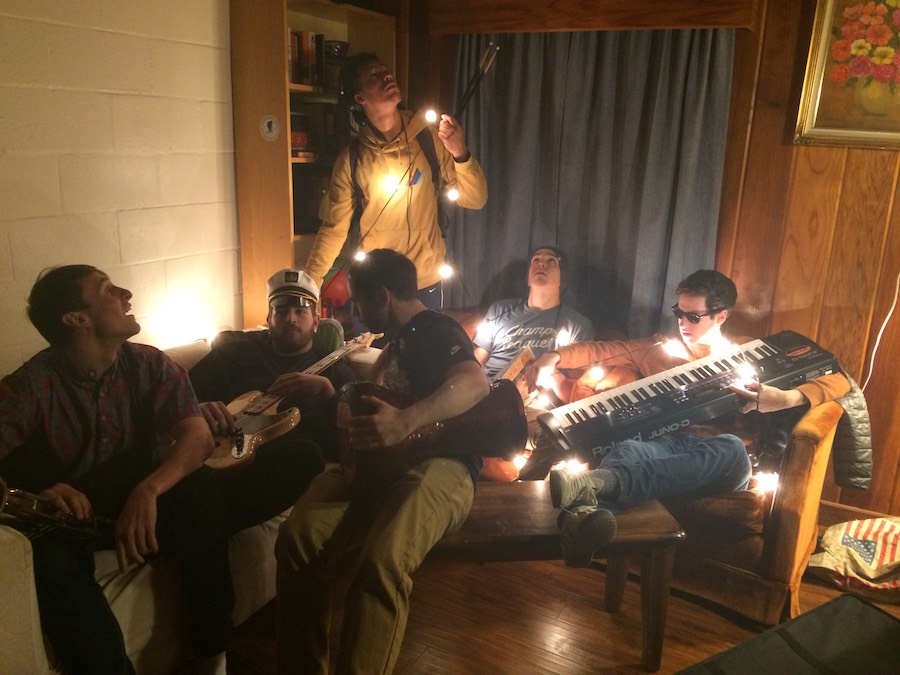
There are a few new things I’ve learned about the local band Lo & The Mix since sitting down with them last year. One cannot help but notice a strong new energy within the band, an undeniable chemistry between the members both new and old. Indeed, only three members of the last version of Lo & the Mix remain after some members departed. Witty back-and-forth banter not only produced a conversation that produced quirky revelations about each band member, but is also an example of the intimacy central to the alteration of the band as a whole.

Fourth-year cinema and digital media major and drummer Sean Johnson and I have the same favorite color. Fourth-year political science major and bassist John Hancock and third-year genetics major and keyboardist Oliver Tucher have the same middle name. Aram Balain, a fourth-year chemical engineering major who does auxiliary percussion for the band, loves progressive rock band King Crimson. Horn players Micah Marmorstein and Caleb Sanders, fourth-year biochemical engineering and biochemistry majors respectively, both have killer laughs. UC Davis alumnus and lead vocalist and rhythm guitar Benett Hannan likes the color blood orange-red because it makes him go “mmhmm.”

Through various interactions and multiple members unintentionally enrolling together in a jazz music class on campus, the current band came into fruition at the end of 2017.

“How we ended up playing together and whether or not we are [the title] Lo & the Mix is not as important as the people who are here […] Sean has grown so much; I have learned hella from talking with John,” Sanders said.

With such chemistry, the band appears more legitimate than before; no longer just a casual jam sesh, but a cohesive group.

Tucher commented on the dynamic between Sanders and Marmorstein, the band’s horn section, in particular.

“They get together and link up. In between their solos is this unified teamwork that is really fun to watch.”

The relationships between members are the key aspect that produces the coherency and sound of Lo & the Mix.

“That’s partly why Lo & the Mix is now set,” Hannan said. “The name is not a particular group, and that’s partly what embodies the ‘Mix’ part of it. We’ve had so many people touch on this one big thing that has grown out of our community of friends, and it’s starting to feel like this is what we are supposed to sound like.”

The sound has evolved from its original ska into a R&B funk melody, according to Marmorstein. The band confirmed the coining of this term on the spot during the interview. Titling their music is not their main objective; rather, their production of masterful music stands on its own.

“It’s funky bass, driving beat, a little more dancy, hot horn hits” Hannan said. “I’ve gone to acoustic […] and having that and the hand percussion adds this islandly feel. We also now have the keys, and that does that jazzy sound.”

For Balain, beyond earworm sound, it’s the hard-to-notice details that distinguish their music from others. Hannan agrees.

“I think everyone has a different thought, but I always thought of the ‘Lo’ being the little interactions between everything,” Hannan said. “The stuff that you don’t even hear on the track but if it was gone you would notice. I think it’s little things about everything we’re saying — the soul.”

Johnson “vibing on the drums” surfaced as a prime example of said energy and soul.  This psyche has cued a songwriting streak for the band. New content has even emerged by accident as the band has been practicing together for their upcoming shows, according to Sanders.

“Right now we are working on our Picnic Day show, and then we are doing Whole Earth Festival,” Sanders said.

Moreover, the band is recording and will be performing their new music, now to even larger audiences.

“What we have online now are our old EPs,” Hannan said. “We have about three new songs recorded right now that will come out on SoundCloud. And on June 2 we will be opening for Riot Makers at Holy Diver in Sacramento. This will be our biggest show yet, upwards of 1,000 people.”

With such tangible growing success, one cannot help but observe a growing maturity within the band. Its strong structural foundation has allowed for more legitimate goals to arise. Again, they are no longer simply jamming in a living room.

“It is a moving goalpost,” Sanders said. “We want to sell our music and we want to get more music recorded. We want people to listen to our music.”

While the goals of the band have become more solidified, the fluid emotions and geniality that unite the members and their sound have remained.

“I think it is not being afraid,” Hancock said. “It’s not like you have to be a structured thing to meet a structured goal. Us having to hit this deadline or play this certain way — none of us feel that way. We really have this idea and want to produce something good, but we don’t feel like we need to do something particular in the way or that we play our music so that we can put it on an album. I’m going to go play with these guys and have a blast doing it.”

As Hannan put it, “for lack of a smaller term,” Lo & the Mix is pure musical love.

“You can’t control it,” Hannan said. “The moment you try to make it go in a way that it doesn’t want to go, it is no longer love.”

That love for music was evident even in the last 15 minutes of the interview. Each member kept asking if they could play a song or two. At the conclusion of the interview, each lept from their seat to attend to their instrument — and the jamming commenced.


Written by: Caroline Rutten — arts@theaggie.org

Resilience Underground

KAILA MATTERA / AGGIE

Curious behavior of native wildflowers during California’s most recent drought

Initially, wildflowers appeared to be mysteriously disappearing from McLaughlin Natural Reserve, which understandably had researchers worried.

We know from other data that some wildflower species appeared to be disappearing from this grassland site,” said Andrew Latimer, a professor in the Department of Plant Sciences at UC Davis. “We wondered whether they were truly ‘gone’ or simply dormant, waiting in the seed bank for favorable conditions.”

Researchers soon solved the mystery. California droughts can be strenuous for most plants, but not for wildflowers. Native wildflowers use a strategy called seed banking to handle California’s temperamental climate, where they keep a portion of their seeds dormant, ensuring their long-term survival. This research done by lead author Marina LaForgia, a graduate student in the Andrew Latimer Lab, is part of a larger aboveground plant community monitoring study. That project had 80 sites, each containing a 40-meter transect along which five one-square meter plots were placed. Visible plant growth was studied at these sites. This specific study took samples in 2012 and 2014, when California was experiencing major drought conditions.

“In 2012 and again in 2014 we took soil cores from each of these five plots per transect, aggregated them together to get one sample per transect, mixed the sample with sand, and laid out the soil in flats in an outdoor bench space in the UC Davis Orchard Park Greenhouse complex,” LaForgia said. “The flats were watered daily and every seedling that came up was identified and discarded. This continued for a year, then the plots were allowed to dry down for the summer, and watering was re-initiated in the fall for another year. After all germinants were identified and no new germination occurred, we terminated the study.”

Native wildflowers were still germinating and producing seeds, but chose to save most of the produced seeds underground. They ended up saving 201 percent more seeds than normal underground, and their aboveground growth increased by 14 percent. Exotic grasses, on the other hand, depleted their underground seed bank by 52 percent and decreased their aboveground growth by 39 percent.

However, this study showed the behavior of wildflowers during one period of drought. It’s possible that prolonged drought could lead to the depletion of the seed banks of wildflowers.

I hope this study helps raise people’s awareness of plant communities, the ways they respond to climate, and the ways they may be changing,” said Susan Harrison, a professor in the Department of Plant Sciences at UC Davis.


Written by: Kriti Varghese — science@theaggie.org

Alfred Hitchcock films showing in Davis this spring

ALLYSON KO / AGGIE

Davis Odd Fellows brings back classic film festival

The Davis Odd Fellows is bringing back its classic film festival for the spring, showing Alfred Hitchcock films in Upper Hall at 415 Second St. in downtown Davis. The first showing is on April 15, and the films are free, with popcorn provided. Doors open at 6:29 p.m., and showtime is at 7:01 p.m.

Dave Rosenberg, the former grandmaster of all the Odd Fellows in California, elaborated on how the Odd Fellows started incorporating classic films as a committee.

“The Davis Odd Fellows do a lot of things to serve the community,” Rosenberg said.  “About five years ago, we installed a large projection system at the lodge, and I’m a fan of classic films, so I thought what a nice combination to start a classic film festival and invite the public. Since that time, we installed an even larger system in the upper hall. The one coming up will be our ninth.”

The organization has a large following with many committees in addition to the classic film festival committee.

“The Odd Fellows started in England over 2,000, close to 3,000 years ago,” Rosenberg said. “We are the oldest organization in Davis. We currently have 293 members, [and] we have the largest Odd Fellows lodge in North America. Right now, our members run around from 19 to 51 [years old]. We have 57 committees, and one of the committees is the classic film festival.”

Since the classic film festival started, it has been held every year in the spring and fall.

“We decided to do it twice a year since it’s incredibly popular,” Rosenberg said. “We always do three films on three Sundays in a row. This one is coming up — April 15th, 22nd, 29th. Each time we feature a certain genre. We’ve done classic film noir, classic Jimmy Stewart films, and this time we’re doing classic Alfred Hitchcock films.”

Beth Dovi, a member of the Davis Odd Fellows classic films committee, explained how the films are picked.

“We just had the idea and it evolved — and we vote as a committee and set the dates,” Dovi said. “It’s usually a different genre, it doesn’t have a format, per se.”

This spring, the Odd Fellows decided on the Alfred Hitchcock films.

“There’s some Alfred Hitchcock films that everyone knows and has seen,” Rosenberg said. “We are not showing those. We are showing lesser-known films but equally engaging. The first one we’re showing on the 15th is called ‘Saboteur,’ and the next one we’re showing on the 22nd is called ‘Shadow of a Doubt.’ One of the special features of what we do is we have a film critic in Davis who’s outstanding — he knows films like nobody I’ve ever met. His name is Derrick Bang and he is a film critic for Davis Enterprise. Before the showing, he tells everyone about the film and then afterwards he will answer questions. It’s a wonderful feature of this film festival. We have the benefit of someone who knows everything about the film.”

Many students attend the annual classic film festival.
“I know the public enjoys it, and we always have a lot of college people attend, and we have people who have actually seen the films,” Rosenberg said. “These films go way back from the ‘30s to the ‘40s, and that’s a long time ago. But, they’re wonderful films, and they have aged well with great entertainment and some great directing and acting.”

Rosenberg also noted how intriguing the Alfred Hitchcock films will be, especially for the public.

“Alfred Hitchcock is known as the master of suspense,” Rosenberg said. “His films will keep you on the edge of your seat. You never know what’s going to happen. Sometimes the protagonist is passive by both the good guys and bad guys. And you never know how it’s going to end.”

Juelie Roggli, another member of the classic films committee, stated that they can make good use of the hall they have for the public to come together.

“It was Dave Rosenberg’s idea as a way to bring the public into our beautiful hall — to show them something different,” Roggli said. “It’s worked out really well. We always get a really good crowd and people get to know the Odd Fellows as well as get the community involved and have a good time.”

Dovi emphasized that the festival welcomes anyone to come see the classical films.

“I think that a lot of times, people haven’t seen many of these older films,” Dovi said. “A lot of people may be interested, and it’s something to do on a Sunday night.”

While the films may not show in theaters anymore, Dovi stressed how important they still are.

“It’s important for a lot of things,” Dovi said. “These are movies that might be missed. Typically they’re made before 1960 — it’s important to keep these movies in people’s minds as these movies were not in the theaters when they were around.”


Written by: Stella Tran — city@theaggie.org

Emerson Hall project approved for UC Davis housing expansion

KAILA MATTERA / AGGIE

Students discuss on-campus housing concerns

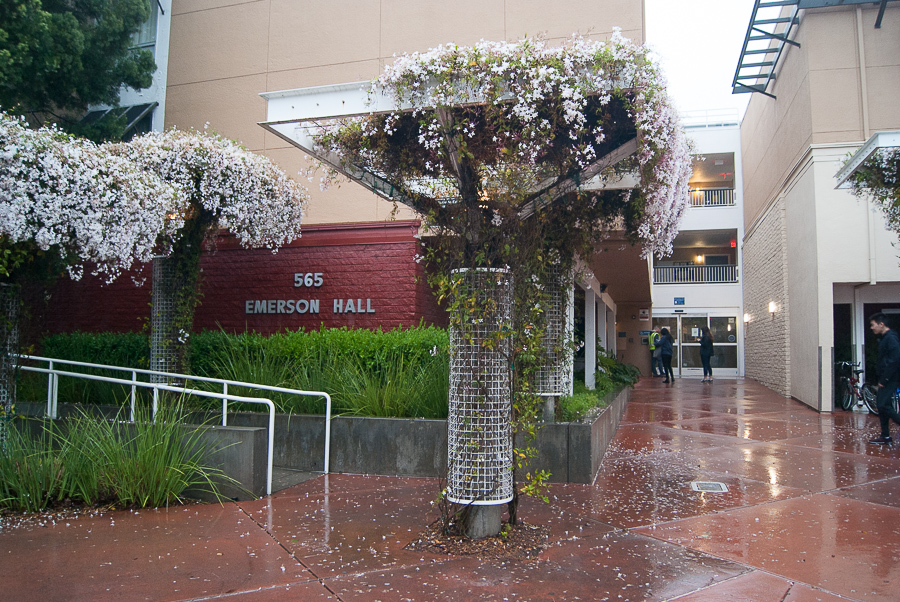
On March 14, the UC Davis Finance and Capital Strategies Committee approved funding for the new Emerson Hall project in the Cuarto student housing area. This action was followed on March 15 with a unanimous vote by the UC Board of Regents for final approval. The Emerson Hall replacement project will tear down an older building in order to construct three buildings which will house over 800 students.

Matt Dulcich, the director of Environmental Planning and Local Government Relations at UC Davis, spoke about the housing changes coming to Cuarto and in general about new housing at UC Davis.

“The key item for Emerson and Webster Hall is to add more supply for UC Davis students and [provide] enough housing capacity for first and second-year students,” Dulcich said. “The Webster and Emerson Hall projects are part of the most ambitious housing plan ever for UC Davis. They will contribute more supply for UC Davis students. That is the first real benefit, and the key idea is that these are part of the overall pipeline of new housing projects that we started.”

Dulcich spoke about what the housing project means for the university.

“I think the basic idea is that it represents UC Davis reinvesting in these properties and contributing to the neighborhood,” Dulcich said. “These buildings will be very attractive, and they will [bring] a high degree of improvement to the appeal of the neighborhood.”

However, construction currently taking place at Cuarto has come at a cost for current students. For Michael Plastino, a first-year undeclared student, and Spencer Towill, a first-year managerial economics major, the construction at Webster Hall has caused serious noise problems.

“I live on the face that is closest to construction and it is very loud,” Plastino said. “It starts at 7 a.m. and they have not gotten a ton done on this building. It has been going on the whole quarter and many mornings I will wake up to the sound of construction and especially when they are doing certain projects with the jackhammer.”

Plastino said that while the construction has not affected everyone at Cuarto, “everyone who is on the face of the building” next to the construction will “wake up in the morning pretty consistently whenever there is construction.”

Both Towill and Plastino are teammates on the water polo team. Towill agreed with Plastino’s concerns about the construction noise.

“My room is situated just right next to where the construction is,” Towill said. “During our [water polo] season, […] we will have a super early morning practice just the day before and we will be super tired and then the next day, when we don’t have practice until 10:00, the construction starts about 6:30 a.m.”

Regarding the construction noise problem at Cuarto, Associate Vice Chancellor of Student Affairs and Executive Director of Student Housing Emily Galindo mentioned actions put into place to improve the situation.

“We have a construction mitigation team [and] their sole responsibility is to ensure that they work with residents, staff and the contractors to deal with any issues that arise,” Galindo said. “Students are told before they come to campus that there is construction occurring. Then we ask the contractors to limit [noise]. They are not supposed to start until 7 a.m. We also have a liberal transfer policy, so if a student truly feels like the noise is something that is impacting their ability to study or are impacting their progress, we do not want to see that happen.”

Dannie Kiel, a second-year applied mathematics and physics double major and former resident of Tercero Hall, explained that construction-related problems and overcrowding have manifested at Tercero. Kiel is also a former resident advisor who resigned recently from her position.

“I lived in Tercero for two years,” Kiel said. “The first year I was there, it was pretty bad. It was pretty overcrowded and usually long lines at the dining common. Then they put in three new buildings at Tercero, and did not expand the food at all.”

Kiel went on to speak about availability of housing in Davis.

“The big problem is that Davis in general has a high occupancy rate,” Kiel said. “There is not enough housing, so it is good that they are putting in new residence halls. They definitely need more housing, because they are letting more freshmen in — they need to have more freshman housing.”

Galindo, responding to student concerns, said the topic of overcrowding is twofold.

“One has to do with our responsibility to make sure to meet our freshman guarantee based on the enrollment,” Galindo said. “The second issue has to do with the buildings themselves in that we purchased them back in the 1980s. They have reached the end of their useful life. There are systems that need to be replaced. Things like they are not sprinkled. We do not have internet. There are just a number a things that, when we did facilities assessment, that led us to a place where it was time to redevelop the properties.”

Galindo spoke about the expansion of the Cuarto Dining Commons to prepare for the additional students coming to Webster Hall.

“The first thing we did in the Cuarto area back in about 2010 was we renovated the dining facility and expanded it, so that it could serve a larger number of students,” Galindo said. “Then we started with Webster Hall, which is currently under construction. It will be complete in the fall of 2019. And then the next redevelopment is Emerson Hall. That is the one we just got design and budget approval for at the regent’s meeting last month.”

For the long-term, Galindo also said that providing housing for second-year students is an objective.

“[A] long-term part of our goal is also to get to a place where we can provide second-year housing for students,” Galindo said. “Right now, we provide it as an option, but it is not a guarantee and we want to get to a place where we can do that. And we feel like our second-year students will be interested in this accommodation.”

The timeline for the Cuarto projects are for Webster Hall to open in Fall 2019. Students displaced by the demolition and subsequent construction of the new Emerson Hall will be moved to Webster Hall. The expected completion of Emerson Hall is slated for Fall 2022.


Written by: George Liao — campus@theaggie.org

Students gather in Quad for Die-In

SCREENSHOT FROM SWERV FACEBOOK PAGE

Protesters seek to demonstrate solidarity with victims of police violence

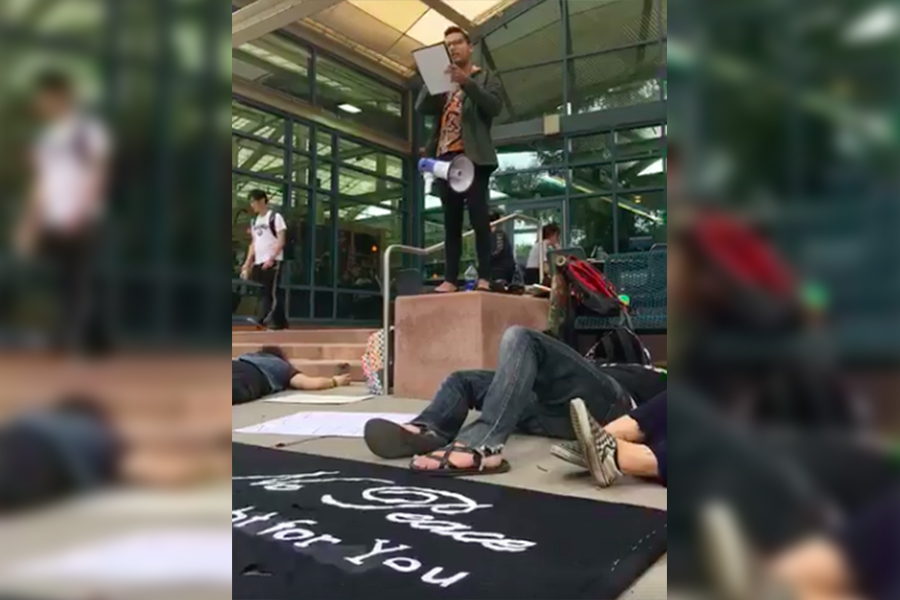
On April 4, the group Students and Workers Ending Racial Violence organized the event #StephonClark Die-In. A group of students gathered in the quad to demonstrate solidarity with people of color who have been killed by police.

According to sociology graduate student B.B. Buchanan, Black Lives Matter Sacramento put out a call on Monday for solidarity actions both across the United States and internationally.

In response to this call, Buchanan and other protesting students had an emergency meeting and organized a die-in to show their solidarity.

“A die-in is a kind of political action which has been [popularized] since Black Lives Matter hit the scene,” Buchanan said. “People lie on the ground […] to provide a visual effect that says the number of people that had been killed has been numerous.”

Around 10 students laid flat on their backs in front of the CoHo, drawing the attention of many passing students.

“[I came out today] for justice for all of the people […] that had been unjustly hurt by the police,” said fourth-year technocultural studies and English double major Becca Payne.

In addition to the die-in, the students chanted slogans such as “No Justice, No Peace.” They demanded justice for Stephon Clark, a black man who was shot and killed by Sacramento police on March 18.

Protesters also laid out a banner which stated “No Justice, No Peace, Rest in Power, We Fight for You.”

“I showed up today because it’s really injustice what happened to Stephon Clark and the whole system of policing,” said second-year political science major Parker Louis. “A lot of people don’t know about these injustices and events like this raise awareness.”

According to Buchanan, there were protests in Sacramento throughout spring break around Clark’s death, and a number of people present at the die-in knew Clark.

“Part of the reason why we put on the solidarity action was to raise awareness that UC Davis is not so far away from Sacramento,” Buchanan said. “People are affected by the death of black folks in Sacramento as well as elsewhere.”


Written by: Clara Zhao — campus@theaggie.org

Beach volleyball and equestrian chosen as new women’s teams

MARK HONBO / UC DAVIS ATHLETICS COMMUNICATIONS

Campus working group confirms the addition of beach volleyball, equestrian as new women’s sports

After almost six months in the making, nearly 600 nomination responses, and a public forum throughout the process, the working group at UC Davis whose duty to select the new women’s sports added to the university ended today, April 13. With the addition of beach volleyball and equestrian, the university now sponsors 16 women’s intercollegiate athletic teams to adhere to Title IX compliance.

Both of these teams are scheduled to begin operating in the 2018-2019 school year, and gifts are currently being solicited from donors to ensure both sports have long term financial stability, according to a press release by UC Davis athletics.

“The process included outreach to various donor groups who had a particular affinity for the candidate teams,” Athletics Director Kevin Blue said in a phone interview. “People could make a pledge of support that would be binding only contingent on their preferred sport being added.”

As for the process by which faculty will be hired, Blue says the Athletics Department “[doesn’t] have those details finalized at this point but [does] look forward to moving without undue delay in [its] coaching searches.”

For beach volleyball, UC Davis will now be seventh school to compete in this sport in the Big West Conference. Planning for a new practice and competition facility has begun immediately according to the press release.

“Beach volleyball is one of the fastest growing sports in the United States,” Blue said. “It has been a significant driver of interest at the Olympic Games so beach volleyball is an increasingly popular sport.”

The new facility will be funded by a generous gift from a university alumni and donor who wants to remain anonymous.

“I’m just wondering where they are going to be getting beach volleyball courts,” said third-year environmental policy major, Regina Weiss. “I think [the addition] makes more equality in sports, it gives women more opportunities to be in athletics at the school.”

Current UC Davis women’s head volleyball coach Dan Conners will oversee the beach volleyball program as the director of volleyball, and a national search will begin to hire a head coach for the team.

“Right now we [the indoor team and coaching staff] are excited,” Conners said in a phone interview. “We will be looking to hire an additional staff member to run the beach side of things. We have to hire a coach and get the recruiting process going for the team, but right now there will be meeting with administration to carve a path forward.”

As for equestrian, the team will compete at a national level in the National Collegiate Equestrian Association against large public schools. The team will be partnered with the  School of Veterinary Medicine and the College of Agricultural and Environmental Sciences at UC Davis.

“With respect to equestrian, I think people in the UC Davis community are familiar with the robustness of our equine programs both in animal science and veterinary medicine,” Blue said. “As a result, the community of people who are interested in equestrian is robust at UC Davis.”

There is currently a capital campaign to build a “state-of-the-art equine performance center” noted in the press release. The team is said to work closely with Campus Recreation, who manages the UC Davis Equestrian Center, which has been at the university since 1962.

“An NCAA Equestrian program at a university such as UC Davis will draw some of the top riders in the nation,” said Dr. Leah Fiorentino, the executive director of the NCEA in an email interview.  “UC Davis has access to one of the strongest pool of Equestrian student-athletes on the West Coast, making UC Davis the strongest in your geographical area to add this type of meaningful education opportunity for NCAA Equestrians.”

The National Collegiate Equestrian Association (NCEA) works in collaboration with the NCAA to guide the sport of NCAA Equestrian through the emerging sport process and we look forward to supporting UC Davis over the next few months.

Donors have already offered support to the program and further gifts for continued financial stability are being sought. As far as the horses for competition, “horses that are part of collegiate equestrian programs are often gifted to universities”, the press release mentioned. A national search for a head coach for the new equestrian team will begin immediately.


A summary of the process of the working group and the assessment of the new teams can be found here.


Written by: Ryan Bugsch and Veronica Vargo — sports@theaggie.org

College basketball season ends with Villanova as Wildcats top Wolverines in men’s title game

BILLY HATHORN [(CC BY 3.0)] / FLICKR
After a tournament filled with upsets, Villanova comes out on top

The Michigan Wolverines and the Villanova Wildcats faced off against one another in the NCAA Men’s Basketball Championship on April 2 after an unpredictable tournament filled with upset, intrigue and entertainment across the board. The game, which was played in front of a packed house of nearly 70,000 people at the Alamodome in San Antonio, drew attention from across the world of basketball with notable players like Villanova red-shirt junior Mikal Bridges and Michigan first-year guard Jordan Poole, whose thrilling buzzer-beater earlier in the tournament helped keep Michigan’s hopes alive. However, once the game began, the attention shifted to an unlikely place.

After a slow start from the Wildcats where they trailed Michigan 14-8 after six minutes of play, Villanova head coach Jay Wright found a spark in the form of red-shirt sophomore guard Donte DiVincenzo, who entered the game with a much-needed three-pointer and never looked back. Despite falling behind by as many seven points, Villanova fought hard to keep it close. Finally, took the 23-21 lead on a DiVincenzo jumper. After a brief exchange of baskets with the Wolverines, DiVincenzo’s stellar shooting helped the Wildcats secure a comfortable margin after going ahead once and for all 25-24 and never looking back.

Despite showing some life in the second half, Michigan was never able to overcome the deficit, falling behind by as many as 22 points on multiple occasions. DiVincenzo’s 19 second-half points and Bridges’s 15 were too much to handle, and despite Michigan showing life throughout the half, they were never able to overcome the Villanova onslaught.

DiVincenzo’s 31 points off the bench on 5-7 shooting from three-point range proved too much for the Wolverines, whose entire bench squad scored just seven points. He didn’t do it alone, however, as Bridges, who is expected to be a sought-after pick in the NBA draft, scored 19 points of his own. On the boards, first-year forward Omari Spellman led the way for his team with 11. For Michigan, led by 23 points from senior guard Muhammad-Ali Abdul-Rahkman, the inability to shoot the ball from three-point range while also failing to get any meaningful production from their bench proved costly for the Wolverines, who eventually fell 79-62.

With Villanova’s victory, the team became the champions of Division I men’s basketball for the second time in three years and third time overall. With Bridges, who was also a part of their last title run, expected to be a high pick in the upcoming NBA draft, the looming signing day could prove vital to their continued success in the long run.


Written by: Bradley Geiser — sports@theaggie.org

NBA postseason preview

MIKE D [(CC BY-SA 2.0)] / FLICKR (left), KEITH ALLISON [(CC BY-SA 2.0)] / FLICKR (right)
A look at teams positioned to make a finals run

The long, strange trip that is the NBA regular season has finally come to a close. Once again, basketball fans were treated to a year of intriguing storylines, surprising performances and all-around drama. Blockbuster trades and major injuries have resulted in impactful roster changes across the league. Young phenoms and new heros have emerged as elite playmakers, inserting themselves into the mix of the league’s perennial all-stars ready to chase a championship ring. But while flashes of individual brilliance are enough to win in the regular season, each club will need its entire roster to contribute when title hopes are on the line. Let’s break down which franchises are entering the playoffs with the best shot at championship contention, and what will help or hinder each team in its quest to bring home the Larry O’Brien trophy this June.


The Unpredictable East

Legit: Toronto, Cleveland

Interesting: Boston, Washington, Philadelphia

Not quite ready: Indiana, Miami, Milwaukee


Toronto Raptors

The Good: The backcourt and the bench. With the Raptors earning the East’s top spot for the first time in franchise history, the Eastern conference has had a different one-seed in each of the past seven postseasons. Although four of the five starters are the same as last season, this is a Toronto team that feels more confident and poised to make a deep playoff run. Not unlike previous seasons, Toronto’s backcourt, led by all-stars Kyle Lowry and DeMar DeRozan, is the strength of this team. At age 32, Lowry is still playing over 30 minutes per night while averaging just over 16 points per game and shooting above 40 percent on threes. At shooting guard, DeRozan has rebounded nicely after having a career year in scoring last season. Averaging 23 points and just over five assists per game, DeRozan has shown that he can be a top-ten scorer and drop dimes, too –– he shattered his single-season record for assists this year. Even if Lowry or DeRozan experience a brief scoring slump, the Raptors have the talent and experience across the entire lineup to take the pressure off the two all-stars. The center power forward tandem of Jonas Valanciunas and Serge Ibaka has also given the Raptors production out of its frontcourt this season. And when Lowry and DeRozan get their much-needed rest, sharpshooting guard Fred VanVleet and veteran point guard CJ Miles have both contributed well in the scoring column off the bench this season.

The Bad: Lowry and DeRozan getting over past postseason failures. Securing the top spot in the east is nice, but that alone is not good enough to erase the previous four postseasons that have ended in heartbreak for the team up north. The Raptors will need its superstar backcourt to kick into high gear to make a run, but to a lesser extent than in past seasons given how well the bench is playing. The Raptors are a well put together, balanced ball club; they do not do much of anything poorly. But Lowry and DeRozan must get over the mental block that has, for whatever reason, contributed to the Raptors downfall in the past. Toronto will only go as far as its backcourt will take them.


Cleveland Cavaliers

The Good: LeBron. The Cleveland Cavaliers are the other team in the East that has a real shot at winning a title, but that’s really only because the Cavs have a player named LeBron James. The four-time MVP has been on an absolute tear over the last month and a half. James averaged over 30 points in the month of March and ranks third in the league in scoring over the entire season. In his 15th NBA season, James totaled a career-high in assists and is having one of his best three-point shooting seasons in several years. The King has proven that he can do it all by himself, and maybe he still has enough to get the otherwise lackluster Cavaliers where they need to go this postseason. But in the midst of a roster that has much to prove, forward Kevin Love might just be that player who takes pressure off James to perform at superhuman levels each night. Love is a talented scorer who can get buckets from beyond the three-point line as well as in the post, so his scoring abilities will be needed to keep the Cavs floating above water.

The Bad: Defense. Cleveland gave its roster quite a shakeup just before the trade deadline. Before the Cavaliers front office orchestrated the multitude of trades in early February, the Cavs were nine games above .500. After the trades, the new look Cavaliers won 17 of their 25 contests. Guards Jordan Clarkson and Rodney Hood have been the most productive out of the batch of newcomers, but it remains to be seen if Cleveland possesses a true championship caliber roster that can back up LeBron. The team ranks third to last in defensive rating and has struggled to keep opposing teams in check all season, so the Cavs will need to start with tightening things up on the defensive end before anything else. Other than that, the plan is to give the ball to James and let the rest flow from there.


Boston Celtics

The Good: Defense and balanced scoring. The Celtics are returning to the postseason with a very different lineup from one year ago. The team is littered with veteran leaders and talented youngsters who are hungry to compete as underdogs this postseason. Experienced forwards like Marcus Morris and Al Horford provide steady scoring alongside the youthful ensemble of guards like Terry Rozier and Jaylen Brown. 20-year-old forward Jayson Tatum has also been an excellent contributor in the starting lineup, and so has fourth-year guard Marcus Smart off the bench. All are averaging double-figures in scoring, showing how balanced and versatile Boston is on the offensive end. Boston’s biggest strength, though, is its team defense. Head coach Brad Stevens’ lineup is talented top to bottom and boasts the best defensive rating in the league. Smart, Brown and Tatum are all in the top-ten when it comes to defensive win shares. With its best player out of the lineup, Boston can depend on its defense to turn stops into much needed extra offensive possessions.

The Bad: No Kyrie. The Celtics were dealt a huge blow this past week when news broke that all-star point guard Kyrie Irving will sit out the entire postseason after undergoing knee surgery. Irving was acquired via trade this offseason and has lived up to his billing in the 60 games he played this year for Boston. An NBA champion in Cleveland, Irving’s postseason experience would have been a key asset for Boston. The Celtics will have a difficult time filling the void that Irving’s absence will leave, especially on the offensive end.  


Philadelphia 76ers

The Good: Ben Simmons and team basketball. The 76ers are back in the postseason for the first time since 2012, when they knocked off the one-seed Chicago Bulls. They are not as big of an underdog this year, but they may feel like they are given how awful the team has been over the past five seasons. The number-one overall pick, Ben Simmons, has been incredible for Philadelphia this season. The rookie scored in double figures, is fifth in assists and is third in rebounding among guards. It helps to have a couple sharpshooters to dish to, though, as veteran guard J.J. Reddick and forward Dario Saric are hovering around 40 percent from beyond the arc. Speaking of dishes, the 76ers are second in the league in assists per game, demonstrating how well head coach Brett Brown’s squad is able to share the basketball and find the best shot each possession.

The Bad: Embiid’s health. All-star center Joel Embiid is Philadelphia’s leading scorer, rebounder and shot blocker and is the heart and soul of this Sixers team. Just when Philadelphia was finally getting a full season out of him, Embiid fractured his orbital bone at the end of March. His injury will keep him sidelined for at least part of the first round of the playoffs, but his return might come too late. If Philadelphia really wants to make a deep playoff run, it will need its best player healthy.


The Wild West

Legit: Houston, Golden State

Interesting: Portland, San Antonio, Oklahoma City

Not quite ready: Utah, Minnesota, New Orleans

Houston Rockets

The Good: The Beard and the offense. The Rockets have far and away been the league’s best team this season. Head coach Mike D’Antoni’s offensive juggernaut has at times been unstoppable. The Rockets attempt an NBA-leading 42 threes per contest and are second in the league in points per game. Much of Houston’s offense goes through all-star guard James Harden, who has put on an MVP-type performance from start to finish this season, averaging just over 30 points per game. The Beard has been virtually unguardable, terrorizing opposing defenses with his uncommon shooting ability and tendency to get to the foul line –– his 10 free throw attempt per night average is tops in the league. When Harden is not draining step back triples or going to the line, he’s slashing to the basket and finding open teammates for easy baskets. His 8.8 assists per game ranks fourth among all players. Houston has constructed a roster built to score. With shooters who can splash home triples from every part of the floor, Harden and all-pro point guard Chris Paul have plenty of options to dish to. The Rockets are a nightmare to defend and will have no trouble pushing the pace against any team.

The Bad: Defense and the frontcourt. The defense this season has improved, but not necessarily to a championship caliber level. Fortunately for the Rockets, they can outscore almost anyone without having to put in as much effort in stopping the other team from scoring –– but this could come back to haunt them when they match up against other western teams that are firing on all cylinders offensively. The lack of rebounding and interior defense has also been questionable. Starting center Clint Capela is athletic and fits Houston’s game, but outside of him the Rockets do not have much of an answer defensively for teams with skilled low-post players.


Golden State Warriors

The Good: Four all-stars and depth. It is nearly impossible to beat the Warriors when they are at their best. The pair of former league MVPs Kevin Durant and Stephen Curry are among the most talented offensive players in the league. Curry can get open and catch fire shooting from anywhere on the court and Durant, with his lengthy frame and skilled ball handling, can match up against any defender. Durant has even elevated his defensive game to new heights as he has become a top-10 shot blocker this season. Shooting guard Klay Thompson is also known for his three-point shooting ability, but his defensive skill often goes overlooked. Expect him to be matched up against the best offensive player on each opposing team. The final piece is forward Draymond Green, whose intensity and versatility is unrivaled. Like Thompson, expect Green to take on the toughest defensive assignments and run as the point-forward when Curry rests. Even with these four off the floor, the Warriors have a veteran bench that can still give opponents headaches. Forwards Andre Iguodala and David West are essential for keeping the Dubs running while the starters sit.

The Bad: Health and turnovers. The four all-star starters have only been on the floor together in half of this season’s games. The Warriors were rarely 100 percent healthy at any point over the regular season, and that wear and tear may take a toll on this banged-up roster as it enters another long playoff push. Curry is likely to return at some point during the postseason, but it is unclear when that will be and whether he will truly be healthy. Golden State also has a tendency to get sloppy with the ball and commits the fifth-most turnovers per game. The Warriors will need to keep the mistakes at a minimum, especially if they want to outlast a fierce offensive threat like Houston.


Portland Trail Blazers

The Good: The backcourt. Guards Damian Lillard and CJ McCollum have improved their game tremendously. They both average over 20 points per game, and Lillard is the league’s fifth best scorer. Adding a healthy Jusuf Nurkic and veteran forward Evan Turner into the starting lineup has also helped take some of the pressure off Lillard and McCollum to do everything, which is a real upgrade from last season.

The Bad: Depth. Portland has a high-powered, balanced starting five. When those starters need rest, however, the Blazers have struggled to keep up. With no proven leader off the bench, head coach Terry Stotts will have to find a rotation that keeps a few starters in at all times to maintain order.  


San Antonio Spurs

The Good: Aldridge and Popovich. Forward LaMarcus Aldridge has elevated his game significantly over the last month. In the 12 contests since March 13, the 32-year-old has averaged just under 30 points and nine rebounds, and has shot over 50 percent from the field in 10 of those games. Although not a young man himself, Aldridge’s play has been enough to keep seasoned vets like Tony Parker, Manu Ginobili and Pau Gasol engaged. But do not forget that the Spurs have one of the greatest coaches of all time in Gregg Popovich. He has been able to get the most out of his aging roster by inserting the likes of Rudy Gay, Patty Mills and 21-year-old Dejounte Murray to keep the energy up on both ends of the floor.

The Bad: Where is Kawhi? San Antonio has lost a bit of its mystique of being a legitimate title competitor. The Spurs are in the postseason for the 21st consecutive season, but this time are without superstar Kawhi Leonard, who has played in just nine games this season. His status remains a mystery as it was reported that he was recently cleared to play but has not shared when or if he plans to return to the court in the postseason. Without him, the Spurs are simply not as good and will have a nightmare matching up with Houston or Golden State.


Oklahoma City Thunder

The Good: The big three. You are probably thinking of reigning MVP Russell Westbrook, all-star Paul George and all-pro Carmelo Anthony, right? Then you are two-thirds correct. The real third piece to the Thunder’s big three is actually Steven Adams, not Anthony. Anchoring down the center position, Adams provides true stability to the Oklahoma City lineup. Adams is an expert rebounder, defender and post scorer. Westbrook and George will do their thing by averaging over 20 points a night, while Adams will consistently score in double figures and win extra possessions for the Thunder to take advantage of. And obviously, Westbrook is one of the best players in the league right now and has the ability to take over any game with his ferocity and athleticism. George is also one of the game’s most skilled scorers and defensive forwards. If the three of them –– Westbrook, George and Adams –– can get hot at the same time, the Thunder will be a curious team to follow this postseason.

The Bad: Inconsistency and depth. Outside of Westbrook and Adams, the Thunder have been wildly inconsistent in terms of production. George and Anthony seem to score in streaks, and there is no true point producer off the bench. The defense has been mediocre as well, especially since noted defender Andre Roberson went down with a season-ending injury in January. It will be interesting to see if the Thunder can remain competitive with Westbrook off the floor.


Written by: Dominic Faria — sports@theaggie.org

Review: Fourteenth Annual Hellacappella

TAYLOR LAPOINT / AGGIE

Mondavi showcase a major success.

Many minds were blown at the 14th annual Hellacappella showcase on April 6. Star-studded performances from a cappella groups from all over the West Coast proved to be an indefinite crowd-pleaser.

The event itself was organized by UC Davis’ premier all-female a cappella group, The Spokes. This year, the showcase sold out the Mondavi Center’s more than 1,800 seats.

Wearing striking, bold shades of hot pink and jet black, The Spokes sang a range of songs aimed at female empowerment and the expression of the group’s unique personality as an all-female ensemble.

Members of UC Davis’ Birdstrike Theatre acted as emcees for the showcase, introducing each of the a cappella groups with line after line of comedy gold.

“One of my favorite parts of the show was the witty comedy in between the a cappella groups,” said Kat Hanrahan, a second-year environmental science and art history double major.

The effort and dedication of each of the individual a cappella groups shone through in their spectacular performances which featured a range of songs old and new.

“There is something really beautiful when others get to share in the fruits of your labor,” said Audrianna Escobedo, a second-year art history major. “It was a wonderful night!”

Another crowd favorite in the showcase turned out to be the all-male a cappella group from the University of Oregon, On The Rocks. The group has recently released an album.

“Hellacappella is actually really special for us because we get to represent the Northwest and much of Oregon,” said Jasper Freedom, a member of On The Rocks. “We’ve been working on this album for four years. We’ve put a lot of thought into every aspect of it.”

Overall, the night proved to be a wild success, continuing Hellacappella’s legacy as a wonderful showcase that highlights the vocal prowess of many West Coast a cappella groups.


Written by: Isaac Flores — arts@theaggie.org

Using gravity to see stars further through space, time

STEVEN RODNEY / UNIVERSITY OF SOUTH CAROLINA

Distant stars come into focus when light bends around massive galaxies

Astronomers have imaged the furthest star yet discovered in the universe and documented an unusually quick brightening and dimming of a different star by using gravity as a magnifying lens. Researchers have given the stars nicknames: the extremely distant star is known as “Icarus” and the star with changing brightness is known as “Spock.”

Both papers, published in Nature Astronomy, use a process called gravitational lensing to see further back in time and space by using gravity of massive bodies to increase magnification of telescopes. Celestial objects which would be invisible can now be studied.

“We use the magnification to study the very first galaxies of the universe,” said Maruša Bradač, an associate professor in the UC Davis Department of Physics involved in both projects. “A team has selected six clusters to study very actively for that particular type of research. We use the galaxy clusters as lenses to study background galaxies.”

Massive galaxy clusters, each containing multiple galaxies and billions of stars, cause the light behind them to be bent and distorted by their immense gravity. Emitted light from stars, galaxies and other celestial structures further away are magnified and made visible to instruments such as the Hubble Space Telescope after bending around the huge clusters.

“They’re among the most massive structures in the universe,” said Austin Hoag, a Ph.D. candidate in the UC Davis Department of Physics and one of the team members of the Spock project. “All that mass makes them excellent tools for looking behind them and using them as natural magnifying glasses.”

Six clusters, called the Frontier Fields, were chosen to be observed for hundreds of hours by Hubble team members due to their exceptional mass and gravitational lensing capabilities.

“Around 2013, there was a new opportunity with Hubble,” said Steven Rodney, an assistant professor in the department of physics and astronomy at the University of South Carolina and one of the leaders of the Spock project. “The director at the time, Matt Mountain, had decided to invest a large amount of Hubble Telescope observing time in to what became the Frontier Fields project. The idea was that, using these gravitational lensing galaxy clusters, you could amplify Hubble’s capabilities. You could reach farther back in time, deeper into the universe, and see things that would normally be invisible, even to Hubble, by harnessing the power of the dark matter lenses that comprise the galaxy clusters.”

Icarus and Spock were spotted in images taken during the Frontier Fields observation studies, each being found in a respective galaxy cluster: MACS J1149 and MACS 0416.

“In the spring of 2016, I was looking through some of the images we got from Hubble and saw a new source in a special part of the field where the magnification from the cluster should be extreme,” said Patrick Kelly, an assistant professor in the School of Physics and Astronomy at the University of Minnesota and one of the leaders of the Icarus project. “It turned out that it had brightened, because a star orbiting around the cluster moved into the right spot and boosted the magnification by a factor of three, up to a total magnification of 2,000.”

For a brief time in May 2016, Icarus was bright enough for scientists to deeply investigate properties of the star. Icarus turned out to be the farthest star yet discovered.

“We measured its redshift, which tells you how much the universe has expanded since the light was emitted,” Kelly said. “We know the light was emitted 9.3 billion years ago, so the light has travelled 9.3 billion light years. That’s about three-fourths of the way back to the Big Bang. The next nearest star we can study individually is 100 times closer.”

After finding Icarus, Kelly was able to review past Hubble images taken in the same area to check if the star, a million times brighter than our sun, had appeared in previous observations. Hubble had been observing the cluster for a few years, allowing comparisons between exposures over time. Icarus is still available for study, but not at the same extreme magnification of 2,000 times.

“We can see [Icarus] all the time, if you look at it with Hubble,” Kelly said. “It’s always magnified by a factor of 600. That’s a difference with the other paper. With Spock, you can’t see anything there anymore.”

Spock is a star that briefly brightened and dimmed multiple times over a period of only a few weeks in 2014, enough time for researchers to notice interesting properties about the event.

“Spock was very unusual because it was very fast,” Rodney said. “It rose to its peak brightness in just a few days and faded away again, also in just a few days. It was all done in a matter of a couple of weeks. It was also unusual because it was fainter than a supernova but brighter than a nova.”

Mysteries remain about what exactly caused Spock to brighten so quickly. Brightening episodes due to stellar explosions or a planet impacting the star don’t seem to fit the timing pattern, or conflict with some of the information researchers received from Hubble studies.

“Spock is at what we call a redshift of one, which is about half the age of the universe,” Hoag said. “So that’s about seven billion years old.”

Having a telescope like Hubble in space has been a boon for stellar researchers. Terrestrial telescopes have trouble piercing the atmosphere with certain instruments and must also deal with light pollution from human civilizations.

“The Hubble Space Telescope images are what makes this possible,” Hoag said. “That’s because the Hubble Space Telescope has really good resolution, and it’s not affected by the atmosphere, which makes the resolution worse.”

The successor to the Hubble Space Telescope is deep in development. By 2020, astronomers and engineers hope to launch and deploy the James Webb Space Telescope, which will orbit the sun about 1.5 million kilometers from earth. The hope is that James Webb will be able to reach deeper into the universe, perhaps up to 13.4 billion years ago, when some of the first stars were forming. Hubble will continue to be used as a valuable scientific tool.

“We are pushing the envelope all the way to the very beginning of the universe,” Bradač said. “We study some of the first galaxies that formed in the universe, trying to figure out what they look like, what they’re made of. In particular, we’re trying to answer the big question: where did we come from?”


Written by: George Ugartemendia — science@theaggie.org

Cartoon: Colors

ARIEL HILOMEN / AGGIE


By: Ariel Hilomen — opinion@theaggie.org


Disclaimer: The views and opinions expressed by individual cartoonists belong to the cartoonists alone and do not necessarily indicate the views and opinions held by The California Aggie.

The tangible effects of global warming on coffee

MARINA OLNEY / AGGIE

Rising temperatures could drive coffee to extinction

Each day brings with it damning forecasts of the consequences of global warming:  intense and prolonged droughts, rising sea levels and stronger storms. And each day, this data falls on deaf ears as we struggle to understand how to incorporate it in our daily routines: How can I feel the effects of the sea level when I live in a landlocked town like Davis?

Data and statistics will not grab the public’s attention, nor will issues that don’t directly impact their lives. It won’t be a polar bear or pine tree that will mobilize students to join the fight against climate change.

It will be the humble coffee bean.

A persnickety plant, coffee requires incredibly specific temperature, amounts of rainfall and soil composition to bear fruit. For these reasons, coffee farms are largely limited to equatorial regions like Venezuela and Ethiopia.

Warming temperatures, however, put these fragile plants on the chopping block. The amount of available land for coffee cultivation in Latin America is predicted to decrease by about 88 percent by 2050, while the loss of acreage will clock in to around 50 percent globally. What does this mean for us coffee consumers?

Some 50 years ago, John Hall, a musician and former U.S. representative, released a song famous for its memorable tagline: “Plutonium is forever.” Replace “plutonium” with “coffee,” and the line becomes a description for how we treat the plant.

American society is so inundated with coffee that we’ve become accustomed to its constant presence. Peer down a block in any city, and you’re likely to find a Starbucks, Dunkin’ Donuts, Peet’s or local cafe.

A couple of years ago, I remember my mother calling me out of the blue: Her hometown in Indiana, she told me excitedly, had just received its first Starbucks. The nearest Starbucks had previously been over an hour away.

Look at our own campus — we’re well acquainted with this culture of coffee as well. Enter the Memorial Union at 8 in the morning, and you will most likely be greeted by a whiff of ground coffee brewing behind the Swirlz counter 100 feet away. And if the MU is too far of a walk for you, go to the South Coffee House, BioBrew or one of the two Peet’s for a cup.

I’m well acquainted with this way of thinking, too.

Whenever I lug open one of the main doors during the calm quiet of an early morning, my body’s reaction is practically immediate and expected: My heart beat speeds up, my steps quicken and a competitive streak the likes of which I’ve never known bursts forth like a student rushing out of a lecture hall when the clock hits the hour.

I can see it now: my holy grail in the form of a small, steaming hot cup of coffee.

In routine moments like these, the future appears set in stone, like the John Hall song: I wake up, I get dressed, I get a piping hot cup of Joe. To me, it feels like a sort of commercialized rite of passage: Are you truly a college student — and, subsequently, a true adult — if you do not rely heavily on coffee to make it through your morning classes?

And after getting my cup, I notice that I’m not alone in using coffee as a crutch — the morning hours in the CoHo spell out a constant influx of students and professors alike lining up to get their own fix.

So when coffee disappears, we college students will most definitely notice its absence.

Scientists and their data will go only so far. That’s not to say that the studies and information are false or irrelevant. But the public can’t fathom what an increase in temperature by 1 degree Celsius means to them. It’d be difficult to find something less relatable than numbers and statistics surrounding an enormously vague scientific concept.

The news needs to be peppered with articles that speak personally to their audiences, articles that will explain how global warming will affect the public individually. We can’t continue to mention how much the sea level will rise as the Arctic melts without first addressing what that means for coastal communities.

If you want to get public’s attention, walk into your local coffee shop in the morning and tell them that coffee won’t be here for much longer.


Written by: Erin Hamilton — elhamilton@ucdavis.edu

Disclaimer: The views and opinions expressed by individual columnists belong to the columnists alone and do not necessarily indicate the views and opinions held by The California Aggie.