41.5 F
Davis

Davis, California

Saturday, December 27, 2025
Home Blog Page 532

Over 200 Bay Area community members arrested in March

JEREMY DANG / AGGIE

Local law enforcement, Immigration Law Clinic, AB540 and Undocumented Student Center perspectives

A certification of an UndocuAlly training is signified by four butterflies against a green background, similar to the logo of the AB540 and Undocumented Student Center, a circle of interconnected butterfly wings. The addition of this butterfly to the end of a professor’s email, or to the number placard on their office door, can mean more to some students than others. According to Jesica Cuervos, a fourth-year transfer sociology student who is also a community advocate for the AB540 and Undocumented Student Center, the butterfly can help build trust.

“This also helps students who are taking a class […] and they see a professor who has that symbol outside their door, it kinda helps them build that trust because automatically they know that to an extent that professor already has that knowledge and doesn’t have to start from the beginning and explain ‘what is undocumented,’” Cuervos said.

This trust may be difficult to achieve during a moment in which the political climate seems to indicate an increasingly aggressive stance toward the undocumented, immigrants and minorities. Holly Cooper, the co-director of the Immigration Law Clinic at UC Davis, reflected on 20 years of work with detainees.

“We’ve always had this architected system of detention which is a very punitive environment for migrants,” Cooper said. “Some of the dynamics that I have seen change since the outset of the Trump administration are policies toward when a person can be released, and policies toward who should be apprehended. Now it feels like almost everybody is a priority.”

Cooper’s experiences have taught her that while the system of detention, which was a Democratic Party construct and increased militarization of the border, was part and parcel of the Obama administration. Today, amid increasingly aggressive immigration reform rhetoric, deportation does not seem to belong only to migrants with a strictly “criminal” history. Despite a broader definition of deportability, the rhetoric of criminality around migrants could not be more prevalent. Cooper and Yolo County sheriff-coroner and public administrator Sheriff Prieto critique this development.

“When we give credence to this whole terminology of criminality, we’re also giving credence to this whole system architected by racial principles, racist principles,” Cooper said.

Although Cooper is skeptical of the history of the criminal, penal system, Prieto works to move past the rhetoric that drives racist immigration policies and turns instead to constitutional law, human rights and due diligence.

“As the sheriff of Yolo County, my position has been very clear, even before the undocumented issues had become so vogue in our nation,” Prieto said. “I’ve always been a very staunch supporter of human rights, our constitutions, I’ve always been a very firm believer in our undocumented, that there are certain rights that have to be afforded to you […] just by the due diligence of law and court proceedings.”

The March 2018 ICE raid and arrest of 232 individuals in the Bay Area piqued the attention of the federal government and the general public following Oakland mayor Libby Schaaf’s warning to her constituents. Schaaf chose to notify her community of a potentially impending raid, information from an undisclosed source, in order to give individuals time to organize their affairs and prepare for the worst. ICE responded negatively, accusing Shaaf of responsibility for over 800 potential obfuscating undocumented migrants with a criminal history. Of the 232 individuals arrested, approximately 100 have a criminal history. Cooper resists the ease and exceptionalism with which political rhetoric has applied criminality to the undocumented.

“I’ve never been one to sort of run away from having a dialogue, an honest dialogue, about what it means to be an immigrant with a criminal history,” Cooper said.

Sheriff Prieto refers to a deep respect for the legal system to handle criminality as opposed to aggressively targeting the undocumented, whom he sees as scapegoated in our current political moment.

“The Yolo County sheriff’s office does not get involved in participating in any form of ICE raids, nor would we nor will we as long as I’m sheriff,” Prieto said. “We do not make arrests of undocumented individuals in the county, those that we stop, just because they’re undocumented. If somebody commits a very serious crime […] they are held in custody until they have a preliminary or they post bail. That is the due diligence of our constitution and human rights.”

Unfortunately, those arrested in Oakland will likely next be detained, according to Cooper. Once detained, Cooper says that the best chance an individual has to avoid deportation is through assistance of a lawyer, often an unaffordable prospect.

“If someone is detained they only have, like, a 15 percent chance that they will have legal representation,” Cooper said. “The chances are even lower that they’ll have free legal representation. The number one determining factor if someone is going to stay in the United States is whether they have a lawyer.”

The system of detention and deportation is convoluted, rendering those arrested hard-pressed to represent and protect themselves. The Immigration Law Clinic at UC Davis tries to represent all those it can within its resources, although they are limited. The AB540 and Undocumented Student Center, too, offers at least some level of legal services to its members.

“In general all students from UC Davis have access to legal resources for them and their family member,” Cuervos said. “Usually students feel confident and comfortable in that setting if they’re making an appointment and coming into the center and talking to a fellow that would also take into account […] even the mistrust that many students and general community members have with talking to lawyers and being in that space.”

Alongside a legal fellow, students of all types of documentation can seek counsel, at the very least. Aside from practical legal aid, the center manifests a space and ethos of community. Previous to 2014, the center was constantly reorganizing, transforming and struggled to present a clear message. Today, it is growing and is able to provide resources and support without constantly teaching people what it means to be undocumented.

“Through our center we offer a lot of different ways for students to get help, whether it’s financially or mentally or just finding a home away from home,” Cuervos said. “Each individual student doesn’t represent the story of everyone, and for that same reason it’s harder to understand the struggles and the amount of stress and the amount of emotional and mental stability that students have to control and deal with on a daily basis.”

Despite the fact that Davis is a sanctuary city and Sheriff Prieto pledges to never cooperate with an ICE raid in the county, members of the UC Davis community and beyond still fear the unknown. Whether for themselves or others, recent events spark fears.

Especially now with the political climate I think everything is in a tension and you just don’t know what is going to happen and the reality is so not sharp for many of the students who identify as undocumented,” Cuervos said. “That’s another fear that students face […] the student might not be undocumented at all but the parents might be, or a sibling might be.”

Those who want to protect and support the undocumented community at UC Davis and Yolo County at large can sign up to become an UndocuAlly with AB540 and Undocumented Students Center.


Written by: Stella Sappington — features@theaggie.org

Humor: Teachers should quit their bellyaching

BRAD PERKINS [(CC BY-SA 2.0)] / FLICKR
I mean, is it really that bad?

It’s like the Buffalo Springfield song, “A thousand people in the street, singing songs and carrying signs.” Only, instead of a thousand people, there are dozens of teachers. Handfuls, really.


All around the U.S., teachers are acting like mafia wise guys, demanding money and respect — in New Jersey accents. That’s what the news reports are calling “teacher activism.” That’s one version of it, anyway. But what I’d like to know is, why should we pay teachers good money to teach the next generation? Isn’t that like investing in our future?


When you think about it, teachers don’t deserve high wages — or wages at all. It’s not like they’re doctors (well, it’s not like all of them are doctors). Besides, what they earn is far more rewarding than any monetary value. Teachers earn the adoration and respect of their students, who would do anything for them — except maybe agree to increase their salaries. If it were up to this reporter, teachers would use a bartering system instead of currency. Imagine this: You could pay for your education with your old stamp collection. It’s better than throwing the stamps away.


“I make peanuts teaching science,” said Ted Nugget, a middle school science teacher. “I heard In-N-Out managers make six-figure salaries, so I’d rather teach your kids to flip burgers. Maybe I can use my old set of Bunsen burners at my new job […] What’s that? […] Oh. I guess they’ve melted those down to make cattle prods for corralling the teachers back inside.”


Some teachers are chanting the slogan “Red for Ed,” which raises a lot of questions. First of all, who’s Ed? Doesn’t Ed’s preoccupation with red have something to do with gangs, matadors or Nazis? Why are teachers spreading Communism to our schools? These are just some of the questions that we may never be able to answer.


There are many teachers who argue that they don’t just care about their salaries. They’re worried about student luxuries like “textbooks” and “asbestos-free school buildings.” Boo-hoo.
Teachers should go back to being martyrs. It’s easier and better for everyone that way.


Written by: Jess Driver — jmdriver@ucdavis.edu

(This article is humor and/or satire, and its content is purely fictional. The story and the names of “sources” are fictionalized.)

Implications of ARC construction on student organizations

DIANA LI / AGGIE

Performing groups struggle to find practice space amid inconvenient construction

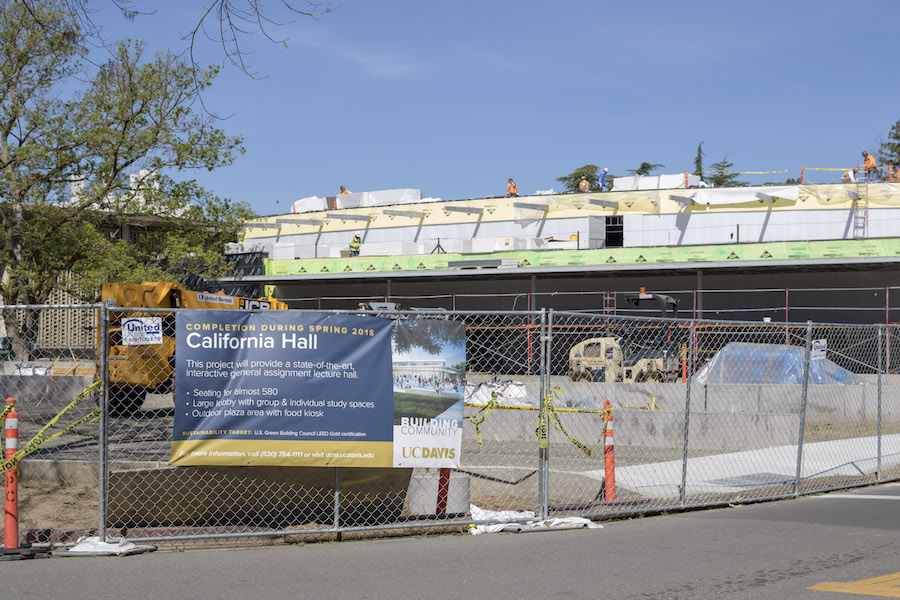
Construction on the ARC began in mid-2017 and will continue through 2019. Avid users of the ARC can testify that construction has been an inconvenience to students; it limits the space of the gym, condensing the weight room on the basketball courts and limiting aspects of the ARC such as volleyball courts, racquetball courts and dance rooms.

Allie Young, a fourth-year clinical nutrition major, is a choreographer and captain of MK Modern, a dance group on campus. Young noted her frustration with the construction on campus and the implications it has in scheduling and planning practices for her dance group.

“One of the things that makes it really difficult [to practice in a studio] is that the ARC closes earlier now and the Pavilion side is closed by 11:30,” Young said.

MK Modern previously practiced in the Pavilion, utilizing the open space and mirrors better structured for dance teams. With the construction making the Pavilion an inconvenient option for dance groups, these organizations are forced to be creative in finding new space to practice. For MK Modern, the Hutchison parking garage makes an adequate practice space.

“Since our practices usually go from 10 p.m. to 1 a.m. and sometimes later, it’s really difficult to start practice in the Pavilion and move outside,” Young said. “Now we kind of just do the whole practice outside, which is why we practice in the parking structure.”

But Young noted that while the parking structure is an option for the dance group to practice at, it isn’t a space intended for performers, which is clear during practices. She notes specifically that the lack of mirrors makes it difficult for MK Modern to learn new routines and reflect on their dances.

“It makes it really hard for us to learn pieces and get an idea of where we really are just because there are no mirrors to watch ourselves and check ourselves,” Young said. “Now it’s really a reliance on the choreographer or the director who are watching the piece to help clean up the choreography.”

Performing groups come to the general consensus that the school doesn’t provide enough support or respect to performance groups, especially highlighted during the construction of the ARC.

“It feels like the school doesn’t really care or respect its registered student organizations, even though we all put a lot of time and effort into our sets in order to perform and compete outside of Davis, representing UC Davis,” Young said. “The Pavilion closes earlier, which means a lot of dance teams are forced to practice outside. The problem is that when we do practice in the parking structure, the police will often come by and kick us out. So in the end, it feels like we can’t practice anywhere on campus.”

Annie Altura, a fourth-year food science major, is a member of the Cleftomaniacs, an acapella group on campus. She notes that the hunt to book rooms may be somewhat easier for her group than for other performance art groups like MK Modern, as they aren’t as limited in their search for a practice space of a specific size. However, Altura admits that the UC Davis administration does give them challenges in booking these practice spaces.

“It is a little challenging, I don’t think we’ve ever gotten helped with regard to booking rooms,” Altura said. “We’ve been trying to book rooms for auditions, and there’s usually a cap of four hours a week, and a raise in price from $10 to $32 per reservation. We would have to request extra hours in order to book more rooms. It’s tricky to find rooms with good sound because that’s not exactly something administration would know.”

These performing organizations attempt to find creative solutions in order to continue their practices and prepare for upcoming competitions and showcases, but emphasize the difficulty in doing so due to the school administration. Hau-Ping Ting, a third-year biochemical engineering major, recalls difficult experiences finding practice spaces for her dance group due to interference from school representatives.

“We got kicked out [during practice] a few times, especially now that the ARC is under construction,” Ting said. “We tried to practice at the racquetball court once but they made us leave. They told us that it was intended for other sports, even though we reserved the court and there wasn’t any other space we could use to practice.”

Additionally, amid the large expansion and construction of the ARC, there was little to no renovation planned to foster growth or support for the performing arts.

“If you see the ARC under construction there’s nothing that really gears towards dance,” Ting said. “The dance studio on the second floor is still open, and it’s just really old. Renovation and expansion is probably needed, but it’s not happening right now.”

Members of these organizations advocate for change and note solutions that UC Davis’ administration can adopt in order to better respect the time and efforts of the performing arts groups on campus.

“I would suggest allowing us to reserve practice spaces more often, more than just two days for two hours,” Young said. “[They could also] allow us to reserve more practice spaces — so not just the Pavilion or dance studio, but also Freeborn Hall or the dance studio in Hickey Gym.”


Written by: Alyssa Hada — features@theaggie.org

Cartoon: Guide to Davis critters

Written by: Diana Olivares — opinion@theaggie.org

Disclaimer: The views and opinions expressed by individual cartoonists belong to the cartoonists alone and do not necessarily indicate the views and opinions held by The California Aggie.

From the California Chronicles: Then I noticed there were two of him…

CHRISTIE NEO / AGGIE

As I leaned in, Paul was trying to hand me a stick of peppermint gum. I cuffed my hand around my mouth and exhaled to get a good whiff. I quickly reached for the stick of gum. Turns out, we were both from the same part of the state, so we had a boring, yet sturdy, starting point to build off of. He was studying biology, which was fine; I could carry the conversation (he was very personable).

I told him that I was an international relations major and I wanted to work in the nonprofit sector. After going back and forth between staring at the ceiling and staring at my phone for a considerable amount of time, I decided to look for something to do. Paul had left to have a final dinner with his family, so it was up to me to find entertainment and make bad decisions on my own.

I suddenly remembered that I had run into a friend from orientation earlier that day who was moving into my dorm building also. To my luck, she was planning to go out with her roommate, and everything is better in threes. Three hours later, we were sitting in their room.

Normally, I’m all for coconut-flavored stuff — but maybe not in rum. My stomach turned and my face scrunched up like I had just stubbed my toe in the middle of the night and couldn’t yowl in pain. The walk down Russell Boulevard was crowded, and the people yelling “freshmen” from their cars soon became obnoxious. We coerced our way into a hot frat house serving warm Kirkland beer. I stared off into the sea of sweaty bodies and started to realize I wasn’t doing so well.

Then I noticed there were two of him, two of the same guy in the doorway. I made my way back to my dorm, got into bed and conveniently needed to pee as soon as I lay down. With a spinning head on my shoulders and wearing nothing but boxer briefs, I felt the door slam behind me without my ID card or my phone.

Paul sent me a text earlier: “Staying at my parents’ hotel. Don’t wait up. Haha.”


Next week: The RA


Written by: Terry Hudson

Disclaimer: The views and opinions expressed by Terry Hudson are completely fictional and do not necessarily indicate the views and opinions held by The California Aggie. The story is fictionalized, as is Terry Hudson.

Gender and Sexuality Commission chair resigns

ALEXA FONTANILLA / AGGIE

Becca Nelson accuses newly-elected ASUCD president of problematic behavior

Fourth-year psychology and Spanish double major Becca Nelson has stepped down as chair of the ASUCD Gender and Sexuality Commision. In an email obtained by The California Aggie, Nelson said part of their reason for quitting is related to the recent Winter Election, as they believe ASUCD workers deserve to “work with people who don’t antagonize and dismiss us for voicing our experiences and pain.”

On Feb. 23, GASC’s Facebook page posted a message in reference to the ASUCD Winter Elections outcome, stating that it doesn’t “support executive elects complicit and active in maintaining white supremacist, trans antagonistic, LGBTQIA antagonistic, and patriarchal institutions.”

Nelson accused newly-elected ASUCD President Michael Gofman of making fun of ASUCD members for their LGBTQIA identity, making light of cultural appropriation and engaging in voter fraud. They also criticized Gofman’s support of controversial Breitbart senior editor Milo Yiannopoulos’ visit to campus last year.

Gofman said that he not transphobic and that “there have been many baseless accusations thrown around this election.”

“As a Jew on a historically anti-Semitic campus, and the son of immigrants and refugees that were discriminated against all their lives, I have a particular drive to end and fight discrimination anywhere I see it,” Gofman said. “I do not participate in any discrimination or antagonization of any people, nor do I plan to.”

In their resignation email, Nelson asked the rest of ASUCD — people who they claim to have witnessed Gofman’s problematic behavior — to understand why they may no longer feel comfortable in ASUCD.

“I hope that y’all have the courage to question why we’d feel uncomfortable speaking and filing reports about clearly unethical and unprofessional conduct,” Nelson stated in the email. “I hope that y’all have the courage to demand respect from our colleagues and expect that they listen to us instead of questioning our worth. I hope that ASUCD really can show the actions to denounce white supremacy, queer & trans-antagonism, settler-colonialism, ableism, sexism, anti-semitism, islamophobia, and other forms of oppression.”

David Heifitz also recently resigned from his position as Business and Finance Commission chair, citing discomfort with alleged transphobia, racism and homophobia on the Senate table.

Nelson joined GASC as a committee member in Oct. 2017.

“I never joined because I wanted to serve the table, I joined because I wanted to serve my community,” Nelson said. “And historically, GASC chair has been treated like shit. We’re responsible for checking people.”

According to Nelson, GASC functions as a “kind of checks and balance for the ASUCD — are y’all being anti-trans, are you being anti-gay?” Nelson said that GASC was enacted because “there wasn’t enough LGBTQ representation” within UC Davis student government.

They say that they have heard Gofman make homophobic comments and sometimes disregard trans and queer folks.

“Tell me why Michael has never shown up to a GASC meeting?” Nelson said. “He’s had a whole year. He’s never [sent] an email of why he can’t make it. Bylawfully, senators have to come to these or send an email explaining time conflict, and other senators send their staff. He’s done none of those things.”

According to Nelson, people in power roles must advocate for those who are marginalized, and promptly dismiss people like Yiannopoulos. Yiannopoulos, after visiting other schools like UC Berkeley, has brought harassment upon trans, Muslim and undocumented students.  

Gofman did write and publish an article titled “UC-Davis takes stand against ‘heckler’s veto’” in response to “disruptive student protests” over Yiannopoulos’ visit, but he has since changed his stance. Gofman said he has “on many occasions actively condemned [Milo], and everything he stands for,” now calling Yiannopoulos “dangerous and offensive.” He also cited his work with the organization Log Cabin Republicans, which advocates for LGBT rights.

According to Gofman, his ASUCD decisions were never influenced by his politics and beliefs.

“None of these things have to do with ASUCD and Presidency,” Gofman said. ”You heard my platforms and that’s what I’m focused for. It’s not taking stances on national politics; it’s for all students.”


Written by: Aaron Liss — campus@theaggie.org

Best brews in town

DANIELLE MOFFAT / AGGIE

Locally brewed, locally loved

One thing Davis has plenty of is beer. We have beer brewing classes, bars dedicated to beer and locally owned and operated breweries. If you want locally made beer, these three breweries are your answer.


Sudwerk Brewing Dock Store, 2001 2nd Street

Known for its craft lager, Sudwerk is a place to relax, eat and drink away the week. Located away from downtown, it serves as an escape from real life. With its weekly changing lineup of beers on-tap there is rarely a dull experience. Sudwerk has food trucks every week from Thursday to Saturday. One of the best perks is that outside food is allowed and the area welcomes all ages. Sudwerk frequently hosts live music and events, so it’s a great place to go and hang out while sipping on a freshly brewed beer.


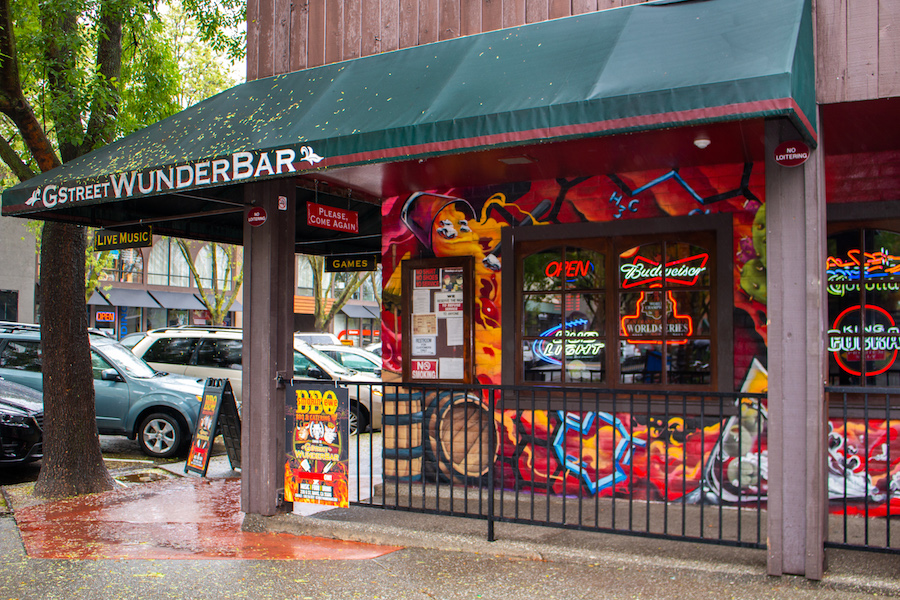
Three Mile Brewery Co., 231 G Street #3

Located in right in the center of downtown, this is a small-batch brewery that mainly serves ales. Its beers change with the seasons and use ingredients that are fresh, local and in-season to create the best tasting beer they can. Created by Davis locals, the main focus of this brewery is to create a long-lasting customer base of people who appreciate variety in beer while supporting the Davis community. As a bonus treat, it has trivia every Sunday from 6 to 8 p.m. Three Mile Brewery is open Wednesday through Sunday.


Berryessa Brewing Company, 27260 HWY 128 in Winters, Calif.

Located just outside Winters, about 30 minutes away from Davis, this brewery is no stranger to Davis students. This brewery has a relaxed atmosphere, with all ages welcome, in a breathtaking country setting. It has indoor seating or outdoor picnic tables that are great for bringing a group a friends. It also has giant jenga, food trucks and live music — and, of course, beer! Berryessa offers full pints, half pints, sample trays and an array of different rotating beers.


Written by: CaraJoy Kleinrock — arts@theaggie.org

Matt and Kim Concert Review

ZOË REINHARDT / AGGIE

Matt and Kim break hiatus

The crowd settled in as the band Twinkids opened for the show. People leaned into the bar to order drinks and excitedly murmured through the performance. Despite an incongruous audience, the electronic duo remained completely immersed in their music, swaying with eyes closed as if no one else were in the room. Eager to be with Matt and Kim for their first tour ever, Twinkids started the evening by being unapologetically themselves. Gene Fukui even paid homage to his hometown in Tokyo with a Japanese cover, completely entrancing everyone with the soft ballad.

Following Twinkids was Cruisr, an indie band from Philadelphia. The music evoked summer vibes — upbeat and reminiscent of the beach. Lead singer Andy States was refreshingly sardonic and full of jokes in between each song. At one point he asked everyone to shout out their names simultaneously and dedicated the next song to the first name he heard. For Twinkids and Cruisr, the stage was a place to pour their hearts into, and that’s exactly what they did. The theme of the night was apparent: honest, humorous and experimental.

The first appearance of Matt and Kim took me by surprise. There was no introduction or ease into the show. The Brooklyn duo ran onto stage and immediately began playing before I knew what was going on, and at that point I realized I was in for a show that would completely blow me out of the water. Having listened to Matt and Kim’s music before, I expected a burst of energy from the performance. However, I didn’t anticipate it going completely wild.

Kim was undoubtedly the highlight of the night, sporting electric blue eyeshadow, a black mesh top, bralette, red plaid pants and the biggest smile on her face. Her no-filter personality shone through as she openly embraced her sexuality, drumming with a pair of giant dildos and tossing a few blow-up dolls into the audience to mimic a crowd surf.

I quickly caught on that Matt and Kim weren’t there to make me feel comfortable. They were there to break me out of my shell, forget the world outside and have pure fun. By the end of the show, everyone was dancing together, bodies glued to each other.

Although the concert followed a set list, it seemed completely improvised. They performed a little bit from each album, a few sneak peaks for upcoming singles and a cover of Rihanna’s “Umbrella.” The duo exuded a level of energy that made me wonder why I always felt contrarily lethargic in my day-to-day life. They proved there’s no age limit on having fun and expressed their joy in music and in each other by simply being themselves.

There was a simplicity in their music. With only a drum, keyboard and a couple pre-recorded samples, Matt and Kim executed arguably one of the craziest concerts I’ve attended. Though the absence of structure was something I wasn’t used to, seeing the duo having a blast and completely in tune with the audience made the show one I’d want to go to over and over again.


Written by: Becky Lee arts@theaggie.org

The early bird may be too late for the worm

ERIC POST / COURTESY

Trends show spring starting earlier at higher latitudes

Having spring start early may sound pleasant, especially in cold areas such as the Arctic. However, as spring keeps occuring at earlier dates, places at higher latitudes are more likely to start the season at a faster rate than the rest of the world, affecting animals and plants.

In an interdisciplinary paper published in Nature, researchers looked at historical and current data of phenology and the physical climate system to determine that spring was occuring sooner for most of North America.

Phenology is concerned with the study of timing in the natural world, the interplay of daylight length, plants and animals. The physical climate system describes climate and the role of physics in it.

“So this project — which looks at the relationship between the two, i.e. how physical climate changes are impacting ecosystems, was a perfect collaboration,” said Michael E. Mann, a co-author of the paper and a professor at Pennsylvania State University.

In general, spring is occurring earlier for all parts of North America. But closer to the North Pole, spring occurs much sooner than it did a decade ago. This means that some places in California could have their spring season start a few days earlier than it did a decade ago. For Arctic regions, the season could start weeks sooner.

“This project in particular was motivated by a long-standing observation based on very few analyses that spring is advancing more rapidly farther north,” said Eric Post, the lead author of the paper and a fellow at the John Muir Institute.But one aspect of the results that I didn’t expect is that the rate of advancement of spring with increasing latitude is about 2 to 3 times greater than previously thought.”

An increase in the amount of daylight signals to wildlife that spring has arrived, and many change their behavior in response. Since spring is occuring sooner in some areas than others, animals that migrate will be affected greatly, for they could come from a place that just started spring and go to areas that may or may not have began the season.  

“Our results suggest that any long-distance migratory species […] may find it increasingly challenging to keep up with the onset of spring resource availability on their breeding grounds,” Post said. “Such species start their annual northward migrations on the basis of changes in daylength, while the species they plan to consume on their breeding grounds, whether those are plants or insects, time their spring emergence on the basis of local temperatures. With future warming, the early bird may not be early enough to get the worm.”

This study shows that as the planet warms, regions such as the Arctic will be especially vulnerable. The start of warmer seasons shows one of the global effects of climate change that is very difficult to reverse.

“Nature is really noisy, which makes it hard to detect a human signal, but we’re starting to see clear evidence of human impacts on a large scale,” said Byron A. Steinman, a co-author of the paper and a professor at the University of Minnesota Duluth. “The effect of surface temperature increases on ecosystems is one such broad scale change that we can now, with confidence, say is due to human activity.”


Written by: Rachel Paul — science@theaggie.org 

Cambridge Analytica: Privacy breaches in the age of “transparency”

JD LASICA [CC BY 2.0] / FLICKR
What do Cambridge Analytica’s actions imply for today’s Facebook users?

Facebook users have become increasingly startled this month as revelations regarding Cambridge Analytica’s involvement in social media privacy breaches have been made public. Cambridge Analytica is a firm that develops voter profiles based on data harvested from social media. In tandem with an app company, it paid Facebook users to participate in a personality test. The app also gathered the information of participants’ friends, purportedly in order to create a fuller psychological profile of each test taker — and thus each potential voter.

The undeniable violation of privacy that this constituted has been condemned by Facebook, but more complicated is the politically inflected nature of the data harvesting. Both President Donald Trump’s campaign and the Brexit movement contracted Cambridge Analytica to develop sociopolitical portraits of potential voters. Whether these particular political movements were aware of the extent of the privacy invasions remains unclear, but as The Guardian reported on Apr. 4, the original estimated number of targeted Facebook users — 50 million — has increased to 87 million.

Perhaps most troubling is that, early in the campaign process, Facebook became aware that the firm was harvesting user data, including individuals’ political and religious beliefs, but did not tell the public, instead demanding that Cambridge Analytica delete the information. But in March, a whistleblower alerted the multimillion-dollar social media company to the fact that the data had not actually been deleted as promised. The company’s failure to honor its oft-expressed commitment to privacy and transparency among users is now being called into question. Facebook has said that it will be more heavily regulating apps that demand private information from its users — but the damage has already been done.

Whether or not this enormous privacy breach was of special help to the Brexit and Trump campaigns is unclear. In any political process, candidates actively seek out voters who seem most likely to support their message. It’s part of the game.

But the moral issue with Cambridge Analytica’s actions is that the firm obtained voter information at tremendous cost, perhaps, to those it targeted. Ordinary individuals who assumed that Facebook’s privacy settings would protect them from this kind of digital espionage must now come to terms with the fact that their personal information was obtained without their knowledge or consent. Moreover, Facebook’s mantra of honesty with its users has been utterly undermined by its failure to notify people of a damaging privacy breach. This breach could have aided political movements that might not have adequately reflected users’ views.

While the idea that nothing is private is hardly new for today’s social media enthusiasts, it’s difficult to imagine that your personal information could have been used for purposes you didn’t consent to. The implications of this breach leave many Facebook users in a double bind: to leave social media marks a kind of withdrawal from mainstream 21st-century life that is hardly appealing, but to stay means that your private information could be used for reasons beyond your control.


Written by: Rebecca Bihn-Wallace — rbihnwallace@gmail.com

Disclaimer: The views and opinions expressed by individual columnists belong to the columnists alone and do not necessarily indicate the views and opinions held by The California Aggie.

Physician Assistants: The New Movers and Shakers of Healthcare

JAMIE CHEN / AGGIE

PA education, career reality, job mobility

The physician assistant position is a relatively recent profession in healthcare that has become a rapidly growing entity. PAs make patient care more accessible, particularly in primary care with a constant shortage of doctors. The PA profession has also gained traction as a future career path for undergraduates at UC Davis.

The American Academy of Physician Assistants shares the history of the genesis of the PA profession on its website. The PA was a product of a lack of primary care providers and the fast-track training of doctors that took place during WWII. Inspired by this, the first class of PAs was put together in 1965, and soon the new concept gained acceptance and recognition as a creative solution to the shortage of physicians. Today physician assistants have accreditation standards, a national certification process and standardized examination.

Dr. Jeffrey M. Pearl, a cardiac surgeon by training, and the director of the physician assistant program at the Betty Irene Moore School of Nursing at UC Davis, dedicates his time to educating the next generation of PAs because he finds them to be a key part of the healthcare team.

[PAs are] the primary people that assist in the operating room in several specialties, including the one I was in, which was cardiac surgery,” Pearl said. “They […] really are right there with the surgeon doing everything. They also take care of the patients post-operatively. As I was getting further in my career and starting to teach more, I felt I had a good understanding of what the PA role is — I understand their value — so that’s why I want to get involved with educating the next generation of them.”

The PA role helps buffer some of the constant shortage of physicians by expediting the medical education into a program of about 27 months, and requiring no following internship or residency — the PA is allowed to begin practice immediately, one of the main points of difference between the PA and MD. It is important to note, however, that PA applicants often must have 1,000 to 3,000 clinical hours in order to even apply. This displays a reversal of the general timelines between the PA and MD education systems, wherein the MD training involves more years of education after undergraduate, and experience accumulation comes much later.

“The biggest difference between a physician assistant and a medical doctor in terms of the clinical practice, is that a physician assistant doesn’t practice independently,” Pearl said. “They do need a supervising physician. Now that can mean a lot of things. Typically if it’s in a surgical practice, they will be in the OR with the surgeon, but they may open or close before the surgeon is there. They may be seeing patients, putting in lines, taking out lines […] without [the doctor], but they can’t go do an operation on their own.”

However, this doesn’t mean that the PAs are completely bound by their supervising physician with no independence or space to work with patients on their own. For instance, as Pearl explained, in urgent care or in office practices, PAs can practice without the physician on-site. They have an arrangement with the physician who will audit a certain number of their charts, which decreases as the PA gains experience. Therefore, as Pearl expressed, trust and mutual communication is key in the PA-physician relationship. Although the PA education is shorter, Pearl expressed that PAs are still able to perform 80 percent of what a physician can and must absorb similar amounts of rigorous academic material.

“A lot of people have this conception that when they first get a PA instead of a doctor, they’re like, ‘you’re not a doctor,’ but I feel like that’s now being transitioned out,” said Nerisa Yokoyama, a second-year neurobiology, physiology and behavior major and pre-PA student. “Being a PA should be just as respected as a doctor.”

Yokoyama shadowed an emergency department PA, and found that the PA was able to help many emergency patients get care sooner than they would have if they had all been waiting to see only a doctor; wait times can generally run from four to eight hours.

“I actually think there’s so much more you can do than a doctor when you’re a PA, because PAs don’t have to be stuck in one specialty,” Yokoyama said. “Once you’re certified as a PA, you can work as a PA in the [emergency department], you can do family care, you can do surgery, you can do kind of whatever  — and as soon as you don’t feel that’s right for you and you lose interest — you can move somewhere else and that’s perfectly fine.”

The Pre-Physician Assistant Club at UC Davis was founded to help support and guide undergraduates who have an interest in learning about the PA path by providing them with guest speakers, mentors and creating events such as CPR clinics. Stevie Lamb, the club’s president and a fourth-year NPB major, began her career at UC Davis as a pre-med student. After exploring other niches in health care, Lamb has decided to follow the PA pathway, particularly because of its fluidity between specialities.

“I think it’s a really special profession that lot of people aren’t aware of,” Lamb said. “When I started Davis, I wanted to go to medical school, but then I started to research more into different opportunities that are available. [The PA profession] really inspires me because you get to work with underserved communities and […] I always like to challenge myself and do new things […] so I kind of like the flexibility to keep learning.”

A general trend currently taking place in health care is the shift toward an interprofessional and team-based approach. For instance, in a hospital ICU setting, as Pearl explained, a surgeon, ICU physician, a nurse practitioner, PA, nutritionist and perhaps even a child life specialist in the case of children’s hospitals, may all come together to take care of that patient. This trend extends to outpatient settings as well, such as in a sports medicine clinic where another provider, such as a physical therapist, may join the care team.

“[Teamwork] does a few things,” Pearl said. “It improves communication, it improves efficiency of patient care, and it just improves the patient care. They get things done quicker and there’s more collaboration. We have a shortage of physicians […] but we don’t have a shortage of people needing primary care. So the PA is really filling this vital role of being able to get access to care for thousands and thousands of patients who would otherwise not be able to see a doctor. And the PAs are doing probably just as good or better than a lot of doctors seeing these primary care people. That teamwork is very critical. You have to trust each other and communicate in order to do that. ”


Written by: Sahiti Vemula — features@theaggie.org

$160,000 from NRA went to UC between 2010-16

KYLA ROUNDS / AGGIE

Money used to develop youth shooting programs for students as young as nine

In the midst of national gun violence debates following the shooting in Parkland, Fla., The Sacramento Bee recently revealed that the Regents of the University of California in Davis accepted $160,000 from the National Rifle Association between the years of 2010-2016. The funds were used to create shooting clubs for 4-H youth development programs.

The California 4-H youth development program, a part of the UC Division of Agriculture and Natural Resources, comprises centers across California dedicated to providing creative, hands-on learning experiences for children. According to the 4-H website, its centers aim to enrich students’ understanding and interests in fields like science, technology, engineering, agriculture and math as well as promoting healthy living.

Shooting clubs for students have been established at many of these centers across the state with the help of funds from the NRA. Students as young as nine are able to take part in 4-H shooting clubs.

Stephanie Beechem, a spokesperson for the UC Office of the President, discussed the specifics of the shooting clubs the UC ANR helped create.

“With the guidance, training and supervision from adult mentors, 4-H shooting sports promote the safe and ethical use of firearms and archery equipment,” Beechem said.

All 4-H instructors go through 12 hours of mandatory training of 4-H curriculum and are screened by the state. Specific training of adult mentors overseeing shooting clubs was not disclosed.

UC spokesperson Dianne Klein spoke to The Bee in response to backlash and widespread controversy regarding the UC’s ties to the NRA. Klein said the UC ANR will no longer apply for grants from the NRA.

Davis College Democrats member Maryann Mcnamara, a second-year international relations and history double major, offered her opinion on the university’s involvement in creating youth shooting clubs. Mcnamara discussed the UC’s involvement in funding other recreational clubs and how such clubs differ from shooting clubs.

“I don’t believe that guns and shooting clubs should be considered to be a leisure hobby,” Mcnamara said. “Guns are inherently violent, and the UC system should not be involved.”

When reached out to for comment, the Davis College Republicans responded that it had  no comment on the topic.


Written by: Ally Russell — campus@theaggie.org

Spaces in Engineering Library reallocated to QMAP

ZOË REINHARDT / AGGIE

Students petition loss of open study space

The second and third floors of the Physical Sciences and Engineering Library are in the process of being taken over by the UC Davis Center for Quantum Mathematics and Physics. Newer and more popular materials from the second and third floors will be relocated to Shields Library while other resources will be stored at the the UC’s Regional Library Facilities in Richmond, California and at UCLA. Students are voicing their disapproval of the reallocation by circulating petitions.

QMAP is a research initiative led by theoretical physicists and mathematicians that intends to explain certain aspects of how the universe works. It was established in 2015 and regularly holds seminars and lectures that are open to the public. According to its website, QMAP’s goal is to create “an environment where there is a seamless exchange of ideas between theoretical physics and mathematics.”

In order to clear the library space for QMAP, the university will vacate the second and third floors of the Engineering Library by September 2018. During this period, all library materials will be moved out of the Engineering Library and into either Shields Library or the university’s storage facility in Richmond. Renovations of the space begin in October 2018 and are expected to continue until December of 2019.

According to the university, these renovations include “seismic retrofit, accessibility improvements and fire suppression system renovations.” These improvements will be implemented in all floors of the building, not only the space being redistributed to QMAP.

However, some student groups are opposed to the recent renovations. A number of engineering clubs on campus have circulated petitions denouncing the reallocation of space as it takes away open workspaces from engineering students.

“While I don’t think many people necessarily need the space, the Engineering Library provides a great atmosphere for engineers to meet and study,” said third-year materials science and engineering major Justin Mulvey. “Removing this space might ruin this collaboration.”

An ASUCD-made survey designed to collect student input regarding the reallocation of space has also been circulating. ASUCD intends to send the data from this survey to administration.

In response to the question of where students should study instead of the second and third floors of the Engineering Library, administrators wrote on the UC Davis Library website that “students who routinely use the materials shifted to Shields may also wish to use the study spaces available there.”

Faculty and students were invited to nominate specific works to be kept in Shields Library rather than storage before Feb. 28. Now, materials stored at the Regional Library Facilities may still be temporarily checked out by faculty and students; they will then be delivered to campus. They can also be viewed online upon request.


Written by: Jacqueline Moore — campus@theaggie.org


Humor: Yeah, I’m STEM — Spending Time Eating, Mmmm

MICHAEL STERN [(CC BY-SA 2.0)] / FLICKR
I’ll take food over a degree any day

College is a time for exploration, a time for finding your passion and a time for growth. I found my passion in exploring the menu at Dumpling House and growing my waistline.     

Why do I need a degree when my best credential is on display at the South CoHo in the form of a Polaroid on the wall, which I earned by eating three quad stack chili bowls?

   Oh, does UC Davis have something to teach me about technology? Are you sure? Because I’ll have you know I can use the iPads at UOB to find my craft cider faster than anyone else I know. I don’t need to be an engineer to build my own sandwich combo at Ike’s.

Oh, I was supposed to learn economics? I save $1.50 a day by eating the special at Sam’s.

How about statistics? Well, through my extensive field research I have determined that, at the moment you order the tilapia at Dot Island, there is only an 85 percent chance that the next day you’ll wake up with food poisoning.

I’m learning about small business: For instance, the other day the manager of Shah’s Halal told me that, because I spend so much money there, he named a propane cylinder after me.

I’m also involved in student leadership. I lead a particularly ambitious group of one to Delta of Venus, where we vote on which scramble to buy (the vote is always unanimous).

Can I recite the quadratic formula? No. What I can tell you is that, if you eat at El Burrito, you might as well walk across the street to Chipotle because you don’t know what real Mexican tastes like.

Look, we all waste student loan money. I use mine to eat out, my roommate uses his to eat out with me.

I know what you’re thinking: What happens when the student loan money runs out?  Well, through the power of science I have built a theorem that I have earned enough stamps at Yoloberry to cover me for at least a month while I figure out how to declare bankruptcy.    

I would love to spend my time and money getting a fancy degree. But what is college for if not — oh, my pizza just got here.


Written by: Parker Nevin — phnevin@ucdavis.edu

(This article is humor and/or satire, and its content is purely fictional. The story and the names of “sources” are fictionalized.)

Course Evaluations: Grading the Grader

VENOOS MOSHAYEDI / AGGIE

A look at how students grade (or degrade) instructors

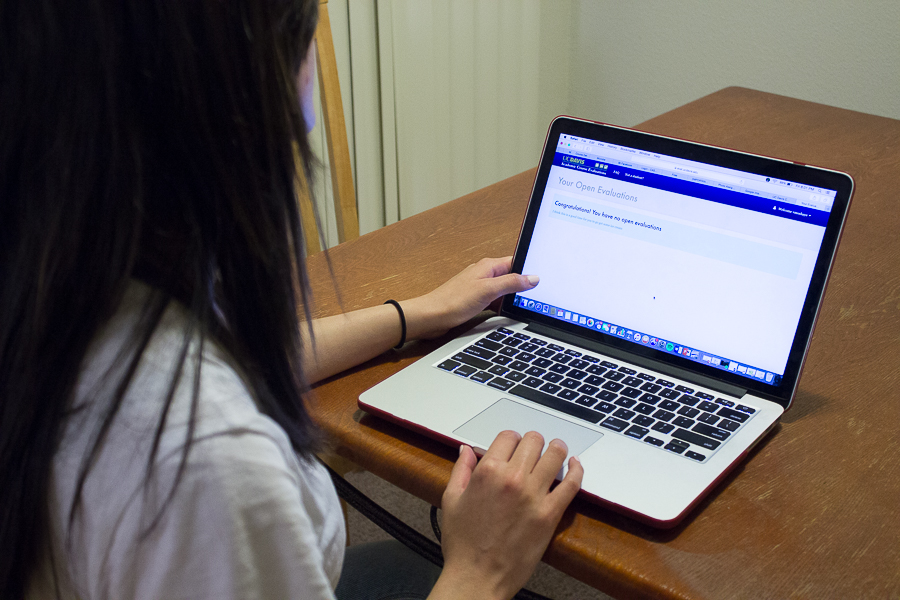
At the end of every quarter, many students take the opportunity to complete course evaluations, either on paper or online, but how their responses are actually used may be a mystery to many students.

In 2013, UC Davis launched the online Academic Course Evaluation system, to which most departments have now switched from the paper evaluation forms.

Scott Kirkland is the application architect for the College of Agricultural and Environmental Sciences Dean’s Office programming team. The Online Course Evaluations system was one of the projects of the development team he manages, which writes custom applications for UC Davis.

Kirkland discussed how the majority of departments on campus have opted to make the switch from paper to online course evaluations.

“Even though the system is completely optional, most academic departments are using the online system, well over 75 percent of all campus and med center departments, and a higher percentage than that of core campus departments,” Kirkland said. “Occasionally we’ll see a department where every professor except for one uses the system, and that’s ok too.”

Professors who choose this option miss out on the efficiency of the online system and create extra work that could be done effortlessly online rather than being transcribed by hand.

Kirkland explained how the responses from students are passed to the instructors, noting the information that individual professors and TAs have access to.

“Professors and TAs are treated similarly in online evaluations,” Kirkland said. “They can see the responses to any course-level question and then only the person-level questions that apply to them. So a TA cannot see what someone said about a professor and visa-versa. Basically it’s some nice bar charts of how students responded to each question asked, plus the text responses if applicable.”
Tracy Lade, the chief administrative officer and department manager for the Department of Physics, explained that the default for her department is to use the online evaluations, but that some instructors still opt to use paper evaluations.


“The decision to switch to online evaluations was driven by convenience for the students in the courses and by staff workload,” Lade said. “Processing online evaluations for high enrollment classes is more efficient.”


Anya Gibson, an administrator for the history, economics and East Asian studies programs, explained why the economics department chose to switch to the online system while the history department opted to continue using the paper forms.


“From a staff standpoint, the economics department wanted to move because it would save funds and people hours needed to get the hard copies of the evaluations, print them, and get the envelopes and pencils,” Gibson said. “It costs much less online, but the history department just isn’t sold on it.”


Adam Getchell, the director of information technology for the Computing Resources Unit for the College of Agricultural and Environmental Sciences Dean’s Office, said that some professors worry about lower response rates if evaluations are moved online.


“The perception remains that online surveys get less response rate than paper ones,” Getchell said. “Strategies such as extra credit or early viewing of grades have been proposed, but to date we are not allowed by the Academic Senate to provide these types of incentives for completing evaluations.”


In addition to the possibility of lower response rates with online forms, faculty may worry that their scores may be artificially lowered. Gibson disputes this, citing studies that are also mentioned on one of ACE’s information pages.


“Studies have been completed at several UCs showing that scores do not change even if fewer students respond,” Gibson said.


Regarding the actual questions asked on the evaluations themselves, UC Davis as a whole has two required questions, but the faculty of each department also decides additional questions they would like to include on the evaluation.


Many students may be curious how the information they provide through course evaluations is used and who has access to it. Does only the instructor read them, or are criticisms and negative trends monitored by the department? Does the information provided actually lead to change?


“Each department is allow to choose their permissions, but almost every department just has one or two staff members who control setting up and releasing evaluations,” Kirkland said.


Lade, along with people from the economics and geology departments, discussed the process of reviewing and analyzing the course evaluations.


“Student evaluations of faculty and lecturers are used during their periodic advancement review or during the reappointment process in the case of a temporary lecturer,” Lade said. “TA evaluations are monitored and they inform future TA appointments.”


Lade spoke about the importance of properly handling criticisms and negative trends about instructors.


“Negative feedback is taken seriously and is addressed in a way that’s appropriate to the situation,” Lade said. “Perhaps a mentoring conversation is indicated, or perhaps referral to the Center for Educational Effectiveness to take advantage of their services would be helpful. In the case of a temporary lecturer, the matter would be addressed in the review and reappointment process. Persistently low student evaluations may result in non-reappointment.”


The online system is designed to ensure that responses remain confidential. Kirkland also made it clear that responses from students are in no way adjusted or moderated. Departments do take care to distinguish between unjustified negative comments and valid criticisms of an instructor’s behavior or teaching style that should be addressed.


“The instructor sees everything that was said for them and about them, so a student could say whatever they want, even something profane,” said Mandy Hanou, an advisor for the department of earth and planetary sciences and the manager of course evaluations for geology. “That goes straight to the instructors, and they know what their students are saying about them.”


If there is a concern then, the department chairs are notified. Giovanni Peri, the chair of the economics department, explained how the department usually deals with negative evaluation of instructors and the role that this student-provided information plays in a professor’s merit evaluation, which occurs every two years.


“Faculties are evaluated on research, teaching and service,” Peri said. “Student evaluations are considered important (but not the only) inputs in evaluating the teaching of a professor.”
While some negative evaluations typically do not cause alarm, patterns and trends are monitored.
“A pattern of not good evaluation in one course, which point out at a concern which seems legitimate (lack of attention to students’ need, neglect of preparation, sloppy classes) are looked at very carefully,” Peri said.


As a department chair, Peri may talk with the professor to determine if specific circumstances led to negative performance evaluations in certain classes. Chairs also make a plan with the professor for how to fix the problem.


“If the problem persists there may be consequences, including the possibility of not obtaining a merit promotion,” Peri said. “It needs to be a pervasive and well-established problem and persistent with the professor to get to consequences. My experience is that evaluations which are not good are enough of an alarm bell for a professor to focus and figure out what is not working and improve.”
The hard work that went into developing the online system facilitates a faster turnover time, which is also useful since not as much time passes between the teaching of the course and the reception of the results.


“We haven’t gotten a ton of feedback from professors, I think most of them just sort of ‘get it’ and wonder why we didn’t have it on campus earlier,” Kirkland said. “They really like being able to see evaluations days after finals are over instead of months later.”


One of the unexpected benefits of the system has been that students can easily access course evaluations via their mobile devices.


“Over one third of all website views are from mobile devices, which were pretty novel back when this system was written, and I’m glad we spent the time to support them well,” Kirkland said.
There have still been some minor unexpected snags along the way.


“On the technical side, I didn’t anticipate the difficulty of dealing with 40,000-plus students all hitting your website during a limited time window,” Kirkland said. “We have auto scaling platforms now setup so as demand ramps up, our pool of available servers automatically grows to handle the load.”
Kirkland added that one of the best aspects of the online system is that it is oriented toward privacy, anonymity and student expression.


“There is absolutely no link between a student and their responses, and there is no data that connects a given response with the time, location, browser, etc., so evaluations can be completely truthful and anonymous, just like they should be,” Kirkland said.


Written by: Benjamin Porter— features@theaggie.org