55.9 F
Davis

Davis, California

Tuesday, December 23, 2025
Home Blog Page 642

Jai Wolf to perform at Ace of Spades

As part of Kindred Spirits tour, Jai Wolf previously played in Oakland. (JAY GELVEZON / AGGIE)

Indie-electronic producer to tour California

As part of his Desert Moon tour, Sajeeb Saha, better known under his moniker Jai Wolf, will play at Ace of Spades in Sacramento on April 19.

Previously, Saha was known for his remix opportunities with Dirty South, Alesso and ODESZA, with each remix landing a #1 spot on Hype Machine. His biggest break came when electronic music producer, Skrillex put an official stamp on Saha’s remix of “Ease My Mind.”

Jai Wolf released his debut single in Summer of 2015, called “Indian Summer” garnering a top spot on Spotify’s US Viral Chart and is now closing in on 30 million plays on the music streaming service. Jai Wolf released his follow up single, “Drive”, which has racked up over three million plays on Spotify and over one million on SoundCloud.

Saha is no stranger to festivals previously playing at Bonnaroo, Coachella and HARD Summer. With support from Chet Porter and Trace, this up and coming artist is sure to bring on a show.

Tickets are surprisingly still on sale at EventBrite for $20 and it is expected to sell out. If the Wednesday date doesn’t work well, Saha will also perform at The Catalyst in Santa Cruz, California on Tuesday, April 16 and Thursday, April 18. Unfortunately, tickets to the Thursday show are now sold out, but tickets for his Tuesday show can still be purchased on TicketFly for #20. For those going to Coachella Valley Music and Arts Festival, he will also be performing both Sundays, April 16 and 23.

For more information about Jai Wolf and the Desert Moon tour, please visit his website.
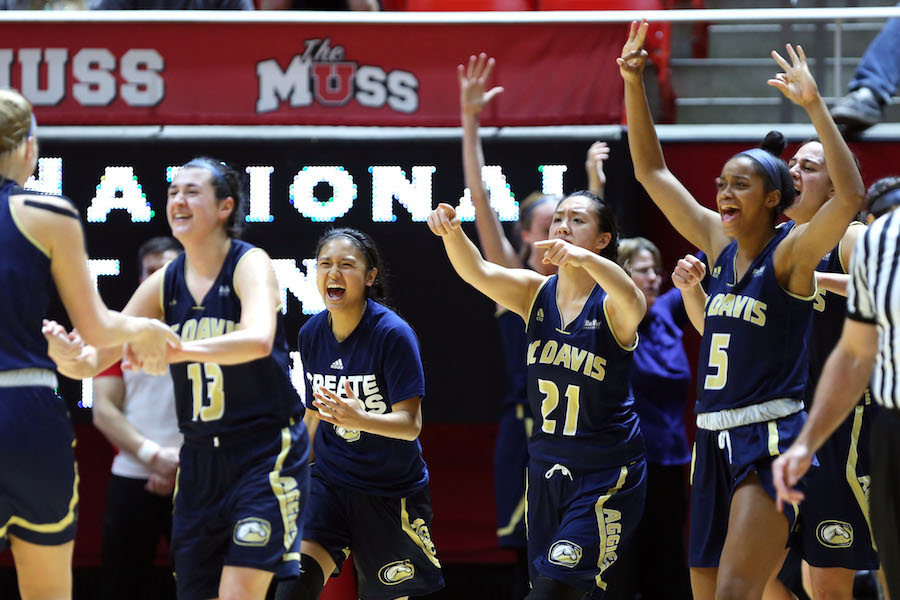
Women’s basketball team makes program history at WNIT

STEVE C. WILSON / UNIVERSITY OF UTAH

In first round of WNIT, Aggies protect basket en route to 72-62 win, claim first postseason victory in program Division I history

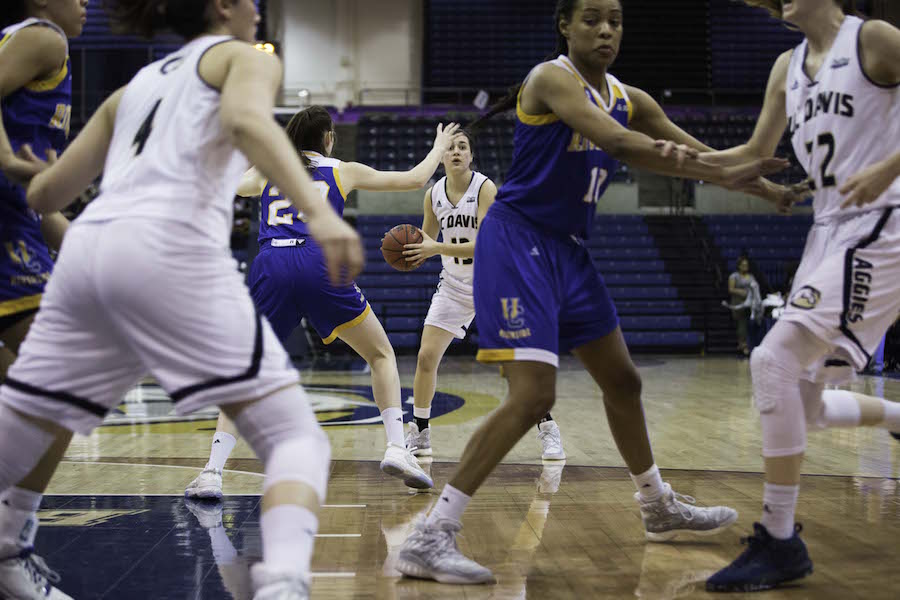
Despite its disappointing loss in the Big West Tournament, the UC Davis women’s basketball team (24-7) found itself in its first postseason game in Division I history during the first round of the Women’s National Invitation Tournament against Utah (16-15) in Salt Lake City. The Aggies responded to Utah’s home court advantage with a commanding 72-62 victory. It was a wall-to-wall victory, as the Aggies came out early and led by as much as 17 in the first quarter. Utah was never able to recover from the initial onslaught,

While the Aggies performed well on offense, they won their game with defense. Utah shot just 34.7 percent from the field and 19 percent from three-point range. The entire Aggie team amassed 12 total blocks over the course of the game with six rejections coming from sophomore forward Morgan Bertsch. Bertsch also led the team in scoring, with 23 points and seven rebounds.

The team’s second and third leading scorers on the season, junior guard Dani Nafekh and junior forward Pele Gianotti, failed to find their shots, shooting a combined 2-13 from the field, and the team needed someone else to step up. Junior guard Rachel Nagel did just that, adding 17 points of her own on a superb 7-10 shooting. Junior forward Marley Anderson added 10 points and six rebounds in just 15 minutes off the bench.

Despite Utah’s struggles to get its shot going as a team, 14 of the Utes’ field goals came from Malia Nawahine (6-13 from the field) and Tanaeya Boclair (8-14). The rest of the Utes shot just 11-45 from the field.

The Aggies hope to continue their postseason run in round two of the tournament on Sunday, March 19, when they will face off against Colorado State in Fort Collins, Colorado.


Written by: Bradley Geiser — sports@theaggie.org


Underdog Aggies fall to Kansas in First Round of NCAA Tournament

JAY GELVEZON / AGGIE

UC Davis men’s basketball team fights hard, falls 100-62 to Jayhawks

Fresh off its First Four win over North Carolina Central on Wednesday, the UC Davis men’s basketball team advanced to the official first round of the NCAA tournament as the sixteenth seed to take on the tournament’s number-two overall seed and the Midwest region’s number-one seed — the Kansas Jayhawks. The Aggies’ dreams of a Cinderella run through the tournament, however, were snuffed out, as they were flattened by the Jayhawks, 100-62.

UC Davis entered the game the heavy underdog; Kansas is an elite college program with a rich winning tradition and a run of 28 consecutive NCAA Tournament appearances, while the Aggies are relatively new to the Division I scene. It was therefore surprising when the Aggies took a slim lead early in the game after a couple of buckets from junior forward Chima Moneke. The Aggies came out with a high level of energy and competed right with the favored Jayhawks. A deep two from senior guard Brynton Lemar tied the game at 21 midway through the first half.

After UC Davis head coach Jim Les was assessed a technical foul moments later, the floodgates opened up. The Jayhawks, led by one of the best players in the country, Frank Mason III, ended the half on a 29-7 run, and Kansas went into the break on top 50-28.

Things didn’t get any better for the Aggies in the second period. The Jayhawks quickly soared to a 30-point lead behind Mason’s masterful three-point shooting and overwhelming skill and athleticism from Kansas freshman Josh Jackson, who slammed down several crushing alley-oops.

But the Aggies never let their intensity drop off. They fought for every loose ball and every rebound, but UC Davis’ shots just did not fall from the outside or in the paint against the Jayhawk forwards, who had the noticeable height advantage. The Aggies’ night was summed up when they played a near perfect defensive possession, but the Jayhawks’ sharpshooter Sviatoslav Mykhailiuk drained a fading corner three as the shot clock expired, despite Aggie senior guard Lawrence White being draped all over him. No matter how hard the Aggies played, the ball just did not bounce their way. But, despite being down by such a large margin, Moneke made arguably the most exciting plays for UC Davis when he threw down a powerful dunk over several Kansas defenders, then elevated on the defensive end and swatted away an attempted shot from the Jayhawks late in the game.

There were some positives that reflected well on UC Davis during the game as well. One of the television announcers, Kevin Harlan, made a remark about the school’s academic prowess, saying that neither he nor the two other broadcasters working the game with him could have gotten into UC Davis. Even actor Rob Lowe, a new UC Davis basketball fan, was in attendance on his birthday to cheer on the Aggies. When Les began to substitute out his senior players, viewers took notice of the emotions that ran high as he embraced each one of his seniors on the court for the last time.

For UC Davis, a basketball program that had advanced to Division I status for basketball in 2004, simply the opportunity to play in the national tournament is fairly surreal. The cameras were rolling when head coach Jim Les addressed his team just before tip-off of the biggest game in the program’s history, perfectly encapsulating what the trip to Tulsa meant for his players and for UC Davis.

“Tonight’s about telling our story,” said Les, with a tone of solemnity. “And we tell it by how hard we work, how hard we compete. So when the 40 minutes are over, they know Adenrele, they know Moneke and they know who the hell UC Davis is.”


Written by: Dominic Faria — sports@theaggie.org

Students protest recent tuition hike

BRIAN LANDRY / AGGIE

Students demand free education in opposition of highly paid UC administrators

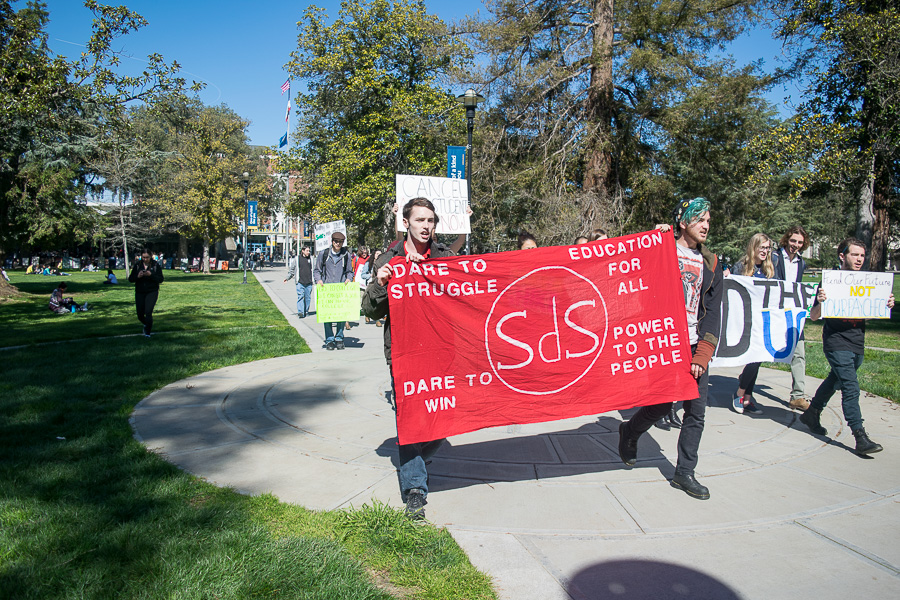
A group of approximately 30 students marched from the Memorial Union (MU) flagpole to Mrak Hall on March 2 at 12 p.m. in an effort to prove to the UC that administrators cannot steal student dollars and dodge criticism.

After a six-year tuition freeze, the Regents voted on Jan. 26 to raise in-state tuition by $336 per year and by $1,688 per year for out-of-state students, totaling $12,630 and $40,644, respectively. As reported by The California Aggie in January, this 2.5 percent increase will go toward supporting growth of the UC.

However, students are unhappy with the bigger checks they will be forced to write in the following years.

“[The hike] sounds insignificant, especially to the Regents, but when you’re a full-time student it’s huge,” said Parker Spadaro, a first-year political science major and the deputy organizing director of the ASUCD Office of Advocacy and Student Representation. “$300 can [pay for] more than 30 meals [and] $1,000 can go toward funding another month of rent.”

Students argued that the state — not the students — should be funding the UC, as it initially did when the it was first established. ASUCD Senator Daniel Nagey stressed the importance of students protesting the tuition hike since the UC will continue to raise fees if administrators think such actions can go by unnoticed.

“Regents think that they can make these tuition hikes without students getting mad,” Nagey said. “This has real effects on students who are already struggling. Tuition is already way over what it should be so even an extra $300 is just absurd.”

While working closely with ASUCD, Spadaro said the collective efforts of students who simply passed out fliers or rallied their friends and communicated through the Facebook event page made the demonstration possible. They stressed the relevance of gathering students to protest the administrators.

“We need to organize and fight back or else they’re just going to keep brutalizing our students, especially through financial violence,” Spadaro said.

The students came prepared to stand up to the UC with signs that read “Poorever in debt,” “Fund our future, not your paycheck” and “Student debt? Indentured servitude.” The students held up their signs at the MU flagpole to a touring group of prospective students, advising them not to attend UC Davis since they will be robbed of their money.

Afterward students marched through the CoHo and then through the Quad to reach Mrak Hall, the building home to UC administrators. Spadaro led students in various chants: “They raised our fees despite our pleas,” “What do we want? Free tuition. When do we want it? Now” and “Hey hey UCD, cut those admin salaries.”

At Mrak Hall, Spadaro discussed the absurdity of such tuition raises on top of existing student pressures.

“Students have to starve and work themselves to death to avoid debt,” Spadaro said. “No student should have to worry about paying for their classes more than their actual classes.”

Spadaro led the protesters in another chant: “Raise your hand, make a fist, we the students will resist.”

“State funding is an issue, but there’s also the issue of what we are doing with the money that we actually have,” said Duane Wright, a Ph.D. candidate in the department of sociology. “We aren’t putting it toward education, we aren’t putting it toward students. [Instead, administrators] are making $400,000 a year outside [their] job.”

Spadaro urged UC administrators to stop “being selfish” and start taking responsibility for their positions.

“They shouldn’t be our enemies, […] they need to actually be on our side and fight for us,” Spadaro said. “They need to either cut their own salaries and actually be in it for the students instead of for the money; or if they’re going to keep their salaries they need to lobby for legislators to fund the UC.”

Spadaro added that there must be UC-wide collaboration to help drive the uphill battle against tuition hikes. Meanwhile, students are encouraged to sign a petition for corporations rather than students to pay for the additional funding.

To sign the petition, please visit fundtheuc.org.


Written by: Jeanna Totah — campus@theaggie.org

Editorial Board sits down with Jill Stein

HANNAH LEE / AGGIE

Green Party presidential nominee’s good intentions not rooted in reality

In welcoming Green Party presidential nominee Jill Stein to UC Davis last week, students received a unique opportunity to hear a progressive vision for America markedly different than anything offered by mainstream parties. But Stein’s calls for a “Green New Deal” don’t change the fact of her stubborn refusal to effect real change by leaving the confines of a third-party.

Before her rally, Stein sat down with The Aggie’s Editorial Board for about 20 minutes to discuss topics ranging from student loans to environmental sustainability to the Dakota Access Pipeline. In the meeting, she displayed the same stalwart progressivism that has both made her a champion to those on the far-left and an irritant to more moderate liberals who fault her for sapping critical votes away from Democratic Party candidate Hillary Clinton in the presidential election.

Stein reiterated a proposal to erase all student debt as part of a plan to overhaul higher education that includes tuition-free college — a noble goal. Americans owe more on student loans than they do on credit cards. But it’s a plan that has its shortcomings. She said that she wouldn’t make an exception for high-income students with the ability to pay down loans, at the risk of her plan becoming a “poor-people’s program.” But these students could help offset the costs to universities of suddenly having a large amount of debt forgiven.

While Stein’s policy proposals reflect a much-needed spirit of progressivism, their success is still rooted in the fantasy that a mass of people will suddenly rise to the occasion of implementing them. That’s the kind of politically ignorant thinking only an American third-party candidate could concoct. While grassroots organizing is essential to resisting Trump — and Stein should be commended for bringing that message to UC Davis — it is certainly not sufficient.

Stein would better serve this country as Bernie Sanders did: by working within the parameters of a mainstream party. Consider that in just the past week, California politicians have been judging the merits of a proposed debt-free college plan, and a “medicare-for-all” health care system proposed by Democratic Lt. Gov. Gavin Newsom as part of his bid for governor. Both are measures Sanders tirelessly advocated for during the presidential election.

But these conversations wouldn’t be happening had Sanders mounted an independent campaign.

Unfortunately, Stein dismissed that possibility of working with Democrats out of hand, calling Hillary Clinton just as dangerous a candidate as Donald Trump. How misguided. Democrats need somebody like Stein who is right to devote so much attention to the environment and the effect of its destruction on vulnerable Native American communities. Even though her call that the United States run entirely on renewable energy by 2030 is wholly unrealistic, it reflects the much-needed urgency that climate change issues deserves.

By throwing Clinton in the same bag as President Trump, Stein has reduced herself to nothing more than a fringe element of American politics — one important only to shine a light on issues, like climate change and the abuse of indigenous people, that demand our constant attention.

Forget the distracting conversations about her swinging the vote. Those would be better spent asking how a bigot like Trump could secure so much of the electorate in the first place. Instead, students talking about Jill Stein should talk about how to turn her progressive values into viable mainstream policies. Only then will the Green Party register as more than a protest movement.

City of Davis accepting nominations for 23rd Annual Environmental Recognition Award

GENESIA TING / AGGIE

Award recognizes environmentally-minded individuals, groups in the community

The City of Davis is currently accepting nominations for its Annual Environmental Recognition Award.

Davis’ Natural Resources Commission created the Environmental Recognition Award in in 1995 to bring attention to those in the community who have made enormous efforts to improve the environment in and around the city. Davis has awarded a business, a nonprofit organization and an individual or group in the City of Davis with this honor for over 23 years.

This year, a fourth category for “legacy” awards is being added in honor of the city’s 100-year anniversary.

“A special category has been added to commemorate our centennial year,” said Kerry Daane Loux, the Sustainability Coordinator for the City of Davis, in a press release. “The Environmental Legacy Awards will celebrate sustainability efforts that have made a difference over Davis’s 100-year history.”

Past recipients of the award include the Bike Campaign, ASUCD for Unitrans Bus system, the Davis Food Co-op and the Hallmark Inn.

In 2016, winners included the Davis Farmers Market and its Market Manager, Randii MacNear, and Gail Doesken, a teacher at the Davis Waldorf School and Sierra Energy.

The Farmer’s Market was awarded in the nonprofit category for “improving local quality of life through its services, public education, inspiration and actions related to a commitment to zero waste.”

Gail Doesken, a Davis resident, was awarded in the individual category for “sharing her love of the land and growing things with students, faculty and families in the school community.”

Sierra Energy was awarded in the business category for “[turning] the environmental problem of solid waste into a business venture that provides clean energy solutions.”

A full list of the past winners is available online at the City of Davis website.

As listed officially in the application requirements, the winners are chosen based upon “achievements [that] address a current environmental concern, […] a record of achievements or actions benefitting the environment,[…] a commitment to continued effort long term, and/or the nominee’s creative implementation or development of an innovative project.” The past winners have been chosen based upon community support through multiple nominations or written letters of support.

The award recipients will be chosen and announced during a city council meeting on April 18, four days before Earth Day. Nomination forms can be found on the Davis City webpage and are due by March 17.

Written by: Caitlyn Sampley — city@theaggie.org

UC Davis women’s basketball team falls short in Big West Conference tournament

CIERA PASTUREL / AGGIE FILE

UC Santa Barbara wins 73-59 with strong third quarter

Members of the UC Davis women’s basketball team headed into the Big West Conference Tournament with a 14-2 conference record, including 10 straight wins to close out the regular season. The Aggies were not required to play until the semifinals, since they secured the top record going into the tournament.

Facing the 15-15 Gauchos from UC Santa Barbara, the Aggies were supposed to have the advantage. However, the Gauchos came prepared, and, thanks to a 23-point third quarter, were able to build a large advantage that the Aggies were unable to overcome, eventually winning the game 73-59.

Junior guard Rachel Nagel led the team in scoring with 18 points to go with five rebounds and an assist. Sophomore forward Morgan Bertsch and junior forward Pele Gianotti each pitched in 12 points of their own. This scoring was not enough to match the onslaught from the Gauchos, as two of their players rallied with 21 and 23 points.

However, there is still more basketball to be played: While the NCAA tournament is out of the picture now the Aggies lost the semifinal, they secured a berth to the Women’s National Invitation Tournament (WNIT) by their regular season success. The women’s basketball team will play University of Utah in Salt Lake City on Friday, March 17 at 5 p.m.

Regardless of the WNIT’s outcome, the Aggies can still build off of the successful year, since most of the team is eligible to return for next season.
Written by: Bradley Geiser — sports@theaggie.org

Aggie Profiles: Camille Pannu

TAYLOR RUNNELLS / AGGIE

One woman’s fighting passion for environmental justice

In late 2015, Camille Pannu received an unexpected phone call from an old acquaintance. It was Angela Harris, a professor of environmental justice at the UC Davis School of Law and a member of the Aoki Center for Critical Race and Nation Studies’ Committee, asking if Pannu was interested in being the director of a proposed water justice clinic. Naturally, Pannu jumped on the opportunity.   

The UC Davis School of Law has a number of clinics that deal with court representation, such as the Immigration Clinic and the Civil Rights Clinic. However, the creation of the Water Justice Clinic is a result of the water bond package that was passed by the State of California in 2014 and requires that legal aid and technical assistance be given to low income, unincorporated communities.

“[Right now] I’m a [full-time] attorney for the clinic, [and] if the clinic is approved [by the law school] then I’ll be the director,” Pannu said. “Clinical education is about teaching law students how to be lawyers, essentially, and giving them meaningful opportunities to work with people.”

Pannu is a self-described “hell-raiser,” but it’s hard to tell through her effervescent and friendly personality. She told stories from her life with a twinkle in her eye, her voice full of passion as she shared her knowledge and perspectives. Pannu comes across like an old friend reminiscing about past adventures, but also undeniably as a scholar who has witnessed the world in multiple, fascinating ways.

“I grew up in Richmond, [Calif.], and [my family was] there when Richmond was the murder capital of the United States,” Pannu said. “You could really see by sixth grade where people’s life opportunities were going to be based on where they came from — I had a bunch of friends whose parents were working so many jobs to make ends meet and they just couldn’t.”

Pannu’s opportunities for an academic future after high school were nearly impossible in Richmond since none of the schools offered any of the coursework required to apply to college. She transferred to a high school in the nearby town of Moraga, which, according to Pannu, was more than 80 percent white at the time and discernibly affluent.

With a laugh, she described the difference was “like night and day.”

“You had these huge green fields and all these wonderful amenities,” Pannu said. “They had this Olympic-sized pool where the US synchronized swimming team practiced. Three-quarters of all students were in competitive sports and four people from my class went to the Olympics — twice!”

Pannu had grown up buying into the narrative of “America’s meritocracy”; that if she worked hard, she could “make it.” However, identifying as South Asian, Pannu noticed a stark difference between the kind of treatment she received from that of her white peers. Not only did her guidance counselor advise her away from the classes and extracurriculars her white peers participated in, she also dealt with racist tirades from classmates and even parents on a regular basis.

She recalled a time in her junior year when her classmate, someone she had never had issues with, raised their hand in class to express that “poor people are poor because they’re lazy.” This was the first time Pannu actively spoke up after three years of silence in the face of stunning ignorance in this community.

“I lost it,” Pannu said. “I was like ‘you guys are all going to go to college, […] you’re all going to become leaders and you’re all going to have opportunity,’ whereas my friends [in Richmond] are working hard [and] some of them had dropped out, some had gotten pregnant, some had been killed, some of them had joined gangs [and] some were trying to get back out of gangs.”

It was at this moment that she realized what focus she would work on for the rest of her life.

“This is the issue I care about, this issue of poverty and the disparities that exist and the lack of understanding between people,” Pannu said.

After graduating high school in 2002, Pannu made for UC Berkeley, where she trained in community organizing and statewide advocacy. Many of the groups Pannu joined focused on access to higher education, but she then shifted to juvenile justice issues and eventually to hate crime in search of what drives structural poverty.

“[Structural poverty] starts so much earlier with the environment you grow up with,” Pannu said. “It matters what opportunity you see and what violence you see and it matters whether your water had lead in it. It matters whether the air you’re breathing gives you asthma.”

And so began her shift to an issue she found extremely fascinating and incredibly fundamental: environmental justice.

“I had seen a lot of the environmental activism at [Berkeley] as being oriented towards things as recycling and composting and saving biodiversity,” Pannu said. “[Although] I think all of that is really valuable, it felt like it lacked urgency to me, in part because I’m overly concerned with human beings.”

Pannu graduated with a degree in political economy and a minor in African American studies. Her first job took her to rural Kenya, where she worked for a development non-governmental organization on a project focused on water-borne diseases called the Rural Water Project. After returning to the U.S., though, she moved away from the field of environmental justice and took up a research position at the Yale Law School that focused on the death penalty in Connecticut. She spent her days sitting in a dim basement, away from people and any sense of community.

“I was feeling really isolated,” Pannu said. “Yale also has a weird relationship with the local community, so living in the local community and [working at the] local school […] just felt a little off.”

Even though she wasn’t a student at Yale, Pannu was allowed to participate in one of the Law School’s clinics as a student director. This is where environmental justice once again trickled into the forefront of her mind, so it was the idea of a marriage between these two passions in addition to her work with the clinic that made her apply to law school. Laughing, Pannu expressed that her life seems to be full of circles, as she ended up back at UC Berkeley.

“I’m good at figuring out how to twist rules to do the opposite of what they’re for, and I was like ‘I should be a lawyer, this sounds like an excellent way to do this,’” Pannu said. “Lawyers are often there to tell you everything that will go wrong, and tell you everything not to do, [but] it helps to have lawyers who come out of community organizing because they’re a key that […] the community gets to turn to open a door, as opposed to being the door and the lock.”

Pannu recalled her time during law school as successful and rewarding, having had the opportunity to work on litigation suing the Chevron refinery which had plagued the resources of her hometown of Richmond. This case happened to be the first victory on an environmental case against Chevron in history. After this, Pannu left the urban-scape to work in rural areas of the San Joaquin Valley. She then worked with the Center on Race and Poverty in the Environment doing clerk work for some judges. This is when she received the phone call from Harris and began the next chapter of her life at UC Davis.

“One of the communities I’m working with has had no water for two and a half years now,” Pannu said. “What happened […in Tulare County] was that when the drought happened, a lot of farmers started digging deeper wells to get to deeper aquifers. It’s essentially like that weird part of ‘There Will be Blood’ where Daniel Day Lewis is like “I take my milkshake and I drink your water — or drink your oil” and the whole time you’re like ‘where is this coming from, what is he talking about?’ So that’s what happened with water in Tulare county — a bunch of people took a deeper milkshake and drank down everyone’s water.”

Unsure of her future goals, Pannu is content to focus on water justice as long as she can. Pannu’s journey up to this point in time has been winding, but she has never strayed from her ultimate goal of doing something where she is connected to people.

“I think one of the best pieces of advice I got when I was in college is that negative information is good information,” Pannu said. “I think that’s why I’ve had so many jobs. A lot of my life has also been figuring out what doesn’t fit and appreciating that experience for the education it gives you about yourself so you can do these really cool things.”


Written by Marlys Jeane — features@theaggie.org

Aggies claim victory over Huskies in series finale

NICHOLAS CHAN / AGGIE

UC Davis baseball team salvages 7-6 win against UConn, but loses series 2-1

After losing to the University of Connecticut Huskies 7-4 last Friday and 9-6 the next day, the Aggies rallied to win on Sunday, March 12, securing a pop-fly to score the winning run.

The Aggies focused on remaining strong and fighting until the last inning.

“Coming into today, it’s kind of a gut check,” said head coach Matt Vaughn. “How are we going to be? We got beat on Friday, basically threw it away on Saturday, so are we going to be tough today? We came out and played tough and found a way to get the win, so I’m really proud of their efforts today.”

The Aggies took the field with senior pitcher Justin Mullins on the mound and senior catcher Ignacio Diaz behind the plate for the third time this series. After a scoreless first inning, the Huskies managed a 3-1 lead in the second inning, courtesy of a bad throw to first base with the bases loaded.

Both teams battled hard in the third inning, each scoring two runs.

NICHOLAS CHAN / AGGIE

“It was a good game,” Diaz said. “We played hard. We fought the entire game. I mean, we had some runs and they got some runs, but we stayed strong.”

The UC Davis baseball team stayed strong, keeping UConn’s score at bay during both the fourth and fifth inning. A hard drive to center field by sophomore left fielder Ryan Anderson drove a run in and helped close the score gap.

UC Davis and UConn tied 6-6 in the seventh, thanks to redshirt senior first baseman Mason Novak stealing third and being driven home by Anderson.   

Redshirt junior pitcher Zach Stone was brought in to close the game at the top of the ninth. Although he allowed the tying run, Stone still earned the win with three ground balls. At the bottom of the ninth, Diaz rallied the team with a walk to first base and advanced to second after a walk by UConn reliever Ronnie Rossomando. Freshman Colton Evans was brought in as pinch runner, and after stealing third, only had to sprint 90 feet to win the game, which he did after a hit by junior infielder Brad Pluschkell, ending the game with a final score of 8-7.

“I was just trying to shut the door, trying to go after guys,” Stone said. “I had a curve ball get away from me, I think I was hurrying to the plate a little bit, but I’m just going out there to attack hitters and shut the game down and get us a win.”

The team credit its win to Aggie pride, which was renewed after watching the UC Davis men’s basketball team clinch its spot in the NCAA bracket after winning the Big West Tournament championship game.

“We were having a rough weekend and every single one of our guys watched that game and I think we came out today and played a little bit better because the Aggies won that game last night,” Vaughn said.

Stone echoed his coach’s sentiment.

“I think it was a good win for us,” Stone said. “We got to come out here and show we got. In the ninth inning, the first two guys put us in a tough position but we responded well and kind of came together as a team and got the big hit to come out on top.”
Written by: Liz Jacobson — sports@theaggie.org

Jill Stein visits UC Davis on California tour

JAY GELVEZON / AGGIE

Former Green Party presidential candidate speaks to students, community members about environment, income inequality

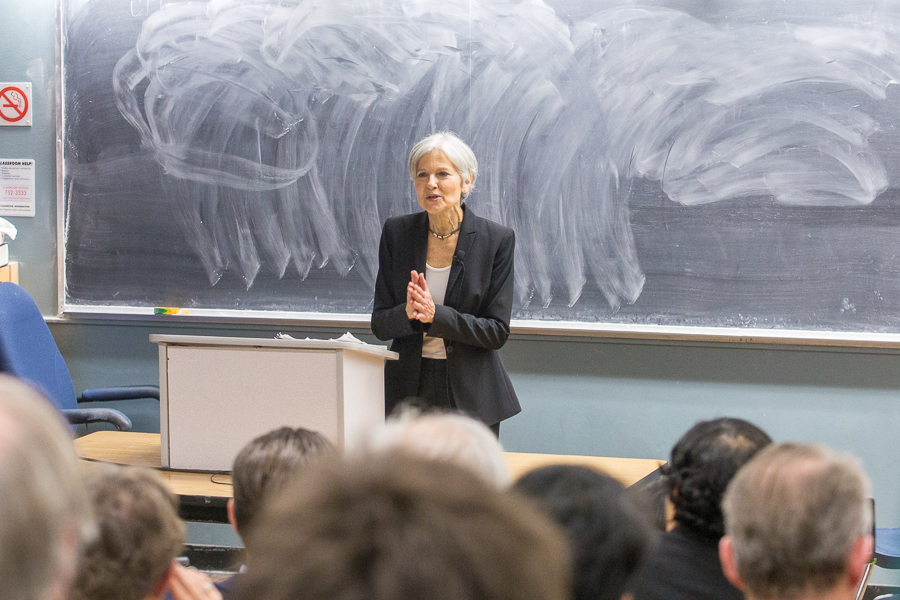
Green Party presidential candidate Jill Stein spoke at a UC Davis rally on March 9 as part of a speaking tour across California. The event, sponsored by the Yolo and Sacramento Green Parties and the Black Student Union of UC Davis, also featured a speech by campaign manager David Cobb.

“This is a time of great peril and great possibility,” Stein said in her speech. “We’ve got to decide which one it is. We don’t have time to go through another four years of being led around by the nose. We are on borrowed time right now; it’s not going to be easy to get out of here alive.”

Throughout her speech, Stein touched on several issues pertinent to her platform, including healthcare, military spending, the environment, student debt and immigration.

Walter England, a fifth-year anthropology major and a student officer for the Yolo County Green Party, said that the rally provided an opportunity for community members to learn more about Green Party policies and ideas.

“[Stein] was paid by Humboldt University to speak, and she took that money and she used it to basically pay to travel up and down California, to meet at various different universities and towns to kind of rally different Greens,” England said. “So this is an opportunity for people and the public to kind of become more aware of the rising Green movement that’s happening right now, and to become aware of Green Party policies and the options that are available and the sort of actions that we help support.”

The rally was held in Wellman 2 and began shortly after 8 p.m. with a short musical performance and announcements by the Sacramento and Yolo County Green parties.

Adam Siegel, the local council secretary for the Yolo County Green Party, said that Stein will tour across California to take better hold of a rise in Green Party support since the election.

“There’s been an upsurge in Green Party activity since the election, since before the election obviously, and there’s been a renewed interest in revitalizing the county party councils across the state,” Siegel said. “Jill Stein is currently barnstorming the state. She was in Arcata earlier today, she’s in Berkeley tomorrow and then the state Green Party is meeting in Bakersfield this weekend, so it’s all sort of a let’s take stock of where we are in 2017 and look to what comes next.”

One of the prominent topics discussed was the lack of choice in the two-party system and a need for alternative candidates in the political field.

“There’s a lot of possibility out there,” Siegel said. “I think, you know, the last year showed most Americans that there’s a real worry that we may be at a real point of departure in the political landscape, so you know there’s a lot of progressive energy out there that’s in the Democratic Party, that’s in the Green Party, that’s in other third parties and that is outside the party structure. […] I think it’s important to build political alternatives or alternative political choices for voters.”

Stein, who at various times compared herself to U.S. Senator Bernie Sanders, said that the Democratic Party has prevented members from the left from having a role in the party structure.

“These are things that, as Bernie Sanders showed, is a majoritarian agenda,” Stein said. “You know, [Sanders] was constrained by the Democratic Party, but other than that, our agendas were pretty similar. He couldn’t quite step up to the plate on transforming from a war economy to a Green economy, and there are a few other things that the Democratic Party just won’t let you do, but the other thing that the Democratic Party won’t let you do is win an election.”

Following the election, many Green Party members have advocated against the new administration. England, who formerly supported Sanders, said that there are various ways in which liberal groups have continued to stay active in the current political climate.

“I was one of those people, those who were incredibly depressed by the outcome of the election,” England said. “But ultimately, no matter how hard it can get, there is always a path forward. There is always an avenue for hope and change, things that we can do to try and make differences and sometimes that can be trying to fight within the party to make it better like Justice Democrats, sometimes it can be creating entirely different organizations like Indivisible, and sometimes it can be bolstering third parties to kind of put pressure from the left onto our local, state and national governments to act in the interest of the unsung people on the left that often get ignored by traditional politics.”


Written by: Ivan Valenzuela — campus@theaggie.org

Aggies fall in battle with Huskies

NICOLE WASHINGTON / AGGIE

UC Davis baseball gives up three in ninth to lose 7-4 to UConn

The UC Davis baseball team opened up its weekend series with a 7-4 loss to the visiting University of Connecticut Huskies last Friday. An exciting game start to finish, the Aggies fell behind early and then rallied to take a slim lead behind some key at bats. But they could not close it out, as an offensive burst by the Huskies in the ninth inning sealed the Aggies’ fate, dropping them to 4-8 on the year.

The starting pitching matchup featured the Aggies’ 6’4”, left-handed sophomore Robert Garcia against the Huskies’ P.J. Poulin. At first, it was Poulin who looked the sharpest. He pitched a shutout through the first two innings while Garcia gave up a run in each of his first two innings. Down 2-0, the Aggies rallied to score three times in the bottom of the third to take a one-run lead. Back-to-back RBI singles from junior third baseman Brad Pluschkell and sophomore second baseman Cameron Briggs tied the game at two. A couple of at bats later, junior Guillermo Salazar, batting in the designated hitter spot, slapped down an infield single to knock in the third run.

“It was good that I was there in that spot,” Salazar said. “I wanted to [designated hit] and luckily I had another chance in my third at bat to take the lead again. I just wanted to execute every [at bat].”

Salazar did exactly that. After a scoreless fourth, the Huskies tied the game at three on a two-out double in the top of the fifth. In the bottom of the inning, the Aggies responded with a two-out rally of their own. Following back-to-back strikeouts, sophomore left fielder Ryan Anderson doubled on a line-drive down the third base line. Salazar stepped in and smacked a ball into left center field for another double that to drove home another go-ahead run for the Aggies.

“We battled well,” Salazar said. “[Poulin] was supposed to be pretty good coming in and we knew that. We put the pressure on early and answered back after we went down. Just couldn’t put it together at the end.”

In three innings, the Aggies managed to score three runs on six hits off of Poulin and added their last run on Salazar’s RBI double in the fifth. Just as Salazar mentions, however, the rest of the game proved frustrating for UC Davis. The Huskies scored on an RBI single in the seventh inning to tie the game at four, but the Aggies prevented further damage on the next at bat by turning a five-three-five double play.

The club played stout defense in the eighth as well. Pluschkell showed off his skills with a spinning grab on a sharply hit ball to third base, complete with a cannon toss over to first in time to get the second out of a three-up, three-down inning. The Aggies looked like they were about to score in the eighth inning when senior catcher Ignacio Diaz reached on a one-out single, completing his perfect four-for-four day at the plate. But on the next at bat, the Aggies hit into a six-three double play to end the inning.

The game finally broke open again in the ninth, as the Huskies ripped a one-out RBI double down the third base line to open up a four-hit, three-run inning. Junior pitcher Blake Peters, despite a solid three and one-third innings of work, was credited with the loss. He exited the game with one out and one runner on in the ninth, and was replaced by his fellow junior pitcher Zach Stone, who ultimately gave up the final two runs.

The Aggies, facing a three-run deficit in the bottom half of the inning, were in position to threaten the Huskies after both junior center fielder Alex Aguiar and senior pinch hitter Mark Cardinalli drew walks. With one out and two runners on, the Aggies’ next two batters were struck out to end the inning, shutting the door on any hopes of a comeback.

Despite the team’s late collapse, Salazar remained optimistic about UC Davis’ chances to take the next two games from UConn.

“[We feel] pretty confident,” Salazar said. “As long as our pitchers pitch the way that they can and if we keep hitting the way we were today I think we should be fine [and] we should take two and win the series.”

The Aggies looked to get back in the winning column on Saturday and Sunday for the final two games of their series against the Huskies, but came up short. On Saturday, the Huskies emerged victorious with a 9-6 win and on Sunday the Aggies won 8-7 to avoid a blowout.


Written by: Dominic Faria — sports@theaggie.org

Local venues host wine and painting classes

ALEXA FONTANILLA / AGGIE

Cork It Again wine seller and Pence Gallery to provide visitors with drinks, painting supplies

For many, painting is intimidating; the thought of a blank canvas and infinite combinations can easily be overwhelming. Fortunately, thanks to the Pence Gallery and Cork It Again wine seller, painting is made simpler with step-by-step instructions — and of course, some alcoholic beverages.


“Canvas and Cocktails” hosted by Pence Gallery

Saturday, March 18 and Saturday, March 25

$45/person, 6:30 to 8:30 p.m.

15 years and older

After the success of the Pence Gallery’s first few “Canvas and Cocktail” events beginning in January of this year, Kelly Roberts, the painting instructor and fourth-year art studio and economics double major, hopes to make it a recurring event.

“I thought Davis and the Pence Gallery would benefit from those kinds of classes — there would be a draw and people would be interested,” Roberts said. “So I proposed the idea and outlined costs and what we would need to start it. […] So [Nelson and I] bought supplies and set some dates.”

Natalie Nelson, the director and curator for the Pence Gallery, has since worked with Roberts to host the “Canvas and Cocktails” events on a regular basis.

“We had a really great response the first time around; people really liked it,” Nelson said. “There’s a lot of these in Sacramento, but there’s nothing here being offered anyways, so I think the community will really like it.”

Before Roberts begins her instruction, the evening starts with a few glasses of wine, chocolates and various appetizers. The $45 fee includes the instruction, all supplies and beverages (both alcoholic and non-alcoholic). Roberts then slowly guides visitors through the step-by-step painting process. Unlike other similar programs, Roberts emphasizes the educational aspect of her lessons.

“I’d like to think I provide a little more teaching, and a little more instruction than most of these classes,” Roberts said. “I think the painting that we do during the paint parties […] they’re a little more in-depth, they’re a little more challenging. Which is to inspire people to get out and paint more, and not just doing a swirly blue thing with some stars on it.”

Nelson, who herself has attended one of these events, notes that the process is easy to follow for someone at any level of experience.

“Once she goes through the paint (this time we’re doing a still life with wine bottles and a wineglass), [Roberts] starts with what brush to use and what color to mix — she goes really slowly through everything so that you feel comfortable doing it,” Nelson said. “Towards the end, people bring them up, or ask questions, and then we share them. It’s fun to talk to friends [..] it’s all very light-hearted.”

The subject of the paintings vary with each event, so anyone who enjoyed the experience can always return. Roberts admits she prefers landscapes or still-lifes, but primarily wants to challenge her students.

“I tend to like to do landscapes, or just something where people can really learn and see how the steps get put together, and how they can create something really cool that they didn’t think they were capable of before,” Roberts said.

All in all, the evening can’t go wrong with a paintbrush in one hand and a wine glass in the other.


“Paint n’ Sip” hosted by Cork It Again Wines

Sunday, March 19

2 to 4 p.m.

$35, $3-4/glass of wine

21 years and older

For Cork It Again, pairing wine and paint is not a novel concept. The small tasting room in downtown Davis has been hosting these events for a little over a year, but, because they host the event outside the tasting room, they are more frequent once the weather gets warmer.

The $35 fee includes all painting supplies, but beverages are not included. With an array of fine wines, however, Cork It Again discounts their wine to $3 to $4 per glass.

In addition to hosting their own events, Cork It Again will bring the party to you.

“We do private parties, too,” said Jake Lenz, the operations manager for Cork It Again. “We’ve even gone to different offices in the area. We have everything — tables, supplies, wine.”

Lenz noted that the instructors for each painting event vary, but the current instructors are all previous or current UC Davis students. Many of the instructors’ work has also been featured in their tasting room.

Similar to the Pence Gallery, Cork It Again ensures that the instructors move slowly and carefully to accommodate all levels of painting experience.

“Everyone’s usually scared to do it, and really, you shouldn’t be,” Lenz said. “Everybody in the class is a beginner — most people have never even painted before. But the instructors make it really easy, so it’s literally like step-by-step.”

The event accommodates a maximum of 20 people, so those interested are encouraged to pre-register on the Cork It Again’s website.


Written by: Ally Overbay — arts@theaggie.org


Agents for change

HANNAH LEE / AGGIE

Students make a difference in community classrooms

As part of an internship, Rebekah Roh, a fourth-year english major and Teach for America campus campaign coordinator, worked in a classroom that provided iPads to its students. Later, she visited a classroom that was struggling to even provide resources to all students. This discrepancy, along with other experiences, led Roh to Teach for America.

A handful of UC Davis students get involved with Teach For America during their time on campus and after they graduate. Teach for America is nonprofit in which those who are accepted into the organization commit to teach a subject to students for two years in a high-need community anywhere across the nation.

“At Teach for America, we recruit diverse and talented leaders who are very committed to expanding opportunities for our nation’s highest need children,” said Taylor Weeks, the recruitment manager of Teach for America.

Teach for America celebrated its 25th anniversary last year. Over the years, about 200 Davis students have participated in Teach for America. Once accepted into the program, students are called corps members. Corps members can teach in different classroom settings ranging from preschool to 12th grade.

Corps members can also give a preference of where in the nation they would like to teach and what they would like to teach. Although Weeks went to school in Boston, when she taught she was very open with her preferencing and was thus placed in Alabama.

“It was the best thing I’ve ever done,” Weeks said.

Roh is going to be a 2017 corps member for Teach for America. She’s set to teach in Los Angeles.

“For me, I wanted to stay in California,” Roh said. “I’m from NorCal but I wanted to go to LA because I wanted to move to another part of California just for my personal growth. I was also interested in particularly urban education.”

Teach for America accepts students from all majors and backgrounds to join its corps program. However, applicants must have a 2.5 grade point average. According to Weeks, the organization looks for individuals who’ve made the effort to have an impact in some way on campus or in something they’ve been involved in.

“There’s really not a cookie-cutter specific profile for somebody that does Teach for America,” Weeks said. “Across the board, everyone is a leader.”

Roh heard about Teach for America as a senior in high school. According to Roh, her time spent at UC Davis and in many internships led her to recognize big inequalities in education.

“I think there is the element of my personal experience,” Roh said. “I [looked] into the broader section of things and I [learned] things in classrooms and I [saw] statistics about access to higher education being almost like reserved for people of privileged groups. I [learned] about minority groups being far less represented in their pursuit of opportunities to learn and to grow. I think those are also things that shaped my decision to particularly partner with Teach for America.”

Teach for America corps members receive the same salary and health benefits as any other first-year teacher in the district. However, not every corps member stays in the classroom after their commitment. Some choose to pursue other fields and interests, but remain a part of the huge Teach for America alumni network.

“I think people want to get on the front lines of change and have that impact right away,” Weeks said. “I think what it comes down to is that they can have an impact from day one with Teach for America. I think teaching, regardless of what their background, is a really valuable experience that going to launch them into whatever career and field they want to go into down the road.”

The Sacramento Area Youth Speaks (SAYS) program also gets UC Davis students into the classroom. SAYS services are set to improve schools through professional development programs for teachers, classroom instruction and after school programs. SAYS hopes to transform education into a tool of empowerment.

“[We] work with upwards to 5,000 young people every year through our in class residency program,” said Vajra Watson, the SAYS founder and the director of research and policy for equity at UC Davis. “In those spaces we really focus on using literacy to connect them to their own leadership abilities. We’ll do a lot of hip hop activities, we’ll do spoken word, we’ll get the young people writing about their lives in order to engage them in school and engage them in the curriculum.”

SAYS also hosts Sacramento’s slam poetry season for the region and Sacramento’s youth poet laureate program.

“There’s a lot of facets of our work, all of it though kind of intersects in […] how [we] help young people become the authors of their lives and agents of change,” Watson said.

Watson founded SAYS over nine years ago. After getting her doctorate in education from Harvard, she wanted to find a way to take what she learned in her dissertation work, which was on community based organizations, and apply it to her work in Sacramento. After meeting with various superintendents and educators, Watson learned that Sacramento was having a literacy crisis specific for black and brown youth and needed new ways of engaging them. Watson made a flier for a spoken word performance poetry meeting and five students came.

At the next meeting, however, there were 57 attendees.

“Those five students said that they were starving in Sacramento for youth empowerment programs and for social justice,” Watson said, “It really just started growing exponentially and that gave me the ability to get some funding and hire some community based poets and really take what I learned from my dissertation and apply to a model that brings the community into classrooms.”

Students from UC Davis can get involved with SAYS as interns or through work study. UC Davis interns are treated just like staff, and work with kids in the classroom and after-school programs. However, they go through about two to three weeks of training, less training than a normal staff member.

Interns also plan the SAYS Summit College Day, which is on May 19 this year. About 1,000 high-risk youth will visit UC Davis to explore the campus, attend educational workshops, participate in spoken word poetry and critical literacy activities and experience higher education.

“We couldn’t do it without the UC Davis students,” Watson said “[They] are just so critical to that mentoring component and showing the students that there’s like really cool relatively young adults on the UC Davis campus.”
Written by: Fatima Siddiqui  — features@theaggie.org

UC Office of the President addresses gender-inclusive restrooms on campuses

MEENA RUGH / AGGIE FILE

Gender-inclusive bathrooms filter now located on the UC Davis campus map

The University of California Office of the President (UCOP) released a statement on Feb. 23 regarding President Donald Trump’s decision to revoke the guidance issued by the Obama Administration on accommodating transgender and gender non-conforming students. This included the unrestricted access to restrooms that conform to students’ gender identities.

“The University of California, in accordance with state law and in keeping with its own principles of nondiscrimination, will continue to ensure that its transgender students, faculty and staff have unrestricted access to restrooms that conform to their gender identities,” said a statement released by UCOP. “We are heartened to hear that protecting all students, including those in the LGBTQ community, remains a stated priority for the Department of Education.”

On the UC Davis campus map, students can now locate all gender-inclusive bathrooms under the student and staff resources tab.

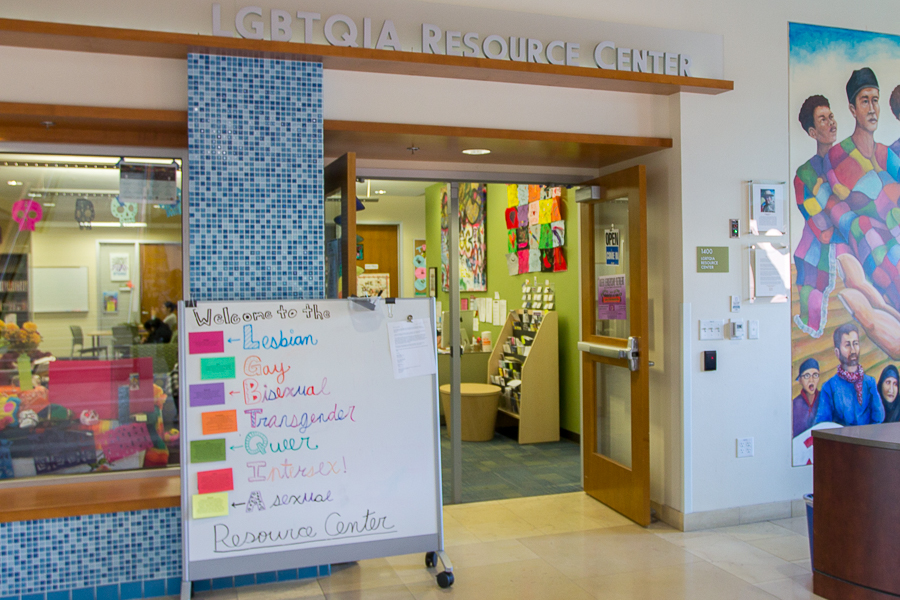
On the UC Davis LGBTQIA Resource Center’s website, an article was released listing the available gender-inclusive restroom locations on campus. The article also includes a statement by JAC Stringer, founder of Heartland Trans* Wellness Group, that addresses the struggles transgender people face in sex-segregated bathrooms and the importance of providing gender-inclusive restrooms for not only transgender people, but also for children or disabled people who are accompanied by a differently-gendered parent or attendant.

“Gender inclusive bathrooms provide a safe, private facility for transgender, genderqueer and gender nonconforming people, families with children and people with disabilities who may need assistance,” Stringer said.

UC Berkeley researchers recently released a study that found transgender and genderfluid teens face up to three times more mental and physical abuse than their gender-conforming peers. The study also found that school-based bullying was the most common form of aggression faced by transgender and genderfluid teens, with transgender girls experiencing the highest rates of cyberbullying and gender-fluid teens assigned male at birth reporting the most cases of sexual violence.

The director of the LGBTQIA Resource Center, elizabeth coté, believes it is important for universities to continue to provide students, faculty and staff the option of gender-inclusive restrooms.

“Having gender-inclusive restrooms and facilities available is crucial to the campus climate for trans and gender non-conforming undergraduate and graduate scholars, staff and faculty,” coté said.

The LGBTQIA Resource Center, coté added, will continue to be a useful and comfortable space for all students of the UC Davis community.

“The LGBTQIA Resource Center will continue our work of providing an open and inclusive space and community that challenges systems of oppression, including cis-sexism,” coté said. “We will continue to provide education about all sexes, genders and sexualities as well as space for self-exploration of these identities.”
Written by: Demi Caceres — campus@theaggie.org

Tom Dalzell documents city’s quirks and reveals an American treasure

BERNT ROSTAD [CC BY 2.00] / FLICKR
Meet the man assiduously recording Berkeley’s past and present weirdness

Should it ever strike your fancy to Google the terms “bowling balls as lawn art,” “enormous dachshund sculptures,” “a pyramid made of birdhouses” or “a house in the shape of a tardigrade,” you’ll be delighted to find that all these oddities exist in the city limits of Berkeley. You’ll also be pleased to learn that one man has taken it upon himself to record all these and more, through photography and written word.

Tom Dalzell is the brains behind Quirky Berkeley, a website that, by anthologizing the eccentricities of the city’s material culture, is helping to preserve a cornerstone of American culture at one of the country’s most prominent public universities.

Dalzell’s prose is liberally peppered with allusions to high culture, the marks of his Ivy League education. A walk through Marcia Donahue’s garden for him inspires the same awe as “a walk into a Maybeck home.” He correctly identifies Marion Friedman’s backyard collection as a homage to “objet trouvé,” a French Surrealist movement. He devotes an entire section of his blog to the aesthetic of emptiness, inspired by the Buddhist philosophy of Sunyata.

But despite the erudition and knowledge which he possesses, Dalzell is incredibly skilled at connecting with his readers. As he guides his audience through the nuance of Berkeley’s quirks, he uses second-person pronouns to directly address the reader. To read his blog is to engage in tȇte-à-tȇte with a romantic on the subject of his lover. A reader who shares Dalzell’s love for quirk will find that his writing exudes a distinct warmth.

All this ran through my mind as I shivered under Dalzell’s cold glare. He had marshalled me to stand opposite his end of his kitchen island, and now sat in annoyed anticipation of my questions.

When Dalzell isn’t curating his quirk collection, he is managing the finances of the International Brotherhood of Electrical Workers (IBEW) California chapter. His career and hobby have shared a serendipitous connection throughout his life, as if labor lawyer and Berkeley enthusiast are in the same karass of occupations.

Back in 1968, when movies cost a nickel and the Beatles still crooned together, Dalzell travelled to Delano, California for a summer gig with the United Farm Workers. It was on a weekend excursion away from the Central Valley when Dalzell first laid eyes upon his city. Love at first sight? Not quite.

“I admit — it was a shock to my eyes,” Dalzell said. “It was more than I could absorb.”

Understandable. 1968 Berkeley was the city at its most extreme. This was the year of the Tet offensive, the Black Power takeover of Columbia, the assassinations of Martin Luther King Jr. and Bobby Kennedy, the student uprising in Paris, the politicized Mexico City Olympics, the bloody Democratic National Convention riots and Prague Spring. And the University of California’s famous student protesters had much to say about it all. To Dalzell, at the time a “just-barely-17 year old Mainline Philadelphia Episcopal” high schooler, the scene was overwhelming.

Yet he kept visiting Berkeley that summer. And after a five-semester stint at the University of Pennsylvania, he heard “the call to be part of social change,” returned to Delano to work for UFW, at one point even rubbing shoulders with Cesar Chavez. But he kept visiting Berkeley.

Our conversation to this point was still quite chilly. Dalzell’s expression this morning rested at a slight scowl. He periodically turned his back to me to wash dishes, sweep the kitchen counter and feed the feisty felines who kept mounting the kitchen island. When he did sit before me, his eye contact oscillated between the window behind me and the notepad in my hands. And he ended his rehearsed replies mid-thought, abruptly shooting his anticipant gaze back at me.

When I posed a more thought-provoking line of conversation (“What is the state of farmworkers today?”), Dalzell perked up. He stopped scrubbing mid-cereal bowl, planted himself firmly to his stool and abandoned his watch of my notebook. Something resembling a smile creeped onto his face, as he laid out a long intellectual indictment of the UFW’s current direction. And, once he finished, he finally acknowledged my presence by asking about my article.

An insight struck me harder than the Campanelli’s clapper strikes its mouth at noon. Dalzell’s cold exterior is not a product of rudeness or scorn. It is a deliberate investment decision, a choice to expend energy on refinement of mind and soul, instead of on the costly upkeep of conventional appearance and manner.

Tom Dalzell is a quintessential Berkeley Gentleman.

**


The idea that a city makes a man is not a novel one. Plato theorized that a city’s cycle of regimes would bring about different breeds of man — a timocracy would create a populace obsessed with an honor, an aristocracy a populace obsessed with wealth. In antebellum America, the Southern gentleman was warm, slow-speaking, mannered and hospitable on the outside, but brutal and flawed on the inside, akin to how the glamour of plantation life lightly coated the disgusting institution of slavery.

On first glance, Berkeley’s grey July skies, dilapidated old buildings and homeless-strewn sidewalks make it seem unwelcoming. Yet should you duck into one of those dingy old buildings, you’ll find likely yourself in a palatable ethnic restaurant, like Naan N Curry. Or in a brimming repository of used books and ideas, like Moe’s Books. Or in a cafe doubling as a hotbed of political debate, like the Caffe Mediterraneum.

Like his city, Tom Dalzell is a treasure trove of insightfulness on the inside. The secrets to digging through Dalzell’s rough exterior and meeting the worldly intellectual are patience and genuine interest.


**


Our conversation carried onward with a newfound energy. Dalzell quit the UFW in the late 1970s due to his aforementioned qualms with its direction. He decided to try his hand at the world’s second oldest profession, by moving to Sacramento and joining Jerry Brown’s ill-fated 1980 presidential campaign. Yes, Dalzell is acquainted with Governor Moonbeam as well.

The IBEW offered him a job in 1984 as the union’s counsel. IBEW’s office is in Walnut Creek, a sleepy suburb 25 miles east of San Francisco. So finally, circumstance permitted Dalzell to settle in his current home, an Edwardian townhouse in North Berkeley.

Dalzell, who sees himself as a flaneur, describes himself on his blog as “a perceptive urban stroller who [makes] aesthetically attuned observations.” Since his first visit to Berkeley, he’s made mental lists of the oddities he’s spotted on walks, but it was a pulmonary failure that led to a near-death experience in 2011 that imbued in him the mission of cataloging all the city’s quirks.

Implicit in his goal is the task of strolling down every block of Berkeley — its squalorous West, upper-class North, gentrifying South and student-tailored East.  

His mission began with a focus on North Berkeley, and a result his entries are composed mostly of the eccentric backyard art and sidewalk installations of Berkeley old-timers. He has only recently started making headway into strolling through other parts of the city, and into documenting its past.

Just before I left, I rose to Dalzell an existential question, one that I imagined had given him many sleepless nights:

“What is Berkeley?”

Without a word, Dalzell stood up from his stool, but not to wash more dishes. He motioned for me to follow him through his memorabilia-adorned hallway (too quick for me to discern much, but I think I spotted a letter from Cesar Chavez, and a photo with Mario Savio) into his office. Amongst the clutter of notes and books on his desk is a stack of bright yellow paperbacks — the contents of his blog, condensed into a publication. He grabs one from the stack, opens it a third of the way through and points me to a short yet profound answer.

“Berkeley is a refuge from the rational culture.”
Written by: Sid Bagga — sidobagga@gmail.com

Disclaimer: The views and opinions expressed by individual columnists belong to the columnists alone and do not necessarily indicate the views and opinions held by The California Aggie.