56 F
Davis

Davis, California

Wednesday, December 24, 2025
Home Blog Page 809

Swimming and diving team finish 2nd in the MPSF Championships

0

A recap of four days of competition from Feb. 18-21

Designed by Sandra Bae

Relentless hard work and dedication rewarded the Aggies with a slew of excellent finishes that were riddled with season best times and satisfying team results.  Though separated by distance – the divers held their events in Pasadena, Calif., and the swimmers held theirs at the East Los Angeles College – the athletes fought as a team, in the end succumbing only to Hawai’i.

The UC Davis swimming and diving team competed in the Mountain Pacific Sports Federation Championships from Feb. 18-21, placing second. The Aggies put up an admirable fight, and held on to their second place position throughout the duration of the weekend.

Day One:

Day one, Feb. 18, proved to be a slow start as both swimmers and divers eased into the weekend competition.

Three Aggie divers dove to top-10 finishes in the 1-meter diving event. Juniors Lucy Lafranchise and Audrey DeNeffe placed fifth and seventh, with scores of 247.30 and 241.75, respectively, and sophomore Serena Yee came in 10th with 237.00.

The swim relay was made up of senior Samantha Shellem, freshman Robin Lampron, junior Marissa Brown and sophomore Kirsten Brand came up second in the 800 freestyle with a season best time of 7:18.02, despite losing to Hawai’i (7:14.88) in the race itself.

With another season best time of 1:41.04, senior Hilary Hunt, junior Hailey Ferko, sophomore Hilvy Cheung and Shellem placed fourth in the 200 medley relay.

Day Two:

Day two brought no definitive wins, but strong efforts from Shellem who placed second in the 500 free with a season-best time of 4:49.95, and the free relay “A” team, comprised of Cheung, junior Brittany Rojo, Brand and Hunt, who touched the wall at 1:32.36 in third, grabbing yet another season best time.

The divers took four top-eight finishes, earning the places five through eight in the championship final for the 3-meter board.  Lafranchise (235.90) ended at fifth, followed by senior Shannon Stewart (232.80), junior Hanna Tears (229.85) and Yee (222.00) for slots six through eight.

The Aggies finished this day tied for second with UC Santa Barbara at 192 points, while Hawai’i led with 293 and Pacific trailed with 173.

Day Three:

The third day of the championships went well for the Aggies as the swimmers won their only relay of the weekend, the 400 medley. Swam by Hunt, Ferko, Cheung and Shellem, the “A” relay team clocked in at 3:40.87.

Cheung beat the competition in the 100 fly, rushing into the wall at 53.65 and exiting the pool with her first MPSF title and a qualifying NCAA “B” time. Hunt came in second in the 100 back with 54.42, less than half a second behind BYU’s Haley Bertoldo.

Two season low times awaited Shellem and Ferko, who placed third in the 200 free with 1:48.11 and fifth in the 100 breast with 1:02.98, respectively. Brown placed sixth in the 400 individual medley (4:24.45) and senior Karley Troup seventh (4:26.19).

In the women’s platform diving event, three Aggies dove their way into top-10 spots. DeNeffe scored highest of her teammates at 189.90, locking her into a seventh place finish. Lafranchise (185.00) and freshman Angelina Proshak (182.35) closely followed DeNeffe for the ninth and 10th places. This brought the diving portion of the championships to a close.

Day Four:

The fourth and final day of the the MPSF championships was a good one for the Aggies, as six swimmers broke previous season best times.

Cheung nabbed her second championship title in the 200 fly, sporting a season best 1:57.35, with senior Megan Leung as the closest Aggie behind her, coming in fourth at 2:02.63.

Brown crushed her previous record of 17:00.39 in the 1650 free with a new time of 16:46.25. Also in free events, Shellem (50.34) and Brand (51.09) both set season bests and hit the wall for subsequent fourth and fifth positions.

Hunt, in another NCAA “B” qualification time of 1:58.56 in the 200 back went home with a second place finish, and sophomore Elise Roberts came up for air in sixth place in the 200 breast, at 2:18.32.

The “A” team 400 free relay, comprised of Cheung, Shellem, Brand and Hunt finished the championships in fourth place, with yet another season best time of 3:23.04.

Though disappointed with falling short of the championship title, the UC Davis swimming and diving team went after their competition with a zeal that was reflected in their numerous accomplishments during the weekend. Hawai’i finished with 747 points, UC Davis with 632 and UC Santa Barbara with 585.5.  A select few Aggies will return Mar. 9-11 for the NCAA Zone Diving Championships in Colorado Springs in the hopes of qualifying for the NCAA Championships Mar. 19-21 in Greensboro, North Carolina.

Graphic by Sandra Bae
The Turtle House to swing easy with jazz

0

Jazz music to be featured at upcoming house show

It’s Saturday evening, Feb. 28, 2015. You’ve parked your bike at 217 2nd Street, and you walk past the garden beds, picnic tables, homey-porch and balcony donning a decorative and historic turtle shell. You hear those familiar jazzy beats that you came for resonating deep within the house and you follow your feet to the left, hungry for those groovy feels. You find yourself in the roomy basement, filled with smiles, hors d’oeuvres and good vibes. With your belly full of beverages, your shoulders start swaying, as you realize without a doubt that is the place for your Saturday evening.

Davis’ own “Turtle House” is proudly hosting a live jazz night this weekend. Featuring tunes by Deep Mushroom, Liz David and Friends, F Street Stompers, GRIFFITH and Dank Ocean.

The first three bands are going to be playing in the basement of the Turtle House and will move outside onto the porch later in the evening for GRIFFITH and Dank Ocean.

Fourth-year NPB major and one of the hosts of the event, Akshay Prabhu, describes Liz David and Friends to be a “trio that plays your typical standard jazz,” and the F Street Stompers as a more “ragtime blues-y band; they’re not quite jazz but they’re the same era – they’ve got a washboard and a banjo and an upright bass.”

“The second two bands are really high energy and very fun… we’re moving outside to make room for more people and to facilitate more dancing,” fourth-year plant bio major and another host of the event, Sam Reisman, said. “GRIFFITH is a seven-piece jazz combo through the jazz department, and they play a lot of standards that have been rewritten to amp up the tempo and include seven or eight people. They swing really, really hard.”

Scott Dunbar, UC Davis graduate and bassist of Dank Ocean, said that their sound is a “more contemporary, jazz-influenced sound with Latin fusion and a wide range of instruments.” Dunbar said he is is very excited about this show because not only is it a return to the first venue they ever played at, but it’s going to be the first show they have played since they have actually recorded (which he added will be available for purchase soon).

“[Because of all our practice for recording] we’re playing better than we’ve ever played before […] and there’s no where better to bring that [sound] to than the good people of the Turtle House,” Dunbar said.

What is it, though, that is so great about seeing a show at the Turtle House? According to Reisman , the residents at the Turtle House love hosting shows for many reasons.

“[They have got] the venue for it — the basement and the front yard — [they’ve got] a landlord that is supportive of it as long as they’re responsible and considerate of their neighbors and the Turtle House actually has a long history of being involved in the Davis music scene,” Reisman said.

Besides just being a jazz-fan that wanted to bring some funky magic to the close-knit town of Davis, Prabhu’s inspiration for this event came from wanting to strengthen the community through fun and memorable events.

“Everyone comes together on that day and sets up and decorates and everything; it’s a really great bonding experience,” Prabhu said.

Prabhu and Reisman both expressed a particular fondness of house-show culture, because of the intimate and relaxed environment it fosters.

“It’s so fun to actually get to hang out with the artist that you just enjoyed and [also] meet artists that aren’t super popular; and you can let them crash on your couch afterwards,” Prabhu said.

According to Prabhu and Reisman, if you come out on Saturday, you’re in for great music, great vibes and great food. Even if you don’t know anyone at the show, Dunbar believes you will not want to miss out.

“There’s good people living there; everyone’s very welcoming and open,” Dunbar said.

If you plan on attending, the hosts ask that you please come to the early parts of the show at 4:30 p.m. to see the first musicians and to please leave by 9 p.m. in order to respect their neighbors. More information on the event can be found on their Facebook event page. Swing ya later.


Film Review: The Duff

0

It’s the age-old story of the bubble gum-smacking mean girl, the locker-slamming jock and the frumpy girl next door that has turned the teen drama genre into an American classic. The films are countless: Pretty in Pink, Clueless, She’s All That and Mean Girls. The list never ends. Somehow audiences keep coming back to relive even the most irksome of high school memories.

We all have them, including the cast of The Duff who had to mentally recall their high school glory days throughout filming.

“It was a tough one, my own high school experience. So I just kind of went back there and relived those sad memories,” Mae Whitman, the actress who played the movie’s protagonist, said.

Whitman’s character, the overall-clad Bianca, learned the unpleasant truth of her status as a DUFF — Designated Ugly Fat Friend — whose sole purpose among the gruesome high school food chain is to make her own friends appear prettier in relation to her. Bianca is aggressive in working to remove her label as a DUFF, with the help of football team captain and neighbor Wesley, played by actor Robbie Amell.

Amell, who says he had a “tame” time in school, said that he believes the film is successful in grasping the true high school experience. He compares the film to John Hughes’ The Breakfast Club, in its ability to break down stereotypes throughout the course of the story.

“You know everybody is trying to find their way and figure out who they are, so it was just nice to see that in something that actually turned out to be so funny,” Amell said.

The film scoffs at the laughable place of teenage social media politics in high school. The official end to a friendship today, as Bianca establishes in the beginning of the film, is really the unfollow and unfriending on Instagram, Twitter, WeHeartIt, Tumblr and of course, Snapchat.

Cliches such as tearful scenes in bathroom stalls and trial and error dressing room montages are forgivable here. Whitman is endearing with her infectious sarcasm and facial expressions that are akin to iPhone emojis, making for a perfect modern-day Eliza Doolittle in clogs. Conversations between Bianca and Wesley are smooth and effortless, some of which were unscripted, according to Amell.

Madison, played by Bella Thorne, solidifies her role as resident mean girl with a hard slap that followed a sloppy kiss with Wesley. Whitman, an onlooker during the scene, added she didn’t know the slap was going to happen.

The movie abolished the notion of the inescapable high school social hierarchy, Whitman adds.

“It was important to me to communicate that you know the coolest kids in the world are bullied, just like me,” Whitman said.

The Duff opened everywhere Feb. 20.

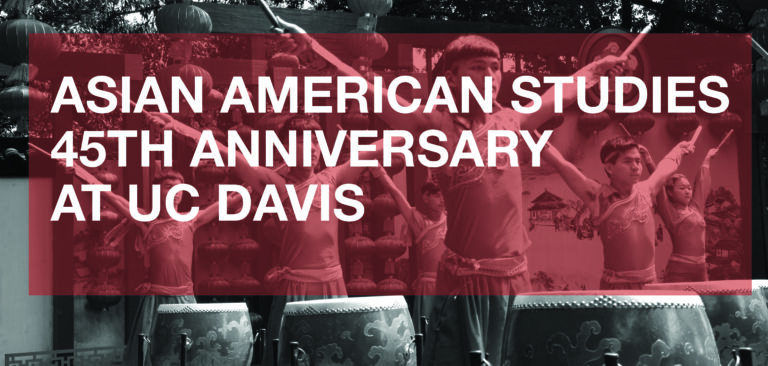
Celebrating 45 years of Asian American Studies

0

UC Davis Asian American Studies reaches a milestone

Flashback to winter 1969: UC Davis students formed the Asian American Concern (later called the Asian American Studies committee), which established the first formal contract between Asian American students and the UC Davis administration. Soon after, the first Asian American Studies class, a history course on the Asian Experience in America, was offered. In spring 1969, about 5,000 UC Davis students took to the quad to rally for ethnic studies, resulting in the establishment of the Asian American Studies (ASA) program in 1970.

In 2015, we approach 45 years of ASA at UC Davis. On Mar. 7, a celebration will be held for the anniversary from 1-7 p.m. at Putah Creek Lodge. The event not only celebrates the milestone, but also commemorates the department’s contribution to the campus culture.

Richard Kim, associate professor and chair of ASA, stressed that the department encourages new ways of thinking and forming identities through its examination of the intricate realms of social relations.

“[ASA] is vital to a liberal arts education that ideally strives to cultivate an informed and socially aware student body [and] the ability to think critically from an interdisciplinary perspective is a significant benefit of an effective liberal arts education,” Kim said. “In these ways, [ASA] has been at the cutting edge of a rigorous liberal arts curriculum that seeks to incorporate new voices and perspectives in developing and disseminating socially relevant knowledge.”

The celebration will open with two panel discussions that feature the voices of current UC Davis students, UC Davis staff, UC Davis alumni and former faculty members. The first panel, “George Kagiwada, His Legacy and Asian American Studies in the 21st Century,” will reflect on Professor George Kagiwada’s vision, pedagogy and contributions as ASA’s first director. The second panel, “Forging Alliances Past and Present,” expounds on the critical movements and cross-racial alliances that have occurred since ASA’s establishment.

Susette Min, associate professor of ASA, expressed the importance of commemorating those who have helped sustained ASA throughout its existence.

“The event aims to promote meaningful dialogue not only about Asian American Studies, but also about social and economic justice, the status of race and racism at [UC Davis], community formation, culture and the future of Asian American Studies in the 21st century,” Min said.

After the panels will be a reception featuring a musical performance by Mass Bass. Mass Bass is a Filipino revolutionary hip-hop group whose music illustrates the everyday experiences and struggles of minority groups, including the Asian American community.

Armael Malinis, keyboardist for Mass Bass, graduated from UC Davis in 2003 with a major in community regional development and a minor in Asian American Studies. Malinis expressed that his ASA courses inspired him to be involved in activism both on campus and in the world beyond.

“Our music speaks on issues such as immigration, the struggles around racism growing up, being exploited at our workplace and everyday issues that Asian American studies convey in the teachings,” Malinis said. “Similar to how the bass is the foundation to music, the masses are the foundation to building a revolutionary movement that will replace the current system we live under.”

Malinis stressed the importance of preserving and propagating culture, which he hopes can be done through educational as well as experiential exposures.

“Mass Bass aims to spark the revolutionary imagination of the UC Davis community [for] activism and organizing should not be limited to what we read in the history books,” Malinis said. “The world that we all have inherited is a challenging place to live in and it is our duty to continue the legacy of struggle that our ancestors began.”

ASA’s 45th anniversary will be free and open to all supporters of the department. For more information, please visit http://asa.ucdavis.edu/annual-events/45th-anniversary.

Graphic by Tiffany Choi

News in Brief: Music of Java at the Mondavi Center

0

Free Javanese Gamelan Gadhon concert today

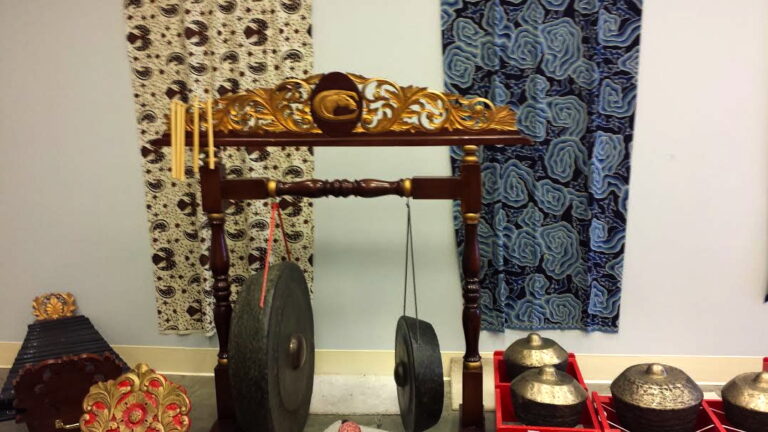
Javanese Gamelan Gadhon, a traditional ensemble of music (an array of instruments played together to make a specific type of sound and feeling) from the island of Java in Indonesia, is set to perform at the Mondavi center on Thursday Feb. 26  at 12:05 p.m. While the island of Java has several different ethnic groups each with their own distinct traditions, Javanese is the largest of these diverse groups.

This small ensemble consists of mostly tuned percussives along with other instruments, such as metallophones, hand drums called kendhang, bamboo flutes, a bowed instrument named the rebab and a female vocalist. A large gong is usually used in part of the performance, along with a number of instruments with metal keys that are hit with soft mallets.

These instruments are considered to be soft-sounding rather than loud that is juxtaposed to the singer and the bow instruments, which create a more forceful sound. All performers and instruments are arranged on the floor, with the instruments raised on intricately carved stands.

One of the performers in this ensemble is the Associate Professor and Chair of the Department of Music at UC Davis, Henry Spiller. His interest in gamelan, the larger version of gamelan gadhon, began in college, where he enrolled in a class on the musical genre. Spiller went on to study Sundanese music in Indonesia, and he describes the melodies as rhythmically relaxing.

“[Gamelan music gives the] sensation of moving slowly and quickly at the same time,” Spiller said.

While Spiller’s main focus is Sundanese music from another ethnic group in Java, he is familiar with Javanese gamelan gadhon and will be playing the metallophone in Thursday’s performance.

Spiller has played with other members of this ensemble, however, and is excited to work with them again. There are three Javanese musicians included in the performance.

Philip Acimovic, the only student member of the group, is a second-year Ph.D student at UC Davis. Acimovic majors in music composition and aside from performing in Javanese gamelan gadhon ensembles, he composes music for western chamber groups. Having studied in Java for two years, Acimovic said he has fully embraced a musical lifestyle.

“There was a lot less talking about music [in Java] than we do here [in America]; [there was] a lot more playing. Through playing and through listening, I was able to make [personal musical] progress,” Acimovic said.

While he has learned to play almost all the instruments in gamelan gadhon, Acimovic will be playing the kendhang drum in Thursday’s performance. When listening to gamelan gadhon, Acimovic hears the vast variety of instruments coming together.

“What I love so much [what] I hear [in this music] is that everyone is working so hard to keep this sense of connection,” Acimovic said.

Admission to this concert is free of charge. For more information you can visit arts.ucdavis.edu/event/javanese-gamelan-gadhon.

Photo by Dimitra Loumiotis

Guest Opinion: Mixed roots, same Earth

0

“So, like, what are you?”

“A human?”

“No, you know what I mean, what are you? What’s your background?”

“Oh….”

This exchange is one that is probably familiar to many on campus and in America whose physical appearance doesn’t fit comfortably into one of the major racial categories that we often rely on to identify, make assumptions about and relate to other people. While people of mixed heritage are certainly not the only ones subject to the “what are you” question, they can face the question and the prospect of giving an answer more complicated than a single-word: Asian, Black, Latino/a, Native or White.

But we are in a strange time; despite the fact that the “what are you” question and the desire for choose-one identities persist, the visibility of mixed people is higher than it has ever been. President Barack Obama’s white mother/black father parentage was a central part of the story he told on his path to the White House in 2008. And in advertising, mass media and academia, an increasing amount of attention has been paid to mixed folks. So-called “racially ambiguous” people, including many with mixed heritage, are in high demand by marketers and talent scouts (think of former SNLers Fred Armisen and Maya Rudolph). In academia, Critical Mixed Race Studies exists as a field of study, a biennial conference, an academic journal, and a community in the process of forming the Critical Mixed Race Studies Association.

When I (Gaby) came to UC Davis from high school, I did not identify as mixed and was not even aware that I could. As the child of a Mexican father and a white mother, I was often perceived as a white woman, with my Mexican heritage invisible and ignored. I remember attending a Chican@/Latin@ welcome event for new students; I stopped at an organization’s table and one student asked me, “Oh, so are you Latina?” At that moment, I became aware of how much appearance mattered, how difficult it was for people to accept more than one answer, and how much my own experience and perspective differed from many others, not just at this event but all over campus. I didn’t want to choose only one ethnicity. I wanted to be in an ethnically diverse space that recognized my mixed identity and experience.

In 2013, a friend approached me about reviving Mixed Student Union, started in 2004 but inactive for several years. I started to explore my mixed heritage and what it meant. Now, as MSU President and as the Multi-Ethnic Community and Mixed Heritage Week Student Coordinator at the Cross Cultural Center, I implement programs that create space for people of mixed heritage to share experiences and create community. One of these programs is the 11th Annual UC Davis Mixed Heritage Week, “Mixed Roots, Same Earth”, which will take place on campus next week, from March 2 to March 6. Organized by the Cross Cultural Center and MSU, MHW is a week long event, open to all, dedicated to the celebration and empowerment of the mixed heritage community, providing space for sharing, learning and connection.

The challenges of creating a strong mixed community have a lot to do with the diversity of experiences and perspectives. But this diversity is also a strength. Listening to mixed folk and thinking about mixed identity can help us think critically about what it means to live in the 21st century, about equality and inequality, and about the realities and possibilities of our multi-cultural nation (and globe).

One of us (Gaby) came to thinking about mixed identity through her own experience as a new undergraduate on campus, the other one (Simon) came to it as a graduate student who studies race and also as a husband and father. I (Simon) am a white man, my son is a child of mixed heritage and we live in a community with many mixed children. I see first-hand the beauties, questions and challenges of this common ground. My son, German-Jewish, Finnish-American, Peruvian and Scottish, plays with other children and close friends, who are combinations of Ecuadorian, Mexican, African American, Korean, Jewish American, Salvadoran, Portuguese and Spanish ancestries. They play and share the wonder of love and acceptance from families and friends. They share the diversity of traditions and languages, all aware of how to navigate different cultures. And yet, times will come, and already have, when they will be judged by appearance and a presumed racial identity. Some, judged white, will be considered “normal,” well-behaved Americans. Some, black, will be viewed as threatening, more likely to be stopped by police. Some, Latino/a, may be asked where they are “really from.” And some will be asked, “So, what are you?”

As long as that question persists, let’s forget the myth that mixed folk are representative of some kumbaya future when “we are all the same.” Instead, let’s take the time to listen, learn and think about the challenges as well as the beauties. If anything, it will be the thinking, not always easy, that will make for an equitable, harmonious and mixed future.

Gabriela Preciado, third-year Spanish major, food and nutrition minor

Simon Abramowitsch, Ph.D candidate, English

Graphic by Jennifer Wu

Guest Opinion: Response to Editorial “ASUCD Holds Uncontested Election”

0

The Editorial Board authored an excellent piece on ASUCD’s uncontested election and the lack of student engagement. Having one political party controlling both the legislative and executive branches is potentially dangerous and the Board is correct in calling attention to this. But I think that the Board’s suggestion, that ASUCD could be improved by adding student protests and demonstrations to the discourse, misunderstands the reason why voter turnout and ASUCD competitiveness is at an all time low and I want to offer an alternative hypothesis.

Let’s begin by considering the composition of Senate following this election. Nine of the 12 senators and the executive office belong to the SMART slate, whose members were heavily involved in protests (i.e., Black Lives Matter) and movements (i.e., Divestment from Israel). While ASUCD and those discourses don’t coincide perfectly, there’s substantial overlap. Recall that SMART is a relatively new slate and has grown from nothing to dominance in the past two years. If the key to student engagement is adding those discussions to ASUCD, then we would expect to see student participation rise. But exactly the opposite has happened. Why?

I think the answer is reflected in the composition of ASUCD leadership. Between the 12 senators, President and Vice President, only one and a half senators are not from Letters and Sciences, and the student leaders that are from L&S are from a small subset of departments with the college. Not one comes from Engineering or Agricultural/Environmental Sciences.

If we think about why, ASUCD is really two separate entities. The majority of ASUCD is like Campus Rec and Unions, in that Unitrans, the Coffee House, the Bike Barn and other units provide services for students. The other side of ASUCD is the student government. They are superfluous with respect to the operating of these services, which raises the question of what the purpose of student government is.

When we think about other governments, like Davis City Council or the state of California, both work to craft policies that benefit their constituents. What’s critical to note is that these governments focus on the common features of their constituents. What I mean by this is that even though many of Davis’ residents are from the Bay or SoCal, the City of Davis limits itself to issues relevant to Davis residents. Likewise, many Californians are from other states and from other countries, but the state limits itself to issues relevant to California residents. You’d never hear of City Council or California attempting to dictate Russia’s policies in Ukraine. The best way of summarizing this is that governments serve their denizens qua denizens.

When we apply the same logic to ASUCD, the government of UC Davis undergraduates, we must first ask the question of what it means to be an undergraduate at UC Davis. Students care primarily about how the quality of the education they receive and how much they pay for that education. These are the defining characteristics of students, and both are subjects that ASUCD is silent on. The only action ASUCD has taken relevant to tuition is attempting to join the University of California Student Association, which is not a very effective move considering that Sean Connelly, UCSA’s professional capital staff, has no evidence regarding the impact UCSA has had on student-related issues, let alone the issue of tuition.

If ASUCD wants to be relevant to more than a small subset of students, it needs to tackle issues that concern all students. ASUCD needs to fight for student representation in the Academic Senate, not just in the Administration, and fight for policies that improve the quality of our education.  Here’s one suggestion – require professors to learn how to teach. Currently (at least in my department and a few others I can name) professors are not required to demonstrate teaching competency or take classes on how to teach.  Here’s another suggestion – incorporate instructional quality in the Academic Senate’s rules regarding hiring, retention and promotion of faculty.

I will not imply that changes like these will be easily accomplished, or that these changes will be accomplished at all.  But so long as the only work that ASUCD does is dictating Middle East policy and editing their bylaws to correct grammatical errors, ASUCD will continue to fall toward irrelevance.

Graphic by Jennifer Wu

The UCD Files: How to: Do a Davis Weekend

0

marxheadshot_opUC Davis is an incredible school. It wasn’t my first choice, and though I can’t say for sure, it may not have been yours either. I’ll admit my immature 17-year-old self wanted to be at the beach or at a big sports school. However, Davis is becoming a well-known school in the eyes of the public. It may be from the great pepper spray incident of 2011, from the cows, from the fact that it is not at the beach or not a big sports school. I’ve heard people over the years complaining about how there is nothing to do here, but that is simply not true.

Yes, you may have a friend at Santa Barbara who snapchats pictures of beach “studying” or huge parties on a Monday night. You may have a friend on the East Coast who appears to be doing Picnic Day every weekend. If you’re like me, this can be kind of upsetting. It is hard to see people doing stuff like this, but it really is better. We are in college to get a degree and be real human beings, and it is a lot easier without the constant distractions that come from schools like this.

I know it’s tough. I spent the first couple years of my time here explaining the city of Davis as exactly like my hometown Pleasanton, but replacing the soccer kids and their soccer moms with college-aged kids. I have always loved the school, but over the years I have learned more about how to make it just as fun as anyone else’s. It starts with doing the weekends right.

Here are some of the less obvious things to do this weekend that will change how you feel about the school.

  1. Go to the Farmers Market on Saturday mornings. A lot of people, including my former self, underutilize this. You don’t have to be the kind of person who grocery shops here to enjoy it. It’s basically a Costco you can walk to, with samples at every station. Get some Bolani samples, and a quart of the famous raw apple juice. Sit on the grass and look at (and play with) all the really good-looking dogs.
  2. Go on the free and for sale DC swipes page and go with a big group to weekend brunch. If you don’t remember, they have a make your own omelette bar, unlimited coffee and POG juice, and you may even see your high school friend’s little sister who you knew as a seventh grader and who is now a sorority girl (this is scary and has happened to me all too often).
  3. Play a game of campus capture the flag. It took me until fall quarter of my senior year to discover this, so I need to share it with you before it’s too late. You are absolutely NOT too old for this. Grab some friends and make teams. Set some boundaries and make sure to include the Death Star (I could write an entire article on why this is good for hiding, but you probably have already lived the nightmare). You’ll get some exercise and feel young again. Take this seriously though, make sure to have some strategies, a substantial prize and an exclusive team group text or bird call.
  4. Go outdoors in the daytime. It appears winter has left already, and Davis is the perfect springtime campus. Specifically on Fridays, go hang out in the MU quad area. There is something about a sunny day with a CoHo baked potato and a lemonade that really brings in the weekend. Bring a football or a frisbee or a whatever you’re into.
  5. Go outdoors in the evening. A great man, Sean William Scott AKA “Country Mac” once said, “Sure there’s bad stuff, but what about sunsets?” Davis is famous for some pretty awesome ones, and you are not too cool to enjoy them.
  6. Hang out with your friend in an apartment complex. They will have a pool and a hot tub. You can use the pool in the daytime while the Rec Pool is still closed. Ask them to put otter pops in the freezer hours before you arrive: this is very crucial. You can use the hot tub at nights and talk about life or play truth or dare or whatever. If you don’t have a friend in an apartment complex, use the Davis weekend to get drunk and meet one. People are pretty friendly, but no personality would make the friendship not worth a hot tub.
  7. Leave Davis. Davis is located pretty close to fun places to be.
    1. It is less than two hours to a beach. Stinson Beach is an awesome place to hang out for a day, and the food nearby is amazing.
    2. Go to the horse races in Berkeley. Golden Gate fields has dollar day on Sundays. Don’t worry though, the betting will allow you to spend much more than that. Wear a ridiculous outfit like a suit with shorts and at the very least put a couple dollars on some races. It helps you get very into the races and you may even make some of your hot dog and beer money back.
    3. Go to one of the nearby lakes. Berryessa is about a half hour away, and Shasta and Tahoe are two hours away. Each of these places have cool hiking trails, and if you’re feeling rich from the above activity, rent some jet skis. You will not regret it.
  8. Celebrate something. You don’t need a friend with a birthday to have a crazy night. You can make something out of nothing. Make an awesome playlist of your group’s favorite songs and have a release party for it. Have a party in celebration of your plants in the backyard being ripe; I’ll never forget last year’s Radish party. Play the moustache game. Put a fake moustache on your TV and celebrate every time it fits on someone in the movie.
  9. For the 21 and over crowd, there are tons of options. Go to the bars on the weekends if you aren’t already doing this. They are a great place to take your relationship with someone from staring at them in class to becoming friends and staring at their Facebook. Buy them a drink, ask them to “study for a midterm,” and the rest is history. Do bottomless mimosas for brunch on the weekends; many places offer this. Do Trivia or Karaoke somewhere; just make sure you’ve been doing the drinking before the singing. Video footage of my rendition of “My Humps” can be made available upon request.

This coming weekend is one of the last true weekends of the quarter before finals hit. It’s the end of week eight, and though week nine doesn’t immediately lead into finals, the stress has begun to set in. The week eight weekend is arguably the last time to justify doing some of the things on the list. It’s also arguably the best weekend for this, because it can completely keep your mind off the impending stress. Apply it to each weekend that qualifies, especially in the spring to come. Break out of your routine of waking up in the middle of the day and doing absolutely nothing. Try some or all of these things out, and watch the weekdays become much easier in anticipation of your next capture the flag showdown.

The UCD Files is your weekly in depth look at our campus and the lifestyle that comes with it, featuring an occasional dropping of knowledge from a senior who has experienced it all.

Feel Free to send questions, comments, hate mail, or anything you would like to see in future articles to Adam Marx at almarx@ucdavis.edu.

Graphic by CA Aggie Graphic Design Team

Photo by CA Aggie Photo Team


Psyches & Serpents: The thought of asking

0

berezovskyheadshot_opIf you know who musician Amanda Palmer is, you are probably a fan. For those who don’t, she has been doing great things in the arts for a while now. The Art of Asking, her new memoir, is one of those things. In it Palmer asks a simple question: Is it fair for the artist to ask for help from fans? Her answer: Yes. Whether you are busking on the street to get $60 a day or raising over $1,000,000 on Kickstarter (Palmer has gone from one to the other), support should be asked for.


This support is mainly financial, so I’ll be on an economic pedestal for some of this column (feel free to knock me off with an email). Palmer’s reasoning is that the real value for the artist (producer) and the fan (consumer) is not in what’s being exchanged (art for money), but in the human connection of the exchange itself (whether in person or over the net).

This week I’d like to look at examples of how those exchanges (and the human connection to boot) occur in the mental health world. Those with mental health issues struggle with the idea of asking for help. Three areas that come to mind for me are: asking for help from psychiatrists, asking for help from therapists and asking for help from friends.

Before I begin, let me note that art for money is of course not the only form of exchange. Exchanges in our 21st century world are complicated, and (as you’ll see) don’t always involve money. Yet Palmer’s principles still hold.

Psychiatrists:

The main exchange in a psychiatrist-patient relationship is drugs for money (like true economists, let’s simplify ourselves out of reality and pretend pharmacists and insurance companies don’t exist). It sounds like a fair exchange, so where’s the concern? Well, unlike other dealers, the psychiatrist actually cares how you use your drugs. So if, like me, you’re meant to be taking two in the morning and two at night daily for a year, but really you’re not taking any (except before blood tests) – then is it fair to ask your psychiatrist to help you deal with your issues? Is it fair to ask them to coach you through a more practical routine? Is it fair to ask them to set you on a path toward one day not needing the drugs (even if it means the psychiatrist isn’t needed)? For me, the answer was yes to all these questions. As any good psychiatrist will tell you, the  human connection is the first priority and the psychiatry comes second.

Therapists:

With a therapist the connection is a bit more obvious, but ironically it’s actually harder to establish good rapport with a therapist. That’s because they are offering a scripted performance in exchange for your money. They’re like a trained actor, only instead of the Stanislavski method (see Marlon Brando), they are versed in the Freudian method. The are many different acting methods, and likewise for therapy methods. As with the psychiatrist, I ask myself whether it’s fair to ask the therapist to step into a different role (though counseling and coaching are actually parts of their job description). Again the answer is yes. Cutting off a prepared speech (some therapists have a lot of these), or asking for advice on an illegal activity (yours or someone else’s). Therapists will usually try to leave their personality, beliefs and worldview outside of the exchange, but it’s completely fair to ask for them for those things.

Friends:

Friends I talk about last because this situation is the most complicated. There’s no real producer or consumer (unless you consider advice and regrettable sex to be products and state transference to be a form of payment). State transference, for those unfamiliar, is basically the process of leaving the friend feeling sad after telling them about your sadness. For this reason, many therapists see their own counselors as an outlet for their feelings (creating a cycle). You can’t practice on yourself (which is also why a depressed person cannot talk themselves out of it). I joke about it, but advice for state transference really does seem to be the exchange. Economically speaking, the person with mental illness has a natural advantage (they get the relief of being heard and get advice). The only benefit the advice-giving friend may get is that feeling of gloating when we find out that we’re doing better than they are (it’s a strange combination of empathy and elation, and I’m ashamed to admit that I’ve felt it myself). But what’s really going on in a friend-to-friend exchange is not about the advice or the story of mental woes. It’s about trust. We all trust our friends with our personal information, and they confide in us as well. That’s what’s important.

A strong connection between producer and consumer means the consumer is more than willing to help raise funds (with either capital or labor). This blurs the lines between a capitalist society based on money (with clear producer and consumer roles) and an alternate community where money is more an afterthought. The real currency is trust.

So, through these three areas of the mental health world hopefully you can see that there are barriers blocking us from making meaningful connections and getting help (which are basically the same thing). If we want to break these barriers, we have to ask. We all deal with at least one of these three areas in our everyday day lives. What’s more, hopefully you can take away the awareness that a business transaction is more about the connection than the product. Anyone can make their own coffee, but we go to coffee shops to connect with others. So don’t be rude to the baristas, they really do want to know how your day is going.

PAUL BEREZOVSKY would like you to ask him something at pbberezovsky@ucdavis.edu.

Graphic by CA Aggie Graphic Design Team

Photo by CA Aggie Photo Team

Board responds to criticism of editorial

0

Students and members of the campus community held a sit-in at The Aggie newsroom Thursday, Feb. 19. The sit-in, which lasted from 2:30-8:00 p.m. and was attended by about 15 people, was in opposition to an Aggie editorial published Feb. 10.

The group indicated to us that they felt that criticising the statements made by the senator, who herself adheres to an Islamic dress code and wears the hijab, triggered an unwitting association with other students who wear hijab. The Aggie Editorial Board certainly did not consider this in the formulation of the editorial and regret that we made students feel demoralized or in any way targeted, as a result. The board was focused only on the expectations and responsibilities of all senators in general, regardless of faith, culture or appearance; this was clarified Thursday.

The editorial was also criticized for providing the senator’s office hours, which was feared to expose her to confrontations or jeopardize her safety. There was no intention to put the senator in any harm, nor did we mean to discount the magnitude of the threats that she received. Providing this information was only to remind students that our representatives are accessible and always willing to listen to those who wish to voice concerns respectfully.

The Aggie exists to serve the UC Davis community and to highlight the interests and opinions of all groups. We believe that when senators run for office they are aware and embrace that in carrying out their duties as an elected official, they must take into consideration the various groups on campus, their respective concerns, sensitivities and sometimes divergent objectives.  Elected representatives are also aware and accept that they may occasionally face public scrutiny from the students they serve. The Aggie, as a media outlet, not only has the right but also an obligation to hold officials, both at the professional and student levels, accountable for their statements and actions while in office.

The Editorial Board is comprised of volunteer students who themselves represent a diverse range of cultural and religious backgrounds and personal interests. In discussing this and any editorial, members of the group are given the opportunity to voice their personal views and are also challenged to confront and reflect on conflicting positions held by others within the group. The Board then attempts to present an editorial that achieves a common ground between its members.

The Board recognizes how the events of the past few weeks have polarized the campus, and that individuals have been deeply affected, others by the residual effects of conflict and the attempts to address it. We were disheartened to hear that some of our readers felt that the editorial contributed to this climate, and regret that its intent was misconstrued. We, in no way, intend to diminish the real concerns over Islamophobia and the strong sentiments many students share regarding the Israeli-Palestinian conflict.

The Aggie makes a conscious effort to maintain inclusivity and cover events and issues that concern all groups on campus. We have reported on Muslim student functions, causes and contributions. The Editorial Board values the opinions of Muslim groups at UC Davis, as they serve an integral role in the campus community. We sincerely hope that, despite the divisive geo-political and/or religious issues that exist outside our campus borders, UC Davis students, student leaders and organizations can continue the peaceful and respectful  dialogue necessary for greater understanding, tolerance and inclusion, even in disagreement.

The Aggie invites criticism and opposing views and encourages its readers to submit Letters to the Editor or guest opinions to editor@theaggie.org or opinion@theaggie.org.

Graphic by Jennifer Wu

This week in sports

0

Athletics action between Feb. 16 and 22


Baseball (5-2-1):

UC Davis vs. Santa Clara University (W, 4-1)

UC Davis vs. Gonzaga (W, L, L, W)


In the UC Davis season home-opener, the Aggies jumped out to an early four point lead and finished with a 4-1 victory of Santa Clara University. Senior Max Cordy was credited with his second win of the year, while junior Nat Hamby finished with the save.

With their first home win under the belt, the Aggies faced visiting Gonzaga for four games in three days. The team was able to finish the first and last days with victories, but fell in two straight on Feb. 21. UC Davis allowed an average of three and a half runs per game in their victories, but gave up an average of 10.5 in their losses.

The Aggies will play two games at home against Eastern Michigan on Feb. 24 and 25 before hitting the road for seven straight competitions.


Men’s Basketball (21-4):

UC Davis @ Long Beach State (W, 65-58)

UC Davis vs. Hawai’i (W, 74-67)


In their first televised game of the season, in January, the Aggies faced off against Long Beach State and squeaked by in overtime. The second time the teams faced, again on ESPN, UC Davis won by a decisive seven point margin. UC Davis was led by senior guard Corey Hawkins who had 26 points in his return from a three-game injury break. The Aggies also led first team all-conference guard Mike Caffey to 15 points on 5-18 shooting.

After their TV victory, UC Davis returned home to face Hawai’i, the only Big West team who has been able to beat them this year. In a game which saw Hawkins make only one of eight shots for six points, senior guard Tyler Les was the star as he hit nine three-pointers for a total of 28 points. The Aggies now have only four games left in the regular season before turning to the Big West Championships for a shot at the NCAA Tournament. Read more about the game here.


Women’s Basketball (13-11):

UC Davis vs. Long Beach State (W, 83-66)

UC Davis @ Hawai’i (L, 60-62)


After suffering a three point loss in Long Beach earlier this year, the Aggies found redemption at home due to hot shooting. UC Davis tied a single-game record with a combined 17 three-pointers, including five by senior forward Sydnee Fipps.

With five straight victories under their belt, the Aggies headed to Hawai’i to face the number one team in the conference. Fipps scored 20 points on an efficient 7-12 shooting, while junior forward Alyson Doherty added 14 points on just six shots. The team started the game on a 12-0 run, but Hawai’i slowly clawed their way back. UC Davis was able to hold its opponent to 33.8 percent shooting, but turned the ball over 17 times and gave up 25 offensive rebounds.


Gymnastics:

UC Davis @ San Jose State (2nd, 192.525)

Despite falling to San Jose State, the Aggies put on a strong showing including several career highs and a broken UC Davis record. UC Davis was able to take first and second place in the vault, the uneven bars, and the floor exercises while failing to place on the balance beam. Sophomore Katy Nogaki, fresh off of back-to-back school record breaking performances, placed first in the vault.

As a team, the vaulters combined to break the school record with freshman Alexis Brown scoring a career high in that area, good for second place. The Aggies will return to the Pavilion on Friday, Feb. 27 to face off in a quadruple meet with Sacramento State, Iowa and Central Michigan.

Men’s Golf:

The Prestige at PGA West (11 out of 14)

Playing the role of host at the Jack Nicklaus Tournament Course at PGA West, the Aggies finished No. 11 in a field that included UCLA, Stanford and many other top competitors. In the first round, senior Mike Brockington shot a 3-under 69 to finish in eighth overall individually. The team was ranked No. 11, staying consistent throughout the entire tournament.

After his strong performance, Brockington dropped off after shooting a 76 and 78 on the last two days. Junior Luke Vivolo finished No. 30 individually after a 2-under 70 on the final round of the tournament. The Aggies will now take nearly a month off before visiting Oregon for the Bandon Dunes Championship on March 13.


Lacrosse (0-2):

UC Davis @ Lehigh (L, 2-7)

UC Davis @ Lafayette (L, 12-14)

The Aggies started their season in faraway Pennsylvania, losing both of their games in their season opening weekend. The first competition, against Lehigh, proved to be a low scoring affair as the Aggies were held to only two goals. Sophomore Melissa Kellan and junior Mary Doyle each had a goal for the Aggies while senior goalie Kai Murphy had 12 saves. Despite the significant difference in final score, the game was played almost evenly over the second half.

Once again, the Aggies fell behind in the first half before playing the second evenly. Sophomore Melissa Kellan had a game high five goals while four other players scored. The teams were all tied up at eight before Lafayette went on a 4-0 run that sealed an Aggies loss. UC Davis lacrosse will now return to UC Davis for four straight home games, beginning with their home opener on March 2.


Softball (4-8):

UC Davis @ Stanford (L, 3-4)

Down 0-2 headed into the second to last inning, the Aggies staged a comeback by scoring three runs in the top of the sixth. With two runners on base, and two outs, freshman Ashley Lotoszynski slammed a ball over the fence to take the lead. The hit was one of two that the freshman had on the day.

Still, the comeback did not go as planned as Stanford responded with two runs in the bottom of the sixth to regain the lead. The Aggies were unable to bring any points in during the final inning, ending their chance at an underdog victory. UC Davis will travel to San Diego for several games before returning to face Stanford at home on March 4.


Men’s Tennis (9-3):

UC Davis @ Saint Mary’s (W, 7-0)

UC Davis vs. Holy Names (W, 7-0)

UC Davis @ San Francisco (L, 3-4)

UC Davis vs. Nevada (W, 5-2)

UC Davis vs. Sonoma State (W, 7-0)


Coming into their match against Saint Mary’s with four straight victories, the Aggies added to their streak with two straight 7-0 sweeps. Finally, UC Davis fell as they travelled to face the University of San Francisco. The two teams tied in singles matches, but the Aggies failed to win the doubles point.

On a pleasant sunday, the Aggies faced two straight opponents at home and finished with two victories. UC Davis failed to win one singles match and did not win the doubles point against Nevada, but swept Sonoma State. The Aggies will now turn to the Pacific Coast Men’s Doubles Championships from March 5 to 8.


Women’s Tennis (3-7):

UC Davis @ UC Irvine (L, 3-4)

UC Davis @ University of San Francisco (L, 3-4)

On Feb. 16, the Aggies headed for warmer weather in Irvine and returned home with a loss under their belt. The team was able to steal the doubles point, but moved on to lose four out of six singles matches. Sophomore Frederique Sleiffer was able to win both of her matches.

A similar storyline played out against University of San Francisco as the Aggies nabbed the doubles point and fell in four of six in singles play. Sleiffer, once again won both a singles and doubles match while freshman Jessie Lee managed to win one as well. The Aggies will now return for four straight, and 11 out of 12, at home.


No. 13 Women’s Water Polo (8-8):

UCI Invitational (L, W, L, W)

In two days, the UC Davis women’s water polo team faced off against four top-15 opponents and came home with two victories. The Aggies started the tournament off slowly, facing No. 4 Cal and falling 2-10. Two UC Berkeley players finished the game with a hat trick. The second game of the day, however, saw the Aggies take on No. 14 Michigan, winning after jumping out to a 5-2 halftime lead. Senior goalkeeper Jillian Wilding finished with seven saves.

The second day of the tournament went the same way as the first, with the Aggies falling in their early game before scoring a late victory. Against No. 8 San Jose State, UC Davis was able to go into the final quarter tied at seven before allowing their opponent to finish with a two point victory. Against No. 10 San Diego State, the Aggies let their guards slip in the fourth quarter again, but rode a four point third quarter to victory.

UC Davis will play UC Santa Barbara at home on March 6 before hosting the Aggie Shootout on March 7 and 8.


ASUCD Court declares divestment resolution unconstitutional

The ASUCD Court has found the ASUCD senate’s endorsement of divestment unconstitutional, according a majority opinion released Feb. 23.

Senate Resolution #9 (SR9), which urged the University of California (UC) Regents to divest from corporations affiliated with Israel, was repealed on the basis of a new court standard requiring “politicised resolutions” to “explicitly state and prove [their] impact to student welfare…” Relative to this standard, the court determined that SR9 was not sufficiently “student focused”.

Article IV of the ASUCD Student Bill of Rights allows senate to pass legislation to “express the opinions of the ASUCD on matters concerning student welfare…” Legislation of this type can only pass by a majority vote.

Senate passed SR9 with an 8-2-2 vote on Jan. 29. Over 550 members of the public were present for the vote.

Marcelle Obeid, co-author of SR9 and President of the campus chapter of Students for Justice in Palestine, said that divestment supporters have not been discouraged by the majority opinion.

“It’s a minor hit to us because, symbolically, the school still did vote to divest from these corporations,” Obeid said. “So we still see it as a big win.”

The majority opinion indicated that the court would not “rescind any official action” taken between the passage of SR9 and the Feb. 18 court hearing in which the court deemed the resolution unconstitutional. As such, the submission of SR9 to the University of California Student Association (UCSA) will not be affected.

However, Obeid indicated that a coalition of divestment supporters would file an appeal. That appeal is currently being assembled by UC Davis School of Law student Mai Sartawi.

The coalition will also be proposing an amendment to the ASUCD Constitution in an attempt to protect the First Amendment rights of the members of all social movements.

“It would be very easy for opponents of [future movements] to do something similar to what they have done to us, which is find a bylaw and rule [their resolution] unconstitutional,” said Obeid. “When you, in turn, deny our vote… you are actually silencing student voices.”

The court stated in its majority opinion that senate may pass another resolution recommending divestment so long as the new resolution demonstrates that divestment will impact student welfare.

Some ASUCD officials voiced concerns regarding the ultimate institutional impact of “politicised resolutions” on the Association.

Vice President Maxwell Kappes questioned the value of such resolutions on the basis that they repel some students from ASUCD.

“I think they’re a net negative on the Association, because I’ve met many people who feel alienated from it because of this,” Kappes said. “I almost didn’t run for vice president because of this–because I just didn’t want to deal with divestment.”

For similar reasons, Senator Amelia Helland stated that she wholeheartedly supports the majority opinion.

“I just don’t want more legislation [like SR9] to come through ASUCD,” Helland said. “It just leads to a hot mess of people hurting each others’ feelings and it’s not conducive to a safe campus climate.”

Obeid disclosed that divestment supporters will additionally propose an ASUCD vote of no confidence in the UC Regents.

Although ultimately inconsequential to the ruling at hand, the court also set several other precedents in its majority opinion of Mitchell v. ASUCD Senate.

Firstly, the court determined that student welfare encompasses more than the four components defined in Spurgeon et. Mercy v. Ponce et Craemer—education, rights, safety and resources.

Secondly, the court concluded that issues need not “affect and be agreed upon” by every student to be considered a matter of student welfare, explaining that requiring a resolution to “affect every single individual student is an unreasonable standard…” Further, the court decided that, “in certain situations, matters of personal welfare can become issues of student welfare.”

Thirdly, the court declared that protections promised by the ASUCD Bill of Rights extend to off-campus incidents.

The final precedent addressed the court’s concern about the fact that senate resolutions ignoring minority viewpoints have nonetheless beared the “ASUCD” name.

The court mandated that senate label “politicised resolutions” as representing the perspective of senate, and not that of the Association as a whole. As stated in the majority opinion, “[t]his implies that while a majority of the elected representatives may agree with the resolution, individual students or student groups may still disagree.”

This mandate will hold until senate resolves inconsistencies between ASUCD’s Constitution and Bylaws.

A detailed account of the court’s reasoning can be found in the majority opinion of Mitchell v. ASUCD Senate, which is available online at http://asucd.ucdavis.edu/court-verdicts/.


Photo by Jian Gelvezon.

Story updated on March. 3.

Sacramento fashion week closes out with its fall/winter collection runway show

Designed by Jennifer Wu

Local fashion designers showcase their designs

On Feb. 21 from 6 to 10 p.m. at the California Automobile Museum, the 10th annual Sacramento Fashion Week (SACFW) closed out with its fall and winter showcase. There were seven featured designers all from the Sacramento area including Maisha Bahati, Ryan Douglas, Karisa Gold, Anastasia Kryukova, Prince Singh, Elena Trotsko and Yennie Zhou.

The events spanning the week of Feb. 15-21 included a Boutique Showcase, a Fashion Forum, Model Boot Camp, a Hair and Makeup Workshop, Emerging Designer Showcase, Spring and Summer Showcase and the Fall and Winter Showcase. According to the SACFW website, the yearly event that began in 2006 was intended to provide a place for the local fashion industry to showcase their work and reach retailers and consumers more effectively.

“[We] produce an upscale quality event with the overall goal to bring more awareness and economic growth to our local fashion industry. We work with local higher education institutions to recruit and develop talent as well provide an avenue for students to learn real-world skills in the various industries that contribute to our event,” the SACFW website says.

Designer Yennie Zhou, who was also the art director for the show this year, chose to use one of the SACFW sponsors’ products, On the Go facial towelettes, to construct her line of clothing featured in the show. She said the process was much different using the On the Go packages rather than cloth.

“Definitely the fabric is easier to handle because this one required a lot of planning. Instead of a fabric store I had to go to Home Depot and Lowes….That means instead of cutting fabric, you know you can get it done in…let’s say 30 minutes,” Zhou said.

Many who attended the event had the opportunity to express their own views of fashion through the outfits they chose to wear. Michelle Gillis, whose husband sponsored the event with On the Go Sports Towels discussed her outfit with us.

“I like to wear something really classic, something like Giorgio Armani. I bought this dress 18 years ago. I don’t know if I’m trendy but I like something classy,” Gillis said.

Anne Batchley, a local artist who does collage, fuse glass and spiritual artwork, attended SACFW after hearing about it from her neighbor.Her outfit for the event included a fuschia dress and a scarf with pink roses. Batchley explains that for her, her outfit represents love and inspiration.

“I think it’s so important to be bold because in this day and age everything is kind of ambiguous, its not stated. It gives you clarity and purpose when you just go out there and go for it,” Batchley said.

Photo Courtesy of Ceejay Willis, SACFW Facebook, Kayla Zola. 

Designed by Jennifer Wu. 

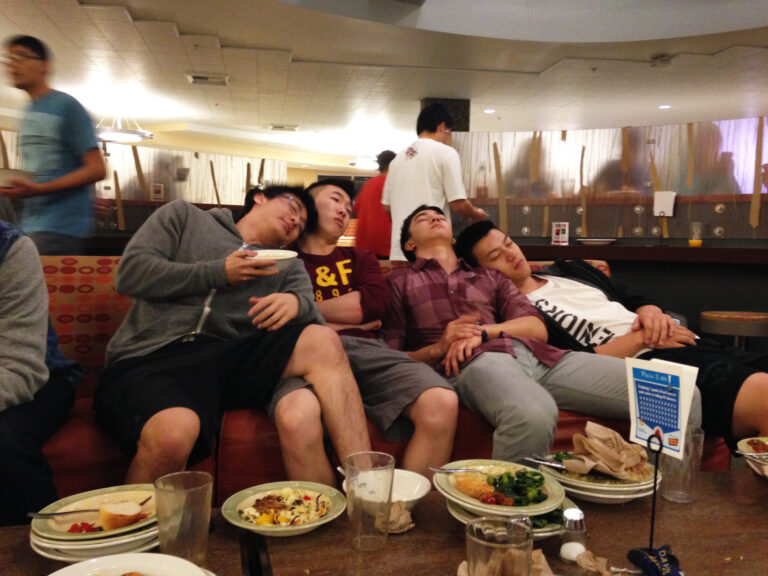
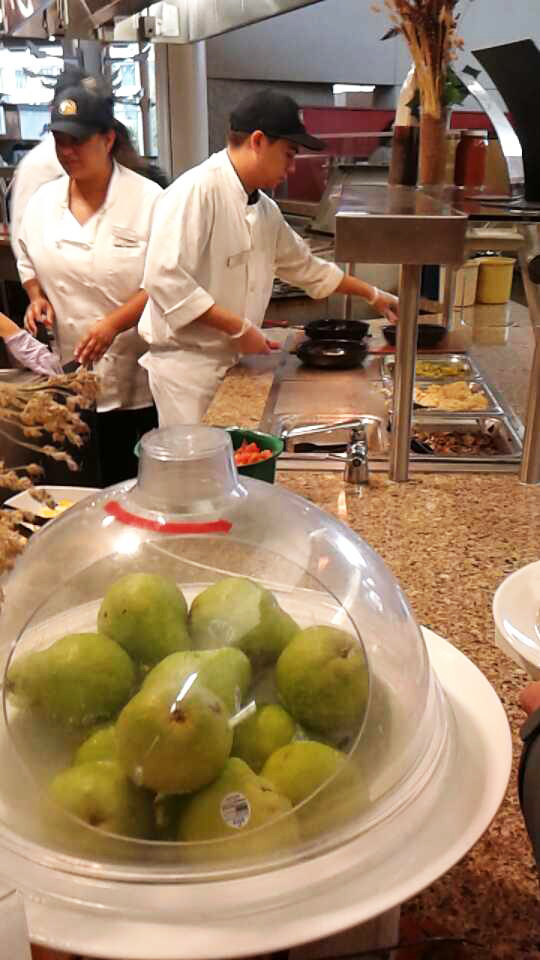
7 ways to spice things up in the dining commons

0

Breakfast and lunch in the DC has never been so easy

Breakfast:

  1. Rise and shine with a non-alcoholic mimosadc_fe1

Whoever thought adding some sparkle to your day could be so simple? Fill half a glass with Sierra Mist from the soda machine, then fill the other half with orange juice. Add sugar to taste.

  1. Get your breakfast to go with a burrito

Sure, it might not be as great as Taco Bell and it’s definitely no Chipotle, but it’s still a burrito. Grab a tortilla from the gluten-free fridge or ask the chef for one, stuff it with eggs and potatoes and top it off with some salsa. But the real secret is to add some shredded cheese from the salad bar. Just make sure an employee doesn’t catch you stealing a little bit from lunch.

  1.  Satisfy your sweet tooth

Bring your own semi-sweet, milk or white chocolate chips to the DC and walk straight to the waffle makers. Pour in the batter, sprinkle in the chocolate chips and then wait three minutes before taking out the waffle. Top with fruit preserves from the row of oatmeal topping bar and some whipped cream from the fridge. Even IHOP will wish they had a waffle as good as yours.

Lunch:

  1. Feeling Devilish

Carefully remove the yolk from two hard-boiled eggs and cream together with mayonnaise, mustard, and a little relish from the sandwich station. Season with salt, pepper and plenty of hot chili flakes (the kind you put on your pizza). If you’re feeling a little exotic or in need of extra heat, add in a few drops of Sriracha or Cholula hot sauce. Scoop the mixture back into the egg whites and enjoy a little taste of heaven — or is it hell?

  1. BRB with BBQ

If they’re serving up fried chicken in the dining halls, making some barbecue sauce to go with it is far easier than you might think. Mix five spoons ketchup with one spoon of mustard, soy sauce, sugar, salt and pepper each. Add extra flavor with two or three spoons of hot sauce.

  1. Float your own boat (or root beer)

Treat yourself with a little soda float by topping of your glass of any orange soda or root beer with some vanilla frozen yogurt. You could add chocolate or swirl frozen yogurt too, but proceed at your own risk.

  1. Get with the trend

Donut chips are a new trend in the gourmet food industry, but it’s possible to make them right in the DC. Grab a doughnut from the dessert table and cut it into slices. Press the slices under a panini maker. Wait until they’re flat and remove carefully before trying!

Photos by Jenna Yonengaga and Eliana Lopez


Aggie Daily Calendar

Tues., Feb. 24

Classical Bassoon & Wine Tasting

5 to 7 p.m.

Monticello Seasonal Cuisine, Davis

Free baroque bassoon performance by Ricardo Rosales with wine tasting host Susan Leonardi.

Salsa Night

9:30 p.m.

The Graduate, Davis

Dance lessons with Cori from ‘Barbara’s Dancing Tonight,’ hosted by DJ Miguel. Tickets $6.


Wed., Feb. 25

Farmers Market

2 to 6 p.m.

Central Park, Davis

Check out all the fresh produce while supporting the local farmers of Davis!

Unofficial Scrabble Club

5:30 to 11:30 p.m.

Crepeville, Downtown Davis

Play everyone’s favorite word game and compete with local Scrabblers! All levels welcome.

Trivia Night

8:00 p.m.

Ketmoree Thai Restaurant

Compete against other teams in answering the hardest trivia questions! Free and open to all ages.

Figure Drawing Drop-in Session

6:30 p.m. to 9:30 p.m.

Pence Gallery, Davis

Bring your own art supplies (no oils) and paint with other local artists – model, tables and space provided. Tickets $14.


Thurs., Feb. 26

Woyzeck

8 p.m.

Wright Hall, Davis

Enjoy UC Davis’ performance of this 19th century set musical! Tickets $16-$22.

DJ Smilez

11 p.m.

Our House, Davis

Dance floor opens up for a free night of dancing!

Javanese Gamelan Garden

12:05 p.m.

Mondavi Center, Davis

Come enjoy authentic music from central Java at this Shinkoskey Noon Concert, free of charge!

Trivia Night

9 p.m. to 11 p.m.

Woodstock’s Pizza, Davis

Join teams of three to six people to answer the hardest trivia questions in town. Prizes, fun and pizza are in store.


Fri., Feb. 27

Folk Music Jam Session

Noon to 1 p.m.

UC Davis Wyatt Deck, Davis

Join your fellow Davis musicians for some good, old-fashioned folk music at this impromptu musical gathering.

Live Music with Bob Wren

5:30 to 8:30 p.m.

Monticello Seasonal Cuisine, Davis

Traditional and international live music featuring instruments including the violin, banjo and mandolin.

Woyzeck

8 p.m.

Wright Hall, Davis

Enjoy UC Davis’ performance of this 19th century set musical! Tickets $16-$22.

Sweeney Todd

8:15 p.m.

Davis Musical Theatre Company, Davis

Enjoy a night in the gutter of London city with the murderous Sweeney Todd in this chilling and heart-wrenching musical. Tickets $16/$18.


Sat., Feb. 28

Hopped Up Comedy

7:30 p.m.

Sudwerk Dock Store, Davis

Enjoy a hilarious, comedy-filled night with comedians as seen on Late Night Shows, Comedy Central, Nickelodeon, FOX and TBS. Tickets $10 at door. Cash only.

Celebrate Africa

6 to 10 p.m.

International House, Davis

Celebrate the African continent with this fundraising dinner! Price TBA.

Woyzeck

8 p.m.

Wright Hall, Davis

Enjoy UC Davis’ performance of this nineteenth century set musical! Tickets $16-$22.

Sweeney Todd

8:15 p.m.

Davis Musical Theatre Company, Davis

Enjoy a night in the gutter of London city with the murderous Sweeney Todd in this chilling and heart-wrenching musical. Tickets $16/$18.

Local Live Music

Woodstock’s Pizza, Davis

Enjoy a fun night of live music free of charge!


Sun., March 1

Food Not Bombs

1 p.m.

Central Park, Davis

Have nice vegetarian meals free of charge with fellow food-lovers of Davis.

Live Irish Music

4 to 7 p.m.

De Vere’s Irish Pub, Davis

Enjoy drink and food specials while listening to traditional Irish music.

Sweeney Todd

2:15 p.m.

Davis Musical Theatre Company, Davis

Enjoy a night in the gutter of London city with the murderous Sweeney Todd in this chilling and heart-wrenching musical. Tickets $16/$18.

International Folk Dancing

7 to 9 p.m.

Davis Arts Center, Davis

Learn how to folk dance, first time free! All levels welcome!


Mon., March 2

Pub Quiz

7:00 p.m.

DeVere’s Irish Pub, Davis

Free quiz night hosted by Dr. Andy, with teams of up to six players. Arrive an hour early to secure a table.