


59.3 F
Davis

Davis, California

Sunday, December 21, 2025
Home Blog Page 833

Crafting Gemeinschaft: Death via the color grey

0

We have been told throughout our lives that graffiti is bad. It depresses home values, encourages gang activity and is destroying our youth. This notion makes it difficult for public art pieces to find their place in society, because they are wrongfully correlated with such vandalism. Do you remember around spring of last year when all of a sudden on the Death Star you saw the faces of your peers? Where did they come from? What was their purpose there? I bet it made your walk to statistics 10 times more enjoyable. Yet getting the installation, called “Davis Inside Out,” approved was considerable work. Part of the reason the Aggie Public Arts Committee had difficulty getting the project approved is because something like that had never been done before on campus, especially by students — people are uncomfortable with difference and the unknown. If projects such as “Davis Inside Out” are done more often, it won’t be as much of a hardship to get projects approved in the future, because the idea of seeing something that’s not expected will be more normal.

Using public art can also change our notions about certain things, such as the use of public transportation. When you go to the metro in Europe, you may confuse it for entry into a gallery. More transportation systems are starting to acknowledge art’s influence, which can be seen in the Federal Transit Administration’s guidelines to incorporate art into public transportation projects. The new Warm Springs / South Fremont BART station will feature an installation by the artist Catherine Widgery, called “Sky Cycles.” The installation will look different at different parts of the day, changing along with the way light passes through it. Is it necessary to the function of the BART stop? Probably not. But I know that my curiosity in regards to how this piece looks at all hours will encourage me to visit and use the station more often. Another example of creative design is a bus stop in Georgia that is designed like a love shack. It was voted one of the best Kickstarter projects of 2012, and the design, in my opinion, makes the inconvenience of using public transportation more insignificant. Come on, I’d wait in that. I’d do more than just wait in it too (obviously talking about Sudoku, guys).

Our interest with public art does not just end at the piece itself, but extends to the person behind the piece. The people behind these public art projects are glorified — one example being Banksy, who has made it into our everyday vocabulary and has a cult following of people trying to find him (gender unconfirmed), called “Banksy hunters.” Why would people be so interested in finding Banksy if they did not value his contribution to society? It’s almost as if Banksy is a superhero: The police want to find him and the masses look up him. The fact that Banksy’s work is considered vandalism reflects that there is some part of our society that needs to change their perceptions of public art. Banksy has served as a role model for artists and activists around the world; he has even inspired someone on the street I live on. One night while walking home I saw a refrigerator on the street where food had been left for people to take. The project, called “Share More, Save Less,” was started on that very property where the tenants had built the refrigerator themselves. When talking to them, they said they needed painters for their refrigerator and wanted “Banksy-style” art on the side. This is a clear example of how people who are pushing for social change are influenced by his art style.

Public art does not always have to be as large scale as a Banksy piece, however. Sometimes when I’m walking up the stairs to my class on the second-floor of Wellman I see stencils of Spongebob on the floor. I don’t know what the greater message behind this is, but all I know is that it makes me smile before sitting in lecture for two hours. Technically, it’s illegal — somebody defaced public property, but what’s the real harm done? Another stencil I saw around Davis was on my morning run when I found the stencil of the words “Follow your bliss” on the pavement. My morning was made and the “graffiti” did not have any effect on the beauty and perception of the neighborhood.

My point is that grey is boring. Let’s accept some color and vivacity into our lives.

If you want to stencil positive phrases on the sidewalk don’t not contact NICOLE NELSON at nsnelson@ucdavis.edu because that is illegal and she would never do anything illegal.
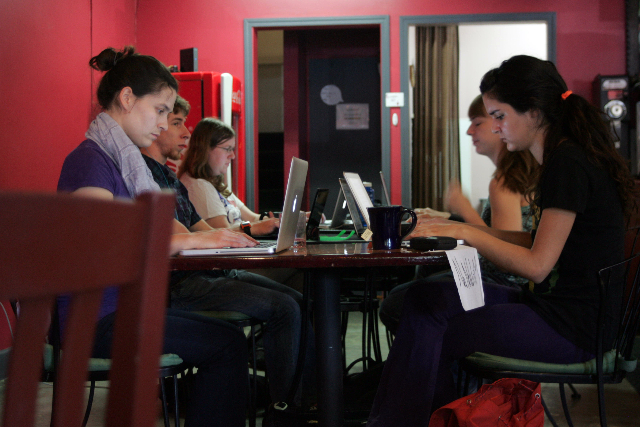
Davis residents, students participate in National Novel Writing Month

0

nanowrimo_fe_Pasturel1

Every year, on the evening of Oct. 31, aspiring and seasoned writers from all over the world eagerly wait for the clock to strike midnight to start work on their 50,000-word novel.

November is National Novel Writing Month, also known as NaNoWriMo for short.

“I feel like a lot of people have ‘write a novelon their bucket list, so why not get it done today?” said Davis resident and NaNoWriMo participant Judy Hanna.

Hanna also participates in the weekly November write-ins that happen at Cloud Forest Café on Sundays between midnight and 3 p.m. The write-ins are designed to connect all Davis participants of NaNoWriMo who may feel they need companionship during their novel writing process.

Second-year English major at UC Davis and NaNoWriMo participant Alicia Josey said writing with other people encourages her to work harder on the project, and also allows her to see how others are doing with their stories. On the first day of the event, Josey wrote by herself at another cafe and she felt that time dragged on.

“I was just writing for 45 minutes. I felt like I was writing for a very long time, but I looked at my word count and it was 600 words,” Josey said. “‘I was like, ‘Oh my gosh, this is going to be terrible.’”

According to the official NaNoWriMo website, 310,095 people participated in 2013 worldwide, and over 250 novels have been traditionally published over the years as a result. Some notable examples include Water for Elephants by Sara Gruen, The Night Circus by Erin Morgenstern and Fangirl by Rainbow Rowell.

Although Josey’s plan is to write 50,000 words, she may diverge from the event’s rule of writing just one piece. Instead, she’ll dedicate at least 300 words to her main story, a science fiction novel about a girl who teleports into another world and joins a private agency that studies different species of aliens.

Josey hopes that by limiting her write count for her main project, she will remain passionate about it all the way through the writing and editing process.

“The thing with NaNoWriMo is that you just write and write and write,” Josey said. “Then you run out of an idea but you still keep writing.”

Preparation for novels began in October, also referred to as National Novel Preparation Month, or NaNoPrepMo. Though Josey’s outline isn’t planned out chapter by chapter, like she usually are, she does have a general sense of where things are going.

The write-in attendees each varied in their style of novel planning. Genetics graduate student Sam Westreich said he had his story outlined chapter-by-chapter, and in total had written out a nine-page outline. On the other hand, Davis resident Sandra Proudman said she hadn’t planned anything out at all.

“Every idea sounds stupid after you think about it too much,” Westreich said. “Try to think of an idea, but try not to think of it too much.”

As one can imagine, balancing novel writing with other responsibilities can be hard. UC Davis English professor and NaNoWriMo alumna Kristen Aldebol said it was all about setting aside a small portion of time just for writing, and believes NaNoWriMo made her a more productive professional writer.

“I would sit down to write my dissertation and I would feel so overwhelmed with the pressure of producing something smart, well-researched and interesting,” Aldebol said. “I also felt like I didn’t have a good creative outlet in my life at that moment. I thought that writing fiction would help me overcome my fear of the page.”

Josey, who has finished NaNoWriMo once before and has partaken in another spin-off version in April called Camp NaNoWriMo, admitted that things may be more difficult this year, since she will have to balance work and school as well.

Josey said that if participation comes at the expense of school grades, then it would be best to postpone participation.

Although there are reasons why some cannot or choose not to participate, Aldebol believes the experience is mostly positive.

“I think it can teach very valuable time management skills, goal setting and breaking down tasks into smaller pieces,” Aldebol said. “Looking back … 30 days, I’m like, ‘Oh my God, I just wrote a novel! That’s crazy.”

Photos by Ciera Pasturel

Improvements to city bicycle infrastructure expected within a year

0

City of Davis bicycle infrastructure is expected to undergo several major improvements throughout the next year. The East Covell Corridor Plan (ECCP) is currently waiting for the input and approval of the Bicycle and Transportation Street Safety Commission. The ECCP will include new off-street bike paths beside the Covell Corridor, which will be implemented between the Unitrans’ O line and F street. This improvement is made to anticipate developments around that area, as well as to invite more people to access other parts of the city, including South Davis.

“We’re improving the bike path which crosses and goes through the driveway that goes into the shopping center up there. Car drivers will see there is a visible path where cyclists would arrive, [and] so they would expect them,” said Mayor Pro Tem Robb Davis.

In addition to new bike paths, the ECCP includes implementation of dutch junctions. These junctions will be placed at the current intersection on J and L street, designed primarily based on European intersections. These junctions are expected to be safer for bicyclists.

“[Dutch junctions] give [bikes] added protection in the turn areas, by putting them in front of the cars [and thus] making them visible, and in some cases, by giving them a different crossing stage,” Davis said.

The design also includes addition to the standard American traffic signal, which will be used to allow exclusive bike phases and easier road crossings for pedestrians, as explained by Brian Mickelson, Transportation Manager of Davis. At the corners of the dutch junctions there will also be pedestrian and bicycle refuge areas, that would be used by cyclists and pedestrians to avoid vehicles moving through the intersection.

By preventing vehicles from making free right turns, the design will prevent conflict between vehicles, pedestrians and bikes crossing at the right turn point.

“We are trying to make our facilities as safe as possible because we’re encouraging more people to ride and ride safely, and make our facilities more inviting for people to ride, especially children. [It is to] encourage higher ridership,” Mickelson said.

The increase of safety for bike riders is expected to improve bike ridership in Davis. With 20 to 25 percent bike ridership, Davis has the highest bike ridership in the U.S. at any given time, according to Steve Tracy, vice president of the nonprofit, DavisBicycles!.

“We’ve got bike lanes all over the place in town, where other communities like San Francisco, that are getting famous for having really great bicycling facilities, tend to get designs that have bike-protected bike lanes, but they don’t have them in every neighborhood in their communities like we do,” Tracy said.

The city has progressively made improvements to the biking infrastructure of Davis. Recent changes include addition of cycle tracks on J Street which were done last spring, cycle tracks in Sycamore which were done last fall, adjustment of lanes on Fifth Street last summer and the implementation of a bike box on B Street. The bike lanes on Fifth Street were widened, which reduced the roadway from a 4-lane to a 2-lane road.

The overall focus of the city is to have “complete streets,” which consider the needs of the users — drivers, bicyclists and pedestrians.

“There’s a specific design element of complete streets, but the overall philosophy is that you look at a street and see the perspective of all users. How do you get pedestrians to cross the street safely? How do you provide safe space for bicyclists to interact with traffic?…And for the [ECCP], the dutch junctions would achieve that,” Davis said.

The concepts of complete streets and dutch junction designs were also explained by Rock Miller at a DavisBicycles! event, last Thursday. DavisBicycles! members as well as the general public attended the event. Miller, an alumni of UC Davis who graduated in 1976, is now working at an engineer firm focusing on street design. At the event, Miller discussed the benefits of Dutch Junctions and bicycle boulevards — roundabouts designed to organize four-way intersections that are primarily used by bicyclists.

Implementing small roundabouts would cost the city between $20,000 to $30,000 while larger roundabouts would cost the city between $100,000 to $200,000.

Miller also introduced the possibility of providing secure bike parking at Amtrak stations to encourage commuters to bike more. Due to the fact that many people in Davis commute to and from Sacramento, he believes that secure parking is needed at the stations, in order to encourage people to use bikes and public transportation more than private vehicles. He believes that every person in Davis, including UC Davis students, should participate in improving the bike infrastructures in Davis, and even choose bicycle and street design engineering as a way to contribute in the improvement of the world.

“A lot of people from Davis have gone on to really help change the world. From the standpoint of embracing bicycling, so many people graduating from college are interested in it….I really like people [who left] Davis, carrying the lifestyle and pushing wherever they end up to try to move the country to the direction of Davis… there are a lot of advantages to relying on a bike as a mode of transportation that other communities just don’t realize,” Miller said.

Ridesharing service Lyft’s first fatal accident occurs in Sacramento

0

A car accident on Nov. 1  in Sacramento involving a Lyft ridesharing vehicle was responsible for one fatality. Others involved in the accident suffered minor injuries.

Five vehicles total were involved in the Nov. 1 accident that killed Shane Holland, 24, of West Sacramento. California Highway Patrol’s (CHP) division in North Sacramento issued a press release the following day on the CHP North Sacramento Facebook page, detailing the developments of the accident.

“Our thoughts and prayers go out to the families and loved ones involved in this tragedy. We are deeply saddened to hear this news and will continue to support those involved as well as authorities in the ongoing investigation,” said Lyft communications manager Paige Thelen in an emailed statement.

According to a CHP press release, the first collision occurred around 1:25 a.m. westbound on I-80, west of Riverside Avenue in the third lane during heavy rainfall when an unknown white sedan rear-ended a Kia. The white vehicle drove off and has not been located, but the Kia spun out in the wet conditions and stalled in the middle lanes of the highway.

Lyft driver Shanti Adhikari, 31, of Sacramento, was driving Holland and another passenger home from their Halloween celebrations. To avoid the Kia in the middle lanes, Adhikari swerved, causing his 2014 Toyota Camry to spin off on the right shoulder of the road. The car hit one tree, then spun into another and hit the second tree with its left rear passenger door before coming to a stop.

Two more collisions occurred with the Kia after the Lyft car hit it until a passerby trucker helped push the Kia off the road. North Sacramento CHP Officer Chad Hertzell explained that this complicated accident, with many different vehicles involved, will take several weeks to determine who, if anyone, is at fault.

Hertzell said that in his 18 years with the CHP he has seen a lot of taxi accidents, but had never heard of Lyft or ridesharing companies until this incident. He believes it is too early in the development of these companies to determine if they are more dangerous than taxis and that in general, the benefit of this new type of transportation may be in reducing drunk driving.

“Anytime you get into a car with somebody else, there’s always a risk involved, but it’s a calculated risk. Is it safer to get into a car with somebody else who’s sober or to get into a car under the influence and drive yourself home? Choosing the sober driver is always the better option,” Hertzell said.

Lyft and the other well-known ridesharing company, Uber, both have $1 million insurance policies. This covers passengers in incidents involving Lyft or Uber vehicles. Both companies also offer the same amount of coverage in cases where an uninsured or underinsured motorist causes damage to a Lyft or Uber vehicle, including hit-and-run cases.

The Sacramento accident raises questions about the safety of services like Lyft and Uber that allow users to book and pay for a car ride through an app on their smartphones. Both companies are based in San Francisco and have recently expanded to Sacramento and Davis — these are three of the nearly 70 cities Lyft now operates in, according to Lyft communications employee Mary Caroline Pruitt.

“To become a Lyft driver, you must be at least 21, have a 4-door car that’s model year 2000 or newer, and must possess a clean driving record and background check,” Pruitt said.

Customers have said they feel safer in Lyft cars than taxis due to the Lyft hiring policies.

“In that aspect, it is as safe, if not more, than a cab, because when I get into a cab, I don’t know what their history is, but when I get into a Lyft car I know they’ve had a background check,” said Jamie Wasson, a fourth-year microbiology major, who is a local ambassador for Lyft.

Lyft and Uber work very similarly. Both use apps to connect ride-seekers with drivers in their area. The popularity of Lyft and Uber is due in part to their convenience. As smartphone ubiquity increases, it is very easy for passengers to connect with drivers and find cheap rides quickly, without having to make a phone call or get out their wallet.

“I think they are definitely less expensive than a taxi. I think the convenience is huge since it’s all through our phones… it [is] really nice that I can just put my debit card in my phone and know that, as long as my phone’s charged, I’ll find a ride home,” Wasson said.

Beaudin also expressed that she appreciates Lyft and Uber services for their low prices and convenience, adding that drivers are required to tell passengers the cost of the ride before entering the vehicle.

Lyft promotes itself through coupons for free rides. As a Lyft ambassador, Wasson gives out these coupons to restaurants and companies in the area. Once people try the service, Lyft hopes they will remain loyal for the low prices, driver quality and convenience.

“Lyft is very active on giving coupons, I’ve already got three free coupons for Lyft rides…they go to very public places, so when everyone was leaving the festival at Treasure Island they handed them out. At Hardly Strictly they handed them out too,” Beaudin said.

While officials say that the Nov. 1 accident is uncommon, services like Lyft and Uber still could be a convenient and safe option to reduce incidences of driving under the influence.

“If your option is to take a cab or Lyft versus driving home under the influence, your better option is to get home safely. Lyft is a good alternative to drunk driving,” Hertzell said.

UC Davis first campus to receive Landscape Management and Operations Accreditation

0

The Professional Grounds Management Society (PGMS) awarded UC Davis a Landscape Management and Operations Accreditation with the highest rating of four stars.

PGMS is an organization that strives to help grounds managers with technique development and management skills. Although the society has existed since 1911, this is the first time it has offered an accreditation that assesses grounds management principles and practices. The accreditation program itself launched this July.

According to PGMS website, “The [accreditation] program evaluates strategic grounds management principles and practices that produce and guide the delivery of properties to an attractive, healthy, sustainable and high-quality state.”

Two other college campuses have also been accredited: the University of Delaware and the College of Wooster in Ohio – each received two stars.

Cary Avery, certified grounds manager, Landscape Operations superintendent, and Grounds and Landscape Services associate director at UC Davis, submitted the accreditation application to PGMS and received the honor on the university’s behalf.

The UC Davis campus impressed evaluators through three determining categories: environmental stewardship, economic performance and social responsibilities – each with seven to eight subcategories. Avery stated that evaluators appraised 38 different best practices within these areas.

The accreditation process entails peer assessment conducted through an on-site tour evaluation, a series of meetings with the management unit, front-line employees, and administrative departments and application review.

“Some of the particular things we saw were the adaptive measures the department used to address some of the restrictions, such as drought conditions, were very responsive,” said Joseph B. Jackson, PGMS lead evaluator and project facilitator.

The campus’ “smart” central irrigation system, for example, reduces water use by 20 to 50 percent depending on the area’s needs. According to Avery, UC Davis has saved over 80 million gallons of water since the beginning of the year, just in landscape. Additional features noticed by the evaluators that normally weren’t seen at traditional campuses included drought-tolerant plantings, bioswales, rain gardens and living walls and fences.

“The team was also impressed by the fact that our tree and irrigation database is part of a model being developed for botanical gardens, parks and zoos worldwide,” Avery said.

Grounds aesthetics only plays a small role in the overall evaluation, as stars are awarded based on a point-system calculation of 200 points. Four stars requires coming within reach of at least 166 points. The total was determined by “beauty” or maintenance points but more heavily by responses to evaluators’ questions regarding the best practices utilized.

“The relationship that the leaders of the management team [have] with the customers [was] exemplary, and the fact [is] that everything that stood out to the evaluation team could not have been successful and maintained on that level without very strong senior leadership and administrative support,” Jackson said.

The use of new technologies, effective maintenance strategies and consideration of existing ecosystems exemplifies PGMS’ mission of achieving a sustainable future.

“The group of employees that we have working to maintain the health and safety of our campus environment is a top-notch group of people,” Avery said. “They care about each other, this place and the environment.”

The grounds and landscape team handles everything on campus, from prepping for events to managing everyday trash and recyclables, facilitating zero-waste operations, performing tree care and maintenance, helping faculty with tree care demonstrations for students and much more.

“We have even been contacted by the Raptor Center to rescue an injured bird from a tree top!” Avery said. “If this team can help, they will be there.”

According to Tom Shaner, executive director of PGMS, the accreditation holds much more significance than just receiving a certificate.

“It’s truly an evaluation of your best practices by your peers,” Shaner said.


UC Davis appoints new Chief Financial Officer

0

On Oct. 14, UC Davis Chancellor Linda P.B. Katehi named Dave Lawlor as the chief financial officer and the vice chancellor of Finance and Resource Management. Lawlor officially joined UC Davis Nov. 3.

Prior to coming to UC Davis, Lawlor held a senior finance post for the past seven years at George Washington University, a private institution with over 25,000 students on three campuses. In addition to his time at George Washington University, Lawlor also has extensive experience working in the private financial sector; he was the chief financial officer and chief operating officer with PCTEL Maryland and spent seven years with Hewlett-Packard and Agilent Technologies in the telecommunications sector.

“I spent most of my career in banking and telecommunications; going into the academic sector wasn’t actually on my radar screen as a career choice to begin with,” Lawlor said. “However, in 2007 I got a call from someone who was doing a search for George Washington University and he proceeded to explain to me some of the challenges that the university was dealing with at the time….It presented some very intriguing opportunities and challenges. That, and being able to have an impact on tens of thousands of students over a career, really piqued my interest.”

Because of the similarities in size between the two universities, Lawlor’s time at George Washington University has given him the tools necessary to deal with the complex nuances that come with a large campus like UC Davis, according to Katehi.

“Universities are incredibly complex entities, especially large research universities like UC Davis,” Katehi said. “Every day roughly 60,000 people come to a UC Davis campus or facility to learn or work … All told, our annual revenues reach $4 billion. [Lawlor] is coming from a similar institution in George Washington University, so he understands how we operate and has the experience to step right in and get to work in this crucial role.”

One of Lawlor’s notable endeavors during his time at George Washington University was chairing the Innovation Task Force. Through this task force, Lawlor could identify savings and new revenue sources that generated and freed up over $27 million annually for academic programs.

“[Lawlor’s combination of both skill and experience] are exactly the type of results and leadership we need to keep UC Davis strong now and for generations to come,” Katehi said.

In addition to the tools he will carry over from his Innovation Task Force, Lawlor plans to combat the financial challenges of the university by focusing on three main components.

“First off, we have an obligation to be wise stewards of all of our assets – operating assets, finance and capital – and we need to be relentless in ensuring that we use every dollar in a very wise way,” Lawlor said.

“The second is [that] we have a responsibility to make sure that the value from a UC degree continues to be enhanced; enhancing the undergraduate degrees [and] the graduate degrees is a function of recruiting and retaining the best faculty [and] creating the best research environment possible out there….So we have a responsibility with limited resources to make sure that we put those dollars to work in the best way possible. The third is centered on general affordability and predictability. I think we have an obligation there that families and students can plan for their educational experience — we need to continue to be committed to affordability, while at the same time recognizing that those quality experiences cost money.”

One of the greatest financial challenges the UC system is currently facing is the nationwide decrease in funding for public higher education. Through innovative efforts such as the 2020 Initiative, the university hopes to build a solid financial foundation that can accomplish all the goals of the university without being too reliant on public funding.

“Understanding what the financial profile is for UC Davis at a macro level is critical; we need to understand the sources of revenue. And tuition and fees are important ones, but they’re not the only ones,” Lawlor said. “We need to look at alternative ways to bring income to the university — public private deals and some of the capital projects that we have down the line is one source; growing research, and the indirect cost recoveries that come from that, are also really important things to focus on.”

The impact of the cuts is not only noticed at the administrative level; students feel the effects from the reduction in student funding on a day-to-day basis. Daniel Riesgo, president of the Finance and Investment Club at UC Davis, thinks that Lawlor’s experience will be integral in changing the fiscal culture at UC Davis.

“They’re cutting classes, class sizes are getting bigger,” Riesgo said. “What [Lawlor] has done at George Washington University is [that] he managed to restructure and reinvigorate the system at the university. Right now, that’s the way UC Davis has been combatting the decreases in funding. That’s why I believe that it would be beneficial to find other ways to get cash flow, and for [him] to incorporate what he did at George Washington University here.”


This Week in Senate

0

ASUCD Vice President Maxwell Kappes presided over the senate meeting on Nov. 6, held in the Mee Room of the Memorial Union (MU). The meeting was called to order at 6:12 p.m.

The senate began by discusssing the new Unitrans terminal at the MU. Representatives for Unitrans spoke about the success of the new terminal, as well as the possibility of having an opening ceremony later this quarter. Other Unitrans updates included that its three new buses seem to be running well. Additionally, a new computer system is being used to manage all data, including shifts and payrolls.

Senate passed six bills: Senate Resolution No. 1, Senate Resolution No. 3, Senate Bill No. 14, Senate Bill No. 15, Senate Bill No. 16, and Senate Bill No. 17.

Senate Resolution No. 1 recognizes Andrew Wyly for his hard work as UC Davis Unitrans Maintenance Manager.

Senate Resolution No. 3 approves Unitrans’ procedures regarding Title VI of the Civil Rights Act of 1964 through ASUCD Unitrans’ 2014 Title VI Program & Language Assistance Plan.

Senate Bill No. 14 allots $56 for Coffee House vouchers to be used at a lunch event with ASUCD. At this event, called “Lunch with ASUCD,” students will be able to have lunch with ASUCD officials. Students will be able to apply for one of seven spots for this event online.

Senate Bill No. 15 moves the Student Government Administration Office under the Student Services Office.

Senate Bill No. 16 gives $16.50 to reimburse The Pantry for printing scholarship applications.

Senate Bill No. 17 clarifies the role of the Creative Media Marketing Department in ASUCD social media.

Senate also confirmed candidates for the Gender and Sexuality commission as well as Outreach Assembly. Additionally, Harley Litzelman was confirmed as director of the ASUCD Office of Advocacy and Student Representation.

The unit director for KDVS announced that, as of last week, a full staff has been hired at KDVS. KDVS has increased its number of general staff meetings and is restructuring its DJ training. Additionally, KDVS is searching for a new location for the future, as within two to four years the unit will have to temporarily relocate due to the construction in Freeborn Hall.

ASUCD President Armando Figueroa then spoke about UC President Janet Napolitano’s recent announcement of a plan that will increase students’ tuition by up to five percent annually over five years. He emphasized the importance of the senators coming to the student forum the following day (Nov. 8) in the ARC Ballroom, as well as the need for the UC campuses to rally together in protest of this change.

The Club Finance Council, an ASUCD-funded program that provides grants to students clubs, also gave a presentation, in which it discussed efforts to increase marketing, updates to the website, funding from the 2013-14 school year and future plans.

Public announcements included that CALPIRG is currently hiring campus organizers and that AggieTV is working on a series about sexual assault, including what UC schools are doing to prevent it.

Last meeting’s minutes were approved, and the meeting ended with a closed session regarding Campus Copies, Classical Notes, and the MU post office. The meeting adjourned at 11:32 PM.

News in Brief: Students Affairs holds forum on proposed UC tuition and fee increases

0

On Friday, Student Affairs held a student forum to discuss the proposed University of California tuition and fee increases. This plan will increase students’ tuition by up to five percent annually over the next five years.
Members of Student Affairs began the student forum by explaining the reasons for the increased tuition, which include the structural deficits of each of the UC campuses. However, Student Affairs said that financial aid support will remain the same despite these UC tuition increases.

Additionally, students had the chance to voice concerns over this tuition increase. Many students expressed anger over UC President Janet Napolitano’s decision to increase tuition.

“The fact is, this is wrong,” said Harley Litzelman, director of the ASUCD Office of Advocacy and Student Representation. “Education should be free. Moving in this direction is wrong.”

Students also questioned what the effects of the potential tuition increase would be on the students’ ability to afford an education, as well as spoke about the need for students to have a role in determining the tuition increase since they are the ones affected directly by this change.

A potential alternative to this tuition increase discussed in the forum was for the state to provide funding to offset the increase. This plan would require the support of California Governor Jerry Brown.
Adrian Lopez, director of State Governmental Relations at UC Davis, said that students will need to step up their advocacy in order for the legislature to listen to them. Many students voiced the possibility of UC Davis students visiting legislators in Sacramento to directly appeal to them.

On Nov. 19, this new tuition and financial aid stability plan will be brought to the UC Board of Regents.

UC Davis student found dead at UC Berkeley fraternity

0

Vaibhev Loomba, a third-year mathematics student at UC Davis, died over the weekend at a UC Berkeley fraternity house. An unresponsive man was found the morning of Nov. 9 face down in the Zeta Psi fraternity house at 2728 Bancroft Ave., and police arrived on scene about 12:10 p.m, according to Lt. Ed Spiller of the Berkeley Police Department. Although the Berkeley Police Department has not officially released a name of the man, friends identified him on Facebook as Loomba, 20, who is from the East Bay and attended Acalanes High School in Lafayette.

More to come as The Aggie looks for more information regarding Loomba and the situation itself. Friends and family are welcome to contact The Aggie at campus@theaggie.org to provide more insight or information.

UC Davis falls in first round of Big West playoffs

0

bigwestmenssoccer_sp_Pasturel

The UC Davis men’s soccer team ended their season with tears, losing 1-2 against CSU Fullerton in the biggest upset of the season on Saturday. In an intense playoff fight complete with over 30 fouls, 5 yellow cards and one ejection, CSUF snatched the win in the last 10 seconds with a tap into the right post.

After a scoreless first half and expulsion of senior defender Ramon Martin Del Campo in the 67th minute, the Aggies secured a promising lead in the 71st minute with a goal by junior forward Dashiell MacNamara.

7 shots, high momentum and an enthusiastic crowd at the Aggie Soccer Field proved insufficient for UC Davis to hold the lead. CSUF found the back of the net in the 85th minute with a power shot from 30 yards out.

“We scored first. We should have been able to close out the game a little bit better than that,” said head coach Dwayne Shaffer.

The game took a final turn for the worse with 10 seconds on the clock, as CSUF slipped the crushing winner into the net.

“I made a big mistake at the end,” expressed junior goalkeeper of the match, Armando Quezada.  “I had to throw my whole body to try to get something on it and unluckily, they got the tip.” Quezada had 5 big saves in the match. He is one of eight players to have received Big West Honors for this season’s performance.

This is the second time UC Davis faced the CSUF Titans this season. The Aggies beat the southern California team 3-1 last month at the Aggie Stadium.

“I felt like my team played really well all season long,” said coach Shaffer. “Today it seemed as if our intensity and our energy levels were down a little bit, but that’s got to be expected. We’ve played 14 overtime games – not only that, all of our other games have been extremely close.”

The UC Davis Aggies end the season after their loss in the first round of the playoffs with 7 wins, 3 ties and 9 losses.

Photos by Ciera Pasturel

Campus receives notice of non-specific bomb threat

According to Campus WarnMe system, the UC Davis campus received a non specific bomb threat at 10:49 a.m. this morning. As of 1:00 p.m., no credible threat has been determined, but students are asked to remain vigilant and to report all suspicious activity to UC Davis Police Department.

Saifuddin, Oved reach out to UC community

Your University of California Student Regent and Student Regent-designate want you to know that they work to represent the students. Unfortunately, they are still forced to fight to assert that their beliefs and religions do not precede their qualifications.

The student regent is a student selected to serve as a voting member of the UC Board of Regents with the primary aim of representing graduate and undergraduate students for a term of one year. Student regent Sadia Saifuddin and regent-designate Avi Oved were both met with significant amounts of resistance upon their confirmations. This resistance was due largely to their outspoken, contending opinions on whether or not the UC should divest from American companies affiliated with Israel.

Oved recently wrote an open letter to the UC student community, addressing how his personal beliefs affected his confirmation. We appreciate the regents’ openness in stating their beliefs and personal biases. Students should not use their religions to define them as representatives. Furthermore, students should recognize that their personal beliefs do not hinder their ability to carry out their jobs. Our student regents should not feel the need to justify their appointments. Saifuddin and Oved both have a myriad of qualifications that enable them to serve as proponents of students, qualifications we feel should overshadow any hesitation people may have about them.

Despite differences in personal beliefs on the Palestine-Israeli conflict, Saifuddin and Oved are able to agree on what is truly important: the causes and initiatives that serve the students. The tired use of “Muslim” and “Jew” at the mention of their names is a devaluation of their roles and distracts from their goals as regents. “We are not here to advocate for our personal beliefs. Our agenda is shaped by the general opinion of the UC Student Community,” Saifuddin and Oved said in a joint letter to UC students last month. They were able to do what many UC constituents have not: overlook their personal differences that were largely irrelevant to the job at hand.

The role of the student regents, we believe, is severely misunderstood by students. This misunderstanding results in an underutilization of their position at the Board of Regents table. Additionally, their recent efforts to reach students through a handful of published letters and campus visits serve as an indicator of their dedication to their constituents. Students just need to meet them halfway by reaching out. Remembering this mutually-dependent relationship that drives their work is the best way to create an amplified and collective student voice.

UC Davis Women’s Cross Country Recap

0

If good things come in threes, then it seems the UC Davis women’s cross country team is due for some more success soon. Their victory this past weekend at the Big West Cross Country Championships, hosted by UC Riverside at the Ag/Ops course, marks the second Big West championship title claimed by UC Davis.

UC Davis came out strong on Nov. 1, looking to reclaim the title from Cal Poly, who took home the win the past two consecutive years. Six Aggie runners finished in the top 13 places with just a 48-second gap between the first and fifth runners.

Junior Christine Hoffman led the Aggies with a time of 20:22:07 for the 6-kilometer course. This performance was considered “an obvious highlight” by coach Devin Elizondo. Sophomore Hannah Kirkegaard, senior Raquel Lambdin and sophomore Clara MacLeod followed Hoffman’s lead to bring home sixth, seventh and ninth place for the team.

Coach Elizondo commended Lambdin on achieving her “first top-10 finish at a cross-country championship” and also on leading the team to a victory as team captain. Lambdin was the only senior representing the Aggies at the championship.

Besides the outstanding performance from the top four runners, the depth of the UC Davis team aided them in their win.

“Having Clara [MacLeod] find an all-conference spot is a testament to the depth and talent in this team. And [junior] Erika Barr did a great job pulling her teammates along in the middle of the race to set us up for putting six women in the top 13,” said coach Elizondo after the race

Beyond the top-four finishers, Barr (12th), sophomore Riana Goins (13th), and sophomore Olivia Goins (35th) all placed highly for the Aggies.

UC Davis’ final score of 36 points, a new school-best, drastically took the lead, leaving the remaining top five rankings to Cal Poly (66), UCSB (86), UC Riverside (95) and Cal State Fullerton (149).

Coach Elizondo felt that the team was able to bring forth such an outstanding performance by learning from the year’s lessons and “getting out strong, holding positions and closing out late.” He praised the athletes’ commitment, noting that, coaching aside, it was their dedicated training that brought them success at the championships.

The Aggies will host the upcoming Doc Adams Open on Nov. 8, before the NCAA West Regional on Nov. 14.

Recap of Big West Championships

0

With less than a month remaining in the season, the UC Davis men’s cross country team pulled off a 6th-place finish at the 2014 Big West Cross Country Championships on Nov. 1.

Hosted at UC Riverside, the Championship marks the last big race before the NCAA West Regional on Nov. 14.  UC Santa Barbara took the title with a total of 21 points and were pursued by Cal Poly, UC Riverside and Long Beach State, who scored 49, 95 and 114 points, respectively. The Aggies came in sixth place with 144 points, just behind CSU Fullerton (129) and in front of UC Irvine (197) and CSU Northridge (218).

Runners in NCAA cross country are assigned points based on their final placing, with more points signifying later finish times. Then, points for a team are added up, and the team’s final ranking is determined.

Chasing the elusive top ten spot after a fall within the first mile, junior Brandon Pugh came in 13th place with a time of 24:39.0, missing the slot by a little over 10 seconds. Close behind Pugh were juniors Jordon Rushing in 31st place, Amar Dholakia in 34th and Nicholas Ratto in 35th place, each finishing within five seconds of one another. Junior Cody Nguyen (25:37.2) and freshman Austin Goins (25:38.9) subsequently finished in 44th and 45th place respectively.

After the race, coach Devin Elizondo expressed disappointment with the results. “We hit some bumpy patches on the men’s side. Having our No. 1 fall in the first mile is tough in any race, especially a small field like a conference meet. Though Brandon [Pugh] recovered well, it wasn’t enough to break into the top 10. The fall notwithstanding, we still did not do enough in that race to fight with the leaders.”

UC Davis will host the upcoming Doc Adams Open Nov. 8, before the NCAA West Regional on Nov. 14.

“We will have another opportunity to race our Big West competition as well as others in our region,” Elizondo said in regards to the Doc Adams Open. “We know we can’t redo this performance, but two weeks will provide some time for us to fuel a comeback to make a final ranking in our region.”


Local school to tackle most musically-complicated show to date

0

On Nov. 7, Davis Senior High School (DSHS) will debut its fall musical, Into the Woods. According to Gwyneth Bruch, director of drama, this will be the school’s most musically complicated show yet.

Into the Woods is based on the book of the same title by James Lapine. It was adapted into a musical with music and lyrics by Stephen Sondheim and premiered on Broadway in 1987. The musical intertwines the plots of several Brothers Grimm fairy tales in a single tale following the journey of a childless baker and his wife, and their quest to begin a family.

Devon Hayakawa, a senior who will be playing The Witch, praises the show for further developing beloved fairy tale characters.

“Every character is really unique and [is] based off a fairy tale character, with the exception of [the] baker and baker’s wife, so it’s really cool developing that character and making them have full depth instead of caricatures,” Hayakawa said.

The show’s musical complexity made for the school’s most rigorous audition process to date. According to Bruch, this was the first time in her 23 years of directing that she was unable to entirely cast the show from the initial auditions. After a consultation with her music director, Bruch made the decision to recruit students from Davis’ junior high schools in order to fill the supporting roles. Although the department has included junior high students before for in its performances, Into the Woods marks the most junior high students present in a single production at DSHS.

Although the high school adaptation follows closely with the original musical, Bruch states that her take on the show will feature more naturalistic performances rather than presentational or stylized performances as seen in the Broadway production. Bruch noted that her adaptation will feature more intimate character interactions, which will lead to a more honest portrayal of the show for the audience.

“The people who did this on Broadway, that works for them. I’m all about naturalism and honesty and that’s what I teach my acting students,” Bruch said. “[To me], theatre is [about] telling the truth in imaginary circumstances.”

Despite the show being a high school production, Bruch asserts that she holds her theatre to high level of professionalism she holds her theatre to. And although the set is designed entirely by a student, Bruch maintains that it is the most complex set the school has ever used. She holds her production against any other community theatre in the area.

“The most important thing for me when I took over the job is to have the community respect our work as art,” Bruch said. “We are not cute kids putting on a show. There’s a perception of high school theaters: [that] we’ll have cardboard sets and they’ll just be as cute as a bug’s ear. That’s not what I’m about.”

As an alumna of UC Davis who met her husband doing community theatre, Bruch encourages UC Davis students to attend the show. She notes her student discount applies to undergraduate and graduate students as well.

Sarah Green, a high school fourth year who will be playing the baker’s wife, encourages the community to attend the show for the moral message.

“I think that no matter if you’re interested in theatre or not, it takes you on a journey through the beloved fairy tales we’ve always learned as children,” Green said. “I think it teaches such a good lesson and I’m not going to spoil that lesson because people learn that at the end of the show.”

Into the Woods will be shown at DSHS’ IPAB Theatre on Nov. 7, 8, 13, 14 and 15 at 7 p.m. and Nov. 9 at 2 p.m. Tickets can be purchased at the box office for $16 general admission, $12 senior citizens (65+) and $10 students with a valid ID.